Saint Camillus de Lellis: Soldier, Gambler and Founder of the Ministers of the Sick
A soldier of fortune with a bad leg and a gambling habit who was once dismissed from a Roman hospital, then returned to reform it, founded a religious order of nurses and became the patron of the sick and of those who care for them.
At a Glance
- Born
- May 25, 1550, Bucchianico, Abruzzo, Kingdom of Naples
- Died
- July 14, 1614, Rome, aged 64
- Ordained
- 1584
- Beatified
- April 7, 1742 (Benedict XIV)
- Canonized
- June 29, 1746 (Benedict XIV)
- Feast day
- July 14 (General Roman Calendar); July 18 in the United States and in the traditional calendar
- Patron of
- The sick and hospitals (Leo XIII, 1886), nurses and healthcare workers (Pius XI, 1930)
- Best known for
- Founding the Camillians and reforming hospital care
- A Soldier's Son from Abruzzo
- The Wound and the Hospital
- Conversion at Manfredonia
- Back to San Giacomo
- Philip Neri and Ordination
- Founding the Camillians
- Reforming Care at the Bedside
- Writings and Last Letter
- Conflicts and Resignation
- Death, Relics and Canonization
- Tradition, Devotion and the Eastern Church
- Frequently Asked Questions
A Soldier's Son from Abruzzo
Camillus de Lellis was born on May 25, 1550, in Bucchianico, near Chieti in the Abruzzo region of the Kingdom of Naples. The Vatican's Dicastery for the Causes of Saints and Pope John Paul II's message marking his birth both confirm the date and place. His family belonged to the minor nobility. His father, Giovanni de Lellis, was a professional soldier, and his mother, Camilla de Compellis, was already elderly when he was born. He is described as her second child.
His upbringing was unsettled. His mother died when he was about thirteen and his father when he was about seventeen. The historian Mario Vanti, writing in the Enciclopedia Cattolica, describes a young man who refused discipline and sustained study and preferred games, adventure and the military life he had seen at home. He went on to serve as a soldier in Venetian and Spanish forces fighting in the Mediterranean wars against the Ottoman Empire, and his service took him to places including Dalmatia and North Africa.
Gambling became his ruin. He lost his pay and his possessions again and again. It is a mark of how honest the sources are about him that the habit is recorded in the early biographies and in every later scholarly study. A pious tradition adds that his mother dreamed before his birth that her son would carry a cross on his chest, which is later read as a sign of the red cross of his order. This is hagiographical tradition and not a documented prophecy, and even an older Lives of the Saints questioned it.
The Wound and the Hospital
A chronic wound on his right leg shaped the rest of his life. It sent him repeatedly to the Hospital of San Giacomo degli Incurabili in Rome. What first caused it is uncertain. Some biographies tie it to his military life, and the account published by Milan Cathedral suggests probable osteomyelitis, but no firm modern diagnosis can be made at this distance.
According to the historian John Patrick Donnelly, Camillus was admitted to San Giacomo in 1571 and stayed on to work there after treatment. He was dismissed in December of that year for gambling, quarrels and neglect of his duties. It is a striking fact that the founder of one of the great nursing orders began his hospital career as an employee who was thrown out.
Conversion at Manfredonia
In 1574, having lost everything once more, Camillus found work as a laborer on a Capuchin building project near Manfredonia. The turning point is dated February 2, 1575, in Vanti's chronology. A Franciscan friar's counsel had moved him, and while traveling through the Gargano region he experienced deep repentance.
The familiar telling says that he dismounted, fell to his knees, wept and begged God's forgiveness. That scene comes from the ecclesiastical biographies, including the account on the Vatican City site. It fits the traditional story, but its details should be credited to the tradition and not to an eyewitness record.
He asked to join the Capuchins, but his leg wound kept him from staying, and a second attempt ended the same way. His illness repeatedly closed the door on the life he wanted and in the end pointed him to another one.
Back to San Giacomo
Camillus returned to San Giacomo, this time as a changed man, and what he saw troubled him deeply. Many attendants were poorly trained. Patients could be neglected, left dirty and given too little attention. He took on more responsibility and began to work out practical improvements, and by 1579 he had become a senior supervisor in the hospital, according to Donnelly's reconstruction.
The man who had once been dismissed from the institution for neglect now insisted that its patients be treated with care. That reversal is the center of his story, and it is why it is useful to remember how he began.
Philip Neri and Ordination
During these years Camillus came under the spiritual direction of Saint Philip Neri, and he studied at the Roman College. He was ordained a priest in 1584. His vocation was becoming a combination of priestly ministry, hands-on care of the body and the formation of a permanent community for the sick.
The relationship with Philip had a difficult side. Donnelly records that Philip wanted Camillus and his companions to keep working within San Giacomo and not set up a separate enterprise. When Camillus refused, Philip stopped acting as his confessor. Why Philip took this step is uncertain. Donnelly weighs several possibilities and settles on none.
Founding the Camillians
Camillus began gathering like-minded hospital workers in the early 1580s. The founding was gradual and not a single event. Donnelly points to a decisive religious experience on August 15, 1582, while Vanti stresses the formal steps of 1584. Sources also disagree on when the first companions received the habit: Vanti gives September 15, 1584 and Donnelly September 15, 1585. Both agree that the community existed before it had papal recognition, and an honest account explains the difference and does not choose a date without comment.
Pope Sixtus V approved the community on March 18, 1586, and the red cross on the habit was allowed the same year. Pope Gregory XIV raised it to a religious order on September 21, 1591, and Camillus and his companions made solemn profession on December 8, 1591. Besides poverty, chastity and obedience, the Camillians took a distinctive vow to serve the sick even at the risk of catching a fatal disease. That fourth vow made personal danger part of their identity.
The order spread beyond Rome. Camillian communities worked in hospitals and private homes in Naples, Milan, Genoa, Florence, Bologna and Mantua, and also at the great Roman hospital of Santo Spirito in Sassia. They gave relief in epidemics, floods, famine and war. Donnelly documents their help during the Roman epidemic and food crisis of 1590 and 1591 and their nursing during campaigns against the Ottoman forces in southeastern Europe.
Reforming Care at the Bedside
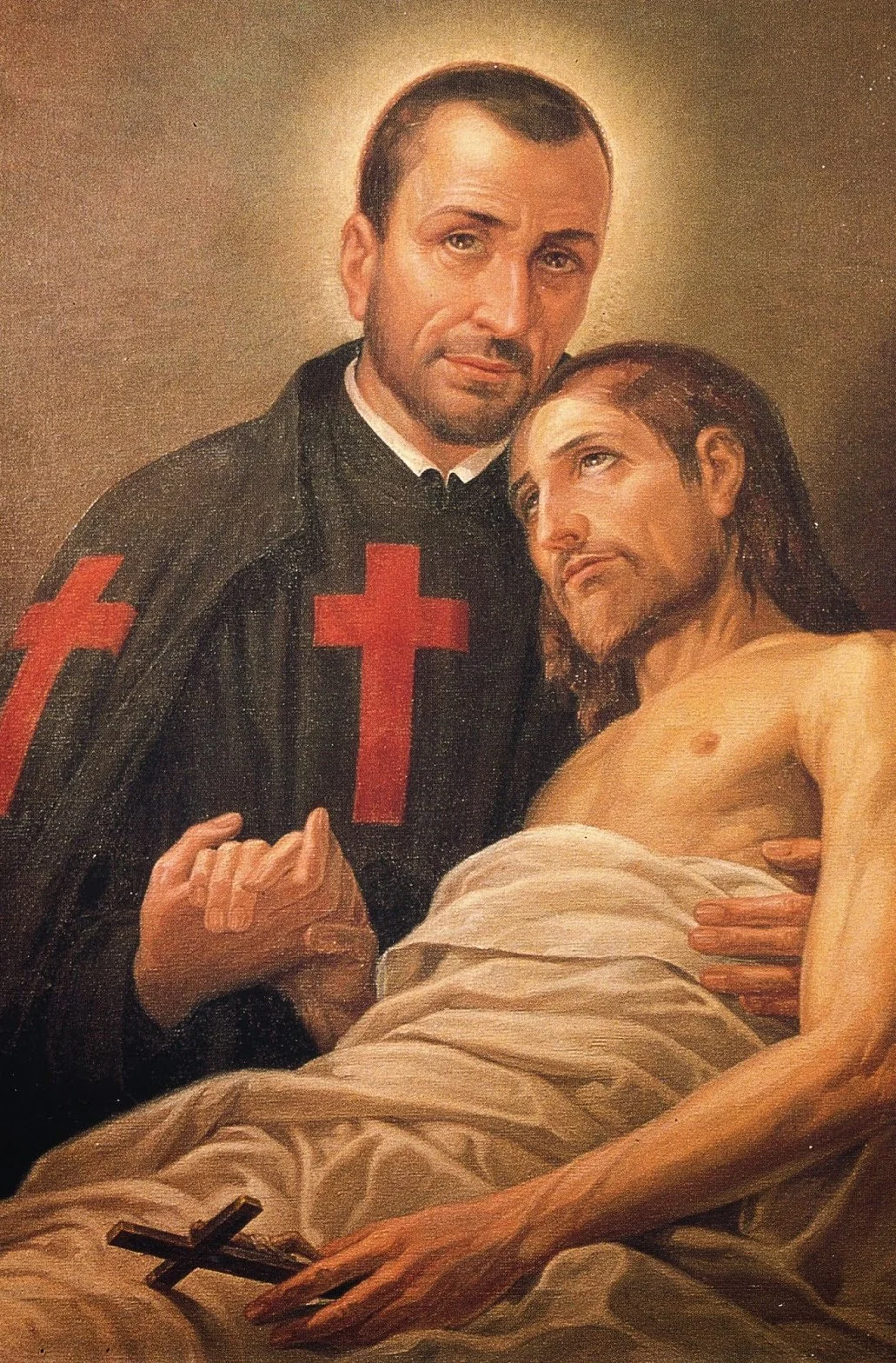
Camillus held that the sick needed competent physical care as well as spiritual help. His methods stressed cleanliness, enough food, fresh air, careful handling of bedridden patients, attention to contagious illness and cooperation with doctors. He also trained his men in person. Camillian accounts describe him putting a bed in the community room and showing the brothers how to change sheets and move a patient without causing needless pain.
His principle was that caring for a suffering body is itself service to Christ. He did not treat bodily care as a mere tool for gaining a hearing for religion. It is fair to add that he did not invent the Christian hospital or organized nursing. Saint John of God had already begun a notable hospital ministry in Spain. What marks Camillus is the combination of direct nursing, formation of religious for the task and practical reform of hospital life.
Writings and Last Letter
Camillus was not a speculative theologian. His surviving writings show the daily demands and reasoning of his work. The most important are his Dispositions and Methods to Be Followed in Hospitals for Serving the Poor Sick, dated 1584 in Pope John Paul II's account, and the Formula of Life of the Ministers of the Sick, approved by the order's General Chapter in 1599. The Formula required common poverty, discipline, prayer, regular sacraments, attention to hospital patients and help for plague victims, and it regulated relations among members to prevent quarrels.
His most personal document is the Testamentary Letter, completed in Rome on July 10, 1614, four days before his death. In it he urged the community to keep its poverty, to maintain harmony between priests and brothers and never to replace care of the body with spiritual care alone. He also asked for prayers and Masses for his soul. The Camillian archives say the letter was copied for the communities and signed by him.
Conflicts and Resignation
Camillus worked in the age of the Catholic Reformation after the Council of Trent, and Pope John Paul II placed his mission within that wider renewal of charitable ministry. His chronic illness never left him. It complicated travel, leadership and bodily service even after the order was established. He also met opposition from hospital administrators who did not share his priorities, since reforming care meant challenging established staffing arrangements and habits of neglect.
Internal disagreements followed. Camillus sometimes took responsibility for whole institutions and not only for the care of patients, and the order's own history names his decision to take on wider duties in Milan as a source of conflict. He resigned as superior general in 1607 and turned back to personal service. These disputes show a founder whose charity sometimes ran up against real questions of governance, money and the proper scope of religious life.
Death, Relics and Canonization
After resigning, Camillus kept visiting and helping the sick as his health allowed. He died in Rome on July 14, 1614, in the community attached to the Church of Santa Maria Maddalena. His early biographer Sanzio Cicatelli, who knew him personally, preserved an account of his last hours with prayers and blessings for his brothers. Cicatelli was also a devoted member of the community, so his work is invaluable but should be read critically.
He was buried at Santa Maria Maddalena, near the Pantheon, which remains the main place of his veneration. His heart has a well-documented history. The Camillian Order preserves an account of its removal after death, its division and its later custody, with portions linked to Naples and Messina. That record is a history of relic preservation and investigation, and it is not evidence that any extraordinary property of the relic was supernatural.
The decree on his heroic virtue was issued on July 24, 1728. Pope Benedict XIV beatified him on April 7, 1742 and canonized him at Saint Peter's on June 29, 1746, in the bull Misericordiae Studium. The Camillian Order's summary says nine miracles were put forward, two of them approved in 1741, and more recognized on May 11, 1745. The published English summary contains a damaged date for the earlier approval, and the individual cases are not described in the accessible sources, so no detailed miracle stories are given here. Pope Leo XIII named him patron of the sick and of hospitals in 1886, and Pius XI added nurses and healthcare workers in 1930. Paul VI named him protector of the Italian military health services in 1974.
Saint Camillus, you knew pain and weakness and turned them into mercy. Pray for the sick, for nurses and doctors, for caregivers who are tired, and for all who struggle with addiction. Teach us to serve Christ in every suffering body, with patience, skill and love. Amen.
This is a short devotional prayer written for this page, and it is not an official text of the Church. The Camillian community publishes its own prayer to him, and a prayer is printed on his prayer card.
Tradition, Devotion and the Eastern Church
The best-known tradition about Camillus is the crucifix that spoke. In Camillian tradition, Christ on a crucifix reassured him during a time of discouragement that the work belonged to God and he should keep going. Versions differ: some describe a dream and others a visible movement of the figure. The order identifies a crucifix in Santa Maria Maddalena with the episode. It belongs to the order's devotional tradition, and its supernatural character cannot be shown from surviving documents. The Catholic Encyclopedia also credits him with prophecy and wonders without documenting each claim, so these reports should be read as gifts traditionally attributed to him.
For Eastern Christian readers the position should be stated plainly. Camillus was a Latin Catholic and his canonization was an act of the Catholic Church. No Orthodox glorification, universal Eastern Catholic feast or Byzantine troparion for him has been found in the sources examined, though that does not rule out individual communities honoring him. There is nevertheless a real historical comparison. Saint Basil the Great built the Basileias near Caesarea, a complex that cared for the poor and the seriously ill, including people with leprosy, as Kenji Doi's study of the institution shows. Basil and Camillus lived centuries apart in different churches, but both treated service to the suffering as a direct expression of faith. The link is one of theology and history and not of liturgy.
Frequently Asked Questions
Mercy That Is Practical
Camillus did not begin as a model of virtue, and that is why his life encourages people. A gambler and a poor employee became a reformer who taught that the sick deserve skilled and loving care. His prayer card is a small reminder for anyone who is ill or who looks after someone who is.
View Prayer Card