Saint Ignatius of Loyola: Soldier, Pilgrim and Founder of the Jesuits
A Basque nobleman whose legs were broken by a cannonball at Pamplona, who turned from knightly ambition to a life of prayer, wrote the Spiritual Exercises and founded the Society of Jesus.
At a Glance
- Born
- 1491, Loyola estate near Azpeitia, Gipuzkoa, Spain (exact date uncertain)
- Died
- July 31, 1556, Rome
- Ordained
- June 24, 1537, Venice
- Beatified
- July 27, 1609 (Paul V)
- Canonized
- March 12, 1622 (Gregory XV)
- Feast day
- July 31 (Roman Catholic calendar)
- Patron of
- Spiritual exercises and retreats (Pius XI, 1922); the Society of Jesus
- Best known for
- Founding the Jesuits and writing the Spiritual Exercises
- A Basque Nobleman
- The Cannonball at Pamplona
- Montserrat and Manresa
- Jerusalem and the Return to School
- Paris and the Vow at Montmartre
- Founding the Society of Jesus
- The Spiritual Exercises
- Education, Letters and Governance
- Suspicion, Trials and Controversy
- Death, Tomb and Canonization
- Visions, Miracles and the Eastern Church
- Frequently Asked Questions
A Basque Nobleman
Iñigo López de Loyola was born in 1491 at the Loyola family estate near Azpeitia, in the Basque province of Gipuzkoa in northern Spain. The year is generally accepted but the exact date is not securely known. His father was Beltrán Yáñez de Oñaz y Loyola and his mother was Marina Sáenz de Licona y Balda. Jesuit biographies usually describe him as the youngest of thirteen children. That number is traditional and not independently established, since some secondary accounts give different counts.
His world was that of minor nobility, military service and political patronage. As a teenager he entered the household of Juan Velázquez de Cuéllar, a senior royal financial official in Castile, and there he picked up courtly manners, administrative experience and ambitions for advancement. Ignatius was not at first the austere figure he became. His own later account admits a young man who cared about fine clothes, romantic success, weapons and reputation, though the surviving evidence does not let us say exactly what his personal failings were.
When Velázquez lost his position, Ignatius entered the service of Antonio Manrique de Lara, Duke of Nájera and viceroy of Navarre. He served in military and administrative roles at a time of conflict between French and Spanish interests. The event that changed his life came in that setting, and not through any early plan to enter religious life.
The Cannonball at Pamplona
On May 20, 1521, Ignatius took part in the defense of the fortress at Pamplona against French forces. A cannonball struck his legs, breaking one and badly injuring the other. He was carried to Loyola for painful surgery and a long recovery, and the injury left him with a permanent limp. He told the story himself in his autobiography, which makes this one of the best-documented turning points in his life.
While he recovered he asked for tales of knights and romance. The house had none, and he was given religious works instead, among them a life of Christ associated with Ludolph of Saxony and a collection of the lives of the saints. He began to compare his dreams of fame at court with the lives of Francis of Assisi, Dominic and other saints. According to his dictated recollections, worldly daydreams gave him brief pleasure and then left him dry, while thoughts of serving God left lasting peace. That observation became the seed of his later teaching on discerning the movements of the spirit.
Montserrat and Manresa
In March 1522 Ignatius visited the Benedictine sanctuary of Our Lady of Montserrat. He made a general confession, gave away his fine clothes and spent a night in prayer before an image of the Virgin Mary. He left his sword and dagger at the shrine, a deliberate sign that he was giving up his old military identity.
He went on to Manresa and stayed about eleven months. He lived in poverty, prayed for hours, served the needy and practiced severe bodily penances. It was not a peaceful time. His autobiography records tormenting scruples, repeated going over past sins, deep discouragement and thoughts of ending his life. In time he eased his penances and learned more about spiritual consolation and desolation. At Manresa he began to write down the reflections that became the Spiritual Exercises. His accounts of mystical experiences there are first-hand testimony about his own religious life and not events that history can independently confirm.
Jerusalem and the Return to School
Ignatius reached Jerusalem in September 1523, hoping to stay in the Holy Land and give his life to religious service. The Franciscan authorities, concerned about security and the consequences of his presence, refused him permission to remain. Back in Europe he concluded that he could not help souls well without more education.
He studied Latin grammar in Barcelona, then attended schools at Alcalá and Salamanca, and in 1528 went to Paris. It was an unusual path for a man who had been a courtier and soldier. He sat in classrooms with boys years younger than himself because he believed that spiritual ministry needed learning.
Paris and the Vow at Montmartre
In Paris Ignatius met Peter Faber, Francis Xavier and others who would become his closest collaborators. His calling moved slowly from solitary pilgrimage and personal penance toward the founding of an organized community.
On August 15, 1534, Ignatius and six companions gathered at Montmartre in Paris, where Peter Faber celebrated Mass. They vowed poverty and chastity and promised to go on pilgrimage to Jerusalem or, if that proved impossible, to place themselves at the pope's disposal. This was not yet the full system of Jesuit vows, and formal obedience within the group was settled later. Ignatius and several companions were ordained priests in Venice on June 24, 1537. Political and military conditions made the voyage to Jerusalem impractical, so they went to Rome.
Founding the Society of Jesus
In Rome the companions gradually formed a permanent association. On September 27, 1540, Pope Paul III formally approved the Society of Jesus. Ignatius was elected its first Superior General in 1541 and held the office until he died in 1556. He did not found it alone. He was the principal founder, working with companions such as Peter Faber and Francis Xavier, and their original commitments of 1534 came six years before the Society's approval.
The Society combined prayer, serious study and active work. Jesuits preached, heard confessions, taught Christian doctrine, nursed the sick and went on missions. Ignatius also worked for disadvantaged women and for people in poverty. Isabel Roser and other women were briefly admitted under vows, but the arrangement did not last, and in 1547 Pope Paul III accepted the request that the Society have no female members and no parallel women's order.
The Spiritual Exercises
The Spiritual Exercises grew out of Ignatius's own conversion experience and was revised over the years. Its first authorized printed edition appeared in 1548 with papal approval. It is not mainly a book of theological argument. It sets out a structured course of spiritual formation, normally given under the guidance of an experienced director.
The main movements deal with sin and repentance, the earthly life of Christ, his Passion and his Resurrection. Ignatius also gives directions for examining one's conscience, recognizing movements of the spirit and making decisions. The traditional retreat lasts about thirty days, though the text itself allows adjustment to the person making it. A well-known prayer in the book, the Suscipe, belongs to the section called the Contemplation to Attain Love. The popular prayer Anima Christi, sometimes credited to him, is older than Ignatius and was already in circulation in the Middle Ages. He used it but did not write it.
Education, Letters and Governance
Education soon became a major work of the Society. The Jesuits opened a college at Messina in 1548 and the Roman College in 1551, which later grew into the Pontifical Gregorian University. From Rome Ignatius directed missionary assignments and kept up a vast correspondence with Jesuits in distant countries. The Society of Jesus reports that more than 7,000 of his letters survive, and they show the practical decisions behind the devotional portraits.
His surviving writings include the Spiritual Exercises, first published in 1548, and the Constitutions of the Society, developed during his leadership and revised before his death. They include his Autobiography, also called the Pilgrim's Narrative, dictated to Luís Gonçalves da Câmara in 1553 to 1555, and a Spiritual Diary with entries from February 2, 1544 to February 27, 1545. Letters and instructions on prayer, obedience, governance, health, education and missions complete the record.
Suspicion, Trials and Controversy
Ignatius's early ministry drew suspicion. He talked with people about religion before finishing his theological studies, and his poor dress and unusual activities attracted attention. He was investigated and imprisoned at Alcalá and Salamanca in the 1520s, as authorities examined whether his teaching was sound and whether he belonged to dubious spiritual movements. He was never condemned as a heretic, but the restrictions he met helped lead him to Paris.
He lived through the Protestant Reformation and the Catholic reform that answered it. The early Jesuits became prominent defenders of Catholic teaching, though preaching, confession, reconciliation, missions and education were just as central to them. Ignatius's letters to Peter Canisius and to Jesuit theologians at the Council of Trent show his part in the conflicts and reforms of his time. His approach to obedience and a centralized government for the Society drew criticism and needed careful negotiation with Church authorities. Later controversies about the Jesuits, including their suppression in 1773 and restoration in 1814, came long after his death and should not be pinned on him personally.
Death, Tomb and Canonization
Ignatius's health declined in his last years. On July 30, 1556, he asked his secretary, Juan Alfonso de Polanco, to seek a papal blessing for him. According to a Jesuit account preserved by Loyola University Chicago, Polanco did not at first see the urgency, and Ignatius died early on July 31 before the blessing could be obtained.
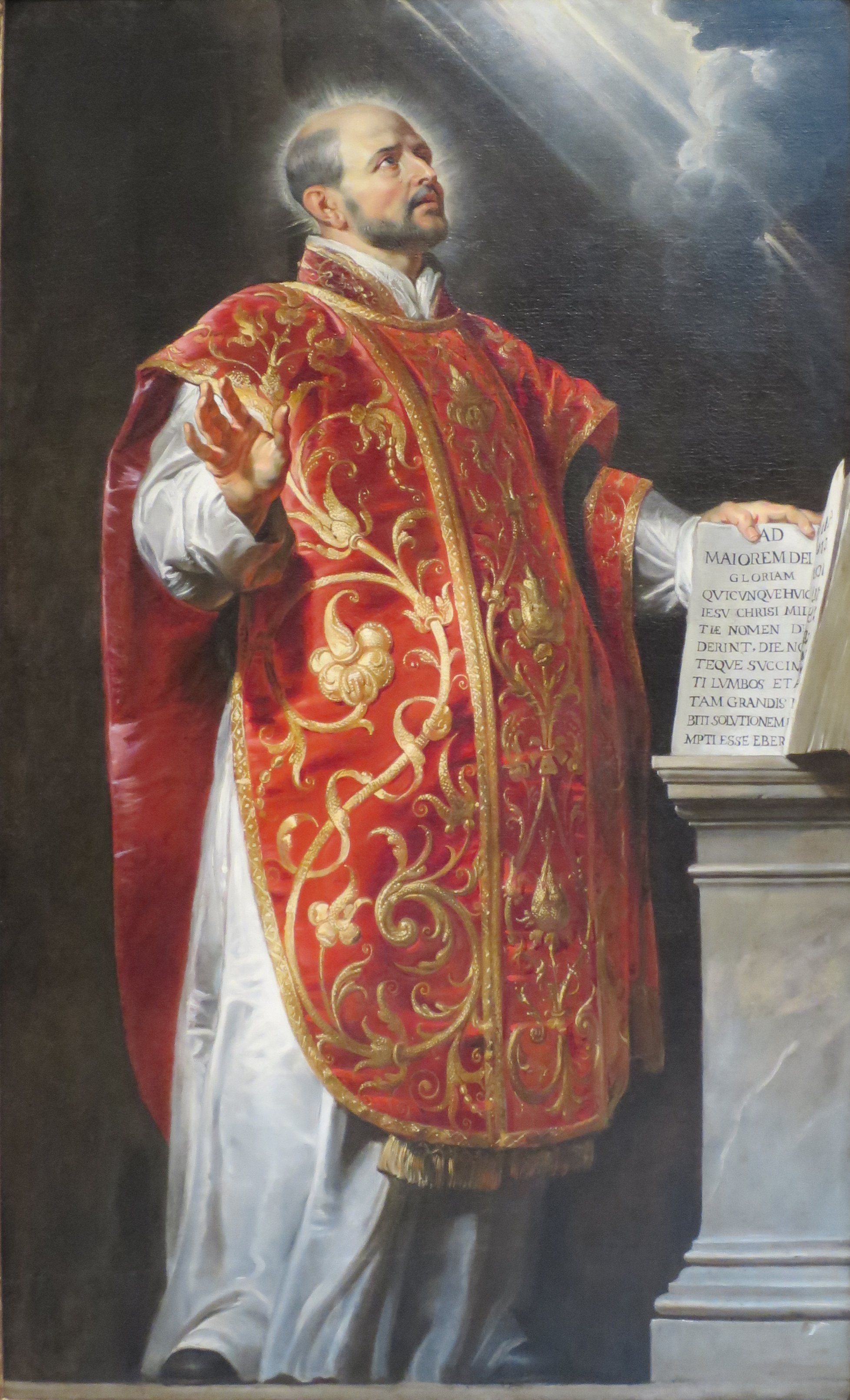
His remains are venerated in the Church of the Gesù in Rome, the mother church of the Jesuits, beneath the altar of the Chapel of Saint Ignatius, which received elaborate Baroque decoration. Pope Paul V beatified him on July 27, 1609. Pope Gregory XV canonized him on March 12, 1622, in a ceremony that also included Francis Xavier, Teresa of Ávila, Philip Neri and Isidore the Farmer. The older Catholic Encyclopedia gives May 22, 1622, but the Vatican's Dicastery for the Causes of Saints gives March 12, and the Vatican record is the one to follow. In 1922 Pius XI named him patron of spiritual exercises and of those who make retreats.
Saint Ignatius of Loyola, you learned to notice where the spirit leads and where it only flatters. Pray for us when we must choose. Give us honest hearts, quiet enough to hear, and courage enough to act on what is good. Teach us to find God in ordinary days. Amen.
This is a short devotional prayer written for this page, and it is not an official text of the Church. The Suscipe from the Spiritual Exercises can be found in published translations of that book.
Visions, Miracles and the Eastern Church
Ignatius described several extraordinary experiences in his autobiography. While recovering at Loyola he reported seeing the Virgin Mary with the infant Jesus, and at Manresa he described illuminations about the Trinity, creation and the Eucharist. These are historically documented as his own testimony, and their supernatural character is a matter of faith. Near Rome, at La Storta, he reported a vision in which he understood God the Father to place him with Christ carrying the Cross, which became central to the Jesuits' sense of vocation. It, too, is personal testimony and not an externally verifiable apparition.
Claims of miraculous help grew after his death. The historian Robert E. Scully notes that Pedro de Ribadeneira's early biography of 1572 did not stress specific miracles, and that later editions added more as interest in Ignatius's canonization grew. Scholars have also studied reports of women being helped in dangerous childbirth by writings or objects linked to Ignatius. These belong to the history of devotion, were not among the miracles formally put forward for his canonization and should not be presented as medically established events.
For Eastern Christian readers the position should be put plainly. Ignatius was a Latin Catholic who lived after the medieval separation of Rome and the Orthodox Churches. He is not an Orthodox saint and no Orthodox commemoration of him has been found. One documented connection is Ethiopia. Ignatius organized the effort to start a Jesuit mission there and, in a letter of February 23, 1555, to the emperor, argued that the Ethiopian Church should enter communion with Rome. The emperor kept to the Alexandrian tradition and did not accept the proposal. The episode shows a real difference between Ignatius's view of the Church and that of the Oriental Orthodox. A later institutional link is that Pius XI gave the Pontifical Oriental Institute to the Jesuits in 1922, centuries after Ignatius. Eastern Catholics and Orthodox readers may still find his teaching on repentance, prayer and discernment worth comparing with their own ascetical traditions.
Frequently Asked Questions
Finding God in Ordinary Days
Ignatius turned a cannonball wound into a new way of seeing. He taught that God can be found in daily choices and that the heart can learn to tell what leads toward him. His prayer card is a small companion for anyone facing a decision.
View Prayer Card