Saint Elizabeth Ann Seton: Wife, Mother, Widow and Educator
A New York widow and mother of five who became a Catholic, founded the Sisters of Charity in Maryland, and became the first person born in what is now the United States to be canonized.
At a Glance
- Born
- August 28, 1774, New York (New York City is the traditional place; the exact birthplace is not certain)
- Died
- January 4, 1821, Emmitsburg, Maryland, aged 46
- Declared Venerable
- December 18, 1959 (John XXIII)
- Beatified
- March 17, 1963 (John XXIII)
- Canonized
- September 14, 1975 (Paul VI)
- Feast day
- January 4 (Roman Catholic calendar for the United States)
- Patron of
- Catholic schools and education, widows, converts, and those grieving the death of loved ones
- Best known for
- Founding the Sisters of Charity of St. Joseph's and a lasting model of Catholic education
- A Family in Colonial New York
- Marriage, Motherhood and the Widows' Society
- Bankruptcy, Quarantine and Widowhood in Italy
- Becoming a Catholic
- To Baltimore and Emmitsburg
- Schools, Orphanages and the Question of Firsts
- Her Writings and Spiritual Teaching
- Grief, Illness and Death
- Slavery and the Early Community
- Canonization, Miracles and Devotion
- Why She Matters to Eastern Christians
- Frequently Asked Questions
A Family in Colonial New York
Elizabeth Ann Bayley was born on August 28, 1774, into a prominent Anglican family in New York, a few years before the American Revolution reshaped the country around her. New York City is the traditional place of her birth, and historians such as Thomas W. Spalding describe her as probably born there, so the exact location remains uncertain. Her father, Dr. Richard Bayley, was a physician and surgeon who taught medicine and later held a public health post. Her mother, Catherine Charlton Bayley, was the daughter of an Anglican clergyman.
Her childhood was marked by loss. Her mother died in 1777, when Elizabeth was about three years old. Her father married Charlotte Amelia Barclay in 1778, and the second marriage proved troubled and eventually ended in separation. Elizabeth and her older sister Mary Magdalene lived through periods of upheaval, including time away from their father's household. The family was comfortable and well connected, but modern historians caution against painting her youth as either a golden age or a tragedy. It contained both advantages and real loneliness.
Her own later reflections show a sensitive girl who loved reading, music, poetry and the natural world, and who felt drawn to prayer. She received the education expected of a young woman of her class, including French and music. The religious world of her youth was Anglican and, in New York terms, Episcopalian, and it gave her a habit of Scripture and prayer that stayed with her for the rest of her life.
Marriage, Motherhood and the Widows' Society
On January 25, 1794, Elizabeth married William Magee Seton, a New York merchant whose family ran an international import and export business. Surviving family letters point to an affectionate marriage. The couple had five children: Anna Maria (1795 to 1812), William (1796 to 1868), Richard Bayley (1798 to 1823), Catherine Charlton (1800 to 1891) and Rebecca Mary (1802 to 1816). Elizabeth took an active part in raising and teaching them, and her letters show that care for her children remained at the center of her life even after she entered religious life.
Her concern for the poor also began well before she became a Catholic. In 1797 she helped found the Society for the Relief of Poor Widows with Small Children in New York, working alongside Isabella Graham and serving as a founding member and treasurer. This detail matters for understanding her. Her charity did not begin as a reaction to her conversion. It grew out of the Anglican and Episcopal world that formed her, and it was later carried into a new religious setting.
Bankruptcy, Quarantine and Widowhood in Italy
The Seton family fortune did not last. William inherited heavy business obligations, including responsibility toward younger members of his family, and the firm was hit by the instability of international trade and mounting debts. The business failed in 1801. William was also suffering from tuberculosis, and the family had to face both financial ruin and his declining health.
In 1803 Elizabeth sailed with William and their eldest daughter, Anna Maria, to Italy, hoping that a warmer climate would help him. When they reached Livorno, which English speakers called Leghorn, the authorities placed them in quarantine out of fear of yellow fever arriving from New York. They spent weeks confined in harsh conditions while his health worsened. William died in Pisa on December 27, 1803, leaving Elizabeth a widow with five young children in a foreign country.
Elizabeth recorded this period in her Leghorn Journal, written for her sister-in-law Rebecca. It is one of the most important primary sources for her bereavement and for the beginning of her turn toward the Catholic faith, because it shows her praying through the worst weeks of her life.
Becoming a Catholic
In Italy Elizabeth was welcomed by the Filicchi family, especially Antonio and Filippo Filicchi and their households, who were Catholic merchants and business partners of her husband. Through them she saw Catholic worship and devotion at close range. She was drawn most strongly by belief in the real presence of Christ in the Eucharist, by devotion to the Virgin Mary, and by the Church's claim to continuity with the apostles.
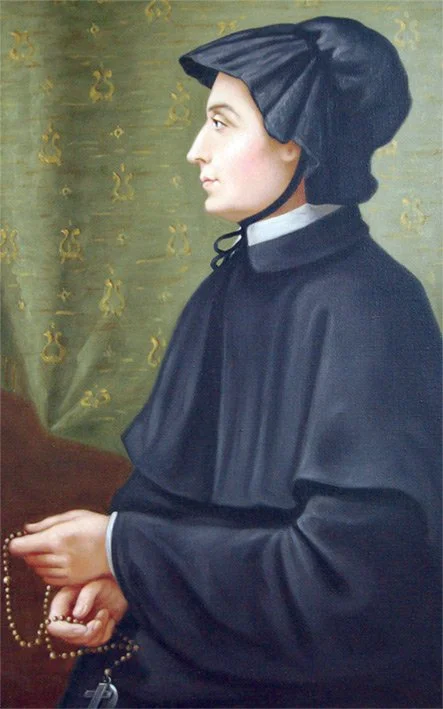
Her path was gradual and not a single sudden event. She returned to New York in June 1804 and spent months corresponding with Catholic clergy and struggling over whether to leave the Episcopal Church that had nourished her. Her former spiritual adviser, John Henry Hobart, who later became an Episcopal bishop, disagreed with her decision, and the conflict cost her relationships. On March 14, 1805, Father Matthew O'Brien received her profession of the Catholic faith at St. Peter's Church on Barclay Street in Manhattan. She made her first Catholic Communion on March 25, 1805. Bishop John Carroll confirmed her in 1806, and at confirmation she added Mary to her name, reflecting her devotion to the Mother of God.
Conversion came at a price. In a country where Catholics were a small and often distrusted minority, anti-Catholic prejudice made it harder for her to earn a living. She tried teaching and running a boarding house in New York, and neither brought lasting security. She also worried about what her new faith might mean for her children's place in the world they had been born into.
To Baltimore and Emmitsburg
A way forward opened when Father Louis William DuBourg, a Sulpician priest, invited her to Baltimore to open a school for girls. Bishop Carroll supported the plan. Elizabeth arrived in Baltimore on June 16, 1808, and began teaching. Other women soon wanted to join her in a shared life of prayer and service.
On March 25, 1809, she made temporary vows of chastity and obedience before Bishop Carroll at St. Mary's Seminary in Baltimore, and from then she was known as Mother Seton. In June 1809 the small community moved to Emmitsburg, Maryland, with the support of the Sulpicians and benefactors such as Samuel Sutherland Cooper. Their rule was adapted from that of the French Daughters of Charity, founded by Saint Vincent de Paul and Saint Louise de Marillac, and modified to suit the American Church. On July 19, 1813, Elizabeth and her sisters made private annual vows that included poverty, chastity, obedience and service of the poor.
It is fair to say that the foundation was a collaboration. The Sulpician priests kept significant ecclesiastical authority over the community, so the Sisters of Charity of St. Joseph's were not the product of Elizabeth's initiative alone. Mother Seton led the community until her death in 1821, and she did so while still raising her own children.
Schools, Orphanages and the Question of Firsts
At Emmitsburg Elizabeth developed St. Joseph's Academy, which taught paying students, and a free school for children whose families could not pay. According to the Encyclopedia of Educational Reform and Dissent, the free school was operating by 1810, and income from tuition helped support the charitable work. Her sisters were soon asked to do more. In 1814 sisters were sent to Philadelphia to run St. Joseph's Asylum, which the Archdiocese of Baltimore identifies as the first Catholic orphanage in the United States. In 1817 sisters went to New York to serve at the Roman Catholic Orphan Asylum.
Popular accounts often call her the founder of the American parochial school system or of the first Catholic school in America. Those claims need qualification. Catholic schooling already existed in North America before her. What she and her sisters did was build a lasting model of Catholic education staffed by women religious, with a firm commitment to children who could not afford to pay. Later communities of sisters, including several that grew out of the Emmitsburg foundation, expanded that model across the country.
The same caution applies to the claim that she founded the first community of women religious in the United States. Earlier Catholic women's communities existed elsewhere in North America, so it is more accurate to call hers the first community of Sisters of Charity founded in the United States. Her real achievement stands without exaggeration.
Her Writings and Spiritual Teaching
Elizabeth was not a systematic theologian. Her written legacy is made up of letters, journals, spiritual reflections, devotional notes, translations and practical communications about the running of her community. The key texts include the Leghorn Journal, her Spiritual Journal, Dear Remembrances, and a large body of correspondence with her children, friends and clergy.
The standard modern edition is Elizabeth Bayley Seton: Collected Writings, edited by Regina Bechtle and Judith Metz with Ellin M. Kelly, published in several volumes between 2000 and 2006. DePaul University hosts a digital repository of related materials. These editions should take precedence over the many quotations that circulate online without a source, because they let readers separate her actual words from paraphrases and later devotional compositions.
Her teaching returns again and again to a few themes. She spoke of trust in Providence, of conforming one's will to the will of God, of the Eucharist as the center of Christian life, of Scripture, and of charity as the test of faith. These themes were forged in practical suffering and not in a study, and that is a large part of why they speak to people today.
Grief, Illness and Death
Mother Seton's religious life was shaped by constant loss. Her eldest daughter, Anna Maria, died of tuberculosis in 1812. Her daughter Rebecca died in 1816 after years of illness and disability. She also watched several sisters in her young community die, and life at Emmitsburg was hard, with illness, limited money and heavy work. Elizabeth herself had tuberculosis and grew steadily weaker, but she stayed involved in the work of the community, in spiritual direction and in teaching.
She died at Emmitsburg on January 4, 1821, aged 46. According to the Archdiocese of Baltimore, one of her last exhortations to her sisters was a plea to be children of the Church, and Pope Paul VI recalled it in his canonization homily. She was first buried in St. Joseph's Cemetery at Emmitsburg. Her remains were later moved, and they now rest beneath the Altar of Relics in the Basilica of the National Shrine of Saint Elizabeth Ann Seton, which was completed in 1965. Sources give 1968 for the transfer of her remains into the basilica.
Slavery and the Early Community
A complete biography has to deal honestly with slavery. Research published by the Daughters of Charity establishes several facts. In 1777 Elizabeth's grandfather, the Reverend Richard Charlton, bequeathed an enslaved person named Brennus to Elizabeth, who was still a small child. What happened to Brennus is uncertain. Historian Catherine O'Donnell has suggested that he may have escaped during the American Revolution, but this is not established.
The Daughters of Charity report that neither Elizabeth nor her community legally owned enslaved people during her lifetime. They also report that the community benefited from slavery through its relationships with the Sulpicians and with slaveholding families nearby. In 1819 a school connected to her community accepted tuition made possible by the sale of an enslaved person, and sisters working at the seminary supervised enslaved women who did laundry.
These findings do not show that Elizabeth personally bought or sold people, and they should not be stated that way. They do show that institutions under her leadership benefited from slavery. The Daughters of Charity formally acknowledged this history and apologized for it in a memorial and letter dated February 10, 2022. Keeping those distinctions clear, between personal ownership, institutional benefit and responsibility, is part of telling her story accurately.
Canonization, Miracles and Devotion
Efforts toward her canonization began in the nineteenth century, and Cardinal James Gibbons encouraged her cause in 1882. The Holy See formally introduced the cause on February 28, 1940. Pope John XXIII declared her Venerable on December 18, 1959 and beatified her on March 17, 1963. Pope Paul VI canonized her on September 14, 1975, making her the first person born in what became the United States to be canonized. In his homily he highlighted her unusual combination of roles as wife, mother, widow, religious superior and founder, and he welcomed Episcopal representatives who attended the ceremony in recognition of her early formation in the Episcopal Church.
The Church accepted three healings attributed to her intercession. They involved Sister Gertrude Korzendorfer, a Daughter of Charity in New Orleans who recovered from pancreatic cancer, Ann Theresa O'Neill, a young girl with acute lymphatic leukemia who recovered in 1952 after her family prayed at Mother Seton's tomb, and Carl Kalin, a New York man who recovered from a rare form of encephalitis. Acceptance of these cases means they satisfied the Church's procedures for her cause. It is not the same as independent proof in the medical literature.
TRADITION: Pilgrims come to her tomb at Emmitsburg, and many report consolation or answered prayers. These are devotional testimonies and should not be confused with miracles investigated by the Church. She is commonly invoked by widows, grieving parents, converts and teachers because of the shape of her own life. No reliable evidence shows that she received a Marian apparition. Her devotion to Mary was deep and documented, but it was not a claim of visions.
Saint Elizabeth Ann Seton, wife, mother and widow, you knew grief, debt and uncertainty, and you trusted God through them. Pray for all who mourn, for parents who struggle to provide, for converts who face misunderstanding, and for teachers who serve the young. Help us to do the will of God in ordinary days. Amen.
This is a short devotional prayer written for this page, and it is not an official text of the Church. The prayer printed on her prayer card is a traditional intercessory text.
Why She Matters to Eastern Christians
Elizabeth Ann Seton was a Latin Catholic, and her community grew out of the French Vincentian tradition. This article found no established historical link between her and Eastern Christianity. No universal Eastern Catholic commemoration of her could be verified, and she has not been glorified by any canonical Orthodox Church. Whether a particular Eastern Catholic jurisdiction includes her in its local calendar is uncertain and would need to be checked with that Church.
Even so, some themes in her life will be familiar to Eastern readers. Her conversion was tied closely to belief in the real presence of Christ in the Eucharist, which is central to Eastern Catholic and Orthodox sacramental life. Her devotion to the Mother of God, her use of Scripture in prayer, her reliance on spiritual direction and her view of service to the poor as a way of union with Christ all have parallels in Eastern spirituality. These are comparisons, not evidence that she studied or practiced the Eastern tradition. She is best read as a Latin Catholic saint whose life of grief, faith and charity can be valued by Christians of every tradition.
Frequently Asked Questions
Faith Through Loss
Elizabeth Seton lost her mother, her fortune, her husband and two of her children, and she still built schools and cared for orphans. Her story belongs to anyone who has grieved and kept working. Her prayer card is a quiet companion for those hard days.
View Prayer Card