Saint Frances Xavier Cabrini: Missionary, Educator and Patroness of Immigrants
A frail Italian schoolteacher who wanted to go to China, was sent to America instead, and built schools, orphanages and hospitals for immigrants across two continents.
At a Glance
- Born
- July 15, 1850, Sant'Angelo Lodigiano, Lombardy (then under Austrian rule)
- Died
- December 22, 1917, Columbus Hospital, Chicago, aged 67
- Beatified
- November 13, 1938 (Pius XI)
- Canonized
- July 7, 1946 (Pius XII)
- Feast day
- November 13 (memorial in the United States); December 22 is the anniversary of her death
- Patron of
- Immigrants and emigrants (declared by Pius XII on September 8, 1950)
- Founder of
- Missionary Sisters of the Sacred Heart of Jesus (November 14, 1880)
- Best known for
- Serving Italian immigrants in the United States and being the first U.S. citizen canonized
- A Farm Family in Lombardy
- Teacher, Orphanage and Vows
- Not to the East, but to the West
- Arrival in New York, 1889
- Schools, Orphanages and Hospitals
- A Worldwide Congregation and Her Writings
- Prejudice, Conflict and Hard Work
- Death in Chicago, 1917
- Canonization and Her Relics
- Miracles, Traditions and Doubtful Stories
- Why She Matters to Eastern Christians
- Frequently Asked Questions
A Farm Family in Lombardy
Maria Francesca Cabrini was born on July 15, 1850, in Sant'Angelo Lodigiano, a farming town in Lombardy, which was then part of the Kingdom of Lombardy-Venetia under Austrian rule. Pope John Paul II confirmed this date for both her birth and baptism in his message to her congregation on May 31, 2000. Her father, Agostino Cabrini, was a farmer, and her mother was Stella Oldini. The Missionary Sisters' history says she was born about two months early and stayed physically frail all her life.
Sources disagree on her place in the family. One congregational biography calls her the youngest of thirteen children, while another page from the same congregation calls her the tenth of eleven. Because the records conflict, it is safest to say that she was one of the younger children of a large family. What is clear is that many of her siblings died young, so bereavement was familiar to the household.
Religion was part of daily life at home. Her older sister Rosa gave her early instruction, and her father reportedly read aloud from the Annals of the Propagation of the Faith, a magazine of mission news. Stories from China made a deep impression on the young girl, and her missionary longing began early. She studied with the Daughters of the Sacred Heart at Arluno and earned a teaching diploma in 1868.
Teacher, Orphanage and Vows
After her diploma she taught, first in a school run by her sister Rosa and then, from 1871, in the village of Vidardo. When she asked to join the Daughters of the Sacred Heart, the community declined, doubting that her health could bear the life. It was a real disappointment, but it did not end her desire to be a missionary.
Her life changed direction in 1874, when church authorities asked her to take charge of the House of Providence, a struggling orphanage in Codogno that suffered from poor management and internal conflict. She accepted the task of reforming it and began forming a small community of women around her. In September 1877 she professed religious vows and took the name Xavier, after Saint Francis Xavier, the missionary to Asia. Bishop Domenico Maria Gelmini of Lodi supported her leadership.
The orphanage itself could not be stabilized as a religious house, and in 1880 the diocese ended the existing arrangement. Cabrini was not discouraged for long. Her life did not contain a conversion from unbelief, since she grew up in a practicing Catholic family. Her path was a slow discernment of religious life, mission and leadership.
Not to the East, but to the West
On November 14, 1880, Cabrini and seven companions founded the Missionary Sisters of the Sacred Heart of Jesus in Codogno, and the diocese approved the community in 1881. Her plan was to take the sisters to China, as she had dreamed since childhood.
Bishop Giovanni Battista Scalabrini of Piacenza, who was deeply concerned about the poor Italian emigrants in the Americas, urged her to serve them instead. She went to Rome to consult Pope Leo XIII. According to the account in John Paul II's message of May 31, 2000, the pope told her to go not to the East but to the West. This is a historically transmitted instruction and should not be treated as a word for word transcript of the audience.
The change redirected her missionary desire without destroying it. She would still cross oceans, found communities, educate children and bring pastoral care to people far from home. Her mission field would be the immigrants of the Americas and not the people of East Asia.
Arrival in New York, 1889
Mother Cabrini reached New York City on March 31, 1889, with six sisters. The welcome was not what they had expected. Archbishop Michael Corrigan had not prepared housing for them and at first suggested that they go back to Italy. According to the congregation's history, Cabrini insisted that she had been sent with the authority of the pope and would stay to do the work.
The sisters began visiting immigrant families, teaching catechism and caring for neglected children. They opened a free school on Manhattan's Lower East Side and, on Palm Sunday 1890, an orphanage for Italian children. Historians note that the relationship with Archbishop Corrigan did not remain hostile. His early opposition gave way to cooperation, so the story should not be reduced to a permanent feud with the New York hierarchy.
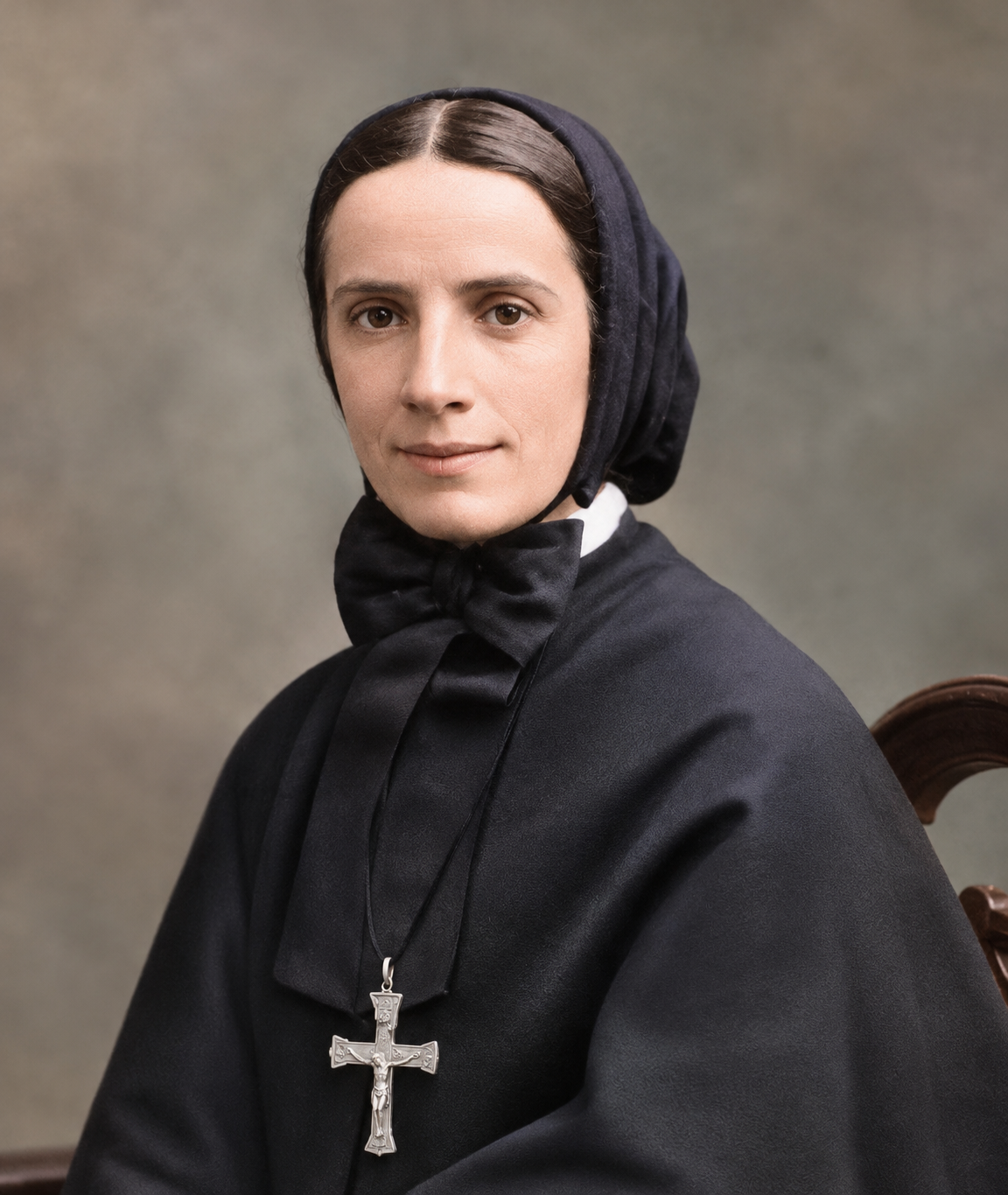
Schools, Orphanages and Hospitals
Cabrini understood that immigrants needed more than a priest on Sunday. Poor families needed schooling, medical care, housing help and protection against exploitation, and she built institutions to meet those needs. Her sisters went from New York into healthcare, and the congregation developed Columbus Hospital in New York and other hospitals and charities in other cities. The Chicago Columbus Hospital opened in 1905 and became important in her last years.
She also founded or directed missions in New Orleans, Denver, Seattle and other American cities. Beyond the United States her congregation opened houses in Italy, Nicaragua, Argentina, Brazil, England, France and Spain, so her work was international and not only American.
She had a clear educational approach in which spiritual formation, moral training and practical learning went together. Maria Patricia Williams' 2018 doctoral study at University College London, which draws on school records and correspondence, points to her emphasis on fitting education to the needs of each child and on careful training of the sisters who taught.
The total number of her foundations is uncertain. Vatican statements and congregational histories commonly credit her with 67 charitable works, while Williams' study counts 70 houses established in her lifetime. The difference may come from how houses, institutions and foundations are counted, so it is best to cite the figure used and not present either as final.
A Worldwide Congregation and Her Writings
Cabrini left a large body of letters, spiritual reflections, travel accounts and instructions for her sisters. An English translation of her letters by Sister Ursula Infante, MSC, was published through the Archdiocese of Chicago in 1970. To the Ends of the Earth: The Missionary Travels of Frances X. Cabrini, published by the Center for Migration Studies in 2001, collects letters arranged as travel diaries, a habit she began on her 1890 journey to the United States.
These writings are the best evidence for what she actually saw, decided and felt, and they help separate her real decisions from later devotional embellishment. Her spirituality centered on the Sacred Heart of Jesus, devotion to the Virgin Mary, obedience, prayer and mission. John Paul II stressed that her long prayer before the tabernacle was the foundation of her activity.
Prejudice, Conflict and Hard Work
Cabrini worked in a period of mass Italian emigration, deep poverty and open hostility to immigrants. Pope Leo XIII described the conditions of Italian laborers in his encyclical Quam aerumnosa, issued on December 10, 1888, which speaks of exploitation, dangerous travel, language isolation and weak pastoral care. It is strong contemporary evidence for the world she entered the next year.
The hostility was not only social. The Library of Congress documents the lynching of eleven Italians in New Orleans in 1891, a reminder of the danger faced by the communities her sisters served.
Her conflicts within the Church were mostly administrative, not doctrinal. She had difficulties at the House of Providence, early disagreements with Archbishop Corrigan, and constant financial pressure. Schools and hospitals needed buildings, staff and steady donations, and she negotiated purchases, raised funds and managed institutions across great distances. She was a capable administrator as well as a woman of prayer. No major doctrinal controversy around her is established, so accounts that dramatize her disputes should be checked against letters and contemporary records.
Death in Chicago, 1917
In her last years Cabrini kept visiting her congregation's institutions in spite of declining health. In December 1917 she was in Chicago, where the sisters were preparing Christmas gifts for children. According to the New York shrine's history, she died unexpectedly at Columbus Hospital on December 22, 1917, of chronic endocarditis, aged 67.
Her remains were first buried at West Park, New York, on property tied to her congregation. In 1933 they were moved to the chapel of Mother Cabrini High School in Manhattan, and after her beatification in 1938 they were displayed for veneration. The present New York shrine was completed in 1959.
Canonization and Her Relics
After investigations and the recognition of miracles attributed to her intercession, Pope Pius XI beatified Cabrini on November 13, 1938. Pope Pius XII canonized her on July 7, 1946. She became the first United States citizen to be canonized, having become a naturalized American citizen in 1909. It is more accurate to call her the first naturalized citizen of the United States canonized than the first American-born saint, since she was born in Italy. On September 8, 1950, Pius XII declared her patroness of immigrants in the apostolic brief Superiore iam aetate.
According to the congregation's relic inventory, the main part of her remains is in New York City. Her heart is kept at the congregation's spirituality center in Codogno, her skull is at the Church of the Redeemer in Rome, a major relic is at the National Shrine in Chicago, and further relics are at her birthplace. Claims that her whole body is incorrupt are not supported. The congregation reports ordinary decomposition, with the heart treated as a special case, and the visible face and hands of the reliquary figure are made of wax.
Miracles, Traditions and Doubtful Stories
Two healings are especially associated with her cause. The first is Peter Smith, a newborn at Columbus Hospital in New York in 1921, whose eyes were badly harmed when a concentrated silver nitrate solution was applied by mistake. According to the New York shrine, the sisters placed a relic of Cabrini's clothing near the child and prayed, and he recovered his sight. He later became a priest and was ordained on June 2, 1951. Sources differ on some dates and medical details, so the exact clinical account should be checked against the original Church medical reports.
The second involves Sister Delfina Grazioli, a member of the congregation with a serious stomach illness described as cancer. In her testimony, Cabrini appeared to her and encouraged her to eat, and she recovered. The apparition is Sister Delfina's own account and should be read as such.
TRADITION: In a story told about her childhood, Francesca set violets in little paper boats and sent them down a stream as imagined missionaries sailing to China. The details cannot be independently confirmed. Another devotional account says she nearly drowned as a child and was rescued by her guardian angel. UNCERTAIN: Some shrine histories say she meant to sail on the Titanic in 1912 and changed her plans for hospital business. No booking record or letter confirms this, and it should not be presented as a verified providential escape.
Saint Frances Xavier Cabrini, you left your homeland and gave yourself to strangers in a new land. Pray for immigrants and refugees, for those far from family, and for all who have an anxious journey ahead. Give us courage to welcome the stranger and to trust God in unfamiliar places. Amen.
This is a short devotional prayer written for this page, and it is not an official text of the Church. A prayer from her journal, used in the congregation's novena, reads: "Let me learn from you how to be a good missionary."
Why She Matters to Eastern Christians
Cabrini was a Latin Catholic foundress, and her devotion belonged to the Roman Catholic tradition. There is no verified basis for calling her an Eastern Catholic saint by rite or an Orthodox saint. No Eastern Orthodox glorification or established Eastern liturgical commemoration was found, and no official Byzantine troparion for her could be verified.
Her relevance to Eastern readers is pastoral and comparative. She faced a problem that Eastern Christian immigrant communities also know well, which is how to keep worship, language, education and community life alive after leaving home. She joined prayer, obedience and practical service in a way that echoes Eastern teaching on charity and repentance, though the traditions are not interchangeable. Her early wish to serve in China shows a missionary heart, but it creates no link with any Eastern church.
Frequently Asked Questions
A Home Far From Home
Cabrini never found the China she dreamed of, and she built a life of service among strangers who spoke her own language. Her story is a companion for anyone far from home. Her prayer card is a small reminder to carry on a journey.
View Prayer Card