Saints Zechariah and Elizabeth: Righteous Parents of Saint John the Baptist and Witnesses of the Visitation
The priest and his wife who waited faithfully, and welcomed the mother of the Lord
At a Glance
- Born
- First century BC in Judea; dates and places UNCERTAIN
- Died
- Dates UNCERTAIN; Zechariah's martyrdom is TRADITION
- Titles
- Righteous priest and prophet Zechariah; Righteous Elizabeth; parents of the Forerunner
- Feast
- September 5 in the Byzantine calendar; November 5 in the traditional Roman Martyrology
- Veneration
- Ancient veneration; no canonization date exists
- Patronage
- Devotional examples for parents and for couples who wait for children; no formal patronage verified
- Who Were Saints Zechariah and Elizabeth?
- A Priest of Abijah and a Daughter of Aaron
- The Incense, the Angel and the Silence
- The Visitation, the Naming and the Benedictus
- Waiting, Doubt and a Dangerous Time
- How the Couple Is Remembered at Death
- Stories Told in the Church
- What Scripture and Later Writings Tell Us
- Devotion and Places Associated With the Family
- Why They Matter to Eastern Christians
- Frequently Asked Questions
Who Were Saints Zechariah and Elizabeth?
Zechariah and Elizabeth are the elderly couple at the start of the Gospel of Luke. Zechariah was a Jewish priest and Elizabeth a woman of priestly family. Luke calls them righteous before God and says they kept the commandments blamelessly. They had no children, and they were old when an angel told Zechariah that his wife would bear a son.
That son was John, who would prepare the way for Jesus. Because of John, the couple stands at the point where the Old Testament priesthood meets the coming of the Messiah. Elizabeth is also the first person in Luke to greet Mary as the mother of her Lord, and her words became part of the Hail Mary.
Almost everything we can know with confidence comes from Luke chapter 1. Later writings add stories about their deaths and families, and this article marks them clearly as TRADITION or UNCERTAIN so that readers can tell what Scripture says from what devotion later added.
A Priest of Abijah and a Daughter of Aaron
Luke places the couple in the days of Herod the Great, king of Judea. Zechariah belonged to the priestly division of Abijah, the eighth of the twenty four divisions listed in First Chronicles. Priests served in the Temple in Jerusalem by rotation, which explains why Zechariah was in the sanctuary only at certain times. Luke gives no birth year, hometown or age for either of them, so these details are UNCERTAIN.
Elizabeth is described as a daughter of Aaron, the brother of Moses, so she also came from a priestly line. Luke stresses that their righteousness was real. Their childlessness is not presented as punishment for sin, which matters because many in their world might have thought otherwise.
Gabriel later calls Elizabeth a relative of Mary, but the Greek does not say how close the relationship was. Popular tradition calls them cousins, and Eastern tradition describes Elizabeth as the sister of Anne, Mary's mother. Neither claim can be shown from Luke, so the exact kinship is UNCERTAIN. Genealogies that name Elizabeth's parents come from later sources.
The Incense, the Angel and the Silence
Neither Zechariah nor Elizabeth turned from another religion. They were already faithful members of Israel's worship. The turning point of their lives came when Zechariah was chosen by lot to offer incense in the Temple, a duty a priest might receive only once in a lifetime. While he served at the altar, the angel Gabriel appeared and promised a son named John.
Zechariah asked how this could be, since he and Elizabeth were old. Gabriel answered that he would be unable to speak until the child was born because he had not believed the message. When Zechariah came out, he could not give the blessing to the people, and they understood that he had seen a vision in the sanctuary.
Elizabeth conceived and kept to herself for five months. She said that the Lord had taken away her disgrace among people. Luke does not describe her feelings at length, but this short saying shows the pain of long waiting. Their story became an example of patient faith in a God who answers in his own time.
The Visitation, the Naming and the Benedictus
Zechariah's recorded work is his priestly service in the Temple. Luke tells us nothing of his daily duties beyond the incense offering. Elizabeth's most important recorded act is her greeting to Mary. When Mary came to her house in the hill country of Judah, John leaped in Elizabeth's womb and she, filled with the Holy Spirit, called Mary blessed among women.
Mary stayed about three months, according to Luke. Luke does not say plainly whether she was present at the birth. When the child was born, relatives expected a family name. Elizabeth insisted that he be called John, and Zechariah confirmed it by writing on a tablet. His speech returned at once and he praised God.
Zechariah then spoke the prophecy that Christians call the Benedictus, found in Luke 1:68 to 79. It blesses God for visiting his people, recalls the covenant with Abraham and speaks to the newborn child as the prophet who will prepare the Lord's way. No separate writing by Zechariah or Elizabeth survives, and no school or institution is attributed to them.
Waiting, Doubt and a Dangerous Time
Their first trial was childlessness. In their world, children were seen as a blessing, and Elizabeth speaks of her disgrace. They went on praying and serving. The Gospel does not suggest that their faith failed in this long waiting, though Zechariah did question the angel when the promise finally came.
Zechariah's silence was a second trial. Gabriel linked it directly to his doubt, so it was both a sign and a correction. Luke presents it as lasting until the promise was fulfilled, and then Zechariah's first act on speaking was to bless God. Elizabeth was not told to be silent, and she spoke with clarity and confidence.
The couple lived under Herod the Great and Roman power, with a priesthood that served the Temple in a tense political world. Later tradition says that Herod's soldiers sought the infant John. This comes from outside the Gospels and is TRADITION. Luke himself does not describe any threat to their family.
How the Couple Is Remembered at Death
The Gospels say nothing about how either of them died. Their birth and death dates are UNCERTAIN. Any account of their last years is therefore later tradition. The earliest long account is in the Protoevangelium of James, an apocryphal work from the second century or later, which has never been counted as Scripture.
TRADITION: According to that work, Herod's agents searched for the infant John. Elizabeth fled into the mountains with him, and Zechariah was killed in the Temple area after he refused to say where his son was. The Orthodox Church in America repeats this account in its lives of the saints and adds that Elizabeth died forty days after her husband. The forty day interval cannot be verified.
No documented tombs or relics of either saint are known from the sources we reviewed, and there is no verified archaeological identification. Because they were honored in ancient times, they have no beatification or canonization date. Their place in the Byzantine calendar and the Roman Martyrology shows long Church veneration, not a modern process.
Stories Told in the Church
TRADITION: The Protoevangelium says that when Elizabeth could not find a hiding place for John, she cried out to God, and a mountain opened to shelter them with a light shining there. This story is dear to Eastern iconography and homilies, but it has no basis in the canonical Gospels.
TRADITION: Zechariah's death in the Temple has been linked to the words of Jesus in Matthew 23:35 about a Zechariah killed between the sanctuary and the altar. Jerome and John Chrysostom discussed this, and Jerome reported several readings, including the prophet of Second Chronicles. Because the identification is disputed, it is UNCERTAIN, and the verse should not be treated as proof.
The scriptural miracles are of a different kind. These are the angel's message, Elizabeth's pregnancy in old age, Zechariah's silence and recovery of speech, John leaping in the womb and Elizabeth's inspired words to Mary. They come from Luke. We found no documented posthumous miracle attached to either saint.
What Scripture and Later Writings Tell Us
The main source is the Gospel of Luke, chapter 1, with verses on their priestly background, the angel, the Visitation, the naming of John and the Benedictus. First Chronicles 24 explains the priestly divisions. These are the texts on which the central claims of this article rest, and they are widely accessible.
For later traditions, the Protoevangelium of James and the lives of the saints printed by Eastern Churches are the main sources. The older Catholic Encyclopedia discusses Elizabeth's descent and gives a genealogy that it admits cannot be established. Modern research, such as Edmon Gallagher's study on the blood from Abel to Zechariah, shows how complicated the ancient reading of Matthew 23:35 was.
A responsible biography keeps these layers apart. It can say what Luke says, say what Church tradition adds and admit that dates, ages, ancestry, the manner of their deaths and the place of their burial are not known. A careful account does not need invented details to fill the silence.
Devotion and Places Associated With the Family
The Byzantine Churches keep the joint memory of the Holy Prophet Zechariah and Righteous Elizabeth on September 5. The traditional Roman Martyrology lists Zachary and Elizabeth on November 5, though that entry does not by itself show their place in the current General Roman Calendar. Another Byzantine feast, the Conception of John the Forerunner on September 23, recalls the angel's message.
Christians in the Holy Land have long honored the family of John near Jerusalem, and churches there recall the Visitation and the birth of John. The traditional sites are devotional identifications, and it is UNCERTAIN whether any site marks an authentic house or tomb. Pilgrims are best advised to treat them as places of prayer.
Icons show the angel appearing to Zechariah, the Visitation and the naming of John. Couples who long for children and parents who pray for their children often turn to these saints. This is a devotional custom, and we did not verify any formal patronage declared by a Church authority.
Lord God, You remembered Zechariah and Elizabeth after long years of waiting and gave them a son who prepared Your way. Through their prayers, give patience to all who wait, faith to those who doubt, and joy to families who trust in You. Saints Zechariah and Elizabeth, pray for us. Amen.
This is a short original prayer written for this article. It is not an official liturgical text. The Orthodox Church in America publishes the official troparion and kontakion for their feast of September 5.
Why They Matter to Eastern Christians
Zechariah and Elizabeth have a place in the Byzantine calendar and hymns, not only a general place in Bible history. The joint commemoration on September 5 honors them as righteous servants of God, with special attention to Zechariah as priest and prophet. Their story is also linked to the cycle of feasts surrounding Saint John the Forerunner.
Eastern Catholics and Orthodox share this commemoration, and the Roman Martyrology also honors them, so they are saints of both East and West. The Orthodox Church in America publishes a troparion and kontakion for the feast, and readers who want the official hymns should consult it. We do not quote them here.
Their holiness is not that of monks or bishops but of a married couple who stayed faithful through suffering. Their story joins the Temple of the old covenant to the coming of Christ. We found no support for claims that they influenced hesychasm or later Eastern controversies, so we make none.
Frequently Asked Questions
Ask Their Prayers
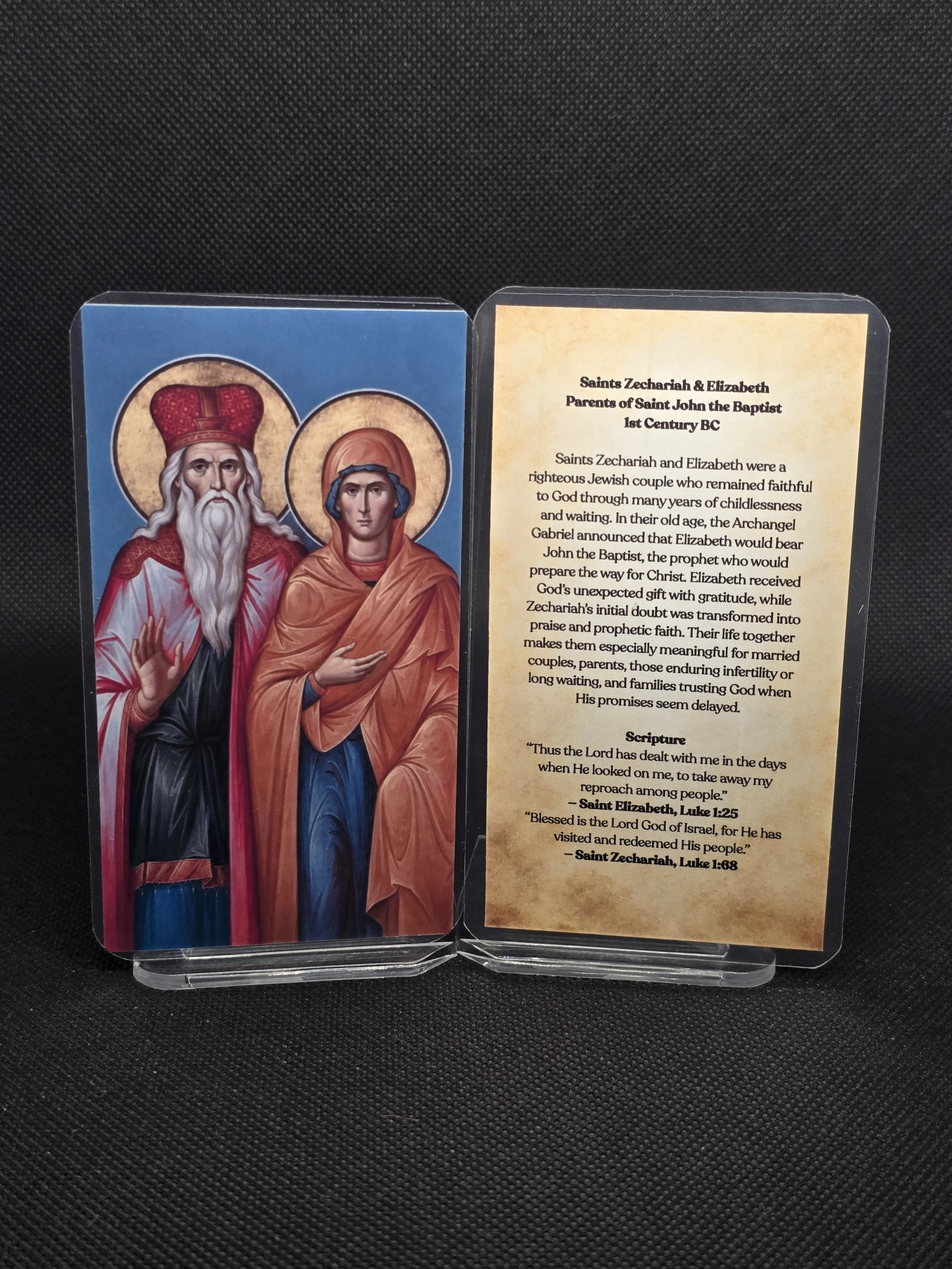
Many couples and parents ask Saints Zechariah and Elizabeth to pray for patience, trust and the gift of children. If you would like a prayer card of Saints Zechariah and Elizabeth, the parents of Saint John the Baptist, you can find one below. Their story reminds us that God hears those who keep faith through long waiting.
View Prayer Card