Venerable Takashi & Midori Nagai: The Complete Story of Nagasaki's Witnesses of Faith
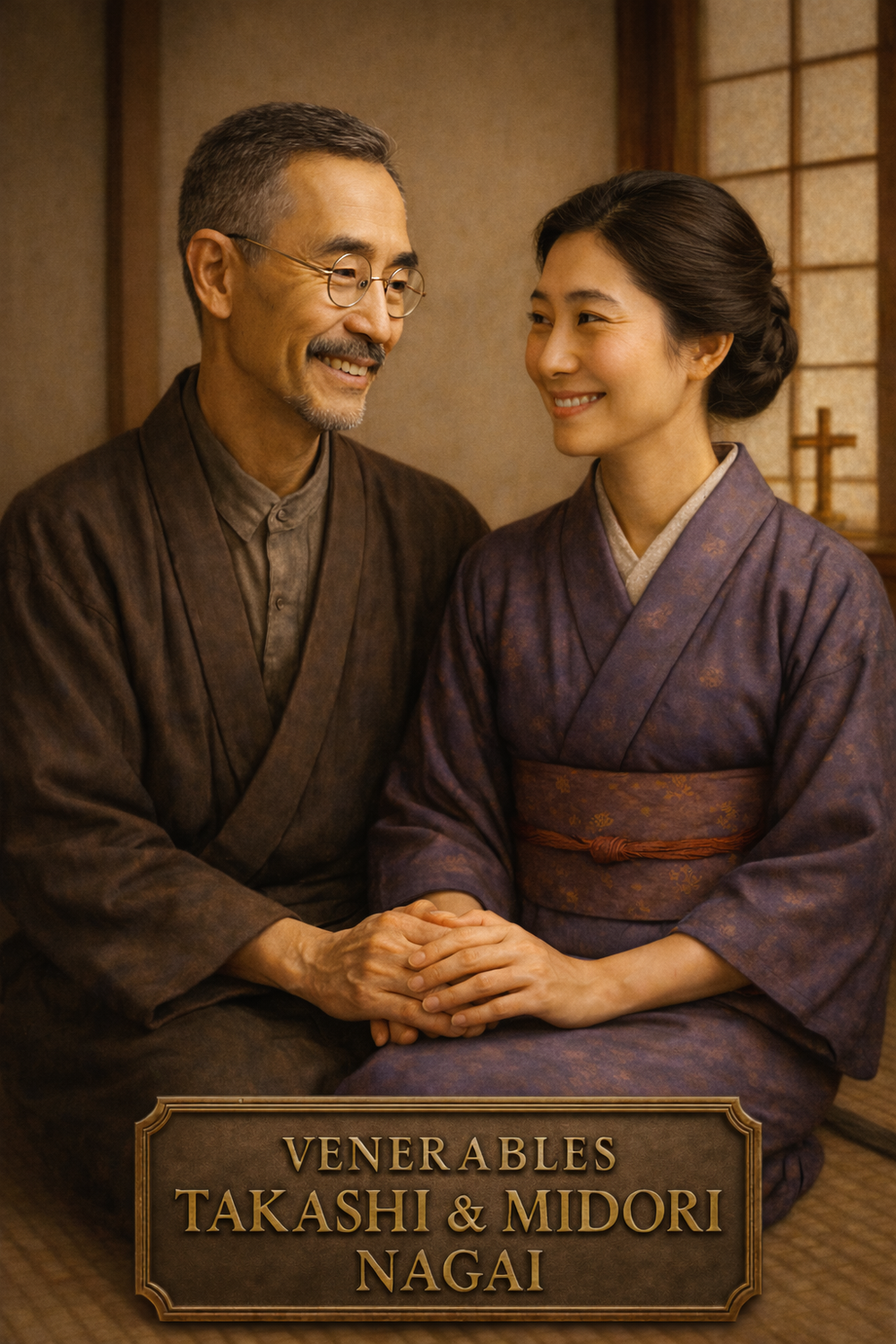
Venerable Takashi & Midori Nagai
The physician, the hidden Christian, and the witness that nuclear fire could not silence
Venerable Takashi & Midori Nagai
Each prayer card is made by hand, one at a time, in Austin, Texas — printed on museum-quality paper, assembled in prayer, with intercessions offered to Takashi and Midori for the person who will receive it.
Get the Prayer Card →Who Were Takashi and Midori Nagai?
There is a small wooden hut in Nagasaki, Japan, that is barely large enough to lie down in. It sits on what was once rubble, in what was once the most Catholic neighborhood in the most Catholic city in Japan. A man spent the last years of his life inside it, dying slowly of cancer, writing books about forgiveness and peace, receiving visitors who came by the hundreds — the Emperor of Japan, Helen Keller, cardinals and diplomats — and praying through the night in a city that had been incinerated by the most powerful weapon humanity had ever built.
That man was Takashi Nagai. His wife Midori had died in the same blast he survived. What remained of her had fit in a bucket.
This is one of the great stories of the twentieth century. It is also one of the least known outside Japan and serious Catholic circles. The reason it matters — for prayer, for history, for anyone trying to understand how faith survives catastrophe — is that it is entirely true, documented in detail, and still unfolding: the Church opened the formal cause for Takashi and Midori's beatification and canonization in 2021.
They are Servants of God. They may become the first canonized Japanese saints of the modern era. And their story begins not with the bomb, but with a family that kept faith alive for seven generations without a priest.
The Hidden Christians of Nagasaki
To understand Takashi and Midori Nagai, you need to understand Urakami — and to understand Urakami, you need to know the history that made it unlike any other neighborhood on earth.
Christianity arrived in Japan with Francis Xavier in 1549 and spread rapidly. By the early seventeenth century, Japan had hundreds of thousands of Christians. Then the Tokugawa shogunate began one of the most severe Christian persecutions in history. The missionaries were expelled or killed. Public practice of Christianity was outlawed under penalty of death. The Nagasaki Martyrs — twenty-six Christians crucified on a hillside above the city in 1597 — were only the beginning. Thousands followed them.
Most of the Japanese Christian community vanished. But in Urakami, a rural district outside Nagasaki, something extraordinary happened. The Christians did not stop being Christian. They went underground.
For more than two centuries — roughly from 1620 to 1865 — the Kakure Kirishitans, or Hidden Christians, preserved the faith without a single priest, without open churches, without any of the external structures of Christianity. They baptized their children in secret. They passed down prayers, catechisms, and the calendar of feasts by memory. They appointed hereditary leaders — families charged with safeguarding the community's faith from one generation to the next.
The Moriyama family was one of those hereditary leaders. For seven generations, they had been guardians of the Kakure Kirishitan community in Urakami. Their daughter, Midori, was the product of that extraordinary lineage.
When Japan reopened to the world in the mid-nineteenth century and Catholic missionaries returned to Nagasaki, the hidden Christians emerged. The Urakami community, discovered by a French missionary in 1865, astonished the Catholic world: thousands of practicing Catholics had survived in secret, their faith recognizably intact after 250 years of isolation. The great Urakami Cathedral — the Immaculate Conception Cathedral — was built by the community over decades, funded not by wealthy donors but by poor farmers and fishermen descended from the Hidden Christians. It became the largest Catholic church in East Asia.
And then, on the morning of August 9, 1945, a single bomb destroyed it in an instant.
Takashi Nagai: From Atheism to the Font
Takashi Nagai was born on February 3, 1908, in Matsue City in Shimane Prefecture, the first son of a family with deep roots in both traditional and Western medicine. His father, Noboru, practiced Western medicine and brought it to rural communities. His paternal grandfather had been a practitioner of traditional herbal medicine. His mother, Tsune, was descended from a family of samurai. The name Takashi means "nobility."
He grew up in the rural village of Mitoya, raised according to Shinto and Confucian teachings. Intellectually gifted and driven, he moved to Matsue at twelve to live with cousins and pursue his studies, and in 1928 he entered Nagasaki Medical College — one of the finest medical institutions in Japan.
By that point, Nagai considered himself an atheist. Western science and the Enlightenment had shaped his worldview thoroughly. Religion, in his estimation, was superstition for people who had not yet discovered reason. He was not hostile to believers — he simply found the whole question uninteresting.
The Death That Cracked Everything Open
In 1930, Nagai's mother died of a brain hemorrhage. He was with her. And in her final moments, something in her gaze — some quality of presence, of going somewhere — stopped him. He could not explain it in the purely materialist terms he had always used to explain everything else. His grandson later described it: "He opened his eyes to the 'essence of the soul'" through her passing.
He did not convert that day. But the certainty of his atheism had developed a crack. He began reading Blaise Pascal — the seventeenth-century French mathematician and physicist who had undergone his own shattering encounter with God and written about it in the Pensées. Pascal's argument that faith is not contrary to reason but demanded by the most honest application of it reached something in Nagai that no argument had reached before.
Still, he was not ready to act. He was a scientist. He would need evidence.
The Moriyama Family and the Midnight Mass
As a medical student, Nagai found lodging with the Moriyama family in Urakami. He knew, in a general way, that they were Catholic. What he had not been prepared for was what Catholic actually looked like in a family that had been keeping that faith alive under the threat of death for seven generations.
The Moriyamas had a quality of life he had not encountered in his scientific education. There was joy in the household that did not depend on circumstances. There was a kind of steadiness — a way of existing in the world that was oriented around something outside the world itself. He found himself observing them the way a scientist observes an unexpected result.
On Christmas Eve, 1932, Moriyama Sadakichi invited him to join the family for midnight Mass at the Urakami Cathedral. Nagai went. He heard the congregation singing. He experienced, for the first time, what it felt like to be in the presence of a community that believed entirely in what it was doing — not performing religion, but living inside it.
He later wrote: "I felt someone close to me that I didn't know yet."
That same night he met Midori Moriyama, the family's daughter. She was a schoolteacher and president of the women's association of the Urakami district — a quiet person, her promoters would later say, of extraordinary strength of faith.
Manchuria, and the Catechism Midori Sent
In January 1933, before his conversion was complete, Nagai was drafted into the Japanese Imperial Army's Medical Corps and sent to Manchuria. He treated the wounded from both sides — Japanese and Chinese — under brutal conditions that further dismantled the tidy certainties of scientific materialism. War does not look the way atheism explains it.
Midori wrote to him. She sent him wool sweaters and gloves she had knitted herself. She also sent him a Catholic catechism.
He read it.
"I will pray for you."
Four words. She kept that promise every day he was gone. When she heard news from the front — the brutalities of the Sino-Japanese theater, the casual destruction of human life — she prayed. When she did not hear news, she prayed. She prayed for his safety and, according to those who knew her, for his conversion. He came home. Whether the prayer was answered in the order she hoped, only God knows.
Nagai returned from Manchuria changed. On a visit to the Urakami Cathedral, a monk told him something he would carry for the rest of his life: "The Gospel is experienced by praying. It cannot be understood with intelligence alone."
The scientist heard that, and finally understood it was not a rejection of intelligence — it was an instruction about its limits.
In 1932, before leaving for Manchuria, an incident had quietly deepened his bond with the Moriyama family. Midori had suffered acute appendicitis. Nagai carried her on his back through the snow to the hospital, where immediate surgery saved her life. He never spoke of this as a turning point — but it is hard to imagine it was nothing.
Baptism and Marriage
On June 12, 1934, Takashi Nagai received baptism in the Catholic Church. For his baptismal name he chose Paul — specifically, after St. Paul Miki, the Nagasaki martyr crucified on the hillside above the city in 1597. The choice was deliberate. He was entering a tradition in Nagasaki that had always had a price.
Two months later, in August 1934, he and Midori Moriyama were married.
He joined the Society of St. Vincent de Paul at his parish and organized teams of physicians to serve remote villages that had no medical care. He advanced steadily at Nagasaki Medical College, becoming an assistant professor and a pioneering researcher in radiology — a field so new, and so hazardous with the equipment of that era, that its practitioners were routinely irradiated in ways they did not fully understand.
He and Midori had four children: Makoto (born 1935), Ikuko (born 1937, died 1939 in an epidemic while Takashi was away at war), Sasano (died shortly after birth), and Kayano (born 1941). Two of their four children died young. When Ikuko died, both Takashi and Midori turned to God for understanding. They had learned, from seven generations of Moriyamas, that faith was not a protection from suffering. It was a way of carrying it.
The Encounter With Maximilian Kolbe
From 1931 to 1936 — while Nagai was still in the process of his conversion — a Polish Franciscan priest named Maximilian Kolbe was living in a suburb of Nagasaki, having established a monastery there as a missionary outpost. Kolbe was publishing Catholic materials in Japanese and building a community of Franciscan brothers. Nagai came to know him through his involvement with the parish St. Vincent de Paul Society.
This is one of the remarkable coincidences of this story. Kolbe would return to Poland in 1936, be arrested by the Gestapo in 1941, and offer his life in exchange for another prisoner at Auschwitz — starved to death in a bunker, singing hymns, in 1941. He was canonized in 1982.
Nagai and Kolbe knew each other in Nagasaki during the years when both were doing ordinary work: Kolbe building a monastery, Nagai building his medical career and his faith. Neither man could have known what the next decade held for either of them.
Their connection did not end with Kolbe's departure. In September 1945, weeks after the bombing, Nagai was near death from radiation sickness. He made a general confession, received Holy Communion, and awaited death. In a semi-conscious state, he heard a voice directing him to pray to Maximilian Kolbe. He did. By October 5, he had recovered miraculously. He immediately returned to analyzing the effects of radiation sickness and helping atomic bomb victims — still dying of leukemia, still irradiated from the blast, but given more time.
Before the Bomb: Leukemia
In June 1945 — two months before the atomic bombing — Nagai was diagnosed with leukemia.
The cause was his work. In the early years of radiology, X-ray equipment provided little or no shielding for the operator. Nagai had conducted radiological examinations by direct observation for years. The cumulative exposure had been causing damage in his blood for a long time before it was detectable. He was given a life expectancy of roughly three years.
He told Midori. She said: "Whether you live or die, it is for God's glory."
He was forty-seven years old — no, thirty-seven. He had two children still living. He already knew he was dying when the bomb fell. The bomb simply changed the shape of how the end would come, and took Midori first.
August 9, 1945: The Day Everything Changed
By August 1945, the war had already arrived in Nagasaki. On April 26, air raids had left numerous victims and overwhelmed the hospital. Nagai had been spending days and nights in his radiology department, serving the wounded. Three days after Hiroshima — on August 9, 1945 — Nagai was at work in the hospital when the second atomic bomb fell.
The Bomb and the Cathedral
The B-29 Bockscar, commanded by Major Charles Sweeney, was carrying "Fat Man" — a plutonium bomb. The primary target that day was the city of Kokura, but cloud cover prevented visual sighting. Orders required visual confirmation. Sweeney turned south to Nagasaki.
Nagasaki too was obscured. But at the last moment, a break opened in the clouds. Bombardier Kermit Beahan adjusted the sight and released the bomb. It detonated at 11:02 AM — not over the shipyards or arsenals the military had intended, but over the Urakami valley: the most Catholic district of the most Catholic city in Japan.
The bomb detonated approximately one-third of a mile from the Urakami Cathedral. At that moment, the largest Catholic church in East Asia — built over decades by the descendants of the Hidden Christians, with bells and spires visible from across the valley — was consumed by fire and blast. Of the 12,000 parishioners of Urakami Cathedral, approximately 8,000 to 8,500 were killed instantly or in the hours that followed. Across Nagasaki, between 40,000 and 75,000 people died in the bombing and its immediate aftermath.
Takashi Nagai was at the hospital, approximately two kilometers from the hypocenter. He was badly wounded — a shrapnel fragment struck him near the right temporal artery. He lost significant blood. But he survived.
In the Ruins
Nagai worked for two days. He treated survivors who flooded the hospital — or what remained of it. He was bleeding, irradiated beyond his already significant leukemia, and operating in conditions that defied description. He organized what medical response was possible. When the army doctors arrived to take over, he was at last able to think about his family.
His children and mother-in-law were safe — he had sent Makoto and Kayano to the countryside in the mountains following the Hiroshima bombing three days earlier. But Midori had stayed home.
He made his way through what had been Urakami. Everything was ash. The cathedral was rubble. The neighborhood where seven generations of Moriyamas had kept the faith — houses, gardens, streets — was simply gone. He found the location of his house by the broken roof tiles and white ash. And there, in what had been the kitchen she loved, was what remained of Midori.
In her right hand — or what had been her right hand — melted into a single mass of metal but still identifiable by its chain and cross, was her rosary.
He bowed his head and prayed: "Dearest God, thank you for allowing her to die praying. Mother of Sorrows, thank you for being with faithful Midori at the hour of her death."
The Response: Forgiveness in the Ashes
What happened next is the center of this story.
Nagai was a physician dying of leukemia, now additionally irradiated by the most powerful weapon ever used against a human population. He had lost his wife. His city was a graveyard. Eight thousand of the Catholics who had kept the faith alive through two centuries of persecution were dead in a single morning.
He did not collapse inward. He did not surrender to rage. He returned to work.
For the rest of 1945, he cared for survivors, organized medical response, and began writing one of the first scientific analyses of radiation sickness and its effects on the human body — a document of extraordinary medical value compiled under conditions of extraordinary personal suffering.
He also did something perhaps more remarkable: he went looking for the cathedral bell.
With a small group of men, he searched the ruins of Urakami Cathedral until they found one of the two great bronze bells that had called the community to prayer. It was intact. They recovered it. By Christmas 1945, the bell of Urakami was ringing again over the rubble of the neighborhood it had served — a sound that told the survivors that something persisted, that the call to prayer was not buried under the ash.
The Funeral Oration: November 23, 1945
On November 23, 1945, a requiem Mass was celebrated in the open air before the ruins of Urakami Cathedral, for the eight thousand Catholics who had died in the bombing. Nagai was asked to speak.
What he said that day was controversial then and has been debated by scholars ever since. He argued — as a physician, as a survivor, as a man who had just gathered his wife's bones from a kitchen — that the destruction of Urakami was not a punishment and not merely a catastrophe. It was, he proposed, a sacrifice: the offering of the most ancient Christian community in Japan, the community that had survived 250 years of underground faith, as a holocaust that helped bring the war to an end and open the door to peace for the world.
Some in the crowd shouted objections. They had lost everything. The theology of sacrifice was not comfort — it was an impossible demand.
Nagai understood that. He was not asking anyone to be grateful for the bomb. He was asking whether it was possible to believe that God had not abandoned Urakami — that the death of eight thousand Catholics who had kept faith alive through two centuries of persecution meant something in the economy of God's providence.
"When the world was standing at the crossroads of fate — either bring a new peace to the world, or plunge humanity deeper into a wretched war — that is, at 11:02 AM, a single atomic bomb exploded in the heart of our Urakami, and in an instant it summoned eight thousand believers to the hands of the Lord God."
He concluded his written oration: "From the atomic wasteland of Nagasaki, we pray to God: Grant that Urakami may be the last atomic wilderness in the history of the world."
Nyokodo: The Hermitage in the Ruins
On October 15, 1945, Nagai returned to live in Urakami. He built a small hut from pieces of his old house, roughly six tatami mats in area. He lived there with his surviving children Makoto and Kayano, his mother-in-law, and two other relatives.
By 1947, his condition had deteriorated to the point where he could no longer teach. That year, the local Society of St. Vincent de Paul organized the parish and the Catholic Carpenters Association to build him a proper structure. It was two tatami mats — approximately four square meters. Barely large enough to lie in. Built by grateful hands on the site where Midori had been born and where she had died.
Nagai named it Nyokodo: 如己堂. The characters mean "As-Yourself Hall." He took the name from Christ's commandment: Love your neighbor as yourself.
He styled it as a hermitage. From his bed in this four-square-meter room, for the remaining years of his life, he wrote books, produced drawings, composed thousands of calligraphy cards bearing the Japanese words for Peace forever, and received visitors. Among those who came to Nyokodo: the Emperor of Japan, Cardinal Gilroy of Sydney, and Helen Keller.
Hundreds of ordinary people came every day. He had become, in the rubble of the most catastrophic thing that had happened to any community in human history, a source of something people needed and could not find anywhere else.
He planted cherry trees to raise the community's morale. He founded a library for children born into the wasteland. He wrote extensively about suffering, forgiveness, and the meaning of what had happened — not as abstract theology, but as a man living in the middle of it, dying of the disease that had begun before the bomb and would finish him regardless.
The Writings of Takashi Nagai
From Nyokodo, bedridden and dying, Nagai produced a body of work that is remarkable not only for its quality but for the conditions under which it was written. A man in a four-square-meter hut, unable to stand, lit by what light the structure allowed, was writing books that would sell across Japan and eventually reach the world.
The Bells of Nagasaki (長崎の鐘)
Completed in 1946. His most famous work — a meditation on the atomic bombing, faith, and meaning. It became a bestselling book and was adapted into a film and a beloved Japanese song. For years, the Nagasaki train station played an instrumental version of the song as passengers arrived.
Children of Nagasaki
A deeply personal account focused on the children left orphaned or devastated by the bombing, and on the question of how to raise the next generation in the shadow of what happened.
Atomic Bomb Rescue and Relief Report
One of the first scientific accounts of the medical effects of nuclear weapons. Written as a physician's clinical record, it documented radiation sickness and its progression in survivors — a document of lasting medical and historical value.
That Which Never Dies
An essay on eternal life and the nature of what survives catastrophe. Available in several European languages; an English translation is in preparation. Its title became the core message of the international movement promoting Nagai's sainthood cause.
Essays, Poems & Memoirs
A large body of shorter writing on God, war, death, medicine, orphanhood, marriage, prayer, and peace — produced in the years between 1946 and 1951.
Calligraphy Cards
Thousands of cards bearing the characters for "Peace forever," written in classical Japanese brush calligraphy and sent throughout Japan and the world — a physical prayer offered by a dying man to everyone who received one.
Midori Nagai: The Hidden Witness
Midori Moriyama Nagai has been, in most retellings of this story, the background figure. She appears as the woman who brought Takashi to faith, who waited while he was at war, who died while he survived. This is a partial reading that does not honor who she was.
Midori was the product of seven generations of hidden Christian leadership. Her family had kept the faith alive — secretly, at enormous risk, without priests or open churches — for two centuries before she was born. That is not merely heritage. It is formation. The kind of faith that survives two hundred years of underground existence produces a person shaped by something most modern Christians have not been asked to carry.
She was, by all accounts, quiet. Gabriele Di Comite, who leads the international association promoting their sainthood cause, describes her: "Midori was a very discreet and silent person, although very strong in faith. She accompanied him through every stage of his life, showing him that life is God's calling, that God calls us to Himself."
She was a schoolteacher and the president of the women's association of the Urakami district. She was not a public figure in the way Takashi became. Her holiness was interior and relational — expressed through fidelity, through prayer, through the knitting of sweaters for a soldier she loved and the sending of a catechism to a man she was quietly praying toward God.
When Takashi told her about his leukemia diagnosis in June 1945, she said: "Whether you live or die, it is for God's glory." This is not a phrase that emerges from conventional piety. It is the response of a woman who has genuinely believed for her entire life that all of life — including its worst moments — is held in the hands of a God who can be trusted.
She died at 11:02 AM on August 9, 1945, in the kitchen of her home. She had been praying. When Takashi found her, she still held her rosary.
The Nyokodo — Takashi's hermitage, the place where he lived out the last years of his life in prayer — was built on the site where Midori was born and where she died. He wrote his books about faith and forgiveness from a hut that stood on the ground where the love of his life had kept the faith of her ancestors and ended her earthly life in prayer. That is not coincidence. That is a man who understood what he was doing and why.
Their Marriage Was Their Path to God
Takashi and Midori did not live holy lives in spite of their marriage — they lived them through it. Their love was the school in which both of them were formed. If you are married and seeking to understand how marriage becomes a way of worship, these books are offered completely free to read online.
Free Marriage Resources →The Death of Takashi Nagai
By 1951, Nagai's body had long since been exhausted by leukemia, radiation, and the wound from August 9, 1945. He was forty-three years old and had been dying for six years by multiple causes simultaneously. His time was nearly over.
On May 1, 1951, he asked to be transported from Nyokodo to the college hospital in Nagasaki. Not for treatment — there was nothing left to treat. He wanted the medical students to be able to observe the final hours of a man preparing to die in faith. He wanted his death to be, as his entire bedridden life had been, a teaching.
He prolonged his hospitalization through the afternoon, waiting for a statue of Our Lady — a gift from the Italian Catholic Medical Association — to arrive. He wanted her present. When she was in the room, his condition seemed stable. He received visitors. He prayed.
Around 9:40 PM, he complained of dizziness and lost consciousness. After medical interventions, he revived briefly. He prayed: "Jesus, Mary, Joseph — into your hands, I entrust my soul."
He took the cross from the hands of his son Makoto, who had rushed to the hospital.
His last words were: "Please pray!"
In Japanese: 祈ってください.
He died that evening. He was forty-three years old. His feast day is May 1.
Legacy and the Cause for Sainthood
The Nyokodo Today
The Nyokodo still stands in Urakami. It was preserved after Nagai's death and became the Nagasaki City Nagai Takashi Memorial Museum in 1952, after the addition of a small library. Today it is managed by Tokusaburo Nagai — Takashi's grandson and the son of Makoto — who continues his grandfather's mission of keeping the story alive. The museum receives approximately 120,000 visitors each year, 70% of them students.
A second museum, the Dr. Takashi Nagai Memorial Museum in Unnan City in Shimane Prefecture, stands near the place where he grew up.
Takashi Nagai's name has been added to the Monument to the X-ray and Radium Martyrs of All Nations in Hamburg, Germany — a memorial to the scientists who gave their lives to radiation research before adequate protections existed.
In 1991, the Takashi Nagai Peace Award was established in Nagasaki, given annually to individuals and organizations contributing to world peace through improvements in human welfare.
The Canonization Cause
On March 23, 2021, an international association called Amici di Takashi e Midori Nagai (Friends of Takashi and Midori Nagai) was formally established in Rome, with the purpose of promoting the testimony of this married couple and their cause for beatification and canonization.
In October 2021, the Archbishop of Nagasaki, Most Reverend Joseph Mitsuaki Takami, officially accepted and approved the request to open the two causes of beatification and canonization for both Takashi Nagai and Midori Nagai — jointly and severally. With this, they formally received the title Servants of God — the first official step in the Catholic canonization process.
The cause is now in its investigative phase. The association in Rome is working with the Church of Japan to gather testimonies and documentation. Nagai's grandson, when asked about the family's view of the process, said: "We only obey God's will."
A cause for beatification and canonization begins with the title Servant of God. After formal investigation, if evidence of heroic virtue is confirmed, the title advances to Venerable. A verified miracle attributed to their intercession then allows beatification (Blessed). A second verified miracle leads to canonization (Saint).
Takashi and Midori Nagai are officially Servants of God. Many who have followed this cause believe they are already Venerable in all but the formal declaration, and that their canonization is a matter of when rather than whether. Nagai has been called the Saint of Urakami since the early 1950s — the Church is in the process of catching up to what the people already knew.
Connections to St. Maximilian Kolbe and the Hidden Christians
The threads connecting Nagai's story to the broader tapestry of Catholic history are worth noting. He knew Maximilian Kolbe personally — a saint who gave his life at Auschwitz. He was received into the faith by the descendants of the Kakure Kirishitans — communities whose story was told to the world by Martin Scorsese's 2016 film Silence. He chose as his baptismal name Paul Miki — a Nagasaki martyr of 1597. His life stands at the intersection of several of the most extraordinary chapters in the history of Japanese Christianity.
Timeline of Their Lives
Patronage and How to Pray to Them
For Whom They Intercede
Takashi and Midori Nagai are sought by those who have experienced the kind of loss and suffering that cannot be explained away — the loss that rewrites the story of a life without asking permission. They are not generic intercessors. They are witnesses who have been exactly where the person praying is standing.
A Prayer to Venerable Takashi and Midori Nagai
Venerable Takashi and Midori Nagai, witnesses of peace forged in devastation, pray for us.
Intercede for the suffering. Heal the wounded heart. Lead us through the darkness that follows great loss into the mercy of Christ, who does not abandon those He loves even when everything else has been taken away.
Amen.
Venerable Takashi and Midori, faithful spouses who endured unimaginable loss, pray for me.
You walked through ashes and chose forgiveness. You faced death and chose service. You buried your beloved and chose peace. You lived in a hut in a wasteland and said: I am happy.
I bring you what I am carrying today. [Name your need here, in your own words.]
If grief feels like it will swallow me, steady my heart. If illness has entered my life or the life of someone I love, give courage. If anger rises from injustice or loss that makes no sense, teach me the forgiveness you found in the ruins of Urakami.
Help me rebuild when everything feels broken. Help me trust God when I cannot see where this is going. Help me love when fear is louder than faith.
Takashi — you wrote from your deathbed that the first thought you had every morning was that you were happy. Teach me what you knew. Midori — you died praying, holding your rosary in a kitchen. Intercede for me, that I may die as well as you lived.
By your intercession, may Christ restore what has been lost, strengthen what remains, and lead me — as He led you — all the way home.
Amen.
Venerable Takashi & Midori Nagai Prayer Card
Each card is made by hand in Austin, Texas — printed on museum-quality paper, assembled in prayer, with intercessions offered to Takashi and Midori for the person who will receive it. Every card is created to order, never kept in stock, because every person who needs it deserves to be prayed over specifically.
Get the Prayer Card →Frequently Asked Questions
Venerable Takashi and Midori Nagai — the physician who prayed through the atomic wilderness and the hidden Christian who died with her rosary in her hand — pray for us.