Saint Agathon of Kavsokalyvia: The Complete Biography of Mount Athos's Hidden Hesychast
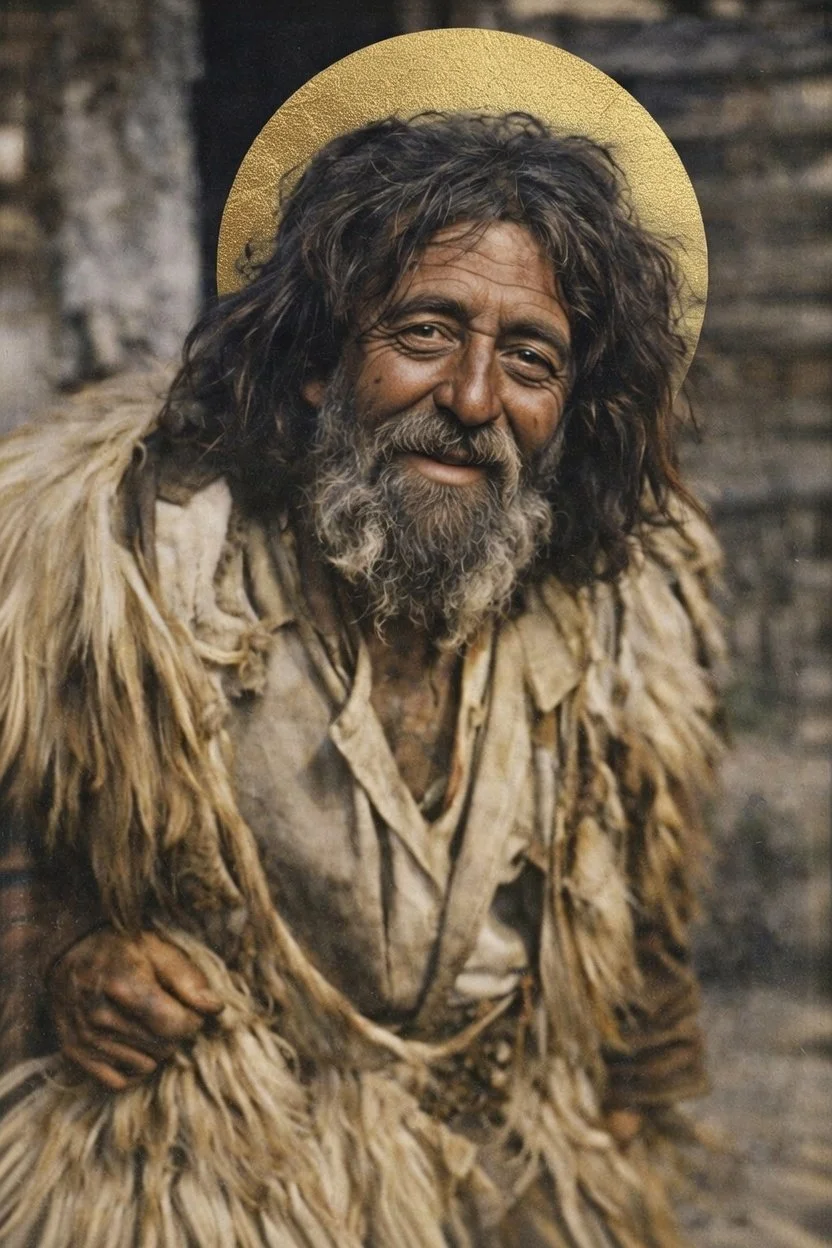
Saint Agathon of Kavsokalyvia
One of the Seven Righteous Saints of Kavsokalyvia — the hidden ascetic whose silence became intercession
Saint Agathon of Kavsokalyvia
Each prayer card is made by hand in Austin, Texas — printed on museum-quality paper, assembled in prayer, with intercessions offered to Saint Agathon for the person who will receive it. Created to order, never kept in stock.
Get the Prayer Card →The Place That Made Him
At the very southern tip of the Mount Athos peninsula, where the cliffs drop sharply to the Aegean and the path from the Great Lavra narrows to little more than a goat track, there is a settlement that has no parallel on earth. It clings to the rock face one hundred meters above the sea. The cells are scattered, their monks rarely visible. The whole area has a quality of absolute finality to it — you cannot go further without falling into the water. You have reached the edge of the world.
This is Kavsokalyvia. Its name means "burned huts." And the man for whom it is named burned his hut every time he moved, so that no attachment to any earthly shelter could take root in his heart.
This is the place where Saint Agathon chose to live his life before God. This is where he prayed, where he suffered, where he received visitors with brief words that changed them, and where he died. To understand him, you must first understand this place — because Kavsokalyvia does not merely house its saints. It forms them.
The History of Kavsokalyvia: A Desert at the Edge of the Sea
The story of Kavsokalyvia begins with one of the most unusual saints in the history of Christian monasticism: Maximos Kavsokalyvites, whose feast falls on January 13 and who died around 1365.
Maximos was born around 1272 in Lampsacus on the Hellespont. From his youth he felt a consuming love for the Mother of God, and he persistently asked her for one gift above all others: the grace of unceasing mental prayer. His prayer was answered in Constantinople, at the Church of the Theotokos at Blachernae, where he venerated an icon and felt, as he later described it, a warmth and flame enter his heart that did not burn but filled him with sweetness and compunction. From that moment, the Jesus Prayer began to repeat itself in his heart continuously, no longer requiring the effort of his will.
He came to Mount Athos and entered the Great Lavra. But in order to hide his extraordinary spiritual gifts and avoid the fame that would come if people understood what he was, he adopted the guise of a holy fool — behaving strangely, wandering, appearing unhinged. This was deliberate and ancient: the tradition of foolishness for Christ as a protection against spiritual pride.
When he moved from one location to another, he burned his shelter down. Every time. He would construct a crude hut from branches, inhabit it, and then set fire to it when it was time to leave. The act was theological: nothing would attach him to any particular place, any particular comfort, any earthly possession. Each burning was a small death to self-will.
When Saint Gregory of Sinai arrived on Athos and encountered this apparent lunatic, he recognized immediately what he was actually seeing. Gregory called Maximos "an earthly angel" and persuaded him to stop the holy fool behavior so that others could benefit from his spiritual experience. Maximos settled in the area at the foot of Athos that would bear the name of his habit: Kavsokalyvia. He lived there for decades, receiving visitors including Byzantine emperors and the Patriarch Kallistos. He died around 1365, having shaped a place that would shelter holy men for centuries after him.
The Holy Trinity Skete
The settlement Maximos established gradually organized itself into a skete — a type of monastic community that falls between a hermitage and a full monastery. The Holy Trinity Skete of Kavsokalyvia is an idiorrhythmic skete, meaning each monk or small group of monks lives in their own cell according to their own rhythm, gathering in the common church for the Sunday Liturgy and major feasts but otherwise maintaining independent lives of prayer and labor.
The skete has forty cells, not all occupied at any given time. It sits one hundred meters above the Aegean on the cliffs of the southern Athos peninsula, a dependency of the Great Lavra. Its main church — the Kyriakon, dedicated to the Holy Trinity — was built in 1745 and adorned with frescoes at the end of the eighteenth century. The skete houses a library of manuscript books and centuries of accumulated icons, vestments, and relics.
What defines Kavsokalyvia is not its architecture but its spiritual atmosphere. This is a place where the extreme physical conditions — the cliff edge, the isolation, the exposure to weather, the distance from supplies, the sheer difficulty of getting there — have always served to filter its inhabitants. The men who settled here were not seeking comfort. They were seeking God with an intensity that accepted any cost.
Mount Athos has always sheltered two kinds of holy men: those who became known — whose teachings were written down, whose spiritual fatherhood shaped communities and traditions — and those who did not. The unknown ascetics of Athos are its deepest saints. Elder Paisios of Mount Athos wrote of encountering one of these invisible men when he first arrived on the Holy Mountain in 1950: an anchorite of extraordinary luminosity who appeared on a cliffside, gave him directions, and disappeared. Paisios was told by experienced elders that this was one of the righteous anchorites who live invisibly at the peak of Athos.
Saint Agathon belongs to this tradition of hidden holiness. His obscurity is not an accident of history. It is the shape of his sanctity.
The Life of Saint Agathon
The historical record of Saint Agathon of Kavsokalyvia is sparse, and the article before you will not pretend otherwise — because to pretend otherwise would be to do him a disservice. He was a hidden ascetic. He did not seek documentation. He was not a writer, a preacher, or a public figure. What was preserved about him was preserved by those who encountered him and carried the memory of that encounter.
What we know is this: he lived at Kavsokalyvia. He embraced the fullness of the hesychast tradition — guarding the heart, practicing the Jesus Prayer, fasting, vigil, silence, and radical simplicity. He received visitors who came seeking counsel. He bore prolonged illness in his final years with thanksgiving rather than complaint. He died, and after his death, healings and deliverances were reported through his intercession — particularly for those suffering spiritually or physically.
He is commemorated among the Seven Righteous Saints of Kavsokalyvia, a group of Athonite ascetics who are venerated together on the First Sunday of October as a spiritual family — souls formed by the same place, the same tradition, the same burning love for God.
His feast day is January 8 in the Old (Julian) Calendar, corresponding to January 21 in the New (Gregorian) Calendar.
Called to the Desert at the Edge of the Sea
In the tradition of Eastern Christian monasticism, a man does not choose his cell so much as it chooses him. The Desert Fathers taught that a monk who changed his location frequently was like a tree transplanted too often — it never took root deep enough to bear fruit. But the movement from one monastery to another, from one skete to one hermitage, was also understood as the work of the Holy Spirit drawing a soul toward its proper place of formation.
For Agathon, that proper place was Kavsokalyvia. In this he was not unusual. Something about this particular cliff edge on the southernmost point of Athos has drawn certain kinds of souls for centuries — men who wanted not simply to pray, but to disappear into prayer. Men for whom the Jesus Prayer was not a practice they did, but the air they breathed.
His cell was simple. Its contents were almost nothing. Food was sparse. Clothing wore thin and stayed thin. He labored with his hands — the ancient monastic practice of manual labor as a discipline against idleness and a source of modest provision — and he spent the rest of his hours in prayer.
The Hesychast Life: What It Actually Meant
To say that Agathon was a hesychast is to say something specific. In the popular imagination, hesychasm sometimes gets reduced to a prayer technique — a method of breathing, a visualization practice, a physiological discipline. This is a misreading.
Hesychasm is a way of living before God. Hesychia — the Greek word from which it comes, meaning stillness or quiet — refers not to the silence of the environment but to the interior silence of a heart that has been gradually freed from the noise of the passions. The hesychast is not a person who sits in a quiet room. The hesychast is a person whose heart has been quieted by long years of prayer, repentance, and the grace of God, so that what the tradition calls noetic prayer — prayer of the intellect and heart united — becomes continuous.
The instrument is the Jesus Prayer: Lord Jesus Christ, Son of God, have mercy on me, a sinner. In the beginning this prayer is said deliberately, consciously, with effort. With time and grace, it descends from the verbal level to the mental level, and from the mental level into the heart. The fathers speak of the Jesus Prayer becoming, in an advanced practitioner, truly unceasing — continuing through work, through sleep, through all the movements of daily life.
This is what Agathon pursued. Night after night standing in prayer. Long fasting. Radical silence. The deliberate choice, day after day, to give to God whatever his body and his time and his energy had to give.
The Authority That Comes From Hiddenness
Something happens to a person who has lived long in genuine prayer. It is not glamorous. It does not look the way that movies about mysticism look. But those who have encountered it describe something consistent: a quality of presence, of seeing, of knowing that does not come from intelligence or education or experience alone.
Other monks noticed this in Agathon. Though outwardly simple — his appearance unremarkable, his speech minimal — he carried what the Eastern tradition calls diakrisis: the gift of discernment. Visitors who came to his cell seeking counsel often left with a peace that they could not explain and had not expected. Those suffering from spiritual confusion felt clarity return after speaking with him. People described the sense that he had understood their struggle before they articulated it — not through any information they had given him, but through prayer.
He never claimed gifts. He only prayed. The tradition has always recognized that the man who does not claim spiritual gifts is more likely to have them than the man who does. The fathers of the desert used this as a test: let the proud man speak confidently of his visions, and let the humble man say nothing of what God shows him. Which of the two should you trust?
Illness as Asceticism
Late in his life, Saint Agathon endured prolonged physical illness. His body failed. By the account that has been preserved, he bore this without complaint — more than without complaint. He bore it with thanksgiving.
This is not a romantic idea. It is a specific theological conviction that the Eastern tradition has always maintained: suffering accepted with patience and offered to God is not wasted. It is the most direct form of participation in the suffering of Christ available to a human being. The monk who has labored for decades to die to himself through fasting and vigil and silence and poverty finds, in illness, the final stripping away of what he could not strip away himself. God does the last part of the work.
Agathon continued to receive visitors even while frail. He offered brief words of encouragement. He prayed quietly over the sick who came to him. Those who witnessed his final years described his cell as filled with an unusual peace — the peace, the tradition says, that passes understanding.
He died gently, having poured out his strength in hidden intercession for others.
The Name Agathon and Its Spiritual Lineage
The name Agathon comes from the Greek agathos, meaning good. It is an ancient name in the Christian monastic tradition, carried by one of the great Desert Fathers of Egypt — Abba Agathon of Scetis — whose sayings are preserved in the Apophthegmata Patrum, the Sayings of the Desert Fathers. These two saints are distinct: Abba Agathon of Egypt lived in the fourth to fifth century and is commemorated on March 2; Saint Agathon of Kavsokalyvia is the Athonite hesychast commemorated on January 8/21. But they stand in the same tradition, and the sayings of the earlier Agathon illuminate the spiritual world that formed the later one.
Abba Agathon of Egypt is one of the most striking figures in the Apophthegmata. He was known above all for three things: his extraordinary meekness, his gift of discernment, and his love. The monks of the desert tested him by accusing him of being a fornicator, a proud man, a gossip. He accepted each accusation humbly, saying "yes, it is very true." But when they accused him of being a heretic, he protested immediately — because heresy separates a man from God, and that he could not accept. The monks were astonished by his discernment and left edified.
It was said of Abba Agathon that for three years he lived with a stone in his mouth, until he had learned to keep silence.
A brother asked him: "Which is better — bodily asceticism or interior vigilance?" The old man replied: "Man is like a tree, bodily asceticism is the foliage, interior vigilance the fruit. According to that which is written, 'Every tree that bringeth not forth good fruit shall be cut down,' it is clear that all our care should be directed towards the fruit, that is to say, guarding of the spirit."
The brethren asked him: "Amongst all good works, which is the virtue which requires the greatest effort?" He answered: "I think there is no labour greater than that of prayer to God. For every time a man wants to pray, his enemies, the demons, want to prevent him, for they know that it is only by turning him from prayer that they can hinder his journey. Whatever good work a man undertakes, if he perseveres in it, he will attain rest. But prayer is warfare to the last breath."
Having reached perfect love, Abba Agathon said: "I wish I could find a leper to give him my body and take his." This was not a statement. It was a measure of how far love had grown in him — far enough to want to take another person's suffering into himself entirely.
These are the sayings of the Egyptian Agathon. But they describe the world into which the Athonite Agathon was baptized by his very name — a world where silence is learned over years, where discernment is the fruit of prayer, and where the measure of growth in God is not peace for oneself but the willingness to bear suffering for others.
The hesychast tradition of Kavsokalyvia was itself an heir of the Egyptian desert. The Desert Fathers did not stay in Egypt. Their wisdom traveled: through the Philokalia, through the writings of Gregory Palamas, through the living transmission of monk to monk across centuries. Maximos Kavsokalyvites learned from Gregory of Sinai, who had learned from the Sinaitic tradition, which traced its roots to the same desert that produced Abba Agathon. The tradition is one unbroken river.
The Seven Righteous Saints of Kavsokalyvia
Saint Agathon did not live in isolation from a tradition. He lived in the middle of one. Kavsokalyvia has produced an extraordinary concentration of sanctity across the centuries, and Agathon is commemorated together with its other saints in the annual Synaxis on the First Sunday of October. To understand him is to understand the company he keeps.
The Hut-Burner
The Younger
These saints span six centuries of the same skete. What they share is not a common spiritual program — each lived differently, some in complete solitude, others in active ministry — but a common root in the hesychast tradition of Maximos, a common love for the Jesus Prayer, and a common conviction that the most important thing a human being can do is stand before God and let Him do His work.
Agathon is among the quietest of this company. He left no disciples of record, no writings, no dramatic story of martyrdom or wonder-working known to wider Christendom. What he left was the intercession that continues after death — the hidden work that saints do when their earthly life is finished.
Why His Obscurity Is Part of His Message
There is a temptation, when researching a saint whose historical documentation is thin, to be apologetic about it. To say: we wish we knew more. To promise that what little exists will be supplemented by inference and spiritual imagination.
But Saint Agathon of Kavsokalyvia does not need that apology. His obscurity is not a deficiency in the historical record. It is the most accurate picture of his life that could be preserved.
He was a hidden monk. He chose not to be known. He lived on the cliff edge of the world precisely because there were fewer people there to know him. He spoke little, wrote nothing, claimed nothing. The prayer that sustained his life was interior — the prayer that no one sees, that no one hears, that exists only between the soul and God.
The tradition of the Desert Fathers was clear on this point: the holiest man in the desert is not the one whose sayings are most widely quoted. It is the one who has been most completely forgotten by the world. The deeper a soul goes into God, the less it needs to be known by anyone else.
On the scarcity of sources: Saint Agathon's biography is preserved in the living memory of the Kavsokalyvia Skete and in the Orthodox menologion, rather than in extensive hagiographic literature. This is characteristic of many Athonite saints. The Holy Mountain has sheltered men whose entire lives were offered in silence, and the documentation reflects the life. What is preserved — the feast day, the patronage, the accounts of healings and deliverances — is what the Church needed to preserve. The rest is between him and God, where it belongs.
When Saint Akakios of Kavsokalyvia had a vision of Saint Maximos censing the church with forty righteous ones following him, he asked who they were. Maximos answered: those saved from the area of Kavsokalyvia. Forty. Their individual names were not all given. Their individual stories were not all recorded. They were simply those who had lived and prayed and died in this place, and been received by God.
Saint Agathon is among them.
Patronage: For Whom He Intercedes
The pattern of a saint's intercession reflects the pattern of their life. Agathon's life was one of bearing — bearing illness, bearing solitude, bearing the suffering that others brought to his cell, bearing it all through prayer. Those who seek him today bring him what he spent his life with.
The accounts of those who have sought his intercession describe a quality consistent with his life: the healing is quiet, personal, and deeply interior. He does not bring spectacle. He brings stillness. People speak of the lifting of a weight that had lasted for years — not a sudden dramatic reversal, but a settling, a peace, a sense that they are no longer carrying what they were carrying alone.
This is the fruit of a life spent in hesychia: not the power to command, but the capacity to bring another soul into the stillness where God is.
The Monastery of the Home
Saint Agathon lived his ascetic life in a cell at the edge of the world. Most of us live ours in a home, in a marriage, in the middle of ordinary life. The path to holiness runs through whatever God has given us. If you are married and seeking to understand how that life becomes a school of prayer, these books are completely free to read online.
Free Marriage Resources →Hesychasm at Kavsokalyvia: The Tradition That Formed Him
To understand what Saint Agathon was practicing, it helps to understand the spiritual tradition of the place he inhabited.
The hesychast controversy of the fourteenth century — the debate between Gregory Palamas and Barlaam of Calabria over whether the uncreated divine light experienced by the hesychast monks was real — was not an abstract theological dispute. It was a fight about whether human beings can genuinely encounter God in prayer, or whether God remains forever inaccessible behind a veil of His own unknowability.
Maximos Kavsokalyvites himself was involved in this controversy. He firmly aligned himself with Palamas, rebuking those who supported Barlaam. His own experience of the Mother of God appearing to him in "unendurable and never-setting divine light" was exactly the kind of experience at issue. The tradition of Kavsokalyvia was thus born in the very crucible of the hesychast controversy — not as a spectator, but as a participant and witness.
What Palamas established theologically, and what Maximos embodied experientially, was this: the soul that is purified through asceticism and sustained by the Jesus Prayer can genuinely receive the uncreated light of God — not a created symbol of divinity, but the actual energies of God Himself. This is what the Eastern tradition calls theosis: deification. Not the soul becoming divine by nature, but the soul genuinely participating in the divine life, genuinely transformed by its contact with God.
This is the goal toward which every saint of Kavsokalyvia was moving. This is what Agathon was pursuing in his cell on the cliff edge, night after night, in prayer that nobody saw.
The Jesus Prayer — Lord Jesus Christ, Son of God, have mercy on me, a sinner — is not a mantra. It is not a technique. It is an address: a specific person speaking to a specific Person, naming exactly what exists between them. The one praying is a sinner. The One addressed is the Lord. The request — mercy — is the only thing a sinner can honestly ask for, and it is also the one thing God has shown He is most willing to give.
Over years of practice, the prayer changes the one who prays it. The words begin to carry weight they did not carry at first. The name of Jesus — the actual name, not an idea — becomes charged with the presence of the One it names. The monk who has prayed this prayer for decades finds that it has reorganized his interior life around a center that is not himself.
This is what Agathon was doing in his cell. This is why his visitors felt what they felt.
How to Pray to Saint Agathon of Kavsokalyvia
O blessed Agathon, lover of silence and hidden struggler of Mount Athos, thou didst offer thy life as prayer before God.
Intercede for us, that we may receive healing, deliverance, and peace of soul through Christ our God.
Holy Saint Agathon of Kavsokalyvia, hidden servant of Christ and quiet healer of souls, pray for me.
You lived at the edge of the world in a cell barely large enough to stand in, and you found it more than enough because God was in it. I bring you the weight I am carrying today: my illness, my anxiety, my spiritual battles, the darkness that does not seem to lift. [Name your need here, in your own words.]
You bore prolonged suffering with thanksgiving. You received visitors while your own body was failing. You prayed for the sick and the oppressed and the despairing, not from some position of comfort, but from your own experience of what it costs to endure.
Intercede for my illness. Intercede for the darkness that presses on my heart. Deliver me from whatever spiritual oppression has found a foothold in my life. Restore the silence — that interior silence that you inhabited so completely — to a soul that has lost it in the noise of its suffering.
By thy prayers, may I be strengthened in body and soul, and led back to the only prayer that matters: Lord Jesus Christ, Son of God, have mercy on me, a sinner.
Amen.
Saint Agathon of Kavsokalyvia Prayer Card
Each card is made by hand in Austin, Texas — assembled in prayer with intercessions offered to Saint Agathon specifically for the person who will receive it. Not manufactured. Not mass produced. Created one at a time, because every person who needs it deserves to be prayed over specifically.
Get the Prayer Card →


Frequently Asked Questions
Holy Agathon of Kavsokalyvia — you who prayed in secret on the cliff edge of the world — pray for those who cannot find silence, and bring them to the One who is silence itself.