Blessed Alfons Tracki: The German Priest Who Chose Albania and Died Defending a Dying Man's Right to the Last Rites
Blessed Alfons Tracki: The German Priest Who Chose Albania and Died Defending a Dying Man's Right to the Last Rites
Born in Silesia. Raised by the Christian School Brothers. Sent to Shkoder as a young missionary teacher. Ordained in 1925. Shot by a communist firing squad in 1946 for anointing a wounded man. Beatified in 2016 in the same city where he gave his life.
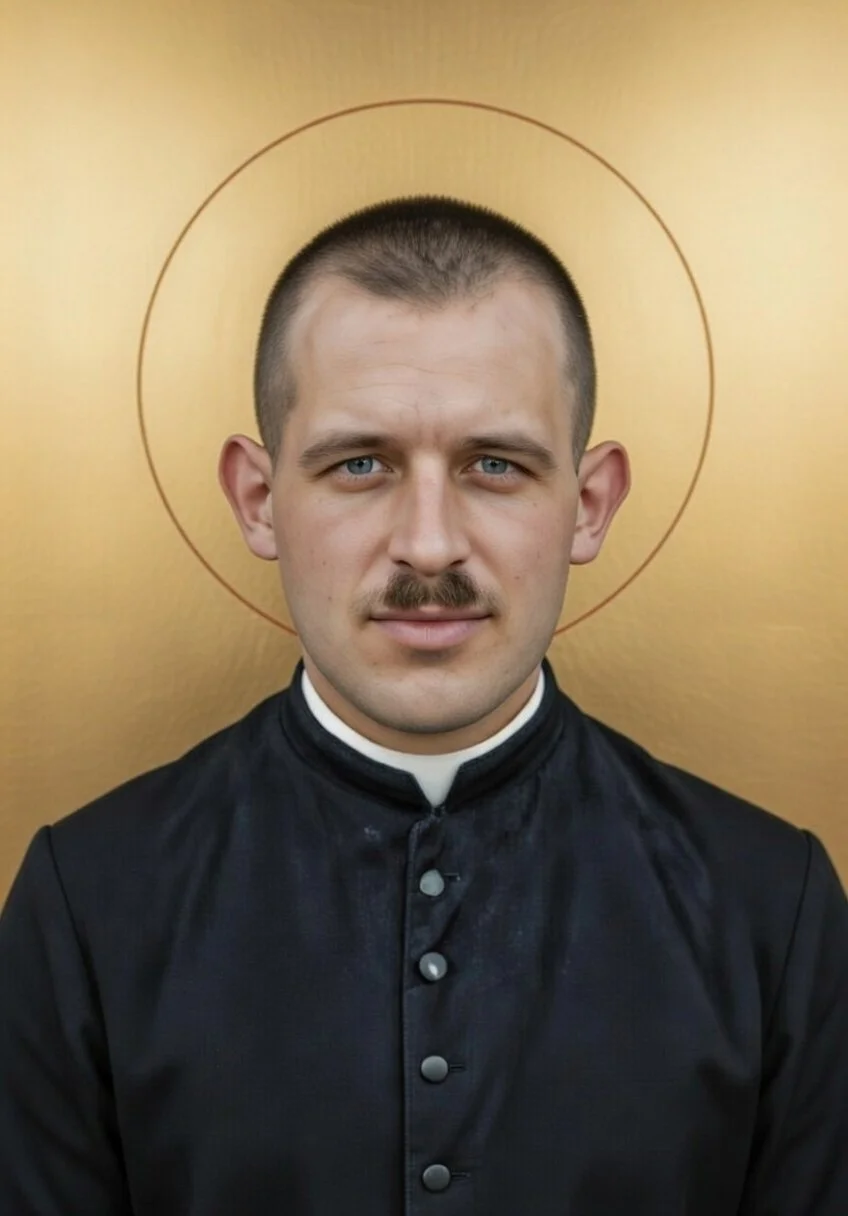
Blessed Alfons Tracki at a Glance
- Also Known As
- Dom Alfons Tracki; in religion, Brother Gebhard
- Born
- December 2, 1896, in Bleischwitz (Bliszczyce), Upper Silesia, German Empire, now Poland
- Died
- July 18, 1946 (age 49), executed by firing squad at Zalli i Kirit, near Shkoder, Albania
- Venerated In
- The Roman Catholic Church
- Beatified
- November 5, 2016, at Saint Stephen's Cathedral Square, Shkoder, by Angelo Cardinal Amato on behalf of Pope Francis
- Feast Day
- July 18, together with the other Martyrs of Albania
- Title
- Priest and Martyr
- Beatification Group
- One of the 38 Martyrs of Albania (Vincenc Prennushi and 37 Companions)
- Ministry
- Chaplain of Saint Stephen's Cathedral, Shkoder; parish priest of Velipoje; founder of the youth society Viribus Unitis
- Canonization Status
- Blessed; no miracle for canonization has been publicly confirmed to date
- I. A Silesian Boyhood and a Vocation Discovered in Vienna
- II. Albania Calls: The First Mission, Interrupted by War
- III. Ordination and the Making of a Missionary Priest
- IV. Viribus Unitis: Rescuing the Poorest Children of Shkoder
- V. Parish Priest of Velipoje and the End of the Blood Feud
- VI. The War Years: A German Who Saved Albanians From the Germans
- VII. Arrest: Anointing a Dying Man Under a New Regime
- VIII. The Trial: A Prosecutor's Own Witnesses Defend Him
- IX. Martyrdom at Zalli i Kirit, July 18, 1946
- X. His Grave, His Relics, and What Remains
- XI. The Cause and the Beatification of November 5, 2016
- XII. His Companions: Connections to the Other Martyrs of Albania
- XIII. Miracles, Graces, and the Path to Canonization
- XIV. On His Homilies and Writings
- XV. Churches, Streets, and Places That Bear His Memory
- XVI. Legacy: What Blessed Alfons Tracki Still Teaches
- Prayer for the Intercession of Blessed Alfons Tracki
- Frequently Asked Questions
A Silesian Boyhood and a Vocation Discovered in Vienna
Alfons Tracki was born on December 2, 1896, in the small village of Bleischwitz, in Upper Silesia, then a province of the German Empire. The village is known today by its Polish name, Bliszczyce, and sits within the modern Polish municipality of Branice, close to the historic city of Breslau (today's Wroclaw). His parents, Josef Tracki and Martha, nee Schramm, raised him in a large family of mixed Polish and German ancestry, a border identity that would shape the rest of his life: a man formed on the seam between two cultures, who would eventually cross into a third.
As a boy, Alfons came into contact with the Brothers of the Christian Schools, the religious teaching congregation better known as the De La Salle Brothers or, in the local idiom, the Lasallians. Something in their community life took hold of him. At the age of fourteen he asked to be admitted to their provincial school in Vienna, and the Brothers accepted him. He entered their novitiate around 1911 and, after roughly two years of formation, was received as a full member of the congregation, taking the religious name Brother Gebhard. Albanian-language sources place his formal clothing in the habit on the Feast of the Assumption in 1912; the most detailed English-language biographical record places his reception as a member on August 16, 1913. Both agree on the essential fact: by his mid-teens, Alfons Tracki had already given his life to religious formation, in a congregation whose members, notably, were teaching brothers rather than ordained priests.
Part II
Albania Calls: The First Mission, Interrupted by War
The Lasallian Brothers sent the young Brother Gebhard to Albania before the outbreak of the First World War, assigning him to teach German at a school connected to the Xaverian College of the Jesuit Fathers in Shkoder, in the country's Catholic north. It was his first encounter with the nation that would become, in his own words years later, his second homeland. He could not have known, teaching German grammar to Albanian schoolboys in the years before 1914, that he was standing at the beginning of a story that would end in that same city three decades later.
The war broke his first Albanian sojourn. He returned to his home village in Upper Silesia and served two years in the German military. Sources differ slightly on the precise sequence of events during these years: Albanian ecclesiastical accounts note that he made his first religious vows on the Feast of the Immaculate Conception in 1914, shortly before being sent to teach in Shkoder, while the fuller English-language biographical record places the completion of his vows during the war years themselves, after his return home. What is certain is that by the war's end, Alfons Tracki had bound himself formally to religious life and was ready to return to the country and the people who had already claimed a share of his heart.

Part III
Ordination and the Making of a Missionary Priest
Back in Shkoder after the war, Alfons resumed philosophy and theology studies. Because the Lasallian Brothers' congregation had no priests among its members, teaching brothers by charism rather than clergy, his growing desire for priesthood and mission work required a step beyond his original vocation. He brought his desire to Archbishop Jak Serreqi of Shkoder, who welcomed the request with evident warmth. "I was already aware of his vocation," the Archbishop wrote, "and had noted his conduct, which has always been very good." The Apostolic Delegate to Albania at the time, Monsignor Cozzi, went further in his own report to Rome, writing that Tracki, together with two fellow candidates named Nikolle Prendushi and Pjeter Meshkalla, offered "the most beautiful hopes for the future," describing Tracki specifically as "a subject for whom we have great hopes, especially for the Catholic education and organization of youth." It was a remarkably prescient assessment. Youth work would in fact become the center of his priestly life.
Alfons Tracki was ordained a priest in Shkoder on June 14, 1925, by Archbishop Lazer Mjeda. At his ordination, the future Blessed Ndre Zadeja, himself later martyred and beatified among the same group of 38 Martyrs of Albania, served as his sponsor. Soon afterward, Tracki took the deliberate and unusual step of formally becoming an Albanian citizen. He explained the decision simply, in words that his fellow priests would remember and repeat for decades: he had, he said, "voluntarily chosen Albania as my second homeland." A German by birth, he had become an Albanian by conviction, years before that conviction would cost him everything.
He joined the Marian Congregation of the Holy Rosary in Shkoder, a confraternity led at the time by another priest who would later be counted among the martyrs: Blessed Vincenc Prennushi, the Franciscan Archbishop who headed the entire 2016 beatification group. Those who knew Tracki in these years described him consistently: a priest who was strict with himself but warm and approachable with the young, a man of unshakeable faith, deeply merciful, and scrupulously honest to his word.
Part IV
Viribus Unitis: Rescuing the Poorest Children of Shkoder
A little more than a year after his ordination, Father Tracki founded an educational, cultural, and sporting society for children and young people, giving it the Latin name Viribus Unitis, "With United Strength." His stated purpose, recorded by those who worked alongside him, was pointed and specific: to gather in the poor, the wandering, and the abandoned children of Shkoder, "those persons," as he put it, "in whom vice develops most quickly," and to form them for a decent life before the streets could claim them. This was not abstract social theory. It was a parish priest walking directly toward the children everyone else in the city had already given up on.
Around this same period he served as chaplain, effectively the vice-parish priest, of Saint Stephen's Cathedral in Shkoder, the mother church of the archdiocese, ironically the very square where his beatification would be celebrated ninety years later. He held this post for years, splitting his energy between cathedral duties and the youth organization that had become his signature work.

Part V
Parish Priest of Velipoje and the End of the Blood Feud
Father Tracki eventually left his cathedral post to become parish priest of Velipoje, on Albania's Adriatic coast near the mouth of the Buna River. There he opened two schools, one in the village of Pulaj and one in Rec, extending the same instinct that had built Viribus Unitis: get to the children before poverty or ignorance did. The results were extraordinary for a small rural parish. Out of the group of young people he raised and formed in Velipoje came fourteen future priests, twelve for the diocesan clergy and two who entered the Franciscan order, along with a young man named Pjeter Arbnori, who did not become a priest but who would go on, after decades as a political prisoner under communism, to serve as Speaker of the Albanian Parliament following the fall of the regime that had killed his old teacher.
The Franciscan priest and writer Zef Pllumi, in his celebrated memoir of the persecution years, Live to Tell, remembered Tracki as a good priest who played a crucial role in forming other priests, singling out Blessed Ejell Deda, a future martyr himself, as one of the young men Tracki helped shape for the priesthood.
Alongside his educational work in Velipoje, Tracki devoted real effort to something that had nothing to do with catechism classes and everything to do with saving lives: the eradication of the gjakmarrja, the blood-feud tradition of northern Albania, under which killings could cascade through families for generations under an inherited code of honor. Tracki offered what he believed was the only real answer to a cycle of vengeance, a specifically Christian solution grounded in forgiveness and reconciliation, and worked to bring feuding families to peace.
Part VI
The War Years: A German Who Saved Albanians From the Germans
The Second World War placed Alfons Tracki in an unusual and dangerous position: a German-born priest living under Italian and then German military occupation of Albania, at a moment when Albanian partisan resistance to those same occupiers was intensifying. According to Albanian-language historical accounts, most fully preserved in the writing of the Albanian-Australian researcher Fritz Radovani, Tracki used his position and his fluency in German to intervene directly with the occupying authorities on behalf of Albanian civilians, on at least two documented occasions.
In the final days of November 1944, as the war in the Balkans was collapsing toward its end, Radovani's account describes Tracki intervening to save the lives of roughly one hundred Albanian men in Velipoje who had been marked for execution by German forces, in a plot researchers describe as having been instigated by Yugoslav partisan elements operating in the area. The same account records a declaration Tracki made in 1944, when asked why he did not simply leave with the retreating Germans as many of his fellow ethnic Germans in the Balkans were doing: "I have no reason to flee with the Germans, since my second homeland is Albania."
A second wartime rescue surfaced years later, and under circumstances no novelist would have dared invent: at Tracki's own 1946 trial, witnesses called by the communist prosecutor to testify against him instead recounted, under oath, how Tracki had personally intervened with the German military command to secure the release of Albanian anti-fascists who had been imprisoned in Prishtina. The prosecutor, Aranit Cela, is recorded as having threatened his own witnesses when their testimony kept turning into vindication rather than accusation. The man on trial for being insufficiently loyal to the new regime had, three years earlier, walked into a German command post and talked Albanian resistance fighters out of a prison cell.
Part VII
Arrest: Anointing a Dying Man Under a New Regime
By December 1943, Tracki had been transferred back to Shkoder's cathedral, serving as vice-parish priest under Father Mikel Koliqi. Even in these years, his own vocational restlessness had not gone quiet: he petitioned the Archbishop of Shkoder for permission to enter the Order of Friars Minor, the Franciscans. The Archbishop granted the request, writing that he did so "only so as not to oppose the divine calling," and adding that for Tracki's priestly service, rendered always with such dedication, "we can have nothing but words of praise and gratitude." Events overtook the formal transfer. Devotional accounts from the Archdiocese of Shkoder-Pult describe him afterward as a Franciscan "by desire," a man whose heart had already made the move his paperwork never got the chance to complete.
The war ended and Enver Hoxha's communist partisans, who had fought against the Italian and German occupation, consolidated total power over Albania. The new regime moved quickly against anyone associated with the old order, a category that swept up Catholic clergy in general, regardless of their individual wartime conduct. Some Albanian sources describe Tracki as having had contact with anti-communist Freischarler, irregular resistance fighters, in the mountains during this transitional period, a detail consistent with the broader climate of the time but less firmly documented than the events of his arrest itself.
On February 13, 1946, Alfons Tracki was arrested by forces of the new communist security apparatus, the Sigurimi, under the command of an officer named Pjeter Bullatovic. The moment of arrest was itself an act of priestly duty: Tracki was in the process of administering Extreme Unction, the Last Rites, to a mortally wounded twenty-six-year-old anti-communist named Ndoc Jakova. He was taken into custody while still performing the sacrament. He was imprisoned in Shkoder, a city that by this point held roughly thirteen improvised detention sites for the regime's rapidly growing number of political and religious prisoners.
Part VIII
The Trial: A Prosecutor's Own Witnesses Defend Him
Tracki was tried before the Shkoder military tribunal on charges built around the performance of an "illegal priestly act," a legal fiction the regime used to criminalize the sacraments themselves. The trial record, as preserved in Albanian ecclesiastical sources, describes accusations so thin that the prosecutor, Aranit Cela, was reduced to threatening the witnesses he himself had summoned, when their answers kept exonerating rather than incriminating the priest in the dock. It was in this trial that the story of Tracki's wartime intervention at the Prishtina command post came out publicly, offered not by Tracki in his own defense but by hostile witnesses who could not bring themselves to lie about what he had actually done during the war.
The Apostolic Delegate to Albania at the time, Monsignor Nigris, later observed that Tracki suffered more severely in captivity than his fellow imprisoned priests, for a bitterly specific reason: because he was German by birth, he had no relatives in Albania able to bring him food, clothing, or comfort, and ordinary Albanians who might otherwise have helped a beloved local priest were afraid to be seen near him, for fear of being branded Nazi sympathizers by association. The injustice cut two ways at once. He was being punished as a foreigner by a regime that would not acknowledge the citizenship he had chosen, and isolated from help by exactly the wartime reputation his own actions had, in reality, been the opposite of deserving.
On July 17, 1946, the military tribunal in Shkoder sentenced Alfons Tracki to death. Albanian law technically permitted an appeal to the High Court in Tirana, and Tracki, or those acting on his behalf, lodged one. It made no difference. The appeal was never meaningfully considered. Within a day of sentencing, the machinery of execution was already moving.
Part IX
Martyrdom at Zalli i Kirit, July 18, 1946
Alfons Tracki was executed by firing squad at approximately five o'clock in the morning on July 18, 1946, at Zalli i Kirit, a stretch of riverbank along the Kiri River outside Shkoder that the regime used repeatedly as a killing ground in these years. He was shot alongside four other condemned men from the same case file: Llesh Marashi, Kol Ashiku, Nikoll Dedaj, and Kel Abati. He was forty-nine years old, twenty-one years a priest, and not yet two years past his rescue of a hundred of his adopted countrymen from a wartime firing squad of a different flag.
Witnesses recorded his final words, spoken to the men who were about to kill him and to the companions who were dying alongside him:
He had reportedly said, in the years before his death, "I want to die here," meaning in Albania, the country he had chosen over the one he was born into. The wish, however dark its fulfillment, came true. Years later, the Franciscan Father Konrad Gjolaj offered what may be the single most striking tribute paid to Tracki by anyone who knew him: "This was the man who taught us other Albanians how a priest dies."
The bureaucracy of the killing outlived the killing itself in one small, telling detail. The day after the execution, the Sigurimi official responsible for the case, Zoi Themeli, filed the official report confirming Tracki's death. In that same report, without apparently intending to, Themeli described the broader climate of the arrests in language that, read decades later, reads as an unintended confession: he noted that arrests were "being made without cause."
Part X
His Grave, His Relics, and What Remains
This is the part of Blessed Alfons Tracki's story that honesty requires be told plainly rather than softened: there is no confirmed, marked grave for him, and no publicly documented reliquary or shrine holding his physical remains. Like the great majority of the clergy executed by the Hoxha regime in the 1940s, Tracki's body was disposed of by the state without any provision for burial, memorial, or family notification. The Albanian researcher Fritz Radovani, who has written the most extensively on Tracki's life outside official ecclesiastical channels, titled his account of Tracki's fate "Nje monument nen dhe," which translates as "A monument beneath the earth," a phrase that captures precisely what can and cannot be said: that somewhere in or near Shkoder, the earth itself holds what the regime tried to erase, but that no one today can point to the exact place.
Readers searching for a pilgrimage site, a tomb to visit, or a parish that holds first-class relics of Blessed Alfons Tracki should know clearly that no such site is documented in any source available for this article. This distinguishes his cause from those of some other 20th-century martyrs whose remains were recovered, identified, and translated to churches after the fall of communism. If a confirmed burial site or relic collection exists that has not surfaced in available research, it has not been publicized by the Archdiocese of Shkoder-Pult or by any source consulted here.
Part XI
The Cause and the Beatification of November 5, 2016
Seventy years after his execution, the Catholic Church formally recognized what the people of Shkoder had believed all along. On April 26, 2016, Pope Francis approved a decree recognizing that Alfons Tracki, along with thirty-seven companions, had died as a martyr in odium fidei, in hatred of the faith, at the hands of the communist regime. Because martyrdom causes do not require a miracle for beatification, a reform Pope John Paul II had introduced in the 1980s, the path from the decree to beatification moved relatively quickly.
On November 5, 2016, Alfons Tracki was beatified together with the other 37 martyrs in a public ceremony held in the square outside Saint Stephen's Cathedral in Shkoder, the very cathedral where he had once served as chaplain. Angelo Cardinal Amato, then Prefect of the Congregation for the Causes of Saints, presided over the ceremony on behalf of Pope Francis. The group is officially known in Vatican records as "Vincenzo Prennushi e 37 compagni," Vincenc Prennushi and 37 Companions, and is commonly referred to as the 38 Martyrs of Albania. His feast day, July 18, marks the anniversary of his execution and is shared communally with the other martyrs of the group.
Part XII
His Companions: Connections to the Other Martyrs of Albania
Blessed Alfons Tracki did not live or die in isolation. His story is woven directly into the lives of several of the other 37 martyrs beatified alongside him on the same day, in the same square:
Blessed Ndre Zadeja
Served as Tracki's sponsor at his priestly ordination on June 14, 1925. Both men were shot by the same regime within the same broader wave of persecution and were beatified together in 2016.
Blessed Vincenc Prennushi
The Franciscan Archbishop who led the Marian Congregation of the Holy Rosary in Shkoder that the young Father Tracki joined after his ordination. Prennushi heads the official Vatican title of the entire beatification group, "Vincenzo Prennushi e 37 compagni."
Blessed Ejell Deda
Formed as a young priest under Tracki's mentorship, according to the memoir of Zef Pllumi. Deda was himself later martyred by the same regime and beatified in the same 2016 ceremony as his mentor.
Nikolle Prendushi and Pjeter Meshkalla
Fellow candidates for the priesthood alongside Tracki in the early 1920s, singled out together with him in Apostolic Delegate Cozzi's report to Rome as young men offering "the most beautiful hopes for the future."
Beyond these direct connections, Tracki's execution on July 17 to 18, 1946, took place within days of the executions of several other future beatified martyrs from the same wave of trials, including Frano Mirakaj, underscoring how concentrated and deliberate this phase of the regime's campaign against the Catholic clergy of northern Albania truly was. The 38 Martyrs of Albania as a group include archbishops, diocesan priests, Franciscan and Jesuit fathers, and lay Catholics, among them Blessed Maria Tuci and Blessed Qerim Sadiku, a convert from Islam executed alongside several priests in Shkoder in 1946.
Part XIII
Miracles, Graces, and the Path to Canonization
This section, too, is best served by precision rather than embellishment. Because Alfons Tracki was beatified as a martyr, under the reformed process that allows a recognized death in odium fidei to substitute for the miracle otherwise required at the beatification stage, no miracle was investigated or claimed as part of his 2016 beatification. For his cause to advance to canonization, the full recognition of sainthood, current Church law requires the Vatican to formally investigate and approve a miracle, typically an inexplicable physical healing, obtained through his intercession after his beatification.
As of the most recent information available, no miracle attributed to Blessed Alfons Tracki's intercession, before or after his death, has been publicly reported, formally investigated, or confirmed by the Archdiocese of Shkoder-Pult or by the Vatican's Dicastery for the Causes of Saints. This article makes no claim otherwise, and readers should treat any secondhand story of a "Tracki miracle" circulating informally with appropriate caution unless it has been documented by the competent ecclesiastical authority.
What does exist is an official prayer, composed for and distributed by the Archdiocese of Shkoder-Pult and broadcast through the Albanian-language service of Vatican Radio, inviting the faithful to seek Blessed Alfons Tracki's intercession for graces of healing, "in soul and in body," and asking those who receive such graces to make them known to the Church, which is the ordinary first step by which any future miracle claim would begin. The prayer appears in full at the end of this article.
Wherever this article distinguishes between events drawn from ecclesiastical sources such as Vatican News and the Archdiocese of Shkoder-Pult, historical research such as Fritz Radovani's published accounts, and the academic record represented in works like Robert Elsie's Biographical Dictionary of Albanian History, it has tried to say so. The rescue of roughly one hundred men in Velipoje in 1944 and the intervention at the Prishtina command post are strongly attested in Albanian-language sources but are not independently corroborated by Western archival documentation available to this writer. They are presented here as well-sourced historical claims, not as legends, but readers doing further research should know precisely where the documentation is strongest.
Part XIV
On His Homilies and Writings
No homilies, sermons, letters, or other original writings by Alfons Tracki have been located in the course of researching this article, and none appear to have been published in any language. This is not unusual for a rural and small-city parish priest of his era and place, but it is compounded in Tracki's specific case by the historical circumstances of communist Albania, where the Hoxha regime systematically confiscated, destroyed, or buried Catholic ecclesiastical archives, personal papers of arrested clergy, and parish records across the four and a half decades of its rule, from the mid-1940s until the collapse of the regime in 1990 to 1991. If any of Tracki's personal writings, sermon notes, or correspondence survived that period, they would most likely be held today, if anywhere, in the private or restricted archives of the Archdiocese of Shkoder-Pult rather than in any publicly accessible collection. This article will be updated if such material comes to light.
Part XV
Churches, Streets, and Places That Bear His Memory
No church, chapel, or shrine currently bears Blessed Alfons Tracki's name as its sole patron, based on the sources available for this article. This may change as devotion to the 38 Martyrs of Albania continues to grow following their 2016 beatification, but as of now, readers looking for a "Church of Blessed Alfons Tracki" to visit will not find one documented.
What does exist, and what stands as a small but real public honor in the very town where he served, is a street. According to the official parish contact information published by the Archdiocese of Shkoder-Pult, the parish of Saint Nicholas in Velipoje, the very parish Tracki once served as priest, is located at an address on Rruga Dom Alfons Tracki, Dom Alfons Tracki Street. It is a modest form of memorial, a street sign rather than a shrine, but it means that anyone who visits the parish he built schools for is, quite literally, walking a road that carries his name.
Readers wishing to consult the Archdiocese of Shkoder-Pult's own published biography of Blessed Alfons Tracki, part of its ongoing series on the Martyrs of Communism, can find it at kishakatolikeshkoder.com, the official website of the Archdiocese, published in Albanian.
Part XVI
Legacy: What Blessed Alfons Tracki Still Teaches
Reduced to its essentials, Alfons Tracki's life traces a single unbroken line: a German boy who found his vocation among the poor of Vienna, carried it to the poorest children of Shkoder, extended it to rescue men of a nation not his own from a firing squad organized by his own countrymen's occupying army, and finally gave his life rather than let a dying twenty-six-year-old go to his own death without the sacraments of the Church. Every documented turn in his story, from Viribus Unitis to the rescue in Velipoje to the arrest mid-anointing, points the same direction: toward people the rest of the world had already written off.
For a website devoted to the full breadth of Eastern and Western Catholic and Orthodox witness, Blessed Alfons Tracki's story stands as a Roman Catholic counterpart to the Eastern Catholic martyrs of the same communist century: a Blessed Omelian Kovch of Ukraine, a Blessed Vincenc Prennushi of his own Albania. Different rites, the same century, the same regime logic, and the same refusal, priest after priest, to let the sacraments be criminalized without a witness.
Holy Trinity, Father, Son, and Holy Spirit, to You be glory, honor, and blessing, for having given to Your holy Church Blessed Alfons Tracki, priest, as a model of fidelity to Christ and of unconditional love for his brothers and sisters.
We ask You humbly: just as You were pleased to glorify him in Heaven, be pleased also to glorify him here on earth, granting us the grace we so greatly desire, which we now ask with confidence through his intercession.
Through Christ our Lord. Amen.
Adapted for English-language devotional use from the prayer for the intercession of Blessed Alfons Tracki circulated by the Archdiocese of Shkoder-Pult. The faithful are invited to make known to their parish or diocese any grace received through his intercession.
More From Our Store, In Honor of the Martyrs of Communism


FAQ
Frequently Asked Questions About Blessed Alfons Tracki
A German Boy Chose Albania. Albania Never Forgot Him.
Alfons Tracki could have gone home in 1944, like so many ethnic Germans in the Balkans did, ahead of the reckoning that was coming for anyone associated with the old order. He stayed, because he had already decided, nearly twenty years earlier, that Albania was his home too. He spent his priesthood on the children nobody else wanted to teach, the families locked in generations of blood feud, the men marked for a wartime execution that had nothing to do with them, and finally, a dying twenty-six-year-old who needed a priest more than the regime needed one less witness to its cruelty.
Seventy years after a communist tribunal called his priesthood a crime, the Catholic Church called it what it was: a life given in imitation of Christ, all the way to the end. There is no shrine to visit. There is a street with his name on it, a prayer the Archdiocese of Shkoder-Pult still asks the faithful to pray, and a feast day, July 18, that now belongs to him and to thirty-seven companions who died beside him in one of the twentieth century's quietest, most thorough campaigns against the Christian faith.
Ask his intercession. Say his prayer. Remember a priest who chose a country, and then chose his people in that country, all the way to a riverbank at five o'clock in the morning.
Get the Blessed Alfons Tracki Prayer Card →