The Orthodox Reading List: Essential Books Every Orthodox Christian Should Read
The Orthodox Christian Bookshelf
This list is not ranked. It is not a countdown, and the numbers below exist only so you can find your place again — not to say one saint outranks another. One book here was written by a Catholic priest and twice revised by Orthodox saints until it became one of Orthodoxy's own. One is a 51-page lecture given eighteen months before its author's death. One introduced Orthodox theology to the entire Western academic world from an apartment in occupied Paris. The goal is a single, honest, ever-growing shelf of everything an Orthodox Christian actually needs to read — starting with the one book everything else here depends on.
As an Amazon Associate, The Eastern Church earns from qualifying purchases made through links on this page.
Forty-one books is a lot to face at once. These three cover the ground fastest: what Orthodox Christians actually read, how to pray, and what the Church actually believes.


This Collection at a Glance
- Books Listed
- 41 Orthodox Christian books, organized across 6 parts, unranked (growing over time)
- Where to Start
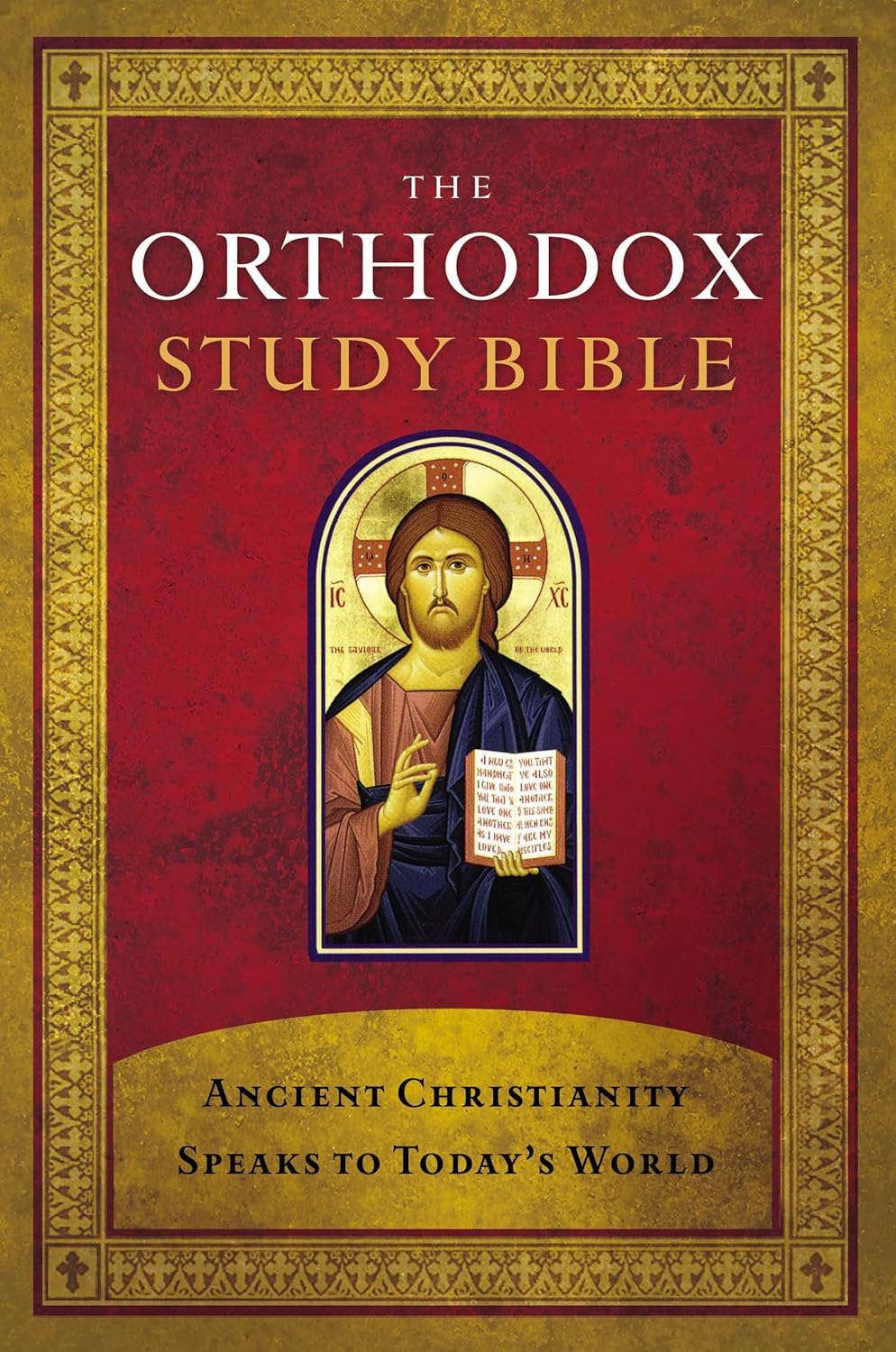
- The Orthodox Study Bible — not "#1," but the foundation everything else builds on
- Oldest Text
- Sayings of the Desert Fathers, compiled 4th–5th century Egypt and Syria
- Most Recently Canonized Author
- St. Justin Popovich, glorified by the Serbian Orthodox Church in 2010
- Crossed Confessional Lines
- Unseen Warfare, written by a Catholic priest in 1589, twice revised into an Orthodox classic
- Introduced Orthodoxy to the West
- The Mystical Theology of the Eastern Church, Vladimir Lossky, written in occupied Paris, 1944
- Central Doctrine Explained
- Theosis — covered directly in at least 5 books on this list
- Companion Titles
- Practical marriage and daily-prayer books are listed separately in Part VI, clearly marked apart from the patristic and saints' texts above them
The Foundational Text
A New Testament-only edition of this project appeared back in 1993, but it took until 2008 for the full Old and New Testament to arrive together in one volume, the product of a team of Orthodox scholars working under the St. Athanasius Academy of Orthodox Theology. It remains the only complete study Bible built specifically for an English-speaking Orthodox readership.
Its most distinctive feature is the Old Testament itself: rather than translating from the Hebrew Masoretic Text most Western Bibles use, it translates the Septuagint, the Greek Old Testament the early Church actually read, quoted by the Apostles and the Fathers. The New Testament uses the New King James Version. Every page is surrounded by patristic commentary, book introductions, and icons, so a reader isn't just getting text but the Church's own historical lens for reading it.
It opens this list not because it "beats" every other title here, but because it is the one book everything else on this shelf is, in some sense, commentary on.
Part II
The Ladder, the Pilgrim, and the Desert
John Climacus earned his surname the hard way. He spent decades as a hermit on Mount Sinai before becoming abbot of the monastery where Moses supposedly saw the burning bush, and it was there, under pressure from a neighboring abbot who wanted a manual for his own monks, that he wrote the book that would define him forever: a treatise so influential it replaced his birth name entirely. Nobody calls him John of Sinai. He is John “of the Ladder” — Climacus — because of what he wrote.
The book itself is built as thirty rungs, one for each hidden year of Christ's life before His public ministry, each rung a vice to renounce or a virtue to acquire: renunciation of the world, obedience, mourning, humility, discernment, stillness, prayer, and finally love. It is blunt, sometimes startling, and never sentimental.
For fourteen centuries, Orthodox monasteries have read this book aloud in the refectory every year during Great Lent. No other spiritual text outside Scripture has held that kind of continuous, universal, liturgically embedded place in Eastern Christian life.

Nobody knows who wrote this book, and that mystery is part of its power. Sometime in the mid-1800s, a manuscript surfaced at a monastery on Mount Athos describing a lame Russian peasant who walks across Siberia with nothing but dried bread, a Bible, and a worn copy of the Philokalia sewn into his coat, trying to obey a single verse of Saint Paul: pray without ceasing.
What is settled is the effect the book has had. It takes the Jesus Prayer — Lord Jesus Christ, Son of God, have mercy on me, a sinner — and shows it moving from the lips, to the mind, to the heart, until the pilgrim says it involuntarily even while asleep. It is the clearest narrative introduction to hesychasm that exists in any language.
The book crossed into Western consciousness in an unlikely way: J.D. Salinger has his character Franny Glass carrying a copy in Franny and Zooey.
Before he was a monk, John of Damascus held one of the highest administrative posts in the Umayyad Caliphate, giving him a kind of protection Byzantine churchmen back in Constantinople didn't have. When the Byzantine emperor Leo III banned the veneration of icons, John was one of the only major Christian voices who could write against it without fear of imperial arrest.
This book, the third part of his larger work Fount of Knowledge, organizes the entire theological inheritance of the Greek Fathers into one coherent system, covering the Trinity, the two natures of Christ, the sacraments, and the resurrection of the body.
It became the first systematic theology in Christian history, and both Eastern and Western thinkers built directly on it: Peter Lombard's Sentences and Aquinas's own Summa both draw on Damascus's structure and arguments.

Before he was Elder Paisios, he was Arsenios Eznepidis, an army signalman during the Greek Civil War, a man who had seen real combat before he ever set foot on the Holy Mountain. That background shows up in his teaching: it is never abstract.
This first volume of his collected counsels is organized by theme — sin, modern civilization, the spirit of the world, the Church — and reads less like a treatise than like transcribed conversations with a wise, occasionally blunt old man who happens to have extraordinary spiritual insight.
Paisios died in 1994 and was formally canonized by the Ecumenical Patriarchate in January 2015, making him one of the most recently recognized saints in Orthodox history.

Schmemann originally delivered this material as lectures for the World Student Christian Federation. As dean of St. Vladimir's Orthodox Theological Seminary in New York, he was trying to answer a very practical question: why does any of this — bread, wine, oil, water — matter to God at all?
His answer is that the entire material world was created to be sacrament, a vehicle of communion with God, and that sin is essentially the loss of that vision rather than the breaking of a rule.
The book is barely over a hundred pages, but it reshaped twentieth century Orthodox liturgical theology and remains one of the few Orthodox texts assigned as regularly in Western seminaries as in Eastern ones.

Timothy Ware grew up Anglican in England, converted to Orthodoxy at Oxford in 1958, and was eventually ordained a bishop under the name Kallistos — making him both an insider and an outsider to the tradition he ended up spending his life explaining.
First published in 1963 and revised multiple times since, it walks through the entire arc of Orthodox history: the apostolic era, the ecumenical councils, the Great Schism of 1054, the fall of Constantinople in 1453, four centuries under Ottoman rule, and the twentieth century collision with Communism, before turning to doctrine and worship.
It has been the standard entry point into Orthodoxy for English-speaking readers for over sixty years.
Anthony Bloom trained and practiced as a physician before the Second World War, served as a surgeon in the French army during the German occupation, and only afterward was secretly tonsured a monk, later becoming Metropolitan of the Russian Orthodox diocese of Sourozh in Great Britain.
The book opens with a jolt that has become famous in its own right: Bloom recounts a woman telling him she had prayed for years and God had never answered, to which he replied that perhaps God had never gotten a word in edgewise, because she had never actually given Him the chance to speak.
It has become one of the two most widely recommended entry points into Orthodox prayer for English-speaking readers, alongside The Way of a Pilgrim.

Porphyrios left home at age seven to work, spent his early years as an electrician and later a hospital chaplain in Athens, and along the way developed what his spiritual children describe as clairvoyance — an ability to perceive things about visitors he had never met.
This book is a compilation of his talks and personal reflections, and it reads less like doctrine and more like the overflow of a heart that genuinely could not stop talking about divine love.
He was canonized by the Ecumenical Patriarchate in 2013, less than a generation after his death.

Brianchaninov started out as a military engineer, trained in the Russian imperial service, before abandoning that career entirely for monastic life. He would later become a bishop, but his enduring legacy is this anthology, compiled from the Philokalia and the sayings of Desert Fathers.
The book doesn't romanticize the practice. It warns, in detail, about the psychological and spiritual dangers of pursuing mystical experience without a spiritual father's guidance.
For anyone actually trying to practice the Jesus Prayer rather than just read about it, this remains one of the most trusted guides in the entire Orthodox literature.

John of Kronstadt became so famous as a confessor that individual confession became physically impossible for him: crowds of thousands would gather, and he began hearing general confessions where entire congregations would shout their sins aloud simultaneously.
This book was never written for publication. It is a private diary, kept over decades of parish ministry, recording his prayers, his temptations, his theological insights, and his unfiltered reflections on serving the Divine Liturgy daily.
It proves that theosis is not reserved for the cloister — it comes from a married, parish-based priest living an intensely public ministry.

When Christianity became legal and then fashionable under Constantine, a certain kind of Christian went looking for something harder. They fled into the Egyptian and Syrian deserts by the thousands, and generations of visitors began writing down the terse, often startling things these hermits said to seekers.
The result is not a treatise but a collection of fragments: Abba Anthony telling a monk that fish die out of water and monks die out of the cell; Abba Moses, a former bandit chief, becoming one of the most quoted teachers in the entire collection.
This is the taproot of all later Christian monasticism, East and West. Saint Benedict knew these sayings. The compilers of the Philokalia built on them.

Silouan was born a Russian peasant named Simeon, worked as a carpenter before his monastic life, and spent decades as an obedient, largely unremarkable monk on Mount Athos, remembered mostly for one line God is said to have spoken to him: "Keep thy mind in hell, and despair not."
Silouan himself wrote almost nothing for publication. This book exists because his spiritual son, Archimandrite Sophrony, gathered Silouan's scattered notes after his death and wove them together with his own extensive commentary.
Silouan was canonized in 1988, and Sophrony went on to found the Monastery of St. John the Baptist in Essex, England, where Archimandrite Zacharias was formed as his direct disciple.

Part III
The Fathers, the Philokalia, and Marian Theology
Athanasius wrote this biography within a couple of years of Anthony's death in 356, while the memory of the man was still raw. This became the template for how Christians would write about holy people for the next sixteen centuries.
The book traces Anthony's withdrawal from a comfortable life into the Egyptian desert, his battles with demonic temptation described in vivid detail, and his eventual emergence as a spiritual father sought out by emperors.
Augustine records in his Confessions that hearing the story of Anthony's conversion, secondhand, was one of the decisive moments that broke him open and led directly to his own conversion.

Gregory of Nyssa was the younger brother of Basil the Great and a close friend of Gregory Nazianzus, together forming the Cappadocian Fathers. Late in life, writing for a friend, Gregory turned to the biblical Moses, reading his entire life as an allegory for the soul's ascent toward God.
The book's most influential idea: because God is infinite, the soul's journey toward Him is a perpetual progress, an unending motion further into a light Gregory calls, paradoxically, luminous darkness.
This concept, epektasis, shaped nearly every later Orthodox mystical writer, including Pseudo-Dionysius's own apophatic theology.

The author claims to be Dionysius, the Athenian convert of Saint Paul mentioned in Acts 17. Scholars are essentially unanimous that whoever wrote this lived four or five centuries later, almost certainly a Syrian monk.
The book's central argument: God is so far beyond human categories that the truest thing we can say about Him is what He is not — shaping an entire tradition of apophatic, or negative, theology.
Both Aquinas and the anonymous English author of The Cloud of Unknowing built directly on this text.

Meyendorff was born to Russian émigré parents in Paris, trained at the St. Sergius Institute there, and eventually crossed the Atlantic to teach at St. Vladimir's Seminary in New York.
This short book was written specifically to give English-speaking readers a compact, modern presentation of Patristic doctrine — the Trinity, Christology, grace, the Church.
It has become a staple in Orthodox seminary curricula across North America.

Where his Dogmatic Theology aimed at accessibility, this book is Meyendorff writing as a historian for other historians, tracing how Byzantine theology actually developed across a thousand years of imperial politics and controversy.
His central argument: Byzantine theology represents a genuine and coherent synthesis of Patristic thought, worth studying on its own historical terms.
It remains a landmark of twentieth-century historical theology, cited constantly by scholars of both Eastern and Western Christianity.

In 726, the Byzantine emperor Leo III banned the veneration of religious images. John of Damascus, living safely under Muslim Umayyad rule outside the emperor's reach, was one of the only prominent theologians free enough to write against the ban.
His argument turns on the Incarnation: because God took on visible, material flesh in Christ, matter itself has been sanctified.
Icon veneration was formally restored at the Second Council of Nicaea in 787, largely on the strength of arguments John had already made decades earlier.

In the 1330s, a Calabrian philosopher named Barlaam visited Mount Athos, encountered monks practicing the Jesus Prayer, and mocked them publicly as omphalopsychoi, men with their souls in their navels, accusing them of heresy. The monks turned to Gregory Palamas to answer him.
The result is Palamas's famous distinction between God's essence, forever unknowable, and God's energies, the uncreated light and grace through which God genuinely makes Himself present to human beings without ceasing to be transcendent.
Palamas defended this position at six separate synods in Constantinople, and hesychasm was formally vindicated as Orthodox teaching in 1351.

Zacharias belongs to a direct spiritual lineage: he was formed by Elder Sophrony, who had himself been a spiritual son of Saint Silouan the Athonite.
This book explores themes central to Sophrony's own teaching: the uncreated light, prayer of the heart, and the paradoxical Orthodox teaching that authentic spiritual life is marked by an ever-deepening awareness of one's own sinfulness alongside an ever-deepening experience of divine love.
Zacharias now serves as abbot of the Monastery of St. John the Baptist in Essex, England, meaning this is a living report from someone actively practicing hesychasm today.

Isaac wrote this biography as a direct spiritual disciple of Paisios, with access to Paisios's letters, personal recollections from those who visited him, and firsthand memory of a man that thousands of ordinary Greeks traveled to see in person.
The book traces Paisios's path from wartime army signalman through decades of monastic struggle on Mount Athos, describing the stories that made him a folk saint even before his official canonization.
It remains the most authoritative single biography of one of Orthodoxy's most beloved twentieth-century saints.

Isaac accepted appointment as Bishop of Nineveh and then, five months later, resigned and walked into the mountains to live as a hermit for the rest of his life.
His homilies, written in Syriac, focus overwhelmingly on divine compassion and mercy, a theme that has made him a touchstone for Orthodox debates about the nature of hell and universal salvation ever since.
For centuries his work circulated mainly within the Church of the East until Greek translations reached Mount Athos and became essential reading for the same monks who compiled the Philokalia.

In the late 1700s, two Greek monks on Mount Athos set out to rescue centuries of scattered ascetical texts from potential obscurity, gathering writings on prayer and the spiritual life from Greek Fathers spanning the fourth through fifteenth centuries.
A Moldavian monk named Paisius Velichkovsky translated it into Church Slavonic, carrying hesychastic practice into Russia, where it fed directly into the nineteenth-century Russian spiritual revival that produced figures like the Optina Elders.
It remains, in its various volumes, the central reference library of Orthodox contemplative prayer.

Meyendorff wrote this short study to clarify a point of doctrine that confuses many outsiders: Orthodoxy venerates the Theotokos with enormous devotion, yet rejects the Catholic dogma of the Immaculate Conception as an unnecessary theological addition.
He traces how Orthodox Mariology developed instead around the Dormition, celebrated liturgically every August 15th, without ever defining the precise mechanism the way Rome eventually did in 1854.
The book is a useful corrective for anyone assuming Orthodox and Catholic Marian devotion are simply the same belief wearing different vestments.

Part IV
The Great Fathers, Old and New
Basil is one of the Three Holy Hierarchs of the Orthodox Church, the founder of the first recorded monastic rule in Eastern Christianity, and the older brother of Gregory of Nyssa. On the Holy Spirit is his lucid, sustained appeal to Scripture and early Christian tradition proving the full divinity of the Holy Spirit, written against an age when even sympathetic churchmen hesitated to say so plainly.
His companion work, the Hexaemeron, nine Lenten homilies on the six days of creation, was in its own time considered his most celebrated achievement. Gregory of Nazianzus wrote that whenever he took the Hexaemeron in hand, he was brought face to face with his Creator, and its influence reached St. Ambrose in the West and St. Ephrem the Syrian in the East, who quoted it directly.
Basil's three hundred surviving letters also reveal a practical reformer, someone who spent as much energy rebuilding the liturgy and organizing care for the poor as he did defending doctrine at the writing desk.

Ephrem wrote almost nothing in prose. He composed in verse, as a deacon rather than a priest or bishop, and his fifteen Hymns on Paradise remain his most celebrated cycle: a theological meditation on Genesis 2 and 3 built entirely out of poetic typology rather than argument.
His method is distinctly Semitic rather than Greek philosophical: he describes nature and Scripture as God's two witnesses, and he layers image on image, the garden of Eden against the Church, Adam against Christ, until the reader is meant to feel the connections rather than follow a syllogism.
Because his theology works through symbol rather than a particular philosophical vocabulary, it reads with a freshness that few other fourth-century texts manage today, and it remains one of the very few major Orthodox spiritual classics that was never written in Greek at all.

Justin Popovich spent his life translating patristic homilies and saints' lives into Serbian while writing his own multi-volume dogmatics, all while living under first fascist and then Communist persecution that repeatedly silenced and exiled him.
His central conviction, repeated across his work, is that truth in Christianity is not a philosophy or a system but a living Person, Jesus Christ Himself, and that theology divorced from actually living "with all the saints" collapses into empty abstraction.
He was formally glorified as a saint by the Serbian Orthodox Church in 2010, and his direct, often blunt writing against Western rationalism and ecumenism has made him one of the most influential and most debated Serbian theologians of the twentieth century.

Nikolai Velimirovich, a Serbian bishop educated in the West at Oxford, Bern, and Geneva before returning to defend traditional Orthodoxy, compiled this day-by-day collection of saints' lives, hymns, reflections, and homilies for every day of the year.
His gift, by wide agreement, was making complex doctrine accessible without ever flattening it, which earned him the nickname "the New Chrysostom" among his own people.
Velimirovich was imprisoned by the Nazis and later emigrated to the United States, and the Prologue remains one of the most beloved daily devotional sourcebooks in the entire Orthodox world, still read one entry per day in households and monasteries alike.

Optina Monastery, tucked in the forests of central Russia, became the single most influential center of Russian eldership after the Philokalia reached Russia in Slavonic translation. A line of elders there, several later canonized, including Ambrose, Anthony, Leonid, and Macarius, drew visitors from every level of Russian society, reportedly including Dostoevsky and Tolstoy.
This anthology gathers their advice into short, thematic entries, ranging from a single sentence to a full paragraph, on spiritual warfare, love of neighbor, the education of children, and the path of salvation.
The counsels resemble the sayings of the ancient Desert Fathers in their brevity and directness, and they are one of the clearest surviving windows into the specific flavor of Russian eldership that shaped figures like Dostoevsky's fictional Elder Zosima.

Born Tomislav Strbulovic, Elder Thaddeus lived through both World Wars, Nazi imprisonment for suspected resistance activity, the Communist takeover of Yugoslavia, and, at the very end of his life, the NATO bombing of Serbia in 1999 — suffering alongside his people through nearly every catastrophe the twentieth century could deliver.
As a young novice he learned the Jesus Prayer from Fr. Ambrose of Miljkovo, a Russian monk who had himself been a disciple of the Optina Elders after fleeing the Bolshevik revolution, making Thaddeus a direct link between the Optina tradition and Serbian monasticism.
His central, oft-repeated teaching gives the book its title: that peaceful, humble thoughts produce a peaceful life, while destructive thoughts produce disharmony, a simple-sounding claim he lived out through decades of loss with visible, disarming gentleness.

Hierotheos Vlachos, Metropolitan of Nafpaktos and Agios Vlasios in Greece since 1995, has written more than fifteen books applying the Church's patristic tradition to the concrete spiritual and psychological condition of modern people.
His central claim is unsettling to modern ears until it's explained: that the soul suffers a genuine illness distorting its relationship to God, to other people, and to the created world, and that the Church functions as a hospital with an actual therapeutic method, not merely a set of moral rules to follow.
The book draws heavily on the Philokalia and the hesychast tradition, and it has become a standard bridge text for readers who want the Church Fathers' teaching on the passions and the nous applied directly to the anxieties and disorders of contemporary life.

Part V
Modern Elders, Apologetics, and Daily Practice
Archimandrite George Kapsanis served as abbot of the Holy Monastery of Gregoriou on Mount Athos, and wrote this short work specifically to explain the doctrine that separates Orthodox soteriology most sharply from Western Christian frameworks: theosis, the teaching that human beings are meant to become god by grace, not merely improved or forgiven.
The book walks through the patristic basis for this teaching, tracing it back through the Cappadocian Fathers and Maximus the Confessor, and clarifies exactly what theosis does and does not mean.
If the word theosis has come up repeatedly across this list without a clear explanation, this short book is the most direct place to finally get one.

Fr. Seraphim Rose wrote this in 1975 from his remote cabin in the mountains of northern California, arguing that Eastern religions, spiritism, occultism, and ecumenism, however varied on the surface, were converging toward the same underlying counterfeit spirituality.
The book moves through yoga, Hindu-derived movements, occultism, and the ecumenical movement, arguing that each offers religious experience detached from the specific, doctrinally grounded God of historic Christianity.
It remains one of the most widely read and most argued-over works of modern Orthodox apologetics, especially popular in convert-heavy American parishes; it is also one of his more polemical works, and readers should know it has its critics within Orthodoxy as well as its admirers.

Every Orthodox household eventually needs a working prayer book, not a book about prayer, but the actual texts: morning and evening prayers, prayers before and after Communion, akathists, and the canons appointed for particular seasons and needs.
This compilation gathers those standard texts into a single, practical volume meant to sit by the icon corner and get opened daily, rather than read once and shelved.
It is the working tool that puts everything else on this list into daily practice.

This reference volume takes on an ambitious scope: six hundred individual saints' lives, deliberately including pre-schism Western saints, figures like Patrick of Ireland or Benedict of Nursia, alongside recently canonized twentieth century figures like Paisios and Porphyrios.
Many popular hagiography collections stick narrowly to Greek and Russian saints; this collection pushes back against that narrowing, treating the entire pre-schism Christian West as part of the same inheritance Orthodoxy claims today.
It belongs on a shelf to be opened whenever an unfamiliar saint's name comes up in a service, a prayer card, or a conversation.

This primer grows out of the same spiritual lineage as Fr. Seraphim Rose's St. Herman of Alaska Brotherhood, sharing the instinct that some of the people most likely to actually hear the gospel are those furthest from a comfortable, conventional religious upbringing.
As a primer, it deliberately assumes no prior Orthodox background, walking a newcomer through the basics of Orthodox spirituality, prayer, fasting, and the sacramental life.
It has found a particular audience among converts arriving at Orthodoxy from genuinely secular or countercultural backgrounds.

This book began in 1589 as Il Combattimento Spirituale, written by an Italian Catholic priest, Lorenzo Scupoli. Two centuries later, the Athonite monk Nikodimos of the Holy Mountain translated and adapted it for Greek Orthodox readers, and the Russian bishop Theophan the Recluse revised that adaptation even further for a Russian audience.
The content is unsparingly practical: detailed guidance on recognizing and resisting the passions and demonic temptation, structured almost like a field manual for spiritual combat.
A Catholic priest's manual, twice revised by Orthodox saints, became one of Orthodoxy's own essential texts on spiritual warfare.

This is not a book about the liturgy; it is the liturgy itself, the fixed text of prayers, litanies, and the anaphora celebrated in Byzantine Rite parishes almost every Sunday of the year. Its core structure carries the name of Saint John Chrysostom, though the text as used today developed over many subsequent centuries.
Having the actual service text in hand lets a reader see the theological structure underneath the chant and incense: the shape of the Anaphora, the exact wording of the epiclesis calling down the Holy Spirit on the gifts, the litanies that punctuate the whole service.
It is, by raw repetition, prayed by more people more often than any other single text on this list.

In 1981, roughly eighteen months before his death, Fr. Seraphim Rose delivered a lecture to a comparative religion class at UC Santa Cruz. This slim book is essentially the transcript of that lecture along with the question-and-answer session that followed.
Drawing on Scripture, the Fathers, and Solzhenitsyn's account of the Soviet gulag, Rose argues that suffering is very often the specific mechanism by which God breaks through to a hardened or distracted heart.
Readers consistently note that it can be finished in a single sitting and still outweighs books many times its length.

Lossky was a Russian émigré theologian living in Paris, writing during the German occupation in 1944, at a moment when Orthodox theology had almost no serious academic foothold in Western European scholarship.
It systematically lays out apophatic theology, the Palamite doctrine of uncreated energies, and the doctrine of theosis, presenting all of it with a rigor Western academic theologians could not simply dismiss as exotic or peripheral.
By broad consensus among both Orthodox and non-Orthodox scholars, it is the single most influential twentieth century work of Orthodox theology written for a Western audience.

Part VI
Companion Reading for Marriage & Family Life
The four titles below are practical, contemporary companions for married and family life rather than primary patristic or hagiographic texts, and they are kept in their own section for that reason — not ranked or numbered alongside the Church Fathers and canonized saints above, and not presented as "essential" reading on the same footing as the Philokalia or the Ladder of Divine Ascent. If you're looking for a working prayer book for a marriage or family in a specific season, start here.
Written entirely inside the vocabulary of the Eastern sacramental tradition: marriage as mysterion, the home as a domestic church, the spouse as one path among several toward theosis.
It draws on the patristic foundation Saint John Chrysostom laid centuries ago on the theology of marriage described in Ephesians 5, and pairs that with the bridal mysticism of Saint Ephrem the Syrian.

Starts from the premise that the reader likely has a job, a family, a commute, and maybe twenty minutes of quiet, and asks what hesychastic prayer can actually look like under those conditions.
Draws on the Jesus Prayer, the Philokalia, and the teaching on nepsis, translated into a framework a working layperson can actually follow.

A working prayer companion organized around the specific crises real families face: a marriage under strain, a spouse who has drifted, a child who has wandered.
Each section offers structured daily prayers, drawing on the Orthodox conviction that the family functions as a small domestic church.

An anthology built around a single premise: the ancient Christian prayer tradition already contains everything a contemplative seeker needs, gathered here in a form someone can use daily.
For someone who wants to begin practicing contemplative prayer tonight, rather than after finishing the Philokalia, this is a practical, low-barrier place to start.

Which Book Should You Read Next?
If you already know where you're headed, jump back up to any of the six parts above. If you don't, the fastest way in is still the same three books.
This collection will grow. More books will be added as they are discovered, read, and confirmed accurate, always with a real, named author or compiler behind them.