Prayer in Daily Life: How Busy People Find God
Eastern Christian Spirituality • For Workers, Parents, and the Permanently Busy
Prayer in Daily Life: How Busy People Find God
You do not have a free hour. You do not have a quiet room. You have a commute, a job, maybe children who need you the moment you sit down. The Eastern Christian tradition has an answer that does not ask you to find more time — it asks you to bring God into the time you already have.
Prayer in Daily Life — At a Glance
- The Core Teaching
- You do not need to add hours to your day — you need to transform the hours you already have
- Primary Tool
- The Jesus Prayer — “Lord Jesus Christ, Son of God, have mercy on me, a sinner”
- Origin of the Practice
- Born among manual laborers — weavers, farmers, fishermen — centuries before it became a monastic practice
- Best Moments to Pray
- Commutes, walks, chores, transitions between tasks — the “cracks” of the day
- Patron for Work
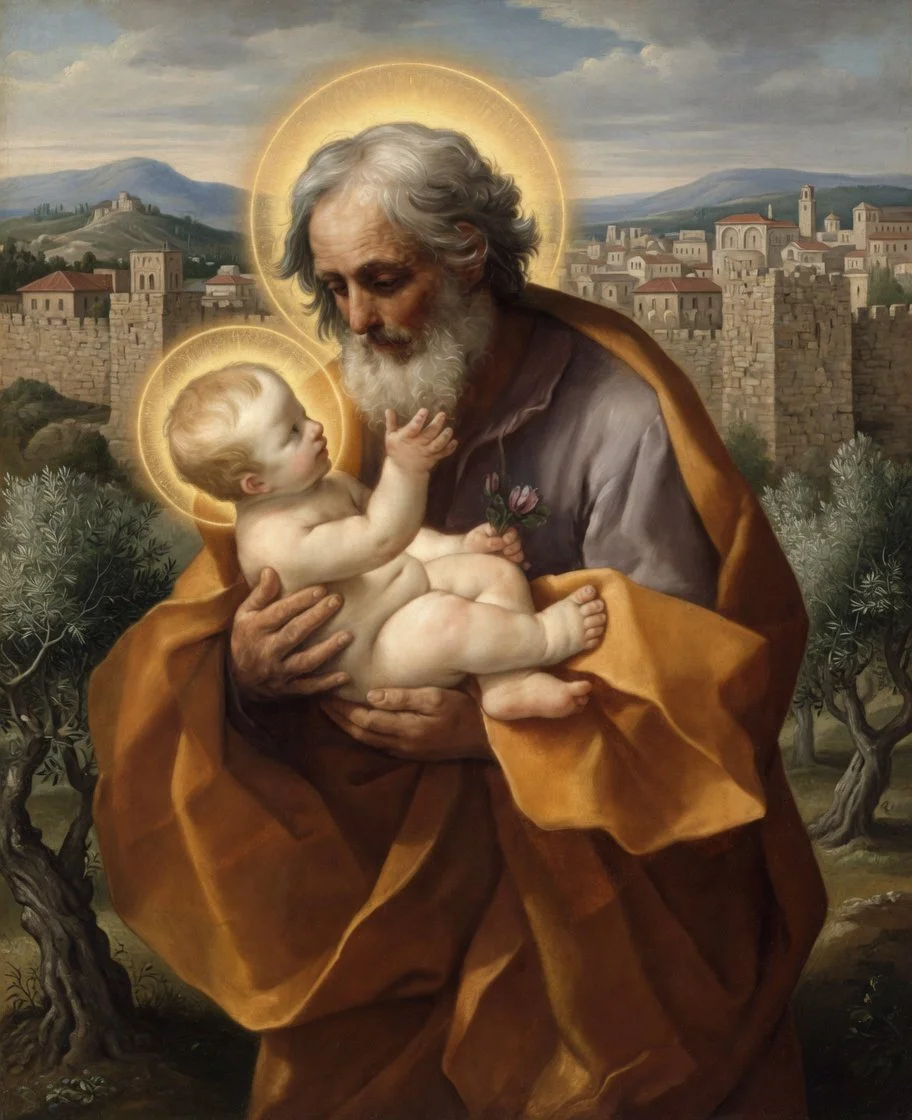
- Saint Joseph — foster father of Christ, patron of workers, fathers, and households
- Patrons for Parenthood
- Saints Joachim and Anne — parents of the Theotokos, patrons of parents and grandparents
- Portable Tool
- The prayer rope — a knotted cord, fits in a pocket, anchors the hands during prayer
- For Parents
- “Pray when you can, not when you want to” — redeeming whatever moments the day provides
- Key Principle
- Interruptions are not obstacles to prayer — responding to them with patience is itself the mystical life
- Where It Is Taught
- Practical Mysticism for Laypeople by A Servant of God — Chapters 16 and 17
The Real Problem Is Never Time
Almost everyone who wants to deepen their prayer life eventually says some version of the same sentence: I don’t have time. There is a job. There is a commute. There are children, or aging parents, or both. There is the simple exhaustion of being a person with responsibilities in the modern world, where every hour seems to already belong to something else before the day even begins.
The Eastern Christian tradition does not dismiss this difficulty, but it does reframe it, and the reframe changes everything. The problem, the tradition insists, was never the absence of time. The problem is the assumption that prayer requires time set apart from ordinary life rather than time woven through it. A monk in the Egyptian desert and a parent loading a dishwasher at nine at night are, in this framework, equally capable of deep prayer — not because their circumstances are similar, but because prayer was never designed to require silence, solitude, or a spare hour in the first place.
This is not a modern accommodation invented to make ancient practices more palatable to busy people. It is, in fact, closer to the original context in which these practices were born. The Jesus Prayer, the single most important tool in the Eastern contemplative tradition, did not begin in monasteries. It began in fields, in workshops, and on fishing boats.
Part II
A Prayer Born Among Workers
It is easy to assume that the Jesus Prayer — “Lord Jesus Christ, Son of God, have mercy on me, a sinner” — was developed by hermits seeking silence in the desert, and then, centuries later, generously offered to ordinary people who lacked the luxury of monastic solitude. The actual history runs in nearly the opposite direction. The short, repetitive prayers that eventually crystallized into the Jesus Prayer were practiced by laborers long before they became formalized as a method of contemplative monasticism.
The Desert Fathers themselves often came from working backgrounds, and the brief, breath-length prayers they taught — what the early teacher Evagrius Ponticus called “arrows” flung toward heaven — were explicitly suited to people whose hands were occupied with manual tasks. The prayer did not compete with the work. It accompanied it. By the time the prayer reached the form most familiar today, it had already been tested for centuries by exactly the kind of people who have the least free time: people who worked with their hands for a living.
This matters enormously for anyone today who assumes that a demanding job disqualifies them from serious prayer. It does not. If anything, a busy working life places a person closer to the original context in which this prayer was designed to function than a quiet retreat ever could.
Part III
How to Pray While You Work
The method is simpler than most people expect, and that simplicity is the point. Any task that does not require the full engagement of your verbal mind is an opportunity for prayer running quietly underneath it. Driving. Walking. Cleaning. Repetitive manual labor. Yard work. Exercise. Even data entry, once the pattern becomes automatic. The prayer occupies the background of the mind while the surface attention handles whatever the task requires.
This is not a distraction from the work. The tradition is specific on this point: work done in the presence of the prayer is generally done better, not worse, because the prayer is not competing with reality for your attention. It is grounding you more deeply in it. Tasks that demand full verbal engagement — an important conversation, writing that requires careful thought, leading a meeting — do not lend themselves to simultaneous prayer, but they can be framed by it: a brief invocation of the name of Jesus before walking into the room, a return to the prayer in the first quiet moment afterward.
Beginning the Workday
Before the demands of the day take over, a brief and deliberate offering sets the tone: “Lord, this day and all my labor in it are yours. Use them for your purposes. Keep me mindful of your presence in everything I do.” This takes fifteen seconds. It changes the orientation of everything that follows.
During Difficult Moments
When a colleague is difficult, when a customer is unreasonable, when frustration rises during a long shift, the prayer offers something other than the instinctive reaction. “Lord Jesus Christ, Son of God, have mercy on me, a sinner.” Not them. Me. This single shift in attention — from judging the other person to acknowledging one’s own need for mercy — creates a small gap between provocation and response, and in that gap, something other than reflex becomes possible.
Part IV
Saint Joseph: The Patron of Ordinary Work
The Gospels give Saint Joseph almost no recorded words. What they give instead is a man who worked. A carpenter by trade, Joseph raised the Son of God in a household that ran on ordinary labor — cutting wood, repairing tools, providing for a family through the same unglamorous daily effort that defines work in every century. There is no recorded mystical vision of Joseph standing in ecstatic prayer. There is a man who got up, went to work, and quietly did what needed to be done, trusting God with the parts of the story he could not control.
This is precisely why the Eastern and Western traditions alike have long held Joseph up as the patron of workers. He did not retreat from ordinary labor to encounter God. He encountered God by faithfully performing ordinary labor, in a household where the line between sacred and secular had, in the most literal sense imaginable, already dissolved. If God himself grew up in a carpenter’s home, then carpentry — and by extension, any honest work — is not separate from the sacred. It is one of its settings.
For anyone trying to integrate prayer into a working life, Joseph offers something more valuable than eloquence. He offers proof by example. A man who said almost nothing, recorded in Scripture, accomplished one of the most consequential acts of faith and labor in human history simply by showing up, doing the work in front of him, and trusting God with what he could not see.
Part V
The Cracks of the Day: Transitions, Commutes, and Waiting
Every day contains dozens of small transitions that most people fill without thinking: the walk from the parking lot to the building, the wait in a checkout line, the few minutes before a meeting starts, the drive between errands, the moments lying in bed before sleep takes over. The tradition calls these moments “cracks” — places where the structure of the day loosens just enough to admit something else.
Almost universally, these cracks are filled with a phone. News, social media, a podcast, anything that prevents a few seconds of unstructured silence. There is nothing inherently wrong with any of these things, but they occupy precisely the space that brief prayer is best suited to fill. The discipline being suggested here is not dramatic. It does not require setting aside thirty minutes you do not have. It requires, instead, resisting the reflex to immediately reach for distraction during these small gaps, and replacing it — even partially, even imperfectly — with a few repetitions of the Jesus Prayer.
Over months, these small moments accumulate into something that begins to feel less like a discrete practice and more like an undercurrent running beneath the entire day. This is not a quick fix or a productivity hack. It is a slow, cumulative redirection of attention, built one checkout line and one red light at a time.
Part VI
The Prayer Rope: A Portable Tool for a Busy Life
A prayer rope is a knotted cord, traditionally made of wool, used to count repetitions of the Jesus Prayer as the fingers move from knot to knot. Most prayer ropes are made with thirty-three, fifty, or one hundred knots. The number is not the point. The prayer rope is not a counting device aimed at hitting a target. It is a physical anchor for a spiritual practice, giving restless hands something to do while the mind and heart are occupied with the words of the prayer.
For a busy person, the prayer rope’s greatest virtue is its size. It fits in a coat pocket, a bag, a car’s center console, or a desk drawer. It requires no setup, no special posture, and no quiet room. A prayer rope can be held during a commute on public transit, during a break at work, while waiting in a parking lot before an appointment, or during the last few minutes before falling asleep. It travels with the busy life it is meant to serve, rather than asking that life to pause for it.
Many practitioners keep a prayer rope in more than one place — one by the bed for the first and last moments of the day, one in a bag or vehicle for the gaps that appear unpredictably throughout it. The goal is never to reach a specific count. The goal is simply to have, within reach, a tool that makes returning to prayer easier than not returning to it.
Part VII
When Children Destroy Your Prayer Life
Children destroy your prayer life. This is not a complaint. It is, according to the Eastern Christian tradition, close to a theological statement. A carefully cultivated silence, a disciplined morning routine, an interior stillness patiently built over months of practice — a two-year-old can dismantle all of it in thirty seconds, and a teenager can dismantle it in ways the two-year-old could not have imagined.
If you are a parent pursuing a serious prayer life, the tradition asks you to accept something at the outset: your practice will look different from a non-parent’s practice. Not lesser. Different. A monk has silence as his discipline. A parent has interruption as theirs. The relentless, unreasonable, non-negotiable needs of small human beings who did not ask to be born and do not care about your prayer schedule are, in their own way, as formative a spiritual discipline as anything practiced in a monastery.
This is sanctifying work of a high order, and the Church has long recognized it as such among the saints who lived it.
Part VIII
Saints Joachim and Anne: Patrons of Parents
According to tradition recorded outside the canonical Gospels, Joachim and Anne were an elderly couple who had spent decades longing for a child without success — a grief made sharper by the social judgment their childlessness carried in their time. Their prayers, offered across years of disappointment, were eventually answered with the birth of a daughter: Mary, who would become the Theotokos, the mother of Christ.
Joachim and Anne are venerated throughout the Eastern Church as patrons of parents and grandparents precisely because their story does not skip over the waiting, the disappointment, or the ordinary domestic life that surrounded the raising of their child. They are not depicted as extraordinary mystics removed from daily concerns. They are depicted as parents — people who prayed through years of difficulty, who raised a child in an ordinary household, and whose quiet faithfulness across decades became the foundation for one of the most consequential lives in human history.
For a parent today, exhausted by sleepless nights or the slow grind of raising children while trying to maintain any spiritual life at all, Joachim and Anne offer a particular kind of companionship. They are not saints who achieved holiness by escaping family responsibility. They are saints who achieved it through it — through years of ordinary parenting, sustained by prayer that never demanded silence or solitude to remain real.

Part IX
Praying With Your Children, Not Only Apart From Them
The tradition offers a specific piece of counsel for parents struggling to maintain any prayer life at all: pray when you can, not when you want to. If the only quiet moment available is five in the morning before the household wakes, then five in the morning becomes the prayer time. If it is ten at night after everyone is finally asleep, then it is ten at night. The tradition calls this redeeming the time — finding whatever pockets of possibility exist in a day that largely belongs to other people’s needs.
Just as important is the counsel to pray with children rather than only apart from them. This does not mean forcing a child into adult contemplative practices. It means praying simply and visibly in their presence — a brief prayer before a meal, a short psalm or the Jesus Prayer at bedtime, a prayer card or icon kept in a common space that quietly draws the eye over time. Children absorb far more from what they observe than from what they are told. A parent who prays consistently, even briefly, even imperfectly, teaches prayer to a child without ever delivering a single lecture about it.
Part X
Letting the Interruption Be the Prayer
Perhaps the most demanding teaching in this entire framework is also the most practical: the interruptions themselves are not obstacles to the mystical life. They are, in their most incarnate form, the mystical life itself. When a child calls out in the night, when a teenager needs to talk at the worst possible moment, when a carefully planned evening falls apart because someone is sick, scared, or simply needs attention right now — these moments are not detours from prayer. They are an opportunity to practice the same self-emptying love that stands at the center of the entire Christian mystical tradition.
Responding to another person’s need with patience, with genuine presence rather than visible irritation, is itself a form of prayer, even when it does not feel like one in the moment. It rarely feels mystical at three in the morning. The tradition insists that it is exactly that.

Part XI
A Prayer for the Busy and the Tired
Lord Jesus Christ, Son of God, I do not come to you today with a quiet hour. I come to you with a commute, a job that needs me, and people who depend on me before I have had the chance to depend on you.
Meet me here, in the cracks of this day — in the drive to work, in the line at the store, in the few minutes before sleep takes me whether I am ready or not. I do not ask for more time. I ask for the grace to notice the time I already have, and to fill it, even briefly, even imperfectly, with your presence rather than with distraction.
If today brings interruption, let me receive it as you would receive it — with patience rather than irritation, with presence rather than resentment. If today brings exhaustion, remind me that you are not waiting for me to find silence before you will meet me. You are already here, in the noise, in the work, in the tired arms and the unfinished list.
Lord Jesus Christ, Son of God, have mercy on me, a sinner, and make this ordinary, overfull day enough. Amen.
Part XII
Frequently Asked Questions About Prayer in Daily Life
Your Life Is Not an Obstacle to Prayer. It Is the Place Where Prayer Happens.
The monastery offers silence. Your life offers something else entirely: a job, a commute, a family that needs you, a thousand small moments that look nothing like a chapel and are, the tradition insists, exactly as capable of bearing the presence of God. Saint Joseph proved it with a hammer in his hand. Saints Joachim and Anne proved it across decades of ordinary parenting. You do not need a quieter life to begin. You need only the willingness to bring God into the one you already have.
Carry a prayer card with you today — in a pocket, a bag, on a desk — as a small, physical reminder that the next crack in your day is an invitation, not an interruption.
Get the Saint Joseph Prayer Card →