Theosis: What Does It Mean to Become One with God?
Eastern Christian Theology • The Mystical Tradition • The Goal of the Spiritual Life
Theosis: What Does It Mean to Become One with God?
Not a metaphor. Not a figure of speech. The Eastern Christian tradition teaches that human beings are called to actual participation in the life of God — to become, by grace, what God is by nature. This is theosis, and it is the most audacious claim in all of Christian theology.
Theosis — At a Glance
- The Word
- Greek for “divinization” or “deification” • From theos, meaning God
- The Core Teaching
- Human beings are meant to participate in God’s own life by grace, not by nature
- Not Pantheism
- Theosis never means becoming God in essence — the Church has always rejected that idea
- Key Theologian
- Saint Athanasius the Great (c. 296–373) — “God became man so that man might become God”
- The Theological Mechanism
- Saint Gregory Palamas’s distinction between God’s essence (unreachable) and God’s energies (truly God, shared with creation)
- Visible Proof
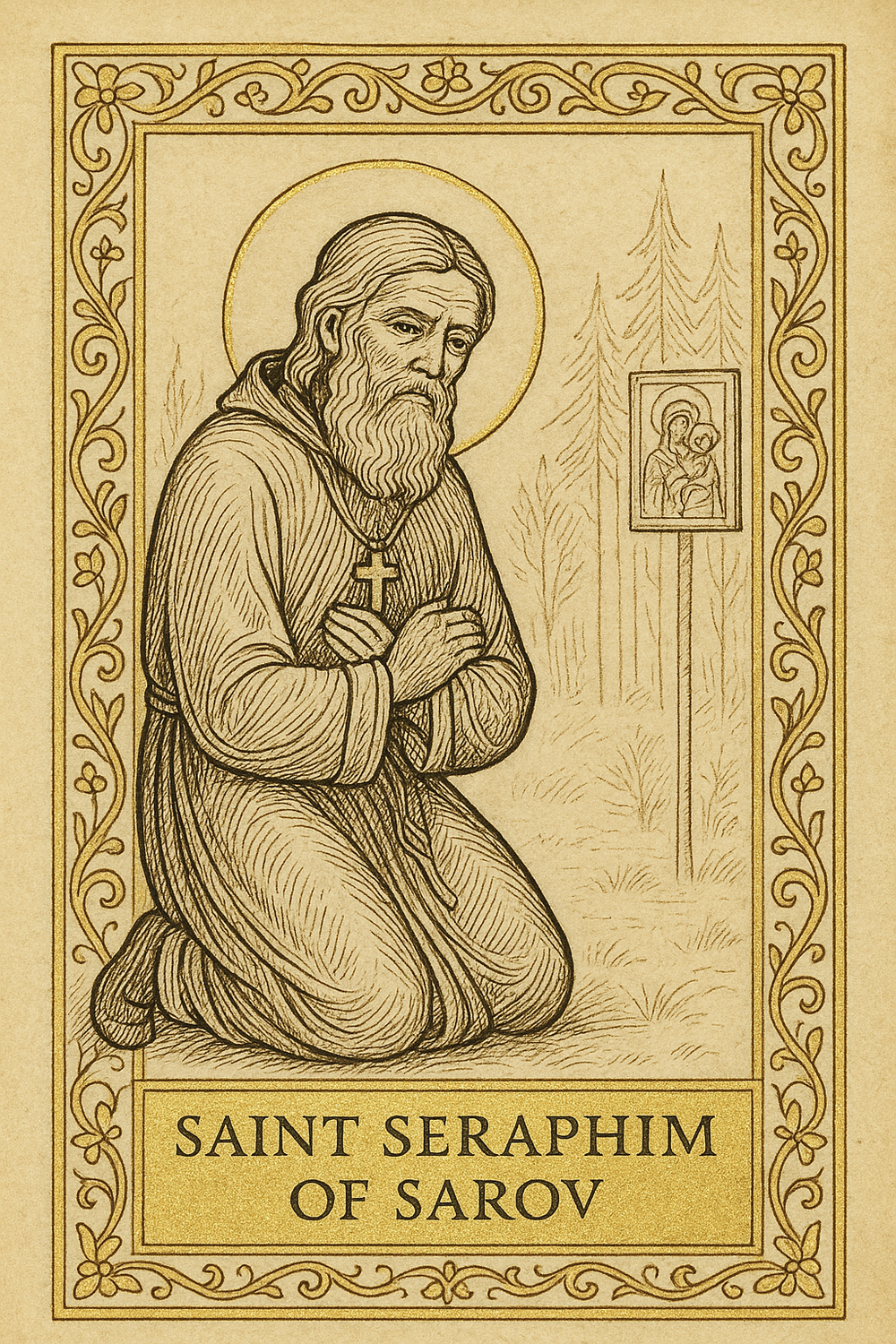
- Saint Seraphim of Sarov’s uncreated light, witnessed by Nicholas Motovilov in 1831
- Who It Is For
- Every baptized person — monks, married laypeople, parents, workers, without exception
- How It Begins
- Three pillars: ascesis (fasting and discipline), prayer (especially the Jesus Prayer), and the sacraments
- The Timeline
- Decades, not days — the Fathers describe gradual transformation over a lifetime of practice
- Where It Is Taught
- Practical Mysticism for Laypeople by A Servant of God — Chapters 2, 21, and 22
What Theosis Actually Means
Theosis is a Greek word, and like many of the most important words in Eastern Christian theology, it resists easy translation into English. The closest renderings are “divinization” or “deification,” and both of them sound, to modern ears, slightly alarming. They sound like a claim no sober theology should make. And yet theosis is not a fringe idea borrowed from some esoteric corner of Christian history. It is, according to the Eastern Christian tradition, the entire point of the Christian life.
The teaching is this: the purpose of human existence is not merely to be forgiven, not merely to behave morally, not merely to arrive at a peaceful afterlife. The purpose of human existence is to become, by grace, what God is by nature. Not God in essence — that distinction matters enormously, and this article will return to it — but a true participant in God’s own life, so intimately united to him that the line between Creator and creature becomes, in some mysterious way, permeable.
This is not a Western theological category, and that is precisely why it sounds unfamiliar to many Christians raised in a Roman Catholic or Protestant context. Western Christianity has tended to describe salvation primarily in legal and relational terms: justification, forgiveness, adoption, reconciliation. These categories are true and necessary. But the Eastern tradition asks a further question that the Western tradition has historically asked less often: forgiven and reconciled for what purpose? The Eastern answer is theosis. You were forgiven so that you could be transformed. You were reconciled so that you could be united. Salvation is not merely rescue. It is destination.
Every practice in the Eastern Christian spiritual life — the Jesus Prayer, fasting, the Divine Liturgy, confession, the veneration of icons — exists for this single purpose. None of these practices are ends in themselves. They are the means by which a human soul is gradually opened to receive what God has always wanted to give: himself.
Part II
Why Theosis Is Not Pantheism
The first question anyone encounters when learning about theosis is also the most important one: does this mean human beings literally become God? The answer, stated plainly and without qualification, is no. Theosis has never meant, and does not now mean, that a human being merges with God’s essence or ceases to be a distinct creature. That idea is pantheism, and the Eastern Christian tradition has rejected it as firmly and as consistently as it has rejected any heresy in two thousand years of doctrinal history.
The distinction the Fathers draw is between essence and grace, or, in the more technical language developed later, between essence and energies. God’s essence — what God is in himself, the inner reality of his being — remains forever beyond any created thing. No saint, no angel, no creature in any state of glorification will ever know or share in God’s essence. To claim otherwise would collapse the distinction between Creator and creature that the entire structure of Christian theology depends upon.
What theosis describes instead is participation in God’s energies — his activity, his self-communication, his grace, poured out toward creation. These energies are not a created substance standing between God and the soul. They are God himself, truly and really, acting outward in love. When the tradition says a person is “deified,” it means that person has been so thoroughly permeated by this divine energy that their whole being — body, mind, and spirit — begins to radiate what it has received. The person does not become God. The person becomes, increasingly and by grace, what God always intended a human being to be: a living icon of the divine, fully alive, fully transparent to the light that passes through it.
A Helpful Analogy
The Fathers often reached for the image of iron placed in fire. The iron does not become fire. Its essential nature as iron remains entirely intact. But the iron, having been placed in the flame long enough, takes on the properties of fire — it glows, it radiates heat, it can no longer be touched without being burned. Anyone observing the iron from a distance would say it has become fire-like, even luminous, even though a careful examination would confirm that it remains, in its essential nature, iron. This is the closest analogy the tradition offers for theosis: the human person, placed in the presence of God through prayer, the sacraments, and grace, over time begins to take on the qualities of the divine without ceasing to be human. The nature does not change. The participation does.
Part III
Saint Athanasius: “God Became Man So That Man Might Become God”
If theosis has a single founding sentence in the history of Christian theology, it belongs to Saint Athanasius the Great, the fourth-century Bishop of Alexandria who spent much of his episcopate defending the full divinity of Christ against the Arian heresy. In his treatise On the Incarnation, Athanasius wrote the line that has echoed through Eastern Christian theology for seventeen centuries: “God became man so that man might become God.”
This was not poetic exaggeration. It was, for Athanasius, the entire logic of the Incarnation. If Christ had not become fully human, humanity could not have been united to divinity. And if that union had no further purpose beyond a single historical moment in Bethlehem, the Incarnation would accomplish forgiveness but not transformation. Athanasius insisted it accomplished both. The Word took on human nature precisely so that human nature, in every person who receives Christ through faith and the sacraments, could be drawn into the very life of God.
Athanasius defended this teaching at enormous personal cost. He was exiled from his see five times by various emperors and rival bishops, spending roughly seventeen of his forty-five years as bishop in exile, often in hiding among the desert monks of Egypt. His steadfastness earned him the title Athanasius Contra Mundum — Athanasius Against the World. He defended the full divinity of Christ because he understood, with total clarity, what was at stake: if Christ was not fully God, then humanity’s union with God through Christ was impossible, and the entire promise of theosis collapsed.
His formula was carried forward by every major theologian of theosis who came after him — Saint Maximus the Confessor, Saint Gregory Palamas, Saint Symeon the New Theologian. Each developed and refined the doctrine, but none replaced Athanasius’s foundational insight: the Incarnation is not only about what God did. It is about what God intends to do, again and again, in every soul that receives him.
Part IV
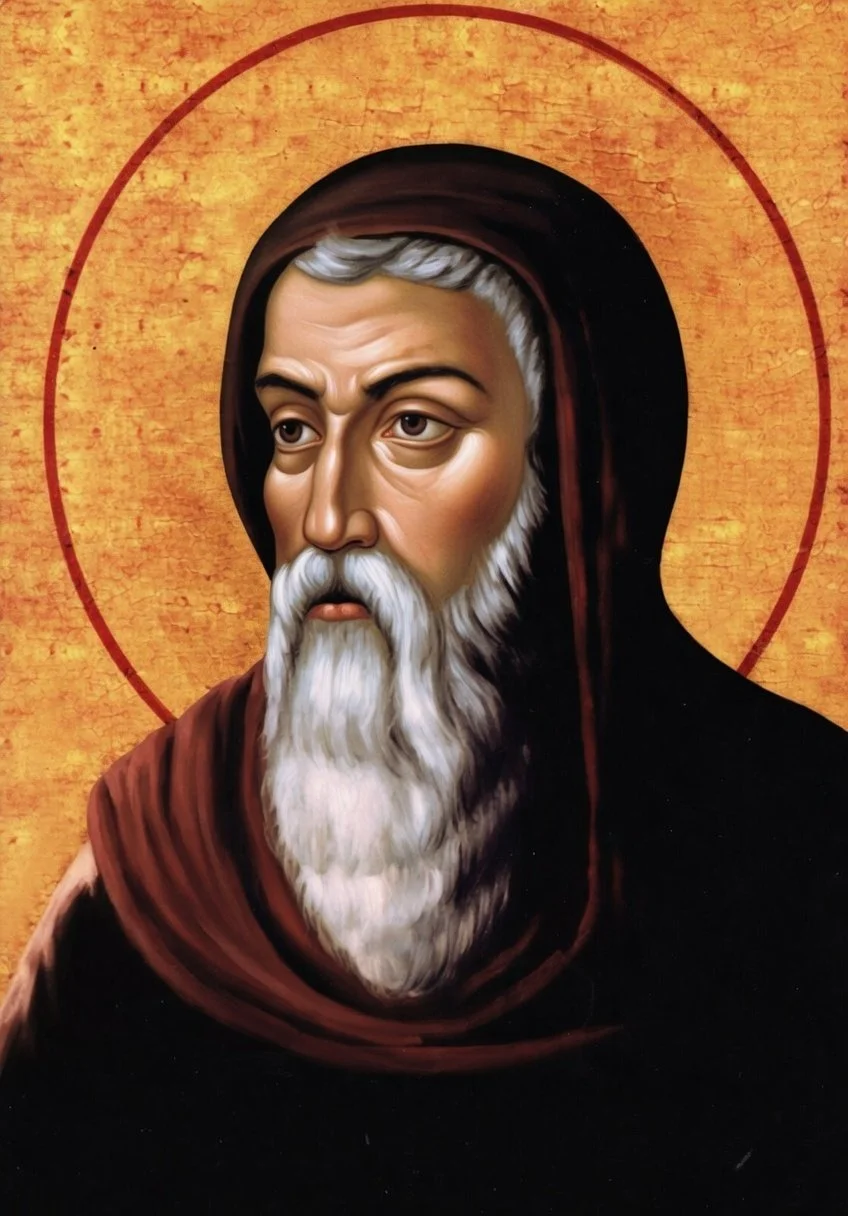
The Essence-Energies Distinction of Saint Gregory Palamas
For nearly a thousand years after Athanasius, the doctrine of theosis was affirmed but not fully explained at the level of theological mechanism. The unanswered question was this: how can a finite creature have any real contact with an infinite, utterly transcendent God without either reducing God to something created or claiming an impossible identity between Creator and creature? It was Saint Gregory Palamas, a fourteenth-century monk of Mount Athos, who provided the answer that the Eastern Church has held ever since.
Palamas distinguished between God’s essence and God’s energies. God’s essence is what God is in himself — utterly beyond human comprehension, beyond the reach of any created intellect, even the highest angels, even the saints in eternity. This is the apophatic truth at the heart of Eastern theology: God is always more than can be thought, said, or conceived. But God’s energies — his activities, his outpourings, his self-communication toward creation — are not created intermediaries standing between God and the world. They are God himself, going out from himself in love. When the saints describe encountering the uncreated light, or feeling the warmth of grace in prayer, they are describing a real encounter with God’s energy, which is God himself acting.
This distinction was not academic. Palamas developed it in direct defense of the hesychast monks of Mount Athos, who were being accused by a Western-trained theologian named Gregory Akindynos and a philosopher named Barlaam of Calabria of claiming an impossible and even heretical experience: that they could see God directly with their physical eyes during contemplative prayer. Palamas’s response was that they were not claiming to see God’s essence, which is indeed impossible, but God’s energy — the same uncreated light that the apostles Peter, James, and John witnessed at the Transfiguration of Christ on Mount Tabor.
The Councils That Settled the Question
The dispute came to a head at two church councils held in Constantinople, in 1341 and 1351. At both councils, Palamas’s theology prevailed. The essence-energies distinction, and the reality of theosis as direct participation in God’s uncreated energies, was affirmed as the official teaching of the Eastern Church. Palamas was later made Archbishop of Thessaloniki and was canonized shortly after his death. His feast is celebrated on the second Sunday of Great Lent throughout the Orthodox world, a placement that is itself a statement: theosis is not a peripheral doctrine. It stands at the center of the entire Lenten journey toward Pascha.
Part V
The Uncreated Light
One of the most distinctive and, to modern ears, most startling claims of Eastern Christian mysticism is that the light which shone from Christ at the Transfiguration on Mount Tabor — the light the Gospels describe as making his face shine like the sun and his garments become white as light — was not a created phenomenon, not a special effect produced for the benefit of the three apostles present. It was the uncreated light of God’s own glory, the visible manifestation of his energy, made perceptible to human eyes through grace.
The Eastern tradition teaches that this same uncreated light remains available to those who progress far enough along the path of theosis. It is not merely a historical event confined to a single mountaintop two thousand years ago. It is, the Fathers insist, the same divine energy that the deified soul begins to perceive and, in the most advanced and rare cases, even visibly radiate. This is not metaphorical language stretched for spiritual effect. The tradition treats it as a literal claim about the nature of advanced sanctity: the saints who reach the deepest stages of union with God become, in some real and perceptible way, luminous with the light that the apostles saw on Tabor.
This claim would remain a striking but unverifiable theological assertion if it had not been documented, in living memory, in a specific and well-attested historical account. That account belongs to Saint Seraphim of Sarov.
Part VI
Saint Seraphim of Sarov: Theosis Made Visible
Born Prokhor Moshnin in the city of Kursk, Seraphim entered monastic life at the Sarov Hermitage at the age of nineteen and spent the rest of his long life in progressively deeper stages of ascetic discipline and prayer. He spent years living entirely alone in a forest hut, observing extreme fasts, praying the Jesus Prayer continuously, and at one point standing in continuous prayer on a granite boulder for a thousand consecutive days. Later in life, after a sustained period of complete silence known as the “pillar of silence,” he emerged from his cell to become one of the most beloved spiritual fathers in the history of the Russian Church, greeting every visitor — peasant or noble — with the same joyful words: “My joy! Christ is risen!”
The most famous account of Seraphim’s life comes from a layman named Nicholas Motovilov, who recorded a conversation he had with the saint in the winter of 1831. Motovilov asked Seraphim how a person could know with certainty that they were in the grace of the Holy Spirit. Rather than answering only in words, Seraphim took Motovilov by the shoulders and asked him to look at him directly. Motovilov later wrote that he could not look, because Seraphim’s face had become brighter than the sun, and that he felt warmth and a profound peace surrounding them both, even though it was the middle of a Russian winter and they were sitting outdoors in the snow. Seraphim explained that this was the same grace of the Holy Spirit that the apostles experienced at the Transfiguration — the uncreated light, made visible, in answer to a sincere question about the reality of grace.
This account is not treated by the Eastern Church as a charming legend. It is treated as the single most thoroughly documented and theologically significant confirmation, in the modern era, of what theosis actually promises. Seraphim was not claiming a private mystical experience inaccessible to ordinary verification. He produced, for a skeptical and educated layman who asked a direct question, a direct and shared sensory experience of the very reality that Athanasius and Palamas had described in theological language centuries earlier. The doctrine and the lived experience meet, in this account, with almost startling clarity.
Part VII
Saint Silouan the Athonite: Theosis Through the Dark Night
Saint Silouan’s path to theosis looked nothing like Seraphim’s. Born Semyon Antonov to a Russian peasant family, he entered the monastery of St. Panteleimon on Mount Athos as a young man and, early in his monastic life, experienced a brief but overwhelming vision of Christ that left him with what the tradition calls an unshakeable certainty of God’s reality. Almost immediately afterward, that consolation was withdrawn entirely, and Silouan entered a period of spiritual darkness that lasted, by his own account, fifteen years.
During those years, Silouan continued every practice of the monastic life — the Jesus Prayer, the liturgical cycle, manual labor, obedience — while experiencing what he described as states close to despair, including a sustained sense of abandonment by God so severe that he once described feeling himself standing at the edge of hell. He did not stop praying. He did not abandon the practices. He continued, exactly as the tradition counsels, doing everything the same even though it felt pointless, because the feeling, as the tradition insists, is not the same as the reality.
After fifteen years, the darkness lifted, and Silouan emerged into a sustained peace and humility that those who knew him described as radiant in its own quiet way — not the dramatic luminosity of Seraphim’s encounter with Motovilov, but a settled, unshakeable gentleness that drew people to him for the remainder of his life. His most famous teaching, preserved by his disciple Elder Sophrony Sakharov, was the principle: “Keep your mind in hell, and despair not.” It is one of the most theologically dense single sentences in the modern Eastern tradition — an instruction to remain honest about one’s own sinfulness without ever surrendering hope in God’s mercy.
Silouan’s story matters for anyone pursuing theosis today because it demonstrates that the path does not always look like Seraphim’s luminous transfiguration. Sometimes it looks like fifteen years of darkness, faithfully endured. Both are theosis. Both are real participation in the life of God. The tradition teaches that the dryness itself can be one of the deepest forms of purification, burning away attachments to spiritual consolation that the soul did not know it had, until nothing remains to hold onto but God himself.
Part VIII
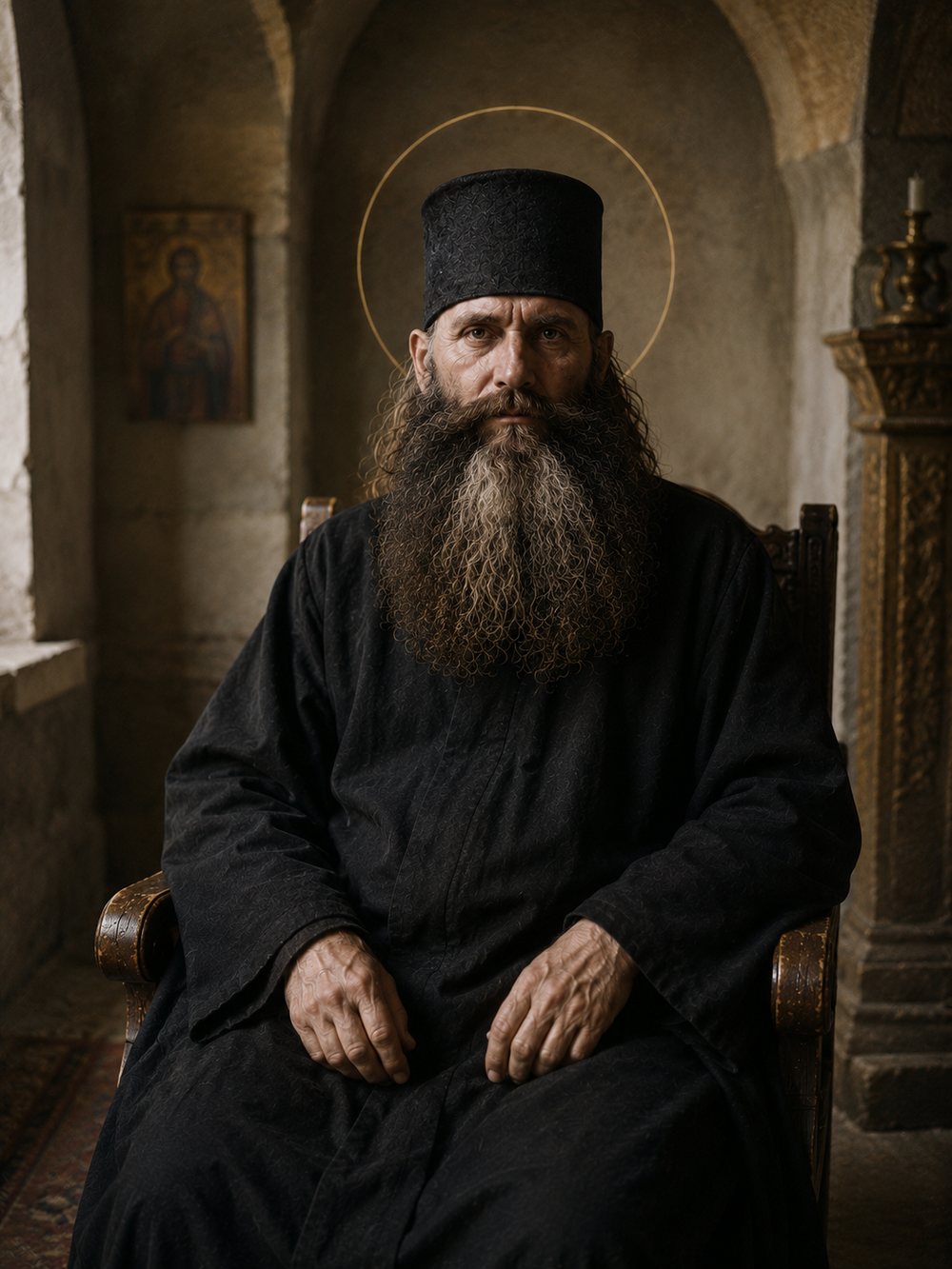
What Theosis Looks Like in an Ordinary Life
It would be a mistake to read the accounts of Seraphim and Silouan and conclude that theosis is reserved for extraordinary mystical experiences accessible only to monks who spend decades in extreme solitude. The tradition is emphatic on this point: theosis is happening, slowly and often imperceptibly, in the life of anyone who genuinely practices the disciplines of prayer, fasting, and the sacraments — whether or not they ever experience anything resembling Seraphim’s luminosity or Silouan’s fifteen years of darkness.
The Fathers describe the visible signs of theosis in remarkably unglamorous terms. The passions — anger, lust, pride, fear, despair — do not vanish all at once. They lose their grip gradually, and almost always through replacement rather than suppression. Where anger lived, patience grows. Where pride dominated, humility emerges, not as performance but as genuine indifference to being thought well of. The person becomes, in small and cumulative ways, more present to the people around them, slower to react, quicker to forgive, less consumed by the need to be right.
This is why the tradition insists that the fruit of genuine theosis is always visible in relationships, even when the interior practice itself remains hidden. A husband does not need to announce his spiritual progress to his wife. If the Jesus Prayer and the sacraments are actually transforming him, she will notice that he has become kinder, more patient, less defensive — not because he told her about his prayer life, but because the prayer life has begun, in however small a measure, to bear the fruit theosis promises.
Part IX
Theosis Is Not Only for Monks
One of the most persistent myths surrounding the mystical life is that theosis belongs to a spiritual elite — monks, hermits, and a handful of extraordinary saints — while ordinary Christians are expected to settle for a simplified, lower tier of the spiritual life. The Eastern Christian tradition rejects this myth directly. The call to theosis is, in the words of Saint Symeon the New Theologian, universal: addressed to every baptized person without exception, without qualification.
The history of Eastern Christianity confirms this in practice. Saint Juliana of Lazarevo was a married woman who raised thirteen children while practicing a depth of prayer and charity that earned her recognition as a saint. She did not set aside her responsibilities to pursue union with God. She pursued union with God within them — while cooking, while nursing, while managing a household of considerable size and complexity. The Philokalia itself, the great anthology of Eastern spiritual texts that forms the backbone of the hesychast tradition, was deliberately compiled and published in the eighteenth century not for monasteries but for the general Christian public, precisely because Saints Nicodemus of the Holy Mountain and Macarius of Corinth understood that the treasures of contemplative theology belonged to every believer.
This means that a parent exhausted from a sleepless night, a worker offering an ordinary shift to God, a married couple practicing patience through the friction of daily life — all of these are, in their own circumstances, walking the same path toward theosis that Seraphim walked in his forest hermitage and Silouan walked through fifteen years of darkness on Mount Athos. The setting differs. The destination does not.
Part X
The Three Pillars That Lead Toward Theosis
Theosis is never earned through technique. The tradition is firm on this point: you cannot will your way into union with God through sheer effort, the way you might master a skill through practice. But the practices are not therefore unimportant. They dispose the soul to receive a grace that is always being offered. Three pillars, taken together, are what the Eastern tradition identifies as the foundation for the entire mystical life.
Ascesis
Ascesis, the voluntary discipline of fasting, simplicity, and self-denial, loosens the grip of the passions so the soul can turn toward God without the constant drag of disordered desire. It does not earn theosis. It creates space for it.
Prayer
The Jesus Prayer — “Lord Jesus Christ, Son of God, have mercy on me, a sinner” — is the primary vehicle of contemplative prayer in the Eastern tradition. Prayed with patience over years, it gradually descends from the lips, to the mind, to the heart, becoming, in the words of the tradition, not something a person does, but something that is being done in them.
The Sacraments
The Eucharist is where theosis is not merely prepared for but actually accomplished: God entering the body, uniting himself to human flesh in the most direct and physical encounter possible this side of eternity. Regular confession clears away what stands between the soul and the grace it is seeking to receive.
None of these practices require a monastery. They require willingness, patience, and the grace of God, which the tradition insists is already being offered, right now, whether it is felt or not.

Part XI
A Prayer for the Path of Theosis
Lord Jesus Christ, Son of God, you who became man so that I might become, by your grace, what you are by nature — I come to you today not asking for visions, not asking for the light that Saint Seraphim saw, not even asking for an end to whatever darkness I may be carrying. I ask only for the grace to continue.
Teach me to pray without needing to feel your presence. Teach me to fast without needing to see results. Teach me to receive your sacraments with the hunger of someone who knows their own poverty, and the trust of someone who knows your mercy is greater than that poverty.
I do not ask to become you. I ask only to become, slowly and by your grace, the person you made me to be — transparent to your light, however dim my own light may presently be, however long the road may still be ahead of me.
Lord Jesus Christ, Son of God, have mercy on me, a sinner, and complete in me the work your grace has already begun. Amen.
Part XII
Frequently Asked Questions About Theosis
You Were Not Made to Stay the Same
Theosis is not a doctrine to file away under advanced theology. It is the destination of every prayer you have ever prayed, every confession you have ever made, every Eucharist you have ever received. Saint Athanasius staked his life on it. Saint Gregory Palamas defended it before church councils. Saint Seraphim of Sarov became luminous with it. Saint Silouan walked fifteen years of darkness to reach it. And the same grace that transformed all of them is, the tradition insists, already at work in you — right now, whether you feel it or not.
Carry a saint of theosis with you. Let their prayer card be a daily reminder that the path is real, that it has been walked before, and that you are not walking it alone.
Get the Saint Seraphim Prayer Card →