Saint Arsenius the Great: Roman Deacon, Desert Father and Teacher of Silence
From the court of Emperor Theodosius to the cells of Scetis and Troe
At a Glance
- Born
- Rome, traditionally about 354 (UNCERTAIN)
- Died
- At Troe (Turah) near Cairo, about 445 to 450 (UNCERTAIN)
- Feast days
- May 8 (Byzantine and Roman Martyrology), July 19 (older Latin calendars), 13 Bashans or about May 21 (Coptic)
- Known as
- Arsenius the Deacon, Abba Arsenius, Arsenius of Scetis and Turah
- Way of life
- Court official turned hermit in the Egyptian desert
- Veneration
- Ancient cult; no formal canonization date is recorded
- Who Was Saint Arsenius the Great?
- Early Life and Roman Background
- The Imperial Court and the Sons of Theodosius
- The Call to the Desert
- Life in the Cells of Scetis
- His Teaching: Silence, Humility and Tears
- Raids, Flight and the Last Years
- Death, Burial and Veneration
- Writings and What We Can Trust
- Saint Arsenius and the Eastern Churches
- Frequently Asked Questions
Who Was Saint Arsenius the Great?
Saint Arsenius the Great, also called Arsenius the Deacon or Abba Arsenius, was a Roman Christian of the later fourth century who gave up a life near the imperial court to become a hermit in Egypt. He lived first at Scetis, the great monastic region of the Wadi El Natrun, and later at Troe, modern Turah, near Cairo. The Church remembers him as one of the most austere and most respected of the Desert Fathers.
Our knowledge of him comes mostly from the Sayings of the Desert Fathers, a collection of short stories and teachings gathered in the fifth and sixth centuries. His section is one of the longest in the alphabetical collection. Because these texts were shaped by later compilers, scholars treat many details as tradition rather than firm history. This article marks what is well supported and what is not, using the labels TRADITION and UNCERTAIN.
Early Life and Roman Background
Arsenius is traditionally said to have been born in Rome around 354. The year is UNCERTAIN. Lucien Regnault, who wrote the entry on him in the Coptic Encyclopedia, thought it probable that he came from a senatorial family, but no source names his parents or his rank. Calling him a senator, as some popular accounts do, goes beyond the evidence. Belonging to a senatorial family and holding the office are different things.
He received the education of a Roman of means, with Greek and Latin letters, rhetoric and philosophy. The Sayings preserve a memorable contrast between this learning and the plain wisdom of Egyptian monks. In one story he is said to have asked an unlettered Egyptian elder for advice, while knowing Greek and Roman learning well. The point of the story is humility, and it shows how the tradition remembered him.
Later biographies call him a deacon of the Roman Church, sometimes under Pope Damasus I. The modern Roman Martyrology repeats this as a tradition. No ordination record survives, so the diaconate is TRADITION. The name Arsenius the Deacon has nevertheless stayed with him for centuries.
The Imperial Court and the Sons of Theodosius
The best known part of his story places him in Constantinople around 383, serving Emperor Theodosius I and teaching the emperor's sons, Arcadius and Honorius. The older Catholic Encyclopedia says he held this post for about eleven years. These figures cannot be independently confirmed, and they are TRADITION.
Regnault pointed out that the Sayings describe Arsenius as a kind of father to the princes, and that later readers may have turned this into a formal appointment as tutor. So the link to the court is likely, while the exact office is UNCERTAIN. What matters for his story is the contrast. He had access to wealth, comfort and influence, and he chose another life.
A famous saying records that he prayed to be shown the way to be saved. In that story he heard a voice telling him to flee from people, and he left the court. The account is TRADITION. It appears at the very start of his section in the Sayings and has shaped how every later generation understands his calling.
The Call to the Desert
According to the Sayings, the first command Arsenius received was to flee, and the second was to be silent and to pray always. These short words became the center of his spirituality. They are remembered in the Orthodox tradition as the guide to his whole life.
He left the court and traveled to Egypt, where he came to Scetis. Regnault places his arrival about 390, though other reconstructions suggest a date near 394 to 400. All of these are estimates. A story told in the older biographies says that he first went to Saint John the Dwarf and was left ignored at a meal, with bread thrown to him as a test of his humility. This episode is TRADITION. It makes the point that he arrived as a man of rank and had to learn the monastic life from the beginning.
Life in the Cells of Scetis
Arsenius lived as an anchorite, a monk who stays alone in his cell. He prayed for long hours, ate little, slept little and earned his bread by weaving palm leaves into rope and baskets. A well known detail says he kept the water used to soak the palm leaves for a whole year, letting it grow foul, as a deliberate answer to the perfumes and luxuries of his earlier life. The detail comes from the Sayings and is TRADITION.
He did not welcome visitors. Even high church figures, including the Archbishop Theophilus of Alexandria in one story, found him unwilling to speak. The Sayings explain this as a desire to protect his solitude, not as an insult to the bishop. In another story the contrast is drawn with Abba Moses the Ethiopian, who received guests warmly. A vision recorded in the text suggests that both ways of life pleased God.
Solitude did not make him a stranger to others. Alexander, Zoilus and Daniel are named in the Sayings as disciples or companions who carried on his memory. Through them his short, hard sayings entered the monastic tradition.
His Teaching: Silence, Humility and Tears
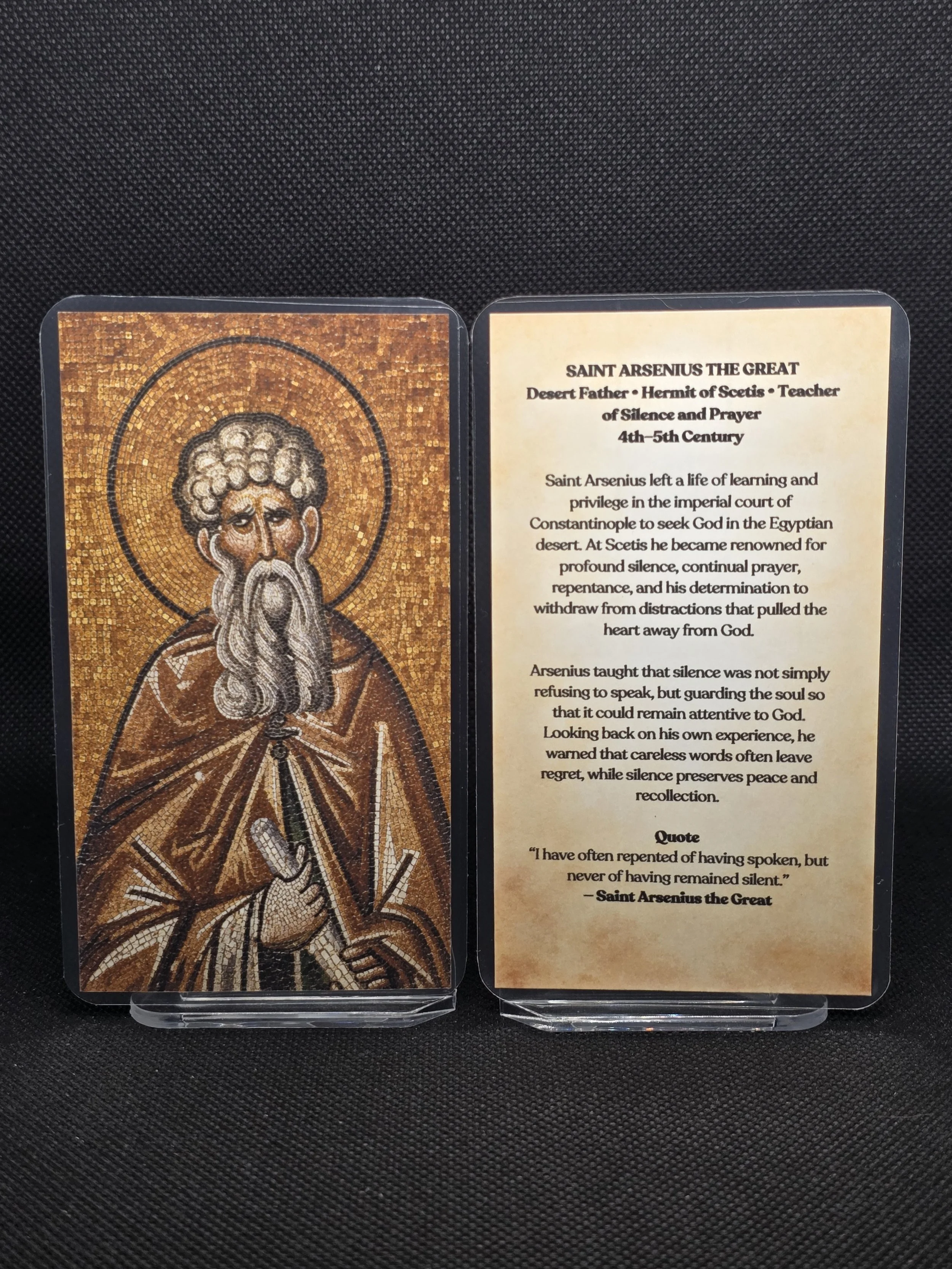
The center of Arsenius's teaching is guarding the heart through silence. A saying attributed to him says that he often regretted speaking and never regretted keeping silent. We cannot confirm the exact words, but the idea fits everything else the tradition records about him. For Arsenius, silence was not only a rule but a way of listening to God.
He also taught humility by example. He is said to have worn old, poor clothes after leaving the court, and to have refused honor from anyone. The Sayings stress that he judged no one and learned from simple people, including Egyptian peasants and fellow monks of low rank. Pride was the enemy he feared most.
Finally, the tradition remembers his tears. Later accounts describe his weeping as so constant that it marked his face. This is TRADITION in its details, but it explains why the Byzantine hymns for his feast speak of his tears and of repentance. He is a model of sorrow for sin that leads toward hope, not despair.
Raids, Flight and the Last Years
Scetis was attacked more than once. The Coptic Encyclopedia lists raids by nomads in 407, 434 and 444. William Harmless, a scholar of the Desert Fathers, treats the first raid as a turning point for Egyptian monasticism. Many monks left, and Arsenius was among those who moved away from the area.
The Sayings link his sorrow over Scetis to the fall of Rome to Alaric in 410, as if the two disasters grieved him together. It is not certain which raid finally drove him out. According to one saying about his life, he spent forty years at Scetis, then ten at Troe, three at Canopus near Alexandria, and two more at Troe before his death. These figures are part of the transmitted tradition and cannot be used to fix exact dates.
In these years he remained devoted to the cell. When asked why he fled from people, the tradition has him answer that God knows he loves them, but he cannot be with God and with people at the same time. The exact wording belongs to the tradition, yet it names the tension he lived with.
Death, Burial and Veneration
Arsenius is said to have died at an advanced age, traditionally around ninety five, at Troe. The date is UNCERTAIN, and sources suggest 445, 449 or 450. The Sayings say that he asked his disciples not to hold elaborate meals in his memory, and one story even has him asking to be buried without honor. This is TRADITION, but it fits his lifelong dislike of fame.
A monastery at Turah, later known as Dayr al-Qusayr, became associated with his tomb. A medieval tradition attributed to Eutychius of Alexandria says Emperor Arcadius built it, but Arcadius died in 408, years before Arsenius is thought to have died. The story cannot be correct as told. The location of any relics today is UNCERTAIN.
No formal canonization date exists, because his veneration began in the ancient Church before later procedures. The Roman Martyrology lists him on May 8, as do the Byzantine calendars. Older Latin martyrologies gave July 19. The Coptic Church keeps his departure on 13 Bashans, usually May 21.
Writings and What We Can Trust
Arsenius did not leave a book. The alphabetical Sayings are the main source, containing about forty short items about him. Other writings have been attributed to him, including an exhortation printed in Patrologia Graeca volume 66 and a comment on a gospel passage, but their authenticity is disputed.
A letter preserved in Georgian is more interesting. Gerard Garitte published it in 1955, and Michel Van Parys later judged its authenticity probable, though not certain. The letter praises remaining in one's cell, silence and constant prayer, which matches the Sayings. Still, a careful reader should treat the collection as a portrait shaped by the monks who loved him, which is itself a valuable witness to what the early Church admired.
Some modern writers suggest a connection with Evagrius Ponticus or with ideas shaped by Origen. Regnault mentions such links as a hypothesis. There is no evidence that Arsenius was ever condemned or disciplined.
Lord Jesus Christ, you called Saint Arsenius from the halls of power to the quiet of the desert. Teach me to leave what hinders me and to love silence. Give me a humble heart that does not judge, and the grace of tears for my sins. When I am restless, call me back to prayer. When I fail, let me begin again. Through the prayers of your servant Arsenius, have mercy on me and save me. Amen.
This prayer was written for this page. It is not an official liturgical text.
Saint Arsenius and the Eastern Churches
Arsenius lived before the divisions between East and West, so he belongs to all Christians. Byzantine Orthodox and Byzantine Catholic calendars keep his feast on May 8, and the Orthodox Church in America publishes a troparion and a kontakion for him. The Coptic Church remembers him in the Synaxarium on 13 Bashans, and historical Maronite and Syriac sources also recorded a commemoration on July 19.
His importance for Eastern spirituality lies in what he taught about silence, watchfulness and repentance, themes later developed in Eastern monastic writing. It would be wrong, however, to call him a founder of hesychasm or to credit him with the later Jesus Prayer. He belongs to the earlier stage of Egyptian monasticism from which those traditions drew.
For readers today, he is a reminder that the way to God can pass through the quiet of an ordinary day. Many Orthodox and Catholic monasteries still read his sayings, and his short counsel to flee, be silent and pray always remains one of the best known lines of desert wisdom.
Frequently Asked Questions
Begin Again in Silence
Saint Arsenius left almost no writing, yet his short sayings still reach readers after sixteen centuries. If you carry this prayer card, let it remind you to find a few quiet minutes each day, to speak less and pray more, and to begin again whenever you fall.
View Prayer Card