Saint Euthymius the Great: Abbot of the Judean Desert, Founder of Lavras and Defender of Chalcedon
From Melitene to the wilderness between Jerusalem and Jericho
At a Glance
- Born
- Melitene in Lesser Armenia, about 377 (traditional date)
- Died
- January 20, 473, at his lavra near Jerusalem
- Feast day
- January 20 in the Byzantine calendar and the Roman Martyrology
- Known as
- Euthymios the Great, Venerable and God-bearing Father
- Way of life
- Priest, monk, hermit and abbot in Palestine
- Veneration
- Ancient cult; no formal canonization date is recorded
- Who Was Saint Euthymius the Great?
- Early Life in Melitene
- The Journey to Palestine and the Cave of Theoctistus
- The Lavra Near the Jericho Road
- Teacher of Monks and Friend of the Arabs
- Chalcedon and the Empress Eudocia
- Death and Burial
- What the Archaeology and the Sources Tell Us
- Miracles and Devotion
- Saint Euthymius and the Eastern Churches
- Frequently Asked Questions
Who Was Saint Euthymius the Great?
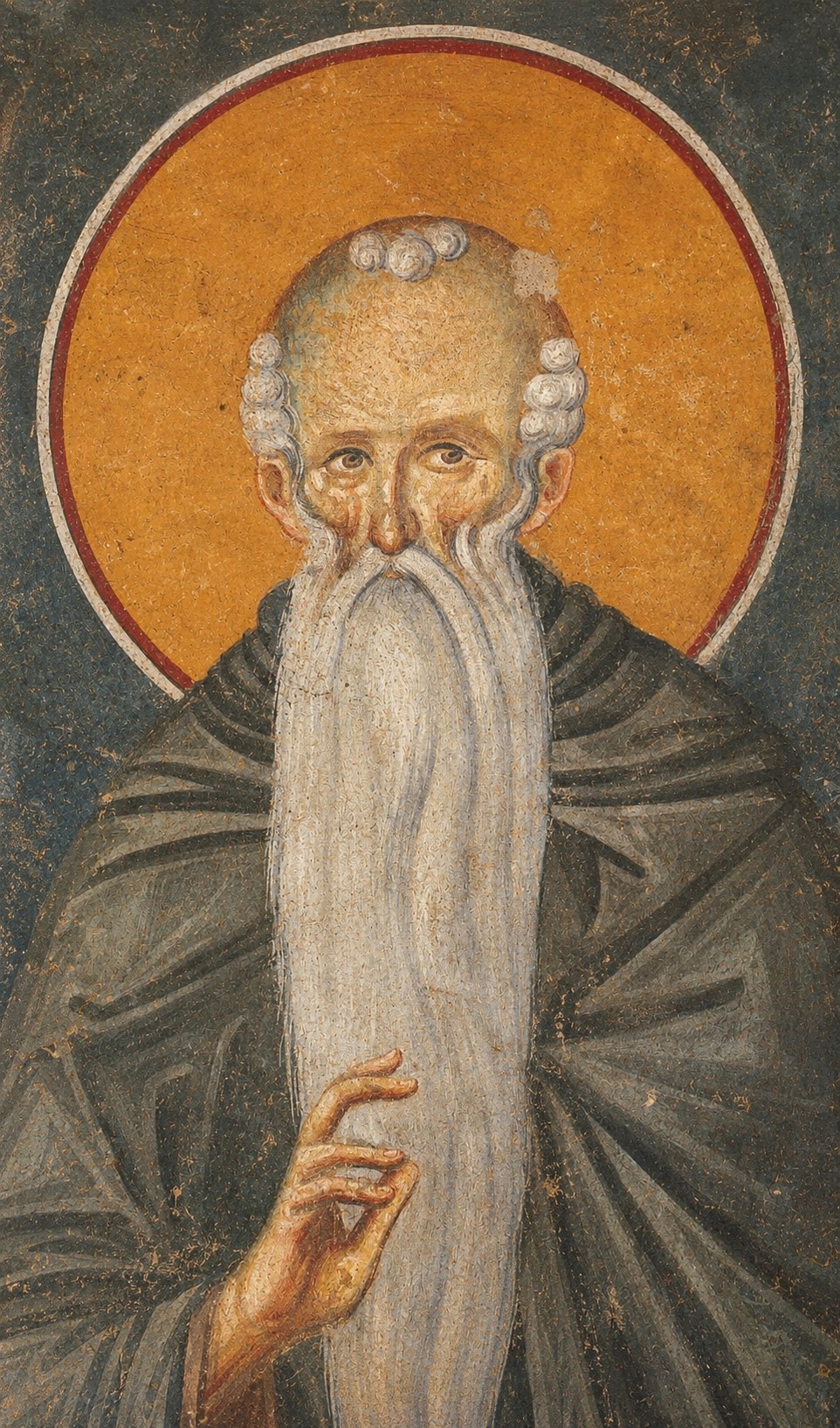
Saint Euthymius the Great, also written Euthymios, was a monk, priest and abbot who lived in Palestine in the fifth century. He is remembered as one of the founders of the monastic world of the Judean Desert, the rocky wilderness between Jerusalem, Jericho and the Dead Sea. In Greek and Byzantine usage he is called the Venerable and God-bearing Father.
The main source for his life is the Life of Euthymius by Cyril of Scythopolis, written in the sixth century. Cyril gathered memories from monks who knew the saint or had heard of him from older brothers. This makes the account valuable but also shaped by devotion. In this article, events that rest on that devotion alone are marked TRADITION, and dates or details that cannot be confirmed are marked UNCERTAIN.
Early Life in Melitene
Euthymius was born in Melitene, a city in the region then called Lesser Armenia, near the upper Euphrates. The modern city of Malatya in Turkey stands in the same area. His birth year is traditionally given as about 377, though no birth record survives and this is UNCERTAIN.
His parents are named in the tradition as Paul and Dionysia, Christians of good standing who had been childless for a long time. TRADITION says they prayed for a son and were told that he would bring joy to the Church, which is why he was named Euthymius, a Greek name linked with good cheer. Some later writers call Dionysia a deaconess, but the principal short biographies do not agree on this, so it is UNCERTAIN.
After his father died, his mother placed him in the care of her brother, the priest Eudoxius. Eudoxius brought him to Bishop Otreius of Melitene, who educated him and made him a reader in the church. He later became a priest and was given charge of the monasteries of the diocese. He was therefore trained inside the organized Church before he ever became a wanderer in the desert.
The Journey to Palestine and the Cave of Theoctistus
Around 405 or 406, when he was about twenty nine, Euthymius left Melitene for Jerusalem. Authors differ slightly on the year. He visited the holy places and then settled at the lavra of Pharan, a monastic community connected with the earlier tradition of Saint Chariton.
At Pharan he met a monk named Theoctistus, and the two became close friends. Both wanted more time for prayer than the busy life of the community allowed, so they began to withdraw together into the wilderness. Cyril records that they found a cave in a remote ravine and settled there, in a passage dated by modern editors to 411.
The cave grew into a community. Euthymius preferred solitude, so Theoctistus took charge of the gathering monks and the monastery that became known by his name. The pattern is important for the rest of the story. Euthymius remained the spiritual guide, while others managed the practical tasks of common life.
The Lavra Near the Jericho Road
Euthymius also lived alone in the wilderness of Ruba near the Dead Sea and later in the region of Ziph. Tradition links one of his caves with the refuge of David, but the exact place has not been identified and is UNCERTAIN. Eventually he founded his own lavra near the road that runs between Jerusalem and Jericho, in the place now called Khan al-Ahmar.
A lavra was different from a regular monastery. The monks lived in separate cells, often caves or small huts, so that they could pray in near solitude, but they gathered for worship and counsel at a common center. Euthymius believed this was a good path for monks who had first learned obedience in community.
The dates for the foundation are not settled. The Catholic Encyclopedia gives about 420 for the founding and 428 for the church, while other sources place the founding about 428 and the church consecration about 429. These probably reflect different stages of the same growth, and we do not try to force them into one date.
Teacher of Monks and Friend of the Arabs
Euthymius taught humility, obedience, moderate fasting, manual work, prayer and freedom from possessions. According to his biography he warned monks against fasting that was meant to impress others and expected everyone to take part in the common worship. His rule was gentle but steady, and he valued the practical tasks of hospitality for the poor and for strangers.
Among those he influenced was the Arab chieftain Aspebetus, who became a Christian and took the name Peter. He later served as bishop of the Arab camps in Palestine and is recorded at the Council of Ephesus in 431. This detail gives the story an independent footing, because the bishop and his attendance can be confirmed apart from the miracle stories connected with his conversion.
Euthymius also helped to form Saint Sabas the Sanctified. The tradition says that he received the young Sabas but sent him first to Theoctistus for training in community life, before allowing him to practice stricter solitude. In this way two great generations of Judean monks were linked.
Chalcedon and the Empress Eudocia
Euthymius lived during the great arguments about the person of Christ. The Council of Ephesus in 431 condemned Nestorius, and Euthymius supported its teaching. The Council of Chalcedon in 451 taught that Christ is one person in two complete natures, divine and human, and Euthymius accepted this teaching. He never attended the council himself, but he became an important defender of its decisions among the monks of Palestine.
This mattered because many monks and clergy in Palestine opposed Chalcedon. Cyril describes Euthymius as a firm opponent of the party led by the monk Theodosius. A word of care is needed here. Older biographies often call all opponents of Chalcedon Monophysites. Modern dialogue between Catholics and the Oriental Orthodox Churches distinguishes their Miaphysite teaching from the teaching of Eutyches, which denied the full humanity of Christ.
The widowed Empress Aelia Eudocia lived in Palestine in the 450s and supported churches, monasteries and works of charity. Cyril says she came to accept Chalcedon through the guidance of Euthymius and also built a reservoir and a church near his lavra. How much of her change of heart came from him personally is UNCERTAIN, since the detailed story comes mostly from Cyril.
Death and Burial
Euthymius died on January 20, 473, at his lavra. Traditional sources give his age as ninety six or ninety seven. The exact day of his birth is not known, so the age is UNCERTAIN. Cyril says he gathered his monks before his death and urged them to hold to their rule, to attend worship, to practice humility and to welcome strangers.
Patriarch Anastasius of Jerusalem is said to have attended the funeral together with many monks and clergy, including Saint Gerasimus of the Jordan. He was first buried at his monastery and later moved into a larger tomb, built under the care of the deacon Fidus. Cyril records the translation on May 7, in the year of his death or the next, a point that remains UNCERTAIN.
The present location of any relics attributed to him is also UNCERTAIN. The Orthodox tradition tells of a Russian pilgrim, Abbot Daniel, who saw the relics in the twelfth century, but this should be read as a pilgrim memory and not as proof of what survives today.
What the Archaeology and the Sources Tell Us
The ruins at Khan al-Ahmar give independent support for the story. Archaeological studies identify the site as the monastery of Euthymius and describe its change from a lavra into a regular community about 482, its destruction in an earthquake in 659 and its later rebuilding, including work in the Crusader period. The monastery therefore survived long after the saint.
Euthymius left no known book, letter or written rule. His teachings survive only as instructions and sayings reported by Cyril of Scythopolis, so each saying should be treated as a report and not as a text from his own hand. Cyril wrote decades after the saint died and wanted to honor him and defend the Chalcedonian tradition, so the work is indispensable but should not be taken as a transcript of every event.
Some other points remain open. His ethnic identity is called Armenian in many Church sources, but modern national categories do not fit a man of that time and place. Euthymius also was not the first monk in Palestine, since Chariton and others came before him. His importance is that he strengthened and shaped that heritage.
Miracles and Devotion
Euthymius is remembered as a wonderworker. TRADITION says he prayed over Terebon, the son of Aspebetus, who was ill, and that the boy recovered, leading his father and many Arabs to become Christians. The Christian community that resulted is better documented than the healing itself.
Another story says that about four hundred Armenian pilgrims arrived at the monastery when supplies were low. Euthymius told the monks to feed them, and the bread, wine and oil were found to be replenished. Other accounts say the brothers saw fire around him during the Divine Liturgy, and that he knew the hidden thoughts of his disciples and foretold his own death. All of these are TRADITION.
A touching story is told of his disciple Dometian, who is said to have seen Euthymius after his death inviting him to follow. Dometian died soon afterward and was buried near his master. The most reliable evidence for devotion is not the miracle collection but the continued celebration of his feast, the survival of his biography and the long life of the monastery.
Lord Jesus Christ, you led Saint Euthymius from his home to the wilderness and made him a father to many. Teach me to love quiet prayer and to welcome those you send to my door. Give me humility in my work, steadiness in my faith and a generous heart toward the poor and the stranger. Through his prayers, grant peace to my life and to your Church. Amen.
This prayer was written for this page. It is not an official liturgical text.
Saint Euthymius and the Eastern Churches
Euthymius belongs to the shared heritage of Byzantine Christians. The Byzantine Catholic Metropolitan Cantor Institute gives January 20 as his feast and lists him with Anthony and Sabas among the saints named at the preparation of the gifts. The Greek Orthodox Archdiocese of America publishes the hymns for his day, and Orthodox calendars that follow the Julian reckoning keep the feast on February 2 of the civil calendar.
His life shows how solitary and shared forms of monastic life can support each other. He sought quiet, yet he accepted responsibility for disciples, poor visitors and new Christian communities among the Arabs. His defense of Chalcedon also ties monastic life to the confession of faith, an important theme in both Byzantine Catholic and Eastern Orthodox tradition.
It would be wrong to say that every Eastern Christian tradition honors him in the same way. The Oriental Orthodox Churches, which did not accept Chalcedon, do not share his liturgical place. For Byzantine Catholics and Eastern Orthodox readers, however, he remains a trusted guide to the discipline and hospitality of the desert.
Frequently Asked Questions
Quiet That Leads to Charity
Saint Euthymius sought the silence of the desert and yet welcomed pilgrims, the poor and new Christians. May this prayer card remind you that real quiet in prayer makes room for kindness to others.
View Prayer Card