Saint Sabas the Sanctified: Founder of Mar Saba, Leader of Palestinian Monks and Defender of Chalcedon
From a Cappadocian village to the Great Lavra in the Kidron Valley
At a Glance
- Born
- Mutalaska near Caesarea in Cappadocia, 439
- Died
- December 5, 532, at the Great Lavra (some older works say 531)
- Feast days
- December 5; return of relics October 13 (Julian), October 26 (Gregorian)
- Known as
- Sabas the Sanctified, Venerable and God-bearing Father, Child-Elder
- Foundation
- The Great Lavra of Mar Saba, about 483
- Veneration
- Ancient cult; no formal canonization date is recorded
- Who Was Saint Sabas the Sanctified?
- Childhood in Cappadocia
- Journey to Palestine and Training under Euthymius
- The Cave on the Kidron
- The Great Lavra of Mar Saba
- Priest and Leader of the Hermits
- Chalcedon, Emperors and Opposition
- Death, Burial and the Journey of His Relics
- Miracles and Devotion
- Saint Sabas and the Eastern Churches
- Frequently Asked Questions
Who Was Saint Sabas the Sanctified?
Saint Sabas the Sanctified, also spelled Sabbas or Savva, was born in Cappadocia in 439 and died in 532 in the Judean Desert. He became one of the most influential monastic leaders of Palestine. He founded the Great Lavra, known today as Mar Saba, which still stands in the Kidron Valley southeast of Jerusalem and is still a living monastery.
The main source for his life is the Life of Sabas by Cyril of Scythopolis, written in the sixth century. Cyril drew on the memories of monks who knew Sabas, so he is close to the events. He was also a devoted biographer who wrote with a clear point of view. This article marks stories that rest on that devotion as TRADITION, and details that cannot be confirmed as UNCERTAIN.
Childhood in Cappadocia
Sabas was born in the village of Mutalaska, near Caesarea in Cappadocia, in what is now Turkey. Cyril names his parents as John and Sophia, Christians. His father served in the imperial army. When John was sent to Alexandria, he and Sophia left their young son in the care of his mother's brother, Hermias.
Trouble followed. According to Cyril, disputes broke out over the management of the family property, and the boy moved to the home of his father's brother, Gregory. The quarrels among relatives continued, and Sabas finally took refuge in the nearby monastery of Flavianae when he was about eight years old. There he learned the Psalter and the discipline of common life.
His relatives later tried to pull him back, urging him to take up his inheritance and to marry. He refused. Sabas was raised a Christian, so his turning point was not a conversion from unbelief but an early and lasting choice for monastic life. TRADITION adds that as a boy he entered a hot oven to fetch clothing and came out unharmed.
Journey to Palestine and Training under Euthymius
Around 456 or 457, Sabas left Cappadocia for Palestine. He visited Jerusalem and then went to seek the guidance of Euthymius the Great, who was already the best known monastic father of the Judean Desert.
Euthymius judged Sabas too young for the harder life of solitude. He sent him to the community led by Theoctistus, where Sabas would learn obedience in a shared life before attempting the life of a hermit. That order of training, community first and solitude later, stayed with Sabas for the rest of his life.
Sabas became known for seriousness, humility, fasting and prayer. Euthymius is said to have given him the affectionate name Child-Elder, meaning a young man with the maturity of an old one. In time Sabas was allowed to spend long periods alone in a cave and to return to the monastery for common worship. He also went with Euthymius into the wilderness during times of deeper fasting and silence.
The Cave on the Kidron
Euthymius died in 473, and Sabas gradually moved deeper into the desert. Around 478 he settled in a cave above the Kidron Valley, in rocky and difficult country. TRADITION says that an angel led him to the cave. The place was remote, yet it became the heart of his most important work.
Disciples began to gather around him. Sabas loved solitude, but he accepted the responsibility of guiding men who asked to follow him. In this way a personal call to prayer grew into the leadership of a community.
TRADITION also tells that Sabas saw a wild donkey dig and drink at a spot in the ground, and that water was found there for the growing community. Whether or not the story is taken literally, access to water was one of the real problems of the place, and the monastery later built cisterns and other water works.
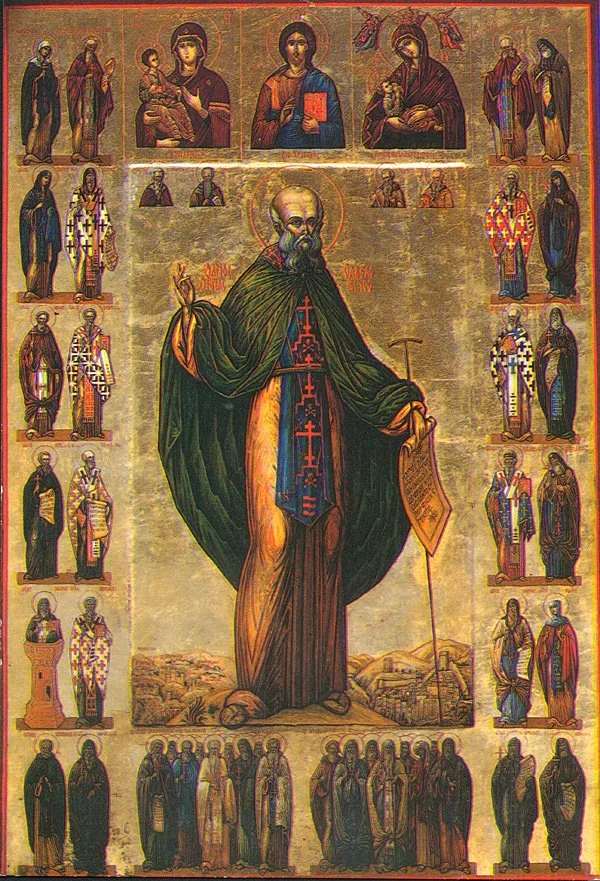
The Great Lavra of Mar Saba
The Great Lavra was formally established around 483. Its monks lived in separate caves or cells during the week, praying and working with their hands, and gathered for the Divine Liturgy, common prayer, teaching and the sharing of supplies. This blend protected both solitude and shared life.
Sabas did not invent the lavra. Earlier Palestinian monks, including Chariton, had founded similar communities. His contribution was to organize and enlarge this form of monasticism on a large scale. Over time Mar Saba gained churches, living quarters, water systems, defensive walls and a guest house for visitors.
Sabas also helped found or support other communities, including the New Lavra near Tekoa. The total number of monasteries credited to him varies between accounts and depends on how dependent houses are counted, so it is UNCERTAIN.
Priest and Leader of the Hermits
Sabas was ordained a priest by Patriarch Sallustius of Jerusalem. Sources give the year as 491 or 492, so the date is UNCERTAIN. Around 493 or 494 he was given authority over the hermits of the Jerusalem area, while his contemporary Theodosius the Cenobiarch led the monks who lived in community. Statements that Sabas ruled every monastery in Palestine go beyond the evidence.
His name is often tied to the Jerusalem Typikon, the book of liturgical rules that later spread through the Byzantine world. Here care is needed. The tradition of Mar Saba did shape Byzantine daily prayer, vigils and hymns, but the complete Typikon in use later was shaped over centuries. The Catholic Encyclopedia questions rules attributed to Sabas, and later Sabaite manuscripts, such as a twelfth century Sinai manuscript, should not be treated as his own work. Sabas should be seen as the founder of a tradition and not the author of that book.
No substantial writings can be safely attributed to him. His influence is better known through the institutions and practices that grew from his foundations.
Chalcedon, Emperors and Opposition
Sabas lived during the long disputes that followed the Council of Chalcedon in 451, which taught that Christ is one person in two natures, divine and human. Sabas supported the council and defended the patriarchs of Jerusalem who held to it. Older writers call those who opposed Chalcedon Monophysites. Modern dialogue between Catholics and the Oriental Orthodox distinguishes their Miaphysite teaching from the view of Eutyches, which denied the full humanity of Christ.
Around 511 or 512, under Emperor Anastasius I, Sabas traveled to Constantinople with other monks to resist pressure on the patriarchate of Jerusalem. Around 530 or 531 he traveled there again, this time before Emperor Justinian I. Cyril says he asked for relief from taxes after the Samaritan revolt, help with church repairs and care for pilgrims. Cyril presents Justinian as favorable, but how fully the promises were kept needs separate checking.
Sabas also met trouble at home. Some monks questioned his rule and his education, and for a time he withdrew from his main community. Our evidence comes mostly from writers who favored him, so the motives of his critics are hard to judge. Later, teachings linked to Origen divided the Palestinian monasteries, especially around the New Lavra. Cyril wrote as a firm opponent of those teachings, and the great controversy came to a head after Sabas died, including at the Second Council of Constantinople in 553. It would be wrong to credit him with every later decision.
Death, Burial and the Journey of His Relics
Sabas died at the Great Lavra on December 5, 532, by the most common reckoning, though some older works give 531. He was buried at the monastery. Since traditional biographies differ on his age, this article does not try to settle it.
His relics later reached Venice. Sources disagree about when and how they were removed from Palestine, and the move is often linked to the Crusades, so the details are UNCERTAIN. A later account that his body was found incorrupt is TRADITION and lacks independent confirmation.
The return of the relics is far better documented. In 1965, during the pontificate of Paul VI, they were sent from Venice to the Greek Orthodox Patriarchate of Jerusalem. They arrived in Jerusalem on October 26 (Gregorian), were honored at the Church of the Holy Sepulchre and then taken to Mar Saba, where they are venerated today. The Jerusalem Patriarchate keeps this return on October 13 by the Julian calendar. The gesture was a sign of goodwill between Catholics and Orthodox, though it did not restore full communion.
Miracles and Devotion
Most miracle stories about Sabas come from Cyril and later Church tradition. TRADITION tells of angelic guidance to his cave, the discovery of water, rain after his prayers in times of drought, healings and the casting out of demons. Other stories speak of him living at peace among wild beasts, including a lion that left a cave to him. Such stories follow a pattern known from desert literature, where holiness restores harmony with creation.
These accounts show what the monks believed and valued. They cannot be verified as events. The firmer evidence of devotion is the long observance of his feast, the monasteries named for him, the veneration of his relics and the continuing life of Mar Saba itself.
His historical importance does not depend on any single wonder. His foundations, his leadership among the monks and his influence on Palestinian Christianity stand on their own.
Lord Jesus Christ, you called Saint Sabas from his childhood to seek you in the desert and gave him many sons to guide. Make me patient in prayer and faithful in small duties. Teach me to love the quiet of the cell and to serve my brothers and sisters, especially those in need. Through the prayers of your servant Sabas, keep your Church in peace and save our souls. Amen.
This prayer was written for this page. It is not an official liturgical text.
Saint Sabas and the Eastern Churches
Sabas lived before the separation of Rome and Constantinople, so he belongs to all Christians. The Melkite Greek Catholic Church, Byzantine Catholic calendars and the Eastern Orthodox Churches honor him on December 5. Churches that use the Julian calendar celebrate it on December 18 by the civil calendar in this century.
Mar Saba became a center of study, copying of manuscripts, translation and hymn writing. Saint John of Damascus is among the figures later linked with its tradition. The monastery also connected Greek, Georgian, Armenian, Syriac and Arabic speaking Christians. This is one reason his name is so closely linked with Byzantine worship.
For Eastern Catholics outside the Byzantine tradition, a direct liturgical link to Sabas should not be assumed. For them he is best honored as part of the shared monastic heritage of early Christianity. For all, he is a model of a man who loved solitude yet gave himself to his brothers and to the poor.
Frequently Asked Questions
A Heart Both Quiet and Generous
Saint Sabas loved the silence of the desert and still opened his door to anyone who came for help. May this prayer card remind you to guard time for prayer and to give your strength to others.
View Prayer Card