Saint Romanos the Melodist: Deacon, Hymnographer and Master of the Kontakion
The sweet singer of Syria and Constantinople who turned Scripture into sung sermons
At a Glance
- Born
- Emesa (modern Homs), Syria, about 490 (UNCERTAIN)
- Died
- Constantinople, after about 555, often given as 556 (UNCERTAIN)
- Feast day
- October 1
- Known as
- Romanos the Melodist, the Sweet Singer, Romanus Melodus
- Office
- Deacon at Beirut and Constantinople
- Veneration
- Ancient cult; no formal canonization date is recorded
- Who Was Saint Romanos the Melodist?
- Early Life in Emesa
- Deacon in Beirut and Constantinople
- The Kontakion: Preaching in Song
- His Surviving Hymns
- His Theology of Scripture and Incarnation
- The World of Anastasius and Justinian
- The Scroll from the Mother of God
- Death, Burial and Veneration
- Saint Romanos and the Eastern Churches
- Frequently Asked Questions
Who Was Saint Romanos the Melodist?
Saint Romanos the Melodist was a Christian deacon of the sixth century and the most admired Greek hymn writer of the early Church. Born in Syria and later active in Constantinople, he wrote long poems called kontakia that retold the Bible in dramatic sung form. Many of them were used as sermons in the midst of worship, and the best of them still move readers today.
We know his work far better than his life. His hymns survive and are the strongest witnesses to his skill and his faith. The details of his biography come mostly from later Byzantine commemorations, which are more devotional than historical. In this article, stories that rest on that later tradition are marked TRADITION, and dates or facts that cannot be confirmed are marked UNCERTAIN.
Early Life in Emesa
Romanos was born in Emesa, the Syrian city now called Homs. His birth is dated about 490, but the exact year is UNCERTAIN. Pope Benedict XVI, in a general audience on Romanos given on May 21, 2008, placed his birth at about 490. A scholarly encyclopedia of Syriac heritage uses a wider range, from about 485 to about 560 for his whole life. These are estimates, not recorded dates.
The Greek Orthodox tradition says that Romanos was born to Jewish parents, citing a hymn in his honor that calls him a Hebrew. Scholars have also pointed to Semitic features in his Greek poetry. This is a valuable clue to how he was remembered, but no record names his parents or describes their faith, so his Jewish background is UNCERTAIN. His parents' names, any brothers or sisters, and whether he ever married are unknown.
Benedict XVI says that Romanos received the foundations of Greek and Syrian culture in Emesa and then continued his studies in Beirut, where he learned rhetoric. His poems show deep knowledge of Scripture and a trained literary mind. They do not tell us which schools he attended.
Deacon in Beirut and Constantinople
No story of his baptism survives from his own time. The Greek Orthodox Archdiocese says that he was baptized, but his age, the circumstances and the person who baptized him are UNCERTAIN. If his family was indeed Jewish, he would have come to Christ as an adult or a child, but we cannot reconstruct it.
According to Benedict XVI, Romanos was ordained a deacon around 515 and preached in Beirut, serving at the Church of the Resurrection. Toward the end of the reign of Emperor Anastasius I, which ended in 518, he moved to Constantinople. There he became attached to a church of the Mother of God in the district called tou Kyrou. Later accounts also link him with the churches of Blachernae and Hagia Sophia.
The years in Constantinople were decisive. In the capital his poetry grew into a new kind of sung preaching, where rhythm, dialogue and refrain made the stories of Scripture easy to remember. His fame rests largely on this period of work.
The Kontakion: Preaching in Song
Romanos is best known for perfecting the kontakion, a long hymn that blends teaching, poetry and storytelling. A full kontakion opens with a short introductory stanza called a prooimion and then continues with a series of matching stanzas called oikoi. Benedict XVI notes that these poems usually have between 18 and 24 stanzas built on a steady pattern of syllables and accents.
Each stanza ends with the same refrain, which the people could sing back. In many of them the first letters of the stanzas spell out a message, often the name of the author, which was a way of signing the work. The hymns were not small songs placed between other parts of worship. They worked as poetic homilies that taught the faith through narrative.
A word of care is needed. Romanos did not invent the kontakion. The Gorgias Encyclopedic Dictionary of the Syriac Heritage points out that earlier examples of the form existed. Romanos became its most famous master, but he stands in a tradition and did not found it.
His Surviving Hymns
Among the best known works linked to Romanos are the kontakion On the Nativity of Christ, with its famous opening about the Virgin giving birth to the One who is beyond all things, and Mary at the Cross, a moving dialogue between the grieving Mother of God and her crucified Son. Others include On the Sacrifice of Abraham, On the Prodigal Son, On Pentecost, On the Ten Virgins and On the Newly Baptized.
In many of the hymns biblical people speak. Mary, Sarah, Adam and others ask questions, mourn and respond to God. This dramatic style makes the stories feel alive without leaving the teaching of the Church. English readers can meet the hymns in the translations of Ephrem Lash and in other modern collections.
How many did he write? Tradition credits him with about one thousand kontakia. That figure cannot be checked, and it is UNCERTAIN. Benedict XVI reports that eighty nine kontakia are transmitted under his name. The Syriac encyclopedia notes that the editors Maas and Trypanis regarded fifty nine as genuine and doubted another twenty nine. The number he truly composed is unknown, and the count of works attributed to him must not be confused with the count that can be proved.
His Theology of Scripture and Incarnation
The hymns of Romanos teach the unity of the Old and New Testaments, the Incarnation, the saving work of Christ, the role of the Holy Spirit, repentance and charity. He affirms that Jesus Christ is fully God and fully man in one person. His Marian poems show the Mother of God both as the mother of the Lord and as a real human mother who feels grief, wonder and love.
Scholars have long seen ties between Romanos and the Syriac poetic tradition of Saint Ephrem the Syrian. The similarities include stanza patterns, refrains, rich biblical imagery and dramatic dialogue. Studies by Sebastian Brock, William Petersen and others support this link. In this way Romanos stands as a bridge between Syriac and Greek Christian poetry.
Benedict XVI observed that Romanos did not mainly argue theology in technical terms. He taught the faith of the councils through story and song, so that ordinary worshippers could take it in. No monastery or church can be named as his foundation from the sources we have.
The World of Anastasius and Justinian
Romanos worked in the years after the Council of Chalcedon in 451, when the Church was divided over how to speak about the person of Christ. His hymns repeatedly affirm the unity of Christ's person and his full divinity and humanity, but they do so through scenes from the Gospels and not through the language of debate.
His career overlapped with the reign of Anastasius I and then with Justinian I, whose reign was marked by building projects and religious politics. Some of his hymns reflect the fears of the capital, including earthquakes and fires. Some scholars link one hymn with the dedication of Justinian's rebuilt Hagia Sophia on December 27, 537. That dating is not accepted by everyone, and it is UNCERTAIN.
No source says that Romanos was imprisoned, exiled, beaten or condemned for his writings. His trials, if he had any, are not recorded. Later biographies speak of ridicule from other clergy, but that story belongs to the tradition below.
The Scroll from the Mother of God
The best known story about Romanos comes from the Byzantine synaxarion, the book of short lives of saints used at worship. TRADITION says that he was at first a poor singer and reader. During a service for the Nativity he was laughed at and left in distress.
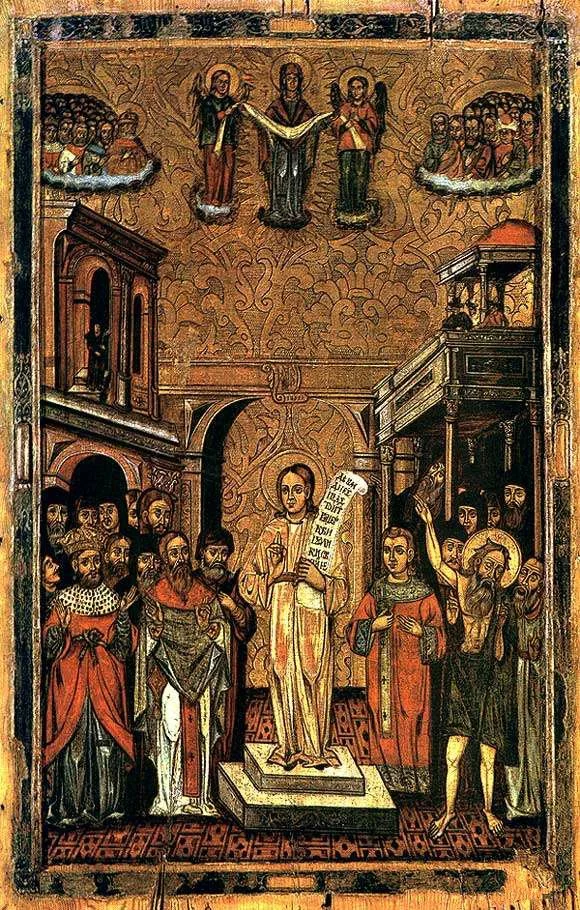
That night, as he prayed before an icon of the Virgin Mary, she appeared to him, gave him a scroll and told him to eat it. When he woke he found himself able to sing and compose. At the next Nativity service he sang the famous kontakion for the feast. Benedict XVI mentions this story and names the synaxarion as its source. This is why Romanos is often shown in icons holding a scroll.
Historians treat the account as a pious tradition. It cannot be confirmed from his own time, and the literary form of the kontakion existed before him. The story is valuable as a picture of how the Church understood his gift, as a grace received from God.
Death, Burial and Veneration
Romanos seems to have spent his last years in Constantinople. The Orthodox Church in America gives about 556 as the year of his death, Benedict XVI says after 555, and the Syriac encyclopedia allows a date up to about 560. The exact date is UNCERTAIN. Later Byzantine tradition connects his burial with the church of the Mother of God in the Kyros district of the city.
No contemporary record of his tomb has been found, and the location of any relics is UNCERTAIN. Older accounts speak of a manuscript said to be in his own hand, but this should be treated as tradition and not as confirmed history. Nothing identified so far allows pilgrims to visit authenticated relics.
He became a saint through the long growth of Byzantine liturgical veneration, and no decree of canonization or glorification is known. His feast is October 1, confirmed by the Greek Orthodox Archdiocese of America and the Orthodox Church in America. He is remembered by singers, chanters and writers of hymns, though no universal official patronage has been established.
Lord Jesus Christ, born of the Virgin for our salvation, you gave Saint Romanos a voice to tell your story in song. Open my lips to praise you. Teach me to hear the Gospel as a living word and to sing it with a humble heart. Let my prayer be joyful and my life be a hymn of thanks. Through the prayers of your servant Romanos, have mercy on me and save me. Amen.
This prayer was written for this page. It is not an official liturgical text.
Saint Romanos and the Eastern Churches
Romanos lived long before the division between Rome and Constantinople, so his legacy belongs to all Christians. He is honored in the Orthodox Churches, and Benedict XVI gave him a full general audience as a theologian and poet of the early Church. This does not mean that every Eastern Catholic Church places him on the same date or in the same calendar, so such details should be checked locally.
His hymns help show how the Christian East taught the faith. Complex doctrine was carried by ordinary experience, by dialogue between Christ and his Mother and by the call to repentance in the Prodigal Son. Some short pieces from the kontakion tradition are still sung in Byzantine worship, especially on feast days. The long, many stanza form is rarely sung in full in parishes today, but the texts remain important in study and prayer.
Romanos also reminds us that Syriac and Greek Christianity once spoke to each other closely. Born in Syria and singing in Greek, he is a bridge between two great streams of Eastern Christian poetry.
Frequently Asked Questions
Let Your Prayer Become a Song
Saint Romanos taught the faithful to hear the Gospel as a story that could be sung. May this prayer card remind you to praise God with joy, whether in church or at home.
View Prayer Card