Saint Macrina the Younger: Ascetic of Pontus, Teacher of Gregory of Nyssa and Sister of Saint Basil
The eldest sister who led a family into the monastic life
At a Glance
- Born
- Cappadocia, about 330 (UNCERTAIN)
- Died
- Annisa in Pontus, 379 or 380 (UNCERTAIN)
- Feast day
- July 19 in the Roman Martyrology and Orthodox calendars
- Known as
- Venerable Macrina, Macrina of Pontus, sister of Saint Basil
- Family
- Daughter of Basil the Elder and Saint Emmelia
- Veneration
- Ancient cult; no formal canonization date is recorded
- Who Was Saint Macrina the Younger?
- A Family of Saints
- Education and Early Formation
- The Betrothal and the Vow
- Basil, Naucratius and the Turn to Asceticism
- The Community at Annisa
- Macrina as Teacher: On the Soul and the Resurrection
- Death and Burial
- Miracles and Devotion
- Saint Macrina and the Eastern Churches
- Frequently Asked Questions
Who Was Saint Macrina the Younger?
Saint Macrina the Younger was a Christian woman of the fourth century who lived in Cappadocia and Pontus, in what is now Turkey. She is remembered as an ascetic, a teacher and the leader of a small community of women and former servants who lived a shared life of prayer, work and service to the poor. She was also the eldest sister of Saint Basil the Great and Saint Gregory of Nyssa, two of the most important teachers of the early Church.
Almost everything we know about her comes from her brother Gregory, who wrote the Life of Macrina soon after her death. Gregory was both a witness and an admirer, and he wrote in the style of his time. In this article, stories that depend on his report alone are marked TRADITION, and details that cannot be confirmed are marked UNCERTAIN.
A Family of Saints
Macrina was born into a wealthy Christian family with property in Cappadocia and Pontus. Her father was Basil the Elder and her mother was Saint Emmelia. Her paternal grandmother, Macrina the Elder, had kept the faith through earlier persecution, and Gregory says the granddaughter was named after her. The birth year is traditionally about 330, but the exact year and place are UNCERTAIN.
She was the eldest of ten children. Her brothers included Basil, later bishop of Caesarea, Gregory, later bishop of Nyssa, Peter, later bishop of Sebaste, and Naucratius, who chose a quiet life and died young. Few families have shaped Eastern Christian thought so deeply.
Gregory says that before Macrina was born, her mother had a dream in which a figure called the unborn child Thecla, after the early virgin and martyr. Gregory presents Thecla as a private name used alongside the public name Macrina. The dream is TRADITION, since it rests on Gregory's report.
Education and Early Formation
Gregory says that Emmelia herself taught Macrina. Instead of the pagan classics studied by her brothers, the girl learned Scripture, especially the Psalms and the Wisdom of Solomon. These texts shaped her prayer and her sense of virtue from childhood.
She also learned the practical work of a large household, including wool work and the management of property. This training mattered later, when she had to organize a community and feed many people in a time of hardship. Her upbringing joined prayer, labor and responsibility for others.
Scholars disagree about how much formal philosophy she studied. In On the Soul and the Resurrection Gregory shows her discussing difficult ideas with skill, but his portrait is literary and cannot by itself prove her schooling. This question remains UNCERTAIN.
The Betrothal and the Vow
Macrina was raised a Christian, so her turning point was not a conversion but a commitment to lifelong virginity and the ascetic life. According to Gregory, her father arranged for her to marry a promising young man who was training as a lawyer. The young man died before the wedding.
Other suitors came, but Macrina refused them. Gregory says she regarded the dead man as her husband and believed that fidelity continues in the hope of the resurrection. He presents this as a sign of her faith and not only as a refusal of marriage.
She stayed with her mother, helping to manage the household and to raise her younger brothers and sisters, especially after her father died. In this way her vocation grew out of ordinary family duties and not out of a flight from them.
Basil, Naucratius and the Turn to Asceticism
Gregory records that when Basil came home from his advanced studies, he was proud of his skill in speech. Macrina urged him to turn from worldly prestige toward the Christian life. According to Gregory, her influence helped redirect Basil toward the religious calling that later made him famous. This is an important claim, but it is Gregory's account and not an independent record.
Another turning point was the sudden death of Naucratius, who had left public life to live near the Iris River and care for poor and elderly people. His death devastated their mother, Emmelia. Macrina helped her bear the loss without giving up her faith.
Eventually Macrina persuaded Emmelia to adopt a more ascetic life at home. The family estate at Annisa near the Iris River became a place of prayer, work and simple living.
The Community at Annisa
At Annisa, Macrina and Emmelia set aside the social distinctions of their old life. Gregory says that former servants lived beside their mistresses as equals and shared the common life. The Orthodox Church in America adds that the family's slaves were freed. The community prayed the psalms, worked with their hands, kept a simple table and served the poor.
Gregory stresses that prayer there continued day and night, with hymns marking the hours. It should be seen as an early form of Christian monastic life, not as a monastery with the structures of later centuries. Macrina gave spiritual guidance and took practical responsibility. She also educated her youngest brother Peter, who later became a priest and bishop.
Gregory also tells of a famine, when many people came to the community for food. He says Macrina had taken in abandoned children and raised them there. This charitable work is a well attested part of the story, although later devotion adds miracles that cannot be confirmed.
Macrina as Teacher: On the Soul and the Resurrection
Macrina's greatest influence on theology comes through Gregory's dialogue On the Soul and the Resurrection. Gregory wrote it after their last meeting and presents Macrina as his teacher. The work deals with the soul, the meaning of death, the resurrection of the body, the healing of the passions and the final purpose of creation.
It shows Gregory, a bishop and a leading theologian, learning from his sister, who held no office in the Church. That is a rare testimony in early Christian literature. Still, the dialogue should not be read as a record of her exact words. Gregory shaped it as a philosophical work, and how much of it comes from Macrina and how much from Gregory is UNCERTAIN.
No writings by Macrina herself survive. Her prayer at death and her teaching are preserved only through Gregory. Claims that she wrote Basil's monastic rules or began particular doctrines go beyond the evidence, although her influence on the family is well attested.
Death and Burial
After Basil died, Gregory traveled to see Macrina and found her sick with fever. She did not allow the visit to become only a time of grief. She spoke with him about the resurrection and encouraged him to place his sorrow within Christian hope.
She prayed facing east and, according to Gregory, offered a long prayer of thanks for Christ's victory over death and a plea for forgiveness and safe passage to eternal life. She ended by making the sign of the cross. The death year is traditionally 379, though some scholars favor 380 or discuss a date in the winter or summer. Her feast is July 19, but whether that was the real date of her death is UNCERTAIN.
Gregory arranged the funeral, with psalms, clergy, monks and women of the community. A deaconess named Lampadia is mentioned as someone who knew Macrina's wishes, but this does not show that Macrina herself held that office. Gregory and Bishop Araxius carried her body to the church of the Forty Martyrs of Sebaste, where she was buried beside her mother. The location of any relics today is UNCERTAIN.
Miracles and Devotion
Gregory reports several wonders, which are TRADITION. He tells how Macrina once had a painful swelling and refused to see a physician. After she prayed, her mother made the sign of the cross over it, and it disappeared, leaving only a small mark that Gregory says he saw when preparing her body. He also reports that the daughter of an army officer was healed of an eye ailment, with the parents crediting her prayers.
Other accounts speak of wheat multiplying in time of famine, and Gregory describes a dream of shining martyrs' relics before he reached his sister, which he later read as a sign of her coming death and holiness. His dream is his own report, and its meaning is a matter of faith.
Her lasting place in devotion rests less on these stories than on the memory of her life of prayer, her care for the poor and her teaching. No formal canonization date is known, and she was honored in the early Church through local memory and liturgy. She is sometimes linked with women religious and with Christian teachers, though no official patronage has been established.
Lord Jesus Christ, you gave Saint Macrina a heart that loved the Psalms and the poor. Teach me to guide my family in prayer and to serve those in need. Comfort me in sorrow with the hope of the resurrection. Let my home be a place of peace, work and praise. Through the prayers of your servant Macrina, have mercy on me and save me. Amen.
This prayer was written for this page. It is not an official liturgical text.
Saint Macrina and the Eastern Churches
Macrina lived long before the separation of East and West. She is commemorated on July 19 in the Roman Martyrology and in the Orthodox calendar, and the Greek Orthodox Patriarchate of Antioch and the Orthodox Church in America both honor her. Her liturgical memory is especially strong in the Byzantine tradition, where she is called Venerable.
For Byzantine Catholics and Eastern Orthodox readers she is a remarkable example of a woman who led a community and taught a bishop. She shows that Eastern Christian monastic life included women from the beginning, and that the family home could become a school of holiness. Her influence on Basil and Gregory connects her with the theology of the whole Cappadocian tradition.
It would be wrong to credit her with the later teachings of her brothers. What the evidence supports is that she was a spiritual guide, a founder of a community and a trusted voice in one of the greatest families of the Church.
Frequently Asked Questions
A Home Made Holy
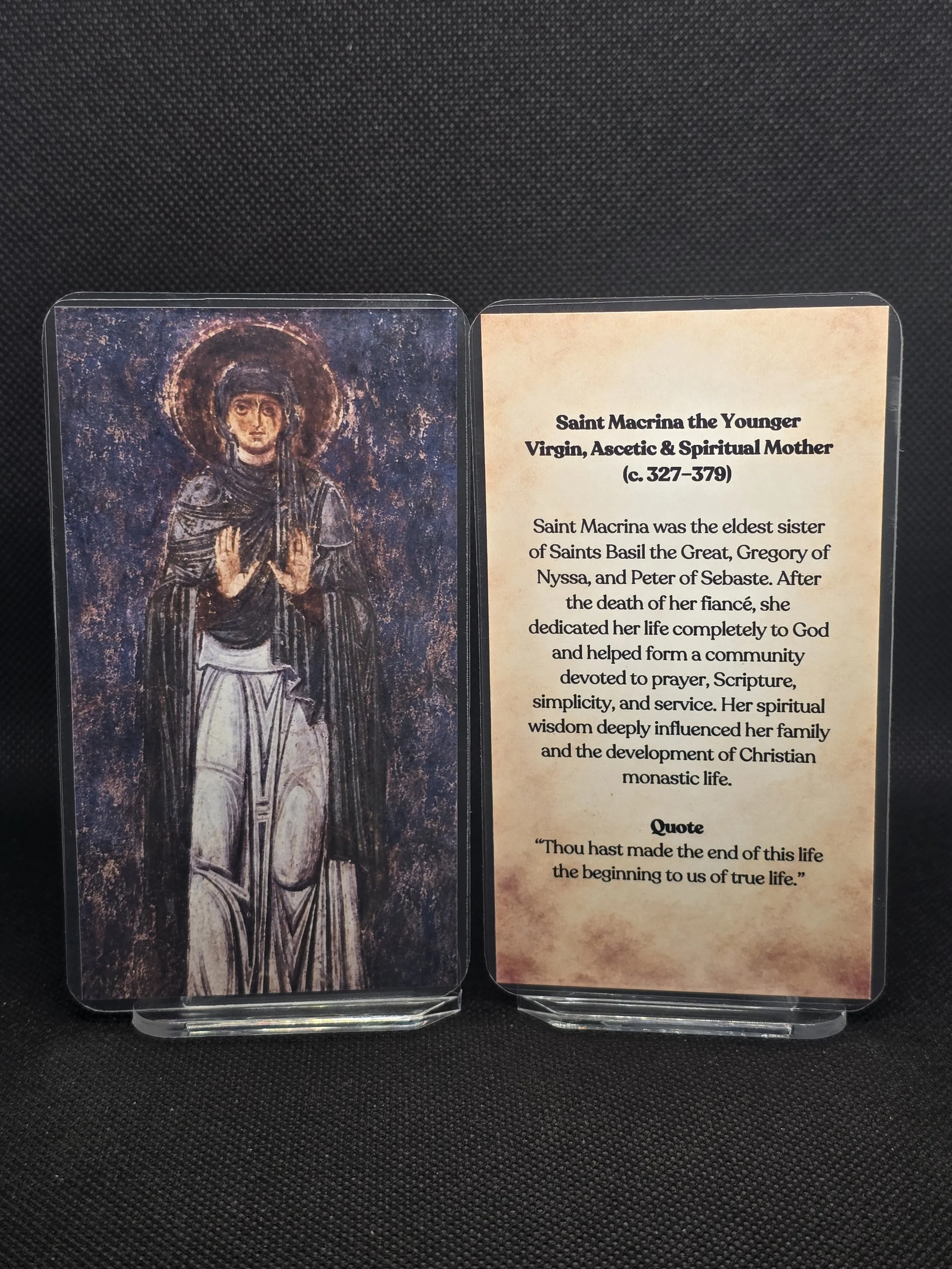
Saint Macrina turned an ordinary family home into a place of prayer and care for the poor. May this prayer card remind you that holiness can begin at your own table.
View Prayer Card