Saint Bishoy: Desert Father of Scetis, Founder of the Monastery of Anba Bishoy and Beloved of Christ
A monk of the Egyptian desert, called the Perfect Man by the Copts and Paisius the Great by the Byzantines, remembered for humility, tears and a monastery that still stands.
At a Glance
- Born
- Traditionally about 320 AD, at Shansa in the Nile Delta. The year is UNCERTAIN.
- Died
- Traditionally July 15, about 417 AD, near Antinoe. The year is UNCERTAIN.
- Monastery
- Monastery of Saint Bishoy, Wadi El Natrun (Scetis), Egypt
- Feast
- 8 Abib (July 15) in Coptic usage. June 19 as Paisius the Great in Byzantine Orthodox usage.
- Titles
- The Perfect Man, the Beloved of Our Good Savior, Paisius the Great
- Recognition
- Ancient saint, venerated from early centuries. No formal canonization date exists.
- Who Was Saint Bishoy?
- The Youngest of Seven Sons
- Scetis and the School of Abba Pambo
- The Monastery and the Teaching of the Elders
- Companions in the Desert
- Flight from Scetis and the Years at Antinoe
- Death, Relics and the Meeting with Paul of Tammah
- The Stories That Are Told
- The Spirit of the Desert Today
- Bishoy in the Eastern Churches
- Frequently Asked Questions
Who Was Saint Bishoy?
Saint Bishoy, also written Pishoy, Pshoi or Bishoi, and given the title Anba as a mark of respect, was a monk of the Egyptian desert in the fourth and early fifth centuries. He lived at Scetis, the monastic valley now called Wadi El Natrun, west of the Nile Delta. A great monastery that still bears his name is traditionally linked to him, and his body is honored there.
The Coptic Orthodox Church calls him the Perfect Man and the Beloved of Our Good Savior. Byzantine Orthodox calendars remember a Saint Paisius the Great on June 19, and scholars generally identify this saint with Bishoy, since Paisius is the Greek form of the name. Bishoy lived before the Council of Chalcedon in 451, so he belongs to the shared heritage of East and West and not to either side of the later divisions.
Much of what is told about him comes from Lives written long after his death. Modern scholars, including Tim Vivian and Maged Mikhail in their 2022 edition of the Lives, show that these texts grew by stages. This article therefore separates what is reasonably historical from what is TRADITION, and marks open questions as UNCERTAIN.
The Youngest of Seven Sons
The Coptic Synaxarium says Bishoy was born in Shansa, a village in the Delta, and was the youngest of seven sons in a Christian family. His father died while the boys were young, and his mother raised them. The traditional date of his birth is about 320. Some accounts place it earlier, so the year is UNCERTAIN, and the exact village is also not certain.
The names of his parents and brothers are not securely known, since our reports come from hagiography written long after his life.
TRADITION: an angel appeared to his mother and asked her to give one of her sons to God. When the angel chose the youngest, who was physically weak, she objected, and the angel confirmed the choice. The story echoes the words of Saint Paul that strength is made perfect in weakness. It is a pious account, not an independent record of his childhood.
Scetis and the School of Abba Pambo
He was apparently raised a Christian, so there was no conversion from another religion. His turning point was his entry into the monastic life of Scetis, in the desert the Copts call Shiheet. The traditional date is about 340, when he was about twenty, but this date comes from a reconstructed chronology and is UNCERTAIN.
At Scetis he became a disciple of Abba Pambo, one of the best-known elders of early Egyptian monasticism. His fellow disciple and close friend was Saint John the Short, who is also called John Kolobos. Their friendship has a large place in the surviving Lives.
The Greek Life describes his training in obedience, prayer, Scripture and fasting, and a discipline of guarding the eyes and of avoiding idle talk. After Pambo died, Bishoy and John stayed together for a time and then took up separate solitary lives.
TRADITION: after a night of prayer an angel told John to stay where he was and Bishoy to go deeper into the desert.
The Monastery and the Teaching of the Elders
The main contribution of Bishoy to history is that he stands at the beginning of a major monastery at Scetis. The Monastery of Saint Bishoy became one of the principal communities of Wadi El Natrun, alongside those linked with Macarius, John the Short and the community now called Baramus. Coptic tradition says that he founded it in the late fourth century. Scholars agree that the community is ancient but say the exact foundation date is unknown.
Scetis was known for a form of monastic life in which monks lived in separate cells or small groups but met for worship and sought the guidance of elders. It would be wrong to picture Bishoy's community as a developed monastery with a written rule.
In the Lives his teaching centers on obedience, humility, repentance and the struggle against pride. Work with the hands was part of the monk's daily life, and the Lives picture the monks making handicrafts, supporting themselves and sharing with the poor. Bishoy is shown as a patient spiritual father who corrects privately and gently, and not by public shame. These episodes belong to the hagiographic tradition, but they show the kind of fatherhood his followers wanted to remember.
No book written by Bishoy himself is known. His teaching reaches us through the Lives and church tradition. A major Life is traditionally attributed to John the Short, but recent study concludes that John cannot have written the surviving form, which assumes events after John's death. Words attributed to Bishoy should therefore be labeled as attributed in a later Life.
Companions in the Desert
Bishoy was one of a generation of monks who shaped Christian life in Egypt. Saint Pambo, his teacher, is quoted often in the collections known as the Sayings of the Desert Fathers. Saint John the Short, his friend, is remembered for obedience and humility. Saint Macarius of Egypt belonged to the same valley. Together these monks made Scetis a school of prayer for visitors from across the Roman world.
Many pilgrims came to learn from them, and some, like Evagrius and John Cassian, carried what they learned to Greek and Latin Christians. The spread of this monastic wisdom is one reason why Eastern and Western churches both honor the desert fathers.
We do not have a diary or letters from Bishoy to show how he talked with these companions. What we have is the shared life of the valley, in which prayer, silence, work and welcome were the daily rule, and in which each monk was known by a few vivid memories handed down by his disciples.
Flight from Scetis and the Years at Antinoe
The desert was not safe. Raids by nomadic tribes struck Scetis, and tradition dates one attack to 407. Scholars connect Bishoy's departure from the valley with this raid. He moved to the region of Antinoe, called Ansena in Arabic, in Middle Egypt, where he lived out his life. The sources do not give every detail of the journey.
Later attacks and rebuilding followed, with disturbances traditionally dated to 434 and 444, but these belong to the history of his monastery after his time. His monastery was repeatedly destroyed and rebuilt, which is part of why its present buildings are of later date.
TRADITION: the Synaxarium tells of an ascetic who denied the divinity of the Holy Spirit. Bishoy is said to have taken a woven basket with three handles and used it to begin teaching the Trinity from Scripture, and the ascetic and his followers returned to the faith. The story is not confirmed by a contemporary report, but it shows how the Copts remembered him as a teacher of orthodox faith.
Death, Relics and the Meeting with Paul of Tammah
The Coptic tradition places his death on 8 Abib, which is July 15 in our calendar, about the year 417, in the region of Antinoe. This year is a scholarly approximation and not a documented date. Some Byzantine accounts speak of an earlier death around 400.
He was buried near where he had lived after leaving Scetis. The sources name various burial places. His memory became joined with that of Saint Paul of Tammah, another Egyptian monk, and the two were venerated together.
The Lives tell of a first transfer of the bodies within the Antinoe region and of a later, better documented transfer to the monastery at Scetis. The scholar Tatjana Starodubcev dates this later translation to the time of Patriarch Joseph I of Alexandria, between 830 and 849, about 840. The monastery today keeps relics identified as those of Bishoy and Paul and the Coptic Church venerates them.
TRADITION: Coptic accounts say that his body remained free from ordinary corruption, connected with a promise of Christ in the story of Bishoy carrying him. UNCERTAIN: we found no modern scientific examination that settles the question of incorruption. There was no formal canonization. His cult grew through liturgy, relics, devotion and the Lives.
The Stories That Are Told
Several famous stories are told of him, and each is TRADITION and not a verified event.
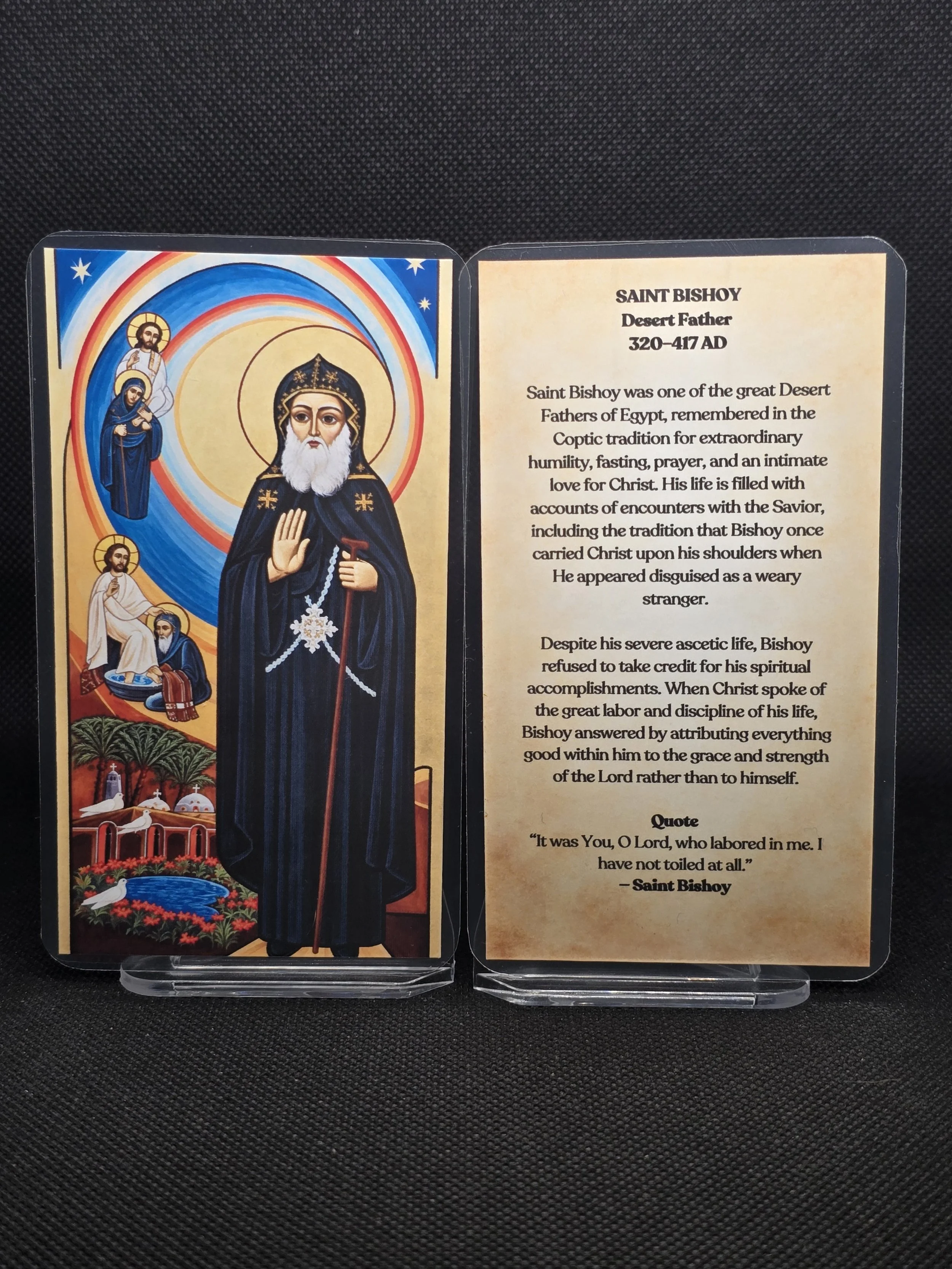
The first is the washing of the feet of Christ. Christ appeared to Bishoy as a guest, and Bishoy washed his feet. The second is the carrying of Christ. Bishoy met an old stranger who could not walk, carried him, and then recognized the Lord, who promised that his body would not decay. Scholars note that the carrying story appears as an addition in later manuscripts and is treated separately in the 2022 edition of the Lives.
A third story says that he tied his hair to a peg above his cell so that sleep would not interrupt his night prayers. It appears in the major traditions of the Life.
Another says that the prophet Jeremiah appeared to him and explained hard passages. Another tells of a visit from a Syrian holy man, sometimes named as Saint Ephrem, who could not speak his language. The identification with Ephrem appears in a limited manuscript tradition and is UNCERTAIN, and the tale of Ephrem's staff growing into a tree is a late development. A final tale says a boat carrying his body would not move until the body of Paul of Tammah was placed aboard, explaining why the two saints are honored together.
Healings are also reported at his relics. They are part of devotion, but individual cases should not be called medically established without documentation.
The Spirit of the Desert Today
The stories of Bishoy keep returning to a few simple things: weakness, humility, tears and hospitality. He is shown as a man who does not trust his own strength, who guards his heart, and who treats guests as if they were Christ.
That has a use for ordinary life. A parent who is tired can pray in weakness. A person who has been corrected can learn from the gentle way Bishoy is said to have corrected others. A household can treat every visitor, even the stranger at the door, as a possible bearer of the Lord.
The prayer card on this page can be kept where you pray in the morning, as a reminder that a hidden life of prayer can feed many who never see it.
O Lord Jesus Christ, you showed your love to Saint Bishoy in the desert and made his weakness a sign of your strength. Give us a humble heart, tears of repentance and a welcome for every stranger. Through the prayers of Saint Bishoy and all the desert fathers, keep us faithful in prayer and bring us to your kingdom. Amen.
This is a short original prayer written for this page. It is not an official prayer of the Church. The Coptic Church commemorates Saint Bishoy in its own liturgy and Synaxarium.
Bishoy in the Eastern Churches
For the Coptic Orthodox Church, Bishoy is among the most beloved saints. His monastery is a living place of prayer in Wadi El Natrun, and his feast is kept on 8 Abib. In Byzantine usage the commemoration of Saint Paisius the Great falls on June 19, and Orthodox sources identify him with the same Egyptian monk. He must not be confused with Saint Paisios of Mount Athos, who died in 1994.
For Eastern Catholics, he is a link to the ancient monasticism of Egypt, since he lived before the great divisions of the fifth century. We found no evidence that every Eastern Catholic Church keeps his feast, and we found no dedicated feast in the Latin general calendar, so we do not claim one. Catholics and Coptic Orthodox Christians have met in friendly dialogue, and Coptic monasteries are places where Christians of many traditions have been welcomed.
Frequently Asked Questions
A Hidden Life of Prayer
Keep this prayer card as a reminder that humility and prayer can serve many. Ask Saint Bishoy to pray for you and your family.
View Prayer Card