Saint Ephraim of Nea Makri: Orthodox Hieromartyr, Wonderworker and Monk of Mount Amomon
A monk of Attica remembered as a martyr, whose relics were found in 1950
At a Glance
- Born
- September 14, 1384 (traditional date)
- Martyred
- May 5, 1426 (traditional date), Mount Amomon, Attica
- Feast
- May 5 (Orthodox)
- Relics Found
- January 3, 1950
- Recognized
- 2011, Ecumenical Patriarchate (reported)
- Titles
- Hieromartyr, New Martyr, Wonderworker
- Who Was Saint Ephraim of Nea Makri?
- Early Life and Family
- Monastic Life on Mount Amomon
- Priesthood and Ministry
- Attack, Captivity and Martyrdom
- What History Can and Cannot Confirm
- The Discovery of the Relics in 1950
- Recognition and Shrines
- Miracles, Traditions and Devotion
- Why He Matters to the Eastern Churches
- Frequently Asked Questions
Who Was Saint Ephraim of Nea Makri?
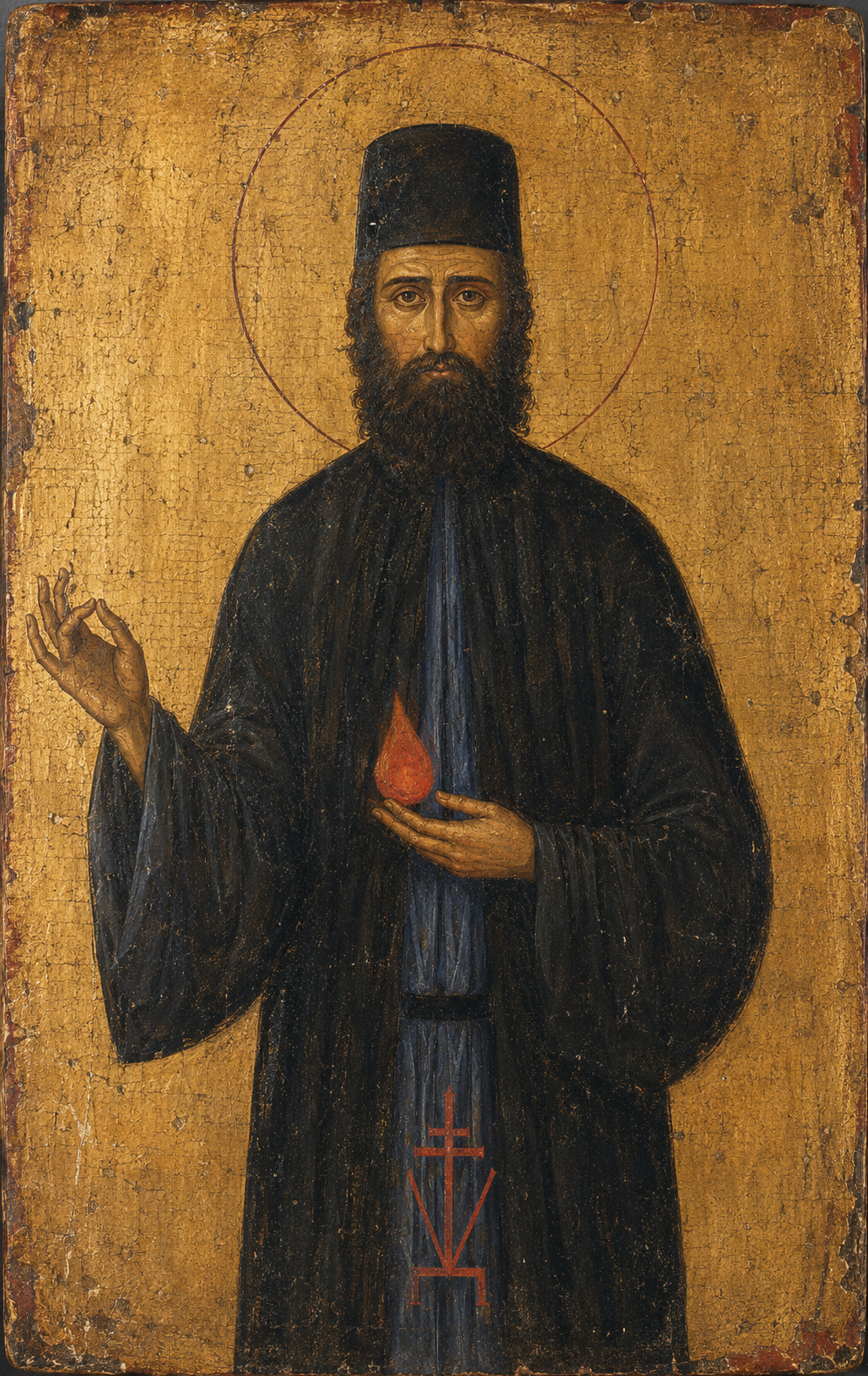
Saint Ephraim of Nea Makri is a monk and priest of the Eastern Orthodox Church who, according to tradition, died as a martyr in 1426 at the Monastery of the Annunciation on Mount Amomon, near Nea Makri in Attica, Greece. He is called a hieromartyr, a term for a priest who dies for the faith, and also a New Martyr and a Wonderworker.
He is a saint of unusual kind, because the details of his life reached the public mainly in the twentieth century. His relics were found in 1950, and the story of his life was then told through the testimony of Abbess Makaria Desipri, who said she received visions of him. We do not have a surviving fifteenth century biography written by someone who knew him.
This article therefore keeps three things apart: the recognition of Ephraim as a saint by the Orthodox Church, the traditional story of his life and death, and what historians can independently confirm. Traditional details are marked TRADITION, and uncertain points are marked UNCERTAIN.
Early Life and Family
The Orthodox Church in America gives his birth as September 14, 1384, in Greece. His father died while he was young, leaving his mother to raise seven children. She is described as a devout Christian who brought up her family in hard circumstances.
Some Greek accounts name Trikala in Thessaly as his birthplace, and the directory of Greek monasteries preserves a tradition that he entered religious life partly to escape the seizure of boys by hostile forces. UNCERTAIN: neither the birthplace nor this reason for becoming a monk has been confirmed by a contemporary record.
The names of his parents, his baptismal name and his brothers and sisters are not known from the sources we examined. The date September 14 is the feast of the Exaltation of the Holy Cross, but we cannot tell whether that date was recorded early or added through later revelations. UNCERTAIN: the safest way to put it is that Orthodox tradition places his birth in 1384 and that this cannot be checked independently.
Monastic Life on Mount Amomon
There is no tradition that Ephraim came to Christianity from another religion. He is described as a Christian from childhood. According to the Orthodox Church in America, he entered the Monastery of the Annunciation on Mount Amomon when he was about fourteen. The monastery was also linked with Saint Paraskeva.
The traditional account describes the usual life of an Eastern monk: obedience, prayer, fasting, withdrawal from worldly ambition and a slow purifying of the passions. His life is set in the ascetic tradition and not in public preaching or missionary work.
The OCA says he lived nearly twenty-seven years as a monk and was then ordained a priest, while Hieromonk Makarios of Simonos Petra speaks of about thirty years. UNCERTAIN: these lengths of time are traditional, and they were not taken from monastery registers. No certificate of ordination and no account by an eyewitness who knew him has been found.
Priesthood and Ministry
Ephraim is remembered chiefly for his ascetic life and his death, and not for books, journeys or foundations. His ministry is thought to have taken place within the monastery on Mount Amomon in the northeast of Attica. As a hieromonk he would have joined monastic discipline with the priestly service of the sacraments.
The OCA describes his reverent celebration of the divine mysteries and his care for the purifying of his soul. These descriptions come from later hagiography and not from his own words.
No writings by Ephraim have been identified, and there is no reliable evidence that he founded a new monastery or community. The modern monastery at Nea Makri is closely tied to Abbess Makaria Desipri, who began to restore religious life at the ruined site in 1945. That twentieth century restoration should not be credited to Ephraim himself.
Attack, Captivity and Martyrdom
According to the received biography, Ottoman raiders attacked the monastery and killed members of the community, and Ephraim was later captured. Some accounts place the first attack in 1424 and his capture in 1425, while the OCA describes an attack on September 14, 1425.
TRADITION: one version says that Ephraim was praying in a nearby cave during the assault, and that on returning he found his brothers dead and buried them. TRADITION: his captors then held him and tried to make him deny Christ. He refused through long confinement, beatings and torture.
The OCA gives the date of his martyrdom as May 5, 1426, and describes him being hung upside down from a mulberry tree and tortured with a burning implement. UNCERTAIN: Makarios of Simonos Petra gives September 14, 1425 to April 25, 1426 for the period of torture, so the exact sequence is not agreed. These details belong to the received martyrdom narrative, and no eyewitness account from 1426 survives.
What History Can and Cannot Confirm
The story raises a real historical question. It describes Ottoman attacks in the region of Athens in the 1420s, yet Athens itself did not come under permanent Ottoman rule until 1456. Before that it was held by Latin rulers and then by the Acciaiuoli family, as scholars such as Maria Gerolymatou have described.
This does not prove that no raid took place. Ottoman forces could raid the countryside before they ruled the city. It does mean that independent documentary confirmation would be especially useful, and for this attack on this monastery we have not found any.
UNCERTAIN: the attack, the capture, the identity of his captors and the methods of torture have not been confirmed by chronicles, administrative records or archaeology in the sources we reviewed. The strongest evidence for his status is the Church's acceptance of his cult. The weakest evidence concerns the exact events of his life, since modern visions are the main source of the details.
The Discovery of the Relics in 1950
According to Orthodox tradition, Ephraim died on May 5, 1426, and the place of his burial was forgotten. Abbess Makaria Desipri settled in the ruined monastery in 1945. By her own testimony she felt repeated promptings to dig in one particular spot.
On January 3, 1950, a workman digging there uncovered human remains, including a skull and clothing taken to be monastic garments. TRADITION: Makaria reported a sweet fragrance at the discovery, and she later described an apparition of a monk who named himself Ephraim and told her details of his life.
TRADITION: another account says that Metropolitan Iakovos of Attica was at first cautious, and that during the Divine Liturgy near the relics he saw his miter move in an extraordinary way, after which he allowed public veneration and asked for further inquiry. This is a religious testimony and not an independently verified event.
Recognition and Shrines
The relics are venerated at the Monastery of the Annunciation at Nea Makri. The Romanian Patriarchate also reports that relic fragments are kept at Radu Voda Monastery and at the Patriarchal Residence in Bucharest.
Secondary accounts say the Church of Greece acknowledged his sanctity in 1998, and the Romanian Patriarchate reports that the Ecumenical Patriarchate formally recognized him on March 2, 2011. The Romanian Orthodox Church added him to its calendar in May 2014. UNCERTAIN: we did not obtain the original synodal text of the 1998 act or the full text of the patriarchal act.
His principal feast is May 5, and the finding of his relics is remembered on January 3. Churches using the Julian calendar keep these days on dates thirteen days later in the civil calendar, so readers should follow the calendar of their own church.
Miracles, Traditions and Devotion
Devotion to Ephraim grew quickly after 1950. Hieromonk Makarios of Simonos Petra describes reports of apparitions, healings, deliverance from danger and comfort for people in spiritual or emotional distress. He also mentions a reported apparition in 1982 that involved Ephraim and Saint Raphael the New Martyr of Mytilene.
TRADITION: believers report recovery from serious illness after praying to Ephraim or visiting his relics. TRADITION: witnesses of the discovery spoke of a fragrance, which is understood in the Orthodox tradition as a sign of holiness. TRADITION: he is said to have appeared to monks, nuns and lay people with guidance or help, and devotion also links him with rescue from accidents and fires.
The title Wonderworker expresses a long devotional association with reported miracles. It does not mean that each testimony has been medically or historically investigated. It is worth noting that the reported miracles became part of the process by which his identity and biography were reconstructed in modern Orthodox tradition.
Lord Jesus Christ, You strengthen the faithful in every trial. Through the prayers of Your servant Saint Ephraim, who is remembered as a martyr for Your name, give courage to those who suffer, healing to the sick and comfort to the afflicted. Keep us faithful to You in good days and in hard ones. Amen.
This is a short original prayer written for this article. It is not an official liturgical text. The Orthodox Church in America publishes the official troparion and kontakion for his feast.
Why He Matters to the Eastern Churches
For Orthodox Christians, Ephraim stands for faithfulness to Christ in suffering, the continuity of monastic life, and the belief that God continues to show holiness in the saints. His place in the calendar and the pilgrimage to his shrine at Nea Makri show that importance.
For Eastern Catholics, the meaning is more limited. They share the Byzantine heritage of monastic prayer, reverence for martyrs and the struggle against the passions, and the story belongs to that shared vocabulary. Yet by tradition Ephraim lived after the separation of East and West, and his recognition took place within the Orthodox Church.
We found no Catholic canonization decree and no universal Catholic feast for him, so he should not be described without qualification as a saint of the whole Catholic Church. Eastern Catholic readers can still learn from his witness and from how modern Orthodox devotion tells the story of a martyr.
Frequently Asked Questions
Ask for Courage in Trials
Saint Ephraim is invoked by many for healing and for help in urgent need. You may wish to keep a prayer card of Saint Ephraim of Nea Makri near you as a reminder to pray for courage and for the sick.
View Prayer Card