Saint Joseph the Hesychast: Athonite Elder, Teacher of the Jesus Prayer and Spiritual Father of Many Monks
The silent elder of Mount Athos whose letters and disciples renewed Orthodox monastic life
At a Glance
- Born
- 1897, Lefkes, Paros, Greece (some sources say 1898)
- Died
- August 15, 1959, New Skete, Mount Athos
- Birth Name
- Francis Kottis
- Glorified
- 2020, Ecumenical Patriarchate
- Known For
- Teaching the Jesus Prayer and hesychast life
- Best Known Disciples
- Elder Ephraim of Arizona and Elder Joseph of Vatopedi
- Who Was Saint Joseph the Hesychast?
- Early Life on Paros
- Arrival on Mount Athos
- Caves, Huts and a Small Brotherhood
- His Teaching on the Jesus Prayer
- His Letters and Writings
- Disciples and Lasting Influence
- Death and Glorification
- Traditions and Devotion
- Why He Matters to the Eastern Churches
- Frequently Asked Questions
Who Was Saint Joseph the Hesychast?
Saint Joseph the Hesychast was a Greek Orthodox monk of the twentieth century and one of the most influential spiritual fathers of modern Mount Athos. He is also called Joseph the Cave-Dweller or Joseph the Silent. He was born Francis Kottis on the island of Paros, and he took the name Joseph when he was made a monk. A hesychast is a person who seeks hesychia, a Greek word for stillness, through prayer, watchfulness and silence.
He did not found a famous monastery in his own lifetime, he held no office in the Church, and he was not a university theologian. His influence came through his own prayer, through a small group of disciples, and through a collection of letters that were later published. Several of his disciples went on to renew monastic life on Mount Athos and in other countries.
One point of confusion should be cleared at the start. Saint Joseph the Hesychast (1897 to 1959) is a different man from Elder Joseph of Vatopedi (1921 to 2009), who was his disciple and who wrote about him. This article is about the teacher and not the disciple. Where sources disagree, the point is marked UNCERTAIN, and later devotional stories are marked TRADITION.
Early Life on Paros
Francis Kottis was born in the village of Lefkes on the Cycladic island of Paros. St. Anthony's Monastery in Arizona gives the date February 12, 1897, while another biography gives 1898. UNCERTAIN: the birth year differs between sources, and 1897 is used here because it is supported by a detailed monastery biography.
His parents were George and Maria Kottis, a poor and devout family. According to the monastic biography, Francis was the fourth of seven children, and his father died while he was young. Poverty forced him to work early, and around the age of seventeen he went to Piraeus, the port of Athens, where he worked as a merchant.
Sources describe him as hard working and strong. One diocesan biography also says that he served in the Greek navy, but it gives no dates and no corroboration. UNCERTAIN: this detail is not firmly established. The St. Anthony's biography also says that around the age of twenty-three he became engaged, and that the engagement did not lead to marriage. His reading of the lives of the ascetic saints drew him away from a settled family life.
Arrival on Mount Athos
Francis came to Mount Athos in 1921. He was not a convert from another faith. He was a believing Orthodox Christian who wanted a teacher who could show him the practice of inner prayer, especially the continual calling on the name of Jesus.
He first sought guidance from the circle of the respected elder Daniel of Katounakia. The elders there advised the eager young man to learn obedience and not to rush into harsh isolation without a guide. He also met a fellow seeker named Arsenios, who became his close companion in the ascetic life. UNCERTAIN: the exact order of these early steps differs in the retellings.
The St. Anthony's biography records that he was tonsured a monk on August 31, 1925, and given the name Joseph. UNCERTAIN: this date comes from one monastery biography, and we have not been able to check it against a second independent record. From then on his life was shaped by obedience to an elder, by the struggle against distracting thoughts, and by the hope of constant prayer.
Caves, Huts and a Small Brotherhood
In time Joseph became the spiritual father of a small brotherhood. The monks lived by prayer, fasting, obedience, manual work and silence. They sought solitude, and for a period they lived in caves and rough dwellings in the wild southern part of the Athos peninsula, in the area of Little Saint Anne's. This is the origin of his title the Cave-Dweller, which describes the way he lived and not membership in any special order.
Later the brotherhood moved to the place called New Skete. UNCERTAIN: St. Anthony's Monastery dates this move to 1953, while a biography from Vatopedi gives 1951. The year needs further study.
The life was hard. The monks had little protection from weather, little food and few comforts, and the strict way of life was too much for some who came to try it. The biography at St. Anthony's admits that some aspirants could not endure. Joseph's own health was affected by the hardships, and his letters speak openly about discouragement, sorrow and the fight against sinful thoughts.
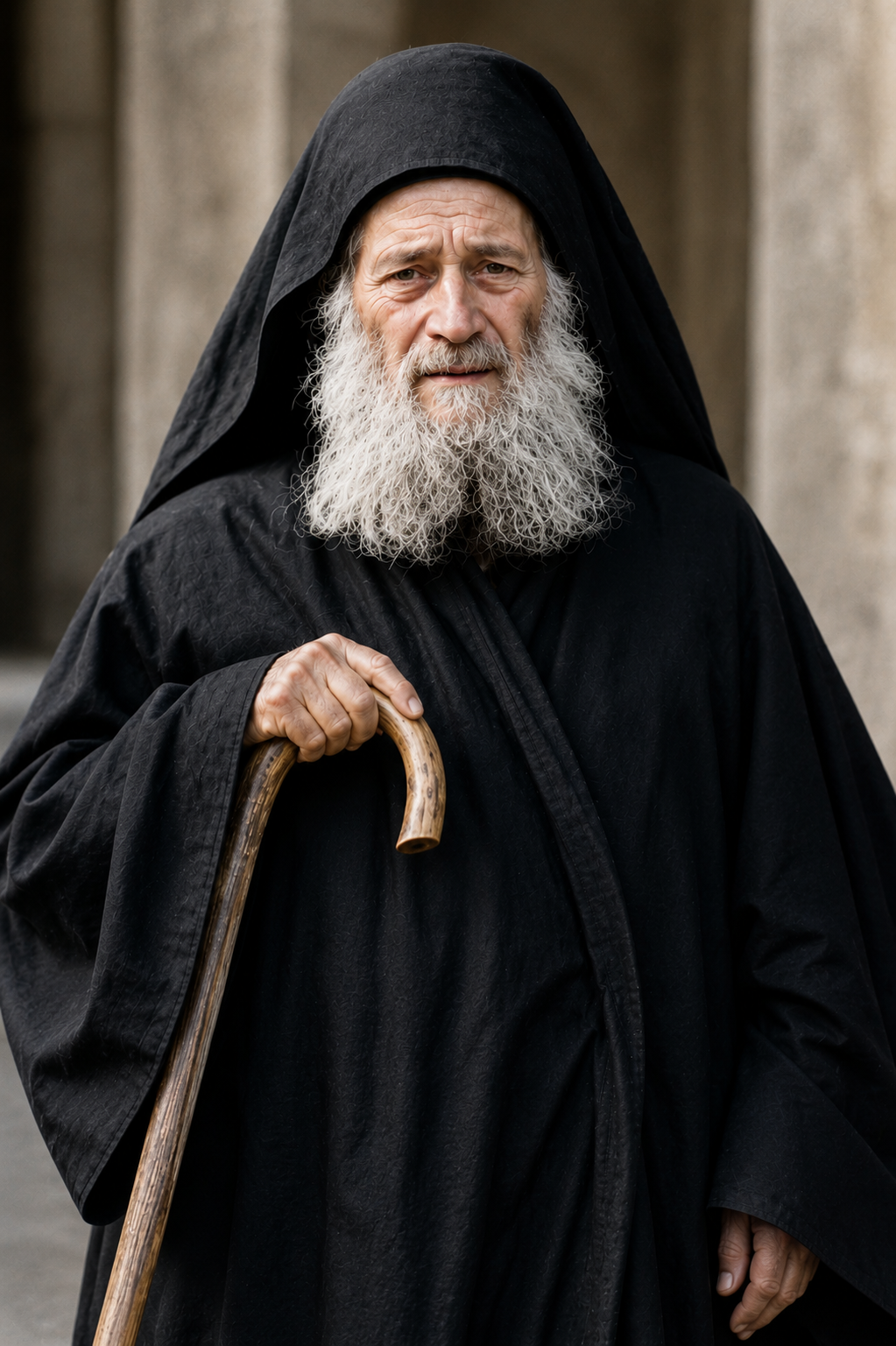
His Teaching on the Jesus Prayer
The center of his teaching was the Jesus Prayer, in its short form: Lord Jesus Christ, have mercy on me. The prayer is repeated with attention, in humility and with trust in God's grace. He taught his disciples to guard the mind from wandering thoughts and to keep returning to the name of Jesus, patiently and without force.
He did not treat prayer as a technique. For him it was part of the whole Christian struggle against pride, anger, vanity and carelessness, and it needed obedience, repentance and humility. The aim was the purification of the heart and communion with God, and not unusual experiences.
His teaching belongs to the hesychast tradition of the Desert Fathers, the collection of texts known as the Philokalia and the theology of Saint Gregory Palamas. It would be wrong to call him the inventor of hesychasm, since the tradition is much older. His part was to practice it, to live it in the modern age and to hand it on.
His Letters and Writings
Joseph left no large systematic treatise. His main written legacy is his correspondence with monks, nuns and other spiritual children. The letters were gathered in Greek under a title that means Expression of Monastic Experience. They were published in English as Monastic Wisdom: The Letters of Elder Joseph the Hesychast, translated by Ephraim Poonen, with the first English edition issued by St. Anthony's Monastery in 1998. Some library records list 1999.
A review of the collection says it includes eighty-one letters and an extra work called the Epistle to a Hesychast Hermit. The letters deal with prayer, temptation, grace, discernment, humility and perseverance, and they give direct access to his own words.
A cautious reader should remember that the English book was prepared by communities devoted to his memory, so the editing and presentation reflect their care for his legacy. Even so, the letters are the best evidence we have of what he actually taught, and they are valued more than later retellings.
Disciples and Lasting Influence
Joseph's greatest historical influence came through those he formed. Among the best known are Elder Ephraim of Philotheou and Arizona (1928 to 2019), who later founded many monasteries in North America, and Elder Joseph of Vatopedi (1921 to 2009), who helped revive the Great Monastery of Vatopedi and wrote about his teacher. Another disciple was Elder Charalambos of Dionysiou (1910 to 2001).
These men carried his teaching to monasteries on Mount Athos and beyond. Joseph himself did not found these houses. They grew out of the work of his disciples after his death, and their size and reach show how far a quiet life of prayer can spread.
His time was also a hard one for Athonite monasticism, since many communities had few monks and little energy. Vatopedi's own account describes him as an important figure in the return to inner watchfulness and prayer. At the same time, the sources we reviewed do not show him as the subject of any formal church trial or doctrinal condemnation. His trials were those of the ascetic life: illness, hunger, cold, temptation and the burden of guiding others.
Death and Glorification
Joseph died at New Skete on Mount Athos on August 15, 1959, the feast of the Dormition of the Mother of God by the church calendar followed on the Holy Mountain. His disciples continued to read his letters and to keep his memory.
On October 20, 2019, Ecumenical Patriarch Bartholomew publicly announced during a visit to Athos that Joseph would be recognized as a saint. The Holy Synod of the Ecumenical Patriarchate formally entered his name in the list of saints on March 9, 2020. UNCERTAIN: some popular accounts treat the October 2019 announcement as the glorification, but the synodal act is the formal step. Services in his honor were composed and later published in English translation.
UNCERTAIN: we could not find a reliable account of an exhumation of his remains or a documented list of where relics are kept, so none is claimed here. His commemoration falls in August, and the exact day listed varies between calendars and communities, so readers should check the calendar of their own church.
Traditions and Devotion
TRADITION: His monastic biographies say that his mother had a vision soon after his birth in which an angel came to take the infant, and that she understood this to mean that the child belonged to God. TRADITION: disciples also report a vision in which angels called him to serve the heavenly King, which is presented as a turning point toward monastic life.
TRADITION: his disciples tell that the Virgin Mary appeared to him before his death and told him he would depart on her feast, and he did die on the Dormition. These stories come from monastic witnesses and later devotional writing. They cannot be checked as historical events.
The letters also describe experiences of spiritual warfare and divine light in the language of Orthodox ascetic life. These are his own religious testimony and are best read in that way. We did not find a fully documented posthumous healing with medical records, so no healing is presented here as a proven miracle. The clearest sign of his continuing influence is the spread of his teaching through his disciples.
Lord Jesus Christ, Son of God, have mercy on us. Through the prayers of Your servant Saint Joseph the Hesychast, quiet our restless minds, teach us humility and obedience, and keep our hearts turned toward You. Help us to call on Your name with attention and trust. Amen.
This is a short original prayer written for this article. It is not an official liturgical text. Orthodox services in his honor were published after his glorification.
Why He Matters to the Eastern Churches
For Orthodox readers, Saint Joseph is a modern witness to the hesychast way. Through his disciples, the Jesus Prayer, obedience to a spiritual father and the life of stillness were handed on to a new generation of monks and nuns, and to many lay people who read his letters.
For Eastern Catholics, his meaning is spiritual and historical. They share the Byzantine heritage of the Jesus Prayer, the Philokalia and the theology of Saint Gregory Palamas. The Second Vatican Council's decree on the Eastern Catholic Churches, Orientalium Ecclesiarum, issued in 1964, encourages the preservation of Eastern spiritual traditions.
Even so, the sources do not show any Catholic canonization of Joseph or any place for him in the universal Catholic calendar. His recognition took place in the Orthodox Church, and respect for the shared Eastern heritage should not be mistaken for formal Catholic recognition of every saint of the Orthodox Church.
Frequently Asked Questions
Learn to Pray in Stillness
Saint Joseph invites us to a simple and patient prayer. You may wish to keep a prayer card of Saint Joseph the Hesychast near you as a reminder to quiet the mind and call on the name of Jesus.
View Prayer Card