Saint Nikephoros the Leper: Orthodox Monk of Chios, Chanter and Spiritual Father of Saint Eumenios
A modern Greek monk who lived and died with leprosy, and was glorified in 2012
At a Glance
- Born
- 1890, Sirikari near Chania, Crete
- Died
- January 4, 1964, Saint Barbara institution, Aigaleo, Athens
- Feast
- January 4 (Orthodox)
- Glorified
- December 1, 2012, Ecumenical Patriarchate
- Spiritual Father
- Saint Anthimos of Chios
- Disciple
- Saint Eumenios Saridakis
- Who Was Saint Nikephoros the Leper?
- Early Life in Crete
- Flight to Alexandria and Arrival on Chios
- Under the Guidance of Saint Anthimos
- Prayer, Chanting and Obedience
- The Letter of 1961 and His Own Witness
- Transfer to Athens and Saint Eumenios
- Death, Relics and Glorification
- Traditions and Devotion
- Why He Matters to the Eastern Churches
- Frequently Asked Questions
Who Was Saint Nikephoros the Leper?
Saint Nikephoros the Leper, also written Nicephorus, was a Greek Orthodox monk of the twentieth century. He was born Nikolaos Tzanakakis in 1890 in the mountain village of Sirikari near Chania on the island of Crete. As a teenager he developed Hansen's disease, which was then called leprosy and was widely feared. He spent most of his adult life in the leprosy institution on the island of Chios, and he ended his days in a similar institution in Athens.
He is remembered for patience in suffering, for faithful chanting in the chapel even as his sight failed, and for his closeness to his spiritual father, Saint Anthimos of Chios. He in turn became the spiritual father of Saint Eumenios Saridakis. He was not a bishop, a founder or a writer of treatises. His witness is the quiet witness of a monk who stayed at his post under very heavy trials.
His life is recent, but many details come to us through the recollections of monks and visitors rather than through detailed historical studies. In this article, documented facts are kept apart from devotional tradition, and uncertain points are marked UNCERTAIN. Eastern Orthodox readers will find in him a recent saint, and Eastern Catholic readers can learn from the same ascetic heritage, while remembering that his glorification took place in the Orthodox Church.
Early Life in Crete
Nikolaos Tzanakakis was born in 1890 in Sirikari, a mountainous settlement near Chania in western Crete. The Orthodox Church in America names his home neighborhood as Kostoyianides. Some secondary publications give 1887 as the birth year. UNCERTAIN: the exact birth day is not known, and 1890 is the better supported year.
His parents are remembered as devout village Christians. They died while he was still young, and his grandfather took charge of his upbringing. The sources do not reliably give the names of his parents, the dates of their deaths, or details about any brothers and sisters. A careful biography leaves these points open rather than guessing.
At about thirteen, Nikolaos went to Chania and became an apprentice in a barber shop. It was while he was learning this trade that the first signs of Hansen's disease appeared. In that period there was no cure, and the disease brought fear, shame and separation from family and work. On Crete, people with leprosy were commonly sent to the island settlement of Spinalonga, and this fate hung over the young man.
Flight to Alexandria and Arrival on Chios
According to the traditional biography published by the Orthodox Church in America, Nikolaos feared being confined on Spinalonga. When he was about sixteen he left Crete by ship for Egypt. He settled in Alexandria and again worked as a barber. As the disease advanced, the marks on his hands and face became hard to hide.
A clergyman then helped arrange for his transfer to the leprosy institution on Chios. The sources do not establish the date he reached Alexandria, the name of the priest who helped him, or the details of the sea voyage. What they do agree on is the year of his arrival on Chios. A letter he wrote himself in 1961 gives 1914, and this matches the main Orthodox biographies. Some later publications give 1924, and that date appears to be an error.
He arrived at the age of about twenty-four. The institution had houses for the patients and a chapel dedicated to Saint Lazarus, the friend of Christ whom the Gospel of John says was raised from the dead. A venerated icon of the Mother of God, called Panagia Ypakoe, Our Lady of Obedience, was kept there. For Nikolaos this place of exile became the place of his vocation.
Under the Guidance of Saint Anthimos
On Chios Nikolaos met Father Anthimos Vagianos, the priest who served the patients and who is now himself venerated as Saint Anthimos of Chios. Nikephoros's own letter says that Anthimos began serving at the institution in 1912, two years before he arrived. Anthimos became his spiritual father and his guide in the life of prayer.
Around 1916, about two years after his arrival, Anthimos tonsured him a monk and gave him the name Nikephoros. The name means victory bearer. UNCERTAIN: the exact date of the tonsure is given only approximately in the sources available to us.
The relationship between the two men shaped his whole life. In the Eastern Christian tradition a monk is expected to find a spiritual father, to confess his thoughts, and to learn obedience. Nikephoros did this in the most difficult circumstances. He did not leave the institution to enter a monastery. The hospital grounds became his monastery, and the chapel of the sick became his place of worship.
Prayer, Chanting and Obedience
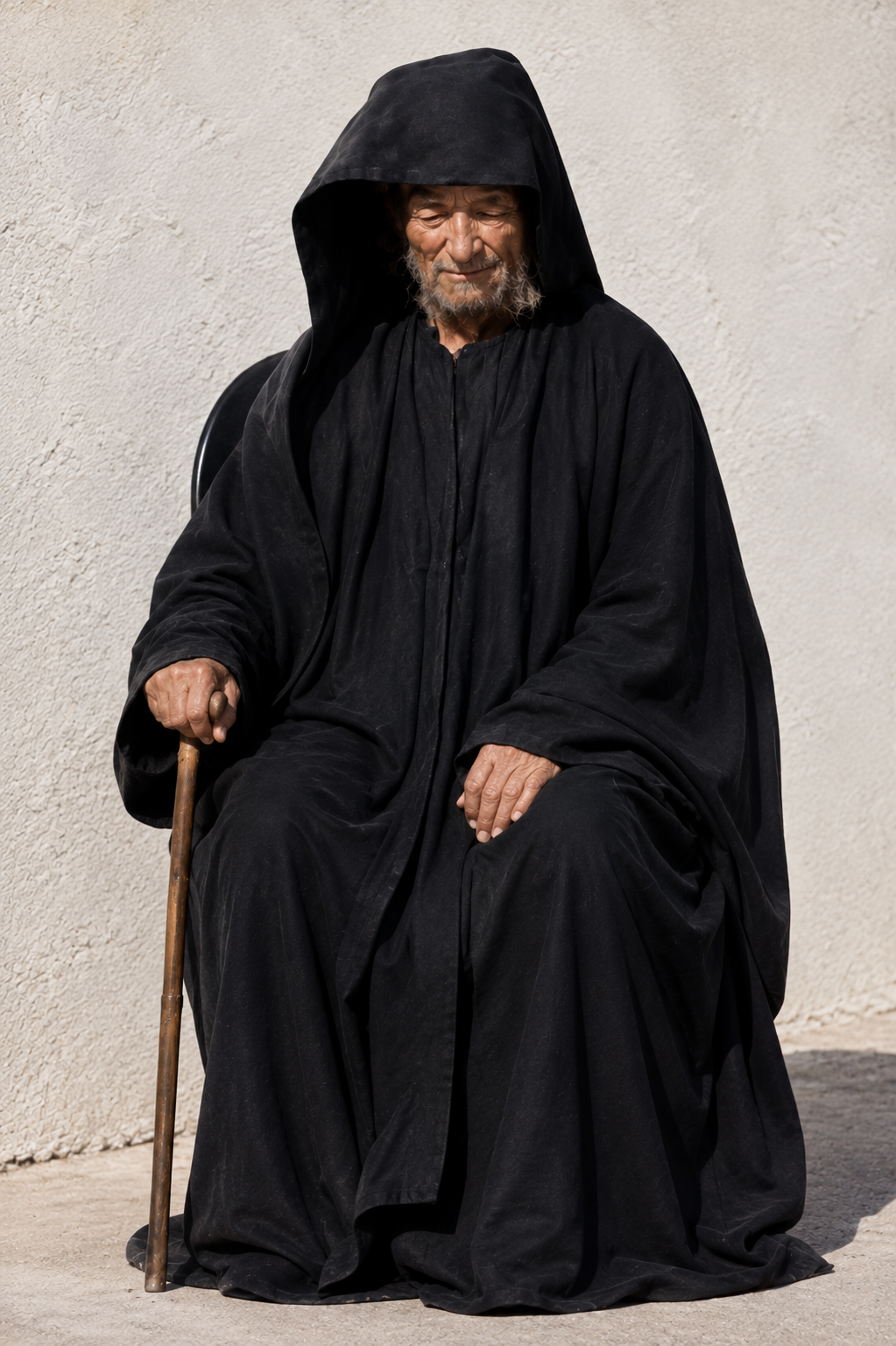
Nikephoros was not a priest. The sources describe him as a monk and a chanter, and the title Father is used for him out of respect. UNCERTAIN: no record of ordination for him was found. In the chapel on Chios he served as the principal chanter, and he is remembered for long nights of prayer, fasting and prostrations. He also worked in the institution's gardens as far as his health allowed.
As his eyesight failed, he relied more and more on hymns and Scripture that he knew by heart. This shows that blindness did not end his liturgical life. He carried the services in his memory, and the community depended on his voice.
Accounts of his later years describe him encouraging visitors to practice the Jesus Prayer, the short prayer asking Christ for mercy that has been central to Eastern Christian spirituality for many centuries. This was an inherited practice, not a new teaching. The conversations reported in the biography by Monk Simon are recollections of witnesses, and they should not be read as exact transcripts.
The Letter of 1961 and His Own Witness
Nikephoros did not write a theological work, and he founded no order or monastery. Yet one of the best sources for his life is a letter he wrote himself. It is dated July 22, 1961, was sent from Athens, and is addressed to the abbess of the Monastery of Panagia Voitheia on Chios.
In the letter he records episodes that he believed showed the miraculous help and spiritual gifts of Saint Anthimos. He names people and describes healings and deliverances, and he separates what he saw with his own eyes from what happened before he came to the island. The letter also fixes his arrival on Chios in 1914 and the start of Anthimos's service there in 1912.
This letter is valuable evidence of what Nikephoros believed and remembered, and of his deep love for his spiritual father. It does not by itself prove the supernatural character of the events it describes. UNCERTAIN: there is no complete catalogue of his writings, and it would be wrong to claim either that he wrote nothing or that all his letters have been collected.
Transfer to Athens and Saint Eumenios
In 1957 the leprosy institution on Chios was closed. Nikephoros and the other remaining patients were moved to the Saint Barbara leprosy institution at Aigaleo, in the Athens area. By then the disease had badly affected his sight, his mobility and his hands. Leaving the island where he had lived for over forty years was a heavy disruption for an elderly and disabled monk.
In Aigaleo he met Father Eumenios Saridakis, a former patient who had recovered from leprosy but chose to stay and care for the others. Eumenios became Nikephoros's disciple and caregiver. This is a distinctive chain of spiritual fatherhood: Anthimos guided Nikephoros, and Nikephoros guided Eumenios. Readers should note that Eumenios was healed of the disease and Nikephoros was not, a difference that is sometimes confused in popular retellings.
The sources do not show Nikephoros taking part in any doctrinal quarrel or church dispute. His life was one of illness, isolation and disability, with patience and gentleness remembered as his marks. Because treatment is now available, it would also be wrong to hold up his particular ascetic path as a pattern that every sick person must copy. His vocation grew out of one monastic relationship and one setting.
Death, Relics and Glorification
Saint Nikephoros died on January 4, 1964, at the Saint Barbara institution in Aigaleo. With the usual birth year of 1890, he was about seventy-three or seventy-four. His disciple Eumenios preserved his memory and helped spread devotion to him.
The Romanian Orthodox Patriarchate reports that his remains were exhumed about three years after his death, around 1967, and gave off a pleasant fragrance. This is a religious testimony and not a scientific finding. UNCERTAIN: the sources we examined do not give a full list of his relics or the place of every fragment. Relics are venerated in Orthodox communities beyond Greece, and one documented example is a fragment received by Paltin-Petru Voda Monastery in Romania, reported in August 2020.
On December 1, 2012, the Holy Synod of the Ecumenical Patriarchate enrolled Nikephoros among the saints of the Orthodox Church. The Patriarchate's pastoral health network published the announcement on December 3, 2012. His feast is kept on January 4. The Romanian Orthodox Church added him to its calendar through a Holy Synod decision on July 21, 2021.
Traditions and Devotion
TRADITION: After his death, believers reported healings and other favors after asking for his prayers, and the Patriarchate's announcement speaks of miracles attributed to him. The official summaries we saw do not give a case by case medical review or a confirmed number of miracles. TRADITION: disciples and visitors also credited him with discernment and a gift for consoling people during his life.
Devotion to him grew sharply during the COVID-19 pandemic, because he had lived with an infectious disease and with long isolation. The Romanian Orthodox Patriarchate noted this growth. TRADITION, UNCERTAIN: stories circulated that he appeared to individuals and promised protection during the pandemic. These are private devotional claims. They are not historically verified, and they are not a guarantee of protection from any illness.
He is commonly asked for prayers by people living with leprosy, infectious disease, chronic illness or long suffering. This is a pattern of popular devotion, and it should not be described as a formal patronage of the whole Church.
Lord Jesus Christ, You looked with mercy on the sick and the outcast. Through the prayers of Your servant Saint Nikephoros, who bore illness with patience, give comfort to all who suffer. Strengthen those who are alone, heal those who are ill, and teach us to love and serve those whom the world avoids. Amen.
This is a short original prayer written for this article. It is not an official liturgical text. The Orthodox Church in America publishes the official troparion and kontakion for his feast.
Why He Matters to the Eastern Churches
For Orthodox readers, Saint Nikephoros is a documented modern example of monastic obedience, liturgical faithfulness, the Jesus Prayer and spiritual fatherhood. His glorification in 2012 and his place in the church calendar make that recognition clear. His life also shows how a tradition of spiritual guidance is handed from one generation to the next, from Anthimos to Nikephoros to Eumenios.
For Eastern Catholics, his meaning is spiritual and historical. They share the Eastern heritage of monastic life, the Jesus Prayer and patient endurance of trials. Yet the sources do not establish any Catholic canonization, any universal Roman Catholic feast, or any inclusion in the calendars of the Eastern Catholic Churches. His glorification took place in the Orthodox Church, and Catholic readers can admire his witness without confusing that with Catholic recognition.
His story speaks plainly to anyone who is sick or isolated. He did not escape his illness, and he did not become famous in his lifetime. He kept praying, chanting and caring for others, and that is why the Church has set his name beside the saints.
Frequently Asked Questions
Remember Those Who Suffer
Saint Nikephoros asks us to remember people who live with illness and isolation. You may wish to keep a prayer card of Saint Nikephoros near you as a reminder to pray for the sick and for those who care for them.
View Prayer Card