Saint Photini the Samaritan Woman: Equal-to-the-Apostles, Witness at Jacob's Well and Martyr
The woman at the well who became a messenger of Christ
At a Glance
- Born
- First century, probably in Samaria (UNCERTAIN)
- Died
- Traditionally about 66 in Rome under Nero; some accounts say Carthage (UNCERTAIN)
- Feast days
- March 20 in the Roman Martyrology and in Slavic Orthodox use; February 26 in Greek Orthodox use
- Liturgical day
- Sunday of the Samaritan Woman, the fifth Sunday of Pascha in the Byzantine calendar
- Known as
- The Samaritan woman, Photina, Equal-to-the-Apostles, Great Martyr
- Veneration
- Ancient cult; no formal canonization date is recorded
- Who Was Saint Photini?
- The Meeting at Jacob's Well
- Samaria and the Woman at the Well
- Her Witness to Her Town
- The Name Photini and Her Family
- Mission and Martyrdom in Tradition
- The Historical Problems
- Death and Relics
- Devotion and the Sunday of the Samaritan Woman
- Saint Photini and the Eastern Churches
- Frequently Asked Questions
Who Was Saint Photini?
Saint Photini, also spelled Photina or Fotini, is the name Eastern Christian tradition gives to the Samaritan woman who spoke with Jesus at Jacob's Well in the Gospel of John, chapter four. She is honored as Equal-to-the-Apostles and as a martyr. Her name comes from a Greek word linked to light, and it is often explained as the enlightened one.
Two very different kinds of evidence meet in her story. The Gospel gives a clear, moving account of her meeting with Jesus and her witness to her town. It does not give her name. Her name, her family, her missions and her martyrdom under the emperor Nero come from later Christian tradition.
This article keeps those two apart. The Gospel account is the firmest part. Later stories are marked TRADITION, and points that cannot be confirmed are marked UNCERTAIN.
The Meeting at Jacob's Well
According to John, Jesus was traveling through Samaria and sat beside Jacob's Well around noon, while his disciples went into the town to buy food. A woman came to draw water, and Jesus asked her for a drink.
She was surprised that a Jewish man would ask a Samaritan woman for water. Jesus answered by speaking of living water, a gift that satisfies a deeper thirst. The conversation moved from water to her own life and then to the right worship of God and the coming Messiah.
Jesus told her that true worshipers would worship in spirit and truth, and he then told her plainly that he was the Messiah she spoke of. This is one of the very few places in the Gospels where he says so so directly.
The woman left her water jar and went back to her town. She invited people to come and see for themselves.
Samaria and the Woman at the Well
The woman lived at or near Sychar, a Samaritan town linked with the story of Jacob and Joseph. The Samaritans accepted the Torah as Scripture and held that Mount Gerizim was the proper place of worship. Their disagreement with the Jews over worship is central to the conversation in John 4.
John says she had had five husbands and was then living with a man who was not her husband. The Gospel does not say how her earlier marriages ended, whether by death, divorce or some other cause.
It goes beyond the text to call her a prostitute or a notorious sinner. Such claims are UNCERTAIN, and a careful reader leaves them aside. Scholars such as Robert Gordon Maccini have also warned against reading her conduct only through later Jewish rules, since a Samaritan woman speaking with a man at a well need not have been shocking in her own society.
What the Gospel does show is a woman who asks real questions, argues honestly and then acts on what she has learned.
Her Witness to Her Town
The most secure part of her public life is what she did after the conversation. The people of the town came out to Jesus because of her testimony. John says many believed because of what she told them. After Jesus stayed two days, more believed because they heard him themselves.
John carefully separates the two stages. First they believed through her word. Then they believed through their own meeting with Christ. This pattern shows what a good witness does. She points beyond herself to Jesus.
Saint John Chrysostom, in his preaching on the Gospel of John, praised her eagerness to tell others what she had found. He compared her leaving of the water jar to the apostles leaving their nets, and he described her as doing the work of an evangelist. This shows that her witness was valued in the early Church long before the later legends were written down.
The Gospel does not record any formal commission to her, nor any later baptism or travel.
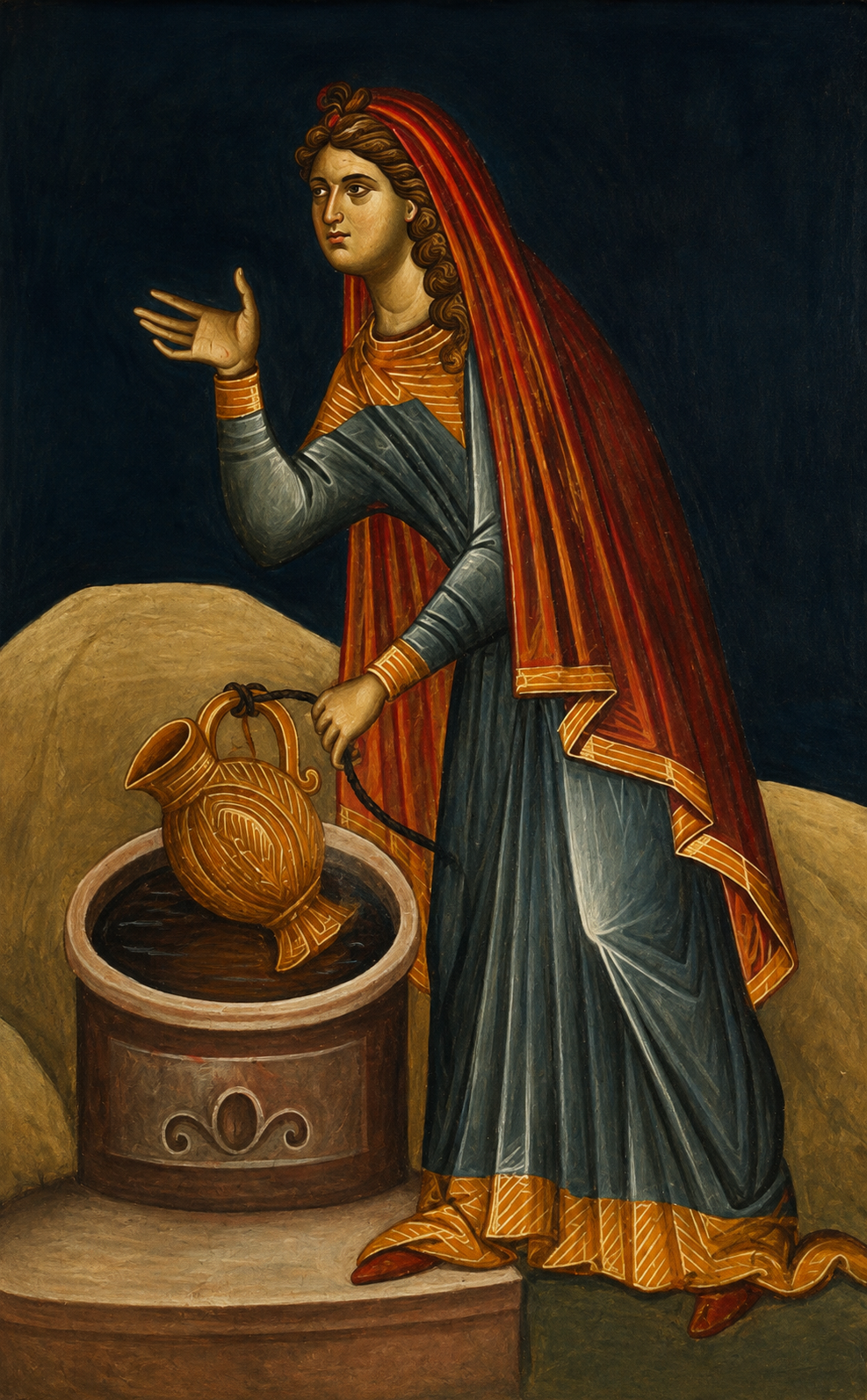
The Name Photini and Her Family
The Gospel never names her. TRADITION says that after Pentecost she was baptized by the apostles and received the name Photini, the enlightened one. The name fits the image of light and living water that runs through the Eastern hymns about her.
Eastern hagiography gives her family as well. It names her sons as Victor, later called Photinos, and Joses, and her sisters as Anatole, Photo, Photida, Paraskeve and Kyriake. They are remembered alongside her in Orthodox commemorations.
These names and relationships are TRADITION. They are not found in the Gospel or in Acts, and we have no independent early record of them. Treated carefully, they show how the Church wished to remember her as the founder of a family of witnesses.
Mission and Martyrdom in Tradition
TRADITION, as told by the Orthodox Church in America and the Patriarchate of Antioch, says that Photini carried the Gospel far beyond Samaria. The Antiochian account speaks of preaching in Carthage in North Africa with her family. Other versions describe her in Rome, confronting the imperial court.
In the longer account, her son Victor became a Roman military officer and met an official named Sebastian, who became a Christian. Photini and her companions were then brought before Nero. They refused to give up Christ in spite of threats, torture and prison.
The story tells of Domnina, called Nero's daughter, who came to believe along with her household, and of the healing of Sebastian's blindness. It describes long imprisonment and protection from torture.
All of this is TRADITION. No independent first century source confirms a mission by Photini in Carthage or Rome, and the routes, dates and length of any journeys are UNCERTAIN.
The Historical Problems
The Gospel account and the later martyrdom story have to be read as separate things. John gives us a real scene in first century Samaria. The later stories come centuries afterward and have very different aims.
The identity of Domnina as Nero's daughter cannot be confirmed from reliable Roman records. The speeches and miracles in the story cannot be authenticated. The versions also disagree about whether she died in Carthage or in Rome. Scholar Craig S. Farmer has noted that different traditions about her later life developed over time.
Her personal name, her family, the earliest text of the martyrdom account and the place of her death are all open questions. They do not lessen what John tells us. They show where careful readers must tell the Gospel from the Church's inherited stories.
Equal-to-the-Apostles is a title of honor. It means that her witness is compared to that of the apostles. It does not mean that she was one of the Twelve.
Death and Relics
TRADITION says that Photini died about 66, in the reign of Nero, after refusing to offer sacrifice to pagan gods. In the form told by the Orthodox Church in America she was tortured and imprisoned and finally thrown into a well. Her sons and sisters are said to have suffered martyrdom as well. Another tradition places her death in Carthage. The year 66 is a traditional estimate and not a documented date.
The Orthodox Church in America says that her head is kept at the Grigoriou Monastery on Mount Athos. The origin and unbroken history of these relics have not been confirmed from early records, so they remain UNCERTAIN.
The same source reports that two churches in Constantinople were dedicated to her, and that healings of eye diseases were reported at them. The dates and individual reports are UNCERTAIN.
There is no date of formal canonization. Her veneration grew in the ancient Church, as with many saints of the early centuries.
Devotion and the Sunday of the Samaritan Woman
The strongest living devotion is the Byzantine Sunday of the Samaritan Woman. It falls on the fifth Sunday of Pascha, counting Pascha as the first. The Gospel of John 4 is read, and the themes of baptism, light and resurrection are drawn from it.
John 4 reports no miracle worked by the woman herself. Her gift in the Gospel is her testimony. The healings, conversions and protection from torture in later accounts are TRADITION.
At Jacob's Well near Nablus there is a church of Saint Photini, and Orthodox worshipers still gather there. The well, which the Gospel describes, is among the most ancient places linked with Jesus.
In the West, the Gospel of the woman at the well is read on the Third Sunday of Lent in Year A. That reading honors the Gospel scene and does not make a universal feast of Photini in the Roman calendar. The Roman Martyrology has been cited for a commemoration on March 20.
Lord Jesus Christ, you spoke kindly to the woman at the well and gave her living water. Meet me in my thirst and in my questions. Free me from shame and make me honest. Let me invite others to come and see you, and then step aside. Through the prayers of your servant Photini, have mercy on me and save me. Amen.
This prayer was written for this page. It is not an official liturgical text.
Saint Photini and the Eastern Churches
In the Greek Orthodox tradition her commemoration is February 26, while Slavic Orthodox use gives March 20. The Orthodox Church in America publishes a troparion in Tone 3 for her as Great Martyr and Equal-to-the-Apostles, and the text should be read there. Its date of composition is UNCERTAIN.
Byzantine Catholics keep the Sunday of the Samaritan Woman within the Paschal season. The Catholic reading of the Gospel is shared, as shown by the Roman Third Sunday of Lent reading and the Byzantine Paschal Sunday.
Pope John Paul II discussed the encounter at the well in Mulieris Dignitatem, in connection with how Christ treated women. These Catholic and Orthodox readings join in valuing her example, even though the detailed later biography is uncertain.
Her message holds both East and West together. A single honest conversation with Christ can turn a person into a messenger who points others to him.
Frequently Asked Questions
Come and See
Saint Photini invited her town to meet Christ for themselves. May this prayer card help you do the same.
View Prayer Card