Saint Thecla of Iconium: Equal-to-the-Apostles, Protomartyr Among Women and Disciple of Saint Paul
The young woman of Iconium whose story shaped early Christian devotion
At a Glance
- Born
- First century, in Iconium, now Konya, Turkey (UNCERTAIN)
- Died
- Traditionally near Seleucia, now Silifke; date unknown (UNCERTAIN)
- Feast day
- September 24 in the Orthodox calendar; September 23 in the older Roman Martyrology
- Known as
- Equal-to-the-Apostles, Protomartyr among women, Virgin and Martyr
- Veneration
- Ancient cult; no formal canonization date is recorded
- Main source
- The Acts of Paul and Thecla, a second century work that is not part of the Bible
- Who Was Saint Thecla of Iconium?
- What the Evidence Shows
- A Family and a Betrothal in Iconium
- Hearing Paul and Refusing Marriage
- Fire and the Arena
- Teaching and the Shrine at Seleucia
- The Controversy Over Her Story
- Death and Relics
- Devotion and Miracle Tradition
- Saint Thecla and the Eastern Churches
- Frequently Asked Questions
Who Was Saint Thecla of Iconium?
Saint Thecla of Iconium is one of the most widely honored women of early Christianity. The Orthodox Church calls her Equal-to-the-Apostles and Protomartyr among women, and Christians in both East and West have remembered her for many centuries. Her story tells of a young woman from Iconium, in what is now Turkey, who heard the preaching of Saint Paul, refused a planned marriage and followed Christ through great danger.
There is an honest difficulty at the center of her biography. Her veneration is certainly ancient and well documented. But the story of her life survives mainly in an apocryphal book, the Acts of Paul and Thecla, and in later writing built on it. Neither the Bible nor any first century source mentions her.
This article therefore separates what the evidence shows from what tradition tells. Episodes that come from the Acts and later writers are marked TRADITION, and points that cannot be confirmed are marked UNCERTAIN.
What the Evidence Shows
The earliest full account is the Acts of Paul and Thecla, generally dated to the second century. The Catholic Encyclopedia places it around 180. It is called apocryphal because the Church did not include it in the Bible. Later writers expanded her story in the Life and Miracles of Thecla, composed in the fifth century, between about 445 and 474 according to modern scholarship. It was long credited to Basil of Seleucia, but its authorship is disputed.
Scholar Stephen J. Davis has shown in The Cult of Saint Thecla that devotion to her spread widely around the Mediterranean, especially among Christian women. Her image appears on pilgrim flasks, lamps, textiles, crosses and other objects.
So the existence of a strong Thecla tradition is certain. Whether each detail of her life happened, or how closely the story follows a real woman, cannot be proven. The Catholic Encyclopedia allows that a real woman may stand behind the narrative. No writings by Thecla herself survive.
A Family and a Betrothal in Iconium
According to the Acts, Thecla came from a wealthy family in Iconium and was known for her beauty. Her mother is named Theocleia and her intended husband Thamyris. Orthodox accounts add that she was eighteen when she turned to Christ, but this and other ages are TRADITION and cannot be verified.
The Acts say she was already engaged when Paul came to town. The names of her mother and fiancé cannot be confirmed from any independent record, so they belong to the story and not to established history.
Even so, the tale reflects real tensions of the time. A young woman who rejected an arranged marriage for a life of Christian devotion could trouble her family, challenge parental authority and upset the plans of a household. The story shows why early Christian teaching about virginity could seem so disturbing to neighbors.
Hearing Paul and Refusing Marriage
TRADITION says that Thecla heard Paul preaching from a window in the house next door, the house of Onesiphorus. She listened for days to his teaching about Christ, the resurrection and chastity. The narrative describes a sudden turning of her whole life and not a long course of instruction.
Her mother grew alarmed when Thecla would not return to the plans for her wedding. Thamyris accused Paul of breaking up the city's families, and Paul was put in prison.
In the story, Thecla gave her jewelry to the guards so she could visit Paul in prison, and she stayed to listen to him. She was found and brought before the authorities. She refused to give up her faith.
The Acts of the Apostles in the Bible describes Paul's work in Iconium in chapter fourteen, but it does not mention Thecla. None of these episodes can be confirmed by a first century source, so all of it is UNCERTAIN as history.
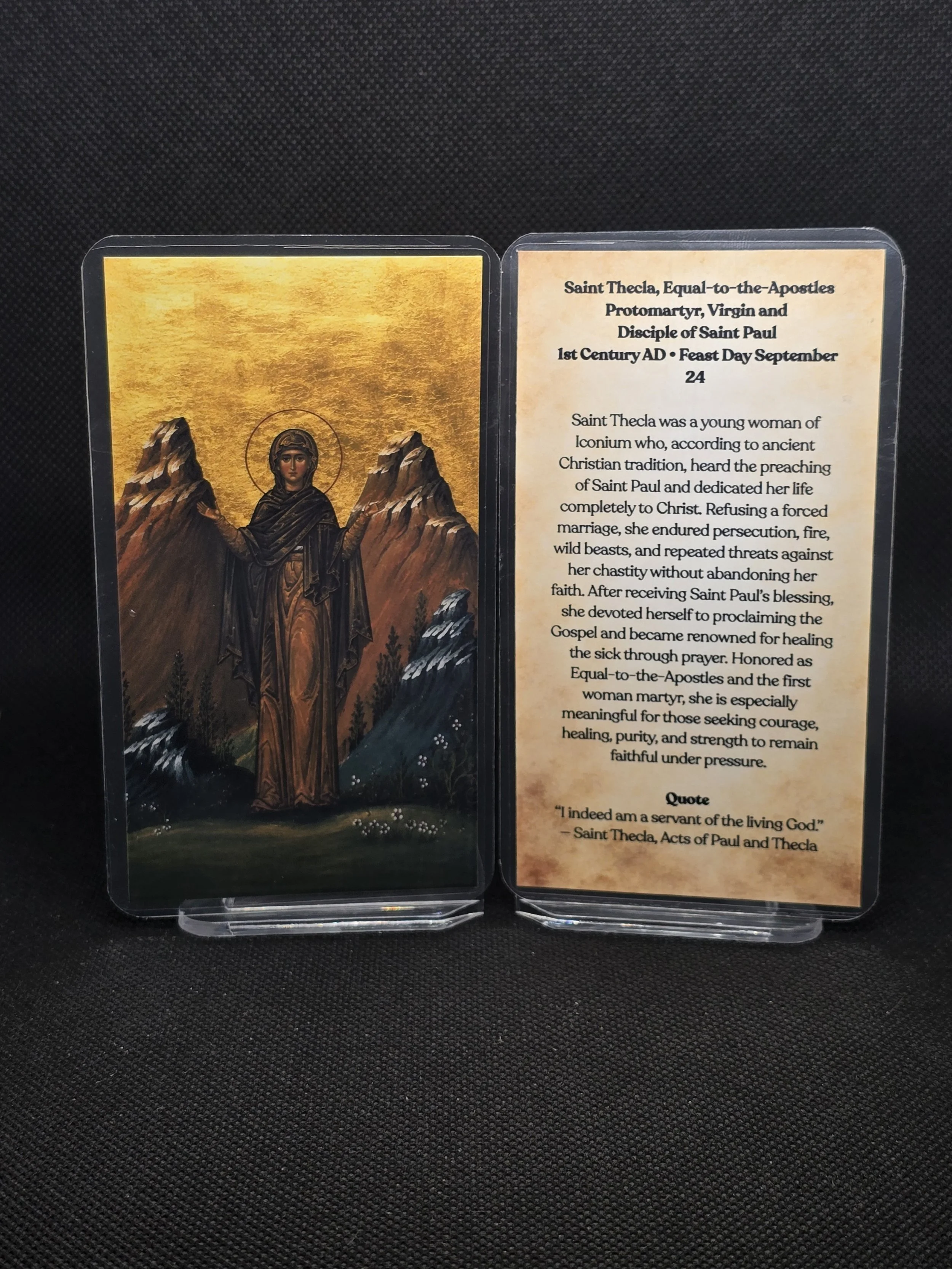
Fire and the Arena
The Acts say Thecla was condemned to death by burning. TRADITION says that the flames did not harm her, and that a sudden storm of rain and hail put out the fire. She then escaped Iconium, found Paul again and traveled with him toward Antioch.
At Antioch, according to the story, a powerful man tried to take her by force, and she resisted him. She was then thrown to wild animals in an arena. A lioness defended her, and the animals could not harm her.
In another scene she threw herself into a pool of dangerous creatures and spoke the name of Jesus Christ, which the narrative presents as her baptism. Other animals meant to tear her apart were freed from their bonds and did her no harm.
All these episodes are TRADITION. They are best read as a way the early Church told of courage under pressure. They are not documented events, and the name Protomartyr does not prove that she was killed for her faith, since the story says she survived each attempt.
Teaching and the Shrine at Seleucia
According to tradition, Paul gave Thecla permission to teach the word of God. She then traveled, preached and settled in the region of Seleucia, now Silifke in Turkey. The Acts do not describe her as a bishop or priest. Her ministry is shown as teaching, witness and ascetic life.
Her reputation as Equal-to-the-Apostles comes from the Church's later devotion and not from the Acts themselves. The title expresses the belief that she carried the Gospel to others.
By late antiquity Seleucia was a major center of pilgrimage. The pilgrim Egeria visited it in the late fourth century and wrote that there was a church there surrounded by many cells of monks and nuns. She also tells of meeting a deaconess named Marthana, who led communities of ascetics and virgins at the shrine.
This account is valuable because Egeria describes a living community that she saw herself. It shows that by the late fourth century the shrine was tied to organized women's religious life. It does not prove that Thecla herself founded those communities, which is UNCERTAIN.
The Controversy Over Her Story
The best known historical dispute concerns the Acts of Paul and Thecla. Tertullian, writing around the end of the second century, challenged the book. In his work On Baptism he reports that a presbyter in Asia had written it out of love for Paul and was removed from office when he admitted it.
Tertullian also objected to Christians who used Thecla's example to defend women teaching and baptizing. His testimony shows that the story was circulating early and was already disputed. It also shows that Paul did not write the book.
His criticism does not prove that no woman named Thecla ever lived. It shows only that the book itself was not accepted as apostolic.
Scholars also notice the strong theme of sexual renunciation in the Acts, and they debate how it relates to early Christian ideas of virginity and women's religious authority. The story gives evidence of early Christian arguments about marriage, celibacy, baptism and the public work of women.
Death and Relics
Her death is UNCERTAIN in every way. We do not know the year, the manner or the place of her burial. The Acts connect her last years with Seleucia, and later accounts differ about her end.
TRADITION, as told by the Orthodox Church in America, says that in old age she was threatened by enemies. She prayed, and a rock opened and hid her. The fifth century Life and Miracles also describes her vanishing into the earth. Because the accounts differ, no exact date of death can be given.
Tarragona Cathedral in Spain keeps a reliquary said to hold part of her arm. The cathedral says the relic came from Lesser Armenia in 1321, through King James II of Aragon, and a chapel was built for it between 1760 and 1775. Thecla is a patron saint of Tarragona. The cathedral's possession and the veneration of the relic are documented, but whether the bone belonged to the historical Thecla cannot be confirmed.
Her veneration is ancient. There is no date of canonization or Orthodox glorification.
Devotion and Miracle Tradition
The Life and Miracles of Thecla records forty-six numbered stories of healing, protection and help for people who sought her intercession at Seleucia. These are TRADITION. They show what believers experienced and hoped at her shrine, but they are not independently verified events.
Her cult was strong among ascetic women, though it was never limited to them. Davis finds Thecla imagery across many kinds of objects, showing how widely she was loved.
The Orthodox Church in America also connects her with women's monastic tonsure, which links her ancient reputation for virginity and asceticism with living Eastern Christian practice.
The Greek Orthodox Archdiocese publishes a traditional hymn for her in the Third Tone. It praises her love for Christ, her courage and her prayers for the faithful. It is an established Orthodox liturgical text and not a prayer written by Thecla.
Lord Jesus Christ, you gave Saint Thecla courage to hold fast to you when her family and city opposed her. Give me the same faith in times of pressure. Help me to love you more than comfort or approval. Protect those who suffer for their faith. Through the prayers of your servant Thecla, have mercy on me and save me. Amen.
This prayer was written for this page. It is not an official liturgical text.
Saint Thecla and the Eastern Churches
Thecla has a recognized place in Byzantine Christian worship. The Orthodox Church keeps her feast on September 24 and calls her Equal-to-the-Apostles and Protomartyr. The Roman Martyrology has listed her on September 23, though that is not a required memorial in the current Roman calendar.
For Byzantine Catholics she belongs to the shared Byzantine calendar and hymns. Our research does not show that every Eastern Catholic Church marks her on the same date or with the same texts, so that point is UNCERTAIN.
Her memory also reaches beyond the Byzantine tradition. Her veneration spread among Egyptian ascetic communities and other Eastern Christians.
She reminds readers that the early Church honored women as witnesses and teachers of the faith, while also showing that her story must be read with care. A faithful reading honors her cult and admits the limits of the evidence.
Frequently Asked Questions
Courage in Faith
Saint Thecla is remembered as a woman who held to Christ under pressure. May this prayer card help you stay faithful.
View Prayer Card