Saint Macarius the Great of Egypt: Desert Father, Spiritual Guide and Priest of Scetis
The elder of the Egyptian desert, known for mercy and humility
At a Glance
- Born
- About 300, traditionally in the Nile Delta (UNCERTAIN; some give about 331)
- Died
- About 390 at Scetis, now Wadi El Natrun (UNCERTAIN; 389 to 391 in sources)
- Feast day
- January 19 in the Byzantine calendar; January 15 in the Roman Martyrology; 27 Paremhat in the Coptic calendar
- Known as
- Abba Macarius, Macarius the Egyptian, Macarius of Scetis, Desert Father
- Veneration
- Ancient cult; no formal canonization date is recorded
- Shrine
- Monastery of Saint Macarius (Deir Abu Maqar), Wadi El Natrun, Egypt
- Who Was Saint Macarius the Great of Egypt?
- Early Life in Egypt
- The Call to the Desert
- Scetis and Spiritual Fatherhood
- Sayings and Teaching
- The Homilies Wrongly Credited to Him
- Persecution and the Question of Exile
- Miracle Stories
- Death, Relics and the Monastery
- Saint Macarius and the Eastern Churches
- Frequently Asked Questions
Who Was Saint Macarius the Great of Egypt?
Saint Macarius the Great of Egypt, also called Macarius of Scetis or Abba Macarius, was a monk and priest who lived in the Egyptian desert in the fourth century. He is counted among the Desert Fathers, the early Christian hermits and teachers who shaped monastic life in the East and the West. His name comes from the Greek word makarios, which means blessed.
He is remembered as a wise spiritual father who taught humility, mercy and restraint in judging others. He is also remembered for an old and important confusion. A famous set of homilies, the Fifty Spiritual Homilies, circulated for centuries under his name, but most scholars today do not think he wrote them.
Much of what we know comes from later writers and from Coptic biographies. Stories that depend on later tradition are marked TRADITION, and points on which sources differ are marked UNCERTAIN.
Early Life in Egypt
Macarius lived in the early centuries of Egyptian monasticism, when many Christians were leaving towns to pray and work in the desert. The monastery that bears his name says his father was a priest from Memphis, and that Macarius worked as a camel driver carrying natron, a mineral salt, through the desert. These details come mainly from later Coptic biographies and not from records of his own time, so they are UNCERTAIN.
His birth is usually placed around the year 300. Sources disagree on the exact year and place. The monastery identifies the village of Shabshir, while other traditions name a different place, and the Greek Orthodox Archdiocese of America gives a later date near 331.
According to the Orthodox Church in America, Macarius married at the wish of his parents and his wife died soon afterward. He then cared for his aged parents and turned increasingly to prayer. The Greek Orthodox tradition also preserves this story. It is TRADITION, since the earliest writer, Palladius, does not confirm it. There is no reliable evidence that he had children.
The Call to the Desert
Macarius was probably not a convert from paganism. The sources describe a man who already lived among Christians and gradually accepted a harder calling. It is more accurate to speak of a vocation than of a conversion.
Palladius, in the Lausiac History, says that Macarius went into the desert at about the age of thirty and lived there about sixty years. Palladius also says that he never met Macarius, who had died before Palladius reached Egypt. These numbers belong to Palladius's account and cannot be checked against other records.
A Coptic biography tells how a young woman falsely accused Macarius of being the father of her child. According to the story, he did not defend himself. He worked to support her, and when she finally confessed the lie, he left to avoid being praised. Both the monastery and the Orthodox Church in America preserve versions of the story. It is TRADITION and cannot be confirmed.
Tradition also links him with Saint Anthony the Great. The monastery says he visited Anthony in 343 and 352 and learned from him about spiritual struggle. The Encyclopedia of Ancient Christianity warns that the Coptic account of a close tie between them is of doubtful accuracy, so the relationship and dates are UNCERTAIN.
Scetis and Spiritual Fatherhood
Macarius is honored as a leading figure at Scetis, now Wadi El Natrun. There monks lived in separate cells under the guidance of experienced elders. They prayed, read the Scriptures, worked with their hands and gathered for worship. This was different from the more organized communal houses of Saint Pachomius.
He was ordained a priest, and his role as a guide grew with his reputation. Palladius and Sozomen both link his priesthood with his spiritual authority, but the sources differ about how the ordination came about.
Palladius describes disciples who lived near him and sought his guidance. He also tells of a warning Macarius gave to a disciple about greed and the misuse of money meant for the poor. Macarius was known for discernment, humility and compassion.
He is often called the founder of Scetis. That is only partly accurate. Modern scholars note that the early traditions do not agree on a single founder, so the exact chronology and his place as the first hermit there are UNCERTAIN. What is clear is that he became one of the main figures of the settlement.
Sayings and Teaching
The best way to meet the teaching of Macarius is through the Sayings of the Desert Fathers, a collection that preserves the words and stories of the early monks. A good number of sayings are credited to Abba Macarius. They are part of a growing oral and written tradition, so we cannot treat each one as a word for word record.
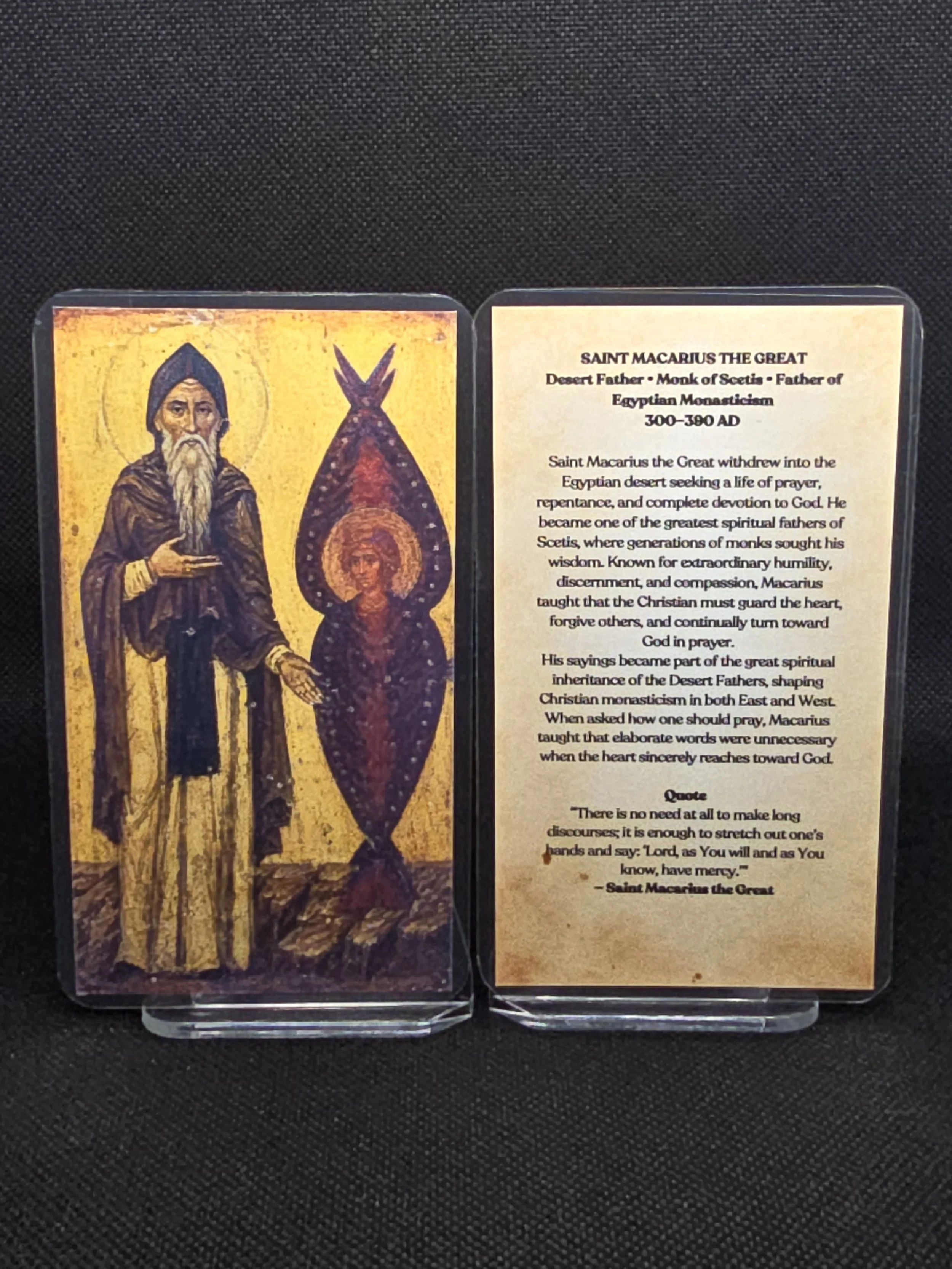
One short prayer in the collection is traditionally credited to him. It asks God simply to have mercy as he wills and as he knows. This saying teaches that prayer does not need many words. It is a transmitted saying and not an independently proven composition.
A well known tale tells how Macarius learned that two married women living together in peace had great virtue. The point of the story is that holiness is not only for monks and hermits. The tale is TRADITION, but it fits the wider message of the desert teachers.
The themes that return are humility, freedom from anger, mercy toward sinners, steady prayer and refusal to condemn others. In a world that tempts us to judge, these themes still speak with force.
The Homilies Wrongly Credited to Him
For centuries a collection called the Fifty Spiritual Homilies was copied under the name of Macarius. These homilies discuss prayer, purification of the heart, grace, the Holy Spirit and the transformation of the soul. They are among the most loved spiritual writings of the East.
Modern scholarship generally does not accept that Macarius of Scetis wrote them. The New Catholic Encyclopedia notes serious problems of authorship, and scholars speak of an anonymous writer or writers, often called Pseudo-Macarius or Macarius-Symeon. Some passages have been linked with the Messalian controversies, though scholars disagree about how close that link is.
This does not mean the homilies are heretical. The Dominican scholar H. C. Graef argued that several passages said to be Messalian can be read in an orthodox way. We must also avoid saying that Macarius himself held Messalian views.
A careful reader therefore separates two things. The sayings in the Desert Fathers' tradition are linked with Abba Macarius, while the Spiritual Homilies are the work of an unknown author. Individual sayings, letters and prayers credited to him still need careful checking, so their authenticity is UNCERTAIN.
Persecution and the Question of Exile
Macarius lived during the disputes over Arianism and the relation of the Son to the Father. Under the emperor Valens, who ruled from 364 to 378, the Arian bishop Lucius of Alexandria opposed supporters of the Nicene faith. Socrates and Sozomen record pressure on Egyptian monks.
A tradition says that Macarius of Egypt and Macarius of Alexandria were arrested and sent to an island of pagans. The monastery dates this to 373 and the return to 375. This episode is TRADITION in part, because the Claremont Coptic Encyclopedia questions whether Macarius of Egypt took part. The stories of the two men may have become mixed.
The two should not be confused. Macarius of Alexandria was a different monk, associated mainly with the settlement of Kellia. Palladius gives them separate chapters.
Macarius of Scetis was remembered as a defender of orthodox faith. He was not a great teacher of councils like Athanasius or the Cappadocian Fathers. His lasting importance lies in monastic practice and spiritual direction.
Miracle Stories
Early literature pictures Macarius as a worker of wonders. All of these stories are TRADITION, and none can be independently verified. Palladius tells of a married woman who appeared to have been turned into a mare by a magician. Her husband brought her to Macarius, who prayed and she was restored. Palladius also tells of a mother who brought a tormented son to Macarius, who prayed and fasted and led him back to a calm life.
Sozomen reports that Macarius raised a dead man to prove the resurrection to an opponent. Another story says that when a thief came to steal from his cell, Macarius helped him load his animal, showing his freedom from possessions.
A tale in the Sayings of the Desert Fathers tells of a skull that speaks about the suffering of the dead and the comfort they receive through prayer. It is a spiritual narrative and not a historical report.
The value of these stories lies in the themes they repeat: humility, mercy, patience and trust in prayer. We cannot say that each episode happened as told.
Death, Relics and the Monastery
Palladius says Macarius died shortly before he himself came to the Egyptian desert. His death is placed around 390, though the year is UNCERTAIN, and sources give 389, 390 or 391. The monastery gives April 5, 390, which matches 27 Paremhat on the Coptic calendar. Palladius says he lived about ninety years, while a Coptic version says ninety-seven.
The monastery tells of a long journey for his body. It says his remains were taken to his native village around 480 and returned to Scetis in 793 under Patriarch John IV. These dates reflect the monastery's own tradition and are not independent historical findings.
The Coptic Orthodox Church says relics identified as those of Macarius the Great are kept in the northern part of the monastery church, with relics of Macarius of Alexandria and a third Macarius, a bishop and martyr.
His veneration is ancient, so no canonization date can be assigned. He was honored long before later formal procedures in the West or the Orthodox synods.
Lord Jesus Christ, you gave Saint Macarius a patient and merciful heart in the desert. Teach me to pray with few words and to trust your mercy. Keep me from judging others and from anger. Help me to see holiness in ordinary lives. Through the prayers of your servant Macarius, have mercy on me and save me. Amen.
This prayer was written for this page. It is not an official liturgical text.
Saint Macarius and the Eastern Churches
Macarius belongs to the time before the later divisions between Catholics, Eastern Orthodox and Oriental Orthodox Christians. He is commemorated on January 19 in the Byzantine calendar, in both Orthodox and Byzantine Catholic usage. The Roman Martyrology lists him on January 15, and the Coptic Church keeps 27 Paremhat, with a further commemoration of his return from exile.
For Eastern Christians he stands for the spiritual father, constant repentance, purity of heart and holiness through prayer. For Coptic Christians his memory is especially visible in the life of the monastery of Saint Macarius in Wadi El Natrun, which still holds his relics according to tradition.
He also reminds readers that holiness is not only a matter of strict fasting or distance from society. The desert tradition insists on humility, mercy and love of neighbor.
A liturgical troparion in Tone 1 is published by the Orthodox Church in America, but its date of composition is UNCERTAIN, and it should not be called a prayer written by Macarius himself.
Frequently Asked Questions
A Heart Without Judgment
Saint Macarius taught mercy and humility in the desert. May this prayer card help you pray simply and judge gently.
View Prayer Card