Saint Justin Popović: Serbian Orthodox Archimandrite, Theologian and Spiritual Father of Ćelije
A monk, teacher and hagiographer who linked doctrine with holiness
At a Glance
- Born
- March 25 (Julian), or April 6, 1894, in Vranje, Serbia; some sources give April 7 (UNCERTAIN)
- Died
- March 25 (Julian), or April 7, 1979, at Ćelije Monastery near Valjevo
- Feast day
- June 1 on the Julian calendar, which is June 14 on the Gregorian calendar today
- Known as
- Venerable Justin of Ćelije, archimandrite and theologian
- Glorification
- 2010 by the Holy Assembly of Bishops of the Serbian Orthodox Church; the decision is dated April 29 and the liturgy May 2 in Belgrade
- Catholic recognition
- None; no Catholic beatification or canonization has been verified
- Who Was Saint Justin Popović?
- Early Life in Vranje and Belgrade
- War, Monastic Vow and Studies Abroad
- Teacher, Priest and Missionary
- His Major Writings
- Life Under Communist Rule
- His Views on Rome and Ecumenism
- Death, Glorification and Relics
- Devotion and Tradition
- Saint Justin and the Eastern Churches
- Frequently Asked Questions
Who Was Saint Justin Popović?
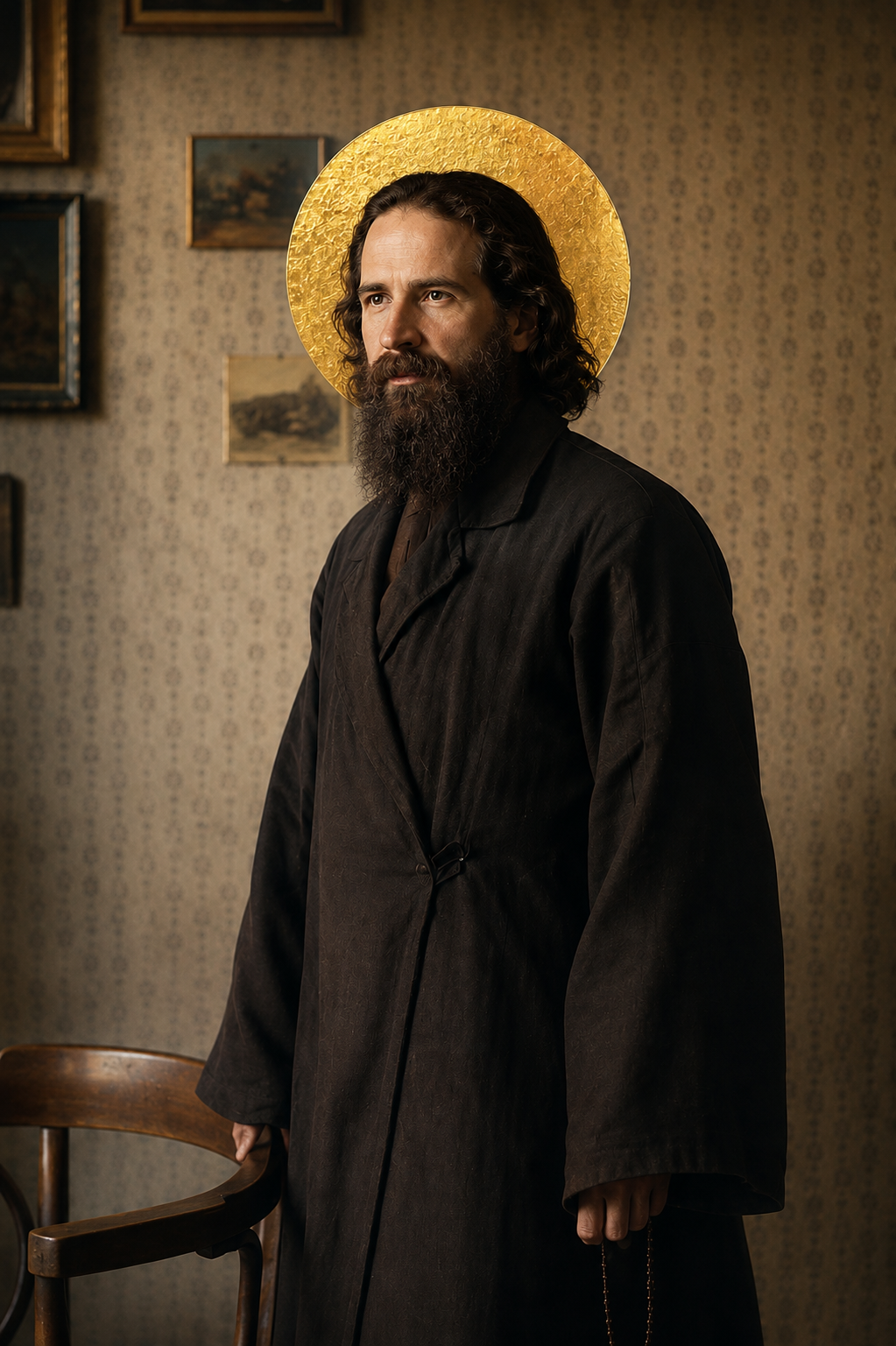
Saint Justin Popović, also called Justin of Ćelije or Justin the New, was a Serbian Orthodox monk, priest and theologian of the twentieth century. He taught in seminaries and at the University of Belgrade, wrote a major work on Orthodox doctrine and compiled a large set of lives of the saints. After the Second World War he lost his university post under the communist government and spent the rest of his life as spiritual father at Ćelije Monastery near Valjevo.
The Serbian Orthodox Church glorified him as a saint in 2010. He is remembered for insisting that theology must grow out of prayer, repentance and the life of the Church. He is also remembered for sharp criticism of the papacy and of some forms of ecumenism. This article presents both sides of his legacy plainly, as his own theological judgments, and not as neutral history or Catholic teaching.
Stories that come from later devotional writing are marked TRADITION, and points on which sources differ are marked UNCERTAIN.
Early Life in Vranje and Belgrade
He was born Blagoje Popović in Vranje, in southern Serbia. Orthodox sources give his birth as March 25 on the Julian calendar, which is April 6, 1894 on the Gregorian calendar, since the difference in that century was twelve days. Some encyclopedias give April 7. The exact date is therefore UNCERTAIN, though April 6 is the consistent conversion.
His family belonged to a tradition of priests, and the surname Popović reflects this. Biographies name his father as Spiridon and speak of earlier generations of clergy. His family visited the nearby monastery of Saint Prohor of Pčinja. One Orthodox diocesan biography says that at fourteen he began carrying a Bible and reading three chapters every day. This is a recollection from church biography and not a documented diary entry, so it is UNCERTAIN.
From 1905 to 1914 he studied at the Saint Sava Seminary in Belgrade. There he met patristic theology, Orthodox spiritual writing and Russian literature, and Fyodor Dostoevsky became a lasting influence on his thought. Bishop Nikolaj Velimirović, later glorified, was an important figure in his formation, and Justin's writings share some of Nikolaj's concern for Serbian Orthodox identity and for the relation between Christianity and European civilization.
War, Monastic Vow and Studies Abroad
Justin was raised Orthodox, so there was no conversion from another faith. His great turning point was the choice of the monastic life. After the seminary the First World War began. He served as a medical orderly with Serbian forces and saw the suffering of the army during its retreat.
During the retreat through Albania he entered monastic life at Shkodër in 1916, taking the name Justin in honor of Saint Justin Martyr. Biographies give January 1, 1916 for the tonsure, but the exact date should be treated as UNCERTAIN, while the year and place are well supported.
He went on to study in Russia, but the upheavals of 1917 disrupted his plans, and he continued at Oxford until about 1919. There he worked on a dissertation about the philosophy and religion of Dostoevsky. He did not receive the degree. Some church biographies say it was rejected because he would not soften his criticism of Western Christianity, while other analysis says the examiners also doubted his uncritical dependence on Dostoevsky. The real reasons are UNCERTAIN, and it would be wrong to reduce them to a single story of persecution.
In 1926 he defended a doctoral dissertation at the University of Athens on personhood and knowledge in the theology of Saint Macarius of Egypt. The work shows his lasting interest in grace and the spiritual life.
Teacher, Priest and Missionary
Justin began teaching at the seminary in Sremski Karlovci in 1921 and was ordained to the priesthood in 1922. He taught Scripture, dogmatic theology and the Fathers. He later taught in Bitola and joined the Faculty of Orthodox Theology at the University of Belgrade in 1934.
His theology was centered on Christ as the God-man, through whom humanity is called into communion with divine life. He argued again and again that theology cannot be only a matter of concepts. For him it had to be joined to worship, repentance, asceticism and holiness.
From about 1930 he took part in Orthodox missionary work in Carpathian Ruthenia, in what was then Czechoslovakia. Many communities there had ties to the Greek Catholic tradition. Orthodox accounts describe the work as bringing communities back to Orthodoxy, while Catholic accounts see transfers of Eastern Catholic Christians. The two descriptions show different views of the same events. Justin was considered for a bishop's post in the region but declined to be consecrated.
He never founded a religious order. His lasting influence came through teaching, books and the spiritual guidance of monks, nuns and clergy.
His Major Writings
His main systematic work is the Dogmatics of the Orthodox Church, whose early volumes the Croatian Encyclopedia dates to 1932. A complete bibliography needs care, since later editions and compilations were published after his death.
His Lives of the Saints, a Serbian collection in twelve volumes issued between 1972 and 1977, reflects his belief that the saints show Christian doctrine lived out in human experience.
The Orthodox Church and Ecumenism, published in 1974, states his mature criticism of Roman Catholic ecclesiology and of some forms of organized ecumenism. It remains influential and controversial. English readers also know him from Orthodox Faith and Life in Christ, a collection published in 1994 that includes the essay Humanistic Ecumenism.
The Inward Mission of Our Church calls for renewal through prayer, fasting, the Eucharist and personal holiness, and warns against reducing the Church to nationalism or administration. The Attributes of the Church, translated into English in 1981, comes from material first published in Serbian in 1974.
His writings also deal with Dostoevsky, Orthodox teaching about the human person and the tradition of Saint Sava.
Life Under Communist Rule
Justin lived through two world wars, the end of old monarchies, the Russian Revolution and the rise of communist Yugoslavia. He opposed communism because he held that the human person cannot be understood apart from Christ, and that systems which deny God put humanity in the place of God.
After the communist takeover he lost his university post. Accounts describe detention, interrogation and continued surveillance. By May 1948 he had settled at the women's monastery of Ćelije, where he became spiritual father to the community.
He kept writing and receiving visitors despite political limits. His position was one of enforced exclusion from academic life, but he was not imprisoned at Ćelije in the ordinary legal sense. It would be wrong to say he spent those decades in a prison cell.
Neven Vukić has written an academic study of Justin's life under communism, which is useful for a careful reading of this period.
His Views on Rome and Ecumenism
Any honest account has to deal with his criticism of the Catholic Church. Justin rejected papal infallibility and the claim of universal papal jurisdiction, which he saw as raising a human authority above the Church. He also criticized the entry of Eastern Christian communities into communion with Rome, a process Orthodox writers often call Uniatism. In The Orthodox Church and Ecumenism he took a very severe position on forms of ecumenism he believed compromised Orthodox teaching.
Vladimir Cvetković has studied how his views developed. He distinguishes Justin's steady objections to papal authority from his changing attitude to particular ecumenical efforts. In earlier years he was more open to some Protestant and Anglican contacts than his later polemics suggest. His deepest worry was that human-centered compromise might replace revealed truth.
Some of his statements about the Catholic Church are sweeping and harsh. They should be read as his own theological judgments and not as established Catholic teaching or neutral history. Catholic readers may also recall that the Second Vatican Council, in Unitatis Redintegratio from 1964, praises the spiritual and liturgical heritage of the Eastern Churches and encourages dialogue.
Eastern Catholics have a particular reason to read him with care, since his criticism touches their own history. A fair reading names the disagreement without hostility.
Death, Glorification and Relics
Justin died at Ćelije Monastery on March 25 on the Julian calendar, which is April 7, 1979. The date is the feast of the Annunciation on the Julian calendar, and Orthodox writers note that this was also the date given for his birth. He was buried at Ćelije, and his grave became a place of pilgrimage.
In 2010 the Holy Assembly of Bishops of the Serbian Orthodox Church recognized him as a saint. Church communiqués give the decision as April 29, 2010, and the celebration took place at the Church of Saint Sava in Belgrade on May 2, 2010. He was given the title Venerable Justin of Ćelije. His main feast is June 1 on the Julian calendar, which is June 14 on the Gregorian calendar, and some calendars also mark April 7.
In June 2014 his remains were uncovered at Ćelije and translated, with Patriarch Irinej of Serbia presiding at the celebrations on June 14. A church dedicated to Saint Sava was built at the monastery according to his will. The present location of his reliquary within the monastery is UNCERTAIN, and visitors should confirm details with the monastery before traveling.
Devotion and Tradition
Veneration of Justin grew among Serbian Orthodox believers before his glorification. His reputation rested on his ascetic discipline, his pastoral teaching, his writing and his steadfastness under pressure.
Orthodox biographies report healings connected with his prayers and visits to his grave. These reports are TRADITION, since the sources do not provide medical records for particular cases. One diocesan biography also mentions reports of an unusual light near his grave, which should be understood as a devotional report and not as a verified event.
Disciples recall long hours of prayer, frequent tears, little sleep and a strict personal discipline. These are valuable testimonies of his reputation, though the details of his private routine are not uniformly documented.
His glorification recognizes him as a saint in the liturgical life of the Serbian Orthodox Church. It does not mean that every story told about him has been verified.
Lord Jesus Christ, God and man, you gave Saint Justin a love for the Fathers and for the poor monastery of his old age. Teach me to join my thoughts to prayer and my prayer to repentance. Keep me faithful in hardship and gentle toward those who disagree with me. Heal the divisions among your people. Through the prayers of your servant Justin, have mercy on me and save me. Amen.
This prayer was written for this page. It is not an official liturgical text.
Saint Justin and the Eastern Churches
Saint Justin belongs to the Serbian Orthodox Church, and an English-language troparion in Tone 4 is published by the American Carpatho-Russian Orthodox Diocese. English versions of his hymns vary, so that text should not be treated as the only authorized translation.
For Eastern Catholics he is a complicated figure. His stress on Christ, the Fathers, asceticism and the Eucharist overlaps with the best of Eastern Catholic spirituality, and the Second Vatican Council encouraged Catholics to value the theological and monastic traditions of the East. At the same time, his opposition to communion with Rome and his criticism of Byzantine Catholic communities cannot be set aside.
We found no reliable evidence of an official Catholic liturgical cult of Justin Popović, so his glorification should not be described as a Catholic canonization. The best reason for Eastern Catholic readers to study him is to meet an important Orthodox theologian, learn from what they share and understand the real differences on Church authority and unity.
Frequently Asked Questions
Theology as Prayer
Saint Justin taught that doctrine and holiness belong together. May this prayer card help you pray with the Orthodox faithful.
View Prayer Card