Saint Nikolaj Velimirović: Serbian Orthodox Bishop of Žiča and Ohrid, Preacher and Writer
A preacher, writer and exile whose legacy is honored and debated
At a Glance
- Born
- December 23, 1880 (Julian), or January 4, 1881, in Lelić near Valjevo; sources differ on the exact day (UNCERTAIN)
- Died
- March 18, 1956, at Saint Tikhon's Monastery, South Canaan, Pennsylvania
- Feast days
- March 18 and May 3 (Gregorian); March 5 and April 20 on the Julian calendar
- Known as
- Bishop of Žiča and Ohrid, the Serbian Chrysostom
- Glorification
- May 19, 2003, by the Holy Assembly of Bishops of the Serbian Orthodox Church
- Catholic recognition
- None; no Catholic beatification or canonization has been verified
- Who Was Saint Nikolaj Velimirović?
- Childhood in Lelić and Education
- Illness, Monastic Vow and Early Ministry
- Bishop of Žiča and Ohrid
- His Major Writings
- War, Arrest and Dachau
- Antisemitism and Political Associations
- Exile in America and Death
- Relics, Glorification and Devotion
- Saint Nikolaj and the Eastern Churches
- Frequently Asked Questions
Who Was Saint Nikolaj Velimirović?
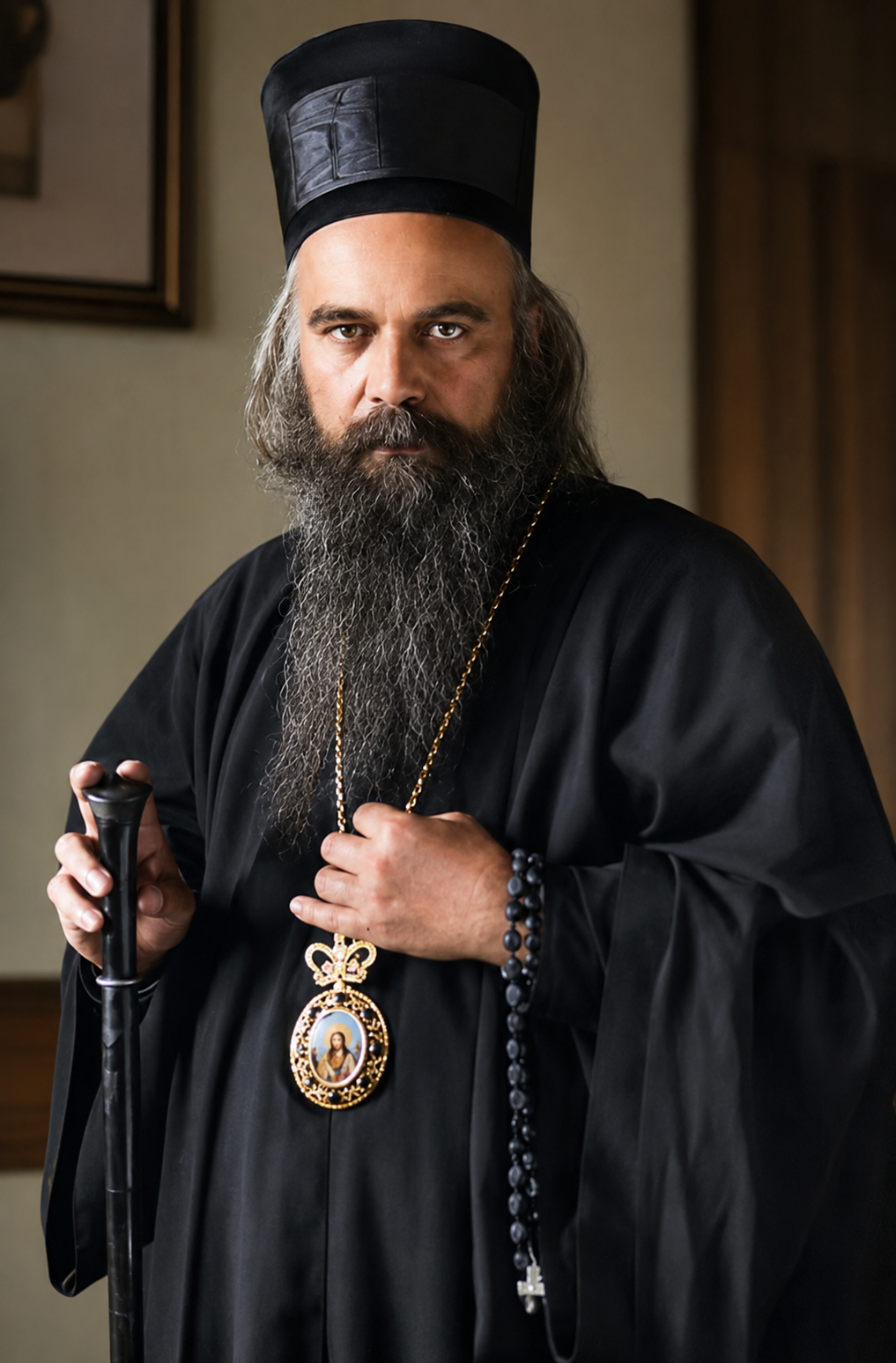
Saint Nikolaj Velimirović, also called Saint Nicholas of Žiča and Ohrid, was a Serbian Orthodox monk, bishop, preacher and writer of the twentieth century. He is known to many readers through The Prologue from Ohrid, a daily book of saints' lives and reflections, and through Prayers by the Lake, a collection of short meditative prayers. His preaching earned him the title the Serbian Chrysostom, a comparison with the great preacher Saint John Chrysostom.
The Serbian Orthodox Church glorified him as a saint in 2003. This article tells his story as the sources record it. It also faces a hard fact: scholars have documented antisemitic passages in some of his writings, and his political associations before the Second World War are debated. A fair account has to hold both his spiritual influence and these serious problems in view.
Some stories in popular biographies come from later devotional writing and are marked TRADITION. Points on which sources differ are marked UNCERTAIN.
Childhood in Lelić and Education
He was born Nikola Velimirović in the village of Lelić, near Valjevo, in Serbia. His parents were Dragomir and Katarina, who raised their children in the devotional life of the Serbian Orthodox Church. The Orthodox Church in America says he was one of nine children. Sources give his birth as December 23, 1880 on the Julian calendar, which is January 4, 1881 on the Gregorian, though some biographies give January 5. The exact day is UNCERTAIN.
His mother taught him prayers and brought him to services at Ćelije Monastery. Popular biographies add detailed childhood conversations and incidents. Without an early source, these should be read as devotional tradition, not as verified history.
After village school he studied theology in Belgrade and then went abroad. He studied at the University of Bern in Switzerland, in an Old Catholic theological setting, and spent time in England. Urs von Arx, a scholar of this period, has documented his Bern studies and his contact with Western Christians. He also studied in Saint Petersburg. This broad education was unusual for a Serbian monastic of his generation.
Illness, Monastic Vow and Early Ministry
Nikolaj was raised Orthodox, so there was no conversion from another religion. His path was a deepening commitment to the monastic life. Orthodox accounts say that after his studies he fell gravely ill, often identified as dysentery, and promised to give his life to God if he recovered. The exact words of this promise come from later devotional biographies, so the details are TRADITION.
He entered Rakovica Monastery near Belgrade. He received monastic tonsure there in December 1909, taking the name Nikolaj, and was later ordained a priest. He became known as a teacher and a gifted public speaker.
During the First World War he traveled to Britain and the United States to speak on behalf of Serbia in 1915. These journeys made him known to English-speaking audiences and created friendships that later helped him when he was in exile.
In 1919 he was elected a bishop. This began the period that shaped most of his public life.
Bishop of Žiča and Ohrid
His ministry is linked with two historic places. Žiča was a center of medieval Serbian Christianity, and Ohrid was an old center of Slavic Christian culture. Sources describe his work in both, but the exact dates of his assignments differ. Urs von Arx identifies service at Žiča beginning in 1919 and again from 1936, while shorter summaries sometimes say 1934. The chronology is UNCERTAIN.
His documented pastoral work included restoring churches and monasteries, supporting orphanages and promoting religious education. He was also closely linked with the Bogomoljci movement, a lay revival that stressed prayer, repentance and regular church attendance. The movement was influential in Serbian Orthodoxy, though its social and political ties also drew criticism.
He preached widely and wrote constantly. His sermons brought the Gospel into the language of ordinary Serbian life, which helped earn the name the Serbian Chrysostom. This title is an honor given by admirers and not a formal office.
Readers should keep in mind that his thinking changed over the decades. A fair biography looks at his works across his whole life and does not treat everything he wrote as the same view.
His Major Writings
Prayers by the Lake, generally dated to the early 1920s, is a book of short meditative prayers connected to his time near Lake Ohrid. It is one of his most loved works because of its simple and poetic language.
The Prologue from Ohrid is a daily collection of saints' lives, reflections and homilies arranged by the Church calendar. It is probably his best known work and has been read widely in Orthodox homes. It is a devotional collection and not a critical modern history. Some accounts in it rest on pious tradition and cannot be independently confirmed.
Other works include Missionary Letters, which answers practical spiritual questions, and War and the Bible, which reflects on history and conflict. The Faith of the Saints, published in 1949, presents Orthodox teaching in catechetical form.
These writings show a gifted communicator who joined biblical imagery with poetry. They also show a man shaped by war, national struggle and strong opinions about Western society. Readers who love his prayers should also be ready to read his more controversial works with care.
War, Arrest and Dachau
Germany invaded Yugoslavia on April 6, 1941. Nikolaj was arrested by the occupying authorities, and the Orthodox Church in America gives July 12, 1941 as the date. He was held at Ljubostinja Monastery and later at Vojlovica, together with Patriarch Gavrilo Dožić. In September 1944 both men were taken to Germany and imprisoned at Dachau.
His detention is well established. The scholar Jovan Byford notes that Nikolaj and Patriarch Gavrilo were treated as special prisoners and held apart from ordinary camp inmates. Some devotional biographies say he was tortured at Dachau, but the surviving evidence does not establish specific torture. This is UNCERTAIN, and it should not be said that he suffered the same conditions as the general camp population, who endured forced labor, starvation and murder.
He left Dachau before the liberation of the camp in April 1945. The exact reasons and circumstances of his release are debated by historians.
Byford also distinguishes his earlier political views from his wartime conduct. He refused to cooperate with the German occupiers and was imprisoned by them. This is a different question from the troubling writings discussed below.
Antisemitism and Political Associations
The most serious controversy about Nikolaj concerns antisemitism. Jovan Byford's research identifies passages in his writings that go beyond traditional theological disagreement with Judaism and express hostility toward Jews as a group. Byford has also studied how later writers have defended, minimized or ignored those passages.
A particularly disputed text is Words to the Serbian People Through the Dungeon Window, published after his death in 1985. It contains antisemitic material, but the circumstances of its writing and editing are contested. Its usual link to his Dachau imprisonment is UNCERTAIN, and should not be stated as proven.
Other debated matters include remarks in a 1935 address that some scholars read as favorable to aspects of Hitler's religious nationalism, a German decoration he received connected with a military cemetery, and his association with Dimitrije Ljotić, leader of the Serbian fascist movement Zbor. Not every scholar reads these facts in the same way. Željko Perović, for example, argues that some readings of his prewar speeches are misleading.
These issues do not rest on one side only. Antisemitic ideas in his legacy are a real historical question, not merely a quarrel about his canonization. At the same time, the record shows that he opposed and was imprisoned by the German occupiers. Christians who honor him can do so while acknowledging the harm of antisemitism and rejecting it clearly.
Exile in America and Death
After the war Nikolaj did not return to Communist Yugoslavia. He settled in the United States in 1946. He taught at Saint Sava Seminary in Libertyville, Illinois, and later at Saint Tikhon's Orthodox Theological Seminary in South Canaan, Pennsylvania, where the Orthodox Church in America records him as dean and rector.
His final years combined teaching, writing and pastoral work with declining health. He died on March 18, 1956 at Saint Tikhon's Monastery. Orthodox accounts say he was found kneeling in prayer in his room. This is a cherished part of his devotional biography and is TRADITION, not a documented medical report.
He was first buried at Saint Sava Monastery in Libertyville, Illinois. His life in exile reminds readers that many bishops of his time lived far from their homelands, and that the Orthodox faith in America grew through such people.
Relics, Glorification and Devotion
In 1991 his remains were returned to Serbia and enshrined in his native village of Lelić. The return became an important moment in the revival of public veneration after the Communist period.
On May 19, 2003 the Holy Assembly of Bishops of the Serbian Orthodox Church entered him into the calendar of saints. The celebration took place in Belgrade later that month. Announcements give May 23 for the scheduled liturgy, while a later Serbian diocesan account gives May 24, so that date is UNCERTAIN. The decision itself is dated May 19.
His feasts are March 18, the date of his repose, and May 3, which marks the translation of his relics. On the Julian calendar these fall on March 5 and April 20. Orthodox devotion includes icons, hymns, pilgrimage to his relics at Lelić and continued reading of his writings.
Some devotional accounts speak of miraculous icons and signs, but we could not confirm a specific, fully investigated posthumous healing. His glorification should be described as an act of the Serbian Orthodox Church and not as the result of a documented miracle file like those used in modern Catholic processes.
Lord Jesus Christ, you called your servant Nikolaj to preach and to pray. Give me a quiet heart and an honest tongue. Keep me from hatred of any people, for every person bears your image. Teach me to ask forgiveness for the wrongs done in your name. Through the prayers of your servant, have mercy on me and save me. Amen.
This prayer was written for this page. It is not an official liturgical text.
Saint Nikolaj and the Eastern Churches
Saint Nikolaj belongs to the Serbian Orthodox Church. He is commemorated there with a troparion and a kontakion, and the Orthodox Church in America also publishes hymns for the translation of his relics.
For Eastern Catholics his place is much more limited. We found no verified Catholic beatification or canonization, no Vatican biography and no official Eastern Catholic liturgical commemoration. His Orthodox glorification does not mean he is recognized in the Catholic calendar. Readers can still study his life as part of the history of Eastern Christianity, for example his studies in Bern and his encounters with Western Christians.
His writings, especially his prayers, are read by many Christians. Readers should do so with the full picture in mind. They can value the beauty of his prayers while naming plainly the antisemitic passages in his legacy. This article offers his prayer card for those who wish to pray with the Serbian Orthodox faithful, and it does not claim more than the sources show.
Frequently Asked Questions
Remembering With Honesty
Saint Nikolaj left prayers that many people love and a legacy that calls for honest study. May this prayer card help you pray and remember with care.
View Prayer Card