Catholic Saints • Rome • New York • 1850 to 1946
Saint Frances Cabrini and Pope Leo XIII: “Not to the East, but to the West”
She dreamed of China, asked the pope for permission to go East, and was told to go West. The full story of the frail Italian nun who became the first American citizen to be canonized.
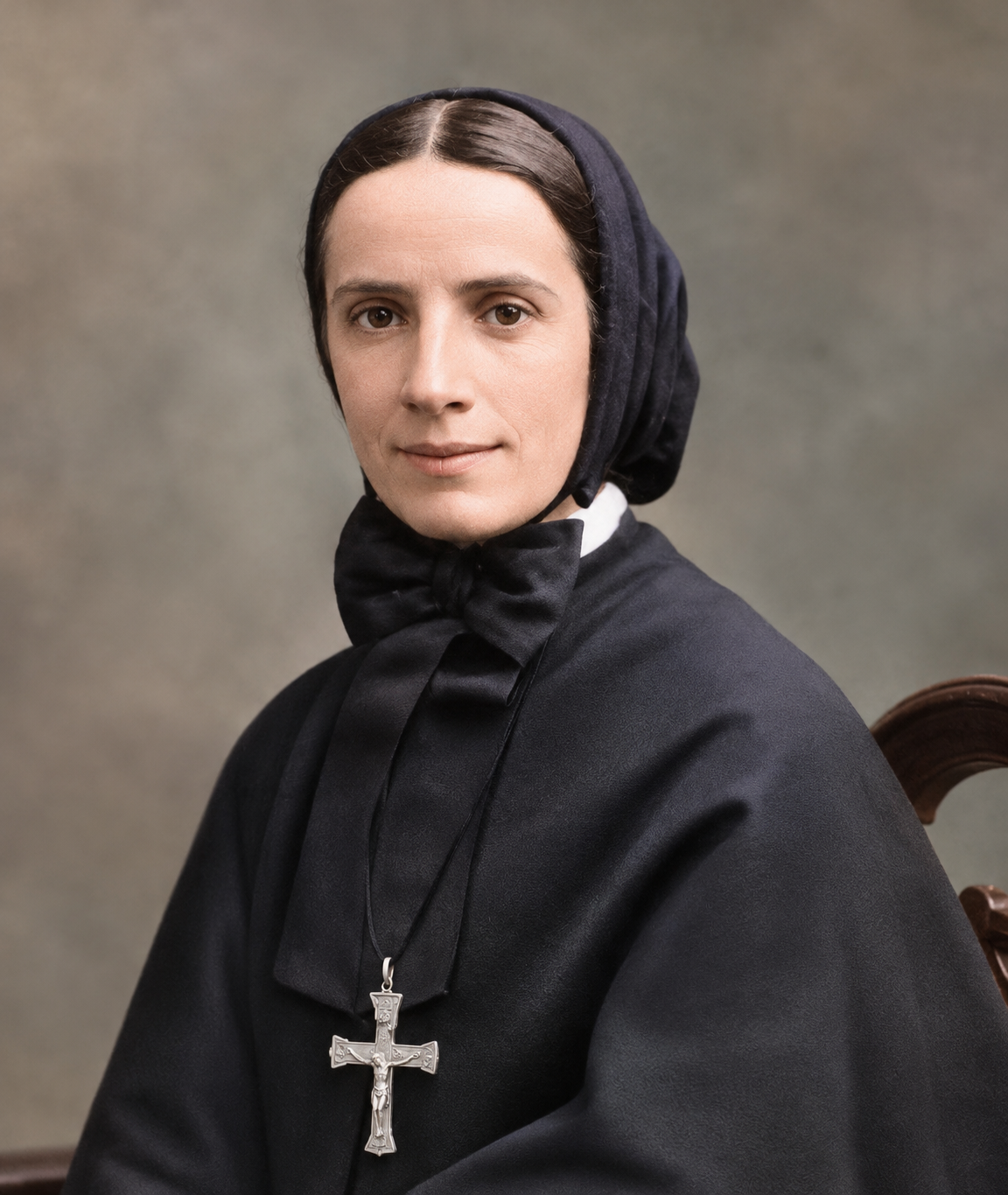
Frances Cabrini at a Glance
- Born
- July 15, 1850, Sant’Angelo Lodigiano, near Milan, Italy
- Family
- The youngest of thirteen children
- Founded
- Missionary Sisters of the Sacred Heart of Jesus (1880)
- The Pope
- Leo XIII, who redirected her mission to America
- Arrived in New York
- March 31, 1889, with six sisters
- Died
- December 22, 1917, Columbus Hospital, Chicago
- Canonized
- July 7, 1946, by Pope Pius XII
The Youngest of Thirteen
Maria Francesca Cabrini was born on July 15, 1850, in Sant’Angelo Lodigiano, a small farming town about twenty miles south of Milan. She was the last of thirteen children born to Agostino and Stella Oldini Cabrini. Several of her brothers and sisters did not survive childhood, a common sorrow in the Lombard countryside of that century, and she herself was small and often unwell from the start.
The household was devout. The family prayed together, and her father read aloud from missionary stories. One tradition says the young Francesca made tiny paper boats, filled them with violets as if they were missionaries, and floated them down a stream toward distant lands. The story is told lovingly by her biographers, but it comes from later recollection, so treat it as family tradition rather than a documented event. What the records do support is the direction of her longing: from childhood she wanted to be a missionary.
She was educated by the Daughters of the Sacred Heart of Arluno and graduated from their normal school in 1870 with a teaching certificate. Her sister Rosa was a teacher there. By the account in one standard biography, she began making a private promise of chastity as a girl and made it permanent at eighteen. In 1872 she caught smallpox while nursing the sick, and the illness left her health more fragile than before. That fragility would become the obstacle she met at every convent door.
Italy in those years was a country remaking itself. The kingdom had been unified only in 1870, and the new government was hostile to church schools and religious teaching. Young Francesca taught for a time in the village of Vidardo, where the new secular laws restricted what she could say about the faith to her pupils. It was a small taste of the larger struggle between Church and state that shaped the Italy she would later leave.
Part II
Rejected Twice, Then Sent to Codogno
In 1874 she asked to join the Daughters of the Sacred Heart, the sisters who had taught her. They refused her, and the reason given was her poor health. She tried another community and was refused again. Two rejections by religious orders, one after another, would have ended most vocations. For Francesca they were a detour that pointed toward her real work.
The local pastor, Father Antonio Serrati, saw something the convents had not. He appointed her to take charge of a struggling orphanage in Codogno, the House of Providence, which had been run by a difficult and dishonest foundress. Francesca went in, taught the girls, mended what could be mended, and gave the place order and dignity. She did this as a lay woman with no habit and no guarantee of a future, and she stayed for several years.
During this time she gathered around her a few young women who shared her aim. The bishop of Lodi eventually closed the House of Providence, but he also saw her gifts and asked her to found a new congregation of sisters. In 1880 she and seven companions began the Missionary Sisters of the Sacred Heart of Jesus. Some sources give 1877 for her first vows and for the earliest steps toward the institute, while 1880 is the year usually cited for the founding itself, so both dates appear in the literature. She took the name Xavier, in honor of Saint Francis Xavier, the great missionary to the East.
The name is a clue to her ambition. She had not founded an Italian teaching order for its own sake. She had founded a missionary institute, and she intended it to go to the ends of the earth, beginning with China.
Part III
A Founder Who Wanted China
The young congregation grew quickly. Within a few years the sisters were running orphanages and schools across northern Italy, and in 1888 the institute received the official decree of commendation from Rome. Mother Cabrini was a gifted organizer, a tireless fundraiser and a practical builder, with an eye for property, bookkeeping and the details that make an institution survive.
But her heart was set on the East. China was her great desire, and she began to plan for it. According to Cabrini Shrine accounts, her own physician, Dr. Morini, told her in December 1887 that she had perhaps two years to live, a prognosis that did nothing to dim her missionary plans, and which she outlived by three decades.
Meanwhile, a different appeal was reaching Rome. Between 1880 and the early twentieth century, millions of Italians left their homeland, and more than a million of them settled in the United States. Many were poor farmers from the south who arrived without English, without a parish that spoke their language, and often without a priest. Bishop Giovanni Battista Scalabrini of Piacenza, founder of a congregation for migrants, had been pressing for help for these emigrants. He and Archbishop Michael Corrigan of New York both wrote on behalf of Italians who were drifting away from the Church.
The tradition tells us what happened when Mother Cabrini brought her China plans to Pope Leo XIII. She had an audience with him in January 1889. She asked for his blessing on a mission to the East. The pope, the tradition says, answered her with the words that became the motto of her life: not to the East, but to the West. The exact phrasing comes to us from later retellings, so I give it here as tradition rather than a verbatim record. What is certain is the outcome. Leo XIII, who is said to have praised her as a woman of marvelous intuition and great sanctity, redirected her to America.
It was a surrender of her own plan, and a large one. She obeyed. There is no record that she ever complained, and she would later say, in effect, that the Italian immigrants of New York were her China.
Part IV
Landing in New York, 1889
On March 19, 1889, Mother Cabrini and six sisters sailed from Italy. They crossed the Atlantic in steerage conditions among the emigrants they had come to serve, and they reached New York on March 31, 1889. A letter from Archbishop Corrigan had asked her to delay the trip because the arrangements he had hoped for had not come together, but it reached Italy too late. The sisters stepped off the ship to find that nothing was ready.
One account says their first lodging was a dingy rented apartment in the crowded Italian quarter, with the school they had been promised not yet available. The story is vivid, and it appears in some accounts but not others, so I would hold the detail lightly. What does not change is the picture of a handful of Italian women, with limited English, standing in a strange city with no home to go to.
Corrigan received them and, after some friction, housed them for a time with the Sisters of Charity. He was cautious about a new institute and doubted the need for an orphanage, preferring that the sisters focus on teaching. Mother Cabrini did what she always did: she listened politely, and she kept working. She visited the tenements, found the neglected children, and talked to the families.
Her first major institution came through a benefactor. Countess Mary Reid di Cesnola, a New York society woman, had raised funds for an Italian girls’ orphanage, and she transferred it to Mother Cabrini’s care. The orphanage opened in the spring of 1889 by one account, while another account places its opening on Palm Sunday of 1890, so the sources differ on the exact date. By June 1890 she had raised funds to purchase a former Jesuit novitiate at West Park, on the Hudson River, which became the Sacred Heart orphanage and the order’s first American motherhouse.
The orphanage and the school were only the start. She built a parish life around the immigrants: religious instruction in their own language, catechism classes, and a presence in the Italian churches. People who had gone for decades without confession or Mass found a woman who spoke their dialect and cared about their children.
Part V
Hospitals, Orphanages and a Restless Itinerary
By 1891 Mother Cabrini had turned to the sick. Italian immigrants in New York were often turned away from hospitals or treated badly because they could not communicate, and she responded by establishing Columbus Hospital, which was incorporated on May 18, 1891. A charity hospital on East 109th Street grew out of the work, and Scalabrini was among those who supported the effort. Within a year the finances were in crisis, and in April 1892 she returned from a trip to rescue it. She separated her order from the original hospital board and opened a new one in two rented apartments, helped by a grant of $550 from Corrigan and gifts from wealthy Italians. It expanded in 1894.
In September 1891 she traveled to Nicaragua, founding a house and school there, and then she opened a school for Italian children in New Orleans. This pattern repeated for the rest of her life. She crossed the Atlantic dozens of times by one count, moving among Italy, the United States, Central America, South America and Europe. She founded schools, orphanages, hospitals and social service programs in New York, New Jersey, Pennsylvania, Louisiana, Mississippi, Illinois, Colorado, California and Washington, and overseas in Nicaragua, Panama, Argentina, Brazil, France, England, Spain and Italy.
She was not an easy woman to oppose. She negotiated with archbishops, bargained for land, and could be blunt when a project required it. Yet her biographers describe a person who remained tender with children and cheerful in hardship. Her health, once the reason convents turned her away, did not prevent her from outworking nearly everyone around her.
In Seattle, she established the Mount Carmel Mission on October 17, 1903, at 1133 South 12th Avenue on Beacon Hill. It included a school, a convent, a free kindergarten, a temporary chapel and the Sacred Heart Orphanage. Within a few years the orphanage was caring for 85 children, a number that grew to 106 within five years. When Seattle’s plans to regrade Beacon Hill forced a move, she acquired a former summer home on Lake Washington, and the orphanage relocated there in 1914.
One detail from her later years is often retold. She and a companion are said to have planned to sail on the Titanic in 1912 but canceled because of urgent business. The story appears in the Seattle essay, and I mention it as one of the traditions told about her rather than a thing I can fully verify.
Part VI
Citizen, Death and Sainthood
Mother Cabrini became a naturalized United States citizen in Seattle on October 13, 1909, while she was in the city for the Alaska-Yukon-Pacific Exposition, where the orphanage children’s work was on display. It is the fact that later made her canonization historic. She was an Italian woman who had become an American, and she is remembered as the first American citizen to be declared a saint.
Her last major foundation was in Seattle. On a final visit in 1915 she planned a foundling home but bought the former Perry Hotel property at Madison and Boren and opened a sanitarium instead. It opened in 1916 as Columbus Sanitarium, later renamed Cabrini Hospital. It was the last institution she founded. By one count she had established about 67 charitable institutions, and some sources say she led roughly 4,000 sisters at her death.
She died on December 22, 1917, at Columbus Hospital in Chicago, in the days before Christmas. Archbishop George Mundelein officiated at her funeral, and she was buried in New York. The work did not stop with her. Her sisters continued to run schools and hospitals, and the institutions she left behind kept serving immigrants for generations.
The Church moved with unusual speed for the usual process. She was beatified on November 13, 1938, in an exception to the customary waiting period, and was the first American to receive that honor. Pope Pius XII canonized her on July 7, 1946, and on September 8, 1950, she was named the patron saint of immigrants.
The story of her life is, in a sense, an answer to a puzzle. The pope who told her not to go East did not cancel her missionary calling. He redirected it to people who were already here, in neighborhoods that most of the Church had overlooked. Pope Leo XIII, who is remembered chiefly for his teaching on the dignity of labor, saw in this fragile nun a person who could put that teaching into practice. Her canonization honors both of them.
Part VII
Timeline
- 1850: Born July 15 in Sant’Angelo Lodigiano, Italy
- 1870: Graduates from the normal school at Arluno
- 1874: Refused by the Daughters of the Sacred Heart; sent to the Codogno orphanage
- 1880: Founds the Missionary Sisters of the Sacred Heart (some sources give 1877 for early steps)
- 1889: Audience with Pope Leo XIII; arrives in New York on March 31
- 1891: Columbus Hospital incorporated May 18; travels to Nicaragua and New Orleans
- 1903: Opens Mount Carmel Mission in Seattle on October 17
- 1909: Becomes a United States citizen in Seattle on October 13
- 1917: Dies in Chicago on December 22
- 1938: Beatified on November 13
- 1946: Canonized by Pope Pius XII on July 7
- 1950: Named patron saint of immigrants on September 8
Keep Mother Cabrini Close
Mother Cabrini spent her life among people who were far from home. A prayer card of Saint Frances Cabrini is a small reminder to pray for immigrants, for those who travel, and for anyone starting over in a strange place.
View the Cabrini Prayer Card →Frequently Asked Questions
