Catholic Saints • Paris • France • 1581 to 1660
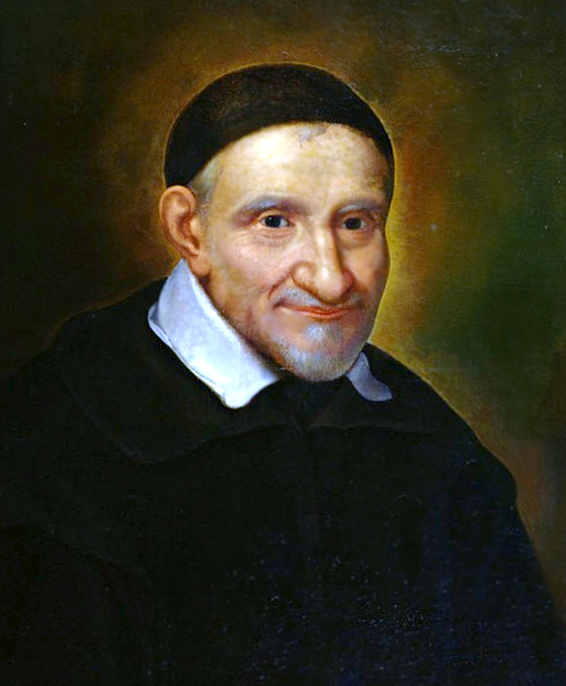
Saint Vincent de Paul and Anne of Austria: The Priest on the Council of Conscience, 1643
The priest who fed the poor of Paris was asked to help a queen choose the bishops of France. His time at court shows how charity and power sat at the same table.
Vincent de Paul at a Glance
- Born
- April 24, 1581, Pouy, Gascony, to a peasant family
- Ordained
- September 23, 1600
- Founded
- Congregation of the Mission (1625); Daughters of Charity with Louise de Marillac (1633)
- The Queen
- Anne of Austria, regent of France from 1643
- At court
- Member of the Council of Conscience, 1643 to 1652
- Died
- September 27, 1660, Paris, aged 79
- Canonized
- June 16, 1737, by Pope Clement XII
A Gascon Peasant Who Became a Priest
Vincent de Paul was born on April 24, 1581, in the village of Pouy, in Gascony, in the southwest of France. His parents, Jean de Paul and Bertrande de Moras, were peasant farmers with several children. Vincent tended the family animals as a boy, and he never pretended to be anything other than a countryman. Late in life, the story goes, he was embarrassed when relatives of humble station came to Paris hoping for his help, and he is said to have blamed his own pride for the discomfort. The details come from early biographers, so they are worth holding as reported rather than as verified.
His father saw that the boy was clever, and he sent him to study. According to the standard account, the family sold a pair of oxen to pay for the schooling. Vincent studied with the Franciscans at Dax, then at the University of Toulouse, where he supported himself by tutoring other students. He was ordained a priest on September 23, 1600, when he was only nineteen, which was younger than the Council of Trent allowed. In those years a priest was often a man seeking a comfortable benefice, and by his own later admission Vincent was no different. He wanted a good income and a quiet life near home.
That ambition is part of the story. The man who later asked the queen to choose bishops by merit, and who would not be bought with offers of benefices, had himself started out hoping to rise. His conversion from comfort to service happened slowly, and the saints are better understood when one admits that.
Part II
Tunis, Paris and the Gondi Household
The next chapter is the most disputed. In his own letters, Vincent described being captured by Barbary pirates in 1605 while sailing from Marseille, sold as a slave in Tunis, passing through a series of masters, and escaping about two years later with one of them, a former Christian who had converted to Islam. They landed at Aigues-Mortes on June 29, 1607, by the usual account. Some modern historians have questioned how much of this is reliable, and a few have argued that the letters were embellished or even not his. Others defend the account. It is an honest question, and I will not pretend it is settled. What is clear is that Vincent returned to France as a different man, and that he spoke later of the sufferings of slaves and galley convicts with unusual feeling.
After a period in Rome and Paris, he came under the spiritual direction of Pierre de Bérulle, one of the leading figures of the French Catholic revival. He served briefly as a parish priest at Clichy, then in 1613 or so became chaplain and tutor in the household of Philippe-Emmanuel de Gondi, the general of the royal galleys, and his wife Marguerite. Madame de Gondi was devout and anxious about the souls of the peasants on her estates, who had almost no access to priests who could instruct them.
In 1617 two events shaped his life. In January, at Folleville, a dying peasant made a confession to Vincent and told him that he would have been damned without it. Vincent preached to the crowd the next day, and the response was overwhelming. In the later years of his life, he looked back on this as the beginning of the Mission. Later that year, at Châtillon-les-Dombes, he found a village where a sick family had no one to care for them, and when he preached about it, so many neighbors brought food that the response became a problem of its own. He organized the women of the town into a confraternity of charity, giving the work a rule and a rhythm. These were the seeds of everything that followed.
Part III
The Mission and the Daughters of Charity
In 1625, with funding from the Gondi family, Vincent founded the Congregation of the Mission, whose priests would preach to the rural poor and train the clergy. Members were later called Vincentians, or Lazarists in parts of Europe, because in 1632 they took over the priory of Saint-Lazare in Paris. The priests took vows of poverty, chastity, obedience and stability, and they gave missions in country parishes and held retreats for men about to be ordained. At a time when many priests had no training at all, this was reform work of the first order.
The second great foundation grew from his partnership with a woman. Louise de Marillac, born in 1591, was a widow of good family who had come under his direction. She was serious, anxious, often ill, and extremely capable. Vincent had been organizing the confraternities of charity, but the wealthy ladies who ran them could not always be relied upon to do the day-to-day nursing. Country girls, willing to work and unafraid of the poor, could. In 1633, Vincent and Louise began to gather such young women, and the community became the Daughters of Charity. It was a radical idea: women who were not cloistered nuns, who lived in the world and served the sick in their own homes and in hospitals. Vincent is said to have told them that the streets were their cloister, though that exact phrasing is traditional.
He and Louise worked side by side for more than twenty-five years. The foundling children of Paris, the sick poor, convicts in the galleys, and, in later years, the victims of war in Lorraine and around Paris were all in their care. Louise died on March 15, 1660, only a few months before Vincent himself.
Part IV
The Court of Louis XIII and Anne of Austria
Vincent had known the royal household for years. He moved in circles that included Cardinal Richelieu, and Anne of Austria, the Spanish-born queen of Louis XIII, knew his reputation. When Louis XIII was dying in the spring of 1643, Anne wanted Vincent at his side. According to an essay in the Vincentian family archive, the king had asked his confessor to seek recommendations for vacant bishoprics and abbeys, especially from Father Vincent, so that he could be given a list ranked by merit. Vincent entered the sickroom on April 23, 1643, and the king died in mid-May. Vincent later said he had never seen anyone die a more Christian death. Other biographers say he stayed until the end, and some go further and say the king died in his arms. The sources differ on the details of the final hours, so I would not press them harder than that.
Louis XIII was succeeded by his four-year-old son, the future Louis XIV, and Anne became regent. She was not a political novice, but she was surrounded by ambitious men. Richelieu was dead, and his successor as chief minister was Cardinal Jules Mazarin, a clever Italian whom Anne trusted.
The queen also trusted Vincent. She had observed what the French Church looked like: bishoprics treated as family property, abbeys handed to children or favorites, and a clergy often chosen by connection. She wanted a different standard, and she turned to the priest of the poor to help set it.
Part V
The Council of Conscience
Anne created a small body to advise her on church appointments, called the Council of Conscience. Its principal duty was to recommend candidates for bishoprics and for the abbeys and benefices in the crown’s gift. One biographer says it had five members. Mazarin sat on it, and so did Vincent, who tried to refuse. He is said to have begged the queen more than once to remove his name, and she declined each time.
Vincent was uneasy among the nobles. He came to court in his plain, worn cassock, and he kept the same schedule of work he had at Saint-Lazare. What he brought to the council was a single principle: the only things that should matter in choosing a bishop were his virtue and his learning. He did not accept gifts in exchange for recommendations, and he did not forward the requests of relatives. Mazarin, by contrast, saw church offices as political currency, a way to reward supporters and satisfy powerful families.
The two principles collided in specific cases. In 1647, for example, Mazarin proposed Edouard Molé for the see of Bayeux. Vincent objected strongly, because the man was known for a scandalous life. Mazarin then reportedly told Vincent to instruct Molé himself, which is the sort of answer a politician gives when he has no intention of yielding. Another story, preserved in a nineteenth-century biography, describes a duchess who pressed the queen to name her unqualified son bishop of Poitiers. When Vincent was handed the nomination paper, it was blank, and he refused to fill it in. After he explained the candidate’s unsuitability, the queen reportedly withdrew the appointment, and the duchess, in a rage, threw a stool at him. Treat that anecdote as tradition, since it comes from a later biography rather than a contemporary document, but it matches the pattern of resentment he met.
He faced other indignities. By the same biographer’s account, a young man refused a benefice insulted him, and a gentleman struck him. Vincent is reported to have answered calmly each time. He was not trying to win the argument. He was trying to keep one small door in the system from being closed.
Part VI
The Fronde and the End of the Council
The council did not last as he hoped. In 1648 France was shaken by the Fronde, the revolt of the Paris Parlement and then of great nobles against Mazarin and the crown. Hunger and fighting spread around the capital. Vincent’s charities organized relief for refugees and the starving, while Vincent himself, anguished by the sufferings of the poor, concluded that the war was Mazarin’s fault. On January 14, 1649, he urged Mazarin to resign and leave France for the good of the country. It was a startling thing for a priest to say to a cardinal, and it cost him.
Mazarin returned to power in early 1652 and barred his opponents from court. In a letter of May 15, 1652, Vincent said he had not seen the queen in six or seven months. In September 1652 he was told that he was no longer on the council. By then the body had in any case met less and less often, and the old patterns returned: bishoprics and abbeys went back under Mazarin’s control. Vincent lamented what he called the detestable barter of bishoprics. The reform at the top had failed, but the reform at the bottom, in seminaries and parishes, was growing.
Vincent died in Paris on September 27, 1660, at the age of seventy-nine, in the priory of Saint-Lazare, by tradition in a chair. He was beatified on August 13, 1729, by Pope Benedict XIII, and canonized on June 16, 1737, by Pope Clement XII. His feast is now on September 27. In 1833, a young scholar named Frédéric Ozanam and his fellow students founded the Society of Saint Vincent de Paul, which still serves the poor in countries around the world.
The measure of his time at court is not what he failed to achieve there. It is that a peasant’s son who might have used his position to enrich his family used it instead to insist that the Church’s highest offices go to worthy men. He lost that argument in his own lifetime and won it in the long run.
Part VII
Timeline
- 1581: Born April 24 in Pouy, Gascony
- 1600: Ordained a priest on September 23
- 1605: Captured by pirates and taken to Tunis, according to his own account (disputed)
- 1607: Lands at Aigues-Mortes, June 29, by the same account
- 1617: Folleville and Châtillon-les-Dombes, the seeds of the Mission and the charities
- 1625: Founds the Congregation of the Mission
- 1633: Founds the Daughters of Charity with Louise de Marillac
- 1643: Louis XIII dies in May; Anne of Austria becomes regent and forms the Council of Conscience
- 1649: Urges Mazarin to resign, January 14
- 1652: Removed from the Council in September
- 1660: Dies September 27 in Paris
- 1737: Canonized June 16
Charity at Every Table
Vincent carried the concerns of the poor into rooms where they were seldom mentioned. His prayer card is a good companion for anyone who serves others, whether at a soup kitchen, a hospital bedside or a council table.
View the Vincent de Paul Prayer Card →Frequently Asked Questions
