Catholic Saints • Paris • Turin • April to May 1883
Saint John Bosco in Paris, 1883: The Crowds, the Tickets and the Victor Hugo Question
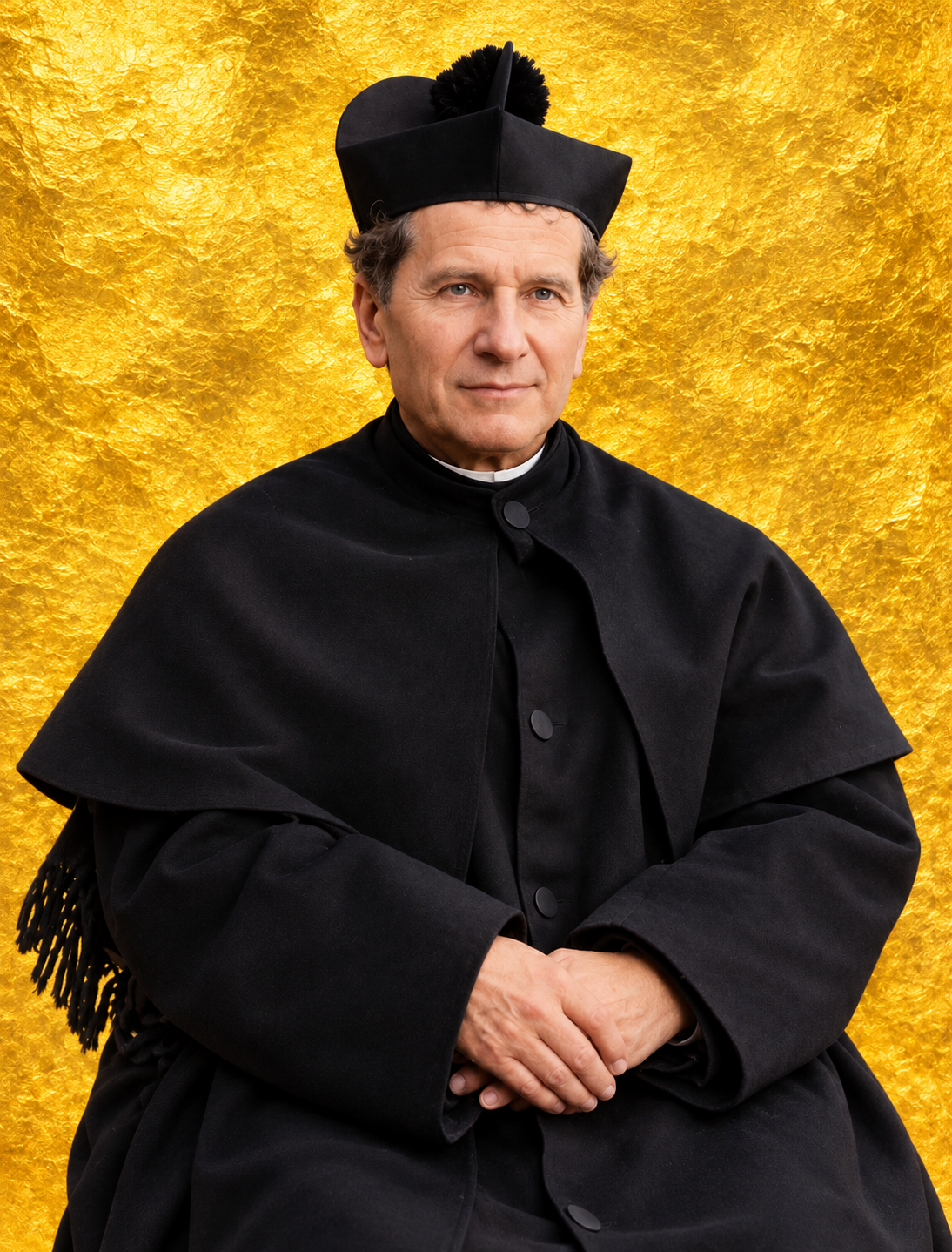
In the spring of 1883 an aging Italian priest came to Paris to raise money for a church in Rome. So many people wanted to see him that his hosts had to hand out numbered tickets. A popular story adds Victor Hugo to the scene, and the record does not support it.
Don Bosco in Paris at a Glance
- Born
- August 16, 1815, Becchi, near Turin, Italy
- Ordained
- 1841, as a priest of the Archdiocese of Turin
- Founded
- The Salesians (1859) and, with Maria Mazzarello, the Daughters of Mary Help of Christians
- Paris visit
- Arrived April 18, 1883, at the Gare de Lyon
- Purpose
- Funds for the Church of the Sacred Heart in Rome and for Salesian works
- Died
- January 31, 1888, Turin, aged 72
- Canonized
- April 1, 1934, by Pope Pius XI
A Farm Boy With a Dream
John Bosco was born on August 16, 1815, in the hamlet of Becchi, in the countryside near Turin. His father, Francesco, a farmer, died when John was barely two years old, leaving his widow, Margaret, with three sons and a household to feed. Margaret was illiterate, devout, and exceptionally steady. She raised her sons on very little money and a great deal of principle, and in later years she would follow John into his work with boys, earning the affectionate title Mamma Margaret.
At about the age of nine, John is said to have had a dream in which he saw a crowd of rough, quarrelling boys, and was told to win them not with blows but with gentleness. He often retold it, and the dream became a kind of founding story for his life. It rests on his own later report, so it is best read as his own account of what shaped him rather than as a datable event.
He worked as a farmhand and a shepherd, and learned conjuring tricks and juggling to hold the attention of other children. He entered the seminary at Chieri in 1835 and was ordained a priest in 1841, at the age of twenty-six. Instead of taking a parish, he followed the advice of a mentor, Father Giuseppe Cafasso, to look at the city. Turin, in the early years of its industrial growth, was full of young migrants from the countryside, sleeping rough and working in dangerous jobs, with no one to teach them a trade or a prayer.
Part II
Valdocco and the Oratory
Tradition dates the beginning of his Oratory to December 8, 1841, when he met a bricklayer’s apprentice named Bartolomeo Garelli in a Turin sacristy and offered to teach him the catechism. Garelli came back with friends, and the group grew. For several years the Oratory moved from place to place, evicted by neighbors and landlords who did not like crowds of boys. It found a permanent home in 1846 in a shed rented from a man named Pinardi, in the Valdocco district of Turin.
From there it grew. By 1852 the Oratory was sheltering some thirty-six boys. By 1854 it had more than a hundred, and by 1860 about 470. Bosco ran workshops where the boys could learn trades such as shoemaking and printing, so that they would have a living. He wrote books for them, built a school, and insisted on a style of education based on what he called reason, religion and loving kindness. He did not want a house run on fear. He wanted a family.
One of his students, Dominic Savio, died in 1857 at the age of fourteen, and Bosco wrote a short biography that became a classic. Dominic was later canonized, in 1954, and his story helped spread Don Bosco’s method of education.
In 1859 Bosco gathered a small group of seminarians and formed the Society of St. Francis de Sales, the Salesians, named for the gentle bishop of Geneva. The rule was approved definitively by Pope Pius IX in 1873. With Maria Domenica Mazzarello he also founded the Daughters of Mary Help of Christians, in the early 1870s, to do for girls what the Salesians were doing for boys. The Basilica of Mary Help of Christians in Turin was built in the late 1860s, and in 1875 the first Salesian missionaries sailed for Argentina.
Part III
A Church in Rome and a Trip to France
By the early 1880s Don Bosco was famous, and exhausted. Pope Leo XIII had asked him to take charge of finishing the Church of the Sacred Heart in Rome, near the Termini station, and Bosco had agreed on the condition that the project would include a Salesian house. The task needed a huge amount of money. He was also managing a growing network of schools and missions on three continents. In 1883 he turned to France, where he had many friends, among them benefactors, members of the Society of Saint Vincent de Paul, and the Assumptionists, who organized pilgrimages to Rome and visited the Oratory in Turin.
He was sixty-eight, and he looked older. His health was fragile, he suffered from poor eyesight and swollen legs, and his companions worried about him. But he went. According to the study by the Salesian historian Francis Desramaut, he arrived in Paris on April 18, 1883, at the Gare de Lyon.
He was met by people who had read about him in the press, and by others who had heard that he could heal the sick. His reputation as a wonder worker had arrived ahead of him. He disliked the idea, and he tried to steer visitors toward prayer and the sacraments rather than miracles. That did not slow the crowds.
Part IV
The Crowds, the Tickets and the Church of Victories
His base was a private house on the rue de la Ville-l’Évêque, where he received visitors from April 19 to 30. The scenes were extraordinary. So many people arrived hoping for a blessing, or for a word, or simply to see him, that his hosts had to hand out numbered tickets to keep order. Tickets were being distributed by April 21 and 22. People waited for hours. He heard confessions, blessed the sick, and signed his name in autograph books.
The newspapers took notice. Some praised him, and others were skeptical about the stories of cures that circulated. Don Bosco insisted that he only prayed and invoked Mary Help of Christians. The record is clear about the numbers of visitors and the demands on his strength, but beyond the plain fact that large crowds came, the claims of specific miracle cures in Paris are harder to document, and I would treat them as the beliefs of his admirers rather than established events.
He did not spend all of his time receiving guests. He preached in a number of Paris churches and spoke to groups of benefactors. In early May he took a short retreat, then resumed his visits, and his last visit in Paris on May 21 and farewell on May 24 are recorded in the sources I consulted. Only one church in Paris today carries a plaque to his visit: Notre-Dame des Victoires, near the sacristy.
The plaque tells a particular story. After receiving Communion there, Don Bosco is said to have had a vision of a young man named Louis Colle, a seventeen-year-old from Toulon with tuberculosis who had died in April 1881 and whose biography Bosco had written. In the plaque’s account, Louis told him that this was the house of graces and blessings. That is the church’s own tradition. It is a moving story, but it is a report of a private experience, not independently verified history.
Part V
The Victor Hugo Question
One of the most repeated stories about Don Bosco’s time in Paris is that he met the great writer Victor Hugo, who was then in his eighties, and that the two exchanged words about faith or education. It is an appealing picture: the Romantic poet and the saint of Turin. Several popular accounts repeat it with confidence.
I looked for support for this in the sources available to me, including the scholarly study by Desramaut and the Paris diocese’s account of the trip. I found none. The record of the Paris visit documents the crowds, the tickets, the benefactors and the churches, but it does not record a meeting with Hugo. That does not prove it did not happen, but it does mean the story should not be told as fact. If you read it, treat it as a legend that grew around a famous visit.
Why did the story take hold? Partly because both men were in Paris in 1883, and both were enormously famous. Partly because it makes a satisfying contrast. And partly because popular saints’ lives attract tales. The honest account is shorter and more interesting than the legend: a tired priest, thousands of ordinary people, a stack of numbered tickets, and a quiet moment in front of a plaque in a church.
Part VI
What Followed: Death, Canonization and a Method
Don Bosco went home to Turin and kept working. The Church of the Sacred Heart in Rome was consecrated in 1887, and he said Mass there. He died in Turin on January 31, 1888, at the age of seventy-two. Crowds filled the streets for his funeral.
The Church moved to honor him quickly. He was beatified on June 2, 1929, and canonized on April 1, 1934, by Pope Pius XI, who had known him personally. In 1988, on the centenary of his death, Pope John Paul II gave him the title Father and Teacher of Youth.
The Salesians today run schools, youth centers and missions in well over a hundred countries. Their approach to education, based on presence, trust and cheerful discipline, is still studied by teachers who have never heard of Valdocco.
The Paris trip shows what that approach looked like when the world noticed. A man who had spent his life with children in a tough city was suddenly the guest of the most cosmopolitan city in Europe, and what the crowds saw was an old priest who listened to them. Perhaps that is why they came.
Part VII
Timeline
- 1815: Born August 16 at Becchi, near Turin
- 1841: Ordained a priest; meets Bartolomeo Garelli on December 8, the traditional start of the Oratory
- 1846: The Oratory settles at Valdocco
- 1859: Founds the Salesians
- 1873: Pope Pius IX approves the Salesian rule
- 1875: First Salesian missionaries sail for Argentina
- 1883: Arrives in Paris on April 18; audiences April 19 to 30; leaves in late May
- 1887: Church of the Sacred Heart in Rome consecrated
- 1888: Dies January 31 in Turin
- 1929: Beatified June 2
- 1934: Canonized April 1
Kindness That Draws a Crowd
People waited in line to see a priest who was known for gentleness with the young. If you work with children or teenagers, or pray for them, the prayer card of Saint John Bosco is a good companion.
View the Saint John Bosco Prayer Card →Frequently Asked Questions
