Saint Julian the Hospitaller: The Complete Legend of the Nobleman Who Murdered His Own Parents and Became the Patron of Travelers
Saint Julian the Hospitaller: The Complete Legend of the Nobleman Who Murdered His Own Parents and Became the Patron of Travelers
Every detail preserved across eight centuries of retelling: the hunted stag that prophesied his crime, his flight, marriage, and knighthood, the tragic homecoming that fulfilled the curse regardless, his pilgrimage and hospice by a dangerous river, the leper who turned out to be an angel, and the scholarly consensus on a legend almost certainly born of pure devotional imagination.
At a Glance
- Traditional Era
- Unspecified; no firm date can be attached to the legend
- Traditional Location
- Disputed: either the River Gardon, Provence, or an island on the River Potenza near Macerata, Italy
- Earliest Known Reference
- Late 12th century
- Central Crime
- Unknowingly killed his own parents, fulfilling a childhood prophecy
- Penance
- Built a hospice at a dangerous river crossing and personally ferried travelers
- Confirming Sign
- A dying leper, revealed as an angel or Christ, declares his penance accepted
- Major Source Text
- The Golden Legend (Legenda Aurea) of Jacobus de Voragine, 13th century
- Historical Status
- Widely regarded by scholars as pious fiction; no verified historical basis
- Feast Day
- February 12
- Patronage
- Travelers, innkeepers, boatmen, pilgrims, circus workers, murderers, childless people
- Part I — The Prophecy of the Hunted Stag
- Part II — Fleeing His Fate
- Part III — Marriage to a Wealthy Widow and Knighthood
- Part IV — His Parents' Search and the Fatal Homecoming
- Part V — The Murder in the Dark
- Part VI — Grief, Confession, and Renunciation of His Estate
- Part VII — Pilgrimage to Rome and Absolution
- Part VIII — The Hospice at the Dangerous River Crossing
- Part IX — The Leper Who Was an Angel
- Part X — Textual History: The Golden Legend, Boccaccio, and the Pater Noster of Saint Julian
- Part XI — Where Did This Happen? The Debate Over Location
- Part XII — Is Julian the Hospitaller Historical? The Scholarly Consensus
- Part XIII — The Church of Saint-Julien-le-Pauvre in Paris
- Part XIV — Literary Legacy: Flaubert, Opera, and Beyond
- Part XV — Feast Day, Patronage, Iconography, and Devotion Today
- Frequently Asked Questions
The Prophecy of the Hunted Stag
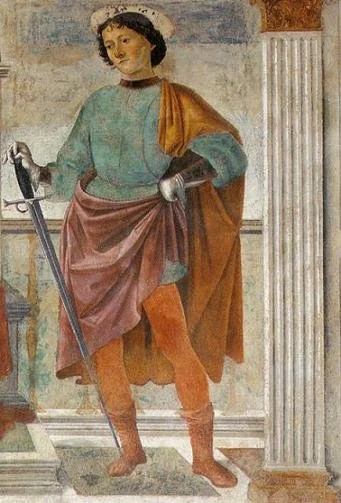
According to the fullest and most influential version of his legend, preserved in the thirteenth-century Golden Legend of Jacobus de Voragine, Julian was born into a family of noble blood, and from his earliest years showed every promise of the courage, skill, and privilege expected of his rank. The defining moment of his young life came, as the legend tells it, while he was out hunting. Pursuing a magnificent stag, or in some retellings a hart, deep into the forest, Julian at last cornered the animal, only for it to turn and face him directly. Rather than fleeing or succumbing, the stag spoke, or in other versions of the story a supernatural sign accompanied the encounter, delivering a prophecy no hunter could have expected to hear from his quarry: that Julian himself would one day kill his own father and mother.
Some tellings of the story push the prophecy even earlier, back to the very night of Julian's birth, when his father is said to have witnessed pagan witches secretly laying a curse upon the newborn child, foretelling the same terrible destiny that would later be confirmed to Julian directly during the hunt. Whichever version is followed, the effect on Julian was the same: he was utterly horrified by the prospect, and resolved immediately and absolutely that he would do everything in his power to ensure the prophecy never came true.
Part II
Fleeing His Fate
Convinced that the surest way to prevent the prophecy from ever being fulfilled was to place the greatest possible distance between himself and his parents, Julian made the drastic decision to leave his family home entirely and in secret, without any farewell or explanation that might allow his parents to follow him. According to one popular retelling of the legend, Julian walked continuously for fifty days before finally stopping to settle in a distant land, a detail meant to convey both the desperation of his resolve and the sheer physical scale of the separation he sought to impose between himself and the fate the stag had spoken of.
Having placed an entire journey of fifty days between himself and everyone who had known him from birth, Julian settled in this new country as a stranger with no immediate family connections, a circumstance that, however painful, at least seemed to guarantee the one thing he wanted most: that he would never again be in a position to harm the parents he loved.
Part III
Marriage to a Wealthy Widow and Knighthood
In his new home, Julian's noble bearing and evident capability quickly won him recognition. He entered into the service of a king, rose within a short time to the position of a trusted advisor and knight, and, in the course of this new and prosperous life, married a wealthy widow, securing for himself the settled household, social standing, and domestic peace that his flight from his birth family had seemed to put permanently out of reach. By every outward measure, Julian's plan had worked: he had escaped the prophecy by escaping his parents, and had built an entirely new and successful life in a land where no one knew the curse that had once been spoken over him.
Part IV
His Parents' Search and the Fatal Homecoming
Julian's parents, meanwhile, had never stopped searching for their vanished son. According to the legend, they spent years traveling throughout the land in an effort to find him, following whatever fragmentary rumors or reports reached them of a knight matching his description. Eventually, their search led them to the very castle where Julian now lived his new life, arriving, as fate would arrange it, on a day when Julian himself was away from home on a hunting party.
Julian's wife, who did not yet know her husband's parents by sight but quickly grasped who these unexpected and evidently noble visitors must be, received them with the warm hospitality due to family, welcoming them into the household and, in a gesture of particular honor, offering them the comfort of her own marital bed, Julian's own bed, for the night while she herself retired elsewhere in the house, intending it as a joyful surprise for her husband when he returned from his hunt.
Part V
The Murder in the Dark
Julian returned home from his hunting party earlier than expected, in the darkness of night, and made his way quietly to his own bedchamber so as not to disturb the household. There, in the dim light, he saw two figures asleep together in his own marital bed. Several versions of the legend specifically note that Julian had a jealous temperament, and in this critical, sleep-clouded moment, he leapt immediately to the most painful possible conclusion: that his wife had betrayed him and taken a lover into his own bed during his absence.
Blinded by a sudden and consuming rage, Julian drew his sword and struck down both sleeping figures without pausing to confirm who they actually were. It was only afterward, stepping back out into the hall or encountering his wife elsewhere in the house, very much alive and untouched by any infidelity, that the true and devastating shape of what he had done became clear: the two figures he had killed in the dark were not his wife and a rival, but his own father and mother, who had been resting peacefully in the bed his wife had so generously offered them. The prophecy the stag had spoken years before, and which Julian had walked fifty days and built an entirely new life to escape, had been fulfilled anyway, by his own hand, in the one place he had believed himself finally safe from it.
Part VI
Grief, Confession, and Renunciation of His Estate
Julian's grief and horror at what he had done were, by every account, total and immediate. According to the Golden Legend, his wife, finding him in this state, did not abandon him but instead offered him comfort even in the depth of his self-condemnation, urging him to place his faith in the mercy of Christ rather than surrender entirely to despair. Yet Julian's own response to his crime went far beyond ordinary grief. Some tellings of the legend describe him forsaking his wife and all his worldly possessions outright, choosing instead a period of wandering as a penitent beggar, compelled by the sheer weight of his guilt to confess his crime of patricide and matricide to any stranger willing to listen, and enduring, in turn, the rejection and scorn that such a confession inevitably provoked. Consumed by an inability to bear the ordinary happiness of family life and the bustling ease of towns, a life he had permanently forfeited any claim to, Julian is described as being driven ever further from human settlement by his own conscience.
In the version of the legend most widely followed by later Catholic and devotional tradition, however, Julian's wife did not remain behind: rather than parting from him, she chose to join him fully in his penance, and the two of them together renounced their entire estate, their gold, their silver, and the whole of the wealthy household they had built, setting out together on the road that would eventually lead them to Rome and, ultimately, to the river crossing where the remainder of Julian's story would unfold.

Part VII
Pilgrimage to Rome and Absolution
Several strands of the legend record that Julian and his wife undertook a formal pilgrimage to Rome specifically to seek absolution for the double killing, a detail that situates the story within the broader medieval devotional culture in which pilgrimage to Rome, and audience with the Pope himself in the more elaborate retellings, represented the highest and most complete form of penitential act available to a layperson burdened by mortal sin. Having received this absolution, Julian and his wife returned from Rome not to resume their former noble life, but to begin an entirely new vocation of penance and service that would occupy the whole of Julian's remaining years.
Part VIII
The Hospice at the Dangerous River Crossing
Returning from Rome, Julian and his wife settled beside a wide and dangerous river, at a crossing point regularly used by Crusaders, pilgrims, and other travelers making their way through the region, a crossing where, the legend records, many had drowned attempting to ford the water unaided. Here the couple established a hospice, a guest house offering food, shelter, and safe lodging to travelers passing through, embodying in concrete, practical form the very virtue of hospitality that would eventually give Julian his enduring title of "the Hospitaller."
Julian himself took personal responsibility for the most dangerous part of this work: rather than simply housing travelers who managed to cross the river on their own, he took up the physically demanding and genuinely hazardous task of ferrying people across the water himself, at all hours and in all weather, over what the legend describes as many years of continuous service. Accounts of this period emphasize the severity of Julian's own self-imposed austerity throughout: he subsisted on the barest possible sustenance, endured the frequent contempt and impatience of travelers he served, and treated the entire enterprise as a sustained act of penance for the crime that had brought him to this remote river's edge in the first place.

Part IX
The Leper Who Was an Angel
The event that brings Julian's legend to its resolution takes place, in every version, on a bitter and stormy night deep into his years of service at the river. Julian heard a voice calling out from the far bank, begging for help to cross. Rowing or wading out to investigate despite the terrible weather, he discovered a leper, a man suffering visibly and severely from the disease, so weakened by cold and exposure that he appeared to be at the point of death.
Julian brought the dying man into his hospice without hesitation, warming him by the fire and offering him food, the ordinary and expected extent of the hospitality Julian had devoted his life to providing. But as the night wore on and it became clear the leper's condition was still worsening, close to death from exposure despite everything Julian had already done, Julian took the act of charity a step further than convention or even ordinary charity would suggest: he gave the dying man his own bed, and, according to the fullest tellings, lay down beside him, embracing him directly in order to share his own bodily warmth, an act that meant physical contact with a disease that carried, in the medieval imagination, an almost unparalleled social and physical horror.
It was in this moment of complete, self-forgetting hospitality, extended without regard for personal risk or social revulsion, that the leper was revealed for who he truly was. In most versions of the legend he is an angel sent directly by God; in other tellings, including the version most closely associated with popular devotion, he is Christ himself. Either way, the message delivered was the same: Julian's long penance had been accepted, his sins forgiven, and his service at the river crossing complete. In several versions, the messenger ascends visibly to heaven before Julian's eyes, sometimes taking the newly redeemed Julian, and in some tellings his wife as well, along with him.
Part X
Textual History: The Golden Legend, Boccaccio, and the Pater Noster of Saint Julian
The single most influential and complete surviving account of Julian's legend appears in the Golden Legend, or Legenda Aurea, an enormously popular thirteenth-century compilation of saints' lives assembled by the Genoese Dominican friar Jacobus de Voragine. This compilation, one of the most widely copied and read books of the entire European Middle Ages, preserved and standardized Julian's story for the whole of the later medieval Christian world, embedding it firmly within the broader devotional culture of penitential literature.
Independent literary confirmation of Julian's popularity comes from Giovanni Boccaccio's Decameron, completed around 1353, which references a specific devotional prayer known as the Pater Noster, or Our Father, of Saint Julian, a variant form of the Lord's Prayer specifically associated with Julian's intercession and recited by travelers seeking his protection before setting out on a journey. Remarkably, this same devotional prayer is recorded as having continued to be passed on by word of mouth in parts of Italy well into the modern era, a testament to the extraordinary staying power of Julian's cult among ordinary lay Catholics long after the formal literary sources that first preserved his story had faded from common reading.
The earliest known reference to Julian the Hospitaller in any surviving document dates only to the late twelfth century, a detail of real significance for evaluating the story's historical claims, discussed further below. Beautiful thirteenth-century stained glass depicting Julian survives at Chartres Cathedral in France, and early fresco paintings of him from the fourteenth century can still be found in Trento Cathedral and in the Palazzo Comunale di Assisi, physical evidence of how widely and how visually his cult had spread across medieval Europe within just a century or two of his earliest documented mention.

Part XI
Where Did This Happen? The Debate Over Location
One of the clearest indications of how thoroughly legendary, rather than historically documented, Julian's story is comes from the simple fact that even the location of his famous hospice cannot be settled with any confidence. Two principal candidates are proposed in the surviving tradition and scholarly literature: the banks of the River Gardon in the Provence region of southern France, or, alternatively, an island situated on the River Potenza on the route heading toward the town of Macerata in Italy. Different regional traditions have championed each location as the authentic site, with the French tradition generally claiming Provence as the story's true birthplace while separate Italian traditions maintain their own claim centered on Macerata, a city that, notably, counts Julian among its patron saints to this day. Belgian tradition, meanwhile, has separately claimed a significant role in the preservation and promotion of the legend through the Middle Ages, connected to Julian's additional patronage of the city of Ghent.
This inability to fix even a single agreed location, let alone a specific date or set of verifiable historical circumstances, is itself among the strongest pieces of evidence supporting the modern scholarly consensus, discussed in the following section, that Julian the Hospitaller's story originated as a devotional legend rather than as the record of an actual documented individual.
Part XII
Is Julian the Hospitaller Historical? The Scholarly Consensus
Unlike many of the martyrs and confessors of the ancient Church, whose historicity is debated on the basis of gaps or embellishments within an underlying core of genuine record, Julian the Hospitaller presents scholars with a case that is, by comparison, considerably more straightforward to assess: there simply is no underlying historical core to debate. No date of birth, death, or any specific historical event can be attached to him with any confidence. No contemporary record from any era prior to the late twelfth century mentions him at all. The location of his central act of penance, the hospice and river crossing, cannot be fixed to a single place, with serious competing claims spanning two different countries. Even sympathetic modern Catholic commentators, writing for a devotional and specifically Catholic audience, describe the Julian legend in direct and unambiguous terms as very likely pious fiction, a story whose entire value lies in its power as a devotional and moral narrative about guilt, penance, and redemption rather than in any claim to biographical accuracy.
This assessment does not diminish the legend's genuine historical and cultural significance; Julian the Hospitaller was, whatever the truth of his individual existence, an immensely popular and widely venerated figure throughout the later Middle Ages, inspiring stained glass, frescoes, devotional prayers, and eventually an entire body of modern literary adaptation, discussed further below. What the evidence supports is a clear distinction between the undeniable historical reality of Julian's cult and popularity, well documented from the twelfth century onward, and the underlying narrative content of his legend, for which no comparable historical documentation exists at all.
Part XIII
The Church of Saint-Julien-le-Pauvre in Paris
Among the most significant physical monuments to Julian's cult is the ancient church of Saint-Julien-le-Pauvre, "Saint Julian the Poor," located on the Left Bank of the Seine in Paris, directly across from Notre-Dame Cathedral. The church's origins reach back to the sixth century, and it was noted from its earliest incarnation specifically for the hospice it maintained for pilgrims and poor travelers passing through Paris, a charitable mission directly paralleling the river-crossing hospice of the legendary Julian himself.
The church's popular name, "Julian the Poor," reflects a genuinely complicated dedication history: the building came, over time, to honor not one but three different saints named Julian, Julian of Le Mans and Julian of Brioude in addition to Julian the Hospitaller, a triple dedication that grew confused as the church's original patron became obscured by the passage of centuries. Rather than privileging any single one of the three Julians by name, the church's popular title of "the Poor" sidestepped the ambiguity entirely while still honoring the shared theme of poverty and hospitality that connected all three men's cults. The church remains, to this day, one of the oldest surviving religious buildings in Paris.
Part XIV
Literary Legacy: Flaubert, Opera, and Beyond
Julian's legend experienced its single most celebrated modern retelling in 1877, when the French novelist Gustave Flaubert, better known for the gritty psychological realism of Madame Bovary, published La légende de Saint-Julien l'Hospitalier, "The Legend of Saint Julian the Hospitaller," as one of the three stories in his collection Trois Contes, or Three Tales. Flaubert's version, notably, immerses the reader in a richly imagined depiction of medieval faith as filtered through a distinctly nineteenth-century literary sensibility, elaborating the birth prophecy, the hunting scene, and the eventual redemption with a degree of psychological and sensory detail well beyond the comparatively spare medieval sources. Critics have long noted the striking contrast between this deeply spiritual and allegorical late work and the moral complexity and social realism of Flaubert's earlier fiction, seeing in Saint Julian something of a deliberate artistic and even spiritual counterweight to the author's own most famous novel.
Flaubert's retelling in turn inspired further adaptations across other artistic forms: the French composer Camille Erlanger wrote an opera based directly on Flaubert's story, also titled La légende de Saint-Julien l'Hospitalier, first staged in 1888. The Italian composer Riccardo Zandonai composed a further operatic treatment, Giuliano, in 1928, drawing on both Jacobus de Voragine's original medieval account and Flaubert's later literary version. In more recent literature, the American author Walter Wangerin Jr. wrote a work of historical fiction titled simply Saint Julian, continuing to draw modern readers back to a legend already many centuries old by the time Flaubert first gave it its most celebrated retelling.

Part XV
Feast Day, Patronage, Iconography, and Devotion Today
Julian's feast is kept on February 12 in the traditions that observe it. His patronage, which developed organically over centuries of popular devotion rather than through any single formal declaration, is among the broadest and most varied of any saint of comparable prominence: he is invoked as the patron of travelers, pilgrims, innkeepers, hotel-keepers, boatmen and ferrymen, hospitallers, and shepherds, all direct extensions of his own hospice and river-crossing ministry. Somewhat more surprisingly, he is also patron of circus and carnival workers, jugglers, clowns, and fiddlers or fiddle players, a patronage generally traced to the entertainment culture that grew up historically around inns and hospices of the kind Julian himself operated, as well as of childless people and, in a patronage that follows with unusual directness from the central event of his own story, of murderers.
In traditional Christian art, Julian is most often depicted on horseback accompanied by a stag, a direct visual reference to the hunting scene that opens his legend, or alternatively shown ferrying a boat across a river, sometimes with the leper-angel visible in the vessel beside him, a scene that captures the defining act of penance for which he is chiefly remembered. He is honored as patron of the cities of Ghent in Belgium, Saint Julian's in Malta, where the only parish in the country dedicated to him gave its name to the town itself, and Macerata in Italy, one of the two disputed sites of his legendary hospice.
O God, who accepted the long and humble penance of Julian, a man who fled a terrible fate only to fulfill it unknowingly, and who found mercy at last through decades of quiet service to strangers, grant us the same trust in Your forgiveness whenever our own failures seem beyond repair.
Saint Julian, patron of travelers and of all who seek safe passage far from home, watch over every journey undertaken today, and over every traveler who, like the strangers you once ferried, depends on the kindness of those they will never see again.
Obtain for us the grace to offer hospitality without counting the cost, as you once offered your own bed and your own warmth to a dying stranger who turned out to be sent from God.
Traditionally prayed on February 12, the feast of Saint Julian the Hospitaller.


FAQ
Frequently Asked Questions About Saint Julian the Hospitaller
A Curse Fulfilled, a Life Redeemed
Julian spent his youth running from a single terrible prophecy, only to fulfill it in the one place he thought himself safe. What followed was not despair, though despair would have been the easier road, but decades of quiet, unglamorous service to total strangers at the edge of a dangerous river, until a dying leper told him what he could never have known on his own: that the account had been settled, and the debt forgiven.
Carry his prayer card. Ask his intercession, not for a life free of terrible mistakes, but for the same patient hope Julian carried through every crossing of that river, that no failure, however devastating, is the last word.
Get the Saint Julian the Hospitaller Prayer Card →