Saint Nerses IV the Gracious: Armenian Catholicos, Hymnographer, Poet and Servant of Christian Unity
The Catholicos who taught his people to pray the hours and reached across the divide between Churches
At a Glance
- Born
- Traditionally 1102 in Cilicia; about 1110 is argued by some scholars, so the year is UNCERTAIN
- Died
- August 13, 1173, at Hromkla on the Euphrates
- Titles
- Catholicos of the Armenian Church, poet, hymnographer, theologian
- Feast
- Movable Saturday in October with the Holy Translators; August 13 is his death anniversary
- Veneration
- Armenian Apostolic and Armenian Catholic; Western recognition in 2026 is UNCERTAIN
- Patronage
- No formal patronage verified; linked to hymns, prayer and Christian unity
- Who Was Saint Nerses the Gracious?
- A Noble Family and a Monastic Schooling
- No Sudden Conversion, but a Deepening Call
- Catholicos at Hromkla
- Between Empires and Between Churches
- Death at Hromkla
- Stories, Titles and Devotion
- The Poet and His Prayers
- Where to Remember Him
- Nerses Among the Eastern Churches
- Frequently Asked Questions
Who Was Saint Nerses the Gracious?
Saint Nerses IV, known in Armenian as Nerses Shnorhali, was Catholicos of the Armenian Church from 1166 until his death in 1173. The name Shnorhali is usually translated as the Gracious or the Gifted. It points to his learning, his poetry and his gentle manner in argument.
He belonged to the Pahlavuni family, which gave several leaders to the Armenian Church. He was the younger brother of Catholicos Gregory III and succeeded him. His life unfolded in Cilicia and along the Euphrates, far from the old Armenian homeland, in a century of crusaders, Turks and Byzantines.
He is remembered for three things: a prayer cycle for the hours of the day, a body of hymns still sung in Armenian worship, and a patient correspondence with the Byzantine emperor. This article separates what the sources support from what is tradition, and it marks uncertain points as UNCERTAIN.
A Noble Family and a Monastic Schooling
Armenian biographies place his birth in 1102, and that year is still the usual one in church sources. UNCERTAIN: a recent manuscript study of a colophon by his nephew has argued for about 1110, so the birth year should not be treated as settled. The exact day often given is less secure still.
His father is named as Apirat Pahlavuni, a military man who is said to have died while his sons were young. The brothers Nerses and Gregory were raised under the care of their relative, Catholicos Gregory II, and were schooled in monasteries. The names of teachers such as Stephen Manuk come from Armenian tradition, and details are UNCERTAIN.
The family claimed descent from Saint Gregory the Illuminator, the apostle of Armenia. TRADITION: this lineage gave the family great prestige, but it cannot be shown generation by generation. What is clear is that Nerses grew up among books, liturgy and church politics, and that his learning was recognized early.
No Sudden Conversion, but a Deepening Call
The sources describe no dramatic conversion. Nerses was raised in the Church and prepared for service from boyhood. Calling him a convert would be inaccurate. His vocation looks like a long, steady deepening, shaped by prayer, study and the needs of a scattered people.
Traditional accounts say he was ordained a priest as a young man and became a bishop in midlife. Those ages depend on the conventional birth year, so they are UNCERTAIN. He worked beside his brother Gregory, helping with administration, letters and the life of the catholicosate.
A turning point came through diplomacy. Talks with Byzantine officials in Cilicia led to a request that the Armenians explain their faith in writing. That request opened the way to the long exchange with Emperor Manuel I Komnenos, and it gave Nerses a calling as a bridge between Churches.
Catholicos at Hromkla
Nerses became Catholicos on April 17, 1166, after the death of his brother. He led the Church from Hromkla, a fortress on the Euphrates that had become the seat of the Armenian catholicosate in the previous generation. The exact year of the move, often given as 1149, is UNCERTAIN.
Soon after taking office he wrote a General Epistle. It speaks in turn to clergy, monks, princes, soldiers, merchants, craftsmen, farmers and women, urging honesty, mercy and faithful prayer. It is a valuable window into Armenian society in the twelfth century and shows a shepherd teaching rather than only commanding.
Under his leadership Hromkla grew as a center of learning and manuscript work. UNCERTAIN: he should not be credited with founding every school or workshop associated with the later fame of Hromkla, since much of its art belongs to later years. His work was a foundation for that flowering rather than the whole of it.
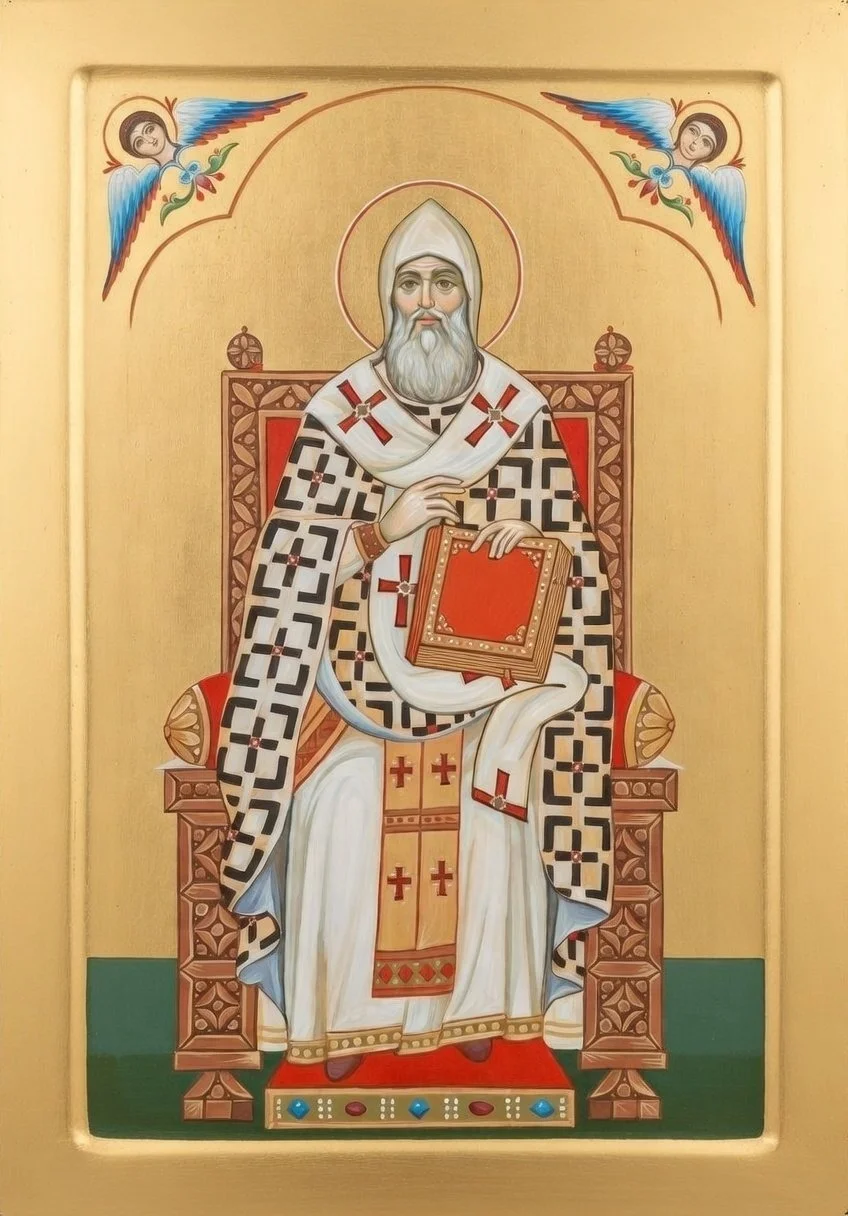
Between Empires and Between Churches
Nerses lived with constant insecurity. Armenian Christians were scattered under Byzantine, Turkish, Crusader and Armenian rulers, and the fall of Edessa in 1144 or 1145 shook the Christian East. His Lament on Edessa, traditionally dated to that time, shows how personally he felt that loss.
The great dispute of his life was the old division after the Council of Chalcedon in 451. The Armenian Church followed the theology of Saint Cyril of Alexandria and did not accept the Chalcedonian formula. Nerses explained that his Church did not confuse or deny Christ's humanity, and he sought words both sides could accept.
The talks with Emperor Manuel and the Greek theologian Theorianos touched on Christ's natures, the bread of the Eucharist and church practice. How far Nerses accepted Chalcedonian language is DISPUTED among historians. What is certain is that no lasting union came in his lifetime, and the work passed unfinished to his successor.
Death at Hromkla
Nerses died on August 13, 1173, at Hromkla, and Armenian accounts say he was buried there. His death interrupted the talks with Byzantium. His successor, Gregory IV, kept up the correspondence, but the hoped for union did not take place.
Relics: UNCERTAIN. The sources reviewed do not show where an authenticated body or relics of Saint Nerses rest today. The fortress at Hromkla passed out of Armenian hands in the thirteenth century, and later movements of relics are not documented well enough to state here.
His sainthood grew from Armenian veneration over time, not from a modern papal process. The date of his first formal liturgical honor is UNCERTAIN. Reports in 2026 say that Rome added him to the Roman Martyrology, but readers should check the Vatican's own announcement and not rely on this article for the wording.
Stories, Titles and Devotion
Unlike many saints, Nerses has few miracle stories attached to him in the sources checked. No lifetime healing or miracle after his death could be verified from an early, reliable text, so none are told here. His holiness is remembered mostly through what he wrote and how he led.
TRADITION: some devotional writers call him a second illuminator of Armenia, comparing his renewal of learning and prayer to the first illumination by Saint Gregory. This is a loving title, not a claim that he founded Armenian Christianity. It tells us how deeply later Armenians valued his gifts.
His name is remembered among the holy fathers and translators in Armenian worship, and the Church honors him each year with the Holy Translators on a movable Saturday in October. Armenians also pray his hours and sing his hymns daily, which is perhaps the truest sign of his devotion.
The Poet and His Prayers
His best known work is I Confess with Faith, Havadov Khostovanim in Armenian. It is a set of twenty-four prayers, linked to the hours of the day. They ask for mercy, light, protection from temptation, a peaceful death and a good answer before Christ, and they have been translated into many languages.
He wrote hymns that entered the Armenian hymn book, the Sharaknots, including the morning hymn Aravot Luso, the Morning of Light. Other works include the long poem Jesus the Son, usually dated about 1152, riddles, and a poem on the heavens. Exact dates for each work are UNCERTAIN.
Modern scholars study his letters for the history of the talks with Byzantium and his General Epistle for social history. Recent articles also question older assumptions, for example whether one letter was truly a call to a synod on union. His writings remain a living text for prayer and a subject of ongoing research.
Where to Remember Him
There is no verified shrine of Saint Nerses to visit. Hromkla, where he lived and died, lies in southeastern Turkey and is not an easy place for pilgrims. The place connected most closely with his memory today is the prayer life of Armenian churches, where his texts are used.
Armenian Apostolic and Armenian Catholic parishes remember him in the feast of the Holy Translators in October, when hymns and readings honor the translators and teachers of the nation. Some communities also recall his death on August 13. Check with a local parish for how it keeps these days.
A fitting pilgrimage is a quiet one at home. Read slowly one of the prayers of I Confess with Faith at the hour it belongs to, in a translation approved by your Church. In this way, a reader far from Hromkla can still stand where he stood, in prayer before the Lord.
Lord Jesus Christ, You gave Your Church a pastor who prayed through the hours of the day and longed for the unity of Your people. Through the prayers of Saint Nerses, teach us to confess our faith with humility, to praise You with a clear heart and to seek peace among Christians. Amen.
This is a short original prayer written for this article. It is not an official text of any Church.
Nerses Among the Eastern Churches
The Armenian Apostolic Church belongs to the Oriental Orthodox family, not the Eastern Orthodox communion of Constantinople. Nerses was its Catholicos, so his Church has always honored him as its own. Readers should keep this distinction clear when comparing him with Greek, Russian or Latin saints.
For Armenian Catholics his hymns and prayers are part of a shared inheritance, because the Armenian Catholic Church keeps the same Armenian liturgical heritage in communion with Rome. The Catholic and Orthodox sides of this tradition therefore meet in his words even though the Churches remain divided.
For Eastern Orthodox and Latin readers, Nerses is an example of respectful dialogue. He took Byzantine arguments seriously, stayed loyal to his own Church and sought agreement without erasing identity. Whether or not unity comes soon, his patient charity is a model for any ecumenical work.
Frequently Asked Questions
Ask His Prayers
Armenian Christians ask Saint Nerses the Gracious to pray for a heart that loves the hours of prayer and a Church that seeks peace. A prayer card of Saint Nerses is a quiet reminder to pray his words and to hope for unity.
View Prayer Card