Saint Seraphim of Sarov: The Hermit Who Fed a Bear, Prayed on a Rock for a Thousand Nights, and Shone With Light
Saint Seraphim of Sarov: The Hermit Who Fed a Bear, Prayed on a Rock for a Thousand Nights, and Shone With Light
A merchant's son who became a monk, then a recluse, then a man wild animals trusted more than most people trust each other. Beaten nearly to death by robbers he refused to fight, he spent his final years calling every visitor "my joy" and teaching that the whole purpose of Christian life was to acquire the Holy Spirit.
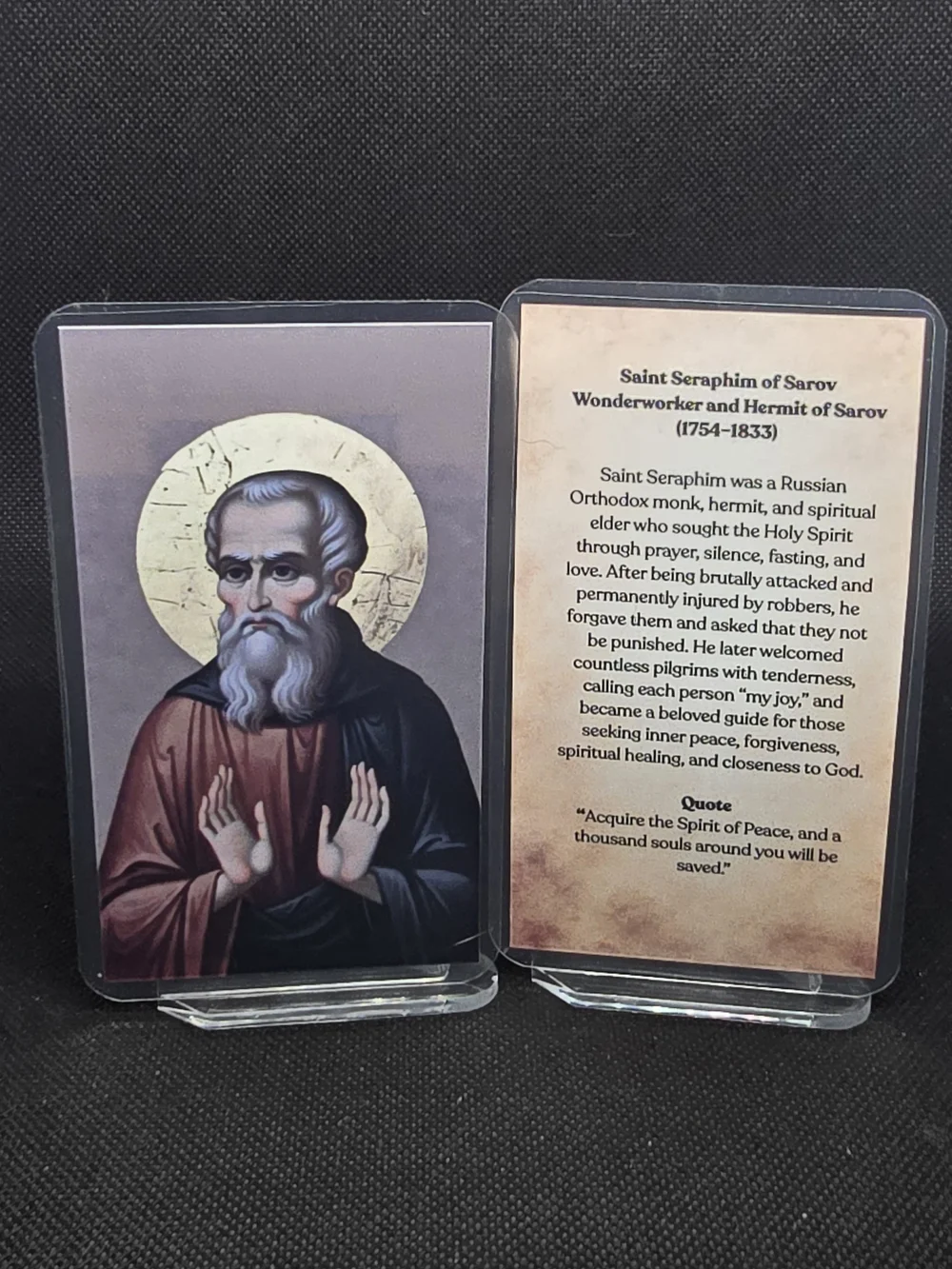
Saint Seraphim of Sarov at a Glance
- Also Known As
- Prokhor Moshnin (birth name)
- Born
- July 19, 1754, Kursk, Russia
- Died
- January 2, 1833, Sarov, Russia
- Venerated In
- The Eastern Orthodox Church and the Anglican Communion
- Canonized
- July 19, 1903 (Old Style), by the Holy Governing Synod of the Russian Orthodox Church, with Tsar Nicholas II in attendance
- Feast Days
- January 2 (repose); July 19 (uncovering of relics and canonization)
- Title
- Venerable; Wonderworker of Sarov
- Known For
- Extreme ascetic feats, twelve apparitions of the Mother of God, the "Conversation on the Acquisition of the Holy Spirit," care for the Diveyevo Convent
- Famous Teaching
- "Acquire a peaceful spirit, and thousands around you will be saved"
- Relics
- Holy Trinity Cathedral, Diveyevo Convent, Russia
- I. A Merchant's Son in Kursk
- II. Healed by the Kursk Root Icon
- III. Entering Sarov Monastery
- IV. A Novice's Illness and a Second Marian Healing
- V. Tonsure, Ordination, and a Vision at the Altar
- VI. The Far Hermitage: A Life Among Wild Animals
- VII. A Thousand Nights of Prayer on a Rock
- VIII. Attacked by Robbers and Left for Dead
- IX. Fifteen Years of Silence and Seclusion
- X. "Christ Is Risen, My Joy!": Opening the Doors
- XI. The Conversation With Motovilov: A Face Brighter Than the Sun
- XII. Father to the Diveyevo Sisters and the Kanavka
- XIII. His Prophecies: Russia's Suffering, His Own Death, and the End of the World
- XIV. Death in Prayer, January 2, 1833
- XV. Canonization, 1903, and an Emperor's Insistence
- XVI. His Relics: Confiscated, Lost, and Found Again in 1990
- XVII. Twelve Apparitions and a Catalogue of Wonders
- XVIII. His Companions: Connections to Other Saints
- XIX. His Teaching: The Acquisition of the Holy Spirit
- XX. Diveyevo Convent, With a Link
- XXI. Legacy: Joy as a Form of Holiness
- Prayer for the Intercession of Saint Seraphim of Sarov
- Frequently Asked Questions
A Merchant's Son in Kursk
Seraphim was born Prokhor Moshnin on July 19, 1754, in Kursk, Russia, to Isidor Moshnin, a merchant and building contractor, and his wife Agathia. Isidor had taken on the construction of a large cathedral in Kursk but died before its completion, leaving Agathia to raise Prokhor and see the project through. As a young boy, Prokhor is said to have climbed the bell tower of the very cathedral his father had been building, still under construction, and fallen from a considerable height. He was found unharmed, an early episode his family and later biographers read as the first sign of a providential protection that would mark the rest of his life.
Part II
Healed by the Kursk Root Icon
At around ten years old, Prokhor fell seriously ill, with his condition worsening to the point that his life was genuinely in danger. According to tradition, he was shown in a dream that the Mother of God would come to heal him. Soon afterward, a religious procession carrying the renowned wonderworking Kursk Root Icon of the Mother of God happened to pass near the Moshnin home, its usual route altered by rainy weather. Agathia carried her ailing son out to the passing procession so that he could venerate the icon directly, and Prokhor's health was restored in the time that followed, a recovery the family attributed entirely to that encounter with the icon.
Part III
Entering Sarov Monastery
As a young man, Prokhor felt drawn increasingly toward monastic life, devoting as much time as possible to church attendance and reading, working his way steadily through the Bible, the lives of the saints, the writings of the Church Fathers, and liturgical texts, a habit of study he maintained for the rest of his life. With his mother's blessing, and wearing a copper cross she gave him that he would keep on his body for the remainder of his years, Prokhor left Kursk in his late teens to seek out monastic life, arriving eventually at Sarov Monastery around 1778 or 1779, following the counsel of a spiritual elder he had consulted along the way, and remained there, in one capacity or another, for the rest of his earthly life.
Part IV
A Novice's Illness and a Second Marian Healing
Several years into his novitiate under the guidance of Elders Pachomius and Joseph at Sarov, Prokhor fell gravely ill a second time, his condition serious enough that he came close to death. Consistent with the pattern that would define his entire approach to physical suffering, he declined ordinary medical treatment, choosing instead to rely on prayer and the sacraments. According to the tradition preserved at Sarov, the Mother of God appeared to him during this illness and healed him, a second Marian intervention in his life that mirrored, and confirmed, the healing he had already experienced as a child through the Kursk Root Icon.
Part V
Tonsure, Ordination, and a Vision at the Altar
Prokhor was tonsured a monk in 1786, receiving the name Seraphim, drawn from the fiery seraphim of the heavenly hierarchy, a name meant to reflect his own burning love for God. He was ordained a hierodeacon the following year and, while serving at the altar, is recorded as having repeatedly seen angels present during the services. The most striking of these experiences occurred on Holy Thursday, when Seraphim reported being caught up for several hours in a vision of Christ himself entering the church surrounded by the heavenly hosts, an experience so overwhelming that he had to be led from the altar and supported for some time afterward. He was ordained a hieromonk, a priest-monk, in 1793, at thirty-four years old, and served the Divine Liturgy daily for a year following his ordination.
Part VI
The Far Hermitage: A Life Among Wild Animals
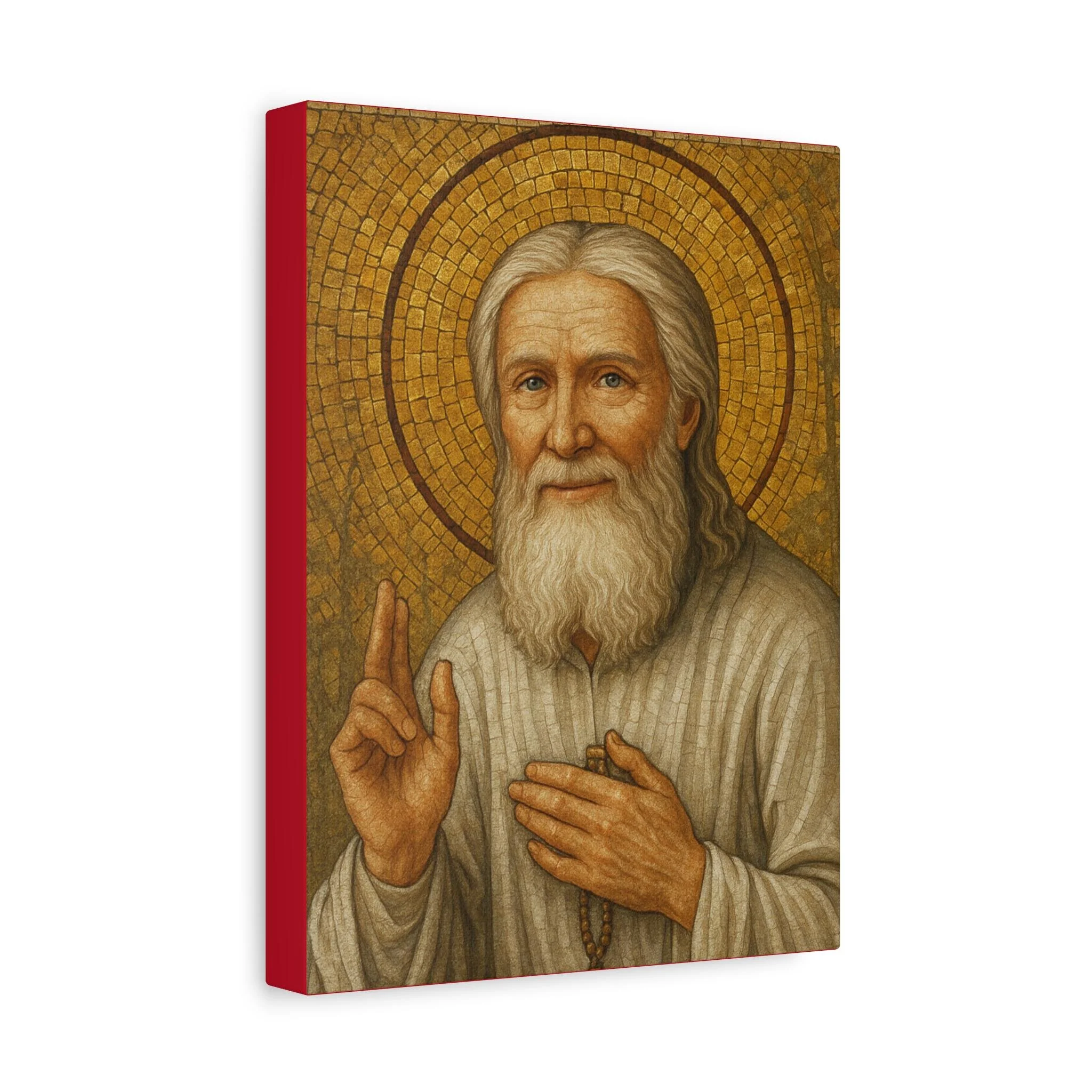
Not long after his ordination, Seraphim withdrew into what became known as his "far hermitage," a small wilderness dwelling roughly five kilometers from the main monastery, where he pursued a life of extreme solitude, fasting, and unceasing prayer. It was here that Seraphim achieved what witnesses described as a striking spiritual perfection, one outward sign of which was his relationship with the wild animals of the surrounding forest. Bears, rabbits, wolves, and foxes are all recorded as having come to his hut without fear. The Diveyevo eldress Matrona Plescheeva later testified to witnessing Seraphim feed a wild bear directly from his hand, describing his face in that moment as particularly radiant, joyous, and bright, comparing it to the face of an angel.
Part VII
A Thousand Nights of Prayer on a Rock
Among the most demanding of Seraphim's ascetic feats, and one of the most frequently retold episodes of his life, is his practice of praying continuously through the night, for a reported one thousand nights, kneeling with his arms raised toward heaven on a large boulder in the forest, repeating the words of the tax collector's prayer, "O God, be merciful to me, a sinner." Tradition holds that he divided this labor between a stone in the forest, where he prayed through the night, and a smaller stone kept within his own cell, where he continued the same prayer through the day, sustaining this extraordinary discipline for years at a time.
Part VIII
Attacked by Robbers and Left for Dead
In 1804, while working alone near his hermitage, Seraphim was attacked by a group of peasant robbers who had heard rumors that the hermit received money from visitors and had come to take it by force. Seraphim, by all accounts a physically strong man and holding an axe at the very moment of the attack, chose not to defend himself, setting the axe down rather than using it against his assailants. The robbers beat him severely regardless, fracturing his skull and causing lasting damage to his spine, and left him for dead. He survived, but the injuries permanently bent his frame, and he walked with the aid of a staff or cane for the rest of his life. During his long and difficult recovery, tradition holds that the Mother of God appeared to him again, this time accompanied by the Apostles Peter and John the Theologian, and said of him, simply, "He is one of ours." When the robbers responsible were later caught and faced punishment, Seraphim personally pleaded for leniency on their behalf, forgiving them for the assault that had permanently altered his body.
Part IX
Fifteen Years of Silence and Seclusion
Following his recovery from the attack, Seraphim entered an extended period of even stricter withdrawal, first taking a vow of silence and then entering what Russian monastic tradition calls zatvor, a formal seclusion in which he withdrew almost entirely from human contact, first continuing in his forest hermitage and later confining himself within his own monastery cell. This period of profound interior purification and training lasted, by most reckonings, somewhere between fifteen and seventeen years, a stretch of his life about which comparatively little external detail survives, precisely because so little of it was witnessed by anyone else.
Part X
"Christ Is Risen, My Joy!": Opening the Doors
In 1825, the Mother of God appeared to Seraphim once more, this time instructing him to end his long seclusion and devote himself instead to the direct service of others. Seraphim obeyed, opening the doors of his cell to all who came seeking him. For the remaining years of his life, thousands of pilgrims arrived at Sarov to seek his counsel, and Seraphim received each one with the same greeting, regardless of the actual season of the liturgical calendar: "Christ is risen, my joy!" Those who came expecting to find a man broken or embittered by decades of extreme deprivation and a near-fatal beating instead consistently described someone radiantly, almost startlingly joyful, a joy his own years of hidden discipline seemed only to have deepened rather than diminished.
Part XI
The Conversation With Motovilov: A Face Brighter Than the Sun
Among the most theologically significant episodes of Seraphim's later life is his recorded conversation with a spiritual disciple, Nicholas Alexandrovich Motovilov, which took place at the end of November 1831. Motovilov, wanting to understand the true aim of the Christian life, asked Seraphim directly, and Seraphim's answer, that the entire purpose of Christian existence is the acquisition of the Holy Spirit, became one of the most quoted teachings in modern Orthodox spiritual literature. During their conversation, seated together in the snow-covered forest, Motovilov reported that Seraphim's face began to shine with a light brighter than the sun, so intensely that Motovilov initially could not bear to look directly at him, while the two of them remained visibly warm despite the winter cold around them, an experience later Orthodox theologians would connect directly to the uncreated divine light described in the Church's own mystical tradition.
Motovilov wrote down an account of this conversation afterward, but the manuscript was lost, tucked away and forgotten in an attic for nearly seventy years, until it was rediscovered shortly before Seraphim's 1903 canonization by the author Sergei Nilus, who had been specifically searching for material relating to Seraphim's life. Its publication in 1903 introduced this teaching to a far wider audience than had ever encountered it during Motovilov's own lifetime.
Part XII
Father to the Diveyevo Sisters and the Kanavka
Seraphim's spiritual care extended in a particular and lasting way to the women's monastic community at Diveyevo, not far from Sarov, originally founded by the ascetic Mother Alexandra, born Agafia Semeonovna Melgunova, a widow of noble birth who had given away her considerable wealth to pursue monastic life. According to the tradition preserved at the monastery, the Mother of God had personally directed Mother Alexandra to found a community in the north of Russia, appearing to her a second time on the road as she rested near the village of Diveyevo and identifying that exact spot as the place she had been seeking, declaring it would become her fourth and final earthly domain, a lot set apart in the same manner tradition already ascribed to Iveron, Mount Athos, and the Kiev Caves. Mother Alexandra spent her final years pleading with the young Hierodeacon Seraphim to accept spiritual responsibility for the small community forming there, and while still a hierodeacon he had accompanied the elder Father Pachomius to Diveyevo for this purpose. Pachomius later specifically entrusted Seraphim with the ongoing care of what came to be called the "Diveyevo orphans," a responsibility Seraphim carried for the rest of his life even though he is recorded as having visited the community itself in person only rarely after his youth, guiding it instead almost entirely through visitors who carried his instructions back and forth. Seraphim insisted that he gave the sisters no instructions of his own, but that it was the Mother of God herself who guided him in every matter concerning the community's governance and needs, and those close to him testified that he seemed to know the layout of Diveyevo, down to individual stones, despite his infrequent visits.
On November 25, 1825, the feast of the Entrance of the Theotokos, while he was praying in the forest near Sarov, the Mother of God appeared to Seraphim again, this time with specific and detailed instructions: she directed him to separate out eight named nuns from the existing community and to establish, under their care, a second and distinct foundation alongside the original Kazan community, to be built beside the local mill and governed by its own stricter rule. This new foundation became known as the Mill Community, and construction proceeded exactly as Seraphim had described it to his disciple Mikhail Manturov years before ground was actually broken, a level of precise foreknowledge later commentators have pointed to as itself a form of the saint's clairvoyant gift. Seraphim himself is remembered as saying of the relationship between his two monastic homes that Sarov was merely a sleeve, while Diveyevo was the entire fur coat, a compact way of expressing how much greater a significance he attached to the community of women he had never formally joined than to the monastery where he had spent his own monastic life.
Under this same guidance, Seraphim directed the digging of a ditch, the Kanavka, tracing a path around a portion of the Diveyevo grounds. Tradition holds this ditch was specifically commanded and sanctified by the Mother of God herself, who is said to have personally walked its path and promised her own protection over it. Seraphim taught that the ditch would one day run from the earth to the sky itself, an impassable spiritual boundary that no hostile power would ever be able to cross, and told the sisters that anyone who walked its length in prayer, reciting the Hymn to the Theotokos a set number of times, would receive a grace comparable to visiting Athos, Jerusalem, and Kiev all at once. The Kanavka remains today one of the most important devotional features of the Diveyevo pilgrimage, walked by visitors in prayer much as it was originally traced, though the original ditch was leveled and destroyed during the Soviet closure of the monastery and has since been restored following the community's reopening.
Among the more striking anecdotes preserved from this period is the story of Elena Vasilievna Manturova, a Diveyevo sister who, out of pure obedience to Seraphim's counsel, voluntarily agreed to die in place of her own brother, whom the elder judged was still needed in the world. Her brother, Mikhail Manturov, had himself earlier been healed by Seraphim from a crippling illness, anointed with oil from the lamp burning in the elder's cell, and had responded to his own healing by selling all his possessions and dedicating the proceeds to the young Diveyevo community, becoming one of its principal early benefactors.
Part XIII
His Prophecies: Russia's Suffering, His Own Death, and the End of the World
Alongside his healings and his visions, Seraphim is remembered in the Diveyevo chronicles as having spoken repeatedly, and with striking specificity, about events well beyond his own lifetime. He is recorded as having foretold, years in advance, that news of his own death would become known through fire, a saying later connected by the sisters to the burning candle discovered near his body, still alight, when he was found kneeling before his icon.
He is also remembered as having spoken at length about the future of Russia itself, telling those close to him that the nation would pass through a period of severe suffering and upheaval before being restored, and connecting his own eventual glorification and the return of his relics to that same larger national restoration, a prophecy many of the faithful understood, after the fact, as having anticipated the revolutionary upheavals of the following century and the eventual reopening of Diveyevo itself after decades of Soviet suppression. In his conversation with Nicholas Motovilov, Seraphim is recorded as having offered a specific figure for how much longer the world itself would endure, a prophecy that remains, by its own nature, unverifiable and unfulfilled, and this article notes it as part of the documented tradition surrounding him without treating it as settled fact.
Readers should approach this entire body of prophetic material with the same care this article has applied elsewhere: these sayings are preserved through the same devotional chronicle tradition, chiefly the accounts gathered by the Diveyevo sisters and by Motovilov himself, that preserves the rest of Seraphim's later teaching, and they carry the same mixture of strong internal consistency and limited independent corroboration that characterizes most prophetic material attributed to Russian spiritual elders of this era.
Part XIV
Death in Prayer, January 2, 1833
In 1831, the Mother of God appeared to Seraphim once more, this final apparition telling him plainly, "Soon, my friend, you will be with us." Seraphim relayed this news calmly to those close to him, telling them of the joy that awaits a soul when the angels come to claim it. In the last months of his life, visitors noted he spoke increasingly often of death not as a loss but as a passage into a joy that made every earthly hardship he had endured seem small by comparison, consistent with the same radiant temperament he had shown throughout his years of open ministry.
He died on January 2, 1833, at seventy-eight years old. His body was discovered kneeling in prayer before an icon of the Mother of God in his cell, his hands crossed over his chest, his final posture suggesting he had passed from this life in the very act of prayer itself, unwitnessed and at peace. A candle was found still burning nearby, an image that became closely associated in later memory with his own earlier prediction that word of his death would come by way of fire.
Part XV
Canonization, 1903, and an Emperor's Insistence
Seraphim's formal canonization took place on July 19, 1903, at Sarov Monastery, presided over by the Holy Governing Synod of the Russian Orthodox Church, and drew a vast crowd estimated at roughly two hundred thousand pilgrims. Tsar Nicholas II and the imperial family attended in person, reflecting a particular devotion the emperor himself held toward Seraphim's memory; contemporary accounts describe the emperor personally pressing the process forward despite some hesitation within Church circles, driven in part by his own family's fervent hope for the birth of a male heir. The imperial family bathed in the holy spring associated with Seraphim near Sarov during the canonization visit, and the following year, 1904, Empress Alexandra gave birth to the long-awaited Tsarevich Alexei, a birth many of the faithful directly credited to Seraphim's intercession.
Part XVI
His Relics: Confiscated, Lost, and Found Again in 1990
In 1920, Soviet authorities confiscated Seraphim's relics as part of the broader campaign against religious veneration, intending originally to put them on public display in a museum designed specifically to mock and undermine Orthodox belief. That planned exhibition never fully opened as intended, and the relics themselves subsequently vanished from public record entirely, their location unknown even to Church authorities for the following seventy years.
The relics were unexpectedly rediscovered in December 1990, found in a storage room of the former Kazan Cathedral in Leningrad, which had itself been converted into a Museum of the History of Religion and Atheism during the Soviet period, the very institution originally intended to house them in mockery. Following their rediscovery, the relics were carried in a triumphant, multi-city procession back to their original home, arriving at the Diveyevo Convent in July 1991, where they remain enshrined today, drawing a constant stream of pilgrims who come daily to bring their sorrows and petitions to the saint.
Few relic histories in the entire Orthodox world offer as complete and well-documented a resolution as Seraphim's: seized specifically to be used as an instrument of anti-religious mockery, they were found decades later inside the very institution built for that purpose, and were returned to full veneration within a single generation of their disappearance.
Part XVII
Twelve Apparitions and a Catalogue of Wonders
Across the whole of his life, tradition records twelve separate apparitions of the Mother of God to Seraphim, a number without parallel among the saints of the Russian Church, spanning from his childhood healing through the Kursk Root Icon to the final visitation announcing his approaching death. Beyond these apparitions, specific individuals are named in the historical record as having received healing directly through his prayers: Nicholas Motovilov himself, healed of a crippling illness that had left him unable to walk; Michael Manturov, cured of a grave illness that led him to become a lasting benefactor of Diveyevo; and a broader, less individually documented but consistently attested pattern of healing among the thousands who came to him during his years of open ministry, and among the pilgrims who have continued visiting his relics ever since their return to Diveyevo in 1991.
Part XVIII
His Companions: Connections to Other Saints
Seraphim's life connects to several other figures venerated within the Orthodox tradition:
Elder Pachomius, Abbot of Sarov
One of Seraphim's earliest monastic guides at Sarov, who later specifically entrusted him with lasting responsibility for the Diveyevo community.
Mother Alexandra (Agafia Melgunova)
The founding ascetic of the Diveyevo women's community that Seraphim would spend decades of his life caring for and guiding on the Mother of God's own instruction, according to his own account.
Saint Tikhon of Zadonsk and the Wider Tradition of Russian Startsy
Though not a direct personal contemporary, Seraphim stands within the same broader eighteenth and nineteenth-century Russian tradition of the starets, the charismatic spiritual elder, that also produced figures such as Tikhon of Zadonsk and, in the following century, the elders of Optina Monastery.
Tsar Nicholas II and Empress Alexandra
Later canonized themselves by the Russian Orthodox Church as passion-bearers, the imperial couple's own devotion to Seraphim, expressed personally at his 1903 canonization, forms a documented historical link between two of Russian Orthodoxy's most beloved twentieth-century cults of veneration.
Part XIX
His Teaching: The Acquisition of the Holy Spirit
Seraphim did not compose formal theological treatises in the manner of some other great spiritual writers of the Orthodox tradition; his teaching survives instead chiefly through the recorded testimony of those who spoke with him directly, above all through Motovilov's preserved account of their 1831 conversation. That single conversation, more than any other source, has shaped how later generations of Orthodox Christians understand the practical goal of ascetic and spiritual life: not simply moral improvement or the performance of good works, but the direct, experiential acquisition of the grace of the Holy Spirit, of which good works are only the means rather than the end itself. This teaching, though delivered in a single conversation between two men on a winter afternoon, has gone on to become one of the most widely cited summaries of Orthodox spiritual theology available in any language.
Part XX
Diveyevo Convent, With a Link
Diveyevo remains the natural pilgrimage destination for anyone seeking to connect with Seraphim's memory today:
Holy Trinity-Diveyevo Convent, Diveyevo, Russia
The women's monastery Seraphim spent decades of his life guiding, now home to his enshrined relics since their 1991 return, the sanctified Kanavka ditch pilgrims still walk in prayer, and one of the most visited Orthodox pilgrimage destinations in all of Russia. diveevo-monastyr.ru
Part XXI
Legacy: Joy as a Form of Holiness
Seraphim of Sarov's legacy rests on an unusual combination that continues to draw people to his memory nearly two centuries after his death: a life built on some of the most extreme ascetic disciplines recorded in the Orthodox tradition, a thousand nights of prayer on a rock, fifteen years of near-total silence and seclusion, survival of a beating that left him permanently disfigured, paired with a public ministry remembered above all for its radiant, almost startling joy. He greeted strangers as though Easter had never ended, fed a wild bear from his own hand, and told a young nobleman that acquiring peace of soul mattered more than any external accomplishment a Christian life could produce.
That combination, extreme austerity married to unshakeable joy, has made him one of the most beloved and frequently invoked saints in the entire modern Orthodox world, a wonderworker whose relics were seized specifically to mock the faith he embodied and were, within a single lifetime, returned in triumph to the community he spent his final decades quietly serving.
Holy Trinity, Father, Son, and Holy Spirit, to You be glory, honor, and blessing, for having given to Your holy Church Saint Seraphim of Sarov, wonderworker, as a model of unceasing prayer, forgiveness of enemies, and radiant joy in the midst of great hardship.
We ask You humbly: just as You filled him with the grace of the Holy Spirit and made his very presence a source of peace to all who sought him, be pleased to grant us, through his intercession, peace of soul, healing in body, and the grace we now ask with confidence.
Through Christ our Lord. Amen.
An original English-language devotional prayer composed for use with the Saint Seraphim of Sarov prayer card, drawing on the traditional themes of his veneration in the Russian Orthodox Church.
More From Our Store, In Honor of Saint Seraphim


FAQ
Frequently Asked Questions About Saint Seraphim of Sarov
He Prayed on a Rock for a Thousand Nights and Greeted Every Stranger Like It Was Easter.
Saint Seraphim of Sarov spent decades emptying himself of everything the world considers necessary: comfort, safety, companionship, even, for a time, his own voice. A bear trusted him enough to eat from his hand. Robbers beat him nearly to death and he forgave them before their trial. He prayed through a thousand nights on a stone in the forest, and then, when the Mother of God finally told him it was time, he opened his door and spent the rest of his life calling every single person who walked through it "my joy."
Ask his intercession. Say his prayer. Remember a monk who proved that the most extreme discipline and the most radiant joy were never actually in competition with each other.
Get the Saint Seraphim of Sarov Prayer Card →