Saint Sebastian: The Soldier Who Survived His Own Martyrdom, Then Went Back to Face It Again
Saint Sebastian: The Soldier Who Survived His Own Martyrdom, Then Went Back to Face It Again
A Praetorian officer who used his own uniform as cover to smuggle courage to condemned Christians. Shot full of arrows and left for dead, he recovered, and instead of fleeing, walked straight back to confront the emperor who had ordered his death.
Saint Sebastian at a Glance
- Born
- c. 255, traditionally at Narbo Martius (Narbonne), Gaul
- Died
- c. 288, Rome, during the persecutions of Diocletian and Maximian
- Venerated In
- The Catholic Church, the Eastern Orthodox Church, Oriental Orthodoxy, and Anglicanism
- Canonized
- Pre-congregation; venerated from the earliest centuries of the Roman Church
- Feast Days
- January 20 (Roman Catholic and Oriental Orthodox); December 18 (Eastern Orthodox); February 14 or 15 (Ethiopian Orthodox)
- Title
- Martyr; traditionally an officer of the Praetorian Guard
- Earliest Source
- The Chronograph of 354 and a sermon of Saint Ambrose of Milan, both predating the later legendary Passio
- Known For
- Surviving an arrow execution before a second, fatal martyrdom by clubbing
- Patronage
- Soldiers, archers, athletes, and protection against plague
- Relics
- Basilica of San Sebastiano fuori le mura, Appian Way, Rome
- I. A Soldier of Gaul in the Roman Army
- II. What the Earliest Sources Actually Say
- III. A Christian Hidden Inside the Praetorian Guard
- IV. Marcus and Marcellian: Steadying Two Brothers on Death Row
- V. Zoe, Chromatius, and a Chain of Conversions
- VI. Discovered and Condemned
- VII. The First Martyrdom: Bound and Shot With Arrows
- VIII. Saint Irene of Rome and an Unexpected Recovery
- IX. The Second Martyrdom: Clubbed to Death
- X. Burial in the Catacombs on the Appian Way
- XI. His Relics: San Sebastiano Fuori le Mura
- XII. Patron Against Plague: The Legend of 680
- XIII. Miracles and Healings Attributed to Him
- XIV. His Companions: Connections to Other Saints
- XV. On the Passio: Legend Layered Over History
- XVI. The Most Painted Saint in Western Art
- XVII. Churches and Shrines, With Links
- XVIII. Legacy: Patron of Endurance
- Prayer for the Intercession of Saint Sebastian
- Frequently Asked Questions
A Soldier of Gaul in the Roman Army
Tradition places Sebastian's birth around the year 255, at Narbo Martius, present-day Narbonne, in the Roman province of Gallia Narbonensis, though other early accounts describe him as raised in Milan by a father from Narbonne and a mother from that northern Italian city. Whichever version of his early geography is accepted, the consistent thread across the sources is that Sebastian entered Roman military service in the city of Rome itself around the year 283, under the Emperor Carinus, and rose within the following years to a position of real trust and responsibility, traditionally identified as captain of the Praetorian Guard, the elite corps charged with the emperor's own personal protection.
Part II
What the Earliest Sources Actually Say
Honesty about sourcing matters especially here, since Sebastian's story is one of the most elaborately developed in the whole of Christian hagiography, and readers deserve to know which parts rest on the earliest, thinnest evidence and which parts were added centuries later. The oldest surviving reference to Sebastian's veneration is the Chronograph of 354, a Roman civil and liturgical almanac that simply records his commemoration on January 20 without narrative detail. The next earliest witness is a genuine sermon of Saint Ambrose of Milan, written in the late fourth century, which states that Sebastian came from Milan and was already venerated there in Ambrose's own time, confirming an established cult within roughly a century of his death but again offering no extended narrative.
The full, richly detailed story that most readers associate with Sebastian today, his military career, his secret ministry to prisoners, the specific converts he made, and the vivid details of his double martyrdom, comes from a later text known as the Passio Sancti Sebastiani, composed in the fifth century by an author long, and almost certainly incorrectly, identified as Saint Ambrose himself, and now generally attributed to an anonymous writer, possibly Arnobius the Younger. This article draws on that traditional Passio for the fuller narrative, as virtually every account of Sebastian's life does, while flagging plainly that it represents devotional legend compiled more than a century after his death rather than a contemporary historical record.
Part III
A Christian Hidden Inside the Praetorian Guard
According to the traditional account, Sebastian entered Roman military service specifically, though covertly, in order to support and defend Christians who were being arrested and condemned under the empire's escalating persecution, all while carefully concealing his own faith from his military superiors. Both Diocletian and Maximian, the co-emperors under whom he served, are said to have valued him highly and remained entirely unaware for years that the trusted officer in their own guard was himself a practicing Christian, secretly using his position and access to visit imprisoned believers, encourage the wavering, and quietly minister to those awaiting execution.
Part IV
Marcus and Marcellian: Steadying Two Brothers on Death Row
The traditional narrative's central episode concerns twin brothers, Marcus and Marcellian, deacons from a distinguished Roman family, both married with households of their own, who were arrested for refusing to sacrifice to the Roman gods and condemned to death. Their parents, Tranquillinus and Martia, visited them in prison hoping to talk them into recanting to save their lives. Sebastian, present at these visits, is credited with speaking so persuasively of the reality awaiting the faithful beyond death that he not only steadied the wavering brothers in their resolve but converted their own parents to Christianity in the same conversation, along with, according to the fuller account, Saint Tiburtius, son of the local prefect Chromatius.
Part V
Zoe, Chromatius, and a Chain of Conversions
The traditional Passio describes a cascading series of further conversions flowing from this same episode. Nicostratus, an official responsible for the prisoners, and his wife Zoe, who had reportedly been mute for six years, both came into contact with Sebastian; Zoe, unable to speak her request aloud, is said to have communicated her desire for conversion through gesture, and upon her baptism her speech was restored. Nicostratus then brought additional prisoners forward, and Chromatius, the prefect of Rome himself, hearing of these events while suffering from severe gout, summoned Sebastian to his own bedside and was healed, converting along with his son Tiburtius and his entire household. Chromatius is said to have responded by freeing his prisoners, emancipating his slaves, resigning his office, and retiring from public life entirely.
Part VI
Discovered and Condemned
Sebastian's Christianity, so carefully guarded for years, was finally exposed around 286. According to tradition he was arrested specifically while burying the bodies of a group of martyrs, sometimes identified with the Four Crowned Martyrs, whom he had continued to serve even at the risk of exposure. Brought before Diocletian, the emperor is described as reproaching Sebastian personally, framing his hidden faith as a betrayal of the trust placed in him as a soldier of Rome. Diocletian ordered him taken outside the city and bound to a stake, to be executed by a company of Mauretanian archers.
Part VII
The First Martyrdom: Bound and Shot With Arrows
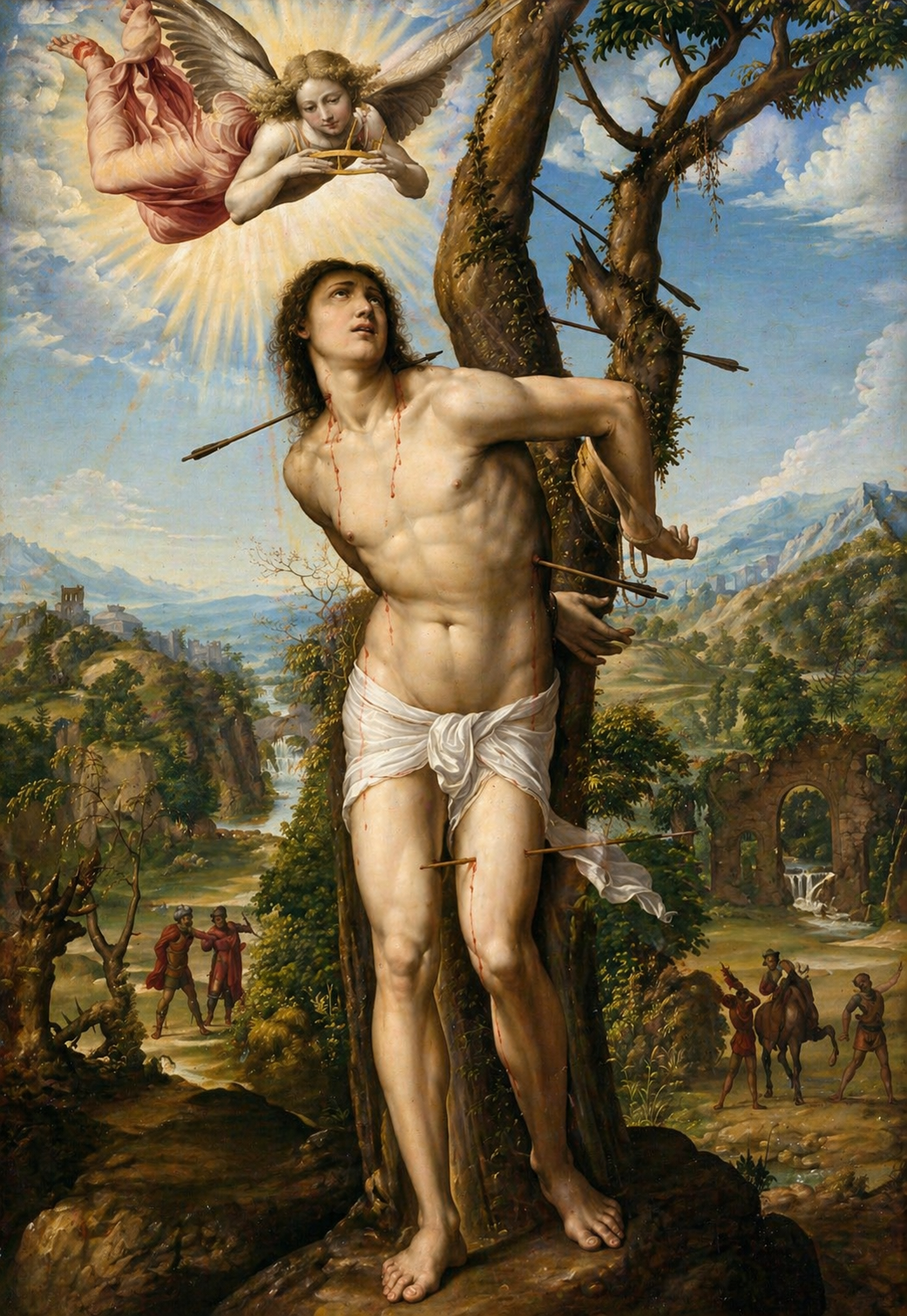
Sebastian was led to the Campus Martius, the Field of Mars, and bound either to a post or a tree, where the archers shot at him until, in the vivid phrase of the traditional account, he was left resembling a creature bristling with quills, his body pierced by so many arrows that his executioners had no reason to doubt they had left him for dead. They departed without confirming the kill, an assumption that would prove mistaken and that would, centuries later, make Sebastian's arrow-pierced body one of the single most reproduced images in the entire history of Western religious art.
Part VIII
Saint Irene of Rome and an Unexpected Recovery
Irene, the widow of the martyr Castulus, went to the site under cover of darkness intending only to recover Sebastian's body for proper Christian burial, a common act of mercy toward executed believers in this period. Instead, she found him still alive, his many wounds severe but not fatal. She brought him back to her own home and nursed him through a slow recovery, an episode of tenderness set against extraordinary violence that later inspired one of the most beloved devotional and artistic subjects connected to Sebastian's story, second in popularity only to the arrow martyrdom itself.
Part IX
The Second Martyrdom: Clubbed to Death
Once recovered, fellow Christians urged Sebastian, understandably, to leave Rome and put himself beyond the emperor's reach. He refused. Instead, according to tradition, he deliberately positioned himself where the emperors would pass near a pagan temple, and when Diocletian and Maximian appeared, Sebastian confronted them publicly, denouncing their persecution of Christians and their impiety to their faces, an act of open, calculated defiance rather than one born of chance encounter. Diocletian, astonished to discover the officer he had already ordered executed still alive and now openly rebuking him, ordered him taken to the Circus Maximus, where this time he was clubbed to death, and his body was thrown into the Cloaca Maxima, Rome's principal sewer, specifically, tradition holds, to deny Christians a body to venerate.
Part X
Burial in the Catacombs on the Appian Way
Even the disposal of his body in the sewer did not, according to the traditional account, prevent proper burial. A pious woman is said to have received a vision or dream in which Sebastian himself directed her to the location of his remains and instructed her to bury him in the catacombs along the Appian Way, near the site associated with the burial of the Apostles Peter and Paul, a location that would later give the surrounding basilica its historic name, ad catacumbas.
Part XI
His Relics: San Sebastiano Fuori le Mura
A basilica, originally known as the Basilica Apostolorum and dedicated first to the veneration of the Apostles Peter and Paul, was built over the catacombs in the early fourth century and was later rededicated specifically to Sebastian, whose relics it has held ever since. The present structure is largely a seventeenth-century reconstruction, commissioned by Cardinal Scipione Borghese in 1609 and completed under the architects Flaminio Ponzio and Giovanni Vasanzio, standing today as one of the traditional Seven Pilgrim Churches of Rome, a circuit of major basilicas established as a single-day devotional pilgrimage route in the sixteenth century by Saint Philip Neri.
The basilica's dedicated Chapel of Relics, constructed in 1625, houses, alongside a stone bearing footprints traditionally associated with the apocryphal Quo Vadis episode of Saint Peter, one of the arrows said to have struck Sebastian during his first martyrdom and a fragment of the very column to which he was bound. These physical relics of the martyrdom itself, distinct from his bodily remains, have been venerated at the basilica for centuries.
Part XII
Patron Against Plague: The Legend of 680
Sebastian's association with protection from plague developed in the medieval period and rests on a specific historical tradition: that the people of Rome credited the cessation of a severe plague in the year 680 to his intercession, having invoked him during the outbreak. The underlying symbolic logic that reinforced this association across medieval Europe connected the arrows of Sebastian's own martyrdom to the ancient and widespread image of plague as a rain of arrows sent by divine wrath, a connection that made him a natural object of appeal whenever epidemic disease struck a city, and devotion to him is documented as intensifying sharply during subsequent waves of plague across medieval and early modern Europe, most famously during the recurring outbreaks of the Black Death and its later resurgences.
Part XIII
Miracles and Healings Attributed to Him
Several distinct wonders appear across Sebastian's traditional story, each worth naming individually. His own survival of the arrow execution, while explainable in purely medical terms as a matter of the archers missing vital organs, has been read devotionally across the centuries as itself a providential deliverance, sparing him specifically so that he could confront the emperor a second time. Within the narrative, two further healing miracles are recorded directly: the restoration of Zoe's speech after six years of muteness, and the healing of Chromatius's severe gout, both credited to Sebastian's prayer and presence. The broader, later tradition of plague protection, rooted in the events of 680, represents a further, larger-scale category of miracle attributed to his ongoing intercession rather than to any single documented episode during his own lifetime.
Part XIV
His Companions: Connections to Other Saints
Sebastian's story is threaded directly through a wide circle of fellow martyrs, several separately venerated as saints:
Saints Marcus and Marcellian
The twin deacon brothers Sebastian steadied on the eve of their own martyrdom, an episode that stands at the very center of the traditional Passio.
Saint Irene of Rome
The widow of Saint Castulus who found Sebastian still living after the arrow execution and nursed him back to health, herself venerated as a saint and a popular subject in later devotional art depicting her tending his wounds.
Saint Castulus
Irene's husband, himself a martyr of the same persecution, whose death is what had placed Irene in a position to perform the same act of mercy for Sebastian that she might once have hoped for on her own husband's behalf.
Saint Tiburtius, Saint Zoe, and Saint Chromatius
Converts credited to Sebastian's ministry and healing, whose own subsequent fates within the persecution are recorded, with varying degrees of detail, alongside his story in the traditional accounts.
Part XV
On the Passio: Legend Layered Over History
No personal writings by Sebastian himself exist or are claimed to exist in any source; he is remembered as a soldier and martyr, not an author. What this article has drawn on throughout, and what the overwhelming majority of accounts of his life ultimately trace back to, is the fifth-century Passio Sancti Sebastiani, composed roughly a century and a half after his death by an author probably not the Saint Ambrose to whom it was long attributed. This gap between the thin, reliable earliest sources, the Chronograph of 354 and Ambrose's genuine sermon, and the richly detailed later Passio is not unique to Sebastian among early Roman martyrs, but it is worth stating clearly rather than presenting the vivid narrative of converts, healings, and confrontations as though it carried the same historical weight as a contemporary eyewitness record.
Part XVI
The Most Painted Saint in Western Art
Few saints in the entire Christian calendar have inspired as vast and continuous a body of visual art as Sebastian. The scene of his arrow martyrdom became a favored subject for major Renaissance and Baroque artists including Sandro Botticelli, Andrea Mantegna, Pietro Perugino, Gian Lorenzo Bernini, and El Greco, in part because it offered painters a rare, theologically sanctioned opportunity to depict the idealized male nude within a devotional religious context. Andrea Mantegna alone painted the subject at least three separate times across his career.
Sebastian's cultural presence has extended well beyond religious art into the modern era: he appears as a central symbolic figure in Thomas Mann's novel Death in Venice, was the subject of a 1911 mystery play with music by Claude Debussy, inspired a 1944 ballet score by the American composer Gian Carlo Menotti, and has been referenced repeatedly in contemporary visual art, film, and popular culture into the twenty-first century.
Part XVII
Churches and Shrines, With Links
One site above all others anchors ongoing devotion to Sebastian:
Basilica of San Sebastiano Fuori le Mura, Rome, Italy
Built over the catacombs on the Appian Way where Sebastian was originally buried, holding his relics along with an arrow and column fragment from his martyrdom, and recognized today as part of a UNESCO World Heritage Site along the Via Appia Antica. Its current form dates largely to a seventeenth-century reconstruction under Cardinal Scipione Borghese. sansebastianofuorilemura.org
Part XVIII
Legacy: Patron of Endurance
Sebastian's enduring legacy rests on a single, almost paradoxical image: a body pierced by arrows that refused to die on schedule. That image has carried him, across seventeen centuries, into roles as varied as patron of soldiers, of archers, of athletes prized for their physical endurance, and of entire cities pleading for deliverance from epidemic disease, a range of patronage unusually broad even by the standards of the early Roman martyrs. What unites all of it is the same underlying story: a man who had already paid the price once, and who chose, with his wounds still healing, to pay it again rather than let silence be mistaken for surrender.
Holy Trinity, Father, Son, and Holy Spirit, to You be glory, honor, and blessing, for having given to Your holy Church Saint Sebastian, soldier and martyr, as a model of quiet courage in hidden service and unshaken resolve after great suffering.
We ask You humbly: just as You preserved his life once so that his witness might continue, be pleased to grant us, through his intercession, protection from illness, physical strength and endurance, and the grace we now ask with confidence.
Through Christ our Lord. Amen.
An original English-language devotional prayer composed for use with the Saint Sebastian prayer card, drawing on the traditional themes of his veneration across the Catholic and Orthodox Churches.
More From Our Store, In Honor of the Roman Martyrs
FAQ
Frequently Asked Questions About Saint Sebastian
The Arrows Were Only His First Martyrdom.
Saint Sebastian spent years hiding a faith he never actually intended to renounce, using a Roman officer's uniform as cover to keep condemned Christians steady on their own way to death. When his own turn finally came, the arrows that were supposed to end his story instead left him alive in a widow's house, healing, with every reasonable option to disappear quietly available to him. He chose the opposite: to stand in front of the same emperor who had already tried to kill him once, and say, again, exactly what had gotten him shot the first time.
Ask his intercession. Say his prayer. Remember a soldier whose body survived what it was never meant to survive, and who used that borrowed time to make absolutely certain his witness could not be mistaken for silence.
Get the Saint Sebastian Prayer Card →