Saint Josephine Bakhita: Kidnapped at Seven, Scarred by Slavery, Freed by a Courtroom, Sainted by Rome
Saint Josephine Bakhita: Kidnapped at Seven, Scarred by Slavery, Freed by a Courtroom, Sainted by Rome
Stolen from her village in Darfur and sold more than a dozen times across twelve brutal years, she carried more than a hundred scars on her own skin. An Italian court set her free. A convent in a small town near Venice became her home for the next fifty years. She said she would kiss the hands of the men who tortured her, because without them she would never have found Christ.
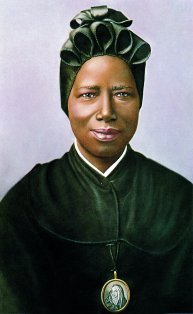
Saint Josephine Bakhita at a Glance
- Birth Name
- Unknown; her own birth name was lost to childhood trauma
- Born
- c. 1869, Olgossa, Darfur, Sudan
- Died
- February 8, 1947, Schio, Veneto, Italy
- Venerated In
- The Roman Catholic Church and the Anglican Communion
- Declared Venerable
- December 1, 1978, by Pope John Paul II
- Beatified
- May 17, 1992, by Pope John Paul II, alongside Saint Josemaria Escriva
- Canonized
- October 1, 2000, by Pope John Paul II
- Feast Day
- February 8; since 2015, also the International Day of Prayer and Awareness Against Human Trafficking
- Title
- Virgin; Canossian Religious Sister
- Patronage
- Sudan and South Sudan; victims and survivors of human trafficking and slavery
- Religious Name
- Josephine Margaret Fortunata (Fortunata being the Latin translation of "Bakhita")
- Relics
- Church of the Holy Family, Canossian Institute, Schio, Italy
- I. A Prosperous Childhood Among the Daju People
- II. Kidnapped Around 1877
- III. Losing Her Own Name, Receiving the Name "Bakhita"
- IV. A Six-Hundred-Mile Forced March to El Obeid
- V. Sold and Resold Across Sudan
- VI. The Turkish General's Household and 114 Cuts
- VII. Callisto Legnani: The First Kind Master
- VIII. The Journey to Italy and the Michieli Family
- IX. Left in the Care of the Canossian Sisters, Venice
- X. The 1889 Court Case That Declared Her Free
- XI. Baptism by the Future Pope Pius X
- XII. Entering Religious Life
- XIII. Fifty Years at Schio: Cook, Sacristan, Portress
- XIV. World War II and "the Protector of Schio"
- XV. Final Illness and Death, February 8, 1947
- XVI. Her Relics: From a Family Tomb to the Church of the Holy Family
- XVII. Canonization: 1978, 1992, and 2000
- XVIII. Miracles Attributed to Her Intercession
- XIX. Her Companions: Connections to Other Saints
- XX. Her Memoir: "Storia Meravigliosa" and Ida Zanolini
- XXI. The Shrine at Schio, With a Link
- XXII. Legacy: Patroness Against Modern Slavery
- Prayer for the Intercession of Saint Josephine Bakhita
- Frequently Asked Questions
A Prosperous Childhood Among the Daju People
The woman the world would come to know as Josephine Bakhita was born around the year 1869 in the small village of Olgossa, in the Darfur region of what is today western Sudan, a region that takes its name from her own people, the Daju. Her family was neither poor nor obscure by local standards. Her uncle held the position of village chief, and by her own later account, recorded decades afterward, she grew up surrounded by warmth, security, and relative material comfort, later saying that as a young child she did not know what suffering was. Some accounts of her life describe her as having had a twin sister, taken from her at the same violent moment that ended her own childhood, a detail that, if accurate, makes the trauma of what followed even more difficult to fully reckon with.
Part II
Kidnapped Around 1877
Sometime around February 1877, when she was approximately seven or eight years old, Bakhita was seized by Arab slave traders, most likely while walking near her family's fields, one of the countless children abducted during this period to feed the still-active trans-Saharan and Red Sea slave trades that continued to operate across Sudan and the wider region despite mounting international pressure against the practice. The abduction shattered not only her freedom but, by her own later testimony, her very sense of self: the shock and terror of that moment was severe enough that she permanently lost the ability to recall her own birth name and much of the detail of her earliest years, a specific and devastating symptom of trauma that she carried, unable to fully repair, for the rest of her life.
Part III
Losing Her Own Name, Receiving the Name "Bakhita"
Unable, in the aftermath of her abduction, to tell her captors what she had originally been called, the young girl was given a new name by the very people who had stolen her: Bakhita, an Arabic name meaning "fortunate" or "lucky." The irony of this name, imposed on a child in the immediate aftermath of the single most catastrophic event of her life, would only fully resolve itself decades later, when Bakhita herself came to understand her eventual path to freedom and faith as a form of providence that made the name, however bitterly it had first been given, genuinely true in a way her captors could never have intended.
Part IV
A Six-Hundred-Mile Forced March to El Obeid
Following her capture, Bakhita was forced to walk barefoot across a distance later estimated at some six hundred miles, driven overland toward the slave market at El Obeid, a major trading city in central Sudan. She was bought and sold at least twice during this single brutal journey alone, changing hands among traders before she had even reached her first extended period of captivity in any one household, a detail that captures how thoroughly the human beings caught in this trade were treated as commodities passed along a supply chain rather than as people with any say in their own fate.
Part V
Sold and Resold Across Sudan
Over the course of roughly twelve years following her initial kidnapping, Bakhita passed through the hands of more than a dozen different owners across Sudan, sold, resold, and given away as a gift in a pattern that continued with grim regularity throughout her childhood and adolescence. She served in a succession of households under varying conditions, eventually arriving, through this chain of transactions, in Khartoum, the Sudanese capital, where the final and most brutal chapter of her enslavement, and the one that would leave permanent physical marks on her body, took place.
Part VI
The Turkish General's Household and 114 Cuts
Bakhita's most severe suffering occurred in the household of a Turkish general, where she served the general's mother and wife and was, by her own later account, flogged nearly every single day until she bled. The most severe single episode of this period was a ritual scarification: a woman engaged for the purpose used a razor to cut patterns into Bakhita's skin, across her breasts, stomach, and right arm, cuts that were then packed with salt specifically to ensure they would leave permanent, raised scars once healed, a practice inflicted on her as both punishment and a form of decoration considered fashionable by her captors, entirely without regard for what it cost the child forced to endure it. Accounts of the exact number of these wounds vary somewhat between sources, with figures most commonly cited at either 114 or, in some accounts, as many as 144 separate cuts; this article notes the discrepancy honestly rather than asserting a single precise figure the historical record does not settle definitively. What is not in dispute is that Bakhita carried these scars, visible for the rest of her life, as the permanent physical record of this period of her captivity.
This site does not sensationalize suffering for its own sake, but Bakhita's own adult testimony, given freely and repeatedly across the second half of her life, treated this period of her story as essential rather than something to hide, precisely because her later forgiveness of her tormentors only carries its full weight when the scale of what she forgave is stated honestly. This article follows her own example in that respect.
Part VII
Callisto Legnani: The First Kind Master
In 1883, the Turkish general sold Bakhita to Callisto Legnani, the Italian vice consul stationed in Khartoum, and the change in her circumstances was immediate and profound. Legnani did not beat her, a fact so far outside her prior experience of enslavement that it marked, in her own later telling, the first real turning point in her long ordeal. When political instability in Sudan, driven by the rising Mahdist uprising, forced Legnani to prepare his own return to Italy, Bakhita pleaded to be brought along rather than left behind or transferred to yet another owner, and Legnani agreed.
Part VIII
The Journey to Italy and the Michieli Family
Bakhita's journey out of Sudan carried her across the Red Sea and the Mediterranean, a long and genuinely dangerous passage given the political turmoil then engulfing the region, before she and Legnani finally reached Italy. Once there, Legnani gave Bakhita as a gift to friends of his, Augusto and Maria Turina Michieli, a family with their own ongoing business interests back in Sudan. Bakhita was taken into the Michieli household in Italy and given responsibility as nanny to the couple's young daughter, known affectionately as Mimmina, a role that placed her, for the first time in more than a decade, in a household where physical brutality was not a daily reality.
Part IX
Left in the Care of the Canossian Sisters, Venice
When the Michielis' business affairs required them to travel back to Sudan, specifically to the port town of Suakin, they made arrangements to leave both Mimmina and Bakhita in the temporary care of the Canossian Sisters at their Institute of the Catechumens in Venice, an arrangement made purely for practical convenience rather than any deliberate spiritual purpose. It was here, in the ordinary rhythm of convent life she was only meant to pass through briefly, that Bakhita first encountered sustained Christian teaching and practice. She later described recognizing in the God she was being introduced to a presence she felt, in some inarticulate way, she had always carried within her heart even during the darkest years of her enslavement, though she had never before had a name or a framework for that intuition.
Part X
The 1889 Court Case That Declared Her Free
When the Michielis returned from Sudan and prepared to resume their household in Italy, they expected Bakhita to rejoin them and, eventually, to return with the family to Sudan as well. Bakhita, having spent months immersed in the life and teaching of the Canossian community, refused. The standoff that followed escalated into a formal legal dispute, with the Canossian Sisters and the Patriarch of Venice intervening directly on Bakhita's behalf to press her case before Italian civil authorities.
The case was decided in November 1889, and the ruling was unambiguous: an Italian court determined that, because slavery held no legal standing under Italian law, and because Sudan itself had, at least on paper, already outlawed slavery before Bakhita's own birth, she had in fact been a legally free woman since at least 1885, whether or not anyone, including Bakhita herself, had recognized that legal reality at the time. The court's decision meant she could not be compelled to return to the Michielis or to Sudan against her own will. It stands today as one of the more historically significant individual court rulings in the long, uneven history of Italy's formal relationship with the international abolition of slavery.
Part XI
Baptism by the Future Pope Pius X
Freed by law and free, for the first time since her childhood, to choose her own path, Bakhita chose to remain with the Canossian Sisters and to formally enter the Catholic Church. On January 9, 1890, at around twenty-one years old, she received Baptism, Confirmation, and her First Holy Communion in a single ceremony, following the ancient pattern of Christian initiation. She took the baptismal name Josephine Margaret Fortunata, with Fortunata serving as the direct Latin translation of her given Arabic name, Bakhita, a deliberate choice that let her carry the meaning of her original imposed name forward into a life she had genuinely chosen for herself.
The bishop who personally administered these sacraments to her was Giuseppe Sarto, Cardinal Patriarch of Venice, who would, thirteen years later, be elected Pope and take the name Pius X, later himself canonized a saint of the Catholic Church, making Bakhita's own baptism a documented point of direct personal contact between two individuals who would each, independently, eventually be declared saints by Rome.
Part XII
Entering Religious Life
Bakhita entered the novitiate of the Institute of Saint Magdalene of Canossa, the formal name of the Canossian order, on December 7, 1893, formally beginning the process of religious formation with the very community that had sheltered and taught her. She made her final, permanent religious profession on December 8, 1896, the Feast of the Immaculate Conception, fully and freely binding herself for life to the community that had received her as a frightened, traumatized young woman not many years earlier and had, in the intervening period, become the closest thing to a stable family she had known since her childhood abduction.
Part XIII
Fifty Years at Schio: Cook, Sacristan, Portress
In 1902, Bakhita was transferred to the Canossian convent at Schio, a small town near Vicenza in northeastern Italy, and it was here that she would remain, essentially without interruption, for the rest of her earthly life, a period of roughly forty-five years. Her duties within the community were entirely ordinary and largely domestic: she cooked, sewed, embroidered, kept the sacristy, and, above all, spent long hours serving as portress, the sister responsible for answering the convent door and greeting all who came seeking the community, whether visiting families, local schoolchildren, or the poor coming to ask for help.
It was in this humble, repetitive daily work that Bakhita became genuinely beloved by the wider town, not primarily through any dramatic public ministry but through the simple, consistent gentleness with which she treated everyone who crossed her path. The children of Schio in particular grew fond of her; her warm, welcoming voice at the convent door became a familiar and comforting presence across the town, and local residents affectionately began calling her Madre Moretta, "the Black Mother" or "our little brown mother," a nickname that, unlike the crueler labels imposed on her during her years of enslavement, was offered and received as a genuine mark of communal love.
Around 1910, at the request of her fellow sisters, Bakhita agreed to have her life story formally recorded and transcribed for the first time, an interview process that would eventually produce the fullest written record of her own testimony available to later generations.
Part XIV
World War II and "the Protector of Schio"
Beginning in 1935, Bakhita was sent, together with another sister, on a series of missionary journeys around Italy, sharing her own testimony and helping to prepare younger Canossian sisters for the community's missionary work in Africa, a striking irony given that Bakhita herself, despite her own African origins, never returned to Sudan in her lifetime. During the Second World War, as fighting spread across Italy, the sisters at Schio cared for wounded soldiers, and Bakhita in particular urged the young men who came through the convent to make use of confession and to turn away from sin, treating the war's suffering as an occasion for spiritual as well as physical care.
Local tradition in Schio holds that, despite the town coming under aerial bombardment during the war, not a single resident of Schio was killed, a fact many townspeople came to attribute directly to Bakhita's presence and prayers, leading them to regard her, even in her own lifetime, as a kind of protector of the town. This article presents this as the sincerely held local tradition it is, while noting that, as with similar wartime protection stories attached to other beloved local religious figures, it rests on community memory rather than a formally documented causal claim.
Part XV
Final Illness and Death, February 8, 1947
In her later years, Bakhita suffered a serious fall and endured chronic, painful illness that eventually confined her to a wheelchair, a physical decline she bore, by every account, with the same steady cheerfulness that had marked the whole of her religious life. When visitors or fellow sisters asked how she was feeling, her habitual reply became one of the most quoted lines associated with her: "As the master desires," a phrase whose deliberate echo of the language of slavery, now voluntarily and joyfully offered to Christ rather than extracted by force from a human captor, captured in a single sentence the entire arc of her transformed life.
In her final days, those caring for her noticed her mind returning, involuntarily, to the traumas of her childhood captivity, reliving fragments of that suffering even as her body approached its natural end. She died on the evening of February 8, 1947, at the Canossian convent in Schio, surrounded by the sisters of her community. Her recorded final words were an invocation of the Virgin Mary: "Our Lady, Our Lady!" Her body was placed on public display for three days afterward, and crowds gathered from across the town and the surrounding region for one final look at the woman they had known simply as their Madre Moretta.
Part XVI
Her Relics: From a Family Tomb to the Church of the Holy Family
Bakhita was initially buried in the family tomb of the Gasparellas, a local Schio family, an arrangement made in anticipation of a later, more permanent translation of her remains. That translation took place in 1969, when her body was moved into the Church of the Holy Family, the temple of the Canossian Institute in Schio, the very community she had served for nearly half a century. Following her 1992 beatification and 2000 canonization, the church itself underwent careful restoration, and her relics were placed, as they remain today, within a bronze and glass urn positioned in the church's presbytery, accessible to the steady stream of pilgrims who continue to visit.
Part XVII
Canonization: 1978, 1992, and 2000
The formal process toward Bakhita's canonization began remarkably soon after her death, opened in 1958 or 1959 under Pope John XXIII, just over a decade after she had died, a comparatively rapid start for a canonization cause. On December 1, 1978, Pope John Paul II signed the decree recognizing her heroic virtue, formally declaring her Venerable. She was beatified on May 17, 1992, in a ceremony at Saint Peter's Basilica, notably held on the very same day as the beatification of Josemaria Escriva, the founder of Opus Dei, linking the two causes together in the same historic liturgy. The news of her beatification was reportedly censored within Sudan itself at the time, a suppression that was directly and publicly reversed less than a year later when Pope John Paul II traveled to Sudan and personally honored her memory before the Sudanese people.
Bakhita was formally canonized a saint of the Catholic Church on October 1, 2000, again at Saint Peter's Basilica, by Pope John Paul II, in a ceremony that also included the canonization of a group of Chinese martyrs, the American saint Katharine Drexel, and the Spanish religious Maria Josefa of the Heart of Jesus. Her canonization made her, by wide consensus, the first Black African woman canonized a saint of the modern Catholic Church, a historic milestone Pope John Paul II himself explicitly noted in his own homily that day, connecting her personal story directly to the continuing exploitation and victimization of women in the contemporary world.
Part XVIII
Miracles Attributed to Her Intercession
Within just three years of Bakhita's death, the Canossian order's own internal bulletin had already published several pages listing individuals who reported having received graces through her intercession, an unusually swift accumulation of popular devotional testimony for a religious sister who had held no public office and performed no dramatic public ministry during her lifetime. This steady stream of reported favors continued across the following decades and fed directly into the formal canonization process.
The specific miracle formally accepted by the Church for her 2000 canonization concerned a Brazilian woman suffering from diabetes, who had developed serious, infected wounds on her legs severe enough to place her at real risk of amputation. After the woman began praying specifically for Bakhita's intercession at the cathedral in Santos, Brazil, her wounds reportedly began to heal and eventually disappeared entirely, a recovery Church investigators later judged, after formal medical review, to be complete, lasting, and medically inexplicable, meeting the standard required for a miracle recognized toward canonization.
Part XIX
Her Companions: Connections to Other Saints
Bakhita's life intersects directly, and in some cases quite unusually, with several other canonized saints:
Pope Saint Pius X
As Cardinal Giuseppe Sarto, Patriarch of Venice, he personally baptized, confirmed, and gave First Communion to Bakhita on January 9, 1890, more than a decade before his own election as Pope in 1903. He was himself canonized in 1954, meaning the sacrament that formally began Bakhita's own life in the Church was administered by a man later declared a saint in his own right.
Saint Josemaria Escriva
The founder of Opus Dei, beatified in the same May 17, 1992 ceremony as Bakhita, a shared date that has since linked the memory of the two causes in the devotional literature of both communities.
Saint Katharine Drexel
The American heiress and foundress canonized alongside Bakhita on October 1, 2000, another saint whose life's work centered specifically on the education and dignity of Black and Native American communities in the United States, a thematic resonance with Bakhita's own canonization that Pope John Paul II noted in his homily that day.
Part XX
Her Memoir: "Storia Meravigliosa" and Ida Zanolini
Bakhita herself never learned to write her own account in the conventional literary sense; the fullest record of her own testimony instead comes down through dictation, given to a Canossian sister, Ida Zanolini, who interviewed her at length and compiled the material into a narrative published in 1930 under the Italian title Storia Meravigliosa, "A Wonderful Story," sometimes rendered in English editions as Bakhita Tells Her Story. This dictated memoir, drawing on the interview process first undertaken around 1910, remains the single most important primary source for virtually everything known about Bakhita's early life in Sudan, since almost no other independent documentation of her childhood, her captivity, or her earliest years in Italy survives.
Among the sayings preserved through this same testimony and through the recollections of those who knew her at Schio, one of the most frequently quoted captures the whole of her spiritual teaching in a single, simple sentence: "Be good, love the Lord, pray for those who do not know Him." When later asked directly what she would do if she ever encountered any of the people who had kidnapped or tortured her, she is recorded as answering that she would kneel and kiss their hands, since without what they had done to her, she would never have become a Christian.
Part XXI
The Shrine at Schio, With a Link
One site anchors ongoing devotion to Bakhita above all others:
Church of the Holy Family, Canossian Institute, Schio, Italy
Construction of this church began in 1850 and was completed in 1901, decades before it became closely associated with Bakhita's own memory. Her relics have rested here since 1969, restored and prepared to receive pilgrims around the time of her 1992 beatification and 2000 canonization, and the site remains an active parish and shrine roughly midway between Verona and Vicenza. visitschio.it
Part XXII
Legacy: Patroness Against Modern Slavery
Bakhita's legacy has, in the twenty-first century, taken on a specific and urgent contemporary weight that few saints canonized in the year 2000 could have anticipated at the time. In his 2007 encyclical Spe Salvi, on the theological virtue of hope, Pope Benedict XVI singled out Bakhita by name as a modern example of what a genuine, life-transforming encounter with God can accomplish, tracing her hope and capacity for forgiveness directly to her trust that she would ultimately be received by the same love that had made her. In 2015, in recognition of her own history as a survivor of slavery, Pope Francis and the wider Church formally designated her feast day, February 8, as the International Day of Prayer and Awareness Against Human Trafficking, a global observance now marked annually by Catholic dioceses, religious congregations, and anti-trafficking organizations around the world.
That designation gives Bakhita's canonization a significance extending well beyond conventional hagiography: she is not simply remembered as a saint who happened, incidentally, to have once been enslaved, but is actively invoked today as a specific patroness for the millions of people still trapped in modern forms of trafficking and forced labor across the globe, a living devotional connection between a nineteenth-century Sudanese child and the ongoing, unfinished work of ending slavery in the present day.
Holy Trinity, Father, Son, and Holy Spirit, to You be glory, honor, and blessing, for having given to Your holy Church Saint Josephine Bakhita, virgin, as a model of forgiveness beyond measure and unshakeable trust in Your providence through the darkest suffering.
We ask You humbly: just as You transformed her chains into freedom and her wounds into a witness of hope, be pleased to grant us, through her intercession, freedom for all who remain enslaved or trafficked today, a forgiving heart toward those who have wronged us, and the grace we now ask with confidence.
Through Christ our Lord. Amen.
An original English-language devotional prayer composed for use with the Saint Josephine Bakhita prayer card, drawing on the traditional themes of her veneration in the Catholic Church.
More From Our Store, In Honor of the Desert and African Saints

FAQ
Frequently Asked Questions About Saint Josephine Bakhita
She Carried More Than a Hundred Scars, and Chose to Kneel and Kiss the Hands That Made Them.
Saint Josephine Bakhita spent the first half of her life as property, passed hand to hand across a continent, her own name lost to the terror of the day she was stolen from her family. She spent the second half of her life as a free woman who chose, entirely on her own, to give herself permanently to God and to a convent door in a small Italian town, greeting every visitor, every child, every stranger who knocked, with the same gentle warmth that had been so completely denied to her for twelve brutal years. She said forgiveness was not just possible but obvious, because without the suffering, she would never have found the faith that carried her the rest of the way.
Ask her intercession. Say her prayer. Remember a woman once sold as property who is now invoked, by name, on behalf of every person still trapped in slavery today.
Get the Saint Josephine Bakhita Prayer Card →