Saint Silouan the Athonite: The Peasant Who Saw Christ, Lost Him, and Spent Fifteen Years Learning How to Pray for the Whole World
Saint Silouan the Athonite: The Peasant Who Saw Christ, Lost Him, and Spent Fifteen Years Learning How to Pray for the Whole World
A Russian farm boy who nearly killed a man in a village brawl became, on a remote peninsula in Greece, one of the most quietly influential spiritual teachers of the modern era. He spent decades doing manual labor at a monastery mill, told almost no one about the vision that had changed his life, and left behind a single sentence that has shaped Orthodox spirituality ever since: keep your mind in hell, and despair not.
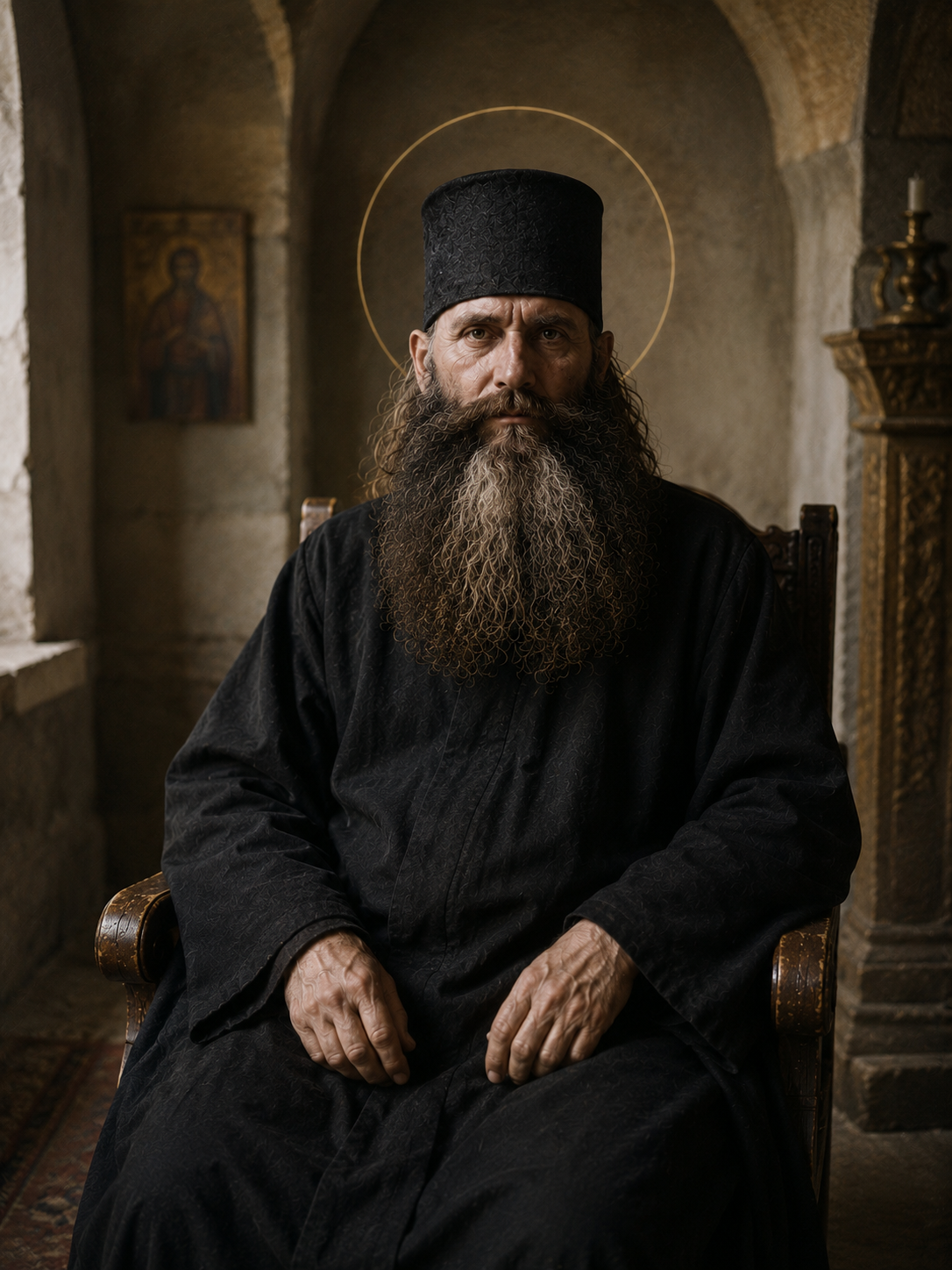
Saint Silouan the Athonite at a Glance
- Birth Name
- Simeon Ivanovich Antonov
- Born
- 1866, village of Shovskoye, Tambov Province, Russia
- Died
- September 24, 1938, Saint Panteleimon Monastery, Mount Athos, Greece
- Venerated In
- The Eastern Orthodox Church
- Glorified
- 1987, by the Ecumenical Patriarchate of Constantinople
- Feast Day
- September 24 (Old Style; October 7 New Style, though commonly kept September 24)
- Title
- Venerable; the Athonite; Elder (Starets)
- Monastery
- Saint Panteleimon Monastery ("Old Rossikon"), Mount Athos
- Known For
- His vision of Christ, his teaching "keep thy mind in hell, and despair not," and his emphasis on prayer for the whole world and love of enemies as the fruit of the Holy Spirit
- Disciple and Biographer
- Saint Sophrony of Essex, himself later canonized
- Relics
- Saint Panteleimon Monastery, Mount Athos
- I. A Peasant Boyhood in Tambov Province
- II. His Father Ivan: A Model of Quiet Wisdom
- III. A Strong, Willful Young Man
- IV. A Warning in a Dream
- V. Military Service and a Father's Counsel
- VI. Arrival at Saint Panteleimon Monastery, 1892
- VII. A Novice's Struggle Against His Own Thoughts
- VIII. The Vision of Christ in the Church of the Prophet Elijah
- IX. Fifteen Years in the Darkness
- X. "Keep Thy Mind in Hell, and Despair Not"
- XI. Tonsure and the Name Silouan
- XII. Decades of Hidden Manual Labor
- XIII. His Central Teaching: Prayer for the Whole World
- XIV. Love of Enemies as the Truest Sign of Grace
- XV. Meeting the Young Sergei Sakharov
- XVI. Death, September 24, 1938
- XVII. His Relics at Saint Panteleimon Monastery
- XVIII. His Writings and Sophrony's "Saint Silouan the Athonite"
- XIX. Glorification, 1987
- XX. His Companions: Connections to Other Saints
- XXI. Legacy: The Peasant Theologian of the Twentieth Century
- XXII. Saint Panteleimon Monastery and the Essex Monastery, With Links
- Prayer for the Intercession of Saint Silouan the Athonite
- Frequently Asked Questions
A Peasant Boyhood in Tambov Province
Simeon Ivanovich Antonov, the man who would one day be known throughout the Orthodox world as Saint Silouan, was born in 1866 in the village of Shovskoye, in Tambov Province in central Russia, to a peasant farming family of modest means but genuine, unpretentious piety. He grew up in the ordinary rhythms of Russian rural life in the decades following the emancipation of the serfs, physically strong and capable from a young age, the kind of young man neighbors would have expected to spend his life working the family's land rather than becoming one of the most quietly influential spiritual figures of the coming century.
Part II
His Father Ivan: A Model of Quiet Wisdom
Throughout his later life, Silouan spoke often and warmly of his father, Ivan Antonov, describing him as a man of remarkable inner peace, humility, and practical wisdom despite having no formal education or worldly standing beyond that of an ordinary peasant farmer. Silouan recalled specific small episodes of his father's patience and self-restraint from his own boyhood, moments of quiet forbearance under provocation that Silouan, only fully understanding their significance many years later as a monk, came to regard as a more authentic form of holiness than anything found in books. His father's example remained one of the touchstones Silouan returned to across his entire monastic life, a living demonstration that genuine sanctity required neither education nor social position, only an honest and humble heart.
Part III
A Strong, Willful Young Man
As a young man, Simeon was known for exceptional physical strength, and, like many young peasant men of his era and setting, was not above the ordinary vices of village social life, including drinking and occasional fighting. The most serious of these episodes occurred during a village disturbance, when Simeon, provoked in the midst of a brawl, struck another man with such force that the man was gravely injured and very nearly died as a result. Though the man eventually recovered, the episode left a lasting impression on Simeon, an early and unwelcome glimpse of the violence his own strength and temper were capable of, one that later biographers and Simeon himself would point to as an early, if still unrecognized, turning point in his spiritual formation.
Part IV
A Warning in a Dream
According to the tradition surrounding his early life, it was around this same period that Simeon experienced a disturbing dream in which he sensed something evil entering into him, an experience he came to interpret afterward as a direct spiritual warning tied to the direction his youthful behavior was taking him. The unsettling force of this experience, arriving as it did not long after the near-fatal fight, stirred in him the first real movements of conscience and repentance, a growing unease with the life he had been living that would, in time, redirect the whole course of his future.
Part V
Military Service and a Father's Counsel
Even as Simeon's thoughts turned increasingly toward monastic life, his father counseled patience rather than haste, advising him to complete his obligatory military service before making any permanent decision about entering a monastery, practical wisdom consistent with the same quiet good sense Silouan remembered admiring in him throughout his childhood. Simeon served in a sapper, or military engineering, battalion, fulfilling this period of service before finally turning toward the religious life he had increasingly felt drawn to. Before his departure for Mount Athos, at around twenty-six years old, he sought and received the prayers and blessing of Father John of Kronstadt, already renowned throughout Russia as a wonderworking priest and later himself canonized a saint, a detail that connects the beginning of Silouan's own monastic journey directly to one of the most celebrated spiritual figures of late Imperial Russia.
Part VI
Arrival at Saint Panteleimon Monastery, 1892
Simeon arrived on the Holy Mountain of Athos in 1892 and was accepted as a novice at Saint Panteleimon Monastery, the great Russian house on the peninsula, popularly known among Russian monastics as "Old Rossikon." At the time of his arrival, the monastery was at the height of its size and influence, housing a community of roughly two thousand monks drawn overwhelmingly from Russia, one of the largest concentrations of Orthodox monastic life anywhere in the world at that moment in history.
Part VII
A Novice's Struggle Against His Own Thoughts
As a new novice, Simeon found himself entirely unprepared for the specific kind of struggle monastic life demanded: not physical labor, which came easily to a man of his strength and background, but the far less familiar discipline of contending against his own intrusive and often violent thoughts. He was taught to counter these thoughts using the Jesus Prayer, the short, repeated invocation of Christ's name that forms the heart of Orthodox hesychast spirituality, and within a remarkably short span of time after beginning this practice in earnest, he received what his own tradition describes as the gift of the Prayer entering into his very heart, continuing there of its own accord even without conscious effort, an experience of grace that arrived far more quickly and completely than is typical even among devoted lifelong ascetics.
Part VIII
The Vision of Christ in the Church of the Prophet Elijah
The grace of this newfound inner prayer was almost immediately followed by an onslaught of fresh temptation and inner turmoil so intense that the young novice was driven to genuine despair. At the height of this crisis, standing before an icon of Christ in the small church of the Prophet Elijah adjoining the monastery's mill, Simeon cried out in simple, desperate prayer, asking for mercy as a sinner. In response, he was granted an extraordinary vision: he beheld the living Christ standing before him, and recognized him instantly and unmistakably, by the direct operation of the grace of the Holy Spirit, as the true and gentle Lord, an experience of such overwhelming peace, love, and light that it reoriented the entire remainder of his life around the memory of what he had seen.
Part IX
Fifteen Years in the Darkness
The vision Simeon received did not remain with him in its original intensity. Over time, the sense of Christ's living presence gradually withdrew, and in its place came a long, grinding period of spiritual darkness that would last, by the traditional reckoning, some fifteen years. During this extended trial, he was afflicted by profound grief, persistent temptation, and an acute, almost unbearable awareness of his own unworthiness compared to the glory he had briefly glimpsed. This period is understood within the Orthodox spiritual tradition not as divine abandonment for its own sake but as a necessary and providential battle against the pride that even a genuine mystical experience can otherwise plant in a soul, a purification allowed by God precisely because the earlier grace had been so extraordinary.
Part X
"Keep Thy Mind in Hell, and Despair Not"
Near the end of this fifteen-year trial, while Simeon was once again engaged in intense, sorrowful prayer, he heard, deep within his own heart, a direct response from the Lord: "Keep thy mind in hell, and despair not." From that moment forward, Simeon adopted this teaching as, in the words later used to describe it, an infallible rule for his entire spiritual life. The instruction did not mean cultivating morbid despair or artificially imagining torment; rather, as his disciple and biographer would later explain at length, it called for a soul to hold, honestly and without flinching, the full weight of its own sinfulness and total dependence on God's mercy, while never once surrendering that honest self-knowledge into the different and far more dangerous sin of hopelessness, since despair itself is, in this tradition's understanding, simply another and more subtle expression of the same pride the whole trial had been sent to dismantle.
Part XI
Tonsure and the Name Silouan
Simeon was tonsured a monk in 1896, receiving the name Silouan, drawn from Silvanus, the companion and fellow missionary of the Apostle Paul named in the New Testament epistles. Unlike many monks of notable spiritual gift, Silouan was never ordained to the priesthood, choosing instead, whether by his own preference, his superiors' decision, or a combination of both, to remain a simple monk for the whole of his monastic life, a status that placed no clerical distinction between himself and the ordinary lay brothers whose daily labor made up the practical life of the monastery.
Part XII
Decades of Hidden Manual Labor
For the great majority of his more than four decades on Mount Athos, Silouan's outward life consisted almost entirely of unremarkable manual labor. He worked for years at the monastery's mill, the very building beside whose small church he had received his vision of Christ, and in later years took on responsibility for overseeing various workshops and outbuildings belonging to the monastery, practical administrative work entirely divorced from anything resembling public spiritual teaching or acclaim. To the vast majority of the two thousand monks living alongside him, and to the pilgrims who passed through Saint Panteleimon Monastery during these decades, Silouan would have appeared to be nothing more than one competent, quiet, unremarkable laborer among many, the outward ordinariness of his life standing in almost total contrast to the depth of the inner spiritual experience that filled it.
Part XIII
His Central Teaching: Prayer for the Whole World
As the years of his hidden labor continued, Silouan's inner prayer life deepened into what became, by the testimony of those who eventually came to know him, the defining characteristic of his entire spirituality: prayer offered not merely for his own soul but continuously, and with genuine anguish, for the salvation of the whole world, every living person without exception, including those who had never known Christ and even those who actively opposed him. He taught that authentic love, once it had matured under the working of the Holy Spirit, could not remain contained within concern for one's own family, nation, or even one's own religious community, but was compelled, by its very nature, to extend outward to embrace the whole of humanity, weeping over the world's suffering and sin as though it were entirely his own.
Part XIV
Love of Enemies as the Truest Sign of Grace
Closely bound up with his teaching on universal prayer was Silouan's insistence that love of one's enemies represents the single clearest, most reliable evidence that a soul has genuinely received the grace of the Holy Spirit, precisely because such love runs entirely against ordinary human instinct and cannot be produced by willpower, natural temperament, or moral effort alone. He taught, in a formulation later Orthodox theologians have quoted extensively, that a soul that has not itself known the Holy Spirit simply cannot understand how it is even possible to love one's enemies, and will not accept the idea as realistic, no matter how sincerely such love is described to it. For Silouan, this was not an abstract theological point but the lived center of his own decades of prayer, since the very people he prayed for with the greatest anguish included those who might be counted, by any ordinary reckoning, among his own or his country's adversaries.
Part XV
Meeting the Young Sergei Sakharov
In 1925, a young Russian painter and intellectual named Sergei Sakharov, who had left a promising career in the arts in Paris to pursue monastic life, entered Saint Panteleimon Monastery, was tonsured the following year, and gradually became acquainted with the older monk Silouan. From his very earliest days at the monastery, the future Sophrony noticed Silouan in passing and felt drawn to him with what he later described as a spontaneous, unaccountable reverence, remarking specifically on how Silouan's face seemed, at certain moments, to shine with an indescribable inner light and beauty.
The two men did not actually speak at length until April 30, 1930, the day Sophrony was ordained a deacon by Bishop Nicolai Velimirovic of Zica, later himself canonized a saint by the Serbian Orthodox Church. Silouan was present at this ordination, and soon after the ceremony, Sophrony himself received a fresh visitation of the same uncreated light that had marked his earlier attraction to the older monk, an experience that lasted, by his own account, roughly two weeks and that deepened the bond between the two men into the defining spiritual relationship of Sophrony's entire life. From this point forward, Sophrony came to know Christ not merely as a matter of doctrinal belief but, through Silouan's direct example and guidance, as a living, personally encountered reality, a transformation Sophrony would spend the rest of his own long life trying to articulate and pass on to others.
Part XVI
Death, September 24, 1938
Silouan died at Saint Panteleimon Monastery on September 24, 1938, having spent almost forty-six years on Mount Athos since his arrival as a young novice in 1892, the overwhelming majority of that time in the same kind of quiet, unremarkable manual labor and hidden prayer that had characterized his entire monastic life. His death drew little outside attention at the time; he was, to nearly everyone beyond his small circle of closer acquaintances, simply one more monk of Old Rossikon who had died at seventy-two years old after a long life of ordinary service, the true scale of his inner spiritual stature almost entirely unknown to the wider Christian world.
Part XVII
His Relics at Saint Panteleimon Monastery
Following the long-established custom of Mount Athos, by which a deceased monk's body is buried directly in the earth without a coffin and exhumed some years later, with the bones then transferred to the monastery's ossuary if found to be appropriately whitened, Silouan's remains were treated in this same traditional manner at Saint Panteleimon Monastery. His skull is preserved and venerated today within the monastery's ossuary, a practice that, to readers unfamiliar with Athonite monastic custom, may seem unusual, but which represents a centuries-old, continuously practiced tradition across the whole of the Holy Mountain rather than any departure made specifically for Silouan's case.
Part XVIII
His Writings and Sophrony's "Saint Silouan the Athonite"
Silouan himself left behind a modest body of personal writing, chiefly notebooks and short spiritual reflections composed across his later years, written in the plain, unpolished language of a man with only a peasant's formal education rather than the trained prose of a professional theologian, a simplicity his later readers have often noted as part of what gives his words their distinctive, unmediated force. After Silouan's death, it was his spiritual son Sophrony who gathered, arranged, and prepared this material for publication, combining it with his own extended biographical and theological commentary into a single work.
Sophrony produced a first, self-published Russian edition of this material in 1948, working from Paris in the aftermath of the hardships of the Second World War, and followed it with a substantially revised and expanded second edition in 1952 under the title Saint Silouan the Athonite, sometimes published in English under the alternate title The Monk of Mount Athos. It was this book, translated into numerous languages over the following decades, that introduced Silouan's teaching to a worldwide Orthodox and non-Orthodox readership alike, and remains, to this day, both the essential biographical source for his life and the primary vehicle through which his own spiritual writings have reached the wider world. Readers seeking Silouan's own words in full are directed to Sophrony's published work itself, since this article, in keeping with ordinary copyright practice, paraphrases rather than reproduces its contents at length.
Part XIX
Glorification, 1987
Saint Silouan was formally glorified by the Ecumenical Patriarchate of Constantinople in 1987, just under half a century after his death, a recognition made possible in large part by the widespread influence Sophrony's published biography and compilation of his writings had already achieved across the Orthodox world in the decades following its first publication. His feast is kept on September 24, the anniversary of his repose, according to the Church calendar.
Part XX
His Companions: Connections to Other Saints
Silouan's life connects directly to several other figures separately venerated as saints:
Saint Sophrony of Essex
His closest disciple, biographer, and the compiler of his writings, who left Mount Athos after Silouan's death, eventually founded the Monastery of Saint John the Baptist at Tolleshunt Knights in Essex, England, in 1958 or 1959, and was himself glorified a saint by the Ecumenical Patriarchate on November 27, 2019, making Silouan and Sophrony a rare modern example of an elder and his own spiritual son both formally recognized as saints of the same Church.
Saint John of Kronstadt
The celebrated wonderworking priest of late Imperial Russia whose blessing and prayers the young Simeon sought before departing for Mount Athos, connecting Silouan's own monastic beginnings to one of the most revered spiritual figures of his home country.
Saint Nikolai Velimirovic of Zica
The Serbian bishop who personally ordained Sophrony a deacon in 1930, an ordination Silouan himself attended and that marked the beginning of the two men's closest period of direct spiritual conversation, and who was himself later canonized by the Serbian Orthodox Church.
Part XXI
Legacy: The Peasant Theologian of the Twentieth Century
Silouan's legacy rests on a striking paradox: a man with almost no formal education, who spent the overwhelming majority of his adult life doing anonymous manual labor at a monastery mill and workshops, has come to be regarded as one of the most theologically significant spiritual voices of the entire twentieth century, Orthodox or otherwise. The Trappist monk and writer Thomas Merton, one of the most influential Catholic spiritual authors of the same century, described Silouan as the most authentic monk of the twentieth century, a striking assessment from outside the Orthodox tradition itself that speaks to how far Silouan's influence has traveled well beyond the Russian monastery where he spent his whole hidden life.
What makes his witness distinctive, even among the long history of Christian hesychast spirituality, is the specific combination he modeled: an interior life marked by direct mystical experience of Christ, joined to an almost complete absence of any external religious authority, office, or public reputation during his own lifetime, and crowned by a teaching, prayer for the whole world and love of enemies, that reoriented Orthodox spiritual theology away from purely individual salvation and toward a vision of holiness inseparable from love for every other human being, including those a person might otherwise be most tempted to hate.
Part XXII
Saint Panteleimon Monastery and the Essex Monastery, With Links
Two monasteries stand as the primary living connections to Silouan's memory today:
Saint Panteleimon Monastery, Mount Athos, Greece
The great Russian monastery where Silouan lived, prayed, and labored for nearly forty-six years, and where his relics remain venerated in the monastery's ossuary according to Athonite custom. As with all twenty ruling monasteries of the Holy Mountain, access is restricted to men who obtain advance permission through the Mount Athos pilgrims' office.
Patriarchal Stavropegic Monastery of Saint John the Baptist, Tolleshunt Knights, Essex, England
Founded by Silouan's own disciple, Saint Sophrony, this mixed community of monks and nuns, the oldest continuously functioning Orthodox monastic community in England, remains the principal center in the West for the study and dissemination of Silouan's teaching, and maintains the publishing rights to Sophrony's own foundational biography of his elder. essexmonastery.com
Holy Trinity, Father, Son, and Holy Spirit, to You be glory, honor, and blessing, for having given to Your holy Church Saint Silouan the Athonite, as a model of humility without despair and love that reaches even to one's enemies.
We ask You humbly: just as You revealed Yourself to him in a moment of desperate prayer and taught him to hold both honest humility and unwavering hope together in his heart, be pleased to grant us, through his intercession, freedom from despair, a heart capable of praying for those who wrong us, and the grace we now ask with confidence.
Through Christ our Lord. Amen.
An original English-language devotional prayer composed for use with the Saint Silouan the Athonite prayer card, drawing on the traditional themes of his veneration in the Orthodox Church.
More From Our Store, In Honor of the Hesychasts of Mount Athos

FAQ
Frequently Asked Questions About Saint Silouan the Athonite
He Saw Christ Once, Lost Him for Fifteen Years, and Spent the Rest of His Life Praying for Everyone Else.
Saint Silouan the Athonite never preached a public sermon, published a book in his own lifetime, or held any office beyond the manager of a monastery mill. What he carried instead, hidden beneath decades of ordinary labor, was a single vision of Christ he never fully got over, fifteen years of darkness that taught him exactly how to hold both his own sinfulness and God's mercy at once, and a love so wide it refused to stop even at the edge of his own enemies. He died almost entirely unknown outside his own monastery. His disciple made sure the world eventually found out who he had been.
Ask his intercession. Say his prayer. Remember a former soldier and farmhand who learned, through fifteen years of honest darkness, exactly how to pray for a world that had never asked him to.
Get the Saint Silouan the Athonite Prayer Card →