Orthodox Saints • Mount Athos • Art and Faith • Sacred Music
Saint Sophrony of Essex: The Painter Who Studied Kandinsky and Advised Arvo Pärt
Before he was an elder on Mount Athos and the founder of a monastery in England, Sergei Sakharov was a young painter in Moscow who had read Kandinsky. Years later a famous composer came to his monastery, and the advice the old monk gave him has been retold ever since.
Saint Sophrony of Essex at a Glance
- Born
- Sergei Symeonovich Sakharov, Moscow, September 1896 (sources give the 22nd or the 23rd)
- Art Training
- Moscow art schools, 1915 to 1917 and 1920 to 1921; influenced by Kandinsky
- Exile
- Left Russia in 1921; Paris from 1922, where he exhibited and sold his work
- Return to Christ
- Easter 1924, Paris
- Mount Athos
- Left Paris in 1925; monk of the Russian monastery of Saint Panteleimon, tonsured 1926
- His Elder
- Saint Silouan the Athonite
- Monastery in England
- Saint John the Baptist, Tolleshunt Knights, Essex, founded 1959
- Died
- July 11, 1993, Essex
- Glorified
- November 27, 2019, by the Ecumenical Patriarchate
- Feast Day
- July 11
A Young Painter in Moscow
Sergei Symeonovich Sakharov was born in Moscow in September 1896 to Orthodox parents. As a boy he prayed every day, and later in life he recalled praying for long stretches without strain. He also described a first experience of divine light in childhood, something he spoke of for the rest of his life. He read widely, and the Russian novelists he lived with as a teenager were Gogol, Turgenev, Tolstoy, Dostoevsky, and Pushkin.
He also drew and painted, and he was good at it. He studied at the Academy of Arts from 1915 to 1917, then at the Moscow School of Painting, Sculpture and Architecture from 1920 to 1921. In between came the revolution, the civil war, and the collapse of the world he had grown up in. Art was not a hobby for him. He used it as a way to reach for something permanent, a kind of beauty that did not fade when everything else was being torn down.
That search is the key to the rest of his life. The man who would later be called Elder Sophrony did not start as a pious monk who turned out to have a hobby. He started as a serious artist who was looking for God through his art, and who slowly found out that painting alone could not answer the question he was asking.
Part II
Kandinsky and the Spiritual in Art
Wassily Kandinsky was born in Moscow in 1866, studied law first, and only turned to painting as an adult. He moved to Munich in 1896 and went on to be credited with some of the first purely abstract paintings. In 1910 he finished a book called Concerning the Spiritual in Art, published in 1911, arguing that art should not simply copy the visible world but should express the inner life of the soul. He called the driving force behind real art "inner necessity."
When the First World War began, Kandinsky was a Russian citizen in Germany and had to leave. He went back to Moscow in 1914 and stayed until 1921. During those years he worked in the new Soviet cultural institutions, helped found the Museum of Artistic Culture, held a university post, and taught at the state art school, Vkhutemas. His spiritual view of art was eventually rejected by more radical colleagues as too individual. In 1921 he left for Germany and the next year began teaching at the Bauhaus.
Those Moscow years overlap exactly with Sophrony's art training. According to the research published by Sophrony's own monastery in Essex, Kandinsky was one of his teachers, and the young Sakharov was deeply affected by Kandinsky's writing on the spiritual in art. A study published by the Essex community notes that the influence showed up more in what Sophrony later wrote than in what he painted.
What That Influence Looked Like
The attraction is easy to understand. Kandinsky told young artists that painting could be a spiritual act, that it could break through ordinary surfaces and reach something deeper. For a talented young Russian already hungry for God and surrounded by a collapsing world, that was an enormous promise.
It also led him somewhere. Around this period Sakharov drifted away from the Orthodoxy of his childhood. He turned toward Eastern mysticism that spoke of an impersonal Absolute, because the personal love taught by Christianity seemed to him limited by comparison. He would spend the next few years finding out how wrong that turned out to be.
It is worth being clear about what the sources do and do not say. Kandinsky did not become a Christian, and Sophrony did not remain a follower of his ideas. The point is narrower and more interesting. One of the great abstract painters of the twentieth century was part of the education of a man who ended up an Orthodox saint, and the saint himself, and his monastery, are open about it.

Part III
Paris, Exhibitions, and Easter 1924
Sakharov left Russia in 1921, partly to keep working as an artist in Western Europe and partly because he was not a Marxist. His ambitions took him through Italy and Germany, and in 1922 he arrived in Paris. His exhibitions there drew the attention of the French press. By any ordinary measure he was succeeding.
It was in Paris, at Easter in 1924, that he had what he described as a powerful experience of the uncreated light, the same kind of light he had known as a child, and it brought him back to Christ. The change was not gradual and intellectual. It was a return, and it cost him his plans. He enrolled among the first students of the new Saint Sergius Orthodox Theological Institute in Paris, hoping to learn more.
Formal theology did not give him what he was looking for. He found academic study unsatisfying and left the Institute, and in 1925 he left Paris for good. He was not going to another city. He was going to Mount Athos, to become a monk.
It helps to remember how much he gave up. He was a gifted young painter with a name in a major European art city. He gave up the career in exchange for a cell on a mountain at the edge of Greece, where no woman may set foot and where monks pray through the night.
Part IV
Mount Athos and Saint Silouan
On the Holy Mountain, Sophrony entered the Russian monastery of Saint Panteleimon and was tonsured in 1926. There he met the man who would shape the rest of his life, the elder Silouan, a simple Russian peasant turned monk who had spent decades in prayer and was almost unknown outside the monastery.
Silouan wrote down his thoughts on scraps of paper in laborious, unformed handwriting. Sophrony became his close disciple and, in the practical sense, his secretary and the keeper of those papers. The brothers of Saint Panteleimon thought of Silouan as a humble, quiet monk. It was Sophrony who understood what he was looking at.
After Silouan's death in 1938, Sophrony put his elder's teaching and his own memories of him together in a book, Saint Silouan the Athonite. It carried Silouan's name far beyond the Holy Mountain, and in 1987 the Ecumenical Patriarchate glorified Silouan as a saint. Many Orthodox readers trace that recognition directly to the book Sophrony wrote.
Sophrony's own path on Athos was not only monastic community life. Following his elder's instruction he lived for a time in the desert of the Holy Mountain, and from October 1943 until March 1947 he lived in the Hermitage of the Holy Trinity, which belongs to the Monastery of Saint Paul. During those years he served as a spiritual father to several Athonite monasteries and to the sketes and cells around them. He had come to the mountain as a painter. He was now being sought out as an elder.
Part V
The Monastery in Essex
Sophrony eventually left Mount Athos for the West. By 1958 a number of people were living near him and seeking the monastic life, and the situation could not continue as it was. A property at Tolleshunt Knights, near Maldon in Essex, was inspected. In early 1959 the Community of Saint John the Baptist was formed there, under Metropolitan Anthony (Bloom) of Sourozh, with six monastics from several nations. In 1965 the monastery moved under the Ecumenical Patriarchate, and it was later made Stavropegic.
It is a double monastery, with both monks and nuns, and it is the oldest Orthodox monastic community in the United Kingdom. English country land, a former rectory, and an old Russian elder from Athos make an odd combination. It worked. Pilgrims came from many countries, and Sophrony served as confessor and spiritual father to monastics and laypeople until his death.
His teaching, gathered in books such as We Shall See Him As He Is, is serious about prayer, repentance, and what the Church calls the uncreated light. It belongs to the same hesychast tradition as the Jesus Prayer, the quiet, repeated prayer of the heart that Athonite monks have practiced for centuries.

Part VI
Why He Went Back to the Brush
When Sophrony became a monk, he largely gave up painting. For decades he put everything into prayer and spiritual fatherhood. In England, in a new monastery with a new community, his art came back, but pointed in a different direction.
The first new building he put up at Essex was an icon workshop. He wrote icons himself, in egg tempera, including a large icon of his own patron saint, Sophronios of Jerusalem. He made murals for the monastery, and drawings and studies for them survive. He also tried out the artistic ability of each new member of the community, and several hidden talents were found that way. Sister Gabriela, who joined in 1983 after studying iconography in Paris at his insistence, went on to learn icon writing from him and helped on his larger works. She has since written books on his art, and the monastery published a catalogue of his drawings and paintings in 2019.
He kept working far into old age. Near the end of his life, when his eyesight and strength were failing, he climbed scaffolding at the age of ninety to touch up a work one last time.
The same man who was once drawn to pure abstraction ended up writing icons in the oldest tradition of the Church. By his own account, it was not a betrayal of the young painter. It was what the young painter had been looking for.
Part VII
Arvo Pärt Comes to Essex
Arvo Pärt was born in Estonia in 1935. He started as an avant-garde composer working in modern techniques, joined the Orthodox Church in 1972, and in the 1970s withdrew from composing for a time to study early music. He came back in 1976 with a completely new sound, which he called tintinnabuli, after the ringing of bells. Works like Fratres, Spiegel im Spiegel, and Tabula Rasa made him one of the most performed living composers in the world.
Before he ever met Sophrony, Pärt had read the writings of Saint Silouan while still living in the Soviet Union. After he left the country he came to know Sophrony in person. According to the Arvo Pärt Centre, they met in 1981 and stayed in contact until Sophrony died in 1993. Pärt spent several months each year in a house near the monastery in Essex and attended the monastery's services every day. The Centre's own account says it was a close relationship, not an occasional visit.
The Advice
The best known story comes from Metropolitan Hilarion Alfeyev, himself a composer and churchman, in a 2011 lecture on music and faith. He explains that while Pärt was still in the Soviet Union, a well-known father-confessor told him to abandon music and become a church watchman. Sophrony, he says, gave the opposite advice.
Hilarion adds that this is exactly what happened. It is a retold conversation, and it comes from Hilarion rather than from a transcript, so it is best read as how the people around Pärt remember it. But it is consistent with everything else documented about the two men. In his old age, Hilarion writes, Sophrony kept an interest in Pärt's work and stayed in touch with him.

Part VIII
The Music Written for Sophrony
Pärt did not just admire the two saints. He wrote music from their words and dedicated several works to Sophrony. According to the Arvo Pärt Centre:
- Nyne k vam (1989), Ode IX from Kanon pokajanen, is dedicated to Archimandrite Sophrony.
- Silouan's Song (1991) is a six-minute piece for string orchestra, subtitled My soul yearns after the Lord, which is the opening sentence of Saint Silouan's writings. It is dedicated to Archimandrite Sophrony and his brethren, was commissioned by Svenska Rikskonserter, and premiered in July 1991 at the Music at Lake Siljan festival in Rättvik, Sweden. A choral version was premiered at the Arvo Pärt Centre in January 2025.
- Für Lennart in memoriam (2006) uses a prayer by Saint Sophrony as one of its texts.
- Adam's Lament (2010) is based on Saint Silouan's prose text of the same name, taken from the book Sophrony compiled, and is dedicated to Sophrony. The story of Adam's grief over his exile and his longing for God is central to both saints' teaching.
Pärt has said that for him the music is a kind of translation of the words it sets. In an interview quoted by The Christian Century he put it this way: “The words write my music.” Two of those words are from a Russian peasant who died in 1938 and a Russian painter turned monk who edited his papers.
Part IX
A Chapel in Estonia
The Arvo Pärt Centre opened to the public on October 17, 2018, in the coastal village of Laulasmaa, about 35 kilometers from Tallinn. It holds the composer's personal archive and library, and it includes a small chapel in one of its courtyards.
On November 27, 2019, the Ecumenical Patriarchate glorified Sophrony as a saint. The Centre announced that the chapel would from then on be called the Chapel of Saint Sophrony of Essex. After about a year of work by the iconographer Deacon Nikita Andrejev, the chapel wall shows Saint Sophrony together with his spiritual father Saint Silouan. The Centre also marks Saint Sophrony's memorial on July 11.
It closes a circle. A young painter who left Russia, a Russian peasant monk whose papers he saved, and a composer who first met him as an exile all end up together on one wall in a small Estonian chapel.
Part X
What Connects Three Very Different Men
It is tempting to draw a straight line from Kandinsky to Sophrony to Pärt. The record is more careful than that. Nothing documents any contact between Kandinsky and Pärt. The connection runs through one man in the middle, Sophrony, who knew both worlds, the serious art world and the serious monastic one, and who understood what each could and could not give.
What Sophrony took from Kandinsky was the belief that art can be a spiritual act. What he found on Athos was that the question behind that belief had a personal answer, and that the answer was Christ. What he gave Pärt, if the account is right, was permission to keep making music as an Orthodox Christian rather than choosing between the two.
There is a quiet lesson here for anyone who makes things. Sophrony did not decide that art was bad. He decided that art could not carry the whole weight he had put on it, and that it became better, not worse, once it was placed inside a life of prayer. The icon workshop at Essex was the first thing he built.
Part XI
Timeline
- September 1896Sergei Symeonovich Sakharov is born in Moscow.
- 1915 to 1917Studies at the Academy of Arts in Moscow.
- 1920 to 1921Studies at the Moscow School of Painting, Sculpture and Architecture. Kandinsky, who returned to Moscow in 1914, is teaching in the city and leaves for Germany in 1921.
- 1921Sakharov leaves Russia.
- 1922Arrives in Paris. His exhibitions attract attention in the French press.
- Easter 1924Experiences the uncreated light in Paris and returns to Christ.
- 1925Leaves the Saint Sergius Institute and Paris for Mount Athos.
- 1926Tonsured a monk at the Monastery of Saint Panteleimon.
- 1938Saint Silouan dies. Sophrony later compiles his writings into a book.
- 1943 to 1947Lives at the Hermitage of the Holy Trinity and serves as a spiritual father on Athos.
- 1959Founds the Monastery of Saint John the Baptist at Tolleshunt Knights, Essex.
- 1965The monastery moves under the Ecumenical Patriarchate.
- 1981According to the Arvo Pärt Centre, Pärt meets Sophrony. Contact continues until 1993.
- 1987The Ecumenical Patriarchate glorifies Saint Silouan.
- 1989Pärt's Nyne k vam is dedicated to Sophrony.
- July 1991Silouan's Song premieres in Rättvik, Sweden.
- July 11, 1993Saint Sophrony dies at his monastery in Essex.
- October 17, 2018The Arvo Pärt Centre opens in Laulasmaa, Estonia.
- November 27, 2019The Ecumenical Patriarchate glorifies Sophrony as a saint. The chapel at the Arvo Pärt Centre is named for him.
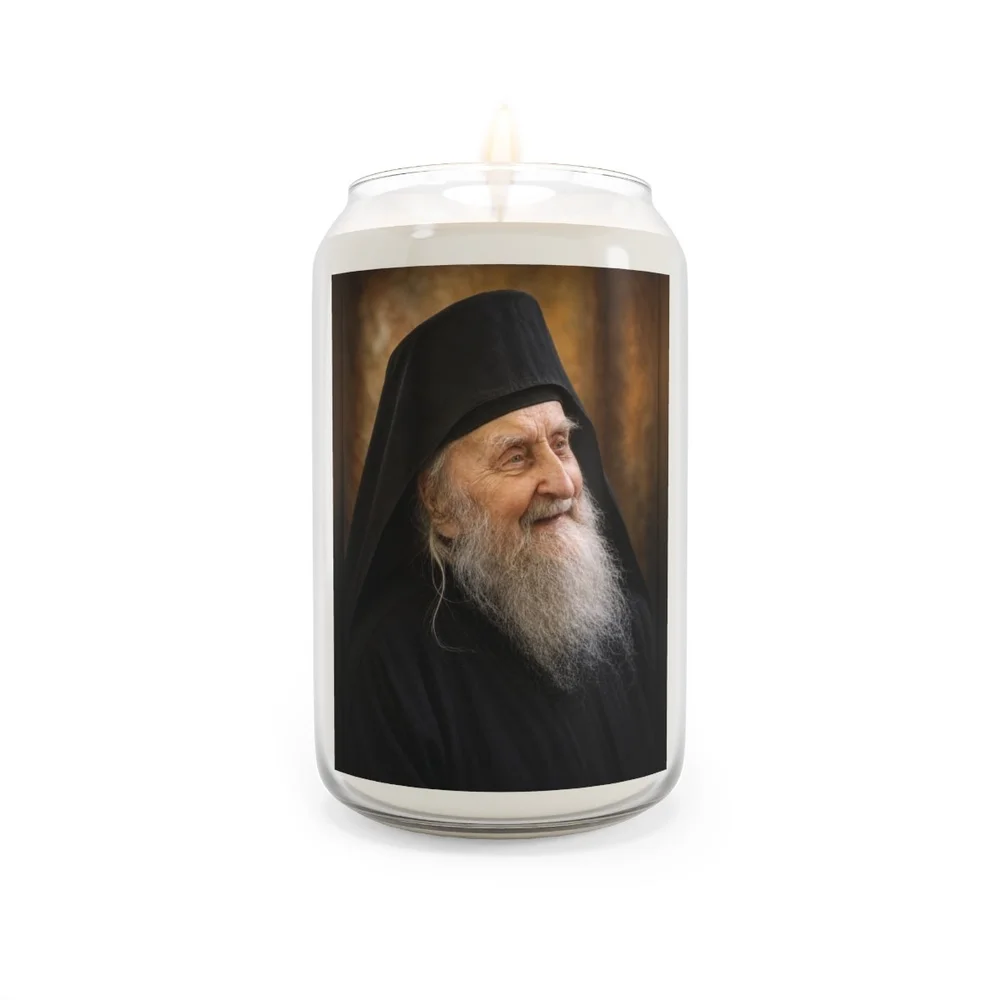
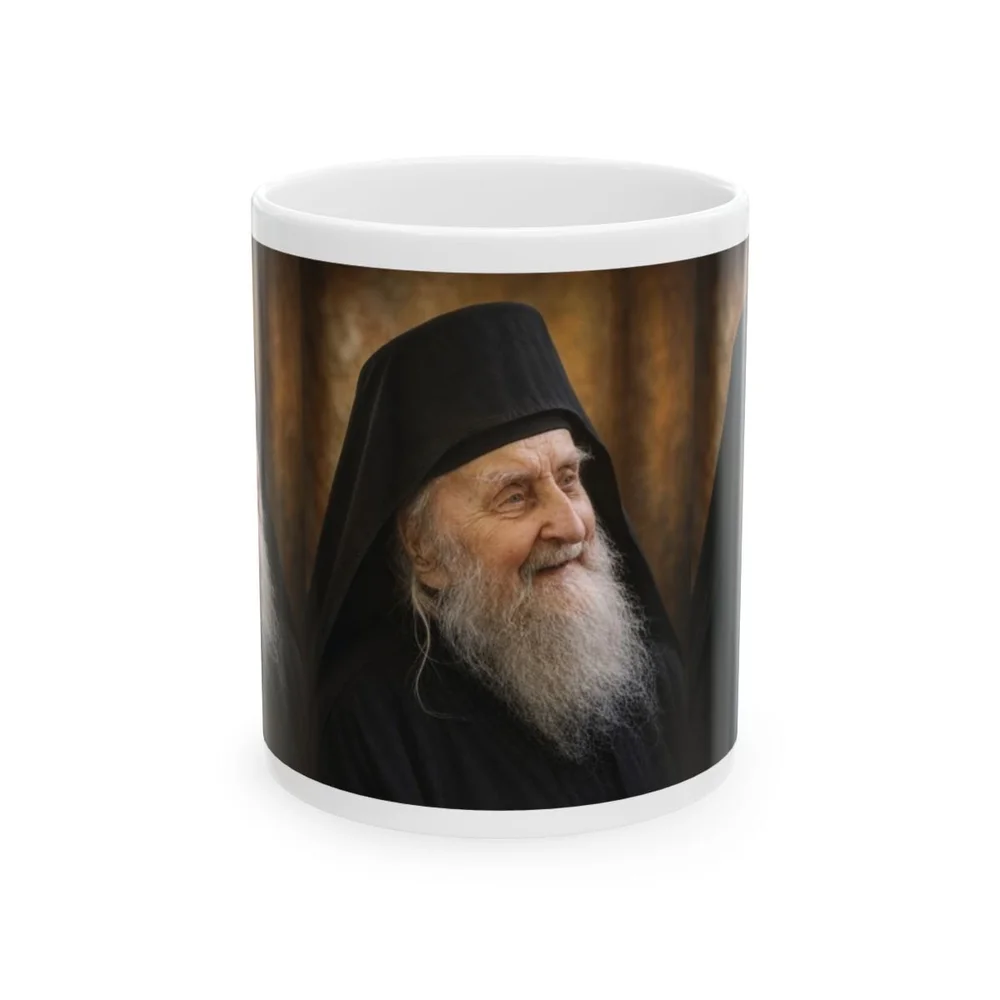
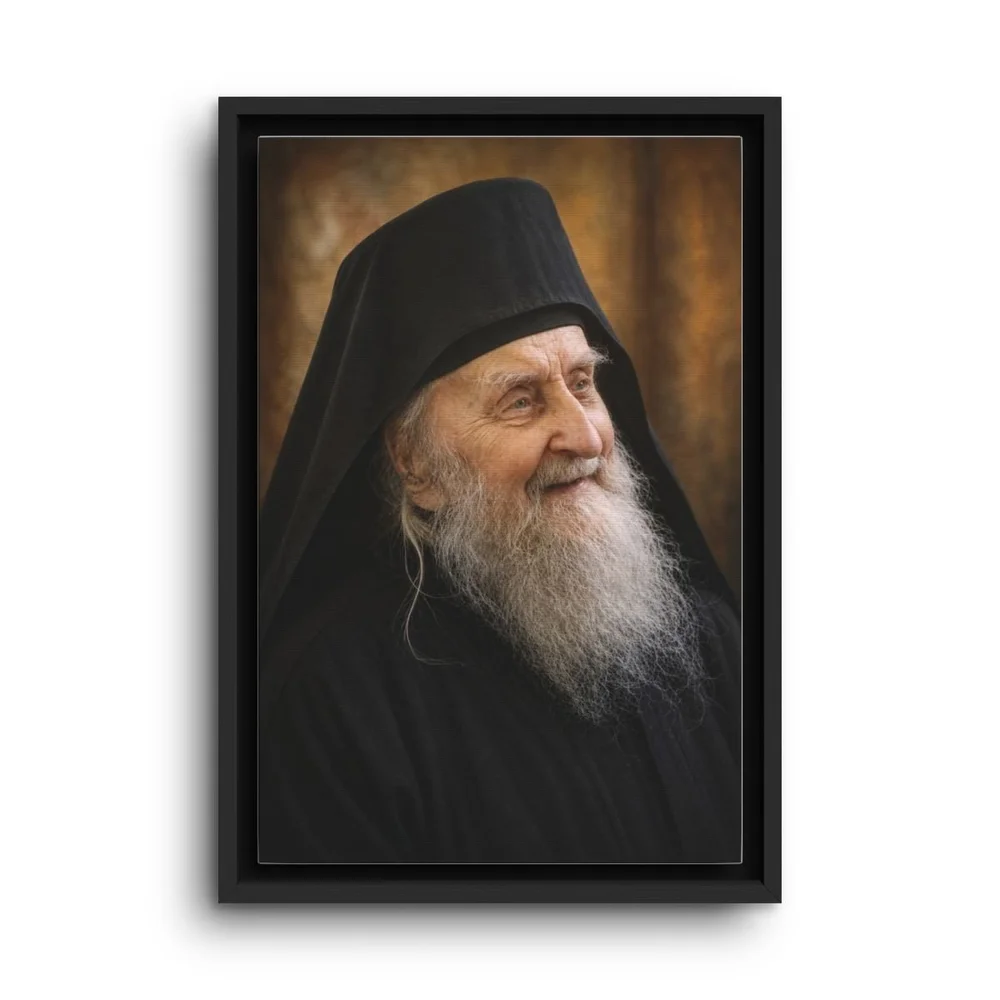
If this story stayed with you, there are a few ways to keep Saint Sophrony close: a candle for your prayer corner, a mug for the morning, or a framed icon print for the wall.
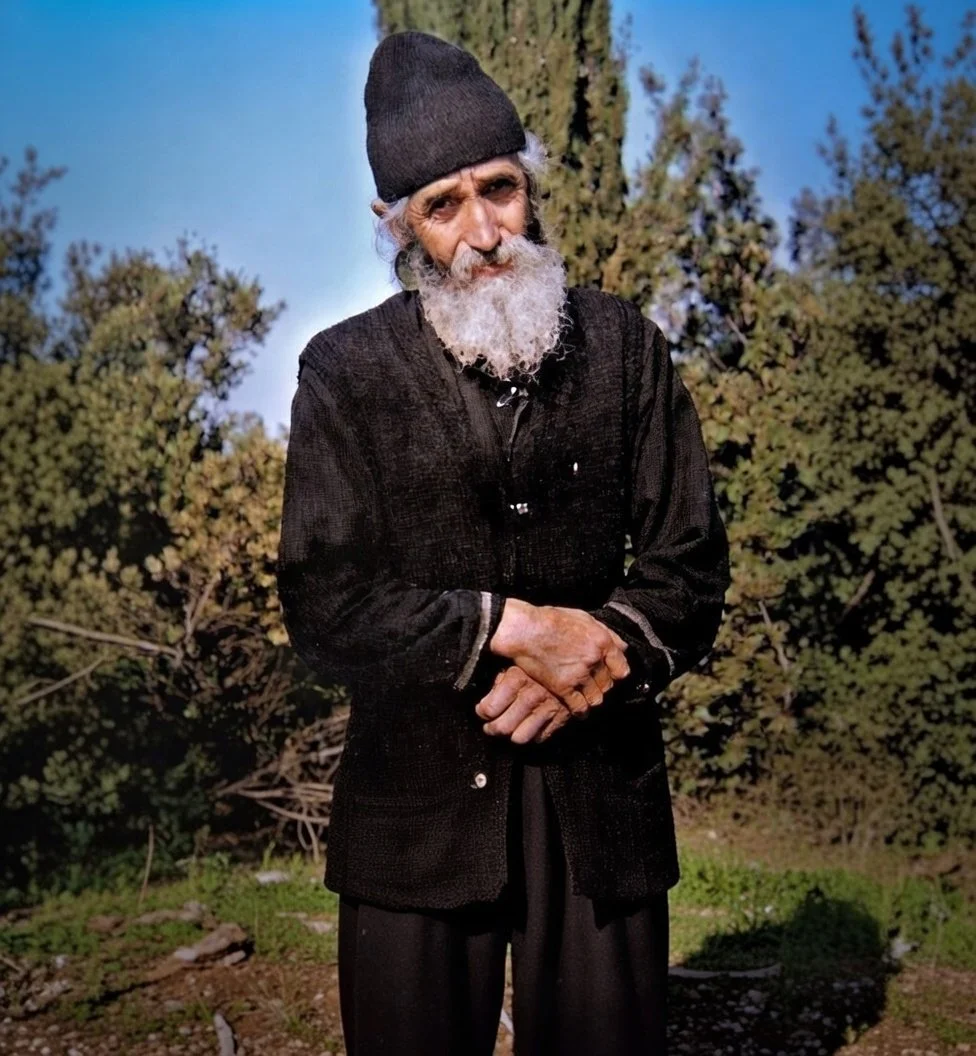
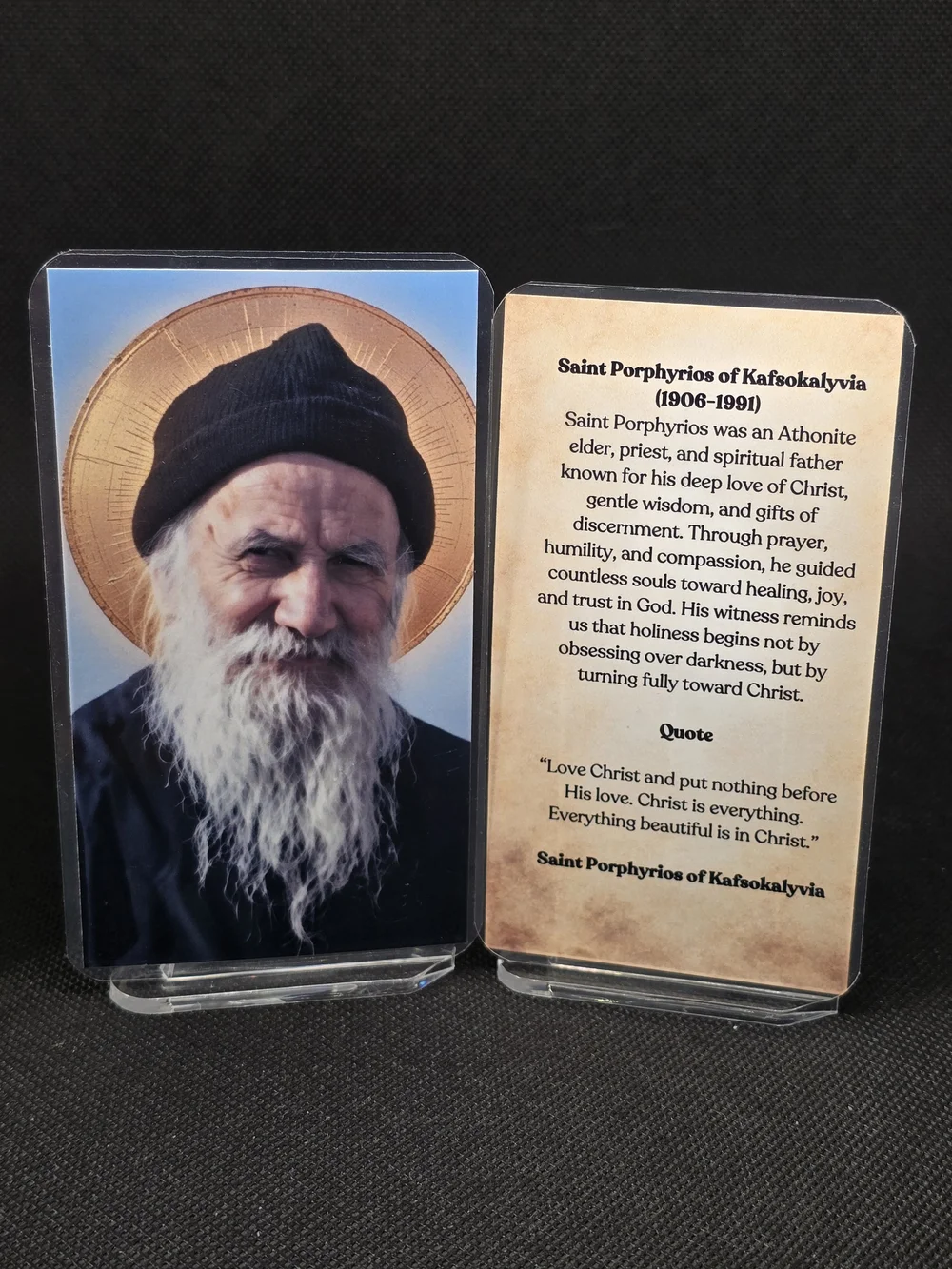
Sophrony lived inside a long line of Athonite and Greek elders. These three prayer cards sit naturally beside his.
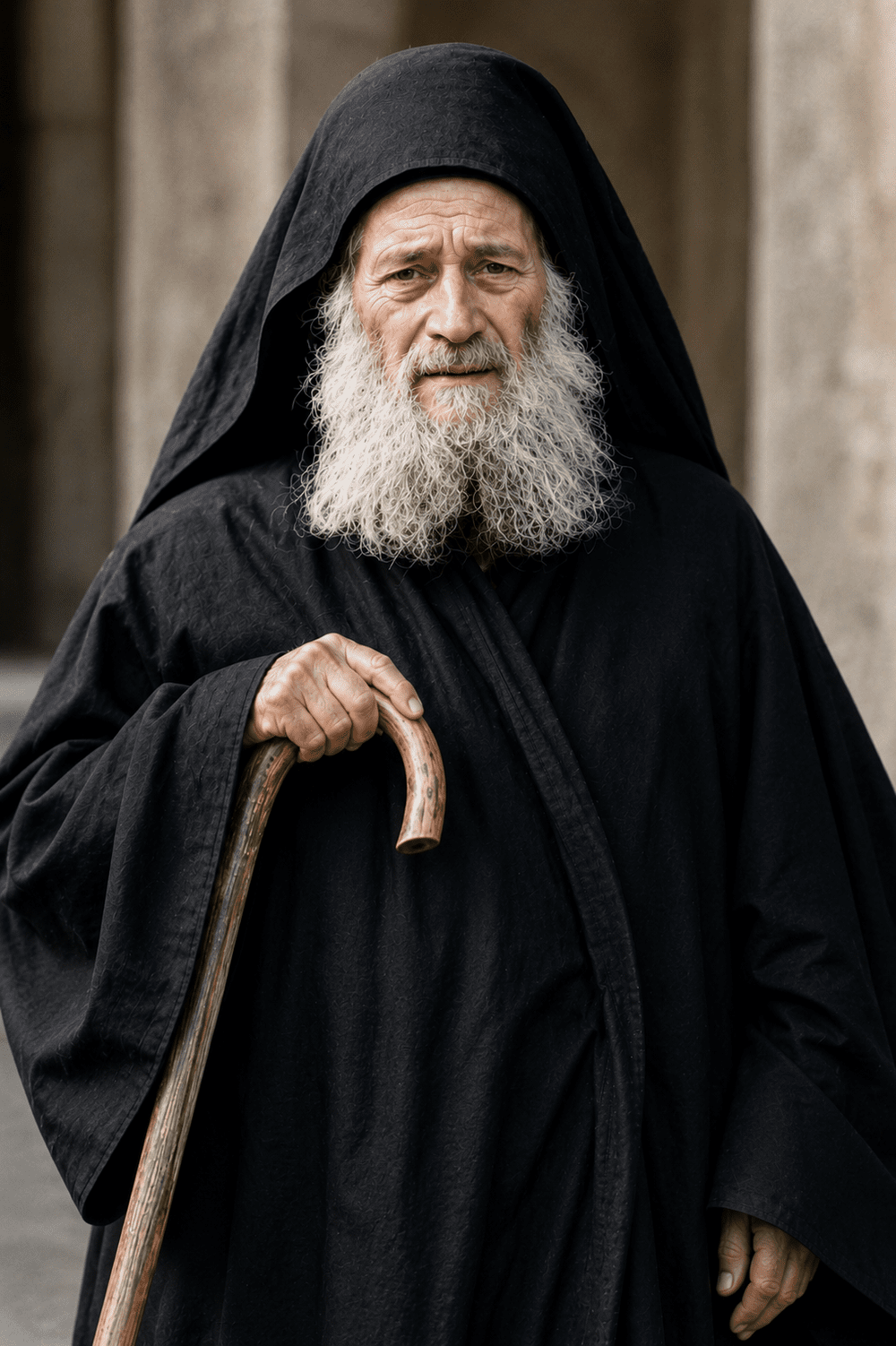
An Artist Who Found What He Was Looking For
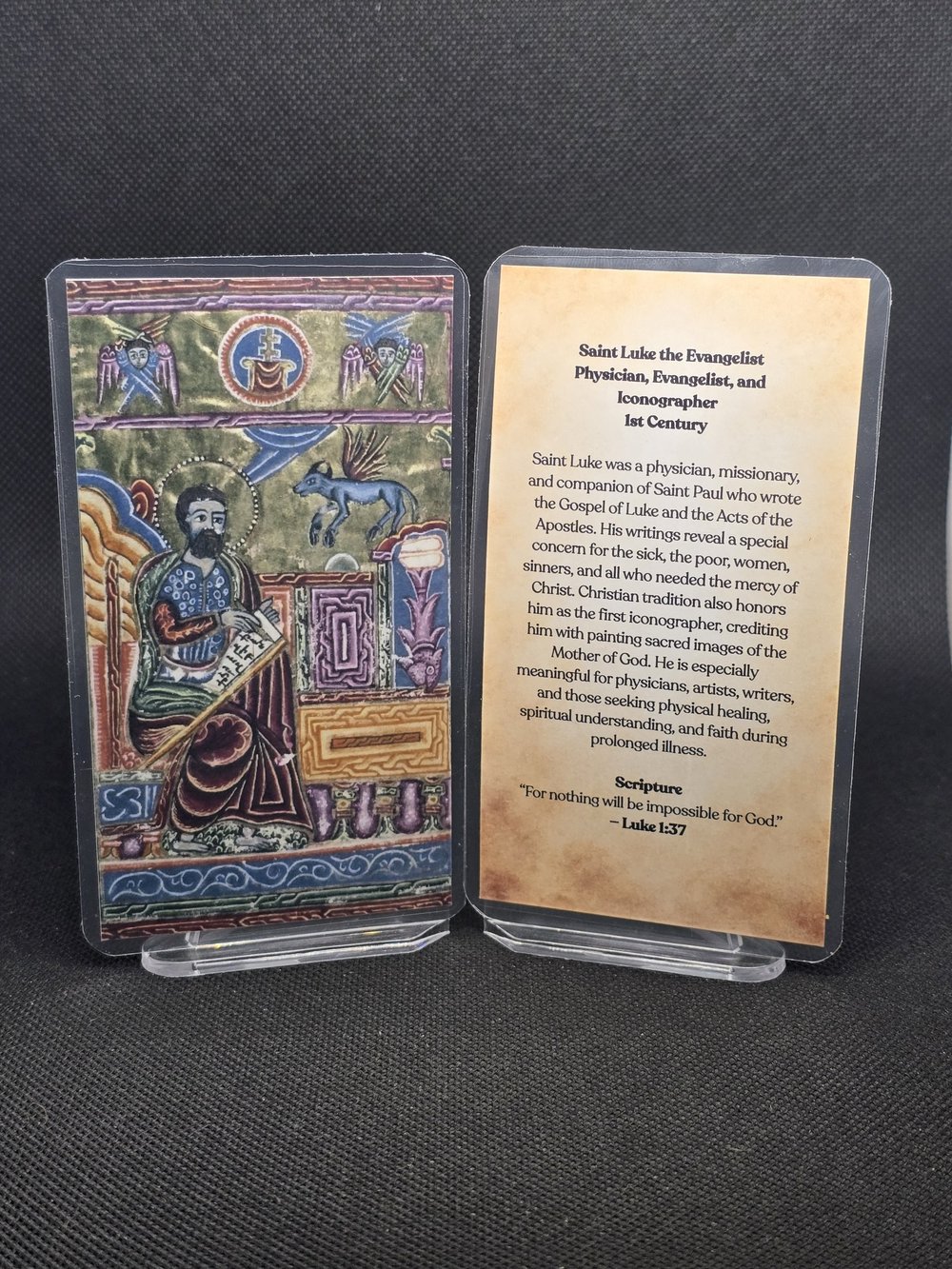
Saint Sophrony started as a painter who wanted to touch eternal beauty. He ended as an elder who taught thousands of people to pray, who gave the world a saint's writings, and who told a struggling composer to keep going. The prayer card of Saint Sophrony, the card of Saint Silouan whose words he saved, and the card of Saint Luke, patron of those who write icons, make a good small set for anyone who works with their hands and wants that work offered to God.
Get the Saint Sophrony Prayer Card →Frequently Asked Questions
