Lebanon • Maronite Eparchy of Jbeil • October 29–30, 2026
Father Samir Daou: The Maronite Priest of Hsoun, Ferhet and Ain el-Delbeh, Killed in Jbeil District
A married village priest drove out to check the olive harvest, vanished for a day, and was found dead. This is who he was, the villages he served, what is known about those 24 hours, and what is still not.
Father Samir Daou: At a Glance
- Full name
- Samir Mikhael Daou (al-Khoury Samir Daou) • Maronite Catholic priest
- Eparchy
- Maronite Eparchy of Jbeil (Byblos) • Bishop Michel Aoun
- Parishes named by the eparchy
- Hsoun, Ferhet, Ain el-Delbeh
- Home village
- Ain Jrain, by the Mashan church
- Family
- Listed as married • His wife was reportedly in Jbeil on the day
- Missing
- Wednesday, October 28, 2026 • Last phone signal about 1:00 PM in Byblos, last camera image about 2:00 PM near his home in Mashan
- Found dead
- Thursday, October 29, 2026, about 24 hours later • Second floor of a house he owned in Ain Jrain, found by family
- Arrest
- October 30, 2026 • Internal Security Forces announced a suspect in custody • Media report he is a Syrian worker (Aleppo per MTV, Idlib per Khaberni)
- Motive
- Not established • Reported confession is not a court finding
- Funeral
- Sunday, November 1, 2026, 2:00 PM • Cathedral in Jbeil • Burial in Mashan
- Not published
- His birth date, ordination date and years of service
Who Father Samir Daou Was
In Lebanon a Maronite priest is addressed as Khoury or Abouna, and the parishioners of Hsoun, Ferhet and Ain el-Delbeh knew Father Samir Daou as both. He was a parish priest of the Maronite Eparchy of Jbeil, the diocese centered on ancient Byblos, and he was a native of the area he served. The funeral notice gives his birthplace as Ain Jrain, a village in the Jbeil District, and says he will be buried there.
The documents we could verify give an outline rather than a full biography. The Maronite clergy directory lists him as Samir Mikhael Daou, a parish priest of the Eparchy of Jbeil, and as married. It records a theology qualification dated 1983 and a master’s degree in missiology from a Canadian institution in 1993. Missiology is the study of the Church’s mission, which fits a man who spent his working life tending several small villages at once. A family directory for Ain Jrain lists a Samir Daou whose parents were Mikhael Daou and Saada Kamel. A letter he signed as a priest on March 7, 2015 is reproduced in a Dominican archive, which puts him in active ministry by that date. Jbeil Today says he was born in the 1950s, which would make him in his late sixties or seventies. We have not seen a birth record, so treat that as approximate.
Reports describe a family he leaves behind. Al-Hadeel says he lived in the area with his wife and their children, and Le Catho says his family described him as devoted to others and asked for a thorough investigation into who is responsible. Outlets disagree on how many children he had, so we do not give a number.
Married is not unusual here. The Maronite Church, like the other Eastern Catholic churches, ordains married men to the priesthood. If you are new to how that works, our guide to the Maronite Church explains it. According to a RED TV report, his wife was in Jbeil on the day he disappeared, and he called her before heading to Ain Jrain.
One more piece of documented biography comes from Aid to the Church in Need (AED). The charity confirmed in a public statement that it supported Father Samir through Mass intentions and help with his health insurance. It did not say when the support began or how much it was. That is a familiar arrangement. Since Lebanon’s economic collapse began in 2019, many village priests have relied on foreign Mass stipends to make a living wage.
Here is what is not public. The eparchy has not published his date of birth, his date of ordination or the years he served in each village. A website has circulated a specific ordination date and a figure of about 33 years as a priest. It names no certificate, announcement or source, and we found nothing to corroborate it, so we are not printing either number. When the eparchy releases a clergy biography, those details will go here.

Part II
The Villages He Served: Hsoun, Ferhet and Ain el-Delbeh
The eparchy’s statement on his death names three parishes under his care: Hsoun, Ferhet (also spelled Farhat) and Ain el-Delbeh. The funeral notice adds two more names to the list of mourners, Mashan and Ain Jrain, the home villages where he was born and will be buried. Five communities in all, in the highlands behind Byblos.
Hsoun
Hsoun (el-Houssoun) is the best documented of the three. It sits at about 916 meters (roughly 3,000 feet) above sea level, around 73 kilometers north of Beirut, on a municipal area of about 3.3 square kilometers. Its residents are reported to be Maronite Catholics and Shia Muslims. That mix is common in the upper Jbeil District, where Christian and Shia villages sit side by side on the same ridges. A priest there is serving a small, mixed neighborhood, not a large flock.
Ferhet and Ain el-Delbeh
We could not find a published history, church dedication or population figure for Ferhet or for Ain el-Delbeh, and we would rather say so than guess. The name Ain el-Delbeh follows a common pattern in Lebanese place names: ain is a spring, and dulb is the plane tree, so the name reads as the spring of the plane tree. Springs and shade trees are what mountain villages grew around.
Mashan and Ain Jrain
The church at the center of his funeral is Our Lady of the Assumption in Mashan, which serves Mashan and Ain Jrain together. Condolences are being received in its church hall, and he will be buried in its cemetery. Being buried in the churchyard of his own village church is the plainest sign available that this was home to him.
One Priest, Several Parishes
The Eparchy of Jbeil was first erected in 1673, suppressed in 1768 and restored in 1990. Its seat is the cathedral in Byblos, and Bishop Michel Aoun has led it since 2012. Church statistics from the end of 2022 count 83 parishes and one mission served by 112 priests, of whom 63 are diocesan and 49 belong to religious orders, for about 145,000 Catholics. Do the arithmetic: 63 diocesan priests cannot staff 83 parishes one to one. Priests like Father Samir cover several villages, saying Mass in rotation, visiting the sick and running funerals across a wide patch of mountain road.
Part III
October 28 and 29: Missing, Then Found
Almost everything below comes from Lebanese media reporting, not from a police report, and we name the outlet each time. Investigators have not released a full account. Where outlets differ on a time or a detail, we say so.
Late October is olive season in the Jbeil hills. RED TV, in a report carried by Lebanon Debate on the evening of October 29, said residents describe Father Samir as a man who regularly passed through Jbeil and picked up workers to help with the harvest. Sources close to the family told the same report that he called his wife, who was in Jbeil, and said he was heading to Ain Jrain to gather the olive crop with a worker. No time for the call has been published. He disappeared that Wednesday, and he was found the next day.
Wednesday, October 28: The Last Signals
Jbeil Today, citing security sources, reported that he set out around noon for his home village of Ain Jrain to check on the olive harvest. Several outlets, including Elsiyasa, SyriacPress and Cedar News, report that his phone’s last signal was picked up in Byblos (Jbeil city) at about 1:00 PM, after which it was switched off. A surveillance camera near his home in Mashan is reported to have captured the last known image of him at about 2:00 PM, and Jbeil Today says his car was last seen around the same time. By that afternoon nobody could reach him, and he was reported missing. The National News Agency, as quoted by Daily Beirut, said he had been missing since Wednesday afternoon.
Local sources quoted by SyriacPress and Lebanon Debate say he had been traveling to Ain Jrain with a Syrian worker. Al-Hadeel reports a last call from the priest to a person identified only by initials, with its timing and circumstances unclear.
Wednesday Night into Thursday: The Search
Lebanon Debate and SyriacPress report that security agencies and army intelligence searched wooded areas, including the forests between Ain Jrain and Fidar, while investigators reviewed surveillance footage to trace his movements. MP Ziad al-Hawat said the authorities were coordinating with the Information Branch of the Internal Security Forces and Army Intelligence, according to SyriacPress. One small detail, from Al-Hadeel and unconfirmed: the house was not searched at first because its doors were closed and nothing showed that anyone was inside.
Thursday, October 29: Found
He was found dead about 24 hours after contact was lost, according to Daily Beirut and Al-Hadeel. Le Catho and VPP News report that family members found him on the second floor of a house he owned in Ain Jrain, a mountain property he did not visit regularly. Outlets variously call it his home or his summer home. Le Catho adds that there were traces of blood, and Al-Hadeel quotes a local resident saying he had been struck on the head with a sharp object and was found in his bedroom. Judicial police, a forensic doctor and Internal Security Forces crime-scene investigators attended, collecting fingerprints and other evidence. MTV, citing its own sources, reported that he had been stabbed multiple times with a sharp object. No forensic report has been published, so treat the cause of death as unconfirmed.
MTV and Tayyar reported that his car was gone, and early reports pointed to the worker who had been with him. Cedar News, citing Jadidouna, added that his wallet and the season’s olive harvest were reportedly taken as well. All of that was preliminary and unconfirmed when it was published. Residents and people close to him declined to speak on camera, Al-Hadeel reports, and described him as their shepherd.
- Wednesday, October 28, about noon (reported)Father Samir sets out for Ain Jrain to check the olive harvest, per Jbeil Today. He had told his wife, per RED TV, that he was going to harvest olives with a worker.
- About 1:00 PMHis phone’s last signal is picked up in Byblos. The phone is then switched off.
- About 2:00 PMA camera near his home in Mashan captures the last known image of him. His car is last seen at about this time, per Jbeil Today.
- Wednesday afternoon and nightContact is lost and he is reported missing. Security agencies and army intelligence search the woods and review camera footage.
- Thursday, October 29About 24 hours later, family members find him dead on the second floor of a house in Ain Jrain. His car is reported missing. MTV’s sources report stab wounds.
- Evening, October 29The Maronite Eparchy of Jbeil issues a statement condemning the killing. MTV publishes its report at 8:17 PM and RED TV’s report on his habit of hiring harvest help runs at 8:21 PM.
- About 4:00 AM, Friday, October 30 (reported)MTV reports a raid on a residential building on the coastal Jbeil–Amchit road. The Internal Security Forces announce a suspect in custody the same morning. Outlets report he is a Syrian man who had been working with the priest.
Part IV
The Arrest and What Is Still Unknown
Lebanon’s Internal Security Forces announced on October 30 that a suspect had been arrested in connection with the killing, and said the investigation continues under judicial supervision. The announcement gave no motive and did not lay out the evidence. Everything beyond it is media reporting, and the outlets do not agree on several points. We have sorted what is solid from what is not.
Father Samir Daou went missing on the afternoon of October 28, 2026 and was found dead on October 29. The Maronite Eparchy of Jbeil publicly condemned the killing. The Internal Security Forces announced a suspect in custody on October 30, with the investigation under judicial supervision. Nobody has been convicted of anything.
An-Nahar, MTV and Lebanon Debate report that the suspect confessed during questioning. Lebanon Debate also reports that officers found the priest’s phone and car keys on him during a raid at a building in Jbeil, and that the report does not say the car itself was recovered. Cedar News adds a wallet and the olive harvest to the list of items reportedly taken, citing Jadidouna. All outlets that name a nationality say he is Syrian and that he had been working with the priest. Reports on his age and background conflict: MTV gives a birth year of 2004 and origins in Aleppo province, an earlier local report put his age at 24, and Jordan’s Khaberni says Idlib. On who carried out the raid, MTV names the Information Branch, while Lebanon Debate names the Jbeil police station and a Mount Lebanon investigations unit. Police have not released the confession or a list of items recovered.
The motive. The precise cause of death, with no forensic report published. The reports of stab wounds (MTV) and a blow to the head (Al-Hadeel, RED TV) are unconfirmed. Whether the suspect worked for the priest before that day. The murder weapon. Whether anyone else was involved. Whether the priest’s car has been recovered. Exactly when he was killed within that 24-hour window. Al Araby’s report on the arrest notes explicitly that no official detail of the alleged confession or motive has been released.
On motive, the only institutional statement we found came from Aid to the Church in Need. AED said that, on the information available when it posted, there was no indication of a religious motive or that he had been targeted because he was a priest. That was an assessment at that moment and not an investigative finding. Theft is a reported line of inquiry because of the missing car, phone and keys, but it remains a line of inquiry. A suspect’s nationality is reported by every outlet. It is not evidence of motive, and the eparchy’s own message was a call for calm.
Part V
The Church’s Response and the Funeral
The Eparchy of Jbeil issued its statement on October 29. Bishop Michel Aoun, with the eparchy’s priests, monks and nuns, condemned what it called a horrific crime, offered condolences to the family and to the parishioners he served, thanked the security services and urged people to stay calm, avoid unverified news and not spread rumors. On October 30, Maronite Patriarch Cardinal Bechara Boutros al-Rai also condemned the killing. He noted that the priest had dedicated his life to serving God and the Church, prayed that the Lord receive him, and urged the security and judicial authorities to pursue the investigation seriously and firmly, uncover the circumstances and bring those responsible to justice.
Others spoke too. Sheikh Ghassan al-Laqis, the Mufti of Jbeil, called the crime heinous, warned of its consequences for the coexistence the Jbeil area is known for, and asked Muslims and Christians alike not to be drawn into sectarian strife and to leave the matter to the judiciary. MP Simon Abi Ramia demanded a full and rapid investigation with no leniency, and said he had contacted the security agencies. The eparchy’s call for calm and the Mufti’s point the same way.
Funeral Arrangements
The funeral notice, as relayed by IMLebanon, sets out the following. Times are local to Lebanon.
- Friday and Saturday, October 30 and 31, 2:00 to 6:00 PMCondolences in the hall of the Our Lady of the Assumption church in Mashan and Ain Jrain.
- Sunday, November 1, from noonThe body lies in state at the cathedral in Jbeil, with two Masses for the repose of his soul. Condolences are received in the cathedral hall from 10:00 AM until the prayer service.
- Sunday, November 1, 2:00 PMFuneral prayers at the cathedral in Jbeil.
- After the prayersThe body is taken to his birthplace, Ain Jrain, for burial in the cemetery of the Our Lady of the Assumption church in Mashan.
Part VI
A Village Priest in Lebanon
The Maronite Church is one of the largest Eastern Catholic churches and it is rooted in the mountains of Lebanon. Its liturgy is in Syriac and Arabic and has its own character, which we cover in our comparison of the Maronite Divine Liturgy and the Roman Catholic Mass. Most of its priests do not work in cathedrals. They work in places like Hsoun: small stone churches, a handful of families, a road that closes when it rains.
A parish priest in that setting does everything. He says Mass in rotation across several villages, buries the dead, visits the sick, settles disputes and keeps the books. Many also farm. Father Samir’s trip to Ain Jrain to gather olives was an ordinary errand for a village priest and needs no explanation.
This is also the second Maronite priest lost this year. Earlier in 2026, Father Pierre al-Rahi was killed in southern Lebanon, reportedly by Israeli tank fire, after refusing to leave his parish. The two cases are unrelated, and the circumstances are very different. For wider background, see who the Maronite saints are.
Part VII
How to Remember Him
The Maronite tradition treats prayer for the dead as a duty owed to them. The ordinary way to honor a priest is to ask another priest to offer a Mass for the repose of his soul. Memorial Masses are commonly offered on the day of burial, at the fortieth day and at the first anniversary. If you are far from Lebanon, any Catholic parish can accept a Mass intention in his name.
The eparchy has asked for calm and for the truth to come out through the courts. That is a reasonable thing to hold both at once: pray for him, and wait for the evidence. We will update this article as the investigation produces verified facts, including his ordination date and years of service if the eparchy releases them.
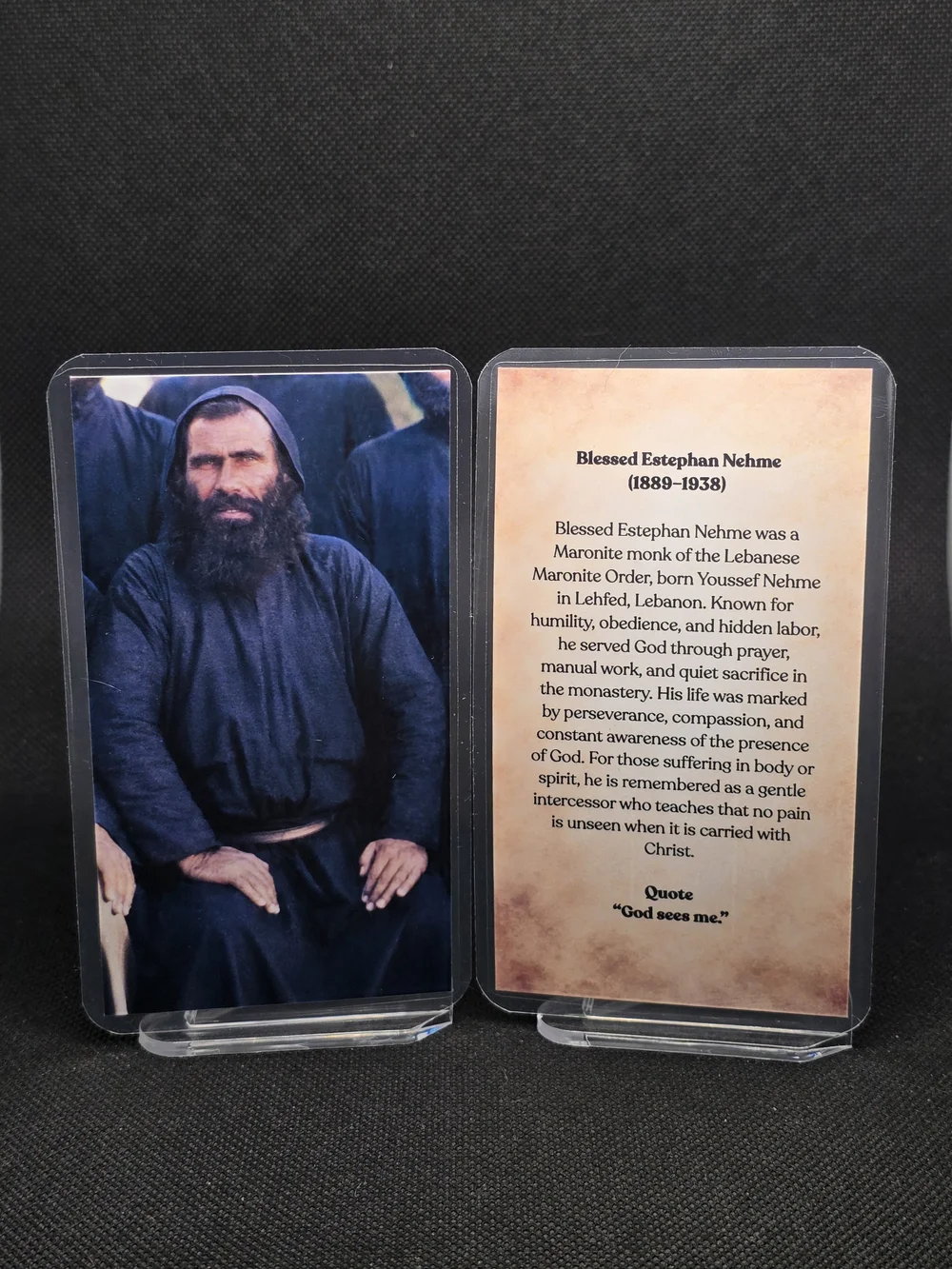
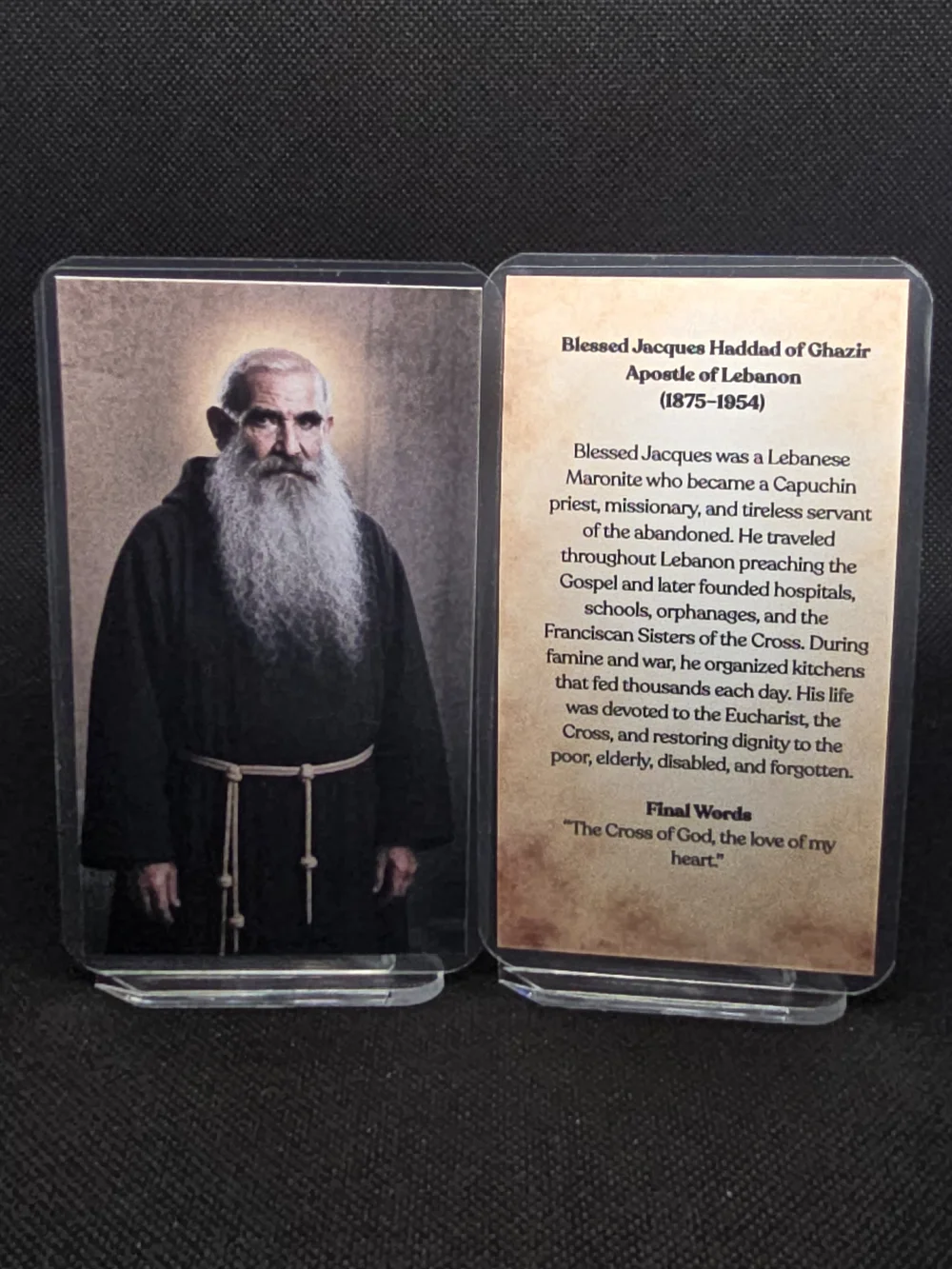
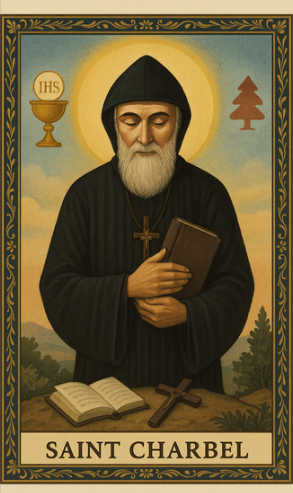
Four cards from our Maronite collection, each tied to the hills of Jbeil or to the work of a Lebanese priest. The full Maronite prayer card collection is on our store.
Appendix
