Orthodox vs Catholic: Sign of the Cross, Purgatory, Mary and the Rosary
Four Questions • Three Answers Each • Orthodox • Roman Catholic • Eastern Catholic
Orthodox vs Catholic: Sign of the Cross, Purgatory, Mary and the Rosary
How do the Orthodox and Catholic Churches differ on the sign of the cross, purgatory, praying to the saints and Mary, and the rosary, and where do the Eastern Catholic Churches fall? Plain answers, with the sources of each view.
The Short Answers
- Sign of the Cross
- Orthodox and Byzantine Catholics: right shoulder to left, three fingers • Latin Catholics: left to right
- Purgatory
- Orthodox: no doctrine of purgatory, but prayers for the dead and a state of waiting • Catholic: purification after death is defined doctrine • Eastern Catholics: accept the doctrine without the Latin imagery of fire and place
- Praying to Saints
- All three ask the saints to pray for them. The teaching is the same. The style differs
- Mary
- All honor her as Theotokos and ever-virgin • Only Catholics, including Eastern Catholics, hold the Immaculate Conception as dogma
- The Rosary
- A Latin devotion. Orthodox use the prayer rope. Many Eastern Catholics use both the rosary and the prayer rope regularly
- Eastern Catholics
- In communion with Rome and keeping Eastern worship. They hold Catholic doctrine in an Eastern way
- Authority
- Details of practice differ by jurisdiction. Ask your own priest
Where the Churches Stand
Questions about the Orthodox and Catholic Churches usually come in a bundle. People notice that a friend makes the sign of the cross in a different direction, hear that one Church believes in purgatory and the other does not, wonder why one prays the rosary and the other a prayer rope, and want to know how the saints and Mary fit in. This article takes those four questions one at a time.
A third group has to be kept in view or the picture comes out wrong. The Eastern Catholic Churches are in full communion with the Pope and accept Catholic doctrine, but they keep the worship, calendar and spiritual customs of the East. A Byzantine Catholic at the Divine Liturgy looks, sounds and prays much like an Orthodox Christian, and holds the doctrines of the Catholic Church. So for each question, this article gives three answers: Orthodox, Roman (Latin) Catholic and Eastern Catholic. If the term is new, read what a Byzantine Catholic is first.
For the wider picture, see our overview of Eastern Orthodox and Roman Catholic differences and our beginner’s guide to Eastern Catholics and Orthodox. This page covers only the four questions below, and covers them in more depth.
A note on method. Practices vary between jurisdictions, and priests differ in how they explain things. Where this article states a doctrine, it says which Church teaches it. Where it states a custom, it says so. None of this replaces a conversation with your own priest.
Part II
Table 1: The Four Questions Compared
| Question | Orthodox | Roman Catholic | Eastern Catholic |
|---|---|---|---|
| Direction of the sign of the cross | Right to left, three fingers together | Left to right, often an open hand or fingers; no fixed rubric | Byzantine tradition follows the Orthodox pattern; other traditions vary |
| Purgatory | Not taught as a doctrine. An intermediate state; prayers for the dead; views on cleansing vary | Defined doctrine (Lyon II 1274, Florence, Trent; CCC 1030 to 1032) | Accepts the doctrine; many reject the Latin imagery of fire and a place |
| Asking saints to pray | Central to worship | Taught (CCC 956; Trent) | Same teaching, in Eastern forms |
| Mary as Theotokos, ever-virgin | Yes | Yes | Yes |
| Immaculate Conception | Rejected as a dogma | Dogma of 1854 | Affirmed; feast kept December 9 in the Byzantine calendar |
| Mary’s end | Dormition, August 15; she died and was taken up | Assumption, defined 1950; whether she died is left open | Dormition feast, same date; same doctrine as Rome |
| The rosary | Not an Orthodox devotion; prayer rope and the Jesus Prayer instead | Standard devotion; 20 mysteries | Both are common: many Eastern Catholics use a prayer rope and a rosary regularly, often side by side |
Part III
The Sign of the Cross
What each Church does
Orthodox Christians bring three fingers of the right hand together (the thumb, index and middle finger), touch the forehead, then the chest, then the right shoulder, then the left. The ring and little finger are folded into the palm.
Latin Catholics trace the cross from the forehead to the chest, then to the left shoulder and then the right. Many use an open hand or the tips of several fingers. The Latin Church has not found it necessary to put the exact manner into its rubrics.
Eastern Catholics of the Byzantine tradition cross themselves as the Orthodox do, right to left with three fingers. Among the other Eastern Catholic Churches, practice varies, and in some places Latin habits have been absorbed. If you are in doubt, watch the people around you.
What the fingers mean
In the Eastern explanation, the three joined fingers confess the Trinity, and the two folded fingers confess the two natures of Christ, divine and human. Before the reforms of Patriarch Nikon in the seventeenth century, Russian Christians made the sign with two fingers. The enforcement of the three-finger form was among the causes of the split with the Old Believers, who still use two fingers.
Why right to left?
Eastern Christians commonly explain the direction by the blessing of a priest or bishop. When he blesses, he moves his hand top to bottom and from his left to his right, which is the faithful’s right to left as they face him. Making the sign in the same direction as the blessing receives it, and it also says that no one blesses himself: every blessing comes from God. In the Byzantine icon of the blessing Christ, the hand forms the Greek letters IC XC, with the thumb meeting the ring finger.
How the West ended up on the other side
Here the history is disputed, and I would not trust anyone who gives you a tidy date. The Eastern Orthodox hold that right to left is the more ancient way. Syriac writings, however, show that left to right can predate right to left. Pope Innocent III, who reigned from 1198 to 1216, wrote in his own discussion of the sign that it is made “from above to below, and from the right to the left, because Christ descended from the Heavens to the earth,” so the right-to-left motion was still being described in the West around 1200. Left to right became the Latin standard later. One scholar reads Innocent’s remarks as referring to the small cross made on the forehead, lips and heart, not the large one.
Is one correct?
No Church teaches that the direction is a matter of salvation. The Catholic Church teaches that the sign of the cross is a sacramental that strengthens us in temptations and difficulties (CCC 2157). A Catholic apologetics answer says some Eastern Catholic Churches use the right-to-left order as an “equally valid custom,” and that a Latin Catholic who finds more meaning in the Eastern form is not doing anything wrong, while advising that you generally follow the customs of the liturgy you are attending.
In the East, people commonly cross themselves far more often than in many Latin parishes, at each mention of the Trinity, on entering a church, before an icon and at the beginning and end of prayer. That is custom, not a rule that I can cite to a single document, but any Orthodox parish will show you.
Part IV
Purgatory
What the Catholic Church teaches
The Catechism teaches that those who die in God’s grace and friendship, but still imperfectly purified, are assured of eternal salvation, yet undergo purification after death to achieve the holiness needed to enter the joy of Heaven (CCC 1030). The Church calls this purification purgatory (CCC 1031). The first formal definition came at the Second Council of Lyon in 1274, which taught that souls who die truly repentant but not yet fully purified are cleansed by purifying punishments, and that the offerings of the living are of benefit to them. The Council of Florence (1431 to 1449) restated the teaching in nearly the same words. The Council of Trent (1545 to 1563) repeated it and asked preachers to keep the more difficult and subtle questions out of popular teaching.
It is worth noticing what the councils did not say. The popular picture of purgatory as a place of literal fire comes from medieval preaching and art, not from the definitions. Lyon, Florence and Trent do not define fire or a place. Recent popes have spoken of purgatory as a state. Benedict XVI, in Spe Salvi, wrote that “the fire which both burns and saves is Christ himself,” and presented this as a theological reflection, not as binding teaching.
What the Orthodox Church teaches
The Orthodox do not teach purgatory and generally reject it as a doctrine. The Ecumenical Patriarchate has listed it among teachings not witnessed in the Bible or in the ancient Church. The objections come in several forms: a dislike of the idea that the soul must satisfy a debt of punishment, discomfort with the link to indulgences, and the conviction in some Orthodox thought that repentance is not possible after death.
At the Council of Florence in 1439, Saint Mark of Ephesus rejected purgatory as a third place of fire. But the Orthodox position is not simply that nothing happens after death. Mark himself allowed that some souls are cleansed after death, either through fear at the moment of departure or while held for a time in Hades. What he rejected was the framework of a third place and a purifying fire. Metropolitan Kallistos Ware has recognized several schools of thought within Orthodoxy on post-mortem purification.
What the Orthodox do hold is an intermediate state between death and the Last Judgment, in which the soul is judged individually and then awaits the final judgment. They pray for the dead constantly. The Panikhida, the memorial service, asks God to give rest with the righteous to the departed and to forgive their transgressions, and Saint John Chrysostom is cited as teaching that remembering the departed at the Eucharist benefits their souls. Many Orthodox also speak of the toll houses, the soul’s passage past demonic accusers after death. Not everyone takes the teaching literally. Father Thomas Hopko described the passage through them as the purification of the soul, without fixing a timeframe or a number of toll houses.
The difference, put plainly
Both Churches pray for the dead and believe the living can help them. Both believe that nothing unclean enters the presence of God. They differ on the framework. The Catholic Church has defined that a purification takes place and that the prayers and offerings of the living help it. The Orthodox Church has not defined it that way, treats the intermediate state as a mystery, and distrusts a legal model with debts and indulgences. Many modern writers on both sides think the gap is smaller than the arguments of the fifteenth century suggested.
The Eastern Catholic position
Eastern Catholics accept the Catholic Church’s teaching that there is a purification after death and that the living can help the dead. But many of their Churches have not adopted the popular Latin image of fire in a particular place, and some have explicitly rejected it. At the Union of Brest in 1596, the Ruthenian bishops who entered communion with Rome agreed: “We shall not debate about purgatory, but we entrust ourselves to the teaching of the Holy Church.” In practice, an Eastern Catholic prays for the dead exactly as the Orthodox do, with the Panikhida (called the parastas in some Churches), memorial prayers and the Divine Liturgy, and does not usually use the vocabulary of purgatory.
Prayer for the dead in the East
Whatever the label, the practice is old. Anyone who has lost a parent can ask for a memorial in either Church, and for most people that is the practical heart of the purgatory question. If you are Orthodox, speak to your priest about commemorating your dead at the Liturgy. If you are Catholic, offer Mass for them, especially in November.
Part V
Praying to the Saints
On this question, the Orthodox and Catholic teaching is nearly the same, and that surprises people who expect a disagreement. Both Churches hold that the saints in Heaven are alive in Christ and pray for those on earth. Both ask for their prayers directly.
The Catholic teaching
The Catechism says that those in Heaven “do not cease to intercede with the Father for us” (CCC 956). The Council of Trent taught that it is “good and useful suppliantly to invoke them.” The Catholic explanation separates two ideas: asking God for a share in the saints’ prayers, and addressing a saint directly with the words “pray for us.” Catholics do both.
The Orthodox teaching
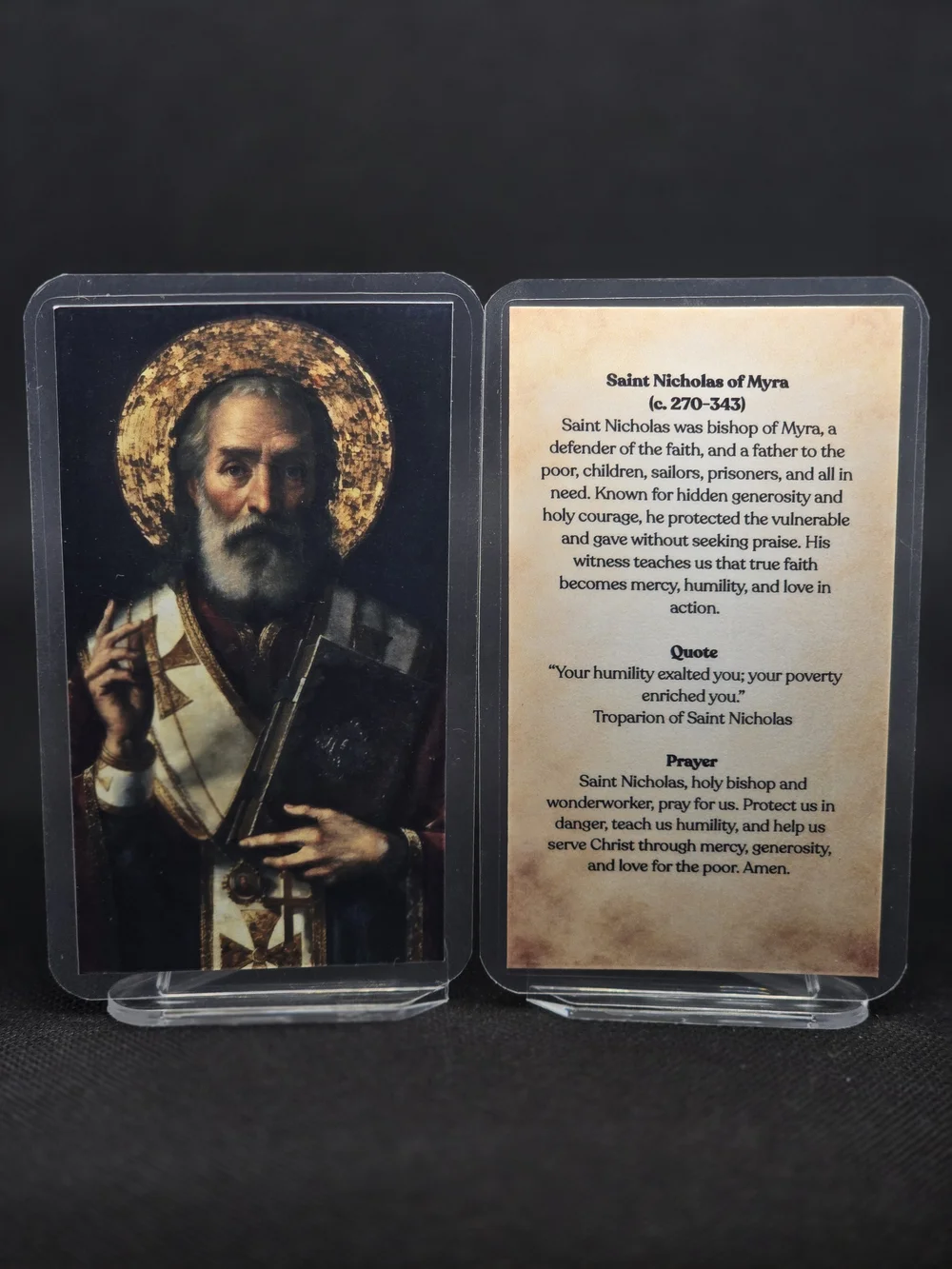
Intercessory prayer to the saints plays an important role in the Orthodox Churches, and the hymns of the Church are filled with it. A typical Orthodox prayer to a saint asks him to pray to God for us, in the form of “Holy Father Nicholas, pray to God for us.” The saints are pictured on icons because they are present in the worship of the Church, with the living, as the cloud of witnesses (Hebrews 12:1).
Veneration is not worship
Both Churches draw a line between the worship that belongs to God alone (latria) and the honor given to the saints (dulia), and a still higher honor given to Mary (hyperdulia) in the Catholic vocabulary. The Second Council of Nicaea in 787 affirmed the veneration of icons on the principle that the honor paid to the image passes to the one it depicts. We explain this at length in why Orthodox and Eastern Catholic Christians kiss icons and how to pray with icons.
The Scripture behind it
Both Churches point to the same texts. In Revelation, the incense that rises before God is the prayers of the saints (Revelation 8:4). The rich man and Lazarus parable (Luke 16:19 to 31) shows the dead aware of the living. The second book of Maccabees describes the dead Onias and Jeremiah praying for the people (2 Maccabees 15:12 to 16). Protestants reject invocation of the saints, and the Reformed tradition considers it a violation of the First Commandment. Orthodox and Catholics answer that asking a saint for prayer is no different from asking a friend, and that death does not separate the members of Christ’s body.
Where the style differs
The difference is mostly one of feel. Orthodox worship surrounds every prayer with the saints, and an Orthodox home has an icon corner. Latin Catholic devotion has a larger apparatus of novenas, patronages, medals and statues, and the Latin Church formally canonizes through a process; the Orthodox Church recognizes saints by a gradual process of local and then wider veneration, and the term “glorification” is used. Eastern Catholics follow the Eastern pattern in their worship and the Latin canonization process through Rome.
Part VI
Praying to Mary
What they share
All three groups honor Mary as the Theotokos, the Mother of God, the title affirmed at the Council of Ephesus in 431 against Nestorius, who preferred “Christotokos.” All believe she was ever-virgin, before, during and after the birth of Christ. All ask for her prayers. As Father John Breck of the Orthodox Church in America puts it, “All Marian piety, in other words, is an expression of christological dogma.” We honor her because of who her Son is.
Where they differ: the Immaculate Conception
In 1854 Pope Pius IX defined in the bull Ineffabilis Deus that Mary, from the first moment of her conception, was “preserved free from all stain of original sin.” The Orthodox Church rejects this as a dogma. It does not teach that Mary was exempt from the condition of fallen humanity, though it affirms her purity and her preservation from personal sin. Metropolitan Kallistos Ware called the Latin dogma “not so much erroneous as superfluous,” and the objection also reflects a different understanding of original sin, which the East treats as an inherited mortality and weakness more than inherited guilt. In 1895 the Ecumenical Patriarch Anthimos called the Immaculate Conception and papal infallibility “Roman novelties.”
Eastern Catholics affirm the dogma, as the Latin Church does, in communion with Rome. They keep the feast on December 9 in the Byzantine calendar, as the Conception of the Theotokos by Saint Anne. Among the Oriental Orthodox, views differ: the Ethiopian and Eritrean Churches accept the teaching, while the Coptic and Syriac patriarchs have opposed it.
The end of her life: Dormition and Assumption
The Orthodox keep the Dormition (falling asleep) on August 15 after a fourteen-day fast. The tradition is that she died, the apostles gathered, and her tomb was found empty when Saint Thomas asked for it to be opened. In 1950 Pius XII defined the Assumption in Munificentissimus Deus: that Mary, “having completed the course of her earthly life, was assumed body and soul into Heavenly glory.” The definition does not say whether she died. Eastern Catholics keep the feast as the Dormition, on the same date and with the same fast, and hold the range of views Catholics are free to hold on whether she died. The Churches differ in how they define it, but they celebrate the same mystery on the same day.
“Most Holy Theotokos, save us”
A Latin Catholic who visits an Orthodox church will hear the refrain “Most holy Theotokos, save us.” This surprises many, since only God saves. The explanation is that the petition asks for her intercession, not that she saves in the way her Son does. Orthodox writers cite 1 Timothy 2:5, that there is one mediator between God and men, and say that Mary mediates only in that she prays and intercedes for us. The Latin Church uses the same logic when it says “pray for us.”
The Hail Mary and its Eastern form
The Western Hail Mary joins the angel’s greeting (Luke 1:28) to Elizabeth’s (Luke 1:42). The petition “Holy Mary, Mother of God, pray for us sinners” was added later; it appeared in print in 1495, and Pius V placed the full form in the Roman Breviary in 1568. The Byzantine form begins “Rejoice, O Virgin Theotokos,” since the Greek word chaire means “rejoice,” and ends with “for you bore the Savior of our souls.” It is a reworking of the same two verses, sung three times at the end of Vespers at the All-Night Vigil and prayed often in private. In the Orthodox form there is no closing request that she pray for sinners, though the Church’s other hymns and prayers ask for her prayers everywhere. Byzantine Catholic Churches use the Byzantine form, and some Eastern Catholics use the Latin one.
Part VII
The Rosary
What the rosary is
The Rosary is a Western devotion built from decades. Each decade is one Our Father, ten Hail Marys and a Glory Be, while the person meditates on one mystery of the life of Christ and Mary. A standard five-decade rosary has 59 beads. Pius V set fifteen mysteries (Joyful, Sorrowful, Glorious), and John Paul II added five Luminous Mysteries in 2002 in Rosarium Virginis Mariae, for a total of twenty.
The history is layered. A tradition says Mary gave the rosary to Saint Dominic in 1208, but there is no evidence of the story in Church or Dominican documents until about 250 years later, and writers describe it as a legend, while crediting the Dominicans with much of its development. The Dominican Alanus de Rupe helped spread rosary confraternities in the 1470s. A fifteenth-century Carthusian, Dominic of Prussia, added a scriptural sentence to each Hail Mary. Pius V’s bull Consueverunt Romani Pontifices in 1569 established the devotion.
The Orthodox approach
Orthodox Christians do not typically pray the rosary. It is not forbidden. An Orthodox parish in the United States says that someone who chooses to may do so, but with caution and discernment. The main objection is the method. Orthodox spiritual tradition is wary of using mental images in prayer, and the rosary’s meditations on the mysteries ask the praying person to picture scenes. Saint Ignatius Brianchaninov warned that images admitted during prayer “will become an impenetrable curtain.” Orthodox who want to pray to Mary on beads have the Rule of the Theotokos, described below.
The Orthodox tool is the prayer rope (chotki in Russian, komboskini in Greek), a knotted cord used to count the Jesus Prayer: “Lord Jesus Christ, Son of God, have mercy on me, a sinner.” Prayer ropes are older than the rosary. The Desert Fathers are said to have used knots to count the Jesus Prayer or the psalms. We cover this in the history of the prayer rope, how to use a chotki and the Jesus Prayer.
The Rule of the Theotokos
The nearest Orthodox counterpart to the rosary is the Rule of the Theotokos. It has fifteen decades of “Rejoice, O Virgin Theotokos,” for 150 in all, which echoes the 150 psalms. Between the decades one prays the Lord’s Prayer and a short prayer, and sometimes a brief recollection of an event in the life of Christ or the Theotokos. It is associated in tradition with Saint Seraphim of Sarov. It is a different prayer from the rosary, with a different method, though a Latin Catholic will recognize the family resemblance.
The Eastern Catholic approach: often both
This is where Eastern Catholics differ from the Orthodox, and it is easy to miss. Many Eastern Catholics use the prayer rope as much as they use the rosary, and many use both regularly. The Jesus Prayer on the prayer rope is part of their Eastern inheritance, and the rosary is part of the Catholic life they share with the Latin Church. For these Christians it is not a choice between East and West. The prayer rope may be the morning and evening prayer, and the rosary may be the prayer in the car, with the family, or at a Marian feast.
The rosary is a private devotion, not a liturgical one, and Eastern Catholics do not pray it as part of the Divine Liturgy. Beyond that, practice differs by Church, by parish and by family. Some Eastern Catholics pray the rosary daily, some pray the prayer rope daily, some do both, and some lean on the Jesus Prayer, akathists and molebens and rarely pick up the rosary at all. Where the rosary has been a lifeline, for example for Ukrainian Greek Catholics who kept the faith under persecution, it is treasured.
The caution some Eastern Catholics raise is not about the rosary itself but about what it might replace. This ties to the larger issue of Latinization: for much of their history, Eastern Catholic Churches absorbed Latin devotions and liturgical habits under pressure. The Second Vatican Council’s decree on the Eastern Catholic Churches, Orientalium Ecclesiarum (1964), affirmed their liturgical rites, ecclesiastical traditions and ordering of the Christian life, and recent popes have urged them to recover their own heritage. So some Eastern Catholics pray the rosary gladly and others are careful to keep their Eastern prayers first. Both are acceptable.
There have also been Eastern versions of the rosary. A Ukrainian rosary pamphlet from the last century, recalled by some Eastern Catholics, kept the Roman mysteries but began with the Trisagion and the Creed and used the Byzantine wording of the Hail Mary. The Eastern Catholic Marian devotions most at home in the liturgical tradition are the Akathist Hymn to the Mother of God and the Paraklesis. See the history of the Akathist Hymn.
Which should you use?
If you are Orthodox, use the prayer rope and your Church’s prayers, and ask your priest before adopting the rosary. If you are Latin Catholic, the rosary is yours, and the prayer rope is not forbidden to you either, many Latin Catholics have come to love the Jesus Prayer. If you are Eastern Catholic, you do not have to choose. Many pray with the prayer rope and the rosary both, and either one is at home in an Eastern Catholic life. Keep your own Church’s liturgy and prayers at the center, and ask your priest if you are unsure about a particular devotion. A rosary prayed with attention is a good prayer, and a prayer rope used without attention is only a cord. Browse our collection of rare and handmade rosaries or read the best prayer ropes for beginners.
Part VIII
If You Are Weighing Eastern Catholic, Orthodox and Latin: What Else Differs
Many readers come to these four questions because they are deciding where to belong. The Eastern Catholic Churches are the hardest to place, because they share the worship and prayer of the East and the communion and doctrine of the Catholic Church. The table below sets out other differences that matter when you are discerning. It is a general guide. Eastern Catholic practice varies from one Church to another (Ukrainian, Ruthenian, Melkite, Maronite, Chaldean, Syro-Malabar and others) and from one parish to another, so treat each row as a question to ask.
| Area | Orthodox | Latin Catholic | Eastern Catholic |
|---|---|---|---|
| Communion with the Pope | Not in communion with Rome | In communion; Pope is head of the Church | In communion with Rome; the Pope is commemorated in the liturgy |
| Worship | Divine Liturgy of the Orthodox Church | The Roman Rite | The Divine Liturgy of its own tradition, in a form close to the Orthodox, and sometimes with Latin additions |
| Doctrine | Holds what the early ecumenical councils taught; does not accept later Western dogmas | Later councils and dogmas, including papal infallibility | Accepts the whole Catholic faith, including the later dogmas, in an Eastern way |
| Marian dogmas | Does not accept the Immaculate Conception as a dogma | Immaculate Conception and Assumption defined | Affirms both |
| Purgatory language | Not used as a doctrine | Used | Accepts the purification; often avoids fire and place |
| Prayer tools | Prayer rope, icons | Rosary, medals, statues | Often both prayer rope and rosary, plus icons |
| Infant sacraments | Baptism, chrismation and Communion given together | Baptism first; confirmation and first Communion later | Most Eastern Catholic Churches give baptism, chrismation and Communion together to infants |
| Married clergy | Married men may be ordained priests or deacons; bishops are celibate | Priests are normally celibate | Married men may be ordained, a tradition now also permitted in the United States |
| Calendar | Varies: Julian or Revised Julian | Gregorian | Varies by Church and country |
| Fasting | Strict traditional fasts | Light obligations | Eastern fasting traditions, with norms set by each Church; often kept less strictly than the Orthodox |
The Creed. The Orthodox do not use the Filioque (“and the Son”) in the Creed. Eastern Catholics accept the Catholic Church’s teaching on the Holy Spirit, but in many Eastern Catholic parishes the liturgy omits the Filioque, and it is not required of them. Practice varies, so ask.
Devotions from the West. Eucharistic adoration and Benediction, the Stations of the Cross, the Sacred Heart, the Divine Mercy chaplet and similar devotions came from the Latin Church. Some Eastern Catholic parishes embrace them, some keep them as private options, and some have set them aside to protect their own tradition. None is required of an Eastern Catholic.
Authority and belonging. An Eastern Catholic belongs to his own Church, with its own bishops and law, and under the Pope. A Latin Catholic who wants to change Churches must follow the Church’s rules for that, so speak with a priest before assuming you can switch.
What to ask a parish. Whether the parish uses the Latin or Eastern Hail Mary; whether the Filioque is said; how the parish observes fasting; whether the rosary and prayer rope are both used; which calendar it follows; and how it treats Latin devotions. The answers show how closely it keeps to the East. For more, see our Eastern Catholic vs Roman Catholic comparison and our guide to the Byzantine Rite.
Part IX
Visiting Each Other’s Churches
Attend, stand when others stand, and make the sign of the cross as you are comfortable. Do not receive Communion unless your own Church’s rules allow it; the rules on this differ and are a matter for your priest, not a matter of courtesy. Everyone is welcome to pray and to receive a blessing.
At an Orthodox church. Expect standing, a great deal of chanting, icons and incense, and frequent signs of the cross. You may be offered blessed bread (antidoron) at the end, which is not Communion. For a walk through the service, see the Roman Mass compared with the Eastern Divine Liturgy.
At a Latin Catholic parish. Expect pews, kneeling, and perhaps a rosary before Mass. The Orthodox visitor will find the Marian devotion in the form of the rosary, statues and processions.
At an Eastern Catholic parish. Expect the Divine Liturgy in the Byzantine or another Eastern form, with a priest who commemorates the Pope, and in some parishes a mixture of Eastern and Latin customs. Ask what that parish does.
Part X
A Prayer to the Mother of God
Rejoice, O Virgin Theotokos, Mary full of grace, the Lord is with you. You are blessed among women, and blessed is the fruit of your womb, for you bore the Savior of our souls.
Mother of God, we are children of one baptism and we do not yet share one cup. Pray to your Son for the healing of the divisions among Christians. Teach us to hold fast what we have received, and to speak the truth in love. By your prayers, bring us to the unity for which Christ prayed. Amen.
Part XI
Cards and Gifts
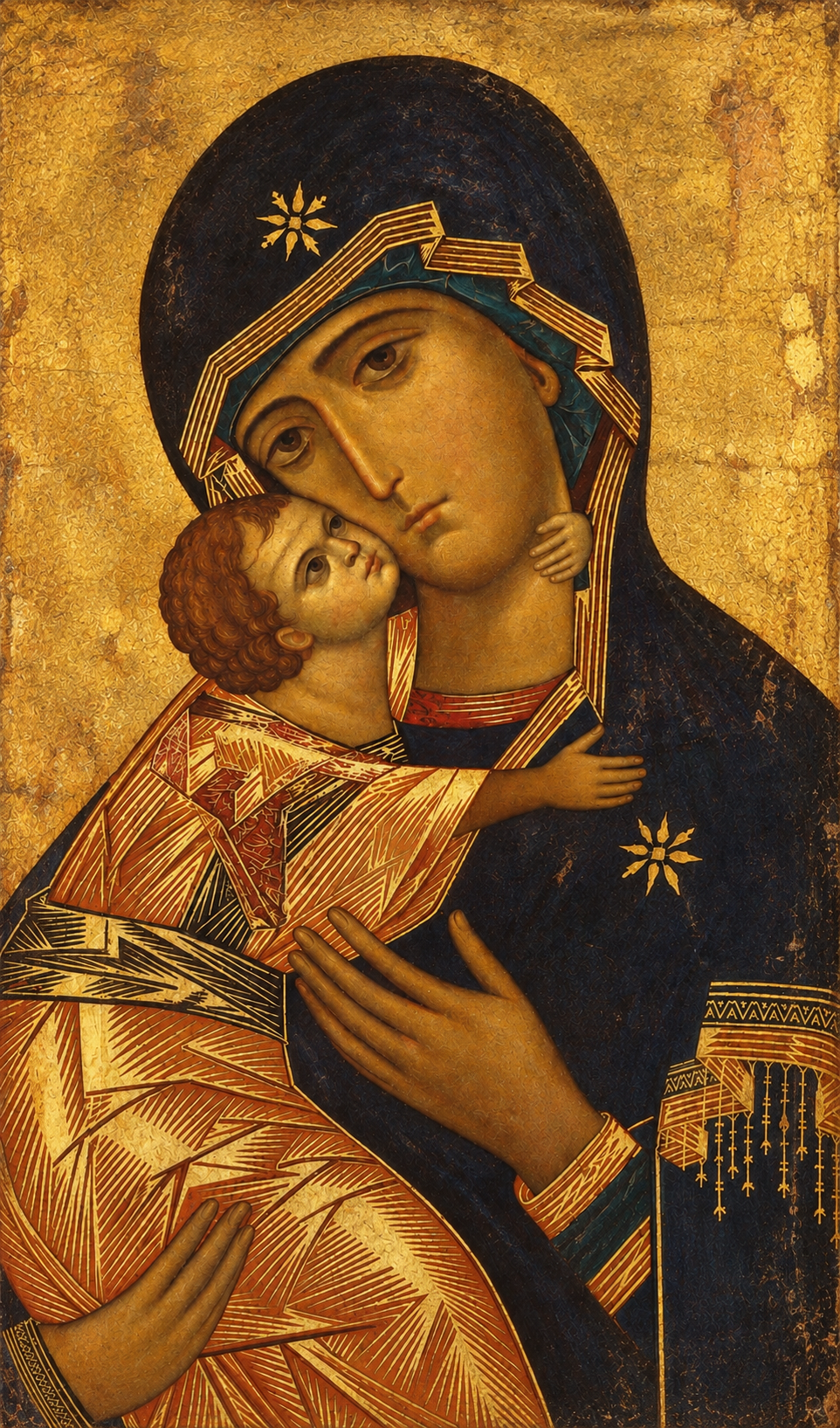
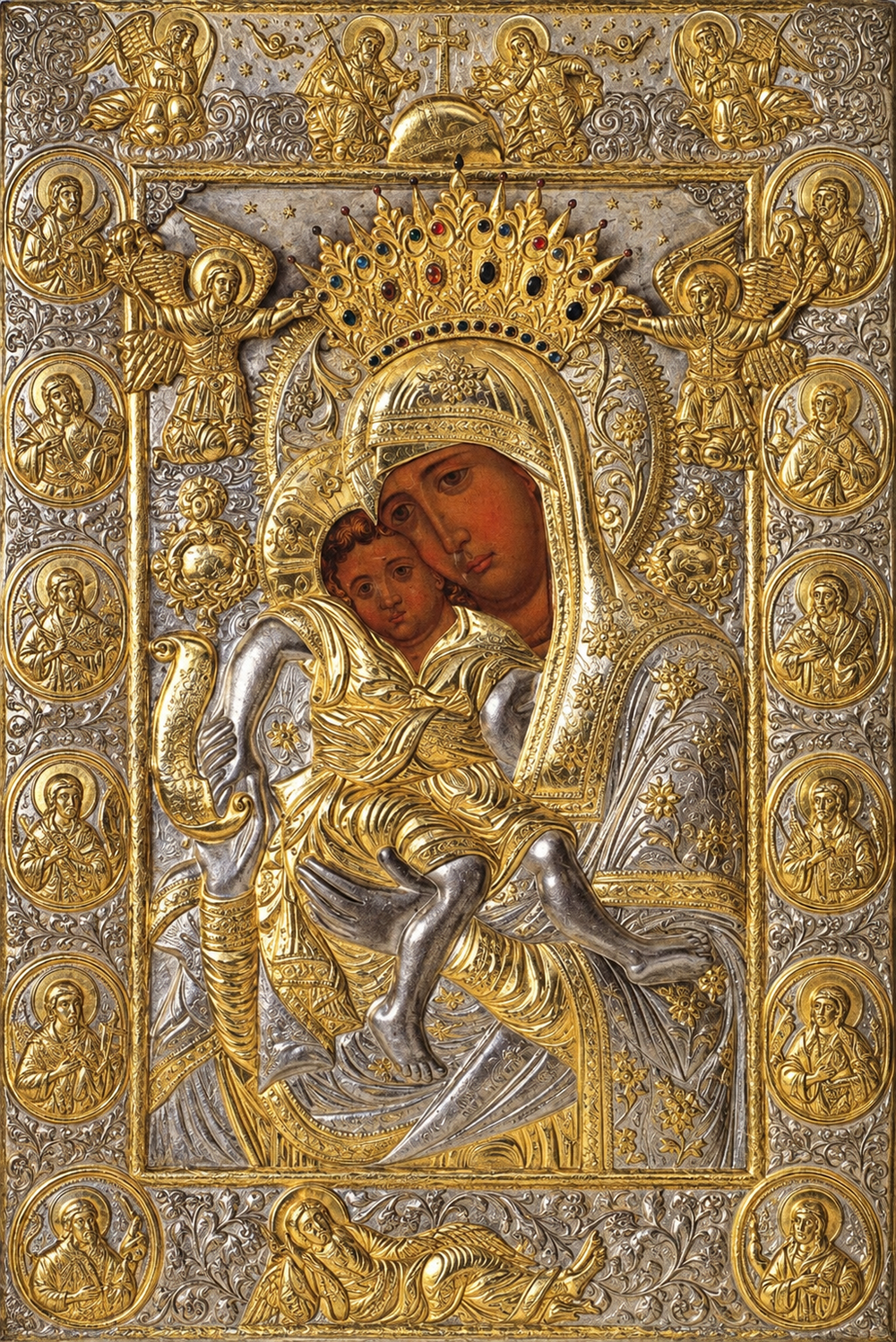
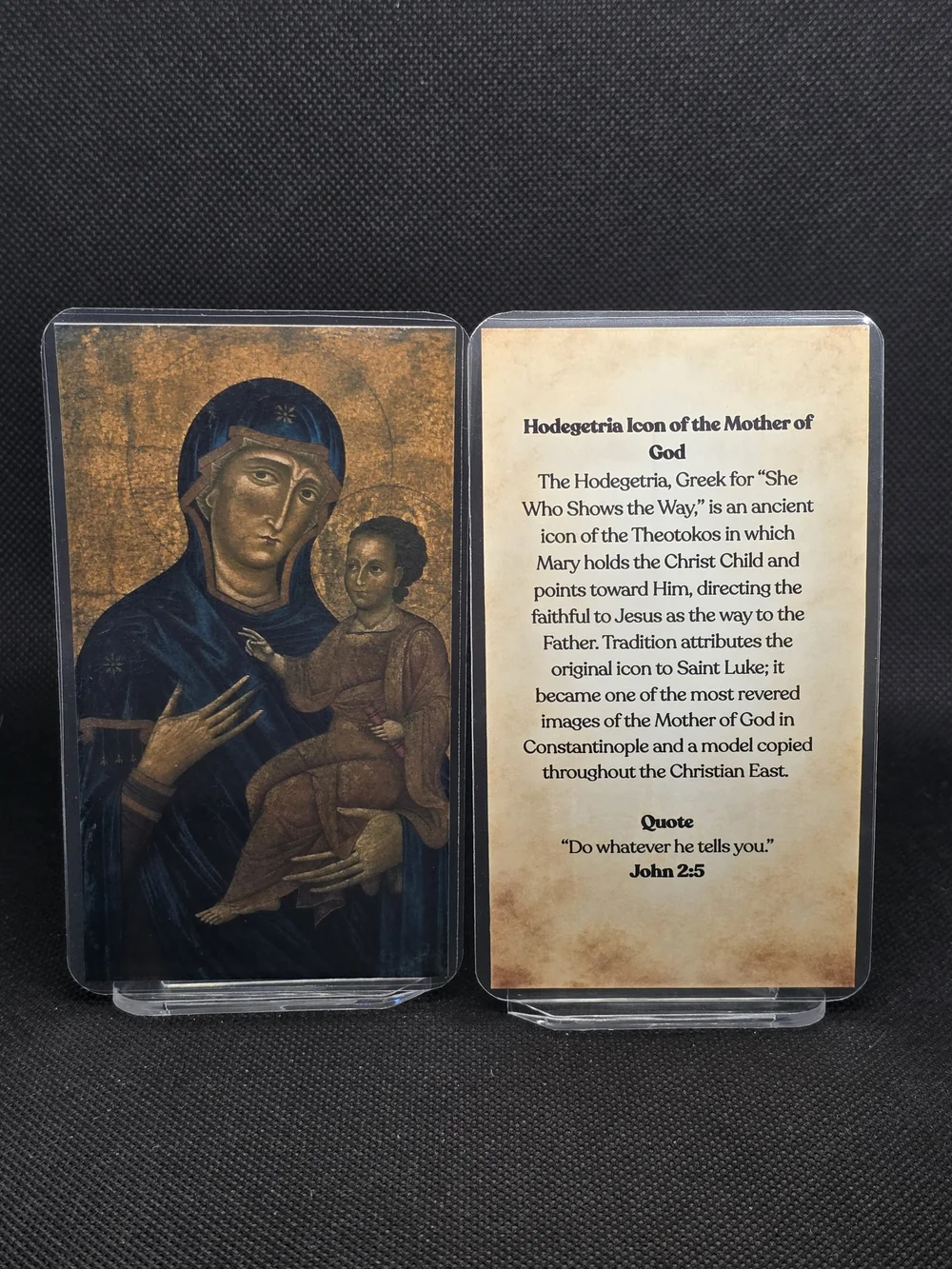
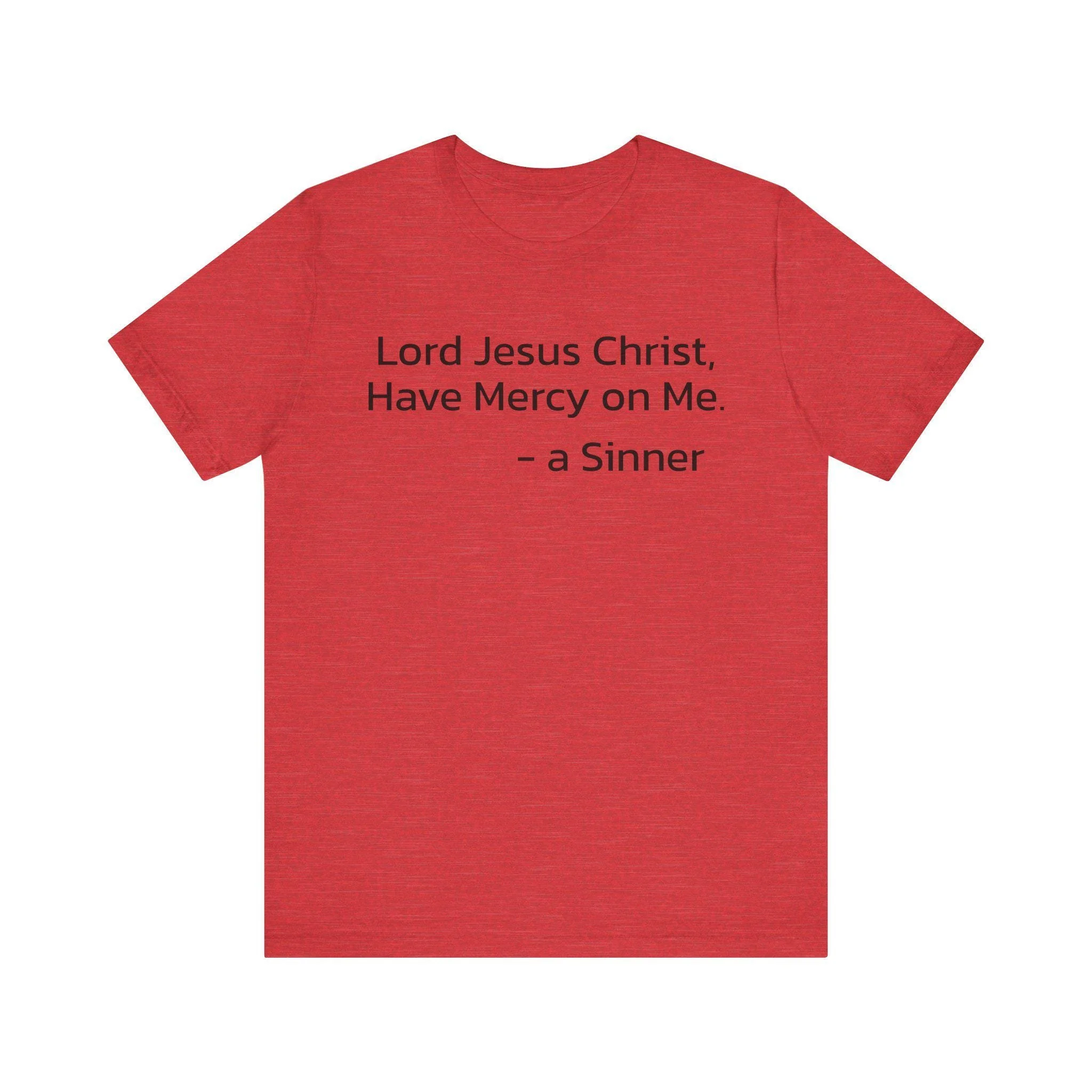
Eastern icons of Mary, honored by Orthodox and Eastern Catholics alike: Vladimir, Axion Estin and the Hodegetria.
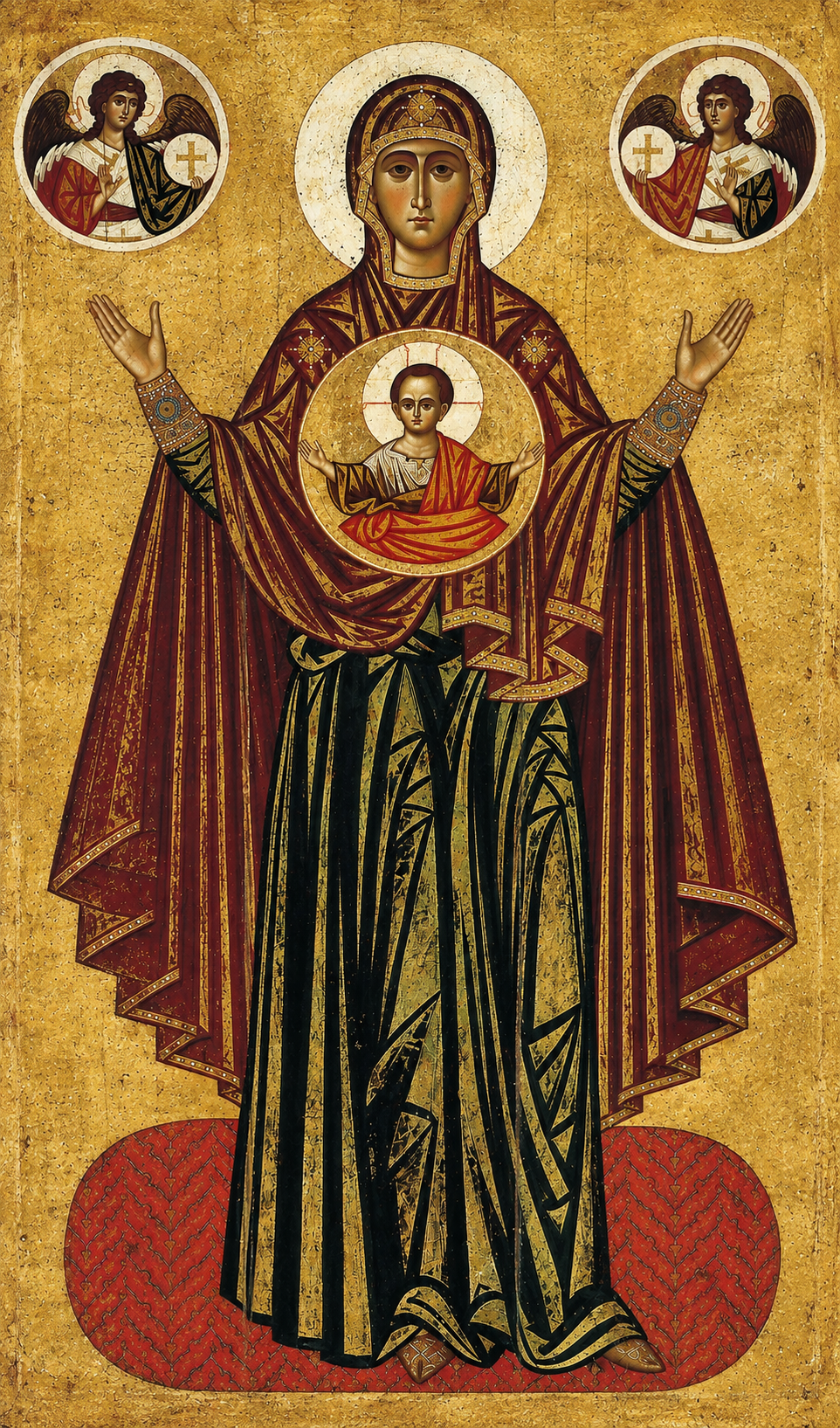
Our Lady of the Sign, Our Lady of Perpetual Help and Saint Nicholas, loved by both East and West.
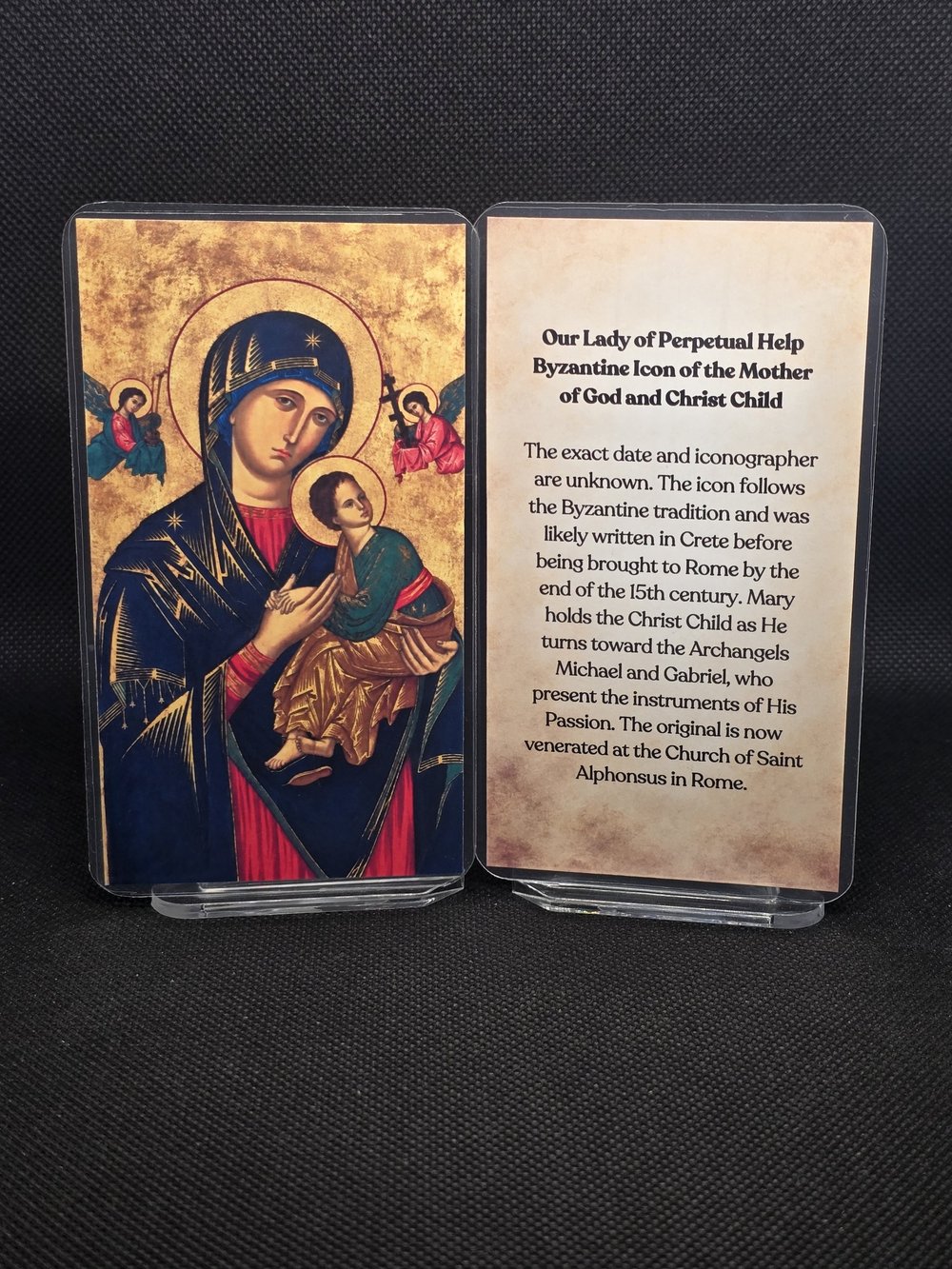
The Jesus Prayer shirt.
More Alike Than It Looks
The sign of the cross goes in different directions, the doctrine of purgatory is framed differently, and the rosary and the prayer rope are different tools. But both Churches pray for their dead, ask the saints to pray for them, honor the Mother of God and make the sign of the cross to confess the Trinity. Learn the differences carefully, and then pray, side by side if you can.
Appendix
