The Chaldean Church: The Complete History of a 1,600-Year-Old Faith the World Forgot
Church History • Eastern Christianity • New Release • The Chaldean Catholic Church
The Chaldean Church: The Complete History of a 1,600-Year-Old Faith the World Forgot
From an apostle on the road to Persia, to a prayer still spoken in the language of Jesus, to a people scattered from Baghdad to Detroit — this is the full story of the Chaldean Catholic Church, and the new book that finally tells it whole.
The Chaldean Church — At a Glance
- Founded
- 1st century, by tradition • Apostle Thomas, with Addai and Mari
- Liturgical Language
- Syriac, a dialect of Aramaic • the language of Jesus
- Communion
- Eastern Catholic Church • full communion with Rome since 1830
- Sister Church
- The Assyrian Church of the East • not in communion with Rome
- Old Mislabel
- “Nestorian” — formally corrected by Rome in 1994
- Greatest Catastrophe
- The Seyfo, 1915–1918 — roughly 70,000 faithful lost
- Modern Catastrophe
- ISIS, 2014 — the Christian heartland of Mosul and Nineveh Plain emptied
- Worldwide Population
- Roughly 1 million • majority now live outside Iraq
- Largest Community
- Metropolitan Detroit, Michigan — over 150,000 faithful
- Current Patriarch
- His Beatitude Mar Paul III Nona, elected April 2026
- Greatest Saint
- Isaac of Nineveh — inscribed in the Roman Martyrology, November 2024
- The Book
- The Chaldean Church: A Complete History from the Apostle Thomas to the Modern Diaspora, by A Servant of God
The Church the World Forgot
There is a prayer that has been spoken in the same language, in the same land, for sixteen hundred years. It is offered at the heart of the Eucharist by a church most Western Christians have never heard of, in a dialect of the very Aramaic that Jesus himself spoke. The church is the Chaldean Catholic Church, and its story is one of the great untold sagas of Christian history: a church that organized itself inside the Persian Empire while Rome was still persecuting believers, that sent missionaries to China seven centuries before Columbus sailed, that was wrongly branded a heretical sect for fifteen hundred years, and that has survived massacre, conquest, and exile right up to our own decade.
Most histories of Christianity look west, from Jerusalem to Rome to Europe. This is the story that looks east, into Mesopotamia and Persia and beyond, and it is every bit as dramatic, as theologically rich, and as soaked in both triumph and suffering as anything in the Western canon. A new book, The Chaldean Church: A Complete History from the Apostle Thomas to the Modern Diaspora, tells this entire arc for the first time in a single accessible volume, written for newcomers and lifelong members of the tradition alike. This article is an introduction to that history, and to the book that tells it in full.

Part II
An Apostle on the Eastern Road
The Chaldean Church traces its founding to the apostle Thomas, the disciple remembered in the Gospel of John for doubting the Resurrection and then making the most complete confession of faith in the New Testament: “My Lord and my God.” In the eastern tradition, Thomas did not stay within the Roman world. He traveled east, toward Persia and India, and the churches strung along that road remember him as their spiritual father.
Alongside Thomas stand two other names: Addai, the evangelist of Edessa, and his disciple Mari, who carried the Gospel deep into Mesopotamia, toward the twin cities of Seleucia and Ctesiphon on the Tigris. These are not merely names in a history book. They are spoken aloud at the center of the Chaldean Eucharist, in the ancient prayer that bears their names — the Anaphora of Addai and Mari — so that every Mass is also an act of memory, reaching back toward the first Christian generation. Few churches on earth keep their origins so close to the altar.
Honest history has to hold two things together here. The apostolic memory is genuine and ancient, central to how this church understands itself. But it cannot be verified the way a modern historian verifies a fact; the earliest solid documentation of organized Christianity in Mesopotamia comes later, in the second century. The book treats this tension carefully, neither dismissing the tradition nor overselling what can be proven. It is exactly the kind of honesty that separates a real history from a devotional pamphlet.
Part III
The Heresy That Wasn’t
For fifteen hundred years, the Church of the East carried a label it never deserved: Nestorian. The charge was that it divided Christ into two separate persons, a heresy condemned at the Council of Ephesus in 431. But the Church of the East was never part of that Roman imperial controversy. It governed itself, across the Persian frontier, and developed its own Syriac vocabulary for the mystery of Christ — a vocabulary built around a term, qnoma, that Greek and Latin theologians mistranslated as “person,” producing centuries of accusation against a church that, in its own language, was saying something orthodox all along.
The theologian who gave this tradition its mature and lasting form was Babai the Great, a seventh-century monk who taught that Christ is “two natures and two qnome united in one parsopa,” one person. Modern scholarship, especially the work of Sebastian Brock, has shown that qnoma does not mean person at all — it means a concrete, actual instance of a nature. Babai was guarding both the full divinity and the full humanity of Christ in a single person, using more precise language than Greek or Latin possessed.
“We confess one Lord Jesus Christ, true God and true man, perfect in his divinity and perfect in his humanity, united in one person, without confusion or change, without division or separation.”Common Christological Declaration, Pope John Paul II and Patriarch Mar Dinkha IV, 1994
In 1994, Rome and the Assyrian Church of the East signed a declaration that formally ended the ancient charge of heresy, acknowledging that the divisions of the past rested largely on misunderstanding. The book devotes a full chapter to walking through this theology in plain English — not as an academic exercise, but because understanding it is the key to understanding why this church was wronged by history, and how that wrong has finally, in our own lifetime, begun to be righted.
Part IV
The Mystics: Ephrem and Isaac of Nineveh
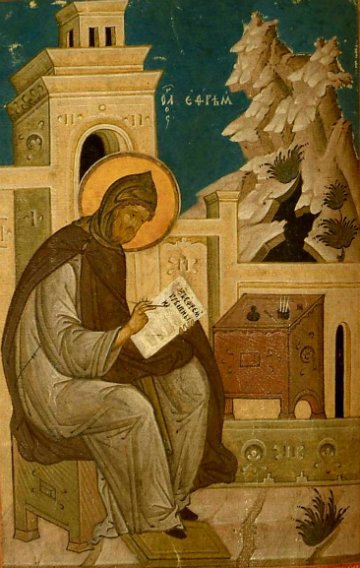
No church this size has produced spiritual writers of greater stature. Saint Ephrem the Syrian, a fourth-century deacon and poet of Edessa, wrote hymns so theologically rich and so beautiful that he is honored as a Doctor of the Church even by traditions that have never resolved their differences with the East Syriac church he belonged to. His hymns are still sung in the Chaldean liturgy today, unbroken across seventeen centuries.
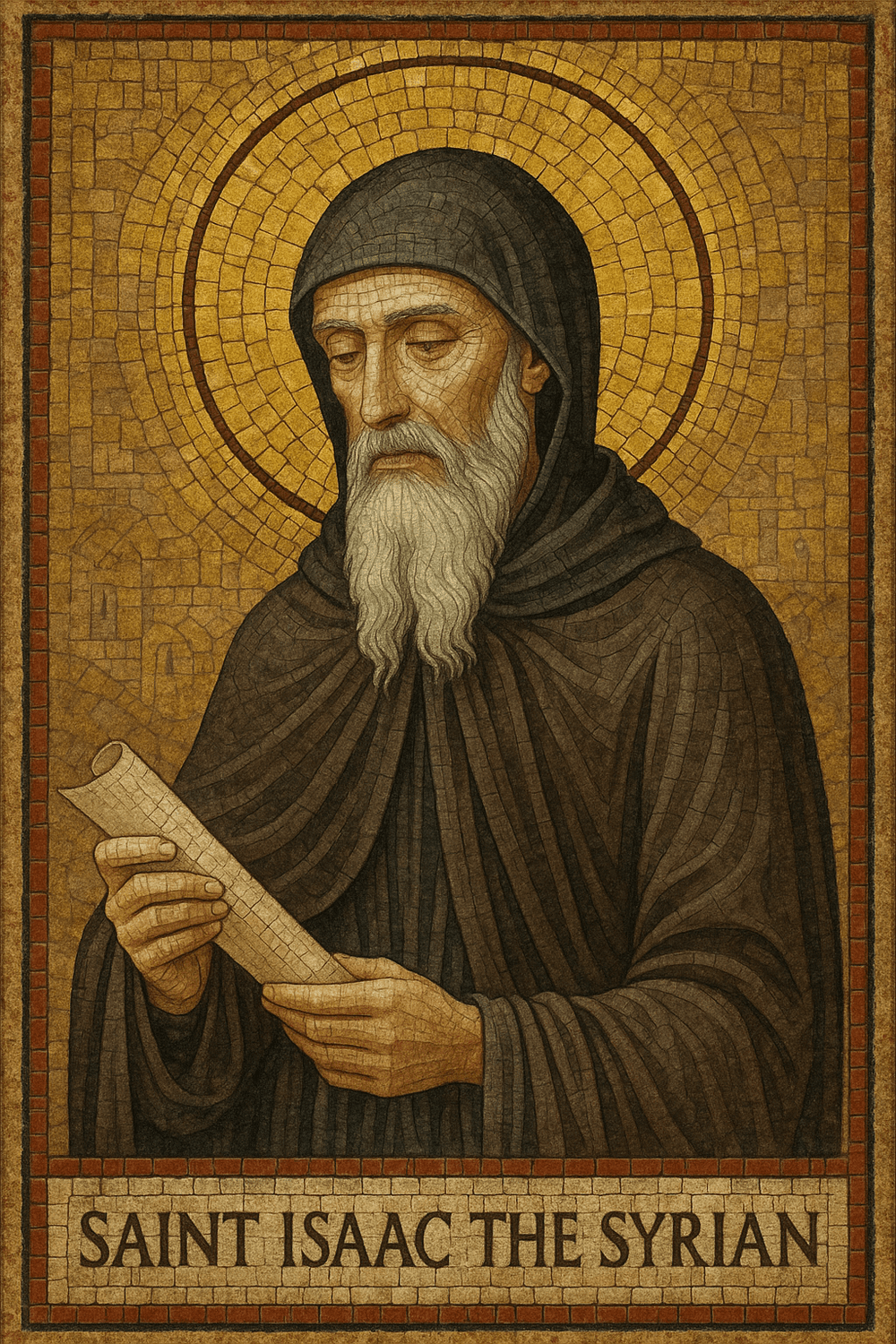
And then there is Isaac of Nineveh, known as Isaac the Syrian, a seventh-century monk whose writings on prayer, solitude, and the boundless mercy of God have been read on Mount Athos, by Russian monastics, and now, after his formal inscription in the Roman Martyrology in November of 2024, by Catholics with the Church’s own blessing. Few moments better capture this church’s long vindication than a saint once associated with the supposed heresy of his church being named, by Rome itself, among the venerated fathers of his tradition.
The book traces this mystical inheritance in detail — not only Ephrem and Isaac, but lesser-known figures like John of Dalyatha and Joseph Hazzaya, whose writings on the interior life remain treasures waiting to be discovered by readers outside the Chaldean and Orthodox worlds.
Part V
From Baghdad to China
At its medieval height, the Church of the East was almost certainly the most geographically extensive Christian body on earth, with some thirty metropolitan provinces and around two hundred dioceses stretching from the Mediterranean to the Pacific. A stone monument still stands in the Chinese city of Xian, carved in the year 781, recording the arrival of Christian missionaries at the imperial Tang court — missionaries who were monks of this same Mesopotamian church.
Under the early Abbasid caliphs, East Syriac Christians became indispensable to the intellectual life of Baghdad, serving as physicians, administrators, and above all as the translators who carried Greek philosophy and medicine into Arabic, and from there eventually into medieval Europe. It was a confident, learned, outward-looking church at the center of the medieval world.
Then came catastrophe. The conversion of the Mongol rulers to Islam and, above all, the devastating campaigns of Timur at the end of the fourteenth century, shattered this continent-spanning network almost beyond recovery. By the fifteenth century, a church that had reached China was reduced to a remnant clinging to the mountains of its Mesopotamian homeland. The book tells this entire rise and fall as one continuous, gripping narrative — the kind of history that reads, in places, like an adventure story, because it was one.
Part VI
A Church Divided Against Itself
How did a Catholic church emerge from this ancient eastern tradition? Not cleanly, and not all at once. In 1552, a reforming party within the Church of the East, frustrated by a hereditary patriarchate passed down within a single family, sent a monk named Yohannan Sulaqa to Rome seeking recognition as an alternative patriarch. He got it — and was dead within two years, killed in the conflict his own union with Rome had helped provoke.
What followed was nearly three centuries of bewildering complexity: rival patriarchal lines, unions made and broken, a church split not once but several times over. The book does not simplify this tangle into a tidy story; it walks the reader through the real, messy history, line by line, until the final settlement in 1830, when Rome recognized a single Chaldean patriarch and the modern church took its definitive shape. This is some of the most fascinating and least-known church history available anywhere — the kind of material that makes you wonder why no one has told this story properly until now.
Part VII
The Sword: Seyfo and the First World War
In the Aramaic of the Chaldean and Assyrian people, there is a single word for what happened to them between 1915 and 1918: Seyfo, the sword. In the same years and as part of the same catastrophe that destroyed the Armenians, the Christians of Mesopotamia were massacred and deported on a scale that nearly ended their presence in their own homeland. A detailed survey from 1913 had counted over a hundred thousand Chaldean faithful; church estimates suggest some seventy thousand of them did not survive the war.
This is not a footnote in the Chaldean story. It is one of its defining wounds, and the book treats it with the gravity it deserves — honest about the uncertainty of the numbers, unflinching about the scale of the loss, and clear about how a once-thriving, educated, modernizing church was forced to rebuild itself almost from nothing in the years that followed.
Part VIII
Becoming Iraqi, and Losing Iraq
Rebuilt after the Seyfo, the Chaldean Church became, across the twentieth century, deeply woven into the life of the new Iraqi state, centered increasingly on Baghdad. For decades it lived a difficult but real security under authoritarian governments that tolerated, even if they never fully equalized, their Christian citizens.
That security collapsed after 2003. Church bombings, kidnappings, and assassinations targeted the community for over a decade. Father Ragheed Ganni was murdered in Mosul in 2007 for refusing to close his church. Archbishop Paulos Faraj Rahho was abducted and died in captivity in 2008. Fifty to sixty worshippers were slaughtered at the Cathedral of Our Lady of Salvation in Baghdad in 2010. And in 2014, the Islamic State seized Mosul and the Nineveh Plain, emptying a Christian presence that had endured for over a thousand years in a matter of days. The book tells this whole terrible decade plainly, honoring the martyrs without sensationalizing their suffering.
Part IX
The Modern Martyrs
Father Ragheed Ganni had studied in Rome and could have stayed anywhere in safety. He chose to return to Mosul, and when gunmen ordered him to stop celebrating the Holy Qurbana, he refused. He was murdered alongside three subdeacons on the third of June, 2007. His cause for beatification has completed its diocesan phase and is now under examination in Rome.
These are not distant, medieval martyrs. They are figures within living memory, men whose families and parishioners are alive today, scattered now between Iraq and the diaspora. The book gives their stories the space and the care they deserve, alongside the ancient martyrs of the Persian persecutions who gave this church its first and deepest instinct: that the faith might cost everything, and is worth it regardless.
Part X
Detroit, San Diego, and a Church Scattered
Today, more Chaldeans live outside Iraq than inside it. The largest concentration of Chaldeans anywhere in the world — homeland included — is in metropolitan Detroit, where immigrants drawn by Henry Ford’s factories a century ago built, instead, a network of family-owned grocery stores that became the economic engine pulling in wave after wave of new arrivals. Detroit, San Diego, Toronto, and Sydney now anchor a worldwide Chaldean community of roughly a million people.
This dispersal raises a question every diaspora family knows in its bones: how do you raise children who speak English, who have never seen Iraq, to still feel Chaldean — to still pray in Syriac, to still know the saints, to still marry within the faith and raise the next generation inside it? It is a question of marriage and family every bit as much as one of liturgy and language, and it is one many Chaldean families wrestle with quietly, generation after generation, far from their ancestral villages.
For couples navigating exactly this kind of pressure — holding a marriage and a family together across cultural distance, generational change, and the strain of displacement — our Christian marriage coaching, grounded in Ephesians 5:25 and the vision of marriage as worship, offers guidance for building a marriage strong enough to carry a faith forward into the next generation.
Part XI
A New Patriarch, an Open Question
In April of 2026, the Chaldean Synod elected a new patriarch: Amel Shamoon Nona, who took the name Paul III. Born in Alqosh, the ancient heartland of the church, he had served as archbishop of Mosul until the Islamic State invasion forced him into exile with his entire flock, and then ministered for over a decade to the Chaldean diaspora of Australia. Few men alive have lived both halves of the modern Chaldean experience as fully as he has.
He took as his motto words from the Gospel of Mark: Do not be afraid; only believe. It is hard to imagine a more fitting word for a church standing, as it does right now, between a wounded homeland and a determined diaspora, between sixteen centuries of survival and a future that remains genuinely open. The book’s final chapters bring the reader fully into this present moment — not with false comfort, but with the same honesty that runs through the whole history.
Part XII
About the Book
The Chaldean Church: A Complete History from the Apostle Thomas to the Modern Diaspora is the first single-volume history to tell this entire story from beginning to end — the apostolic origins, the misunderstood theology, the monastic mystics, the medieval expansion to China, the centuries of division and reunion with Rome, the Seyfo, the Iraqi century, the modern persecution and martyrs, the worldwide diaspora, and the church’s faith and worship as it is actually lived today.
It is written for two readers at once: the newcomer who has never heard of the Chaldean Church and wants a clear, honest introduction, and the lifelong Chaldean Catholic who wants to go deeper into the history behind the liturgy they have prayed their whole life. It does not flinch from hard history — the contested schisms, the catastrophic massacres, the honest uncertainty in parts of the record — but it tells the story with the reverence and the narrative drive that a sixteen-hundred-year survival deserves.
Part XIII
Prayer Cards for the Saints of This Tradition
The saints of the East Syriac and Chaldean tradition are not distant figures locked in a history book. They are intercessors whose prayer cards can accompany your own devotion today. Below are two of the tradition’s greatest fathers, both treated at length in the book.
Part XIV
Frequently Asked Questions
Sixteen Centuries. One Prayer. A Story Finally Told Whole.
The Chaldean Church has survived the Persian Empire, the armies of Timur, the Seyfo, and the Islamic State. It has been wrongly called heretical for fifteen hundred years and formally vindicated in our own lifetime. It has been scattered from Mosul to Detroit and is led today by a patriarch who lived through the worst of it himself. This is one of the great surviving stories in all of Christianity, and now, for the first time, it has been told completely, in one book, from the apostle on the eastern road to the question the church faces right now.
Read the whole story. Carry the saints who lived it with you.
Get The Chaldean Church on Amazon →