Who Are the Saint Thomas Christians? The Astonishing 2,000-Year History of the Syro-Malabar Church
Church History • Saints of Kerala • The Apostle Thomas • A Living Tradition Two Thousand Years Old
Who Are the Saint Thomas Christians? The Astonishing 2,000-Year History of the Syro-Malabar Church
An apostle who would not believe until he touched the wounds sailed east anyway, farther than any of the others, and planted a Church on the Malabar coast of India that still prays in the language close to the one Jesus spoke. This is the complete story of the Syro-Malabar Church — the saints, the wounds, the survival, and the family now scattered from Kerala to Chicago to Dubai who carry it forward.
The Syro-Malabar Church — At a Glance
- Founded
- Traditionally AD 52, by the Apostle Thomas on the Malabar coast of Kerala, India
- Members Today
- Approximately 4.5 to 5 million, the largest Eastern Catholic Church in Asia
- Liturgical Rite
- East Syriac Rite • Anaphora of Addai and Mari • same family as the Chaldean Catholic Church
- Liturgical Language
- Primarily Malayalam today, with surviving Syriac hymns and acclamations
- Communion
- Full communion with Rome • self-governing Major Archiepiscopal Church since 1992
- Current Major Archbishop
- Cardinal Raphael Thattil, elected 2024
- Canonized Saints
- Alphonsa (2008) • Chavara (2014) • Euphrasia (2014) • Mariam Thresia (2019)
- Defining Identity
- “Indian in culture, Christian in faith, Syriac in worship”
- Historic Wound
- The Synod of Diamper (1599) • The Coonan Cross Oath (1653)
- Global Diaspora
- Chicago, Houston, New York/NJ, Seattle, Toronto, Melbourne, the UK, and the Persian Gulf
A Sunday Morning in Chicago, and Two Thousand Years Behind It
On a Sunday morning in a western suburb of Chicago, the parking lot of the Mar Thoma Sleeha Cathedral fills slowly with families. The men wear shirts and pressed trousers. The women arrive in saris of deep red and gold, the older ones with a thin veil drawn over the hair. Children spill out of minivans. Inside, the air is cool and smells faintly of incense and of the flowers banked around the altar. To a visitor who wandered in by accident, it might look at first like any large American Catholic church. Then the singing begins, and the visitor knows at once that they have crossed into another world.
The chant is not in English, nor in Latin. Some of it is in Malayalam, the rolling, vowel-rich language of Kerala, the home state of nearly everyone in the room. And some of it, the oldest part, is in Syriac, a dialect of Aramaic that has been sung in worship for longer than almost any living language has existed. When the people answer the priest, their response carries the same word a worshipper in Mesopotamia would have spoken fifteen hundred years ago.
This is the Holy Qurbana, the central act of worship of the Syro-Malabar Church. To attend it is to step into one of the most ancient living liturgies on the planet, carried not by a handful of scholars in a museum but by ordinary families, doctors and nurses and engineers, who drove to that cathedral the way their grandparents once walked to a church in Kerala. If you are one of those families, if you have ever sat in a pew like that one and felt the chant in your bones even when you could not translate every word, this article is written for you. You belong to something almost unimaginably old, and very few people outside your own community know just how remarkable your story really is. We want to change that.
Part II
The Apostle Who Doubted, Then Went Farthest
Every people has a founding story, and the Saint Thomas Christians have one of the most striking in all of Christendom. They believe that the apostle Thomas, the one the Gospel of John remembers for his doubt and then for his overwhelming confession, “My Lord and my God,” did not stay near the Mediterranean as most of the other apostles did. They believe he sailed east, following trade routes that already carried pepper and spices between India and the Roman world, and landed on the Malabar coast of what is now Kerala in the year 52. There, tradition holds, he preached, made converts among Brahmin families and others, founded seven and a half churches, and was at last martyred near Mylapore around the year 72.
The honest historian must say that none of this can be proved the way a modern court would demand. There is no first-century inscription that places Thomas in India. The earliest written account of his Indian mission, the Acts of Thomas, was composed in Syriac in the early third century, well over a hundred years after the events it describes. But caution is not the same as dismissal. The sea route between the Red Sea and the ports of southwestern India was busy and well documented in the first century. Jewish merchants had already settled on that coast generations earlier, which means a Jewish missionary would have found both a familiar community and a reason to go. And the persistence of the tradition is itself a kind of evidence: this is a people that has held to this memory for two thousand years, through conquest and colonization and every pressure to forget, and communities do not usually invent and then die for a memory out of nothing.
Whatever the precise truth about the apostle himself, one fact is beyond dispute: there was an organized, self-aware Christian community on the Malabar coast at a very early date, already ancient when the first Portuguese ship appeared on the horizon in 1498. The cross this community venerated tells the story in a single image. The Saint Thomas Cross, the Mar Sliva, carved in stone in their oldest churches, bears no figure of the suffering Christ. It is a cross of the Resurrection, rising from a lotus, with a dove of the Holy Spirit descending. The absent body was not a denial of the crucifixion. It was an Eastern Christian instinct, shared with the ancient churches of Syria and Mesopotamia, to proclaim the triumph over death rather than dwell on the agony, and the lotus beneath it was the unmistakable signature of India. Indian in culture, Christian in faith, Syriac in worship — the three threads were already woven together in a single carved stone.
Part III
A Church of the East, Long Before Rome Arrived
For most of their history, the Saint Thomas Christians were not connected to Rome at all. Their bonds ran east. Their bishops came from, and their liturgy belonged to, the great Church of the East, headquartered in the Persian Empire, in lands that are today Iraq and Iran. When a Malabar Christian sang the Trisagion or prayed the ancient Anaphora of Addai and Mari, named for two of the seventy disciples, they were joined invisibly to communities stretching across Persia and along the Silk Road as far as China. The Saint Thomas Christians were the southern wing of a vast Asian Christianity the Western world has largely forgotten.
Here we must address a word that has caused this Church a great deal of grief: “Nestorian.” The Church of the East was long mislabeled this way, accused of denying that Mary was truly the Mother of God. Modern scholarship has dismantled the charge. The East Syriac tradition simply used technical terms that did not map neatly onto Greek and Latin vocabulary, and when theologians sat down in the twentieth century and translated carefully, they found the same orthodox faith confessed in different words. In 1994 a joint declaration between the pope and the patriarch of the Assyrian Church of the East formally acknowledged this shared faith. The Saint Thomas Christians had never been heretics. They had only been misread — and the misreading would soon cost them dearly.
Part IV
The Synod That Tried to Erase a Heritage
In 1498 the Portuguese explorer Vasco da Gama dropped anchor near Calicut, and the long isolation of the Saint Thomas Christians ended. The goodwill did not last. Portuguese clergy, steeped in the suspicions of their age, decided that an Indian Church praying in Syriac and answering to a patriarch in Mesopotamia must be heretical, and the pressure mounted through the sixteenth century.
It came to a head in June of 1599, when the archbishop of Goa, Aleixo de Menezes, convened a synod at Udayamperur, called Diamper by the Portuguese. Over six days, the synod required the community to renounce its patriarch, condemned its Syriac manuscripts, and imposed Latin devotions and discipline on a Church that had never known them. Imagine an ordinary priest at that synod, raised to chant the Qurbana in Syriac, now told by a foreign archbishop that the prayers of his childhood were errors to be confessed and abandoned. Imagine a woman in a village finding the familiar prayers altered the following Sunday, a crucifix with a suffering body where the cross of the Resurrection had stood. Whether or not every manuscript was truly burned, as some later accounts dramatically claimed, the heritage itself was placed under sentence, and a people who had been masters of their own spiritual house became, almost overnight, subjects in someone else’s.
Part V
The Bent Cross: When a People Said No
For half a century after Diamper, resentment deepened in silence. Then, in 1653, a bishop named Ahatallah arrived from the Middle East claiming authority over the Malabar Christians. The Portuguese seized him at Cochin and put him on a ship; he was never seen again. The rumor spread that he had been killed, and the long-suppressed fury of a whole people found its moment.
On January 3, 1653, thousands gathered at the church of Mattancherry around a tall stone cross. The crowd was so great that not all could touch the cross itself, so they tied long ropes to it and held the ropes, and with hands on the cross or the cords bound to it, they swore that they would no longer obey the Portuguese archbishop. Under the weight and pressure of the multitude, tradition says, the stone cross itself bent. Of perhaps two hundred thousand Saint Thomas Christians, only a few hundred remained loyal to the Portuguese in the immediate aftermath. It is one of the most extraordinary scenes in the history of Indian Christianity: a whole community rising at once to reclaim its soul.
The story did not end there. Rome, alarmed at losing an entire community, sent gentler Carmelite friars rather than more Portuguese Jesuits, and within a few years the larger part of the community reconciled to Rome while keeping its Eastern liturgy intact. That reconciled body is the direct ancestor of today’s Syro-Malabar Church. Communion with Rome and fidelity to the East, it turned out, were not incompatible after all. The Portuguese had simply never tried it the gentle way.
Part VI
Chavara of Mannanam: The Reformer Who Rebuilt a Church
Every great tradition produces, at the moment of its need, a figure who gathers its scattered strength and gives it new life. For the nineteenth-century Saint Thomas Christians, that figure was Kuriakose Elias Chavara. In 1831, at Mannanam, he founded the first indigenous religious congregation for men in the Indian Church, the community that became the Carmelites of Mary Immaculate. In 1866 he co-founded the first indigenous congregation for women, the Congregation of the Mother of Carmel. He insisted that a school stand beside every church, that education reach the poor as well as the privileged, and he founded one of the region’s first printing presses, helping to seed the extraordinary literacy for which Kerala would later become famous.
He died on January 3, 1871 — the anniversary, as it happened, of the Coonan Cross Oath that had so shaped his people. He was canonized a saint by Pope Francis in 2014, honored as a father of modern Malayali Catholic identity, proof that to be fully Indian and fully Catholic and fully Eastern was a wealth of gifts, not a burden of contradictions.

Part VII
The Saints of Kerala: Alphonsa, Euphrasia, and Mariam Thresia
The renewal that Chavara began bore an astonishing harvest. Within little more than a century, the Syro-Malabar Church gave the universal Church a remarkable cluster of canonized saints, most of them women, most drawn from the very congregations that nineteenth-century renewal had founded. To meet them is to understand what this Church values, and how it understands the path to God.
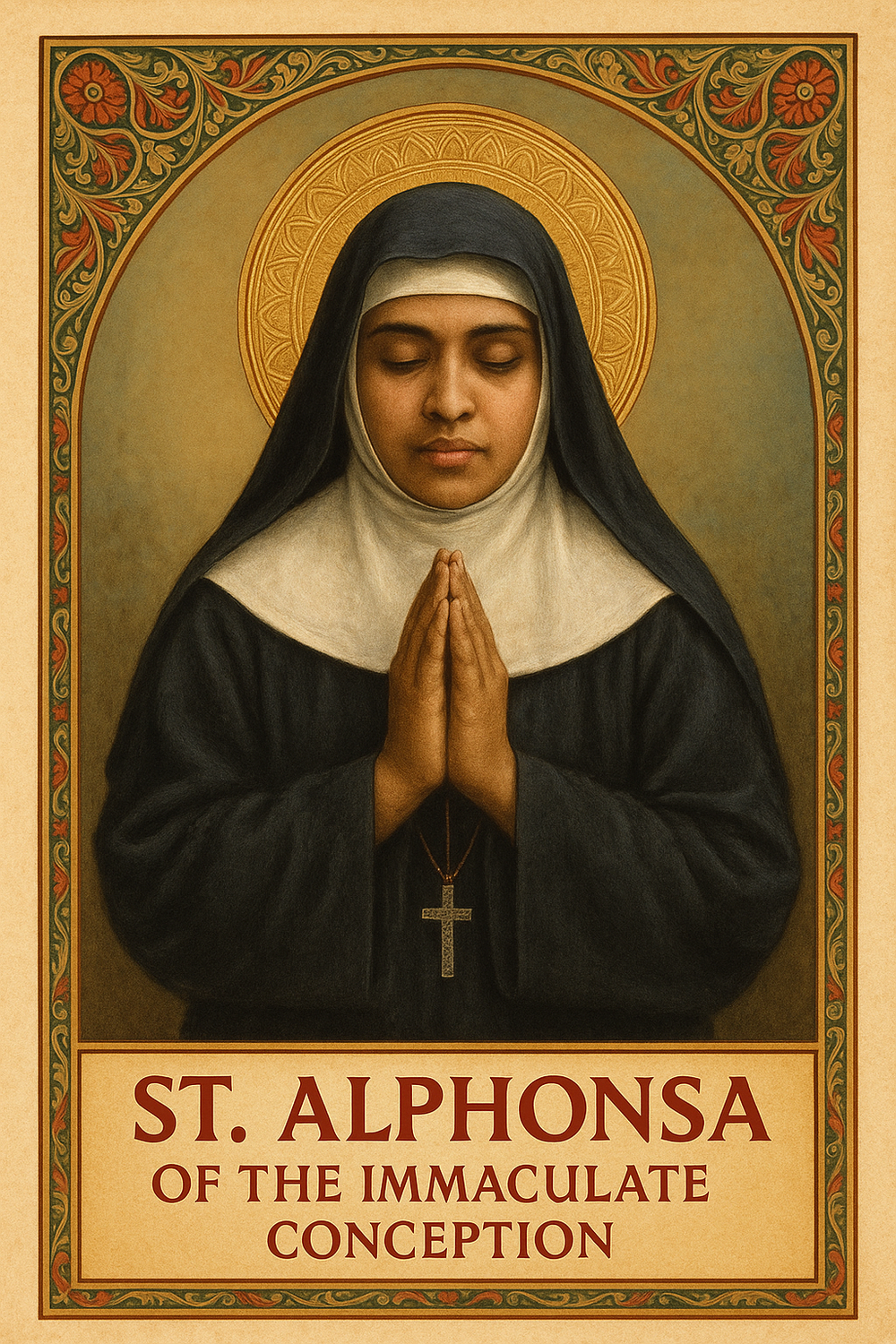
Born Anna Muttathupadathu, she entered the Franciscan Clarist Congregation and suffered chronic illness for years, bearing it with a patience and joy that those around her found luminous. She died at thirty-six. In 2008 she became the first woman of Indian birth ever canonized. Her shrine at Bharananganam draws pilgrims from across the world, and she is invoked especially by the sick, the suffering, and families praying for their children.
Born Rose, she entered the Carmelite congregation Chavara had helped to found and became known as the Praying Mother. The sisters called her a mobile tabernacle for the sense of divine presence she seemed to carry. Bishops and ordinary people alike sought her prayers and counsel. She is a reminder that in this tradition the contemplative who prays in silence is honored as highly as the founder who builds schools.
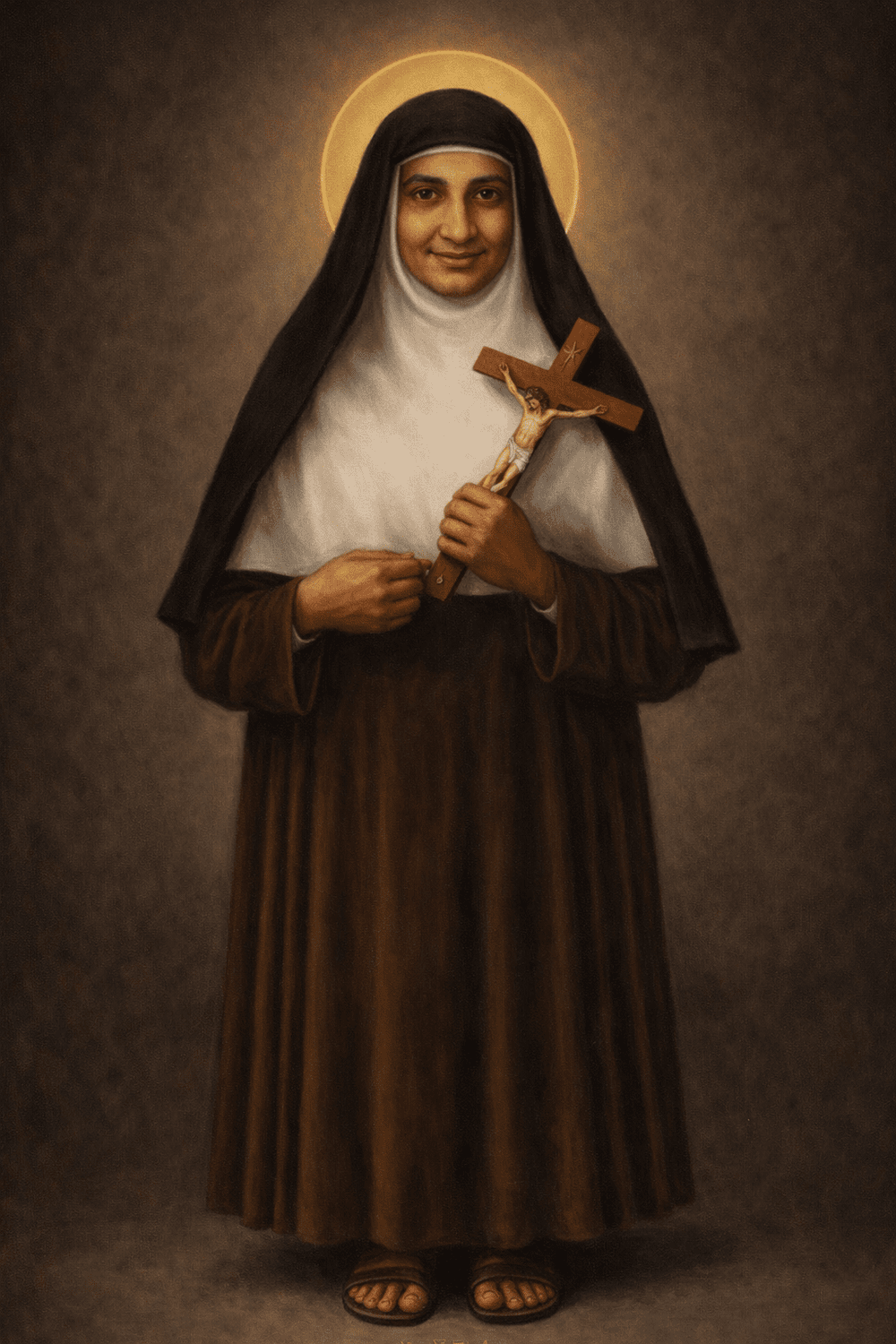
From childhood she knew mystical experiences and a longing for solitude and penance. In 1914 she founded the Congregation of the Holy Family, an order devoted to education, care of the sick, and the strengthening of the home as a school of faith. She is honored as an apostle of the family, one who understood the household itself as a place where holiness is made or lost.

Part VIII
Inside the Qurbana: What Syro-Malabar Worship Actually Looks Like
The Holy Qurbana is not merely a service the Saint Thomas Christians attend. It is the act that makes them what they are. The sanctuary at the east end, often set apart by a veil, signifies heaven; the nave where the people stand is the world on pilgrimage. Brass oil lamps, the nilavilakku, burn before the altar, the same kind that stands in homes across Kerala, here crowned with a cross. The central prayer is the Anaphora of Addai and Mari, one of the oldest Eucharistic prayers in continuous use anywhere in the world, shared with the Chaldean Catholic Church of Iraq.
This prayer, in its most ancient form, does not contain the explicit words of institution that a Western Catholic expects at the heart of the Mass. In 2001 the Vatican, after careful study, gave a remarkable ruling: the Anaphora of Addai and Mari is valid even without those explicit words, because the words and intention of Christ are present throughout the prayer in a dispersed and implicit way, and because it is one of the most venerable liturgies of the apostolic age. It was a striking affirmation by Rome itself of the very tradition the Portuguese had once condemned as heretical.
This worship does not stay in the church. In countless Saint Thomas Christian homes a small prayer corner holds images of Christ, the Virgin, and the saints, especially the beloved Alphonsa, with the brass lamp lit each evening as the family gathers. The home is, as Chavara taught, a domestic church, a little sanctuary where faith is handed from one generation to the next.
Part IX
Across the Waters: The Global Syro-Malabar Family Today
In the second half of the twentieth century the Saint Thomas Christians did something their ancestors had never done on such a scale. They left Kerala in great numbers, carrying their faith with them. Today the Syro-Malabar Eparchy of Chicago, established in 2001, the first such diocese outside India, counts tens of thousands of faithful across more than fifty parishes. Full dioceses now serve Great Britain, centered at Preston since 2016; Canada, centered at Mississauga; and Australia, centered at Melbourne since 2013. Hundreds of thousands more worship within Latin Catholic parish structures across the Persian Gulf states, where no separate Syro-Malabar diocese is permitted.
Every one of these communities began the same way: a handful of homesick families gathering for the Qurbana in a borrowed hall, growing year by year, until a building was bought and a bishop appointed. What began as homesickness in a living room became, within a generation, a cathedral. If your family is part of that story, in Chicago or Houston or Dubai or Toronto, you are living the latest chapter of something the apostle began two thousand years ago. The lamp your grandmother lit in Kerala is the same lamp now lit in your own home, wherever that home happens to be.
Apostle Thomas, you would not believe until you touched the wounds, and then you went farther than any of the others to tell what you had touched. Watch over the Church you planted on the Malabar coast, and over every family who carries it now, in Kerala and across the world. Keep the lamp lit in their homes. Keep the chant alive on their children’s tongues. Through your intercession, and through the intercession of Saints Alphonsa, Chavara, Euphrasia, and Mariam Thresia, may this ancient and faithful people never cease to be wholly themselves.
A devotional reflection inspired by the Saint Thomas Christian tradition, not an official liturgical text.
Part X
Going Deeper: The Complete History in One Volume
Everything in this article is a doorway. The full story, the one that cannot fit into a single page, has now been written in a complete book: The Saint Thomas Christians: A History of the Syro-Malabar Church. It carries the narrative from the apostle’s arrival in AD 52 through the wound of Diamper, the defiance of the Coonan Cross, the flowering of saints, the long road back to self-government, the modern liturgical disputes that reached the desk of Pope Francis himself, and the global diaspora now scattered from Chicago to Melbourne to the Gulf. It also walks through four composite family portraits, drawn from the recognizable patterns of the community, so that the history lands not just as fact but as something readers will recognize as their own.
This is not a dry academic survey. It is written in clear, accessible prose, honoring the tradition and being honest about its hard chapters, trusting the reader to weigh the evidence for themselves. It is a book a Malayali grandmother could hand to her grandson in Chicago and know that he would finally understand, in full, the inheritance he carries.

Whether you trace your own family to a village near Kottayam, to a parish in Chicago, or to a borrowed hall in the Gulf, this is your history, told in full and told with the respect it deserves. We hope you feel seen in every page.
Frequently Asked Questions
The Syro-Malabar Church — Questions & Answers
An Apostle Sailed East. Two Thousand Years Later, the Lamp Is Still Lit.
The Saint Thomas Christians have survived the decline of their mother Church, the trauma of Diamper, the fire of invasion, and every pressure across two thousand years to forget who they are. They have not forgotten. They have produced saints, rebuilt their schools, governed themselves once more, and carried their ancient worship to every continent. If this is your story, we hope this article made you feel, even for a few minutes, truly seen.
To read the whole of it, from the apostle on the beach to the cathedral in Chicago, the full history is now written in one volume.
Get The Saint Thomas Christians on Amazon →