The Maronite Church: The Orthodox Christians Who Missed the Great Schism Entirely
Church History • Eastern Catholicism • The Great Schism • Communion with Rome
The Maronite Church: The Eastern Christians Who Missed the Great Schism Entirely
While Rome and Constantinople excommunicated each other in 1054, a community of Syriac Christians in the mountains of Lebanon had already been cut off from both cities for generations. When the Crusaders finally found them a century later, they discovered something almost nobody expected: an Eastern church that had never stopped asking after the Pope.
The Maronite Church — At a Glance
- Founder
- Saint Maron, 4th–5th century Syriac hermit near Antioch
- Origin
- Monastery of Saint Maron on the Orontes River, founded c. 452 AD
- Status
- Eastern Catholic Church, sui iuris, full communion with Rome
- Liturgical Rite
- West Syriac (Antiochene) Rite • Syriac & Arabic
- Patriarch
- Bechara Boutros al-Rahi, Patriarch of Antioch and All the East
- Headquarters
- Bkerke, Lebanon
- Members Today
- Approx. 3–3.5 million worldwide, majority in the diaspora
- Unique Distinction
- One of only two Eastern Catholic Churches with no Orthodox counterpart
A Church With No Orthodox Counterpart
Ask most Christians to name a church that split from Rome, and they can usually manage it. Ask them to name a church that never had the chance to split from Rome because it was never close enough to reach it, and the conversation stops. That second description belongs almost uniquely to the Maronite Church of Lebanon, and it is one of the strangest, most under-told stories in all of Christian history.
In 1054, a papal legate and the Patriarch of Constantinople excommunicated each other in a dispute that hardened, over the following century, into what history calls the Great Schism, the rupture that still divides the Catholic West from the Orthodox East. It is the single most consequential fracture in the story of Christianity after the fall of Rome. And there is a origional ancient church, still standing today, still fully Catholic, still led by a Patriarch of Antioch, whose ancestors were in the mountains of Lebanon while all of that happened, functionally unreachable by either side of the argument.
This is the history of the Maronite Church: how a hermit's monastery on a Syrian river became a self-governing mountain nation; how five centuries of near-total isolation placed an entire Christian people outside the reach of the controversy that split East from West; and how the Crusaders, arriving in the twelfth century expecting to find Eastern Orthodox strangers, instead found a Christian community that had never stopped caring about the Bishop of Rome. It is a story Maronites tell with real pride, and it deserves to be told with the honesty, care, and appreciation it has earned.
Part II
Saint Maron and the Monastery on the Orontes
The story begins with a single hermit. Maron (also spelled Maroun) was born around 350 AD in the region of Cyrrhus, near Antioch, in what is now Syria. He was ordained a priest, then withdrew from settled life to live in the open air on a mountain in the Taurus range, converting an abandoned pagan temple into his oratory and spending his nights standing in prayer. He became known across the region for holiness and healing, and for a friendship with Saint John Chrysostom, who wrote to him around 405 AD asking for his prayers. Maron died around 410 AD, and his disciples, following the pattern set by the Desert Fathers before him, gathered around his memory rather than dispersing.
In 452 AD, under the Byzantine Emperor Marcian, those disciples built a great monastery on the Orontes River and named it Beit Maroun, the House of Maron. It grew rapidly into one of the largest monastic communities in the Christian East, with contemporary accounts describing as many as 300 to 800 monks in residence. Just one year earlier, in 451, the Council of Chalcedon had defined the two natures of Christ, divine and human, united without confusion in one person, a formula the Byzantine world split over almost immediately. The Monastery of Saint Maron threw its full weight behind Chalcedon, becoming, in the words of one Maronite historian, a fortress of the Chalcedonian faith in a region increasingly pulled toward Monophysite theology. This is the seed of everything that follows: from its very foundation, the community that would become the Maronite Church defined itself by standing with the wider, undivided Church rather than splitting off into a regional theological faction.
Part III
Retreat to the Mountains
The seventh century broke the world the Monastery of Saint Maron had known. The Islamic conquest of Syria in the 630s swept away Byzantine control of the region, and the monastic community found itself squeezed from two directions at once: pressured by Byzantine authorities to accept Monothelitism, the imperially favored compromise doctrine on the will of Christ, and threatened by the advancing armies of the new Caliphate. Rather than accept either pressure, the community did what mountain peoples have always done when the plains become impossible: it climbed.
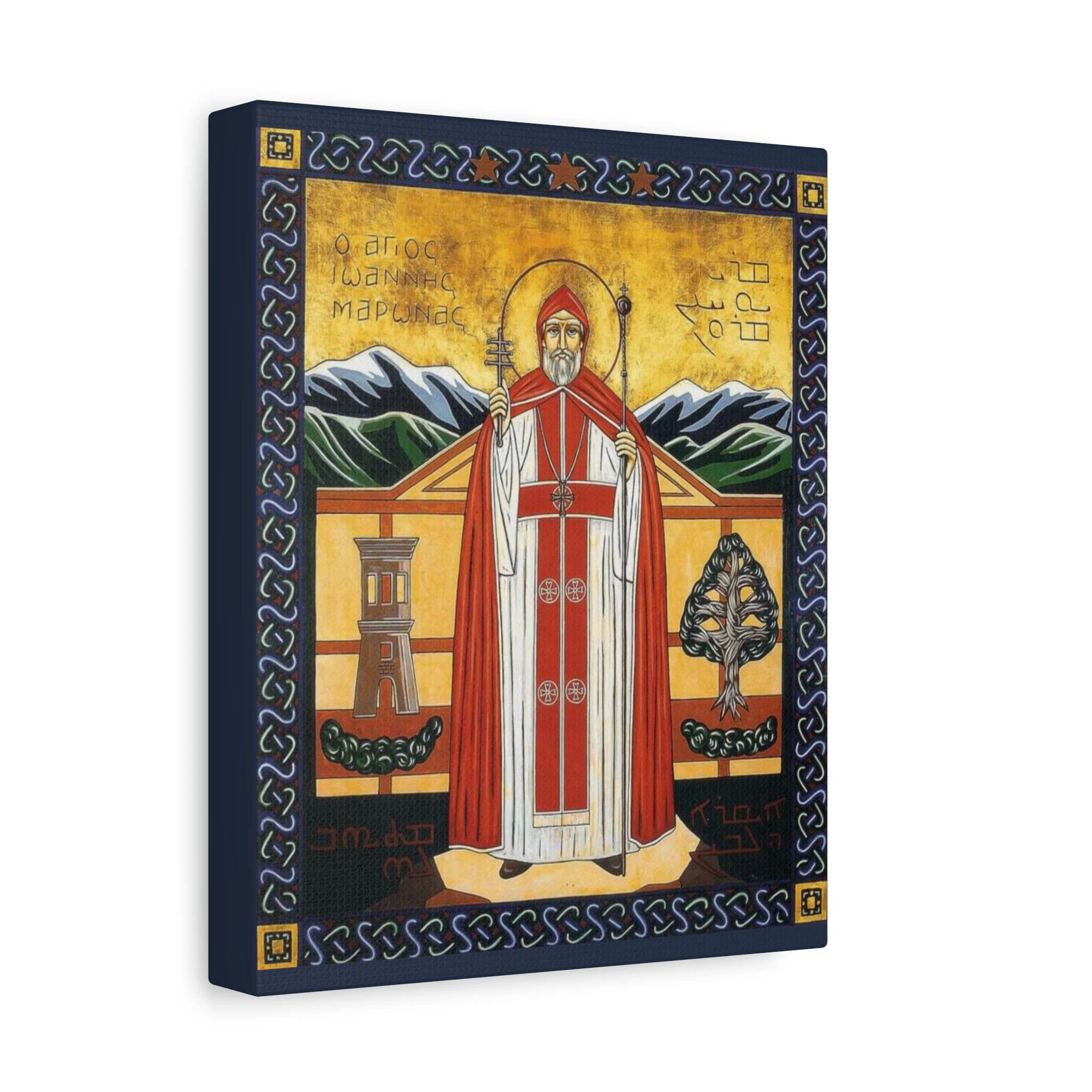
The monks and their followers moved into the rugged, easily defended mountains of Lebanon, joined by the Mardaites, a fierce mountain people of the region known for their military resistance to both Byzantine and Muslim armies. With the normal channels of ecclesiastical authority from Antioch and Constantinople effectively severed, the community elected its own leader. According to Maronite tradition, this was John Maron, born around 575–628 AD, educated in both Antioch and Constantinople, who became the first Patriarch of the Maronite Church around 685 AD, taking the ancient title Patriarch of Antioch and All the East that Maronite Patriarchs still hold today. He is remembered not only as a theologian but as an organizer and a defender, a man who turned a scattered refugee community into a self-governing Church capable of surviving on its own.
This is the moment the isolation truly begins. Cut off from Constantinople, unable to reach Rome, and governed by their own elected Patriarch in the mountains, the Maronites stepped out of the normal flow of imperial church politics entirely, more than three centuries before the Great Schism would even occur.

For the complete biography of the first Maronite Patriarch, including his military leadership and the founding of the patriarchate, see our full profile: Saint John Maron: The Complete History.
Part IV
Five Hundred Years of Silence: How the Maronites Missed the Great Schism
To understand why the Great Schism passed the Maronites by, it helps to understand what the Great Schism actually was. On July 16, 1054, a legate acting for Pope Leo IX (who had in fact already died) laid a bull of excommunication on the altar of the Hagia Sophia in Constantinople, naming Patriarch Michael Cerularius. Cerularius responded in kind. It was, at the moment it happened, a personal and diplomatic rupture between two churchmen in two specific cities, Rome and Constantinople, not an instantaneous, empire-wide severing of every Christian community everywhere. The rift hardened into the permanent East-West division we know today only gradually, over the following century and a half, cemented above all by the sack of Constantinople during the Fourth Crusade in 1204.
By 1054, the Maronites were not participants in that Rome-Constantinople relationship in any meaningful sense. Sources sympathetic to the Maronite tradition describe the community as cut off from communication with Rome for roughly five hundred years before the Crusades reopened contact, governed the entire time by their own patriarch in the Lebanese mountains, with no functioning channel to Constantinople either. A dispute between the Pope and the Ecumenical Patriarch is, by definition, a dispute between two parties. A mountain community with no live relationship to either party was never in a structural position to take a side, receive the news promptly, or be affected by the outcome the way a parish in Thessalonica or a monastery in Cappadocia would have been.
This is the honest version of the Maronite claim, and it is a real and defensible one: not that the Maronites made a conscious decision to ignore the Great Schism, but that they were already so thoroughly outside the communication network in which the schism occurred that its effects, in any immediate sense, simply did not reach them. They kept doing what they had always done: worshipping in Syriac, governing themselves under their own Patriarch of Antioch, and, as later events would reveal, still regarding the Bishop of Rome as a figure worth caring about.

Part V
The Crusaders Arrive
In 1098, the First Crusade established the Latin Crusader Principality of Antioch, and for the first time in centuries, Western Christians moved through the mountains of Lebanon in real numbers. What they found surprised them. William of Tyre, the great Crusader chronicler, wrote of a numerous and warlike Christian people, living in the inaccessible parts of the Lebanon range, using the Syriac tongue, and, most strikingly to the Latin newcomers, a people who inquired after and honored the authority of the Roman Pontiff. For a community popularly imagined by later writers as an isolated curiosity, the detail that struck the Crusaders most was not how foreign the Maronites seemed, but how familiar their loyalty to Rome already was.
In 1182, the Maronite nation, under its Patriarch, formally confirmed its union with the Holy See. Maronite tradition, defended by Maronite historians for centuries, insists on a precise distinction here: this was not a conversion of a previously separate church, but a confirmation and reconnection, the resumption of a bond the Maronites maintain had never actually been severed, only interrupted by centuries of impossible geography and communication. The first Maronite Patriarch to personally visit Rome, Jeremias II Al-Amshitti, attended the Fourth Lateran Council in 1215, opening an era of increasingly close relations that has continued, with real ups and downs, for eight centuries.
The Monothelite Question, Honestly Examined
An honest history has to include the one serious challenge to this narrative. William of Tyre also wrote that 40,000 Maronites were converted from Monothelitism in 1182, the heresy holding that Christ had only one will rather than a fully divine and fully human will, a position the Sixth Ecumenical Council had condemned in 681. If true, this would mean the Maronite community that met the Crusaders was not simply an isolated but always-orthodox church; it would mean a real doctrinal deviation had crept in during the centuries of isolation.
Maronite scholars have pushed back on this claim since at least the era of the Catholic Encyclopedia, arguing that William of Tyre copied the accusation, without independent verification, from the Annals of Eutychius, a Melchite chronicler regarded by Maronite historians as hostile toward the Maronite Church, and pointing to their own unbroken patriarchal succession as evidence that the office of Patriarch, at least, never departed from orthodox Christology. Other modern historians, working from the same limited body of medieval evidence, have concluded the opposite: that some form of Monothelite belief likely did take hold in the Maronite community for a period before 1182, later corrected rather than merely confirmed. Both positions rest on the same handful of medieval sources read differently. What can be said honestly is this: it is genuinely disputed, the Maronite Church's own position for nearly a thousand years has consistently been that it never happened, and the union of 1182 is remembered by Maronites today, without qualification, as a reunion rather than a first embrace of the Catholic faith.
Part VI
Why Maronites Say This Was Never a Conversion
Here is the detail that makes the Maronite story genuinely unusual among the twenty-three Eastern Catholic Churches, and it is not a matter of pride alone; it is a matter of formal classification. Every other Eastern Catholic Church traces its origin to a specific historical break from an Orthodox or Oriental Orthodox mother church. The Ukrainian Greek Catholic Church has the Ukrainian Orthodox Church. The Melkite Greek Catholic Church has the Greek Orthodox Church of Antioch. The Syro-Malabar Church has the Church of the East. In every one of these cases, there is a corresponding Orthodox body the Eastern Catholic church split away from at an identifiable moment.
The Maronite Church has no such counterpart. It is, along with the small Italo-Albanian Catholic Church of southern Italy, one of only two Eastern Catholic Churches in the entire Catholic communion classified as having no Orthodox equivalent, because there was never a moment of separation from an Orthodox mother church for a counterpart to exist. This is not a matter of interpretation; it is the Catholic Church's own formal classification of Eastern Christian bodies, and it is the strongest structural evidence available for the Maronite claim that their communion with Rome, whatever gaps in contact history recorded, was never formally broken in the first place.
This single fact resolves a question that confuses many people encountering the Maronite Church for the first time: is it Orthodox or Catholic? It is fully Catholic, in full communion with the Pope, obedient to Rome exactly as the Latin Church is. But it carries the liturgical language, the monastic asceticism, the married clergy, and the spiritual instincts of the Christian East, because it is the East, simply the portion of it that, through geography and history rather than theology, never had cause to formally separate.

Part VII
What Never Changed
What makes the Maronite Church feel unmistakably Eastern to anyone who walks into one is not a theory. It is the lived texture of the liturgy and devotion, most of it carried forward largely unchanged from the centuries before the union with Rome was ever confirmed. The Maronite Divine Liturgy follows the West Syriac, or Antiochene, Rite. Its oldest core prayers were composed in Syriac, a dialect of Aramaic, the language tradition holds Jesus himself spoke, and even where the Mass today is celebrated in Arabic, English, or another local language, certain prayers are still commonly sung in Syriac, including the Qadishat Aloho, the Trisagion hymn: Holy God, Holy Mighty, Holy Immortal, have mercy on us, the same acclamation sung in Byzantine Orthodox liturgies to this day.
Maronite priests may marry before ordination, in the same ancient pattern followed by the Eastern Orthodox Church and most other Eastern Catholic churches, a discipline the Latin Church does not generally share. Married priests serve the majority of parishes, particularly in Lebanon, while bishops are drawn from celibate, typically monastic, clergy. The entire spiritual culture of the Church is soaked in the monastic asceticism its founder modeled on a mountainside outside Antioch sixteen centuries ago.
The Jesus Prayer and the Prayer Rope
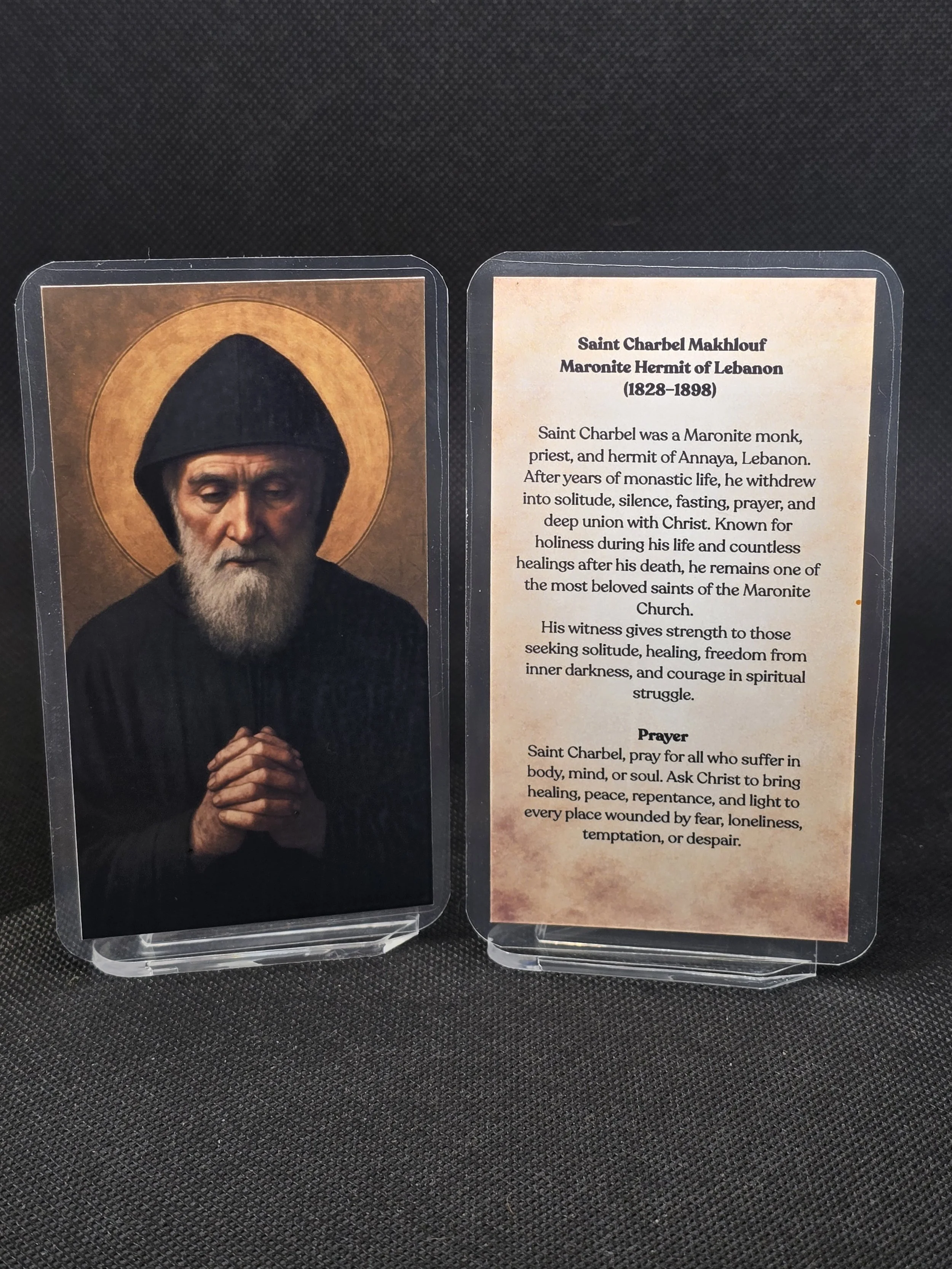
Perhaps nothing captures this Eastern spiritual DNA more directly than the Jesus Prayer. “Lord Jesus Christ, Son of God, have mercy on me, a sinner” appears directly in Maronite prayer resources, and the short, repeated prayer of the heart, counted on a knotted prayer rope, belongs to the same Syriac desert monastic inheritance that shaped Eastern Orthodox hesychastic prayer. Saint Charbel Makhlouf, the most beloved Maronite saint of the modern era, is traditionally depicted in his religious habit holding a prayer rope, an image as central to his iconography as his monk's cowl. It is a small but telling detail, and it is one of the real reasons many Maronites today describe their interior spiritual life as feeling closer to Eastern Orthodox practice than to typical Latin Catholic devotion, even while remaining, without qualification, Catholic.
Want to learn how to pray the Jesus Prayer on a prayer rope yourself? Read our complete guide: The Prayer Rope: How to Use a Chotki to Pray Without Ceasing.

Part VIII
The Saints of the Mountain
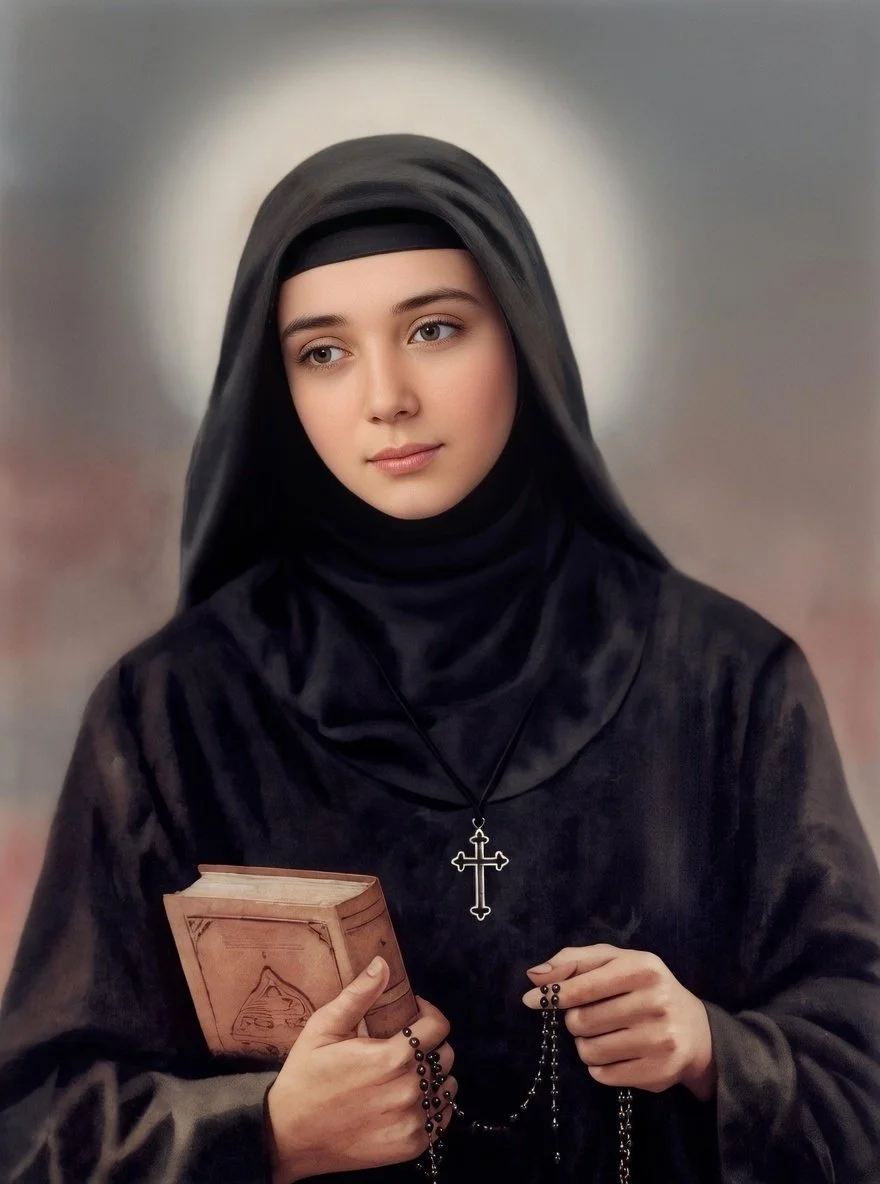
The mountains that hid the Maronite Church from the politics of the Great Schism also produced, in the modern era, an extraordinary concentration of canonized holiness. Saint Charbel Makhlouf (1828–1898), a monk of the Lebanese Maronite Order who lived the last years of his life as a hermit at the Monastery of Saints Peter and Paul in Annaya, was canonized by Pope Paul VI in 1977 and is credited with tens of thousands of reported healings at his tomb, making him one of the most visited pilgrimage sites in the Middle East. Saint Rafqa (Rebecca) Al-Rayes (1832–1914), a nun who accepted decades of blindness and physical suffering with radical peace, was canonized in 2001. Blessed Nimatullah Al-Hardini (1808–1858), a teacher and monk beatified in 1998, rounds out a trio of nineteenth-century Lebanese monastics whose lives are studied and venerated well beyond the Maronite Church itself, including among Eastern Orthodox and Roman Catholic faithful who have never set foot in Lebanon.
For the complete biographies of these saints, our site has full deep-dive profiles: Saint Charbel: Full Life Story, 33,000 Miracles & Healing Legacy and Saint Rafqa of Lebanon: Complete Biography, Miracles, Prayers & Shrine. For the full list of canonized and beatified Maronites, see Who Are the Maronite Saints? A Complete Guide.
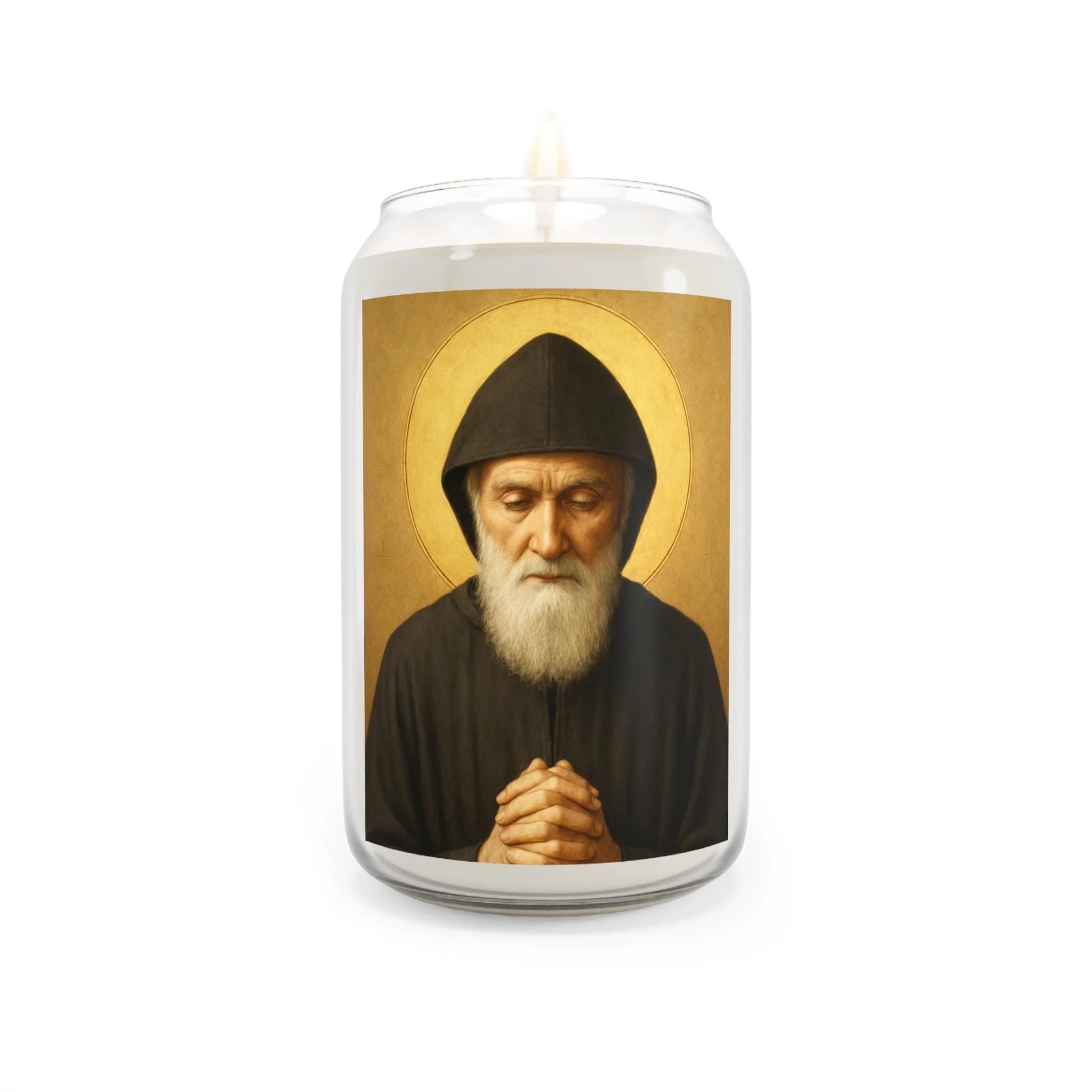
Saint Charbel's healing intercession is also honored with a devotional prayer candle, hand-poured for those seeking his intercession for physical and spiritual healing.
Part IX
The Maronite Church Today
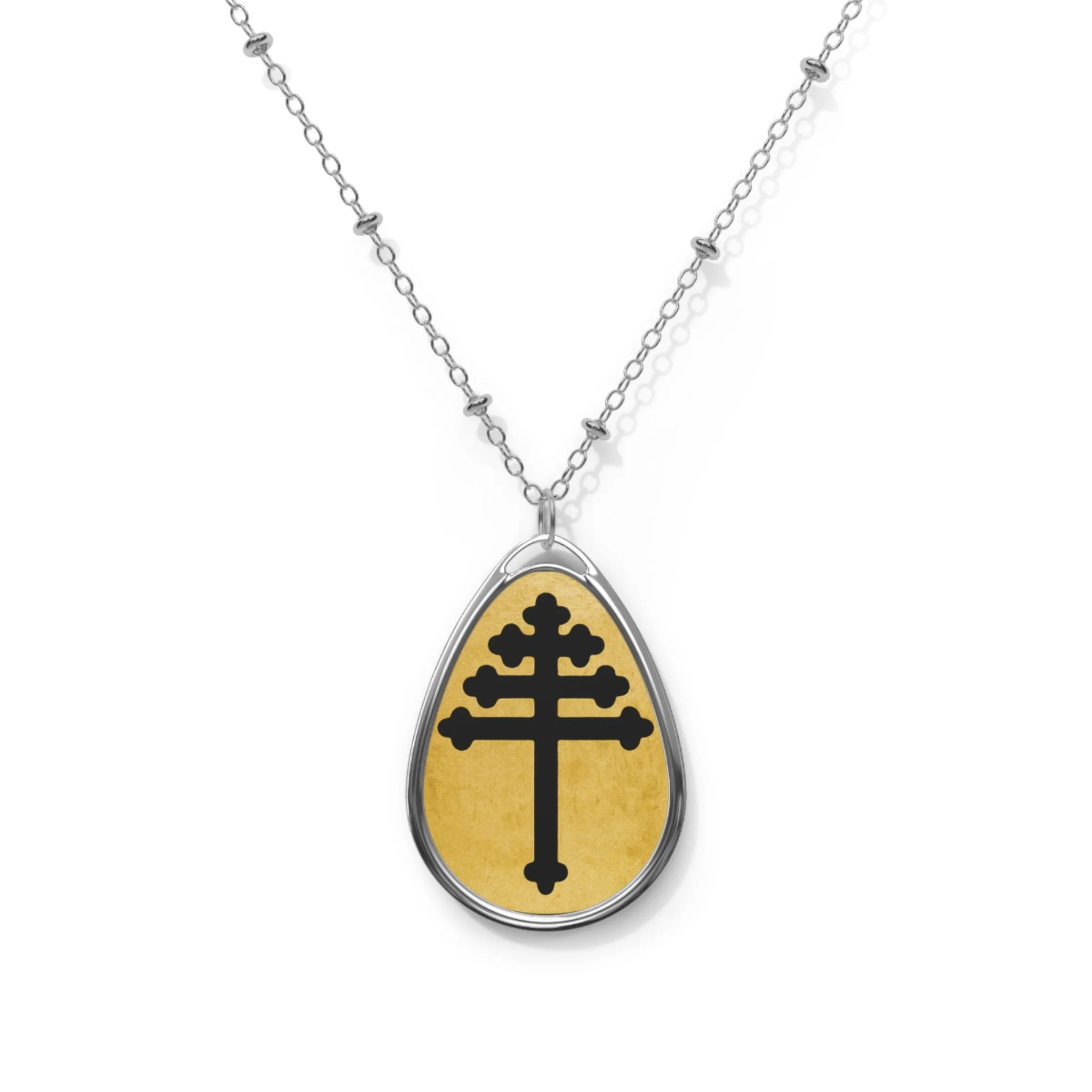
The Maronite Church today counts roughly 3 to 3.5 million members worldwide, and Lebanon, while still its spiritual and historical heart, is no longer where most Maronites actually live. Waves of emigration beginning in the late nineteenth century, driven by Ottoman-era famine, civil conflict, and economic hardship, have scattered the majority of Maronites into a global diaspora, with especially large communities in Brazil, the United States, Australia, Canada, and France. The Church is led today by Patriarch Bechara Boutros al-Rahi, seated at Bkerke northeast of Beirut, continuing an unbroken patriarchal line stretching back, on the Maronite Church's own reckoning, to John Maron in the seventh century.
Through Lebanon's twentieth-century independence movement, its long civil war, and its ongoing economic and political crises, the Maronite Patriarchate has repeatedly stepped into a role well beyond the purely religious, advocating internationally for Lebanese sovereignty and for the safety of Christians across the wider Middle East, a role rooted directly in the same instinct for self-governance and endurance that carried the community through its mountain centuries. It is a small church, by global Catholic standards, but a strikingly resilient one, whose story of isolation, rediscovery, and unbroken loyalty has no exact parallel anywhere else in Christian history.
One of the great modern figures of this era was Patriarch Elias Peter Hoayek, who led the Church through the founding of modern Lebanon and personally advocated for Lebanese independence at the 1919 Paris Peace Conference, one name among the long line of Maronite saints, blesseds, and patriarchs whose lives are gathered in fuller detail elsewhere.

Timeline
Complete Timeline of the Maronite Church
- c. 350–410 ADSaint Maron lives as a hermit near Cyrrhus, Syria, gathering disciples through his holiness and healing.
- 451 ADThe Council of Chalcedon defines the two natures of Christ, a formula the region violently divides over.
- 452 ADDisciples of Saint Maron build the Monastery of Saint Maron on the Orontes River, which becomes a stronghold of Chalcedonian orthodoxy.
- 630s ADThe Islamic conquest of Syria disrupts Byzantine control of the region; the monastic community begins retreating into the mountains of Lebanon.
- c. 685 ADJohn Maron is elected first Patriarch of the Maronite Church, taking the title Patriarch of Antioch and All the East.
- 1054 ADRome and Constantinople excommunicate one another, the event history calls the Great Schism. The isolated Maronite community in Mount Lebanon has no functioning line to either city.
- 1098 ADThe First Crusade establishes the Latin Crusader Principality of Antioch, reopening Western contact with the Maronites for the first time in centuries.
- 1182 ADThe Maronite nation, under its Patriarch, formally confirms its union with the Holy See, an act Maronites describe as a reconnection rather than a conversion.
- 1215 ADPatriarch Jeremias II Al-Amshitti becomes the first Maronite Patriarch to personally visit Rome, attending the Fourth Lateran Council.
- 1584 ADPope Gregory XIII founds the Maronite College in Rome to train Maronite clergy.
- 1736 ADThe Synod of Mount Lebanon codifies Maronite canon law and diocesan structure.
- 1920 ADPatriarch Elias Peter Hoayek helps secure the establishment of Greater Lebanon at the Paris Peace Conference.
- 1977 & 2001 ADSaint Charbel Makhlouf and Saint Rafqa are canonized by Pope Paul VI and Pope John Paul II, respectively.
- TodayThe Maronite Church, led by Patriarch Bechara Boutros al-Rahi, counts roughly 3 to 3.5 million members, most now living outside Lebanon in a worldwide diaspora.
Devotional Prayer
A Prayer for the Church of the Mountain
O Lord, who kept a people faithful in the mountains of Lebanon when the world below them broke apart, we thank you for the witness of the Maronite Church: for Saint Maron who prayed in the open air, for John Maron who gathered a scattered people into a Church, and for every monk and nun who carried the faith through centuries of silence.
Bless the Maronite Patriarch and all the bishops, priests, and faithful of this ancient Church, in Lebanon and scattered across the world. Where they have been forced from their homeland, grant them peace in their new lands and a lasting love for the home their ancestors defended for sixteen centuries.
Through the intercession of Saint Charbel, Saint Rafqa, and all the saints of the Antiochian mountain, grant us the same quiet faithfulness: to hold what we have received, without needing anyone else's permission to know it is true.
A private devotional composition inspired by the history of the Maronite Church. Not a liturgical text of the Church.
FAQ
Frequently Asked Questions About the Maronite Church

They Never Left. They Were Just Impossible to Reach.
The Great Schism is usually told as a story about two men in two cities, a legate and a patriarch, a bull of excommunication laid on an altar in Constantinople. It is rarely told alongside the story of a mountain people who were nowhere near either city when it happened, who kept their liturgy in the language of Christ, elected their own patriarch, and, when the world finally climbed the mountain to find them, were still, after five hundred years of silence, asking after the Pope.
The Maronite Church does not ask to be understood as a curiosity. It asks to be understood as what its own tradition has always insisted it is: not a church that left and came back, but a church that never had reason to leave in the first place. Whether every detail of that claim survives every historian's scrutiny, the endurance behind it does not need defending. Sixteen centuries after a hermit stood praying on a mountainside near Antioch, his spiritual descendants are still there, and still Catholic, and still unmistakably Eastern in everything but name.
Explore All Maronite Prayer Cards →