The Prayer Rope: How to Use a Chotki to Pray Without Ceasing
The Prayer Rope: How to Use a Chotki to Pray Without Ceasing
At a Glance
- Also Called
- Chotki (Russian) • Komboskini (Greek) • Prayer Rope (English)
- Primary Prayer Used
- The Jesus Prayer: “Lord Jesus Christ, Son of God, have mercy on me, a sinner”
- Also Used For
- The Hail Mary • The Lord’s Prayer • Other short prayers
- Common Knot Counts
- 33 (age of Christ) • 50 (Pentecost) • 100 (full prayer rule)
- Biblical Mandate
- 1 Thessalonians 5:17 — “Pray without ceasing”
- Worn On Wrist?
- For convenience, not display — it is never meant to be noticed
- Material
- Traditionally black dyed wool — but material is not what matters
- Theological Tradition
- Hesychasm — the prayer of the heart and inner stillness
The Mandate: Pray Without Ceasing
Saint Paul gave the early Church a command that sounds almost impossible: pray without ceasing. Not pray often. Not pray when you remember. Pray without ceasing — continuously, as a settled condition of the soul, the way your heart beats without you telling it to.
Most Christians read that verse, nod in agreement, and then go back to praying for five minutes in the morning and forgetting God entirely until the next crisis. This is not a failure of sincerity. It is a failure of method. Nobody hands you a way to actually do what Paul asked. You are left with a command and no tool.
The prayer rope is the tool. It was developed by the Desert Fathers and refined over seventeen centuries of monastic life for exactly this purpose: to take an instruction that sounds abstract and impossible and turn it into something your hands and your habits can actually carry out. It does not make ceaseless prayer easy. It makes it possible to begin.
Part II
What a Prayer Rope Actually Is
Strip away the mystique and a prayer rope is simple: a length of cord or wool tied into a series of knots, usually gathered into a loop, used to count repetitions of a short prayer. Russians call it a chotki. Greeks call it a komboskini. In English it is most often called a prayer rope, though many people will recognize it by the word they overheard and only half-remembered — chotki, kotki, the knotted thing.
The knots themselves are usually tied in a distinctive cross-shaped pattern, not simple overhand knots, and traditionally each knot is formed while the maker prays. Common lengths are 33 knots (the years of Christ’s earthly life), 50 (recalling Pentecost), or 100 (a fuller prayer rule), though ropes of 150 or 300 knots exist for those with a more demanding rule of prayer.
None of this is magic. The rope does not absorb merit. It does not protect you the way an amulet is imagined to protect someone in folk religion. It is a counter — nothing more, nothing less — that exists to support a discipline of repeated, attentive prayer. The discipline is the point. The rope is only the means.
Part III
It Is Not Jewelry — and Never Should Be Worn As Such
This needs to be said plainly, because it is the single most misunderstood thing about the prayer rope in the modern West: it is not an accessory. It is not a bracelet with religious branding. If you have seen prayer ropes sold alongside beaded jewelry, marketed by color and style rather than by purpose, you have seen the thing already starting to be misused.
Many people do wear the rope around their wrist. That is a legitimate and ancient practice — but the reason for it is convenience, not display. A prayer rope on your wrist means it is with you when you are standing in line, sitting in traffic, waiting on hold, walking the dog. The whole point of wearing it is that nobody should be able to tell the difference between your prayer rope and a plain bracelet. If a stranger looks at your wrist and thinks “that’s a nice bracelet” and moves on without a second thought, the rope is doing exactly what it should.
What it should never become is a signal. You do not hang it from a belt loop where it swings into view. You do not let it show off as a statement piece. You do not wear it the way some wear a cross the size of a fist — to be recognized, admired, or identified as devout. The moment a prayer rope becomes about being seen, it has stopped being a prayer rope and started being a costume.
Christ’s teaching on prayer is explicit about this: the reward of hidden prayer is hidden, and the reward of performed prayer is merely the performance itself — the admiration of onlookers, and nothing more. A prayer rope worn for show falls into exactly the trap He warned against. A prayer rope worn quietly, used privately, and never flaunted is in keeping with everything He taught about how a Christian should actually pray.
The practical rule is simple: if someone asks about it, answer honestly. But you should never be trying to get that question asked.
Part IV
Which Prayers You Can Use On It
The prayer most associated with the rope, and the one with the deepest roots in Eastern Christian spirituality, is the Jesus Prayer:
This single sentence carries the whole of the Gospel inside it: the confession that Jesus is Lord, the confession that He is the Son of God, and the honest acknowledgment of one's own need for mercy. It is short enough to repeat hundreds of times without strain, and deep enough that a person can spend a lifetime praying it and never exhaust it.
Shortened forms are also used: “Lord Jesus Christ, have mercy on me,” or simply “Lord, have mercy.”
But the rope is not locked to a single prayer. You can pray the Hail Mary on it. It is not a rosary — it has no decades, no mysteries assigned to specific beads, no Catholic devotional structure built into its design — but it can be used the exact same way a rosary is used. A knot, a Hail Mary; a knot, a Hail Mary; moving steadily through the loop. Eastern Catholics in particular often pray this way, and there is nothing irregular about it.
Some use the Lord’s Prayer. Some use a Psalm verse repeated as a refrain. The rope does not care what words pass through it. What matters is that you choose something short, something true, and something you intend to repeat with attention rather than mechanically rushing past.
Part V
How the Rope Trains the Mind
Anyone who has tried to pray for more than thirty seconds knows the problem: the mind wanders. You start with “Lord Jesus Christ” and by the third word you are thinking about an email you need to send. This is not a personal failing unique to distracted modern people — monks in the fourth-century desert wrote about the exact same struggle.
The rope addresses this directly by giving your hands something to do. As you move from knot to knot, the small physical motion gives your body an anchor while your mind tries to focus on the words. It is a strange but consistent feature of human attention: occupied hands often produce a quieter mind than idle ones. The counting is not a distraction from prayer — it is scaffolding for it.
Repetition itself is the deeper mechanism. You are not trying to say the prayer once, perfectly. You are trying to say it many times, allowing your attention to return again and again after it wanders off, the way you might gently bring a child's attention back to a task without scolding. Over months and years, this builds something like a reflex — the mind starts to default toward the prayer in idle moments, the way a habit of any kind eventually runs on its own.
Part VI
Spiritual Armor: Ephesians 6 and the Morning Knot
Saint Paul, writing to the Ephesians, told them to put on the whole armor of God — the belt of truth, the breastplate of righteousness, the shield of faith, the helmet of salvation — each piece named, each piece deliberately put on, not assumed automatically. There is something to that image of deliberate, daily equipping that many who keep a prayer rope on their wrist will recognize.
For those who continue wearing the rope long after they have learned to pray without one, the act of putting it on in the morning can become exactly this kind of deliberate gesture — not a superstition, not a guarantee of protection, but a daily decision to begin the day oriented toward prayer rather than drifting into it accidentally. Putting it on is a small, physical “yes” before the day's distractions arrive to compete for your attention.
This is not required. The rope works whether or not you attach this meaning to it. But many who have prayed with one for years describe exactly this feeling — that wearing it is less about access to the prayer and more about starting the day already facing the right direction.
Part VII
How to Actually Use It, Step by Step
1. Hold it loosely in one hand. Most people use the hand they are not actively using for something else — useful while walking, commuting, or doing simple chores.
2. Find the starting knot. Many ropes have a cross or tassel marking the beginning. Start there.
3. Pray one prayer per knot. Say the Jesus Prayer (or your chosen prayer) once, slowly, as your thumb and forefinger move to the next knot. Do not rush. The goal is attention, not speed.
4. Move at the pace of attention, not the pace of completion. If your mind wanders, gently bring it back and continue. There is no penalty for slowness.
5. Use it anywhere. While driving (hands on the wheel, rope looped on the wrist, prayer silent), while doing dishes, while walking, while waiting. This is the entire purpose — prayer woven into ordinary moments, not confined to a prayer corner.
6. If you lose count, simply continue or start over. The number completed matters far less than the honesty of the prayer offered. Nobody is grading you.
Part VIII
Using It in Public Without Anyone Knowing
The whole discipline collapses if using the rope draws attention to itself. In public, the goal is to keep the rope as hidden as the prayer itself. A simple, well-practiced method:
Hold the rope inside a closed hand, knuckles loosely curled, so the rope sits in your palm rather than dangling visibly between your fingers. Your thumb can move the knots along almost imperceptibly — a small motion easily mistaken for fidgeting, if anyone notices it at all. Keep your hand in a pocket, at your side, or resting in your lap. There should be nothing for a passerby to see except a person standing, sitting, or walking normally.
This is not about shame. It is about obedience to the principle in Matthew 6 — prayer offered to God, not staged for an audience. A monk on Mount Athos praying the Jesus Prayer while sweeping a courtyard looks, to anyone watching, exactly like a man sweeping a courtyard. That is not a failure of witness. That is the witness working correctly.
Part IX
Modern Witnesses: Mount Athos and the Jesus Prayer
It would be easy to assume this kind of ceaseless, hidden prayer belongs only to ancient desert hermits in stories too remote to feel real. It does not. Two of the most beloved Orthodox saints of the twentieth century — both canonized within living memory, both known directly by people still alive today — lived this exact practice.
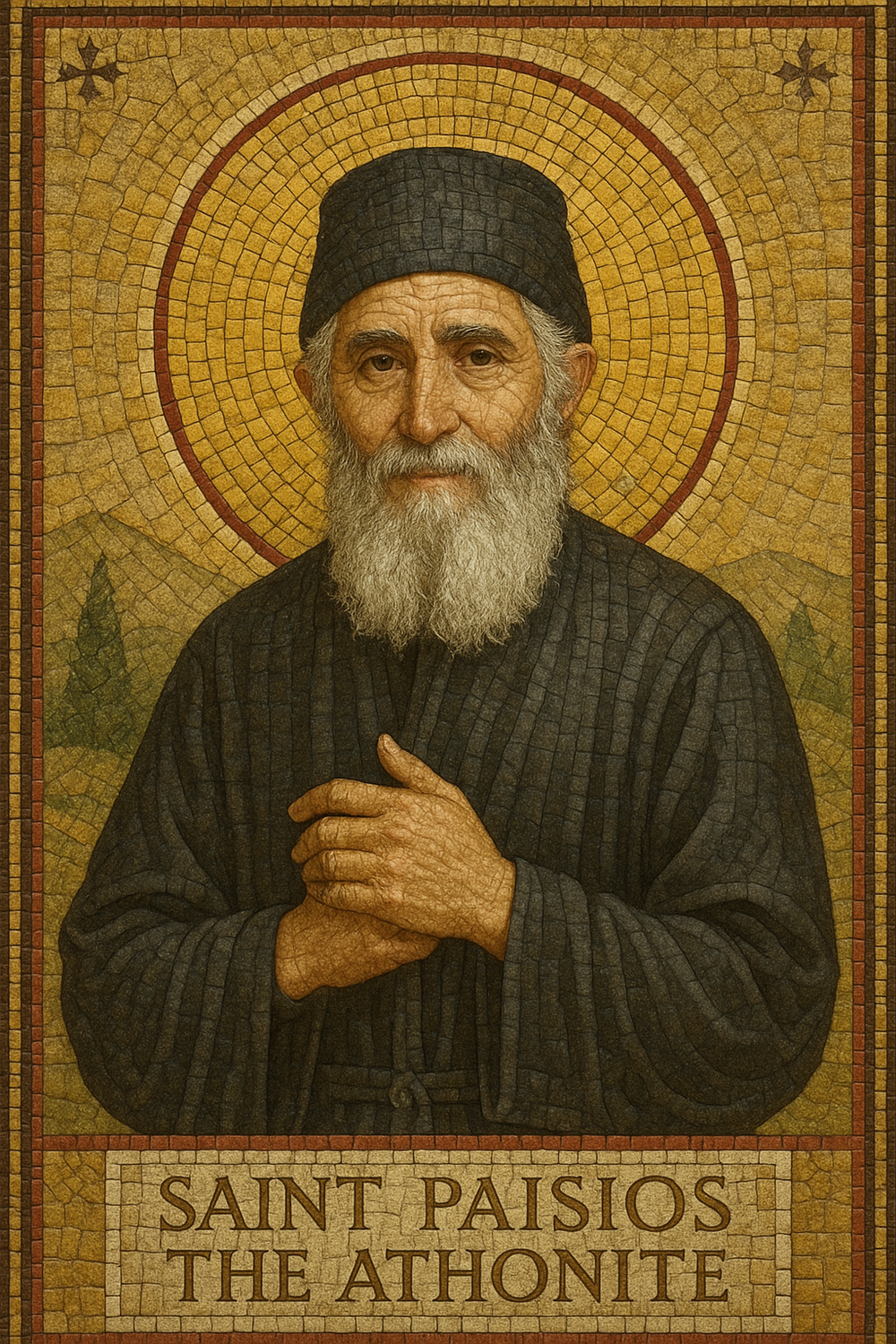
Saint Porphyrios of Kavsokalyvia (1906–1991) is the other essential figure here. Though he spent much of his life off the Holy Mountain due to illness, his entire spiritual teaching centered on simplicity, humility, and a prayer life so internalized that it operated beneath whatever he happened to be doing — a posture of constant, quiet attentiveness to God that never announced itself. Read more about Saint Porphyrios here, including how his approach to prayer differed in tone from the more austere Athonite tradition while pointing toward the same goal.
Both saints stand in the hesychast tradition — the theological and practical lineage built around the prayer of the heart and inner stillness. If you want the deeper theological grounding behind everything in this article, our complete guide to Hesychasm covers the history and theology in full, and this companion article on the Jesus Prayer and the prayer of the heart goes further into the spiritual mechanics of what is actually happening when you pray this way. Eastern Catholics following this same tradition will also want our article on hesychasm within the Eastern Catholic churches.
Part X
Do You Ever Stop Needing the Rope?
Yes — and this is one of the more encouraging things about the practice. With enough time, the prayer stops needing the rope to function. It begins to surface on its own: in a moment of stress, in silence, in the seconds before sleep, the words simply arrive, unprompted, the way a habit you have built over years runs without conscious effort. This is, in a real sense, the goal. The rope was never meant to be permanent scaffolding. It was meant to teach a reflex that eventually operates without it.
And yet many people, including those who have prayed this way for decades, continue wearing the rope anyway. Not because they need it to remember the prayer, but because the small physical ritual of putting it on still carries weight. Slipping it onto your wrist in the morning can feel like putting on spiritual armor — a deliberate, daily decision to face the day prayerfully, even after the prayer itself no longer depends on the object. There is nothing inconsistent about this. A habit fully internalized can still be honored by the gesture that built it.
Part XI
Praying Without Ceasing for Your Spouse
One of the most practical applications of a prayer rope is also one of the most overlooked: using it to intercede for your spouse throughout an ordinary day. Marriage is not sustained only by the conversations you have in the evening or the decisions you make together. It is sustained, in large part, by what you carry for each other in the hours when you are apart — the commute, the workday, the moments neither of you sees.
A prayer rope makes this concrete. Instead of a vague intention to “pray for my marriage,” you have a specific, repeatable action: a knot, a prayer for your spouse’s patience, their burdens, their faith; another knot, another prayer. Over weeks and months, this becomes a quiet undercurrent running beneath the entire relationship — your spouse being held in prayer at moments they will never know about, which is precisely the kind of hidden, unrewarded love Ephesians 5:25 calls husbands to and Scripture calls every believer to more broadly.
Struggling to Make Prayer a Real Part of Your Marriage?
Jeremy works with husbands and Ashley works with wives to build marriages grounded in daily prayer, sacrificial love, and the kind of consistent spiritual habits this article describes — not as theory, but as a workable rule of life for real marriages.
Book a Discovery Call →Part XII
Choosing a Prayer Rope
The traditional prayer rope is made of black dyed wool, hand-knotted in the same cross-knot pattern used in monasteries for centuries. There is something fitting about the simplicity and plainness of black wool — understated, inexpensive, drawing no attention, exactly in keeping with everything said above about discretion.
But the material is not what makes a prayer rope work. It works because of what you do with it, not what it is made of. Wool, nylon cord, simple string — any of it functions identically as a counting tool. If you are drawn to the traditional form, a hand-tied wool rope from Mount Athos is a meaningful and authentic choice.
Frequently Asked
Common Questions About the Prayer Rope
A Knot, a Prayer, and a Lifetime of Practice
You will not master ceaseless prayer in a week. Nobody does. But you can begin today, with one knot and one honest sentence: Lord Jesus Christ, Son of God, have mercy on me, a sinner. Keep it hidden. Keep it humble. Let it become, slowly and without anyone else ever needing to know, the quiet undercurrent of your entire life.
Go Deeper Into Hesychasm →