Saint Gabriel Possenti: The Complete Story of the Lizard, the Brigands, and the Revolver He Almost Certainly Carried
Saint Biography • Historical Investigation • 19th-Century Firearms History • Feast Day February 27
Saint Gabriel Possenti: The Complete Story of the Lizard, the Brigands, and the Revolver He Almost Certainly Carried
No surviving record names the exact weapon Saint Gabriel Possenti held in 1860. But the history of who was arming whom in Italy that year tells us almost everything we need to know — and points to one revolver in particular.
Saint Gabriel Possenti — At a Glance
- Birth Name
- Francesco Possenti
- Born
- March 1, 1838, Assisi, Papal States
- Died
- February 27, 1862, Isola del Gran Sasso, Kingdom of Italy — age 23, tuberculosis
- Religious Name
- Gabriel of Our Lady of Sorrows, Passionist
- The Incident
- 1860, Isola del Gran Sasso — confronted an armed band threatening the town
- Beatified
- May 31, 1908, by Pope Pius X
- Canonized
- May 13, 1920, by Pope Benedict XV
- Official Patronage
- Catholic youth, students, seminarians, clergy, the Abruzzi region
- Popular Patronage
- Unofficial patron of gun owners, handgunners, and marksmen (not Vatican-confirmed)
- Feast Day
- February 27
- The Weapon Question
- Unrecorded by name — but Italy's arms history points strongly to a revolver, most likely the Lefaucheux pinfire pattern
- Shrine
- Basilica of San Gabriele dell'Addolorata, Isola del Gran Sasso, Teramo
Who Was Gabriel Possenti?
Francesco Possenti was born on March 1, 1838, in Assisi, the eleventh of thirteen children. His father, Sante, worked in local government and eventually became governor of Spoleto, where the family later moved. Francesco was, by every account, a normal and even spirited young man — popular, fond of hunting and dancing, a strong horseman, and according to several biographers, an unusually good shot. He was not destined, on the surface, for a life of severe religious discipline.
But illness kept finding him. As a teenager, Francesco fell gravely sick on at least two separate occasions, and both times he promised God that if he recovered he would enter religious life. Both times, once health returned, he set the promise aside and went back to ordinary youthful pursuits. It took a moment during a religious procession — carrying a banner of Our Lady, Help of Christians, through the streets of Spoleto — for the call to finally land. He heard, distinctly, an interior instruction: keep your promise. This time he did not delay.
He entered the Passionists, a congregation devoted to preaching and living out the Passion of Christ, and took the religious name Gabriel of Our Lady of Sorrows. The flamboyant young man who had been engaged, by some accounts, to two different women before he left for the novitiate became known instead for an almost severe interior discipline: fidelity to prayer, habitual small mortifications, and a deep devotion to the sorrows of the Virgin Mary that gave him his religious name.
He never reached ordination. About a year before he was to be made a priest, tuberculosis took hold of him. He died at the Passionist retreat in Isola del Gran Sasso, in the Abruzzo region, on February 27, 1862, at twenty-three years old. Like many of the Church's young soldier-saints, his sanctity was not built on dramatic external achievement. It was built on an unremarkable religious life lived with complete fidelity — which is exactly what makes the one dramatic incident attributed to him so disproportionately famous.
Part II
Italy in Chaos: The World Gabriel Lived In
To understand what happened at Isola del Gran Sasso, you have to understand what Italy actually was in 1860 — which is to say, not yet a country. The peninsula was a patchwork of separate states: the Papal States in the center, the Kingdom of the Two Sicilies in the south, Sardinia-Piedmont pushing unification from the north, and Austrian holdings scattered through the rest. Giuseppe Garibaldi's campaign of 1860, the famous Expedition of the Thousand, tore through Sicily and the mainland south, toppling the Bourbon Kingdom of the Two Sicilies and feeding directly into the formation of the Kingdom of Italy in 1861.
Abruzzo sat in the middle of this collision. The region had a long, troubled history of unrest well before 1860 — rebellions in 1821, 1841, and 1848 had already shown how unstable the area could be. When unification arrived in full force, Abruzzo absorbed the shock directly: it passed from the Kingdom of the Two Sicilies into the Kingdom of Sardinia in 1860 and then into the unified Kingdom of Italy in 1861.
What followed was not a clean transfer of power. It was years of armed chaos. Demobilized Bourbon soldiers, peasants enraged by new taxes and conscription, common criminals, and ideological loyalists to the exiled Bourbon crown all converged into something historians call the Brigantaggio — a sprawling, disorganized insurgency that combined genuine political resistance with straightforward banditry. It would take Italy until roughly 1870 to fully suppress it.
This is the world Gabriel Possenti was living in when he entered the novitiate, and it is the world that came crashing into the town of Isola del Gran Sasso in 1860. The Passionists themselves felt the pressure directly — by that year, the community had already suspended its normal apostolic work because of the growing threat surrounding them. Gabriel was not removed from the unification crisis. He was living inside it, in one of the regions where it hit hardest.
Part III
The Incident at Isola del Gran Sasso
The story, as it has been handed down through more than a century of retelling, goes like this. In 1860, an armed band — accounts put the number at roughly twenty men — entered the town of Isola del Gran Sasso and began terrorizing it: burning, looting, threatening residents. Gabriel, gravely ill with the tuberculosis that would kill him within two years, went out to face them anyway. He was, by every account, completely unarmed when he walked into the street.
One of the men was dragging off a young woman, intending to assault her. He saw the slim, sickly young religious approaching and mocked him for his presumption. Gabriel responded by closing the distance and seizing the man's own weapon directly from him, ordering him to release her. Startled, the man complied. A second man came toward Gabriel and lost his weapon the same way. Then the rest of the band, hearing the commotion, came running.
What happens next is the part of the story that made Gabriel Possenti famous outside Catholic circles entirely: a small lizard ran across the road between Gabriel and the approaching men. When it paused for a moment, Gabriel took aim and killed it with a single shot. Having just demonstrated, in front of twenty armed men, exactly how good his aim was, he turned the weapons on the band and ordered them to extinguish the fires they had set and leave the town. They did. The grateful townspeople are said to have escorted him back to the seminary afterward, calling him the Savior of Isola.
It is, by any measure, an extraordinary scene — a dying seminarian disarming an armed gang through nerve and marksmanship alone, without a single person being harmed. The Church has no shortage of saints whose courage shows up in dramatic, almost cinematic moments, but few combine raw physical danger with such a deliberately bloodless resolution. That combination — capability paired entirely with restraint — is the heart of why this story has endured.
Part IV
What We Actually Know — and Don't — About the Weapon
Here is the most important thing to say plainly before going any further: no surviving primary source names the specific firearm Gabriel Possenti held that day. The earliest biographical material on his life does not even confirm every detail of the incident itself, let alone specify a make or model of weapon. One researcher who has reviewed the older Passionist sources has noted that the lizard episode does not appear in the oldest written life of the saint, nor in the recollections of his own religious superior. It surfaces later, in a 20th-century account whose author acknowledged adding embellishments to make the story "more vivid" for readers.
That does not mean the underlying event is fiction. Most Catholic historians treat it the way they treat many vivid saint stories: there is very likely a real kernel — an armed confrontation in which a gravely ill seminarian intervened to protect a woman and a town — surrounded by decades of retelling that sharpened the details into the dramatic shape we know today. What we are working with, honestly, is a strong oral and devotional tradition rather than a contemporaneous police report.
So when this article makes a case for which weapon Gabriel most likely held, that case is not built on a document that says so. It is built on something different and, in its own way, just as solid: the documented history of exactly what firearms existed, who carried them, and where they were concentrated in Italy in the specific year, region, and circumstance this incident is set in. We are not guessing in a vacuum. We are reasoning from the same kind of evidence a historian uses to reconstruct any undocumented detail of the past — context, distribution, and probability.
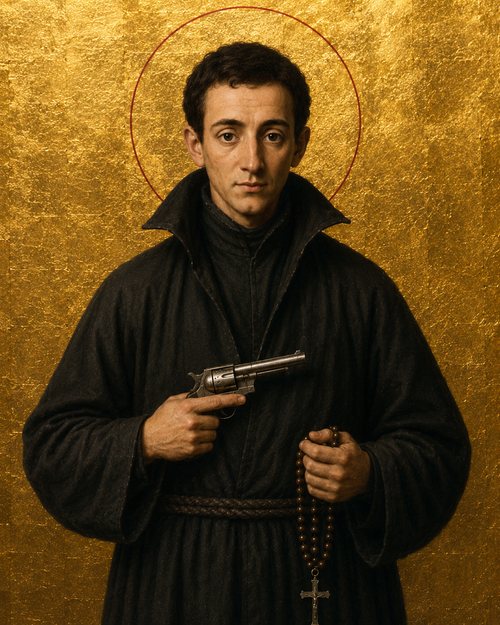
Some modern artwork and devotional images depict Saint Gabriel Possenti holding a sleek, modern-looking semi-automatic pistol, complete with a detachable box magazine. This is not historically possible. The semi-automatic pistol as a category, fed by a magazine inserted into the grip, did not exist in 1860. The first practical self-loading pistols were not developed until the 1890s, roughly three decades after Gabriel's death. Whatever he held that day, it was a revolver of the kind actually circulating in Italy at the time, loaded round by round into a rotating cylinder, not a magazine-fed semi-automatic. Getting this detail right matters, because it is the difference between honoring his story and quietly rewriting it with a weapon from a different century entirely.
Part V
The Lefaucheux Pinfire: Why This Revolver Fits the Evidence
The single strongest piece of evidence pointing toward a specific weapon is not about Gabriel Possenti at all. It is about Italy's own arms procurement in this exact period — and on that question, the historical record is unusually precise.
The revolver in question was designed by the French father-son gunsmithing team of Casimir and Eugene Lefaucheux. Casimir had patented a self-contained pinfire cartridge back in 1832, a genuine breakthrough that used a cardboard body with a brass base to create an effective gas seal, paving the way toward modern breech-loading ammunition. As with so many technological turning points, it took a second generation to turn the invention into a practical weapon: in 1854, Eugene patented a simple, inexpensive, and reliable 12mm caliber single-action breech-loading pinfire revolver built around his father's cartridge design.
What happened next is the part that matters most for our purposes. Within a few years, this revolver had been adopted by military forces well beyond France — including, by name, Italy. Production exploded across Europe as licensed manufacturers in Belgium, Germany, and Austria began turning out their own versions, and by 1867 something on the order of 400,000 pinfire revolvers had been produced on the continent. This was not a rare or exotic weapon by 1860. It was becoming the default sidearm of the era.
And Italy was not a minor customer. The historical record states it directly: Italy was the largest export customer for the Lefaucheux M1854, purchasing more than 27,000 revolvers to arm the Royal Carabinieri and other state police organizations, along with elements of the navy. No other nation on that customer list came close to that volume. If you wanted to identify the one country in Europe where this specific revolver was most heavily concentrated in state hands at the start of the 1860s, Italy is the answer — and Gabriel Possenti's confrontation happened in Italy, in 1860, the same window in which that concentration was building.
The mechanism itself also tells part of the story. The Lefaucheux used a hinged loading gate on the right side of the frame to insert pinfire cartridges, each round aligned so the hammer could strike the small external pin and fire it — a self-contained cartridge system that was, for its time, remarkably uncomplicated and cheap to produce. That simplicity is exactly why it spread so fast: it did not require the skill or expense of the older percussion revolvers, which made it attractive not just to national armies but to police forces, naval units, and eventually private buyers across the continent.
None of this proves that the specific man Gabriel disarmed was holding a Lefaucheux. It cannot. But it establishes something historians consider meaningful in its own right: of every revolver pattern circulating in Europe in 1860, the Lefaucheux pinfire was the one most heavily concentrated in Italian hands, in Italian state service, in the exact years surrounding this incident. If you had to bet on one weapon, this is the bet the evidence supports.
Part VI
Who Was Carrying What in 1860 Italy
It helps to lay out the broader arms timeline of the era side by side, because the Lefaucheux's adoption did not happen in isolation — it happened inside a much larger wave of military modernization that swept through Europe in the 1850s and 60s, exactly the years bracketing Gabriel Possenti's life and death.
- 1832 — The Cartridge That Made It PossibleCasimir Lefaucheux patents the pinfire cartridge in France, using a cardboard body and brass base that creates an effective gas seal — a foundational step toward modern self-contained ammunition.
- 1854 — The Revolver ItselfEugene Lefaucheux patents the 12mm caliber single-action pinfire revolver. Within a few years it is adopted by military forces in France, Italy, Norway, Spain, Sweden, and Romania.
- 1856-1858 — Naval and Military Adoption SpreadsThe French Navy formally adopts the design; Italy follows within roughly two years, and Sweden, Norway, Spain, and Romania begin equipping their own forces with the same pattern shortly after.
- 1858-1860 — The Italian Procurement SurgeItaly purchases over 27,000 Lefaucheux M1854 revolvers, becoming the single largest export customer for the design — arming the Royal Carabinieri, other state police bodies, and naval elements during exactly the years of the Risorgimento's most intense fighting.
- 1860 — The Incident at Isola del Gran SassoWithin this same window of mass Lefaucheux procurement and distribution, the confrontation attributed to Gabriel Possenti takes place in Abruzzo — a region absorbing the full chaos of Garibaldi's campaign and the early Brigantaggio.
- By 1867 — Saturation Across EuropeRoughly 400,000 pinfire revolvers of various makes have been produced across the continent, with Belgian, German, and Austrian manufacturers all licensing or copying the basic Lefaucheux design to meet demand.
What this timeline shows is that Gabriel Possenti's confrontation sits almost exactly at the center of the Lefaucheux's moment of maximum relevance to Italy specifically. He was not living through a vague, undefined "olden days" of swords and muskets. He was living through a sharp, well-documented modernization of European sidearms, in the one country that was buying more of this particular revolver than anywhere else on the continent.
This matters for both sides of the confrontation. Italian state forces — carabinieri, militia, and irregular units loyal to the new government — were being armed with Lefaucheux revolvers in large numbers. But the men attributed in some accounts as Garibaldi-linked soldiers, fresh off engagements like the Battle of Castelfidardo, would also have had access to military-pattern sidearms moving through the same supply chains and battlefield salvage that fed the broader unification conflict. Whichever side of that confused, fast-moving conflict the men at Isola belonged to, the Lefaucheux pattern is the revolver most likely to have been in their hands.
Part VII
Brigands or Garibaldi's Men? Why the Confusion Makes Historical Sense
One detail that trips up readers encountering this story for the first time is that different sources describe the armed band differently — some call them brigands, others identify them specifically as roughly twenty mercenaries connected to Garibaldi's army, looting in the aftermath of the September 1860 Battle of Castelfidardo. This is not sloppy storytelling. It reflects the actual texture of the period.
By late 1860, the line between "soldier" and "brigand" in central and southern Italy had become genuinely blurry. Demobilized Bourbon troops, men loosely affiliated with Garibaldi's volunteer forces, and outright criminals were all moving through the same mountainous terrain, often with the same weapons, frequently switching allegiances or simply abandoning any allegiance at all once formal campaigns ended. The broader Brigantaggio that erupted across Campania, Molise, Apulia, Calabria, and Abruzzo in the years immediately following drew its manpower from exactly this pool — former prisoners, former soldiers loyal to the deposed Bourbon king, foreign mercenaries, and ordinary peasants pushed into armed resistance by poverty and new taxation.
Whether the specific twenty men at Isola del Gran Sasso were demobilized Garibaldine irregulars, opportunistic criminals exploiting the post-Castelfidardo confusion, or some mixture of both, the practical result for our purposes is the same: armed men moving through Abruzzo in 1860 were drawing from a weapons pool saturated with exactly the kind of revolver Italy had been purchasing by the tens of thousands. The uncertainty about who they were does not weaken the case for what they were likely carrying — if anything, it reinforces it, since both regular Italian forces and the irregular bands feeding off the same conflict had access to the same general category of arms.
Part VIII
Courage Without Bloodshed: The Theology Behind the Story
Set the historical weapon question aside for a moment, because it is not actually the heart of why this story matters. The heart of it is what Gabriel does with the capability once he has it. He does not use the seized weapons to harm a single person. He uses them to stop harm — to free a woman, to make a band of armed men back down, and then to send them away without a death on his conscience or theirs.
That is a specific and demanding form of virtue, and Scripture has a name for the pattern: strength that serves rather than dominates. Christian tradition across both East and West has always honored courage, but it has never honored courage detached from love of neighbor. The model Gabriel offers is not the absence of force. It is force entirely subordinated to protection — capability paired with the self-mastery to use only as much of it as the moment actually requires.
This is also, not incidentally, a model with direct relevance to marriage and family life. A husband called to protect his wife and children is not called to dominate them, and the same self-possession Gabriel showed toward armed strangers is the deeper, quieter discipline a man needs every single day inside his own home — patience instead of anger, firmness instead of force, strength placed entirely at the service of the people he loves rather than his own pride or fear.
Strength That Serves Your Marriage, Not Your Ego
Saint Gabriel had the power to harm and chose restraint instead — the same discipline every husband and wife is called to practice inside their own home. If your marriage needs that kind of intentional, Scripture-grounded strength brought back into daily life, faith-based coaching with Jeremy walks with you week by week toward real, visible growth.
Explore Marriage Coaching →Part IX
Why Catholics Pray to Saint Gabriel Possenti Today
Gabriel Possenti's formally recognized patronages — granted by the Church itself — are Catholic youth, students, seminarians, clergy, and the Abruzzi region of Italy, where he spent the final two years of his life. But he is also widely known, especially in the United States, as the unofficial patron saint of gun owners, handgunners, and marksmen, a title that has never received Vatican confirmation but has become the lens through which most modern Catholics first encounter his name. It grew from grassroots lay advocacy beginning in the late 1980s, built directly around the Isola del Gran Sasso story.
Whether or not that specific title is ever formalized, the devotion behind it is sincere and the appeal is easy to understand. People turn to Saint Gabriel Possenti for courage under pressure, for protection in moments of real danger, for purity of heart, and for the particular grace of self-control — the discipline to act with strength guided by holiness rather than by anger or fear. Law enforcement officers, those in personal protection and security roles, responsible firearm owners, and men more broadly who are seeking a model of masculine virtue that pairs capability with restraint have all found something to hold onto in his story.
It is also worth remembering that he is, first and always, a patron of the young: of students wrestling with vocation, of seminarians discerning a call, of anyone navigating the gap between the person they were and the person they are being asked to become. Many of the Church's most beloved patrons of courage share this same arc — an ordinary, even flawed early life, followed by a single decisive turn toward holiness that the rest of their story is built around.
Part X
How to Pray with Saint Gabriel Possenti
Devotion to Gabriel Possenti does not require elaborate ritual. A simple, direct prayer asking for his intercession — especially before moments that call for courage, self-control, or protection of someone vulnerable — is exactly the kind of devotion his own short life modeled.
Saint Gabriel Possenti, you faced armed men without fear, though you were weak in body and outnumbered many times over. You protected the innocent without shedding a single drop of blood, and you showed that real strength is strength placed entirely at the service of love.
Intercede for me now. Grant me courage when I am afraid, clarity when I am provoked, and the self-mastery to act rightly rather than rashly. Help me to be strong for the people who depend on me, and to use whatever strength I have been given only in the service of what is good.
Saint Gabriel Possenti, pray for us.
Many who pray this kind of intercessory prayer regularly find it helpful to keep a dedicated icon nearby, whether on a home altar, a desk, or a prayer corner. The following icons of Christ Pantocrator are well suited to that kind of daily devotional space.


Part XI
Complete Timeline of His Life
- March 1, 1838 — Born in AssisiFrancesco Possenti is born, the eleventh of thirteen children of Sante and Agnes Possenti.
- Childhood and Youth — SpoletoEducated by the Christian Brothers and later the Jesuits in Spoleto, where his father served in local government. Known as popular, fond of dancing and hunting, and an excellent horseman and marksman.
- Two Illnesses, Two Broken PromisesTwice falls gravely ill as a teenager and twice promises to enter religious life if cured — and twice sets the promise aside after recovering.
- The Procession — The Call That Finally LandsDuring a religious procession carrying a banner of Our Lady, Help of Christians, he hears an interior call to keep his promise, and this time follows through.
- 1856 — Enters the PassionistsJoins the Passionist congregation and receives the religious name Gabriel of Our Lady of Sorrows.
- 1860 — The Incident at Isola del Gran SassoConfronts an armed band of roughly twenty men threatening the town, in the chaos following the Battle of Castelfidardo and the broader collapse of order across Abruzzo.
- 1861 — Tuberculosis DiagnosisFalls ill with the tuberculosis that will end his life before he can be ordained a priest.
- February 27, 1862 — Death at Isola del Gran SassoDies peacefully at the Passionist retreat, at age 23, smiling and holding an image of Our Lady of Sorrows, witnessed by his community.
- May 31, 1908 — BeatifiedBeatified by Pope Pius X in Rome.
- May 13, 1920 — CanonizedCanonized by Pope Benedict XV in Rome, declared a patron of Catholic youth.
- 1959 — Named Patron of AbruzziPope John XXIII formally names him patron of the Abruzzi region, where he spent the final two years of his life.
- Late 1980s — Patron of Gun Owners Advocacy BeginsLay advocacy in the United States begins promoting Gabriel Possenti as the unofficial patron saint of gun owners, handgunners, and marksmen, built around the Isola del Gran Sasso story.
Part XII
Frequently Asked Questions
No Document Names the Gun. The History of Who Was Arming Whom Names It For Us.
Saint Gabriel Possenti's own contemporaries never thought to write down which revolver passed through his hands on a single afternoon in 1860 — they were busy recording something they considered far more important: a dying young man who walked toward armed danger to protect a stranger, and who used every bit of strength available to him without taking a single life. The weapon question is genuinely fascinating, and the evidence points strongly toward the Lefaucheux pinfire that Italy was buying by the tens of thousands in those very years. But the courage was never really about the gun. It was about a man who had every excuse to look away, and didn't.
Carry his prayer card. Ask for his intercession the next time courage and self-control both feel impossibly far away at the same moment — because that is exactly the grace his short, extraordinary life points us toward.
Get the Saint Gabriel Possenti Prayer Card →