Saint Genesius: Patron Saint of Actors Who Was Converted on Stage
Rome • Arles • The Acts • The Plays • The Relics • The Prayers
Saint Genesius: Patron Saint of Actors Who Was Converted on Stage
Everything that can be said about Genesius: the story as the Acts tell it, what historians make of it, the second Genesius of Arles, the relics, the plays, the patronages, and how to pray with him.
Saint Genesius at a Glance
- Who
- A Roman actor and comedian who, by the legend, was converted in the middle of a mock baptism and was martyred under Diocletian
- Feast Day
- August 25, in both the Catholic and Orthodox calendars
- Date
- Traditionally 303 • Some scholars of the older school place it about 285
- Burial and Relics
- Via Tiburtina, Rome • Relics now at Santa Susanna, Rome (moved in 1591)
- Patron Of
- Actors, comedians, dancers, musicians, playwrights, converts, lawyers, stenographers, and those with epilepsy
- Earliest Evidence
- A cult in Rome by the fourth century • A gold-glass portrait • A church repaired by Pope Gregory III in 741
- The Hard Question
- The Acts were written centuries later and the story has parallels in Greek legends. Scholars debate how much is history
- The Other Genesius
- A notary of Arles, martyred under Maximian, with the same feast day
Two Saints Named Genesius
The Roman Martyrology, the Church’s official list of martyrs, has two entries for August 25 that carry the name Genesius. The first is an actor at Rome who, while mocking the Christian mysteries on the stage before the emperor Diocletian, was suddenly converted and then died for the faith. The second is a notary at Arles in Gaul who refused to write down the edicts against Christians, threw away his writing tablets and was beheaded. They share a name, a feast day and, as we will see, a good deal of history.
This article covers both, with most of the space given to the actor, because he is the one people search for. It tells the story in full, then asks what historians think of it, then goes through the relics, the churches, the plays, the patronages and the prayers. Wherever a claim rests on a late source or on devotion, the text says so. Nothing is called certain that is not.
Two things are worth saying at the start. First, the story of Genesius is a good one, and it has been loved for more than a thousand years by people who knew it was not a courtroom transcript. Second, the honest answer to the question “did it happen?” is “we do not know, and the scholarly case against the details is strong.” Both can be held together. The Church venerates saints on the strength of an ancient cult as well as an ancient biography.
Part II
Table 1: The Genesii and Their Parallels
| Figure | Role and place | Main source | Standing |
|---|---|---|---|
| Genesius of Rome | Actor and comedian; Rome under Diocletian | The Latin Passion of Genesius (BHL 3320), composed between the mid-sixth and ninth centuries | Feast August 25; cult at Rome by the fourth century; historicity debated |
| Genesius of Arles | Notary and secretary; Arles under Maximian | A Passion attributed to Paulinus of Nola (BHL 3304); a poem by Prudentius around 400; a fifth-century sermon | Feast August 25; cult across Gaul, Spain and Italy; better attested than the Roman one |
| Gelasinus of Hierapolis | Mime who converted during a mock baptism; Hierapolis in Syria | The sixth-century chronicle of John Malalas, which dates it to 297 | A Greek legend with the same plot as Genesius |
| Porphyry the mime | Mime-martyr under the emperor Aurelian | A Greek Passion (BHG 1568z) | Appears to be modeled on the Gelasinus story |
| Genesius of San Miniato | The Arles martyr, honored in Tuscany | A parish church at Vico Wallari is recorded in 715 | Patron of the diocese of San Miniato |
The table shows the shape of the problem. There is one story with several names. The Greek East has actors who convert on the stage, the Latin West has Genesius, and a second Genesius, who was a notary and not an actor, has an earlier and stronger record. The rest of this article works through those pieces in order.
Part III
The Story as the Acts Tell It
The actor
Genesius is a pagan, a comedian and the head of a theatrical company in Rome during the reign of Diocletian. He writes, directs and performs. He is clever and well known, and the emperor himself enjoys his work. In the story he is also a man who hates the Christians. One account says he despised even relatives of his who professed the faith. In a city where Christians were being hunted, mocking them is a good way to win a crowd and the emperor’s favor.
The play
So Genesius prepares a satire. The plot is simple. A man is gravely ill and asks to be baptized. The other actors bring out the props of a baptism, and one of them plays the priest or exorcist, and the whole rite is turned into a joke. The audience, made up of the emperor and the people of Rome, laughs at what they take to be the strange customs of the Christians. Genesius plays the sick man, who says that he is oppressed by a heavy weight and wants relief.
The turn
At this point, according to the Acts, the scene stops being a scene. Genesius, still in the scene, begins to answer in earnest. He says that he wants to receive the grace of Jesus Christ and to be freed from the burden of his sins. The other actors, still thinking it is part of the joke, pour the water and say the words. As they do, Genesius sees something. In the oldest forms of the story it is an angel standing over him with a book that records his sins. When the water touches him, the writing in the book is washed away, and the pages turn white.
His fellow actors, who see nothing, put a white robe on him as a final comic touch. Others, playing soldiers, seize him as though he were a Christian being dragged to the emperor, as the script requires. But Genesius is no longer playing.
The confession
Standing before Diocletian and the packed theatre, Genesius says plainly that he has seen the truth. He tells the emperor that he mocked the faith out of ignorance and idolatry, and that now he believes. He renounces the gods of Rome. He declares that Jesus Christ is Lord and the true God, and he invites the emperor and the crowd to turn to him. The audience realizes, one account says, that he is no longer acting.
The sentence
Diocletian first thinks it is part of the play. When he understands that it is not, he is furious. Genesius is beaten with clubs, then handed to Plautian, the prefect, who orders him racked, torn with iron hooks and burned with torches. Throughout, the accounts say, he repeats that he will not deny Christ. The Roman Martyrology gives the one line it keeps: that there is no king besides Christ. Genesius is then beheaded and receives the palm of martyrdom.
The burial
Christians recover his body and bury it on the Via Tiburtina, in the cemetery associated with Saint Hippolytus. The traditional date is 303. Everything that follows, the shrines, the patronages and the plays, comes from this one afternoon in the theatre.
Part IV
How the Story Changes in the Retelling
Different books tell the same story with different details. This is useful to know if you read more than one account.
The date. The older Catholic tradition, following Baronius, places the martyrdom in 303, the year the great persecution began. The French historian Tillemont, who defended the Acts, preferred 285 or 286, near the start of Diocletian’s reign, and Alphonsus de Liguori, citing the documents quoted by Ruinart, also gives about 285. The Roman Martyrology and most modern reference works use 303.
The catechumen. Some popular retellings say that Genesius enrolled as a catechumen on purpose, to learn the rites and mock them better. That detail appears in recent devotional summaries. The simplest versions of the Acts do not need it, and it should be treated as an embellishment.
The angel and the book. The angel who holds a book of his sins, and the book turning white in the water, is the central supernatural image of the longer accounts, and the Orthodox summary on OrthodoxWiki includes the angel and the erasure of sins. The shorter Martyrology entry says only that he was converted by a divine inspiration and baptized.
The torture. Different accounts vary the list of tortures. The most common sequence is rods or clubs, the rack, iron claws, and fire. Beheading closes the story in every version.
The patron of what? Several lists add other patronages, such as printers and thieves, with no explanation from the Acts. Those come from later devotion, and the next sections explain what we can trace.
Part V
What Historians Say
The case for caution
The text that tells the story of Genesius is a Latin Passion, listed in the standard catalog as BHL 3320. A study published in 2023 by Courtney J. P. Friesen dates its composition to somewhere between the middle of the sixth century and the ninth, and describes it as an expanded adaptation of one or more earlier versions. An Oxford database of early saints’ cults lists the text as known by the early ninth century at the latest. That is five hundred years or more after the date of the martyrdom. The 1909 Catholic Encyclopedia says the Acts are of “very doubtful” value and even states that “the very existence of Genesius is called into question.” Alban Butler’s older work is said by OrthodoxWiki to call the comedian “wholly fictitious.”
The Greek parallels
The plot is not unique to Rome. A Greek Passion of Gelasinus of Hierapolis, preserved in the sixth-century chronicle of John Malalas, tells of a mime who staged a mock baptism, was converted in the middle of it, confessed before the emperor and was put to death, and Malalas dates it to 297. A Passion of Porphyry the mime, set under the emperor Aurelian, follows the same pattern and appears to be modeled on Gelasinus or a similar source. Friesen notes that Genesius is “only one among several such mime-converts in the martyrological tradition.”
The nineteenth-century and early twentieth-century critics concluded that the Roman legend was an imported Greek story. Friesen, summarizing Van der Vorst’s 1910 argument, suggests a process of “doubling”: there was a real martyr named Genesius, a cult grew up around him, and the actor-convert plot was attached to the name from the Greek East. Malalas’s chronicle was partly translated into Latin in the eighth century, which would have helped the Greek pattern reach the West.
The case for a real person
There is also evidence on the other side. A Saint Genesius was venerated in Rome by the fourth century. A church was built in his honor. A gold-glass portrait of him survives from the fourth century. Pope Gregory III repaired and beautified his church in 741. Those facts show that a Roman martyr by that name was honored very early, even if the actor’s biography was added later. Some defenders also argue that the burial tradition on the Via Tiburtina points to a real person. And there is the second Genesius of Arles, whose cult spread so quickly that it reached Rome, where a church was dedicated to a Genesius. The question that scholars cannot settle is whether the Roman Genesius was a separate martyr or a reflection of the one from Arles. The Orthodox Synaxarion, for its part, treats them as two.
A reconstructed play
In 1903 Hermann Reich proposed a four-scene, seven-character reconstruction of the mime that Genesius performed. That reconstruction has been sharply criticized, and Friesen notes that scholars such as Van der Vorst and Panayotakis rejected it. It is best read as a clever guess about what a baptism-mime might have looked like, not as evidence.
How to hold it
A careful Catholic or Orthodox reader can say several things at once. A martyr named Genesius is honored in the Church’s calendar and has been for sixteen centuries. The details of the actor’s conversion come from a text composed long afterward, and some may be legend. The Church has not defined the details of any such Acts as infallible history. A saint can be real and the biography around him embellished, as with many early martyrs. And a good story can teach a true thing even where the facts are uncertain.
Part VI
Was It Really Baptism?
The legend raises a question that theologians have asked: if Genesius was baptized by actors who were making a joke, was it a sacrament? The usual Catholic answer is careful. A sacrament needs the right form, the right matter and the right intention, and a parody does not have the intention of the Church. Alphonsus de Liguori, in his account, holds that Genesius did not receive the sacrament of regeneration but received the “baptism of martyrdom.”
That idea is old and secure. The Catechism of the Catholic Church teaches that those who suffer death for the faith without having received Baptism are baptized by their death for and with Christ (CCC 1258). The tradition calls it baptism of blood. It is the same reason that the martyr of Arles is said to have received baptism “in his own blood.” Whatever the status of the water on the stage, a man who died confessing Christ is counted among the martyrs.
Friesen’s study reads the legend in a different way, as a story about ritual and performance. In the Passion, the baptism begins as entertainment and ends as something effective. He sums it up this way: the baptism of Genesius “started as entertainment and culminated in efficacy.” For the early Church that was a striking claim. It says that God can act through a ritual even when the people performing it do not intend it, and that a rite which a crowd takes as a joke can become a real encounter. The story is therefore as much about how God works as it is about an actor.
Part VII
Genesius of Arles, the Notary
The second Genesius has the better paper trail. According to a Passion attributed to Saint Paulinus of Nola, he was a native of Arles who had first served as a soldier. He then became known for his skill at writing and was made a secretary, or notary, to the magistrate of the city. One day, while he was taking down the proceedings, a decree against the Christians was read in his presence. Genesius, a young catechumen, was so horrified that he threw his tablets at the feet of the magistrate and fled. He was captured and beheaded. He had not been baptized, so the tradition says he received baptism in his own blood.
The evidence for his cult is early and wide. A poem by the Latin poet Prudentius, written around 400, lists him among the martyr-patrons of Gaul. The fifth-century sermon on his life, sometimes attributed to Hilary of Arles, tells his story with fewer miracles than later hagiography. A church and altar to him at Arles were known in the fourth century. In the sixth century Venantius Fortunatus calls Arles the city of Genesius, and Gregory of Tours records relics of a Genesius, probably the notary, in the church at Narbonne. His name appears in the old Martyrology that goes under the name of Jerome. The dedication of his basilica at Arles was commemorated on December 16.
An anonymous Latin text tells how the prayers of Saint Honoratus, the founder of Lerins and bishop of Arles, caused Genesius to intervene to prevent a disaster at the bridge of boats that crossed the Rhone at Arles. A later legend in the Liber Sancti Iacobi, in a manuscript of 1243, says that angels carried his head to Cartagena in Spain. Some scholars have linked Genesius of Arles with the Spanish Ginés de la Jara because of the shared feast day.
In Tuscany, the devotion is old as well. A document from the church of Arezzo records a council of Tuscan bishops that met in 715 at the parish church of San Genesio at Vico Wallari, on the Via Francigena. After that town was destroyed in the early thirteenth century, the name of the church moved to Santa Maria in San Miniato. When that church became a cathedral in 1622, Pope Gregory XV named Genesius the patron of the diocese. Each August 25 the bishop and priests of the diocese celebrate a Pontifical High Mass in his honor. The saint they honor there is the notary of Arles.
The notary is usually shown as a young scribe throwing down his tablets, with a palm and a scroll. He is the patron of notaries and secretaries and is invoked against chilblains and scurf. The Catholic Encyclopedia also lists three other Genesii: a bishop of Clermont who died in 662, another Genesius who died in 725, and an archbishop of Lyons who died in 679. They are different men.
How do the two relate? The Roman actor may have been confused with the notary, because the cult of the notary spread to Rome and a church there honored a Genesius. Some modern scholars think that is what happened. The tradition itself keeps them apart, and the Roman Martyrology gives them separate entries on the same day.
Part VIII
Burial, Relics and Churches
Rome
The tradition buries Genesius in the cemetery of Saint Hippolytus on the Via Tiburtina, the road that runs northeast out of Rome. A church in his honor stood in Rome by the fourth century, and Pope Gregory III repaired and beautified it in 741. His relics are claimed at several places in the city, among them San Giovanni della Pigna, Santa Susanna di Termini and a chapel of Saint Lawrence. In 1591 the relics were moved from San Giovanni della Pigna to the church of Santa Susanna, where they remain and where the main shrine of Genesius stands today.
Santa Susanna is among the oldest churches of Rome. It began as the titulus Gaii, the house church of Gabinus, the brother of Pope Caius, and takes its present name from his daughter Susanna, who is said to have refused the emperor Diocletian’s plan to marry her to his adopted son Maximian and was martyred. The church was first built about 330 and rebuilt in 1593, and Carlo Maderno completed its baroque facade in 1603. It holds the tombs of several saints, including Susanna, Gabinus, Felicity, her son Silvanus, Pope Eleutherius and Genesius. In 1921 the church was given to the Paulist Fathers as the national church of Americans in Rome, and it is one of the Lenten station churches.
Elsewhere in Europe and America
A statue of Genesius with a theatrical mask and a baptismal font stands in Saint Giles Church in Braunschweig, Germany. A stained-glass window of him was dedicated at Saint Mary of the Angels in Hollywood, California, in 1988. In New York, a chapel to Saint Genesius was added in 1920 to the church of Saint Malachy in the theater district, which has been known ever since as the Actors’ Chapel. The parish was founded in 1902 to serve Irish immigrants in Hell’s Kitchen. In the 1920s Father Edward Leonard began offering a late Mass and confession for people who worked in the theatre. The list of people connected with the parish includes George M. Cohan, Spencer Tracy, Irene Dunne, Elaine Stritch, Danny Thomas and Antonio Banderas, and the funerals of Rudolph Valentino and Tennessee Williams were held there.
Part IX
Patronages: Where Each One Comes From
Genesius has a long list of patronages. It helps to sort them by source, because some come from the Roman actor, some from the notary of Arles, and for a few there is no clear reason.
From the actor of Rome. Actors, comedians, clowns, dancers, musicians and playwrights follow directly from his trade. Genesius was a comedian by trade, and many comedians today regard him as their unofficial patron saint. The kinship goes beyond the jokes. What they see in him is a performer who stood alone on a stage in front of a crowd, with everything riding on that moment. No decree names him, but the habit is widespread, and many working comics speak of him with real affection. Converts follow from the shape of the story. Stage magicians and illusionists honor him, and the Catholic Magicians’ Guild counts him among its patrons. The British Catholic Stage Guild considers him its patron, and in the twentieth century the patronage was extended to cinema.
From the notary of Arles. Notaries, secretaries, stenographers and, by extension, lawyers and court clerks come from the second Genesius, the scribe who threw down his tablets. Printers appear on some lists, and they are a natural extension of the writing trades. This explains why a saint known as an actor is also invoked by stenographers: the two men have been merged for centuries. The invocation against chilblains and scurf also belongs to Arles.
Epilepsy and torture victims. The Catholic Encyclopedia lists Genesius as invoked against epilepsy. I could not find a decree that makes it official, and the reason is not stated in the Acts, so it is best called devotion. Torture victims are a natural invocation given the story. Thieves appear on some lists with no source I could trace.
Official or devotional? I could not find a papal decree naming Genesius the patron of actors. The patronage is customary, and it is strong. The one formal act I found is the naming of the notary of Arles as patron of the diocese of San Miniato by Pope Gregory XV. Everything else rests on long use and on the guilds and groups that have adopted him.
Part X
How He Is Pictured
The earliest picture of Genesius is the fourth-century gold-glass portrait. Gold glass is a Roman technique in which a thin layer of gold leaf with a drawing in it is sealed between two layers of glass, usually the base of a cup or bowl. Later images follow the story. He is shown as a young man in a theatrical costume or a white baptismal robe, sometimes with the palm of martyrdom. The two masks of comedy and tragedy have become his best-known symbol, and the Braunschweig statue pairs a mask with a baptismal font, which sums up the legend in one object. The notary of Arles, by contrast, holds writing tablets or throws them down.
Part XI
Plays, Oratorios and Theatres
It is fitting that a story about a play has been made into so many plays. The legend was dramatized in the fifteenth century. In Spain, Lope de Vega wrote Lo fingido verdadero in the early seventeenth century, a religious comedy whose title plays on pretending and truth. It uses a play inside the play and shows the actor as a martyr.
In France, in the mid-1640s, two playwrights wrote tragedies about Saint Genest, as the French call him, for rival troupes. Nicolas Mary Desfontaines wrote The Famous Actor, or The Martyrdom of Saint Genest, in which a love story between Genest and the actress Pamphilie becomes a shared spiritual commitment and a double martyrdom. Jean de Rotrou wrote The True Saint Genest, which makes the fullest use of the idea that Genest is converted by divine intervention in the middle of a performance, and it explores how true and false identities relate from a Christian point of view. It is the best known of the plays, and it is often studied as a masterpiece of the theatre-within-a-theatre. A translation of both French plays, edited by Richard Hillman, appeared in 2023.
Later works include the oratorio Polus Atella by Löwe and a play by Weingartner. The French form of the name also lies behind the title of Jean-Paul Sartre’s 1952 book on the writer Jean Genet, Saint Genet, Actor and Martyr. Sartre’s subject is a different man, and the title is a play on the old legend.
The name is common on stages. The Genesian Theatre in Sydney, Australia, runs six seasons a year. In the United States there are the Genesius Guild in Hammond, Indiana, Saint Genesius Productions in Villa Park, Illinois, the Genesius Guild and Foundation in the Quad Cities, and the Genesius Theater in Reading, Pennsylvania. The Reading theatre is the setting for Douglas Carter Beane’s play Shows for Days, staged at Lincoln Center with Patti LuPone. Catholic high school and college drama clubs often take him for their patron.
Part XII
The Church and the Theatre
It is a surprise to many people that the patron saint of actors comes from a Church that was long suspicious of the theatre. The reason is historical. In the Roman world the stage was tied to pagan religion and often to cruelty and immorality. Tertullian wrote a whole treatise against the public shows. A set of church rules known as the Apostolic Tradition, traditionally attributed to Hippolytus of Rome, whose cemetery is the traditional burial place of Genesius, says that a person who is a performer must give up the profession before being admitted to baptism. In the East, the Council in Trullo in 692 forbade mimes and theatrical shows to the faithful.
The language of the New Testament knows the stage as well. The Greek word hypokrites, which the Gospels translate as “hypocrite,” originally meant a stage actor. When Jesus says, “And when you pray, you must not be like the hypocrites” (Matthew 6:5, RSV), his hearers would have heard the word for a man playing a part. Paul uses the word for the theatre itself when he writes that “we have become a spectacle to the world, to angels and to men” (1 Corinthians 4:9, RSV).
So the legend of Genesius takes on added force. It is the story of a man whose whole trade was playing a part, who was taken at the point where the part stopped, and who then became the one thing a hypocrite is not: a witness. The Church did not need to approve of every aspect of the Roman stage to love that. Over the centuries, as the theatre changed, the same Church came to honor many actors and writers, and Genesius became their patron.
The Eastern Church has a parallel in Saint Pelagia the actress of Antioch, who gave up a life on the stage after hearing a bishop preach. See our biography of Saint Pelagia the Actress. Their stories are different. Genesius dies on the day of his conversion, and Pelagia lives a long life of penance. They share a plain truth: a person can change on a single day.
Part XIII
What His Story Teaches
Grace can interrupt anything. The conversion of Saul on the road to Damascus (Acts 9) is the model of a sudden turn, and Genesius is its stage version. He did not drift into faith. He was stopped in the middle of a joke. No one is too far away or too cynical to be reached.
Truth is not up for performance. The most striking line of the story is that the audience realized he was no longer acting. At a certain point, faith cannot be played as a role, and the world can tell. Anyone who has worked in a job that required a public face will understand the temptation of acting a belief. Genesius shows the difference.
Courage after the turn. In the story, the moment of conversion and the moment of confession are one. He does not wait for a safe time. Whether or not every detail is history, that is the picture the Church has kept: a man who, once he knew, would not take it back.
Honest humor is not the enemy. Genesius was a comedian by trade, but the kinship comedians feel with him is about more than humor. It is about the stage: the nerve it takes to stand in front of an audience, the trust between performer and crowd, and the knowledge that a live moment cannot be taken back. The Church that honors him also honors laughter that is clean and kind. In a 2023 meeting with artists in the Sistine Chapel, Pope Francis called irony “a wonderful virtue,” and on June 14, 2024, he received more than a hundred comedians at the Vatican. Neither event was about Genesius, but comedians who look to him as their unofficial patron may take comfort in them.
A warning for the scoffer. Mocking holy things is not harmless. The story does not endorse it, and the point of the legend is that it is the mockery that is overturned.
Part XIV
Devotion Today
The feast. August 25 is the feast of Genesius of Rome in the Roman Martyrology, and the Orthodox Synaxarion commemorates him on the same day, along with the Genesius of Arles. In the diocese of San Miniato in Tuscany the day is kept with a Pontifical High Mass.
Who prays to him. Genesius is considered by many to be the unofficial patron saint of comedians, and comedians who share the faith often name him as their own, because he is the saint of anyone who performs live on a stage. Actors, directors, stagehands, comedians, musicians, dancers and film workers pray to him, as do lawyers, notaries and stenographers, people who suffer from epilepsy, and converts. The Fraternity of Saint Genesius, a Catholic association, prays for people who work in theatre and cinema and promotes a novena. The prayer asks that those who give their lives to the theatrical and cinematic arts may find the Lord in their work and stay open to his teaching in the middle of the pressures of their profession.
A modern note. One writer who chose Genesius as his patron after returning to the Church describes the saint as a model of acting your way into virtue, of beginning faith through repeated practice and watching it become real. That is a modern reflection and not part of the legend, but it fits the spirit of the story.
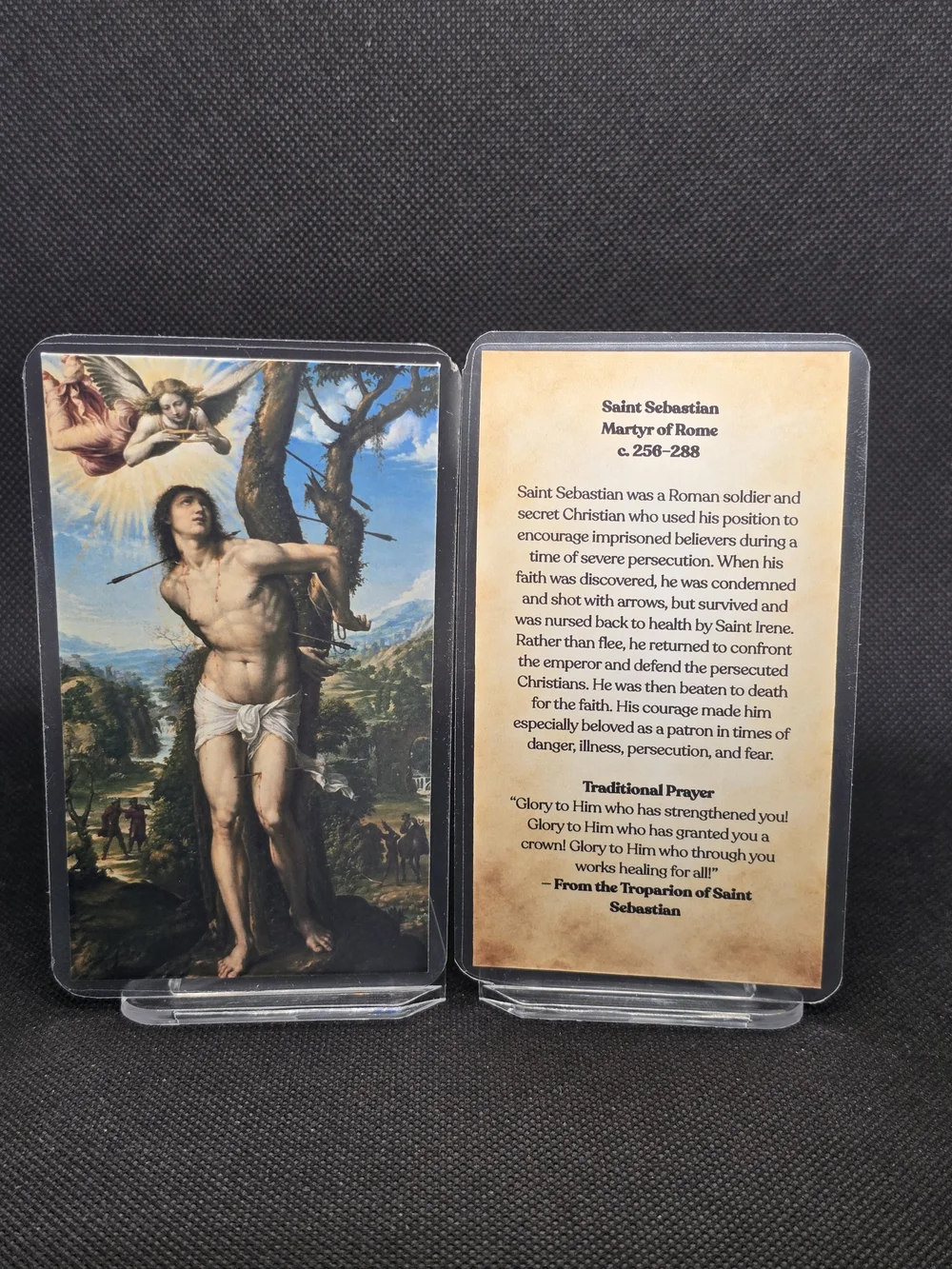
The Eastern angle. For Orthodox and Eastern Catholic readers, Genesius is a saint of the undivided Church, honored in both East and West on one day. His story belongs with the other martyrs of the Diocletian persecution, such as Sebastian, Hermolaus and Barbara. See our biography of Saint Sebastian for a martyr of the same age.

Part XV
Prayers
Lord Jesus Christ, you know every role I play and every face I wear. Make my work honest. Let me make people laugh without cruelty, and let me move them without deceit.
Saint Genesius, who was stopped in the middle of a scene and spoke the truth, pray for me. When I am tempted to put on a part with my faith, give me the courage to be the same person on the stage and off it. Keep my heart clean among the pressures of my profession. Amen.
Lord, I do not know what I am doing when I pray, and I am not sure I believe. If you are there, wash from me what weighs on me. As you came to Genesius in the middle of a joke, come to me in the middle of my ordinary day.
Saint Genesius, pray for those who mock what they do not understand, and for those who are afraid to ask. Turn our hearts to the one who is the true King of Heaven and earth. Amen.
Part XVI
Cards and Gifts
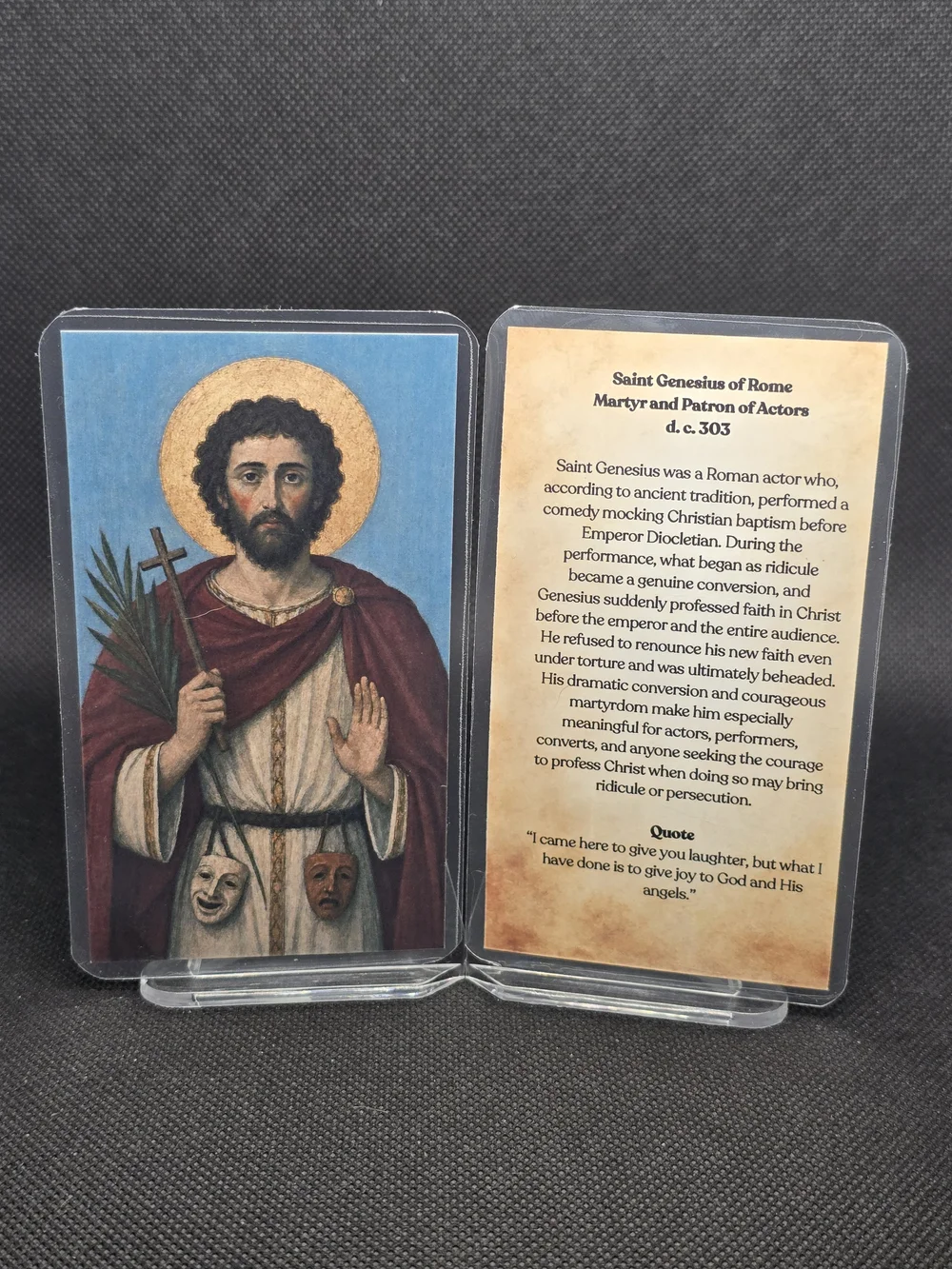
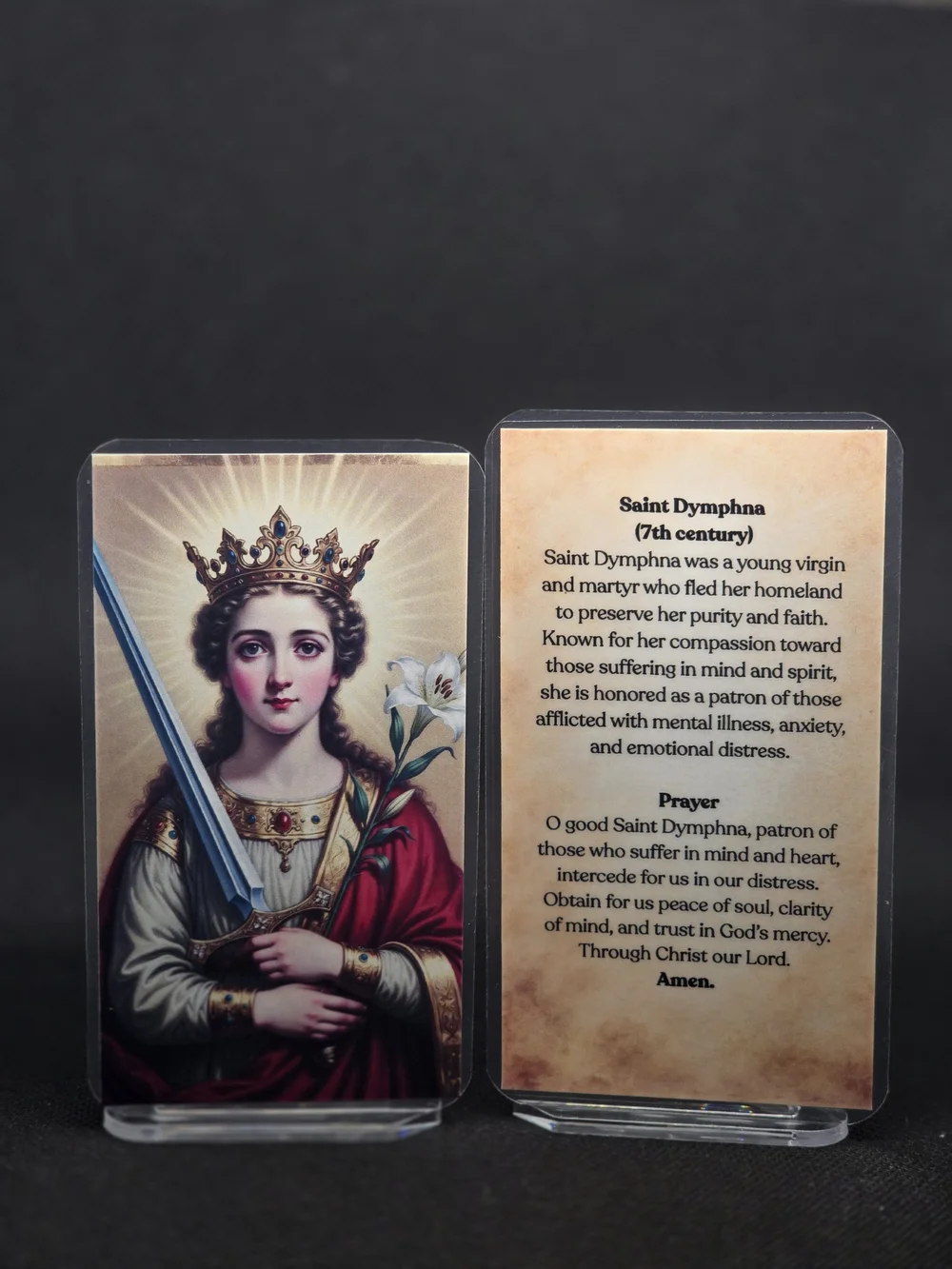
The Genesius card, with Saint Pelagia the Actress and Saint Dymphna.
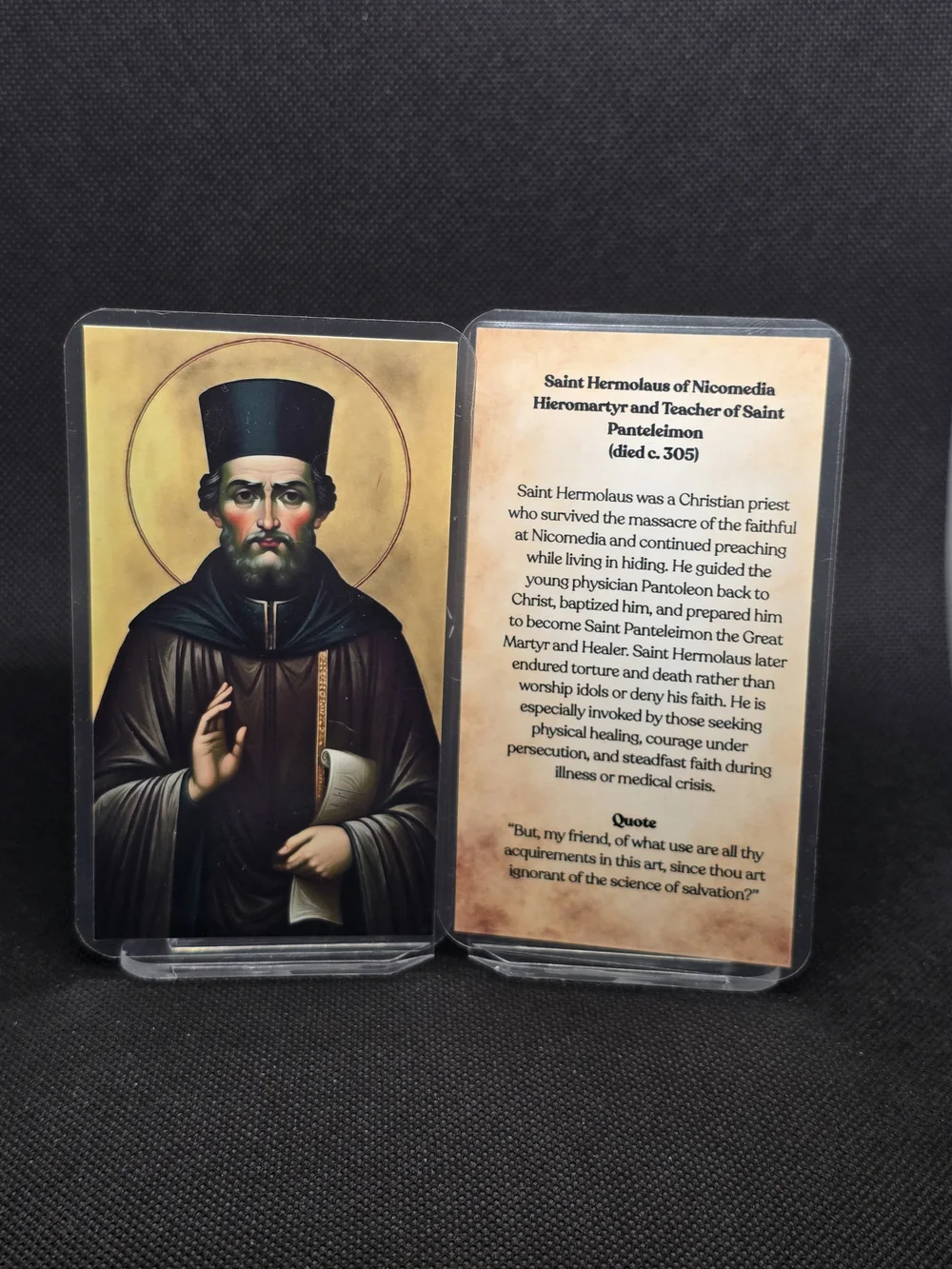
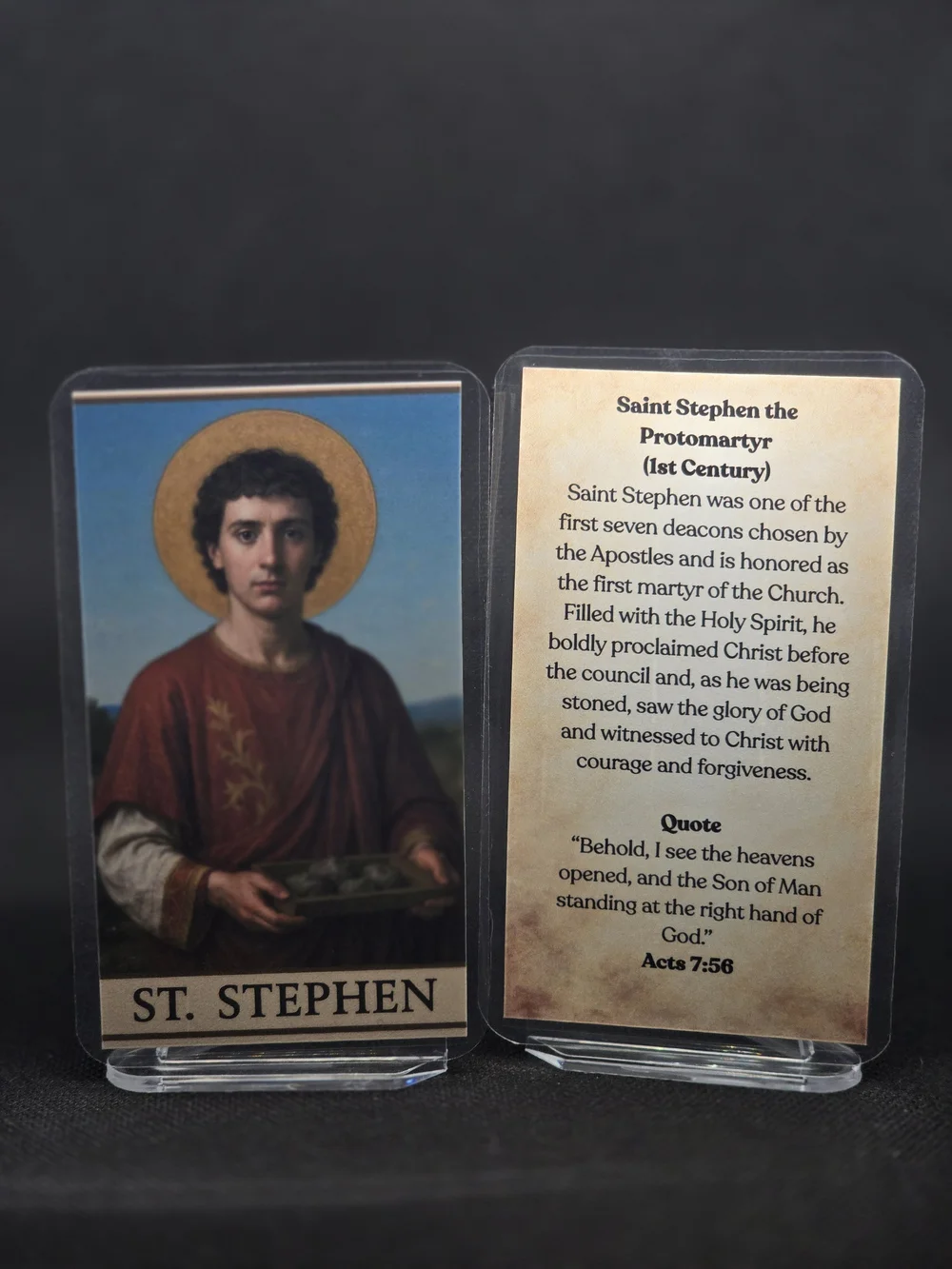
Saint Sebastian, Saint Hermolaus of Nicomedia and Saint Stephen the Protomartyr.
The Jesus Prayer shirt.
The Actor Who Stopped Acting
Whether you know Genesius as the comedian of Rome, the notary of Arles, or both, his story makes one claim: that a person can be interrupted by grace in the middle of anything, and that the right answer is to stop pretending. Ask him to pray for you on August 25, and on any other day you find yourself playing a part.
Appendix
