Saint Dymphna: The Complete Life, Miracles, and Relics of the Patron Saint of Mental Illness
Saint Dymphna: The Complete Life, Miracles, and Relics of the Patron Saint of Mental Illness
A fifteen-year-old girl beheaded by her own father's hand. A village in Belgium that, for eight centuries, has opened its homes to the mentally ill because of her. A red tile found resting on her breast, bearing only her name. This is the most complete account anywhere of Saint Dymphna of Geel — her full life and martyrdom, the documented miracles before and after her death, where her relics rest today, and everything she is patron, and unofficially patron, of.
Saint Dymphna — At a Glance
- Born
- 7th century, Ireland (kingdom of Oriel)
- Died
- c. 620–650 AD, Geel, Belgium • age 15 • beheaded by her father
- Feast Day
- May 15 (historic) • May 30 (current Roman Martyrology, since 2004)
- Title
- "Lily of Éire" • "Lily of Fire"
- Earliest Written Account
- c. 1240s, by Canon Pierre of Cambrai, from oral tradition
- Officially Patron Of
- Mental & nervous disorders • epilepsy • incest victims
- Unofficially Invoked For
- Anxiety • depression • PTSD • sleepwalking • runaways • mental health workers
- Documented Miracle Period
- 1604–1668, recorded by the Bollandist scholars
- Primary Relics
- Golden reliquary, Church of St. Dymphna, Geel, Belgium
- US Relic
- National Shrine of St. Dymphna, Massillon, Ohio — first-class relic
- Living Legacy
- Geel's 800-year community psychiatric care model, praised by the WHO
- Companion Martyr
- St. Gerebernus, her confessor, beheaded the same day
Her Childhood in Ireland
Saint Dymphna was born in the seventh century in Ireland, in a kingdom historically identified as Oriel, in what is now the border region of Ulster. Her name in the original Irish, Damhnait, is generally understood to mean "little doe" or "poetess," and survives today in its anglicized form, Devnet or Dympna. Her father, Damon, was a petty king and, unusually for an Irish ruler of this era, still a pagan at a time when Ireland was almost universally Christian. Her mother is remembered by tradition as a descendant of a noble family and a devout Christian, a woman celebrated equally for her piety and her remarkable beauty.
Dymphna inherited her mother's beauty in a way that struck everyone who saw her, and she was, in the words of her earliest biographer, "the jewel of her home," lavished with every affection from birth. She was placed under the care of a pious Christian woman who prepared her for baptism, which was administered by a priest named Gerebernus — a man who appears to have lived as part of the household and who later personally taught young Dymphna her letters alongside the truths of the Christian faith. She was, by every account, a bright and eager pupil who advanced rapidly in both wisdom and grace.
While still very young, moved by a deep love for Christ that seems to have grown directly out of Gerebernus's teaching, Dymphna chose Him as her Divine Spouse and consecrated her virginity to Him and to the Blessed Virgin Mary through a private vow of chastity. Several traditions place this vow at around the age of fourteen. This vow, made quietly and without any expectation of the crisis it would soon provoke, would become the fixed point her entire life pivoted around in the years that followed.
Part II
Her Mother's Death and Her Father's Descent
Dymphna's settled childhood ended abruptly with the death of her mother. The tradition records that Dymphna shed many secret tears over this loss, finding comfort, even at her tender age, in the Christian faith that had already taken deep root in her.
Her father's grief took a far more dangerous shape. Damon had loved his wife deeply, and at her death he fell into a grief so total that, according to several traditions, it tipped into outright mental instability — a detail worth pausing on, since it means the very affliction Dymphna would later become patroness for healing in others was, in her own story, the affliction that destroyed her father and ultimately took her life. He remained prostrate with sorrow for a long period before his counselors, alarmed at the king's condition, persuaded him that a second marriage might restore him.
Damon agreed, but only on the condition that his new wife resemble his late queen in both beauty and character. Messengers were sent throughout many lands in search of such a woman. They returned empty-handed: no one, they reported, could be found who matched the late queen's beauty and grace — no one, that is, except the king's own daughter, who had grown to be her living image. It was the king's own advisors who first planted this idea in his mind, and it is this detail, more than any other, that historians and theologians alike point to as the moment Damon's grief curdled into something his daughter could not forgive or accommodate.
Part III
The Proposal and the Flight to Belgium
Damon approached his daughter with persuasive and flattering words, revealing his intention to marry her. Dymphna, as any reasonable account would expect, was horrified. She did not refuse outright in the moment; instead, she asked for a period of forty days to consider the proposal — a request that bought her time rather than reflecting any real openness to the demand, and one she used immediately to seek out Father Gerebernus.
Gerebernus's counsel was direct and urgent: flee the country, and do so without delay, since the danger to her was now immediate. Dymphna set out for the European continent accompanied by four companions: Father Gerebernus, two trusted servants, and, in a detail repeated across nearly every version of the story, the king's own court jester and his wife. After a favorable sea passage, the group landed on the coast near what is now the city of Antwerp.
From Antwerp, they continued inland and came to a small village called Gheel (spelled today as Geel), where they were hospitably received and began making plans to settle. They built their lodging near an existing chapel dedicated to Saint Martin of Tours — a detail that places their refuge inside an already-Christian landscape rather than total wilderness, and that later became part of the physical memory the village preserved of Dymphna's presence there.


Part IV
Life and Charity in Geel
Tradition holds that once settled, Dymphna did not live in hiding passively. She used her own dowry and personal wealth to build a hospice for the poor and sick of the surrounding region, devoting herself to caring for people who had nothing — an act of charity entirely consistent with the vow she had made years earlier in Ireland, and one that gives the earliest texture to what would become her enduring legacy as a healer of the suffering.
It was this same generosity that ultimately exposed her. The coins she spent to fund her charitable work and sustain her small household were Irish currency, unusual and traceable in that part of the Continent. When her father's search eventually reached Belgium, it was the distinctiveness of these coins — spent by an innkeeper or merchant somewhere along the way — that allowed his spies to trace the fugitives' location to Geel. The very wealth she had given away in service of the poor became the thread that led her father's men back to her.
Part V
The Pursuit and the Martyrdom
Damon, on discovering his daughter's flight, was described by every surviving account as fearfully angry. He set out at once with his followers, and after some time his men traced the fugitives to Belgium and located their refuge in Geel. According to the most detailed traditions, the king's spies arrived posing as ordinary travelers, were unwittingly directed by locals to exactly where Dymphna lived, and reported the location back to the king.
When Damon himself arrived in Geel, he first attempted persuasion rather than force. He made glowing promises — wealth, worldly honor, prestige — trying to coax his daughter into returning with him willingly. When these failed against her resolve, he resorted to threats and insults. Dymphna remained unmoved through all of it; she would rather die, the tradition is explicit in saying, than enter an incestuous union with her own father or break the vow of virginity she had made years before to Christ.
It was Father Gerebernus who first paid the price for standing beside her. When Damon's wicked intentions toward his daughter became undeniable in the priest's presence, Gerebernus sternly rebuked the king to his face for what he intended to do. Enraged at being confronted, Damon ordered his retainers to kill the priest on the spot. Without delay, his men seized Gerebernus and struck off his head with a single blow of the sword — the first of the two martyrdoms that would take place in Geel that day.
Damon made further attempts to persuade Dymphna, and every one of them proved fruitless. With what her biographers consistently describe as undaunted courage, she spurned his enticements and scorned his cruel threats outright. Finally, infuriated past restraint by her unbroken resistance, the king drew his own weapon — described variously as a dagger or his own sword — and with his own hand struck off the head of his child. Dymphna fell at the feet of her raving father, commending her soul to the mercy of God as she died. She was fifteen years old. Her death is traditionally dated to May 15, sometime between 620 and 640 AD, though some sources place it as late as c. 650.
Part VI
The Discovery of Her Relics
The bodies of Dymphna and Gerebernus lay on the ground at the place of their martyrdom for some time after their deaths — how long exactly, the records do not specify. Eventually the people of Geel removed the bodies to a cave, which was, the tradition explains, the customary manner of burial in that part of the Low Countries during this period.
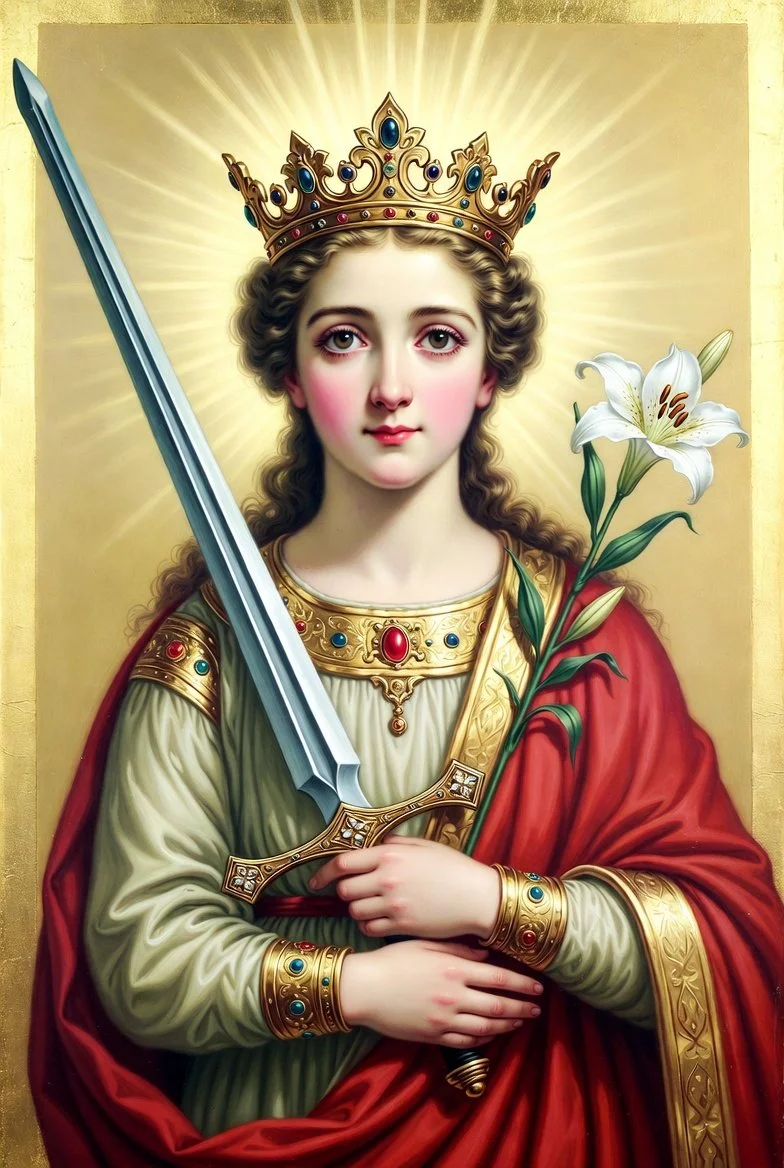
Years passed. Then, recalling the holiness of these two deaths, the villagers of Geel decided the martyrs deserved a more fitting burial than a simple cave. When workmen removed the mound of black earth that had built up at the cave's entrance, they were astonished to discover two tombs carved from stone, white as snow, of a craftsmanship so fine that the people who found them believed angels themselves must have carved them. When the coffin believed to be Dymphna's was opened, those present found, resting on her breast, a red tile bearing a two-line inscription: "Here lies the holy virgin and martyr, Dymphna."
This is, in the most literal sense, the physical evidence the entire centuries-long devotion to Saint Dymphna rests upon. Scholars are honest about the fact that the discovery of an inscribed tile alongside two ancient sarcophagi may itself be the actual origin point of her veneration — that is, the cult of Saint Dymphna as we know it likely crystallized around this thirteenth-century discovery, even though the martyrdom itself is dated centuries earlier, to the 600s. Fragments of these original ancient sarcophagi survive at Geel today, alongside the inscribed brick.
The remains were placed first in a small church built for that purpose. Later, growing need required a larger building, and "the magnificent Church of St. Dymphna" was erected on the very site of the original burial. Today, Dymphna's relics rest there in a beautiful golden reliquary.
Part VII
Miracles After Death: The Bollandist Record
Miracles and cures began occurring at Geel in continually increasing numbers almost as soon as Dymphna's relics were properly enshrined. Her fame as patroness of victims of nervous diseases and mental disorders spread from country to country, and increasing numbers of mentally afflicted people were brought to her shrine by relatives and friends, many arriving after long pilgrimages from distant lands. Novenas were prayed, and Dymphna's relic was directly applied to afflicted patients — a practice that, remarkably, continues at her shrines to this day.
The documentation of these cures is not merely anecdotal folklore passed down informally. The Bollandists — a society of Jesuit scholars founded specifically to critically document and verify the lives and miracles of the saints using the most rigorous historical standards available in their era — published numerous accounts of miraculous cures attributed to Dymphna's intercession, with a documented concentration of cases especially between the years 1604 and 1668. This sixty-four-year window represents the most intensively recorded period of healing in her entire cultus, predating modern psychiatry by centuries and occurring at a time when, virtually everywhere else in Europe, the mentally ill were driven out, chained, exhibited as spectacles at fairs, or simply abandoned.
The remarkable cures reported at Geel caused confidence in the saint to grow daily among the surrounding population. What started as healing at her tomb gradually became something more permanent and structural: the patients who came seeking cures began to be lodged first in a small annex built onto the church itself, and then, as numbers grew beyond what any annex could hold, in the actual homes of the families living in Geel.
Part VIII
How Geel Became the World's Model for Community Mental Health Care
From this overflow of pilgrims came an institution called the "Infirmary of St. Elizabeth," conducted by the Sisters of St. Augustine specifically for the hospital care of the mentally afflicted who arrived at Geel. But the truly distinctive element of Geel's legacy is what happened after that initial hospital stay: most patients, after some time in the institution, were placed in one of the families of Geel, where they lived a comparatively normal life as part of an ordinary household.
Every home in Geel took pride in welcoming such patients into its innermost family circle once they were ready to return to the rhythms of family life. Generations of accumulated experience gave the people of Geel an intimate, practiced skill at caring for those in their charge, and their remarkable spirit of Christlike charity toward society's most afflicted members stands as a living rebuke to any age, including our own, too quick to rely solely on clinical science while neglecting the principles of genuine Christian charity.
This is not merely pious self-congratulation from within the tradition. Renowned psychiatrists, writing from entirely outside any religious framework, have independently testified that a surprisingly large number of patients could be discharged from mental institutions if they could be assured of a sympathetic reception back in the world — precisely the kind of reception the people of Geel have taken pride in providing for eight centuries. Psychiatric literature consistently notes that institutional care alone can only help certain cases to a given point, after which real, sustained progress requires support from people outside the institution. Geel stands as a living confirmation of exactly that principle, and as a direct, traceable exemplar of the Gospel's teaching on charity.
The scale of this system has been documented across more than a century of independent observation. An 1875 report described it as a literal "colony of madmen" living in ordinary households; by the 1930s, an estimated four thousand people were under this form of community care; by 1979, that number had fallen to roughly fourteen hundred; a 2016 count recorded approximately 250 residents still living in Geel under this system, hosted by families who continue to invoke Saint Dymphna's intercession on their behalf. In 2001, the World Health Organization's report on mental health named Geel one of the best examples in the world of how an entire community can become carers for the mentally ill — a designation earned by a model of care that began, eight hundred years earlier, as an act of devotion to a murdered teenage girl.


Part IX
Veneration, Canonization Status, and the Altarpiece
The earliest written account of Dymphna's life dates only to the middle of the thirteenth century — roughly six centuries after her traditional date of death. Under Bishop Guy I of Cambrai (1238–1247), a canon named Pierre, attached to the Church of Saint Aubert at Cambrai, wrote a formal Vita of the saint, drawing explicitly, by his own admission, on oral tradition rather than any earlier written source or documentary evidence. Honest scholarship, including the Catholic Encyclopedia's own historical assessment, acknowledges that this narrative closely parallels a recurring folklore motif — a king who wishes to marry his own daughter — that appears across many cultures, and that nothing in the account can be used to establish reliable historical facts about exactly when Dymphna lived or whether she is identical to a separate early Irish saint, Damhnait, sometimes proposed as the same figure.
This historical uncertainty does not diminish the authenticity or antiquity of her veneration, which is among the most ancient features of her cultus and one that long predates the modern, centralized canonization process. Dymphna was venerated and recognized as a saint well before the formal establishment of the Vatican's Congregation for the Causes of Saints; her feast was already kept in both Ireland and Geel by the time of Pierre's writing, and her name has appeared in the official Roman Martyrology for centuries. She remains, today, a fully recognized and beloved saint of the Catholic Church, venerated under what is sometimes called "equipollent" or "equivalent" canonization — sainthood recognized through ancient, unbroken veneration rather than a formal modern process.
The richest visual record of her story comes from an extraordinary set of painted wooden panels known as the Dymphna Altarpiece, created around 1505 by the Flemish master Goossen van der Weyden, grandson of the celebrated painter Rogier van der Weyden. Commissioned by Abbot Antonius Tsgrooten for the abbey at Tongerlo, near Geel, the original eight panels depicted her life in vivid, narrative detail: her baptism, her flight to Antwerp, the king's spies discovering her hideout, the landlady at an inn in Westerlo recognizing the foreign coins the spies carried, the discovery of the sarcophagi containing her remains and Gerebernus's, and the return of her body to Geel. The altarpiece survived roughly two centuries in place before an eighteenth-century abbot had it dismantled, and it vanished entirely during the chaos of the French Revolution. Seven of the eight panels resurfaced in 1837 in the private collection of a librarian in Geel; the panel depicting the actual martyrdom remains lost to this day. After passing through numerous private collections across the twentieth century, the surviving panels were acquired and meticulously restored over three years by the Phoebus Foundation in Antwerp, and have since traveled to major exhibitions, including the National Gallery of Ireland in 2023 — the first time the panels depicting an Irish-born saint's life had ever been exhibited in her native country.
Part X
Where Her Relics Are Today
Saint Dymphna's relics are not confined to a single location. Centuries of devotion have distributed portions of her physical remains and her cult's memory across several countries.
Church of St. Dymphna
Geel, Antwerp Province, BelgiumThe primary site of her relics, housed in a golden reliquary inside the church built directly on the spot where her body was first buried after her martyrdom. The original medieval church burned down in 1489; its replacement was consecrated in 1532 and still stands today. Pilgrims visit every year on her feast day and on the Tuesday after Pentecost, and a major theatrical procession reenacting her life is held in Geel every five years.
National Shrine of St. Dymphna
206 Cherry Rd NE, Massillon, OH 44646Located inside St. Mary's Catholic Church, this American shrine holds a first-class relic of Saint Dymphna, along with a third-class relic (a piece of cloth touched to the first-class relic) available for veneration. Founded in 1938, the shrine celebrated its 85th anniversary in 2023 and continues to hold an annual feast day Mass and relic veneration each May, alongside a regular Novena in her honor.
Xanten, Germany
Diocese of MünsterThe body of Saint Gerebernus, Dymphna's confessor and fellow martyr, was moved here from Geel; only his head remains at the church in Geel. Geel and Xanten remain twin cities to this day, a relationship that traces directly back to Gerebernus's martyrdom alongside Dymphna.
St. Dymphna's Shrine
Caldavnet, Tedavnet, County Monaghan, IrelandLocated in the region historically identified with the ancient kingdom of Oriel, this site commemorates Dymphna's Irish origins. Geel and Tedavnet remain twinned communities, alongside Xanten, forming a three-city bond rooted entirely in her story.
Part X-B
Deeper History: The Relic Theft, the Holy Wells, and the Scholarly Debate
The Holy Robbers of Xanten
One of the strangest and least-told chapters in Dymphna's afterlife concerns how Gerebernus's relics actually came to rest in Germany. Medieval tradition holds that both Dymphna's and Gerebernus's bones were taken from their coffins in Geel by a group remembered as "robbers from Xanten" — men who, by the curious logic of medieval relic theology, were not considered thieves in the ordinary sense. Popular belief at the time held that a saint's relics could only be successfully stolen if the saint themselves permitted it; an unwilling saint could simply refuse to be moved.
That is exactly what the tradition says happened. Dymphna's bones, the story goes, became immovable partway through the theft, as though she herself refused to leave Geel. Citizens of the town, alerted to the theft, gave chase. Caught between an enraged village and a saint who would not be carried, the robbers abandoned Dymphna's remains, took what they could of Gerebernus's bones instead, and fled toward Xanten. They didn't make it all the way there either: only a few kilometers short of the city, in what is now the area of Sonsbeck, Gerebernus's bones in turn became impossible to move further. The robbers buried what they carried on the spot, and a chapel was raised over the site. Reports of miracles at this new grave soon triggered their own stream of pilgrims, and the church in Geel retained only Gerebernus's head, which can still be seen there today.
This pilgrimage to Gerebernus's relics at Sonsbeck continued for centuries, surviving into the eighteenth century, before ending abruptly and permanently: the relics, and the shrine that housed them, were destroyed by Allied bombing in 1945 during the final months of the Second World War.
Scattered Across Ireland: The Holy Wells
Dymphna's connection to her native Ireland was never severed, even though her martyrdom took place an ocean away. Multiple holy wells across Ireland bear her name and are tied to local traditions of her flight from her father. The most significant is St. Dymphna's Well in Caldavnet, in the civil parish of Tedavnet, County Monaghan — a site enclosed by a stone structure topped with Celtic crosses and shamrocks, with a stone altar for outdoor Mass and a niche holding a statue of the saint. Local tradition holds that Dymphna stopped here while fleeing toward the coast, and that the well's waters are specifically reputed to bring relief from nervous disorders and peace of mind to those who have endured abuse and incest — a patronage that maps with striking precision onto the actual circumstances of her own life. The traditional pattern day at the well, observed for generations through a nine-day novena, falls on May 15.
A second well, St. Dymphna's Well at Corrawillan, Lower Lavey, in County Cavan, carries a local tradition claiming Dymphna fled from Lavey itself before continuing on to Belgium. Documentation collected in 1938 describes this Pattern as one of the most ancient in Ireland, in continuous existence for more than nine hundred years at that point, revived formally in 1934 with the approval of the Bishop of Kilmore. A third site, St. Dympna's Well at Kilnadeema, near Loughrea in County Galway, extends her veneration even further across the country.
Is Dymphna the Same Saint as Damnat?
Honest historical scholarship requires acknowledging a genuine, unresolved scholarly debate here. The Irish place name Tydavnet (Tigh Damhnait, "House of Damhnait") in County Monaghan is associated with a separate, much more obscure sixth-century Irish saint named Damnat, or Davnet, traditionally credited with founding a church or nunnery in the area. A tenth-century ornamental pilgrim's staff associated with her, the bachall Damhnait, survived for centuries in local use for swearing oaths and is now preserved in the National Museum of Ireland.
Popular Irish devotion has long treated Damnat and Dymphna as one and the same figure — a connection considered strong enough that Geel and Tydavnet were formally designated twin towns in 1992. Many religious scholars, however, hold that Damnat and Dymphna were two entirely separate holy women whose names and local cults became conflated over centuries of oral tradition, name-similarity, and the natural human tendency to merge obscure local saints into more famous continental ones. Contemporary scholarship generally treats them as distinct, with Damnat remaining a localized Irish saint with no genuine historical connection to Geel, even as the popular devotional tradition continues to celebrate them together. This article presents this honestly as an open question rather than asserting either position as settled fact.
The Ommegang: A Procession Held Every Five Years
Beyond the annual feast day observances, Geel hosts a much larger event called the Ommegang every five years on or near May 15 — an elaborately choreographed procession through the town that includes costumed reenactments of Dymphna's legend, with townspeople taking on the roles of the saint, her father, Gerebernus, and the other figures of her story. This periodic, theatrical commemoration has become significant enough in Belgian cultural memory that it inspired, in 2015, a Texas craft brewery's "Legendary Series" beer named directly for the saint, created by a brewer whose family hailed from a village near Geel and who grew up hearing his grandmother's stories about Dymphna beside the very chapel associated with her flight.
The Massillon Shrine's 2015 Fire
The National Shrine of St. Dymphna in Massillon, Ohio, has its own more recent history of resilience worth recording. The shrine was damaged by a fire in 2015, closing it to pilgrims for over a year during repairs and restoration. It reopened to the public in December 2016 and has continued its ministry of relic veneration, novenas, and annual feast day celebrations ever since — a small American echo of the same pattern repeated throughout Dymphna's entire cultus: damage, loss, and fire, followed by rebuilding and renewed devotion.
What Saint Dymphna Is Patron — and Unofficial Patron — Of
Officially Recognized
Saint Dymphna's formally recognized patronages, attested across Catholic devotional sources for centuries, are: those suffering from mental and nervous disorders, epilepsy, and victims of incest. She is also traditionally invoked against insanity broadly and on behalf of mental hospitals and the people who staff them, a patronage that grew directly out of Geel's documented history of community psychiatric care.
Widely Invoked, Without Formal Declaration
Beyond her official titles, devotional practice and modern pastoral usage have extended Dymphna's intercession, informally but consistently, to a wider circle of related struggles that her own story speaks to directly:
- Anxiety and depression — reflecting the surge in modern devotion to her specifically among people naming these conditions by their contemporary clinical terms.
- Sleepwalking and dissociative episodes — a patronage with roots in the older "nervous disorders" category under which such conditions were historically grouped.
- Demonic affliction and possession — tied to the original medieval understanding of severe mental illness, which her shrine was specifically sought out to address.
- Runaways and those fleeing dangerous or abusive households — an unofficial patronage that follows directly from her own flight from her father's household under threat.
- Psychiatrists, therapists, and mental health professionals — an extension of her historic patronage over asylums and the Sisters of St. Augustine who staffed Geel's Infirmary of St. Elizabeth.
- Caregivers of family members with severe mental illness — reflecting both Geel's host-family model and the simple fact that her own father's mental collapse, not a stranger's, was the source of her suffering.
This breadth of informal patronage is part of why search interest in Saint Dymphna has grown so sharply in recent years: she is one of the only saints in the entire Catholic calendar whose patronage maps with this much precision onto language people use about their own mental health today.
Part XII
Quotes, Inscriptions, and Documented Words
Because Dymphna's life was first set down in writing roughly six centuries after her death, drawing explicitly on oral tradition, there is no surviving record of her speaking in the way later, better-documented saints sometimes have verified personal letters or recorded sermons. What we have instead are three specific, repeatedly attested textual fragments that the tradition treats as authoritative.
The Tomb Inscription
The single piece of physical text most directly connected to her is the inscription on the red tile discovered resting on her breast when her tomb was opened: "Here lies the holy virgin and martyr, Dymphna." This two-line inscription, found on a quadrangular brick alongside the ancient sarcophagi, is treated by historians as the probable literal origin point of her entire cult — the physical trigger, in other words, for the explosion of devotion that followed.
Her Final Act of Prayer
Every surviving account agrees on the content, if not the precise wording, of her final act: as she fell at her father's feet after the fatal blow, Dymphna commended her soul to the mercy of God. This detail is treated less as a verbatim quotation than as a description of her posture in death — dying in active prayer rather than terror or curse, even toward the father who killed her.
Her Title: "Lily of Fire"
Among the various titles attached to her across centuries of devotional writing — "Lily of Éire," referencing her Irish origin, is the more common — one older devotional source uses the striking phrase "Lily of Fire" specifically, a title meant to capture both the purity she died defending and the violent, fiery nature of how that purity was tested and ended. This phrase appears in earlier 20th-century English-language devotional literature on her life and remains one of the more evocative, if less commonly repeated, titles applied to her.
Part XIII
Prayers to Saint Dymphna
Good Saint Dymphna, helper and consoler of the troubled in mind, those suffering from nervous and mental afflictions, we come to your shrine and seek your assistance.
You who became patroness of those afflicted with mental and nervous disorders through your own undeserved suffering, you are an inspiration and a symbol of charity to the thousands who ask your intercession.
We beg you, Lord, to hear the prayers of Saint Dymphna on our behalf. Grant all those for whom we pray patience in their sufferings and resignation to Your divine will. Please fill them with hope, and grant them the relief and cure they so much desire. (Here mention those for whom you wish to pray.)
We ask this through Christ our Lord, who suffered agony in the garden. Amen.
This traditional prayer is widely published across Catholic devotional sources, including the prayer historically distributed at her shrines; the exact authorship is not attested to any single original source.


Part XIV
Complete Timeline of Saint Dymphna's Life and Legacy
FAQ
Frequently Asked Questions About Saint Dymphna

A Tile With Only Her Name. A Town That Never Stopped Listening.
Saint Dymphna's entire legacy rests on a paradox worth sitting with directly: the affliction that destroyed her family is the very affliction she has spent fourteen centuries helping others survive. Her father's mind broke, and that breaking cost Dymphna her life at fifteen. And yet it is precisely because of what happened to her — not in spite of it — that an entire town in Belgium has spent eight hundred years opening its homes to people the rest of the world was prepared to chain up or cast out.
There is no tidy resolution to her story. She did not live to see the healing her death would set in motion. What she left behind was a tile with nothing but her name on it, and a community that, against every instinct of its era, decided to listen anyway.
Get the Saint Dymphna Prayer Card →