Saint Blaise: The Complete Life, Miracles, and Relics of the Patron Saint of the Throat
Saint Blaise: The Complete Life, Miracles, and Relics of the Patron Saint of the Throat
A physician who became a bishop. A choking boy saved on the road to prison. A wolf that returned a stolen pig at the sound of his voice. A city in Croatia that has carried his bones through its streets every February for over a thousand years. This is the most complete account anywhere of Saint Blaise of Sebaste — his full life and martyrdom, the documented miracles before and after his death, where his relics rest today across three continents, and everything he is patron, and unofficially patron, of.
Saint Blaise — At a Glance
- Born
- c. 280 AD, Sebaste, Lesser Armenia (modern Sivas, Turkey)
- Died
- c. 316 AD • Sebaste • beaten, combed, and beheaded
- Feast Day
- February 3 (Western/Roman) • February 11 (Eastern Orthodox)
- Occupation
- Physician, then Bishop of Sebaste
- Earliest Record
- c. 500 AD, medical writings of Aëtius Amidenus
- Officially Patron Of
- Throat ailments • wool combers • physicians • animals
- Unofficially Invoked For
- Singers & public speakers • choking emergencies • veterinarians • builders
- Defining Miracle
- Healing a choking boy with a fishbone, en route to his own arrest
- One of the
- Fourteen Holy Helpers
- Primary Relics
- Basilica of San Biagio, Monte San Biagio, Maratea, Italy
- Major Relic Site #2
- Dubrovnik Cathedral, Croatia — head, hand, foot & throat relics
- US Relic
- Maria Stein Shrine of the Holy Relics, Maria Stein, Ohio
- Living Tradition
- The annual Blessing of the Throats, observed worldwide every February 3
His Early Life as a Physician
Saint Blaise was born around the year 280 AD in Sebaste, the chief city of Lesser Armenia, in what is today the city of Sivas in central Turkey. Tradition holds that he was born to rich and noble parents and received a thorough Christian education from his earliest years, studying philosophy as a young man before turning to the practice of medicine in his native city.
He became, by every surviving account, an excellent physician, exercising his medical skill with what tradition describes as miraculous ability. Long before he held any formal religious office, Blaise was already known throughout Sebaste as a man who could heal what other doctors could not, and the line between his medical skill and his sanctity blurred early: he is remembered as having begun his public life as a healer of bodies and only later, almost as a natural extension of that calling, becoming what one tradition calls "a physician of souls."
The earliest surviving documentary reference to Blaise at all does not come from a hagiography or a saint's life. It comes from the medical writings of the Byzantine physician Aëtius Amidenus, composed around the year 500 AD, where Blaise's aid is specifically invoked as a remedy for patients who have objects lodged in their throat. This is a genuinely remarkable detail: nearly two centuries before any formal written biography of his life existed, Blaise was already known and invoked, by name, specifically for throat ailments — meaning his core patronage predates and exists entirely independent of the more elaborate legendary Acts that would later be written about him.
Part II
Bishop of Sebaste
When the bishop of Sebaste died, Blaise was chosen to succeed him by what the tradition specifically calls the acclamation of all the people — a detail worth pausing on, since in the early fourth century a man was typically nominated to the episcopate based on his outstanding holiness and leadership qualities, then examined and formally consecrated by other bishops. That Blaise, already a respected physician, was the community's unanimous popular choice speaks to the depth of trust he had already earned among them.
As bishop, Blaise instructed his people as much by his own example as by his words. His great virtue and evident sanctity were attested, even in his lifetime, by numerous miracles. People flocked to him from the surrounding region seeking cures for both bodily and spiritual illness, and tradition holds that even wild animals came to him in herds to receive his blessing — an early sign of the unusual relationship with the natural world that would define much of his later legend.


Part III
The Cave, the Wild Animals, and the Hunters
The Edict of Milan, jointly issued by the co-emperors Constantine and Licinius in 313, had established religious toleration throughout the Roman Empire only a few years earlier. That toleration proved short-lived in Lesser Armenia. In 316, Licinius's appointed governor of Cappadocia and Lesser Armenia, a man named Agricola (also recorded as Agricolaus), began a renewed persecution of Christians in the region, acting on the emperor's orders.
The people of Sebaste, fearing for their bishop's safety as the persecution intensified, convinced Blaise to withdraw from the city. He retreated to a deep cave on Mount Argaeus, where he lived in solitude, prayer, and contemplation for some time. He was not alone there in any ordinary sense: tradition holds that wild animals from the surrounding forest sought him out in his refuge, and that he tended to their wounds and illnesses just as he had once tended to the people of Sebaste, with the animals showing every sign of reverence in his presence rather than fear.
His solitude ended when a group of the governor's hunters, gathering wild beasts to be used in the games of the amphitheater, stumbled upon his cave. They found Blaise absorbed in prayer, with the beasts of the forest gathered peaceably around him — a sight extraordinary enough that the hunters returned to the city and reported the encounter to Agricola in detail. The governor, recognizing immediately that the hermit they described could only be the missing Bishop Blaise, ordered his soldiers to bring him in.
Part IV
Arrest and the Miracle of the Fishbone
When the soldiers arrived to take him, Blaise received them with complete meekness and followed them back toward the city, walking, in the words of one tradition, "as to a triumph" rather than to his own arrest. News of his capture spread immediately through Sebaste, and Christians crowded the road to see him pass. He blessed everyone he encountered along the way, and the sick among them were healed simply by his passing.
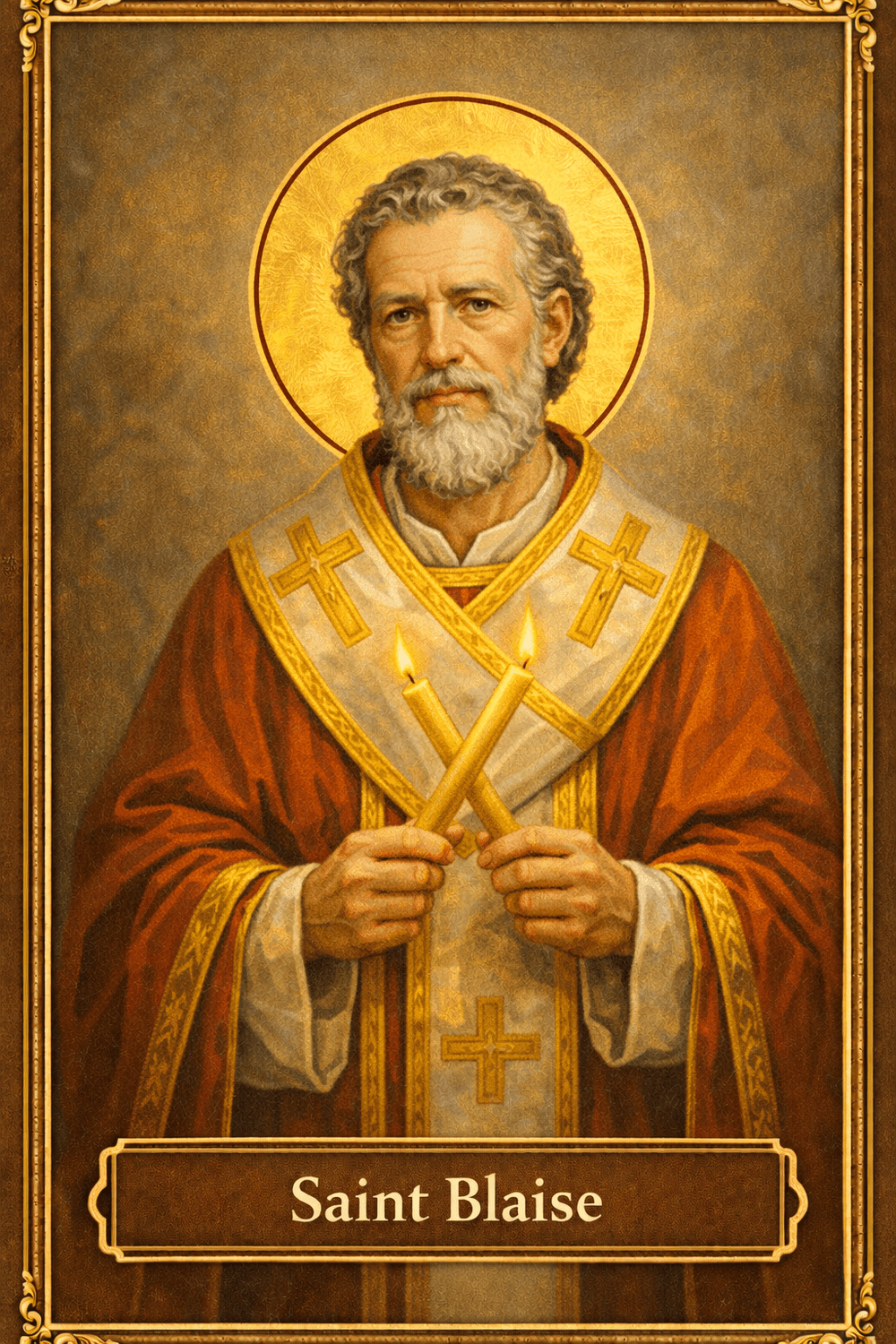
It was on this same road, while under armed guard and being led directly toward his own interrogation and likely death, that Blaise performed the miracle that has defined his entire legacy for the seventeen centuries since. A mother, desperate and out of options, brought her only son to him at the side of the road. The boy was choking to death on a fishbone lodged in his throat. She set him down at Blaise's feet, pleading for his prayers. Blaise, in the middle of his own arrest, stopped and cured the child on the spot.
Even Agricola, when the events of the journey were reported to him, was amazed. It changed nothing in his intentions. He could not, regardless of what he had heard, get Blaise to renounce his Christian faith.
Part V
The Wolf and the Pig
The fishbone miracle was not the only act of mercy Blaise performed during this same journey under guard. Tradition records a second encounter: as he was being led toward Sebaste, the procession came across a poor woman whose pig — her only significant possession and likely her family's sole source of food for the winter — had just been seized by a wolf in plain sight. At Blaise's command, the wolf released the pig completely unharmed and returned it to the woman, to the astonishment of everyone present.
This act of mercy mattered enormously to the woman it helped, and she did not forget it. When Blaise reached Sebaste and was placed in his dark prison cell, she came to visit him there, bringing with her two fine wax candles specifically meant to dispel the gloom of his confinement. It is this single, deeply human gift — offered out of simple gratitude by a woman whose livelihood he had just saved — that became the origin of the candles still used in the Blessing of the Throats performed in his name to this day.
Part VI
Imprisonment, the Candles, and Martyrdom
Once before Agricola, Blaise firmly and openly professed his Christian faith. The governor's first response was severe: he had Blaise beaten with a stick. When this failed to move him, Agricola pressed further at a second hearing, demanding that Blaise worship the pagan gods of the empire. Blaise refused again, completely and without hesitation.
What followed was a deliberately cruel form of torture. Agricola ordered Blaise's flesh torn with iron combs — the same kind of comb used at the time to card raw wool, dragging sharp metal teeth through fiber to separate and straighten it. Used against human skin instead of wool, the effect was devastating, and it is this specific instrument of torture, rather than anything connected to his actual ministry, that later made Blaise the patron saint of wool combers and the broader wool trade across medieval Europe, simply because the tools of his suffering happened to resemble the tools of that trade.
After enduring this torture without renouncing his faith, Blaise was beheaded, traditionally dated to February 3 in approximately the year 316 AD (some sources place the date as 319). The legendary Acts of St. Blaise, composed roughly four centuries after his death, also record the martyrdom of seven women alongside him, though far less is preserved about their individual stories. A pious Christian woman of Sebaste named Elisa, under cover of night, recovered his body and buried it secretly in a location where a cathedral would later be built — a site that itself became a destination of pilgrimage and reported miracles in the centuries that followed.
Part VII
How His Relics Traveled Across the World
Centuries after his death, during the period of Byzantine Iconoclasm under Emperor Leo III the Isaurian, part of Blaise's remains were placed into a marble urn and put aboard a ship in 732 AD, intended for transport from Sebaste to Rome for safekeeping. The voyage did not go as planned. A violent storm overtook the vessel in the Tyrrhenian Sea, and the ship carrying the saint's relics was driven onto the coast near the small Italian town of Maratea, in what is now the region of Basilicata.
According to local tradition, when the ship was forced ashore at the small island of Santo Janni near Maratea, the marble urn containing Blaise's chest relic became wrapped in a halo so bright that its light was visible to every inhabitant of the town. Confronted with this sign, the Armenian crew accompanying the relics chose to leave them in the hands of the local people of Maratea rather than continue on toward Rome. The relics were carried to the top of the mountain overlooking the town, and the site has been known ever since as Monte San Biagio — Mount Saint Blaise. Maratea adopted him as its patron saint on the spot, a status it has held for nearly thirteen centuries.
The basilica that now houses these relics was built directly over the remains of an ancient temple dedicated to the goddess Minerva. Its most sacred interior space, known as the Royal Chapel, was placed under the formal protection of the Spanish Habsburg crown by King Philip IV in a royal letter dated December 23, 1629 — which is why it is still popularly known today as the "Royal Chapel," a name with no connection to any king of Maratea itself, but to the distant Spanish monarch who once took responsibility for guarding it.


Part VIII
Dubrovnik: The City Saint Blaise Saved
Nowhere on earth is Blaise's cult more deeply woven into civic identity than in Dubrovnik, on the Dalmatian coast of modern Croatia. According to the founding legend of this connection, on the night of February 2, 971 AD — the eve of Candlemas — a Venetian fleet lay anchored just outside the city's walls, ostensibly taking on provisions before continuing east toward the Levant. Their true intention, however, was to seize the city under cover of these same supply stops, attacking by night for fifteen consecutive nights while maintaining a posture of friendship by day.
That same evening, the city's priest, a man named Stojko, was walking near the church of Saint Stephen when he noticed the doors standing open. Inside, he found an elderly, gray-haired man who introduced himself as Blaise, the fourth-century bishop and martyr of Sebaste. Blaise explained the Venetians' true plan in detail and instructed Stojko to warn the Senate of Ragusa (as Dubrovnik was then called) immediately, so the city could prepare its defenses. Acting on this warning, the people of Dubrovnik successfully repelled the planned attack, and the Venetian fleet withdrew.
In gratitude, Dubrovnik replaced its previous patrons, Saints Sergius and Bacchus, and declared Blaise the city's principal protector. The Festivity of Saint Blaise has been celebrated in Dubrovnik continuously since 972 AD — documented with certainty back to at least 1190 by UNESCO's own verification — making it one of the longest continuously observed civic religious festivals anywhere in the world. The festivity was formally inscribed on UNESCO's Representative List of the Intangible Cultural Heritage of Humanity in 2009, one of only two such intangible heritage inscriptions held by the city, alongside its UNESCO World Heritage-listed Old Town itself.
The modern celebration retains remarkable continuity with its medieval form. It begins each year on February 2, Candlemas, with the release of white doves over the city as symbols of peace, and the raising of Blaise's banner at the Church of Saint Blaise. On February 3 itself, after a solemn Mass, the Bishop of Dubrovnik and accompanying clergy carry the city's most treasured reliquaries — containing Blaise's skull, his right hand, a foot, and a bone from his throat — in procession down the Stradun, the city's main thoroughfare, before crowds in traditional folk costume. A corps of soldiers called trombunjeri fire historic black-powder muskets to open and close the procession, a tradition recalling the noise once used to frighten off attacking enemies. During the medieval period, the festival even carried a formal amnesty, the Sloboština of St. Blaise, during which debtors, convicts, and exiles could enter the city freely for a period before and after the celebration without fear of arrest.
Part IX
One of the Fourteen Holy Helpers
Blaise's medieval popularity was not an isolated phenomenon. He is counted as one of the Fourteen Holy Helpers, a group of saints who emerged as a distinct devotional category in Germany as early as the twelfth century, venerated together specifically for their reputed power against particular diseases, dangers, and forms of sudden death. The group as a whole became especially significant during the era of the Black Death, when invoking this entire company of saints together was seen as a particularly potent form of spiritual protection against an affliction medicine of the time had no answer for.
Within this group, Blaise's own specific specialty — diseases of the throat — sat alongside other saints with similarly specific patronages: Saint Denis of Paris was invoked for headache and rabies, for example, each Holy Helper carrying a particular, almost clinical area of intercession. This grouping helped cement Blaise's place among the most consistently venerated saints of the entire medieval period, with altars dedicated to him appearing across the European continent, including at the Abbey of St. Blasius in the Black Forest region of southern Germany, which claimed to hold some of his relics as well.
Part X
Miracles After Death: The Cannonball and the Celestial Manna
The miracles attributed to Blaise did not end with the discovery of his relics at Maratea. Two specific, well-documented episodes from the basilica there illustrate how his cultus continued to generate reported wonders for centuries afterward.
The Cannonball of 1806
During a French siege of Maratea's old castle in December 1806, an iron cannonball was fired directly at the basilica housing Blaise's relics. The shell struck near the Royal Chapel and, remarkably, never exploded. To this day, this same unexploded cannonball is kept on display beside the Royal Chapel, and tradition holds that the clear impression of fingers, said to belong to the right hand of Saint Blaise himself, can be seen pressed into its surface — physical evidence, in the eyes of the faithful, that the saint's intercession had personally disarmed the weapon before it could destroy his own shrine.
The Celestial Manna
A second and even more striking phenomenon is recorded specifically inside the Royal Chapel itself: over an extended period, the walls of the chapel were observed to weep a yellow liquid, gathered carefully by the faithful and used to treat the sick. This phenomenon, often referred to as "celestial manna," was significant enough that it came to the attention of the future Pope Pius IV, who in 1563 personally recognized the liquid as a genuine and unexpected blessing offered by Saint Blaise to those who venerated him — an extraordinary level of formal ecclesiastical attention for what began as a purely local, popular report of the miraculous.
The Miracle of Fiuggi, 1298
A third recorded episode, from a different Italian town entirely, illustrates the breadth of Blaise's reputed intercession beyond Maratea. On February 2, 1298, the town of Fiuggi found itself under siege by forces of the Caetani family, who had divided their army to attack from two directions simultaneously. Tradition holds that Blaise caused false flames to appear at the town, deceiving each of the two attacking groups into believing the other had already successfully conquered the city. Both forces, each convinced the battle was already lost to their rivals, withdrew without ever taking Fiuggi.
Part XI
The Blessing of the Throats: A Living Tradition
The single most widespread living expression of devotion to Saint Blaise is the Blessing of the Throats, performed in Catholic parishes around the world every February 3. The ritual directly recalls the candles brought to him in his prison cell by the grateful widow whose pig he had saved: two candles, first blessed the previous day on the Feast of the Presentation of the Lord (Candlemas), are held crossed in an X-shape, either against the throat or over the head of each person receiving the blessing.
The accompanying prayer, recited in the Church's official Roman Ritual, reads: "Through the intercession of Saint Blaise, bishop and martyr, may God deliver you from every disease of the throat and from every other illness, in the name of the Father, and of the Son, and of the Holy Spirit," followed by the sign of the cross. Veneration of Blaise's intercession for throat diseases specifically is documented in the Eastern Church as early as the sixth century, with the practice spreading into Western Europe by the eighth century — meaning some form of this exact prayer relationship has existed continuously for roughly 1,500 years.
Local culinary traditions have grown up around the same feast day across the centuries. In Milan, families traditionally eat the very last remaining slice of Christmas panettone on February 3 as a small act of protection against throat illness, with a local saying that translates roughly as "Saint Blaise blesses your throat and your nose." In several towns in Italy, soft breads and pastries shaped to recall the saint are blessed and distributed specifically because their soft texture was believed to soothe a sore throat. In the town of Subiaco, residents climb to a small hermitage on Monte Taleo each year to have their throats anointed with blessed oil by a monk from the nearby Sacro Speco of Saint Benedict.

Part XII
Where His Relics Are Today
Because Blaise's relics were divided, transported, and distributed across multiple regions over many centuries, churches on at least three continents now hold portions of his remains.
Basilica of San Biagio
Monte San Biagio, Maratea, Basilicata, ItalyThe primary site of his relics, including his "sacred chest" and other bodily remains, kept in a marble urn within the basilica's Royal Chapel since their shipwrecked arrival in 732 AD. A silver bust of the saint is carried in procession through Maratea's streets every year on the first Saturday of May, in a separate weeklong celebration known as the Feast of the Translation.
Dubrovnik Cathedral
Stradun, Dubrovnik, CroatiaHome to what are described as Dubrovnik's greatest cultural and artistic treasures: gold and silver reliquaries containing Blaise's skull (shaped like an 11th-century Byzantine crown), his right hand (a 12th-century goldsmith's work set with a large blue stone), his foot, and a relic of his throat, all carried in procession through the city every February 3.
Church of Santi Biagio e Carlo ai Catinari
Near Largo di Torre Argentina, Rome, ItalyThis Roman church, dedicated jointly to Saint Blaise and Saint Charles, holds several relics presented for veneration each February 3, including a reliquary containing a bone from Blaise's throat that is specifically used to bless the throats of the faithful gathered there.
Maria Stein Shrine of the Holy Relics
Maria Stein, Ohio, USAOne of the largest relic collections in the United States, holding more than 1,100 relics representing 900 saints, the great majority of them first-class. Among this extensive collection is a relic of Saint Blaise, available for veneration alongside relics of many other early martyrs and saints, housed in a 19th-century chapel built specifically for this purpose.
Part XIII
What Saint Blaise Is Patron — and Unofficial Patron — Of
Officially Recognized
Saint Blaise's formally recognized patronages, documented across centuries of consistent Catholic and Orthodox devotional practice, are: sufferers of throat ailments and conditions of the head and neck generally, wool combers and the wool trade, physicians, and animals. He is additionally the patron of the city of Dubrovnik, Croatia, and of the Italian town of Maratea.
Widely Invoked, Without Formal Declaration
Beyond his official titles, centuries of pastoral practice and popular devotion have extended Blaise's intercession, informally but consistently, to a wider circle of related needs that flow directly from the specific episodes of his own story:
- Singers, public speakers, and anyone whose livelihood depends on the voice — an extension of his core patronage over the throat itself.
- Choking emergencies specifically — tied directly to the fishbone miracle, distinct from throat illness more broadly.
- Veterinarians and those who care for livestock — a natural extension of both his patronage of animals and the specific story of the wolf returning the widow's pig unharmed.
- Builders and stonecutters — a patronage attested in some traditions, possibly connected to the iron tools used in his martyrdom.
- Skin ailments, including blisters and conditions historically grouped with leprosy — reasoned, in medieval devotional logic, directly from the iron combs that tore his own flesh.
- Infants — reflecting his broader patronage as a protector of the vulnerable and his role as one of the Fourteen Holy Helpers invoked in times of plague and danger.
Part XIV
Quotes and the Words Used in His Blessing
Because Blaise's life, like Dymphna's, was first set down in writing roughly four centuries after his death, no personal letters, sermons, or verified direct quotations from his lifetime survive. What we do have, preserved with remarkable consistency across the centuries, are two specific texts the tradition treats as authoritative in their own right.
The Latin Blessing Formula
The actual liturgical text recited during the Blessing of the Throats has been preserved in essentially unchanged form for centuries: "Per intercessionem Sancti Blasii liberet te Deus a malo gutturis et a quovis alio malo" — "Through the intercession of Saint Blaise, may God deliver you from illness of the throat and every other illness." This formula, recited over millions of people across hundreds of years every February 3, is arguably the single most-repeated piece of text connected to any saint's specific patronage in continuous use.
His Words to Father Stojko
According to the Dubrovnik tradition, when the priest Stojko asked the elderly stranger in the church of Saint Stephen who he was, the figure answered simply: "My name is Saint Blaise" — before going on to explain, in specific detail, exactly how the Venetian fleet intended to attack the city under the guise of peaceful resupply. This brief, direct self-identification, followed by precise and actionable intelligence rather than vague warning, is part of why the Dubrovnik tradition has retained such concrete narrative power for over a thousand years: the saint did not simply appear and vanish, but gave the city's defenders exactly what they needed to act.
Part XV
Prayers to Saint Blaise
O great Saint Blaise, who as bishop and physician didst heal the bodies and souls of all who came to thee, and who, even on the road to thine own martyrdom, didst stop to save a dying child, we come to thee now with confidence.
Thou who didst suffer the cruelty of iron combs and the executioner's blade rather than deny Christ, intercede for us in our own afflictions, especially those of the throat and of the voice, that we may speak and sing and breathe in health, to the glory of God.
Protect us, as thou didst protect the widow's pig from the wolf, from every danger to body and to livelihood; and as thou didst once warn a faithful priest of hidden danger, grant us discernment to see clearly the dangers that threaten us.
Saint Blaise, bishop and martyr, pray for us. Amen.
This composed devotional prayer draws on the documented episodes of his traditional life; the formal liturgical Blessing of the Throats, given separately above, is the Church's official text.
Part XVI
Complete Timeline of Saint Blaise's Life and Legacy
FAQ
Frequently Asked Questions About Saint Blaise
Two Crossed Candles. A City That Has Never Forgotten Him.
Saint Blaise's entire legacy rests on a single, striking image repeated across seventeen centuries: a man on his way to his own execution, who stopped anyway to save someone else's life. That image is what a choking child remembered when his throat closed. It is what a poor widow remembered when she brought two candles into a dark cell. It is what a priest in Dubrovnik is said to have heard, three and a half centuries later, in the quiet of an empty church at night. And it is what millions of people, completely unrelated to any of these events, still recall every February 3 when two candles are crossed gently against their throat.
Very little about Blaise's life can be proven in the strict historical sense. What can be shown, beyond any doubt, is the sheer continuity of the response his story has produced: a basilica on an Italian mountain, a cathedral procession in Croatia older than most nations, and a fifteen-centuries-old prayer that has never gone out of use.
Get the Saint Blaise Prayer Card →