Saints for Safe Pregnancy and Childbirth: Faithful Companions for Expectant Families
Saints for Safe Pregnancy and Childbirth: The Complete Guide to Catholic and Orthodox Intercessors
A handkerchief that stopped a fatal hemorrhage. A baby cut from his dead mother's womb who became a saint of the living. Three apples carried across open water from Paradise itself. An angel's promise to a childless old woman that would change the history of salvation. The journey to conceive and carry a child can be filled with joy and hope, but also anxiety, grief, and unanswered questions. This is the most complete account anywhere of the saints Catholic and Orthodox families have turned to for nearly two thousand years — their full lives, their documented miracles both before and after death, and the relics in the United States where you can pray before them today.
Saints for Pregnancy & Childbirth — At a Glance
- For Conception & Infertility
- Sts. Joachim & Anne • St. Rita of Cascia • St. Irene Chrysovalantou • St. Stylianos
- For Safe Delivery
- St. Gerard Majella • St. Raymond Nonnatus
- For High-Risk Pregnancy
- St. Gianna Beretta Molla • Our Lady of Guadalupe
- For Pregnancy Loss
- St. Catherine of Sweden • St. Rita of Cascia • Sts. Joachim & Anne
- St. Gerard's Famous Miracle
- The handkerchief that stopped a fatal labor, 1755
- St. Raymond's Birth
- Cut from his deceased mother's womb, 1204 — the origin of "Nonnatus"
- St. Irene's Apples
- Three fruits from Paradise, carried by an angel walking on water
- St. Gianna's Two Miracles
- Both verified medically impossible recoveries, both in Brazil, 1977 & 2000
- St. Stylianos's Gift
- Healed sick infants in life; barren women still conceive through his icon
- US Relic: St. Irene
- Astoria, NY — relic, miraculous icon, annual procession
- US Relic: St. Rita
- Philadelphia, PA & Chicago, IL — first-class relics
- US Shrine: St. Gianna
- La Crosse, WI — relic at National Shrine of Our Lady of Guadalupe
The journey to conceive and carry a child can be filled with joy and hope, but also anxiety, grief and unanswered questions. Across Catholic, Orthodox and pre-schism Christian traditions, believers have turned to particular saints as powerful intercessors when longing for a child, facing infertility, or hoping for a safe delivery. These holy men and women — some of them married, some monastics, some martyrs — understand the deepest desires of parents and have left behind documented histories of trust, prayer, and miracles, both during their earthly lives and in the centuries since their deaths.
What follows is not a brief list. It is the fullest account available anywhere of who these saints actually were, what specifically happened to them, and why families have entrusted their most fragile hopes to their intercession for centuries.
Find the Right Saint for Your Pregnancy or Childbirth Journey
If you are trying to conceive or struggling with infertility
Sts. Joachim and Anne — an elderly couple whose prayers were answered with the conception of Mary; patrons of those longing for a child. St. Rita of Cascia — known as the "Saint of the Impossible," a patron for couples who feel conceiving is hopeless. St. Irene Chrysovalantou — Orthodox abbess associated with miraculous apples that have helped many women conceive. St. Stylianos of Paphlagonia — renowned for healing children and aiding barren couples through prayer.
If you are pregnant and want protection for mother and baby
St. Gerard Majella — a humble Italian brother whose handkerchief saved a woman in a dangerous labor; patron of expectant mothers and unborn children. St. Raymond Nonnatus — born by cesarean after his mother's death, he is asked to intercede for safe deliveries. St. Gianna Beretta Molla — modern physician and mother who sacrificed her life to save her unborn child; inspiration for complicated pregnancies. Our Lady of Guadalupe — the Virgin Mary appearing as a pregnant woman; patroness of the unborn and expectant mothers.
If you seek spiritual healing or support during pregnancy loss
St. Catherine of Sweden — noted for helping those who have suffered miscarriage. St. Xenia and St. Matrona of Moscow — modern Orthodox saints who comfort couples in sorrow and bring hope.
Part I
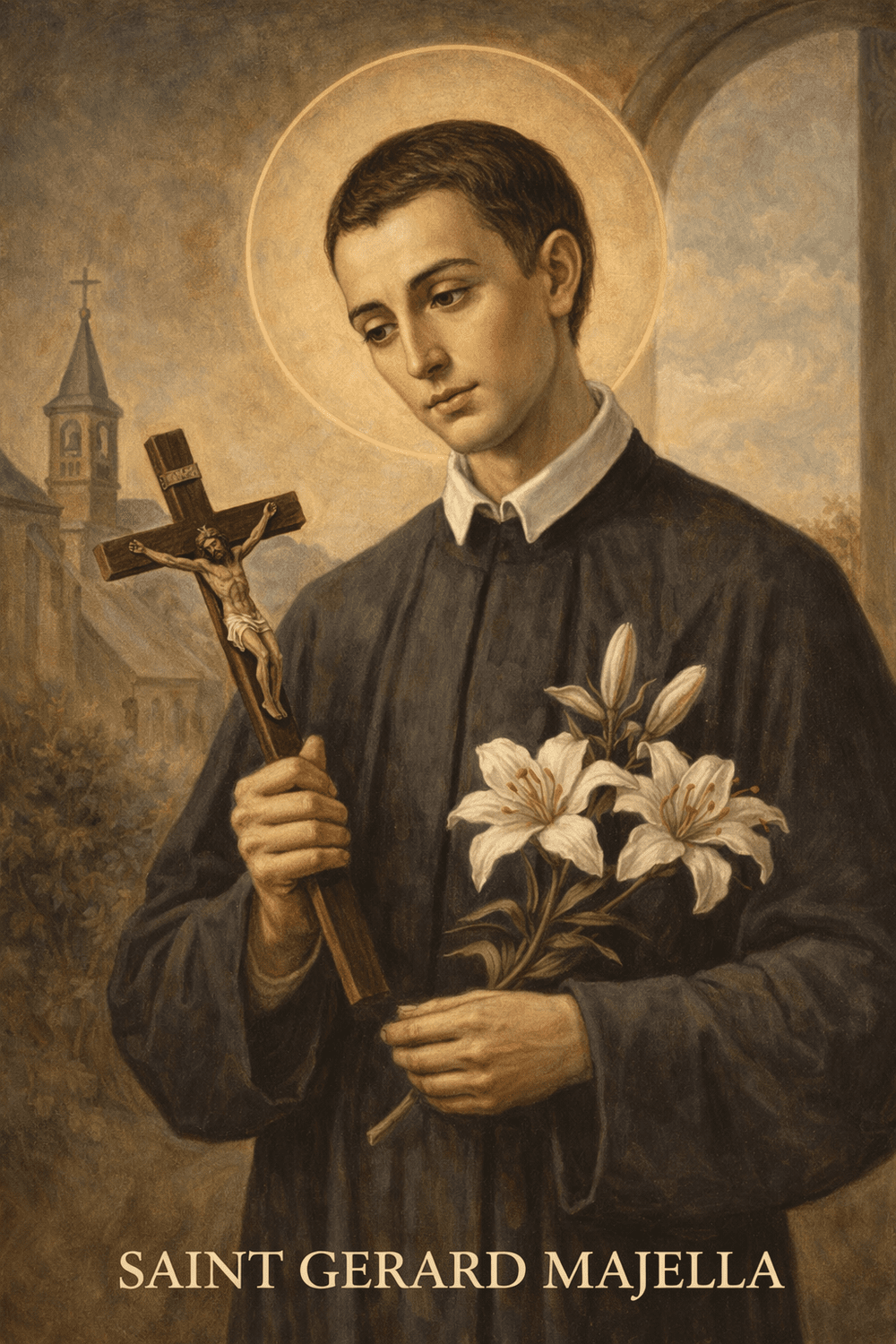
Saint Gerard Majella: The Handkerchief Miracle
He was not a priest. He was not a bishop. He was a humble lay brother who spent his life sweeping floors, cooking meals, and quietly serving others. And yet heaven entrusted him with mothers.
Gerard Majella was born in Muro Lucano, in southern Italy, the youngest of five children to a poor tailor. Frail from birth, he was baptized the same day he was born. After his father died when Gerard was twelve, he was apprenticed to a tailor and later served as a household servant to the bishop of Lacedonia, a man who treated him with severity that Gerard accepted as a share in Christ's own suffering. At twenty-three he entered the Redemptorist order as a lay brother — never ordained, never elevated, content to remain in the humblest tasks of religious life: cooking, gardening, portering, sweeping.
What he lacked in rank, God supplied in extraordinary grace. During his life, Gerard was reported to have read people's hearts, multiplied loaves of bread for the hungry, walked across standing water, and once restored life to a boy who had fallen from a cliff. He was, in the words of those who knew him, already a wonder-worker while still alive.
The Handkerchief
The miracle that defined his legacy happened only months before his death. Visiting the Pirofalo family, close friends of his, Gerard accidentally dropped his handkerchief as he left their home. One of the Pirofalo daughters ran after him to return it. "Keep it," he told her with a smile. "You may need it someday."
Gerard died of tuberculosis on October 16, 1755, at only twenty-nine years old, having spent his final lucid moments crying out, "Look! Look! It is the Madonna!" before falling into a final ecstasy. Years passed. The Pirofalo girl grew up, married, and became pregnant. When her time came, the labor went catastrophically wrong — the midwives present were certain both mother and child would be lost. In her agony, she remembered Gerard's strange parting words. She asked for the handkerchief to be brought to her, pressed it against her body, and prayed to him by name. Almost immediately, her pain disappeared and she delivered a strong, healthy child. That alone was no small thing in an era when only roughly one in three pregnancies ended in a live birth.
Word of the miracle spread through Italy and then, as the Redemptorists expanded into Europe and the Americas, across the world. At the formal process for his beatification, one witness testified that Gerard was already known locally as il santo dei felice parti — the saint of happy childbirths.
Miracles After Death
The handkerchief miracle was, by Gerard's own pattern, a sign of things to come rather than an isolated event. Following his death in 1755, reports of cures and favors at his tomb in Materdomini multiplied rapidly: healings from chronic illness, protection from accidents, sudden conversions of heart. The Redemptorists formally recorded hundreds of these testimonies, and that documentation became central to the Church's case for his sainthood. He was beatified by Pope Leo XIII in 1893 and canonized by Pope Pius X on December 11, 1904.
The shrine of Materdomini in Caposele, Italy, dedicated jointly to the Virgin and to Saint Gerard, is today decorated with countless colored ribbons and knots — physical tokens left by mothers in thanksgiving for pregnancies that, by their own account, ended safely through his intercession. In the United States, the National Shrine of Saint Gerard Majella in Newark, New Jersey, has collected thousands of similar testimonies over the decades: novenas answered with children doctors called medically impossible, and difficult deliveries that turned, after his handkerchief or his name was invoked, into nearly effortless ones.
Part II
Saint Rita of Cascia: The Saint of the Impossible
Saint Rita's connection to fertility begins before her own birth. According to tradition, her parents, Antonio and Amata Lotti, prayed for roughly twelve years before finally conceiving their only child — making Rita herself a living answer to a long, exhausted prayer for a baby, long before anyone could have guessed what her own life would hold.
That life held its own share of devastating impossibility. Married young to a man whose temper and entanglement in local feuds made the marriage genuinely difficult, Rita responded to nearly two decades of hardship with patience rather than retaliation, and is credited with gradually softening her husband's character. He was murdered nonetheless. Within a year, both of her sons died of illness, after Rita prayed that God take their lives rather than let them commit murder in revenge and lose their souls. Widowed and childless, she was then refused entry into the Augustinian convent she had longed for since childhood — until she personally brokered a lasting peace between her husband's family and his killers, the very condition the sisters had set for her admission.
Late in her forty years as a nun, Rita received a mystical wound on her forehead, as though a single thorn from Christ's crown of thorns had pierced her own flesh; it remained open and visible for the final fifteen years of her life. In the dead of winter, bedridden and dying, she asked a cousin to bring her a rose from her childhood garden — a request that should have been impossible in January, yet the cousin found a single bloom on an otherwise bare branch.
Why Couples Facing Infertility Turn to Her
Because Rita's own existence followed twelve years of her parents' unanswered prayer, and because nearly every chapter of her life involved God bringing life and reconciliation out of circumstances that looked entirely hopeless, couples who have exhausted medical options or endured repeated disappointment have long claimed her as their particular advocate. Stories are widely shared of parents who conceived after a nine-day novena prayed in the middle of the night, of women who named daughters Rita in thanksgiving, and of grieving hearts finding peace after miscarriage through her intercession. Her body remains incorrupt to this day, venerated at the Basilica of Saint Rita in Cascia, Italy, and first-class relics of hers are venerated in the United States as well.

Part III
Saints Joachim and Anne: Parents of the Virgin Mary
Their names appear nowhere in the canonical Gospels. What we know of Joachim and Anne comes down to us through the 2nd-century apocryphal text known as the Protoevangelium of James — a document that, while not Scripture, carried enough authority in the early Church that portions of it were read aloud on Marian feast days among the Greeks, Syrians, Copts, and Arabians for centuries.
According to that account, Joachim and Anne were a wealthy, devout couple in Nazareth who endured the particular social cruelty of childlessness in a culture that read barrenness as divine disfavor. The breaking point came on a feast day, when Joachim went to the Temple to present his offering and was publicly turned away by a priest named Ruben, who declared that a man without children was unworthy to stand among the righteous. Humiliated, Joachim did not return home. He withdrew into the wilderness and fasted for forty days and nights, pleading with God for a child. Anne, left behind, wept for both her childlessness and her husband's absence.
Two Angels, One Promise
According to the tradition, an angel appeared separately to each of them with the same message. To Anne: "The Lord has heard your prayer; you shall conceive and bear a child, and your offspring will be spoken of in all the world." To Joachim, in the wilderness: his prayer, too, had been heard, and his wife would conceive. The couple reunited with famous tenderness at Jerusalem's Golden Gate — an embrace that became one of the most painted scenes in the entire cycle of Mary's life, appearing in church frescoes across Europe for seven centuries. Nine months later, Anne gave birth to a daughter. They named her Mary.
This is why Joachim and Anne are invoked, across both Catholic and Orthodox tradition, as patrons of couples enduring years of unanswered prayer for a child. They did not receive an immediate answer. They received decades of disappointment, public shame, and isolation first — and only then, after persistent faith rather than a quick resolution, the child who would become the Mother of God.
Pilgrims have for centuries traveled to shrines dedicated to Saint Anne, most famously the Basilica of Sainte-Anne-de-Beaupré in Quebec, seeking her intercession for conception. Orthodox monasteries on Mount Athos dedicated to Saint Anna will send blessed oil or water to couples unable to travel in person, continuing the same tradition of hope across the centuries.

Part IV
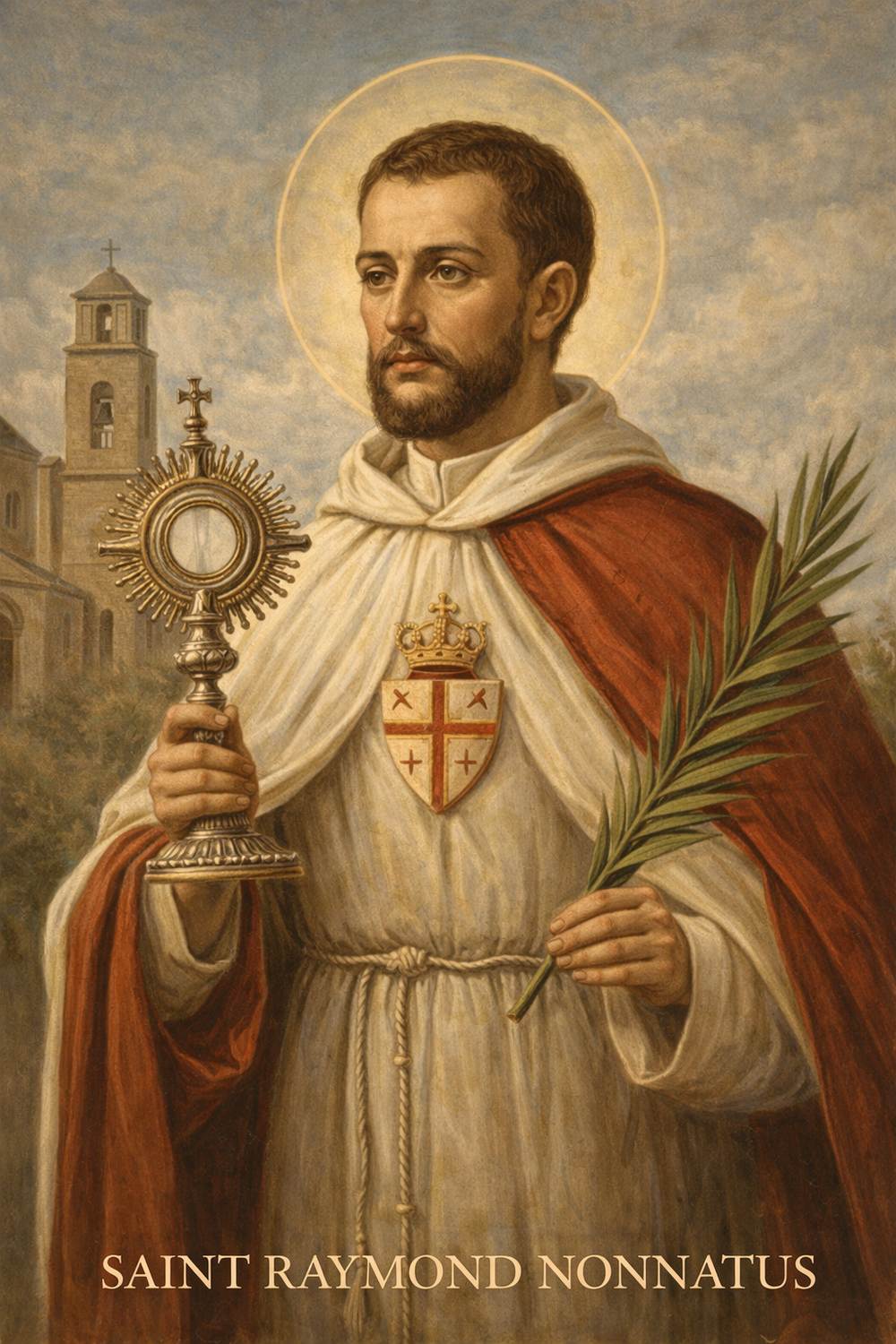
Saint Raymond Nonnatus: Born of a Dead Mother's Womb
His very surname tells his story before anything else can. "Nonnatus" is Latin for "not born," because Raymond's mother died in labor in the village of Portell in 1204, and Raymond was delivered by emergency cesarean section — cut from the womb of a woman who was already gone. In an age when this kind of operation was exceedingly rare and a good number of mothers and infants did not survive childbirth at all, the fact that Raymond lived was, to the people of 13th-century Catalonia, an event bordering on the miraculous in itself. Some traditions credit the local count, others Raymond's own father, with performing the surgery that saved the infant's life.
Raymond grew up devoted to the Virgin Mary, the mother he never knew, and entered the Mercedarian Order — a religious community founded for one specific, dangerous mission: ransoming Christian captives from Muslim slavery across the Mediterranean. He proved relentless in this work, personally ransoming hundreds of captives. In Algiers, having exhausted every coin the order possessed but still facing more enslaved Christians, Raymond offered himself as a hostage in exchange for their freedom.
The Padlock
While held captive, Raymond did not stay silent. He preached the Gospel to his fellow prisoners and succeeded in converting several of his own jailers. His captors' response was brutal and specific: they bored a hole through his lips with a hot iron and sealed his mouth shut with a padlock, unlocking it only once every three days so he could eat. He endured this for roughly eight months. Even then, witnesses recorded that his captors once found him in prayerful ecstasy with his hand resting on an open Bible.
Eventually ransomed and returned to Spain, Raymond was named a cardinal by Pope Gregory IX in 1239. He died of fever the following year while traveling toward Rome, and tradition holds that angels appeared at his deathbed to feed him and administer Communion when no priest could be found in time. A dispute arose afterward over where his body should rest; it was settled, according to legend, by placing his body on a blind mule and letting the animal walk unguided — it stopped at the small chapel where Raymond had prayed as a young shepherd, and he was buried there.
Because his own survival defied the deadly odds of childbirth in his era, Raymond became, almost immediately, an intercessor invoked by women facing dangerous labor, and remains one of the most time-honored patrons of midwives, obstetricians, and newborns in the entire Catholic calendar.
Part V
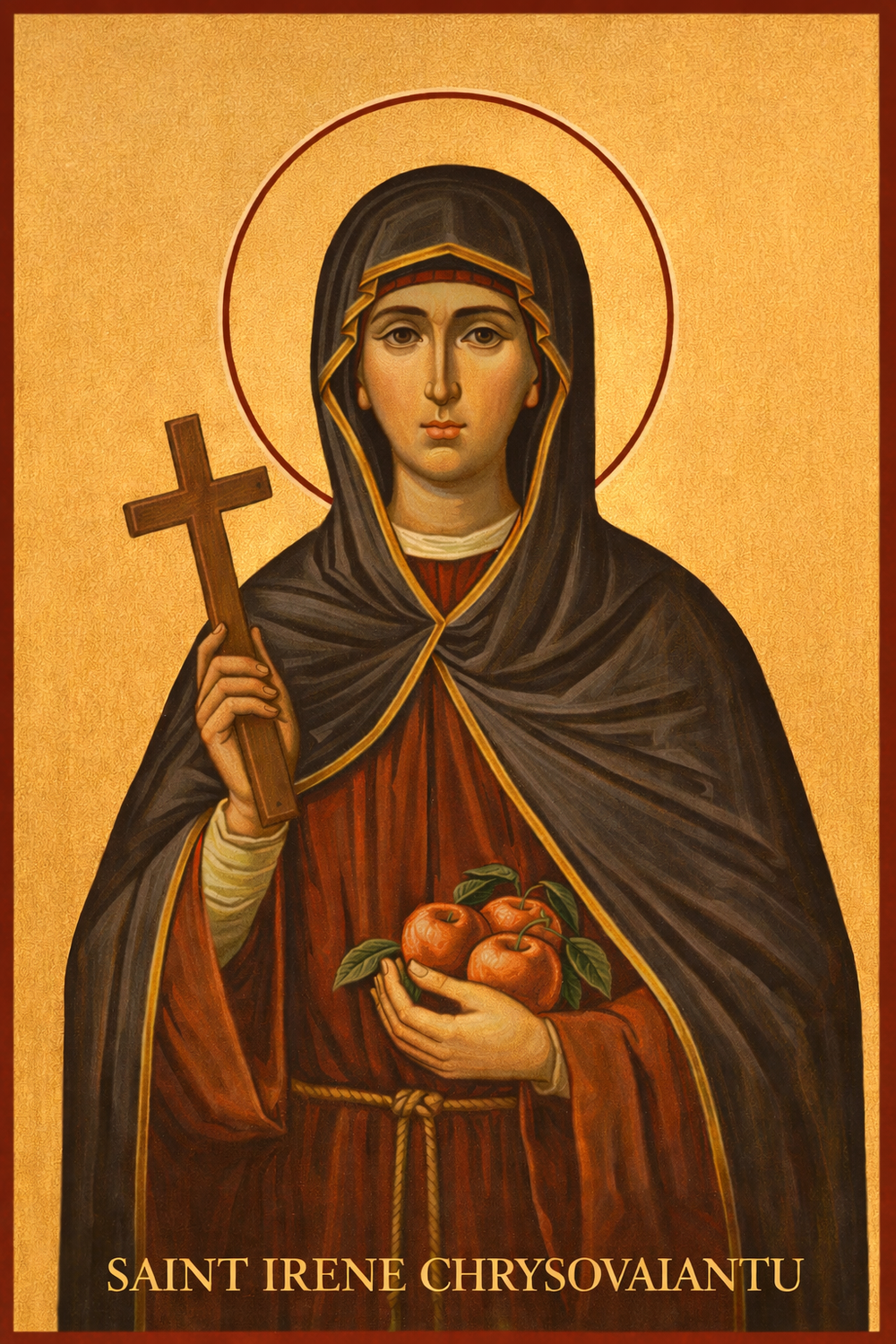
Saint Irene Chrysovalantou: The Apples of Paradise
She was born into nobility and chosen as a candidate to become the bride of the Byzantine Emperor Michael III. Instead, on her journey to the capital, Irene insisted on detouring to receive the blessing of the great hermit Saint Ioannikios, who recognized her by name before she arrived and told her that the Monastery of Chrysovalantou, not the imperial palace, needed her. She never became empress. She became a nun, and then an abbess renowned across the Byzantine world for her holiness.
The Apostle's Apples
The miracle most associated with her life is recorded in detail in her Orthodox synaxarion. A sailor traveling from the island of Patmos was stopped mid-voyage, against a strong favorable wind, by an old man who appeared walking across the water toward the ship. The old man identified himself as sent by Saint John the Apostle and Evangelist, and gave the sailor six apples from Paradise: three for the Patriarch of Constantinople, and three for "the abbess of Chrysovalantou, whose name is Irene." He told the sailor that if Irene ate them, everything her soul desired would be granted, "for this gift comes from John in Paradise."
Irene received the apples with tears of joy and fasted for a week in thanksgiving. She ate from them only sparingly for the remainder of her exceptionally long life, keeping the final apple to breathe in its fragrance whenever sorrow weighed on her. When she was warned by an angel, at over one hundred years old, that she had one year left to live, she spent that final year in fasting and prayer, eating nothing but small pieces of that last remaining apple from Paradise.
Why Women Praying for Children Turn to Her
This is the direct origin of a custom still kept in Orthodox parishes today: the blessing of apples on Irene's feast day, July 28. Worshippers bring apples to church, the priest blesses them, and the faithful — especially women hoping to conceive — eat the blessed fruit while invoking Irene's intercession. Couples who conceive after this practice often name daughters Irene, or Chrysovalanti, in gratitude. Irene died at over 101 years old, her face reportedly still youthful at the time of her death, and miracles were recorded at her tomb in the years that followed.
Part VI
Saint Stylianos of Paphlagonia: Protector of Children
Stylianos was born into one of the wealthiest families of Paphlagonia, in Asia Minor, but inherited a fortune he had no intention of keeping. After his parents died, he gave every part of his inheritance to the poor and withdrew into the desert to live as a hermit — though unlike many ascetics of his era, he did not cut himself off entirely from the world. He moved between solitude in his cave and visits among the people, doing whatever good he could before returning again to prayer.
He became known, even in his own lifetime, as "the smiling saint" for his consistently cheerful, gentle bearing. According to tradition, he received a gift of healing specifically tied to children: parents traveled great distances carrying sick infants to him, and many were healed through his prayer. He was also credited, in his own lifetime, with helping barren women conceive — one account describes a woman who assisted him and could not bear children of her own; after Stylianos prayed for her, she conceived, and her husband spread word of the miracle so widely that barren women from across the region began seeking the hermit out.
An Icon That Still Heals, According to Tradition
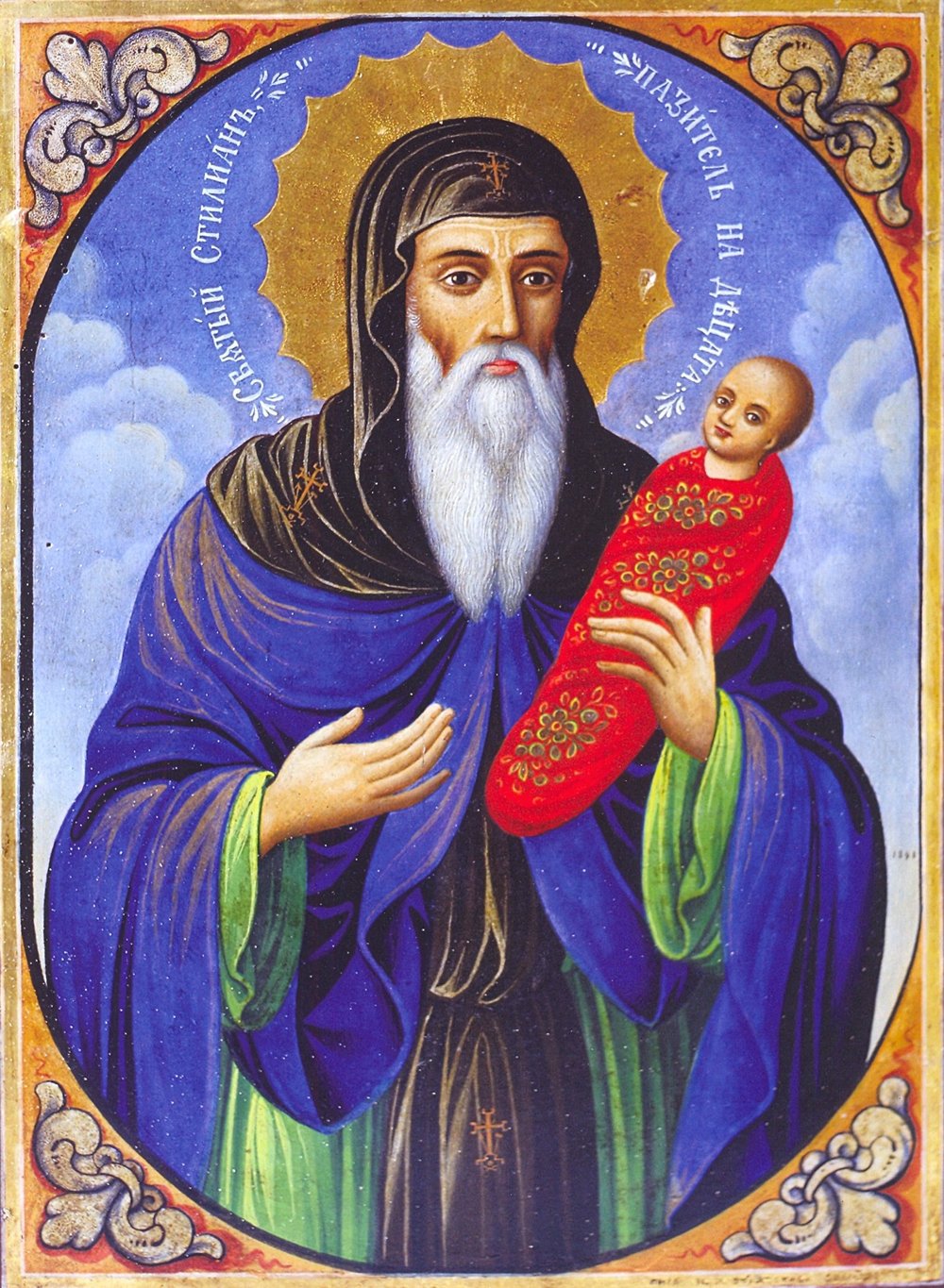
What sets Stylianos apart in the broader history of intercessory saints is how directly the tradition describes his continuing work after death. According to his synaxarion, when an infant dies of illness and leaves the parents childless, any mother who calls on Saint Stylianos with faith and has his icon painted will go on to bear other children. Communities in Paphlagonia kept this practice alive for generations: whenever a child fell ill, the family would commission or bring out an icon of Stylianos and hang it directly above the child's bed. On the Greek island of Icaria, the custom went further — parents would carry the icon to the Divine Liturgy and then bless the sick child with it directly. In Crete, children who died were sometimes given the name Stylianos or Styliani posthumously, and children who fell gravely ill might have their own name changed to his during the illness, as an act of consecrating the child to his protection.
At the moment of his own death, witnesses recorded that his face suddenly became radiant, and that an angel was seen descending to receive his soul — a detail repeated consistently across Orthodox accounts of his life. He remains depicted in icons holding a swaddled infant, a visual shorthand for a protection that, according to the faithful who keep his feast, has never stopped.

Part VII
Our Lady of Guadalupe: Mother of the Unborn
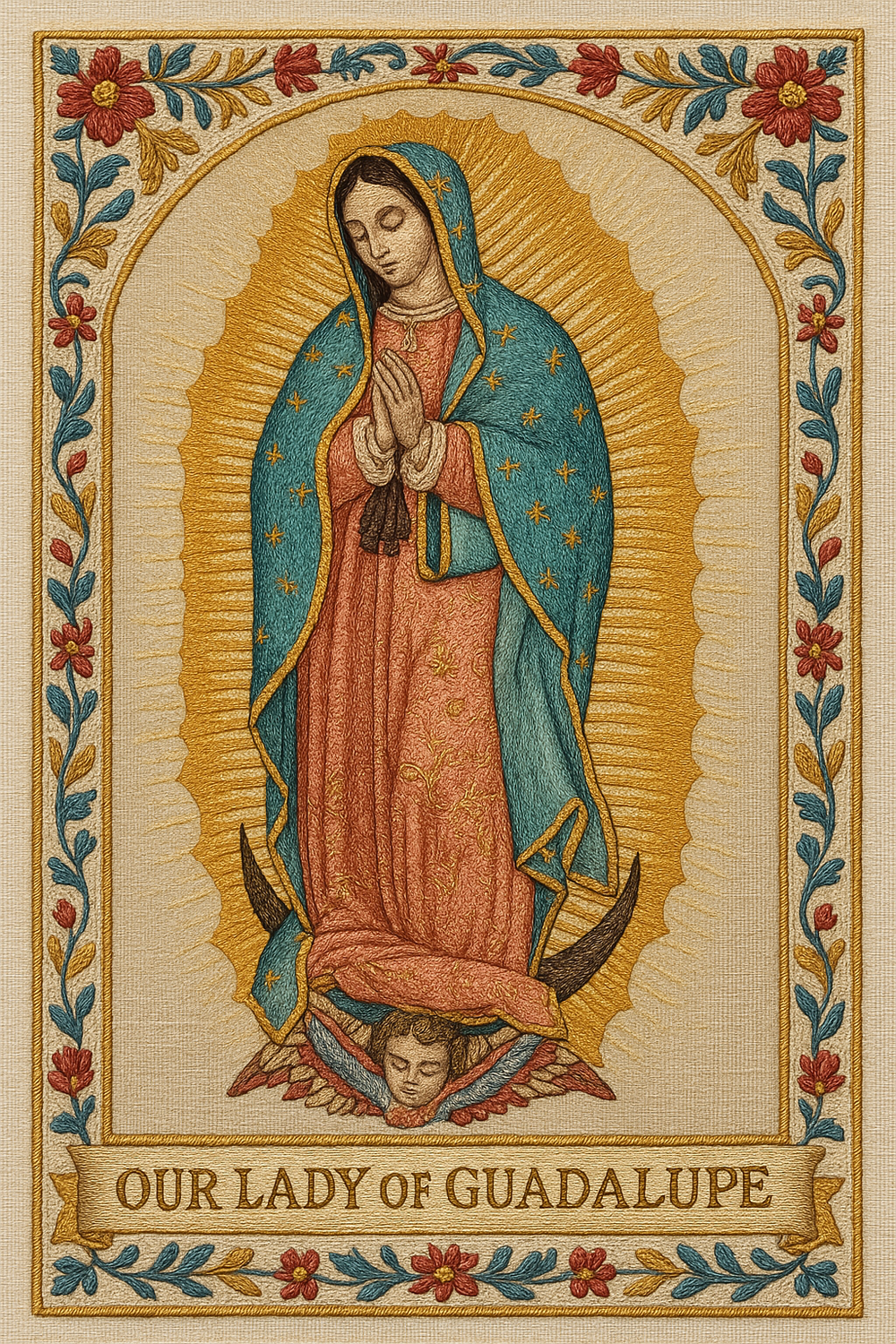
In 1531, the Virgin Mary appeared on Tepeyac Hill outside Mexico City to a poor indigenous convert named Juan Diego, addressing him with the tenderness of "my little son." She did not arrive with thunder or grandeur. The miraculous image left imprinted on Juan Diego's tilma shows her clothed in stars, standing on a crescent moon — and wearing a black sash tied at her waist, a detail that in the indigenous symbolic language of the time was an unmistakable sign of pregnancy. She presented herself, visually and explicitly, as the expectant Mother of the still-unborn Christ.
Because of this detail, Pope John Paul II formally declared Our Lady of Guadalupe patroness of the unborn, entrusting every child not yet born into her particular protection, and Pope Francis has likewise encouraged the faithful to turn to her on behalf of those awaiting birth. Millions of pilgrims visit the Basilica of Our Lady of Guadalupe in Mexico City each year, many of them expectant mothers seeking her intercession directly. The Vatican has recorded numerous testimonies over the centuries of pregnancies carried safely to term after a family entrusted the outcome to her.
Part VIII
Saint Gianna Beretta Molla: The Modern Physician-Mother
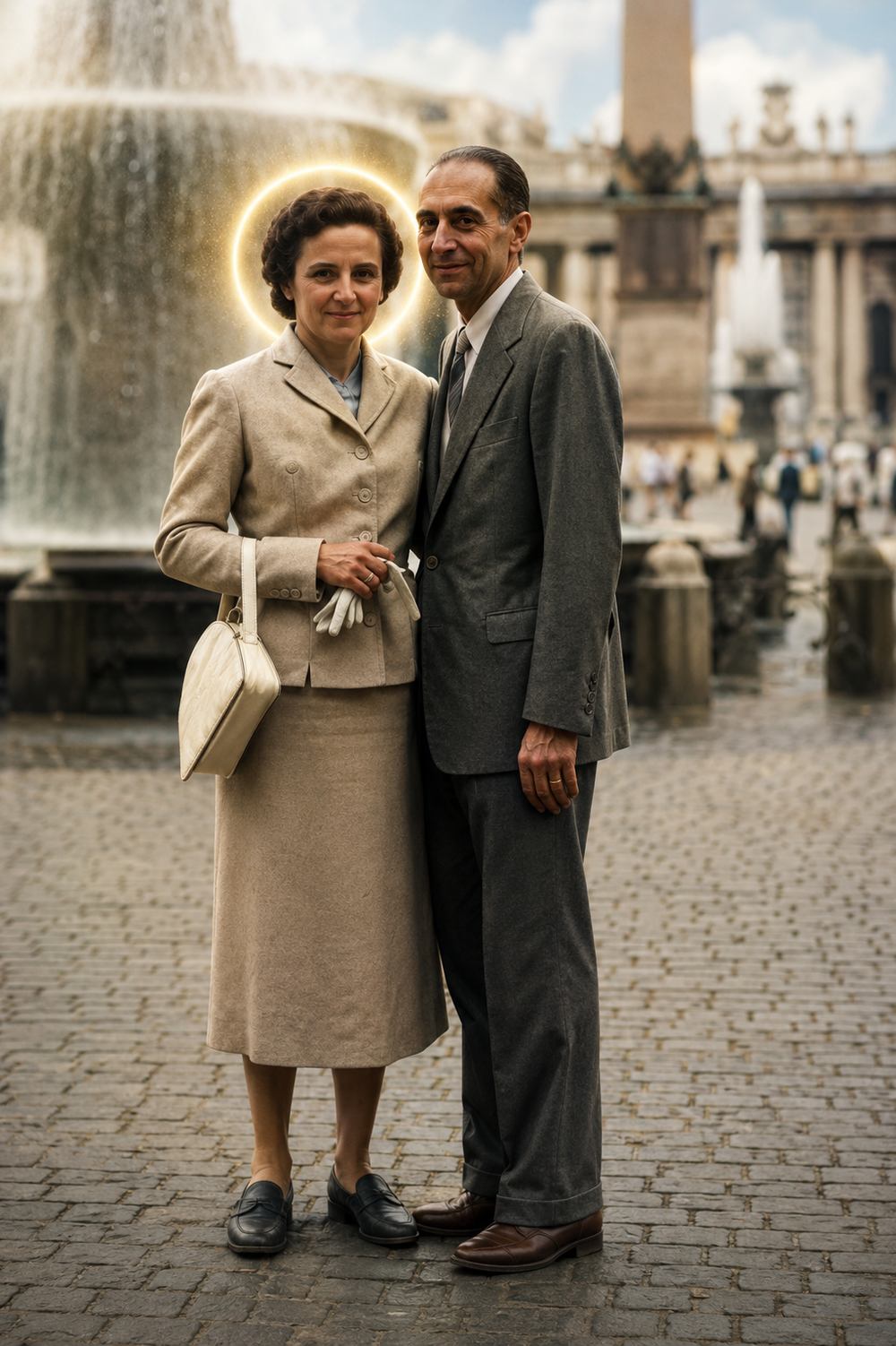
Gianna and her husband Pietro did not live in a monastery. They lived in a kitchen. Gianna was an Italian pediatrician; Pietro, an engineer. They married in 1955 and built, by every account, a marriage of real joy, discipline, and shared faith, raising three children before Gianna became pregnant with a fourth in 1961.
Early in that pregnancy, doctors discovered a uterine fibroma — a tumor that needed to be addressed. They presented Gianna with three options: a hysterectomy, an abortion, or surgery to remove only the tumor, leaving the pregnancy intact but at real risk to her own life. Gianna chose the third option and was explicit about her reasoning. Days before the delivery, she told her husband plainly: "If you must decide between me and the child, do not hesitate. Choose the child. I insist on it. Save the baby."
On April 21, 1962, her daughter Gianna Emanuela was born by cesarean section, healthy. Gianna developed septic peritonitis from complications and died one week later, on April 28, at thirty-nine years old.
The First Miracle — Grajaú, Brazil, 1977
A woman named Lucia Sylvia Cirilo delivered a stillborn child and, within a week of discharge from the hospital, began suffering severe, worsening pain. The nearest equipped hospital was over four hundred miles away. A missionary sister visited her, placed a relic of the then-Blessed Gianna under her pillow, and encouraged her to pray. Lucia described feeling a powerful surge pass through her body; the pain eased, and she fell asleep. When she woke, she was entirely healed, with no medical explanation available. This miracle was approved for Gianna's beatification, celebrated April 24, 1994.
The Second Miracle — Franca, Brazil, 2000
A devout Catholic woman named Elizabeth Comparini Arcolino was sixteen weeks pregnant with her fourth child when her amniotic sac ruptured prematurely, draining all of her amniotic fluid — a condition doctors considered to leave essentially no chance of the baby's survival at that stage of gestation. As Elizabeth was being anointed by a priest, her bishop arrived carrying a biography of Blessed Gianna and told her directly: "Do what Blessed Gianna did, and if necessary, give your life for the child." Elizabeth, already familiar with Gianna's story, prayed for the same intercession. Against the medical prognosis, her pregnancy continued, the baby kept developing despite the absence of fluid, and on May 31, 2000, she delivered a healthy daughter she named Gianna Maria. The Vatican's medical commission formally reviewed the case in 2003 and concluded that, given the severity of the diagnosis and the inadequacy of available treatment, the healthy outcome for both mother and child was medically inexplicable. Pope John Paul II promulgated the decree recognizing the miracle on December 20, 2003, and canonized Gianna on May 16, 2004 — the first time in history a saint's own spouse and children were present to witness the canonization.
Part IX
Other Orthodox Saints and Traditions
While the saints above are among the most widely known patrons of fertility and childbirth, the Orthodox Church honors additional saints who intercede for these same needs.
Saint Eleftherios, a second-century bishop whose name means "deliverance," is held by tradition to ease childbirth for women in labor who invoke him; expectant mothers sometimes wear a small pendant bearing his image. Saint Catherine of Sweden is a longstanding patroness for women who have suffered miscarriage, offering comfort and hope toward future pregnancies. Saint Xenia of St. Petersburg and Saint Matrona of Moscow, two beloved modern Russian saints, are turned to by couples who feel forgotten or overwhelmed in their struggle to conceive. And titles given to the Theotokos herself — "Joy of All Who Sorrow," "Tenderness," "Our Lady of the Sign" — are specifically invoked for the joy of childbearing; many Orthodox mothers pray before these icons, light candles, and ask Mary's own intercession for conception and a safe delivery.
Orthodox families may also attend Moleben services — special supplicatory prayer services — for fertility and childbirth, light beeswax candles before icons, or make pilgrimages to monasteries known for fertility-related miracles. These practices emphasize something central to Orthodox spirituality: the communion of saints, and the conviction that the whole Church, in heaven and on earth, surrounds a couple longing to become parents.
Part X
Where to Venerate Their Relics in the United States
For families in America who wish to pray before an actual relic rather than only an image, several of these saints have confirmed relic sites within the United States.
Sacred Patriarchal Monastery of St. Irene Chrysovalantou
36-04 23rd Avenue, Astoria, NY 11105Founded in 1972, this stavropegial Orthodox monastery (answering directly to the Ecumenical Patriarch) holds a relic and a miraculous icon of Saint Irene Chrysovalantou. Each July, a multi-day panegyri culminates in a procession of the relic and icon through the streets of Astoria, with thousands of pilgrims, including many couples praying for children, lining the route.
National Shrine of Saint Rita of Cascia
1166 South Broad Street, Philadelphia, PA 19146Founded in 1907 and designated a national shrine in 2003, this Augustinian church holds a first-class relic of Saint Rita, widely invoked for fertility struggles and difficult pregnancies given the twelve-year wait her own parents endured before her birth.
Saint Rita of Cascia Shrine Chapel
7740 South Western Avenue, Chicago, IL 60620A second confirmed first-class relic site, with a reliquary dating back to 1906, connected to Saint Rita of Cascia High School and the Midwest Augustinians.
National Shrine of Our Lady of Guadalupe
La Crosse, WisconsinThis shrine holds a painting and a first-class relic of Saint Gianna Beretta Molla, allowing American pilgrims to pray before a physical relic of the modern physician-mother credited with two medically documented pregnancy miracles.
Part XI
How to Use This Page: Novenas, Prayer Cards & Daily Practices
- Choose one or two saints whose stories resonate with your specific need — conception, a difficult pregnancy, or healing after loss.
- Pray for nine days (a novena) or longer, using the prayers above or your own heartfelt words.
- Imitate one virtue from the saint's life each week — patience, trust, generosity, or perseverance.
- Keep a visual reminder — an icon, a prayer card, a medal — near your bedside or prayer space to stay focused and hopeful.
Lord Jesus Christ, You who entered the world through the womb of the Virgin and were entrusted, before You ever drew breath, to the faithfulness of Joseph and Mary — we entrust to You now the child we carry, or the child we long for.
Through the intercession of Your saints who knew this same longing — Gerard who gave his handkerchief, Rita whose parents waited twelve years, Joachim and Anne who waited decades, Raymond who lived though his mother did not, Irene who received fruit from Paradise, Stylianos who healed the children of strangers, and Gianna who gave her life for hers — hear our prayer.
Grant us patience in waiting, courage in danger, and peace in whatever You will. Amen.
This is a composed devotional prayer drawing on the documented intercessions of the saints above; it is not claimed to be a single historical liturgical text.

FAQ
Frequently Asked Questions About Saints for Pregnancy and Childbirth
A Handkerchief. Three Apples. A Rose in January. A Marriage Strong Enough to Carry It All.
Every saint in this guide answered the same basic human longing from a different angle of suffering and grace: Gerard from poverty and hidden service, Rita from a marriage that nearly broke her, Joachim and Anne from decades of public shame, Raymond from a death that should have been his own, Irene from a vocation she never expected, Stylianos from a fortune he gave away, Gianna from a choice no mother should have to make. None of their stories are simple. All of them point to the same conviction the Church has held for two thousand years: that the deepest human longings for life, for family, and for safety are never prayed alone.
If this season — the waiting, the fear, the hope — has put pressure on your marriage as much as your heart, that pressure is worth tending to directly, not just enduring quietly. A marriage built to carry a family through hard seasons doesn't happen by accident; it's built one week, one honest conversation, one act of worship at a time.
Schedule Your Free Discovery Call →