Saints for a Happy Marriage: Models of Love, Faith, and Intercession
The Christian tradition offers a rich tapestry of married saints whose lives inspire couples to pursue holiness and joy within the sacrament of matrimony. Across Catholic, Orthodox, and pre-schism Christianity, these holy spouses endured poverty, illness, persecution, infertility, and profound loss. Yet they remained united in prayer, charity, and sacrificial love.
Marriage in Christianity has always been understood as a sacred calling, not merely a legal or emotional bond. From the earliest centuries of the Church, husbands and wives were encouraged to see their union as a path of sanctification. The saints below show what that looks like in real life.
This guide includes each saint or couple's Church tradition, a practical biography, why they are invoked, how people pray with them, and how their stories have been received in Christian devotion. Use it as a reference, but also as a prayer companion.
Find the Right Saint for Your Marriage
If you are carrying something specific, start with the saints who most closely match what you are walking through right now. This quick guide is a starting point before the full article.
If your spouse is not practicing the faith or has drifted away
Saint Monica (Roman Catholic; honored broadly as an ancient model of persevering intercession)
Saint Nonna of Nazianzus and Saint Gregory the Elder (Pre-Schism Universal Church)
These saints are often invoked for the conversion of husbands, wives, and children through persistent prayer.
If your marriage feels strained, broken, or impossible
Saint Rita of Cascia (Roman Catholic)
Saints Adrian and Natalia of Nicomedia (Pre-Schism Universal Church; venerated in both East and West)
They are patrons for couples seeking peace, repentance, and endurance in hard seasons.
If you are newly married or seeking harmony and unity
Saints Peter and Febronia of Murom (Eastern Orthodox)
Saints Aquila and Priscilla (Pre-Schism Universal Church)
These saints are invoked for conjugal harmony, teamwork in faith, and building a Christ-centered home.
If you are trying to conceive or grieving infertility
Saints Joachim and Anne (Pre-Schism Universal Church; venerated strongly in both Catholic and Orthodox traditions)
They are invoked by couples longing for children and by parents seeking to raise holy families.
If your marriage requires courage under pressure or persecution
Blessed Franz and Blessed Franziska Jägerstätter (Roman Catholic)
They model unity of conscience and fidelity to Christ when faith is costly.
If you want to model your marriage on daily prayer and sacrificial love
Blessed Karl (Charles I) of Austria and Servant of God Empress Zita of Bourbon-Parma (Roman Catholic)
Blessed Luigi Beltrame Quattrocchi and Blessed Maria Corsini (Roman Catholic)
Saints Louis and Zélie Martin (Roman Catholic)
Saint Gianna Beretta Molla and her husband Pietro Molla (Roman Catholic; Pietro is honored privately as a model of husband and father)
These couples show how ordinary married life becomes extraordinary when prayer, sacrifice, and love lead.
How to Use This Page
A simple way to put this guide into practice:
Choose one saint or couple whose story matches your current need.
Pray for nine days with a short daily prayer or a novena, keeping your intention the same each day.
Choose one virtue from their life to practice this week: patience, repentance, hospitality, courage, or shared prayer.
If your spouse will not pray with you yet, pray faithfully on your own and focus on loving well in daily actions.
Table of Contents
Saint Gianna Beretta Molla and Pietro Molla
Saint Eustace and Saint Theopista
Saint Andronicus of Antioch and Saint Athanasia of Egypt
Saint Basil the Elder and Saint Emmelia of Caesarea
Blessed Franz and Blessed Franziska Jägerstätter
Blessed Karl (Charles I) of Austria and Servant of God Empress Zita
Blessed Luigi Beltrame Quattrocchi and Blessed Maria Corsini
Saints Aquila and Priscilla
Saint Julian of Antioch and Saint Basilissa
Saints Timothy and Maura
Saints Adrian and Natalia of Nicomedia
Saint Monica
Saints Peter and Febronia of Murom
Saint Rita of Cascia
Saint Gregory the Elder and Saint Nonna of Nazianzus
Saints Joachim and Anne
Saints Louis and Zélie Martin
Putting the Saints Into Practice
Frequently Asked Questions
Saint Gianna Beretta Molla and Pietro Molla
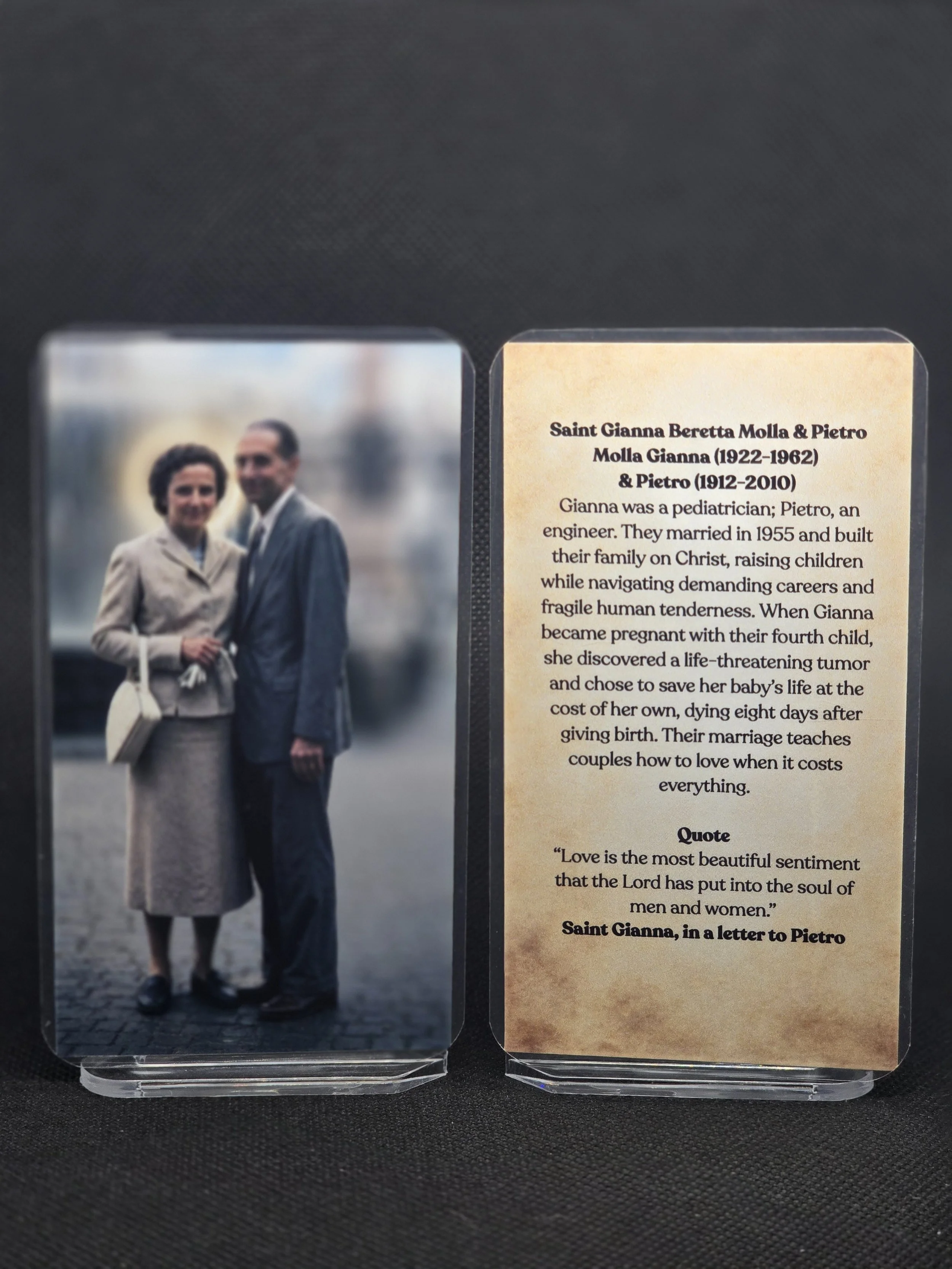
Saint Gianna Beretta Molla and Pietro Molla did not live in monasteries.
They lived in a kitchen.
They raised children. They paid bills. They navigated careers, exhaustion, illness, and the fragile tenderness of marriage. Their holiness was forged inside ordinary family life.
Gianna was a pediatrician in northern Italy. Pietro was an engineer and devoted husband. They met in the early 1950s and quickly recognized in one another a shared desire: to build a marriage centered on Christ.
They married in 1955.
Their love was joyful, disciplined, prayerful, and deeply sacrificial.
Gianna and Pietro are now sought by couples facing marriage crisis, parents navigating high-risk pregnancy, and families who feel overwhelmed by responsibility and fear. They are especially prayed to by husbands and wives struggling to trust God with medical decisions, fertility, and the future of their children.
Gianna’s feast is commemorated on April 28. Pietro is honored alongside her as her husband and spiritual companion.
Their story reaches people who are exhausted by modern life and quietly asking:
How do we love when it costs everything?
How do we stay faithful under pressure?
How do we choose life when fear feels louder than faith?
This handmade prayer card is created for married couples, expecting parents, and families standing at impossible crossroads. It is not sentimental devotion.
It is for real decisions.
Real sacrifice.
Real trust.
Pietro and Gianna teach that holiness is not abstract.
It is choosing love when it hurts.
Tradition: Roman Catholic | Feast day: April 28 (Gianna)
Why They Are Invoked
Saint Gianna Beretta Molla and her husband Pietro offer one of the most modern and relatable examples of sanctity within marriage. Their holiness did not unfold in a cloister. It unfolded in ordinary life: work, parenting, daily Mass, and the steady choice to love with intention.
Gianna was an Italian physician who practiced medicine with a deep respect for life. Pietro was an engineer and a devoted Catholic. Their courtship and marriage were marked by tenderness, spiritual unity, and deliberate commitment. Their letters reveal a relationship anchored in prayer, mutual encouragement, and joyful companionship.
During Gianna's fourth pregnancy, doctors discovered a serious uterine condition. Treatment options could have improved her odds but threatened the life of the unborn child. Gianna insisted that the child be protected, even at the cost of her own life. She carried her baby to term and died soon after delivery due to complications. Pietro raised their children with quiet fidelity.
Many couples turn to them for:
Mutual self-giving and a shared spiritual direction
Courage and charity in medical crises and hard decisions
Fidelity when the marriage story includes suffering, not comfort
Joyful companionship rooted in Christ
Prayer
Many couples pray to Saint Gianna for pregnancy complications, family unity, and the grace to love sacrificially. A simple daily prayer many families use:
Saint Gianna, you offered your life so that your child might live. Teach us to love with generosity and steadiness. Intercede for our marriage, that we may serve one another with joy and remain faithful to God's will. Amen.
Some also pray for Pietro's cause to advance, asking God to reveal his hidden sanctity:
Servant of God Pietro Molla, pray for us and for all husbands and fathers.
Intercession and Devotion
Two miracles were officially recognized in connection with Saint Gianna's canonization. In one case, a mother suffering from a life-threatening infection after childbirth recovered suddenly after prayers and the placement of a devotional image or relic associated with Gianna. In another, a complicated pregnancy was carried safely to term after a novena.
Beyond official processes, many families speak of Saint Gianna's intercession when navigating complicated pregnancies, serious diagnoses, or the fear that comes when a family is facing hard medical decisions. Couples also look to Gianna and Pietro when they need strength to choose love over self-protection.
Practical Takeaway
Choose one concrete way to imitate them this week: pray together before one meal each day, or write one sentence of encouragement to your spouse each day for seven days.
If your marriage is under medical or emotional pressure, pray a short prayer daily and also make one practical plan: a doctor visit, counseling appointment, or a calm conversation time. Faith and wisdom belong together.
Saint Eustace (Eustachius) and Saint Theopista
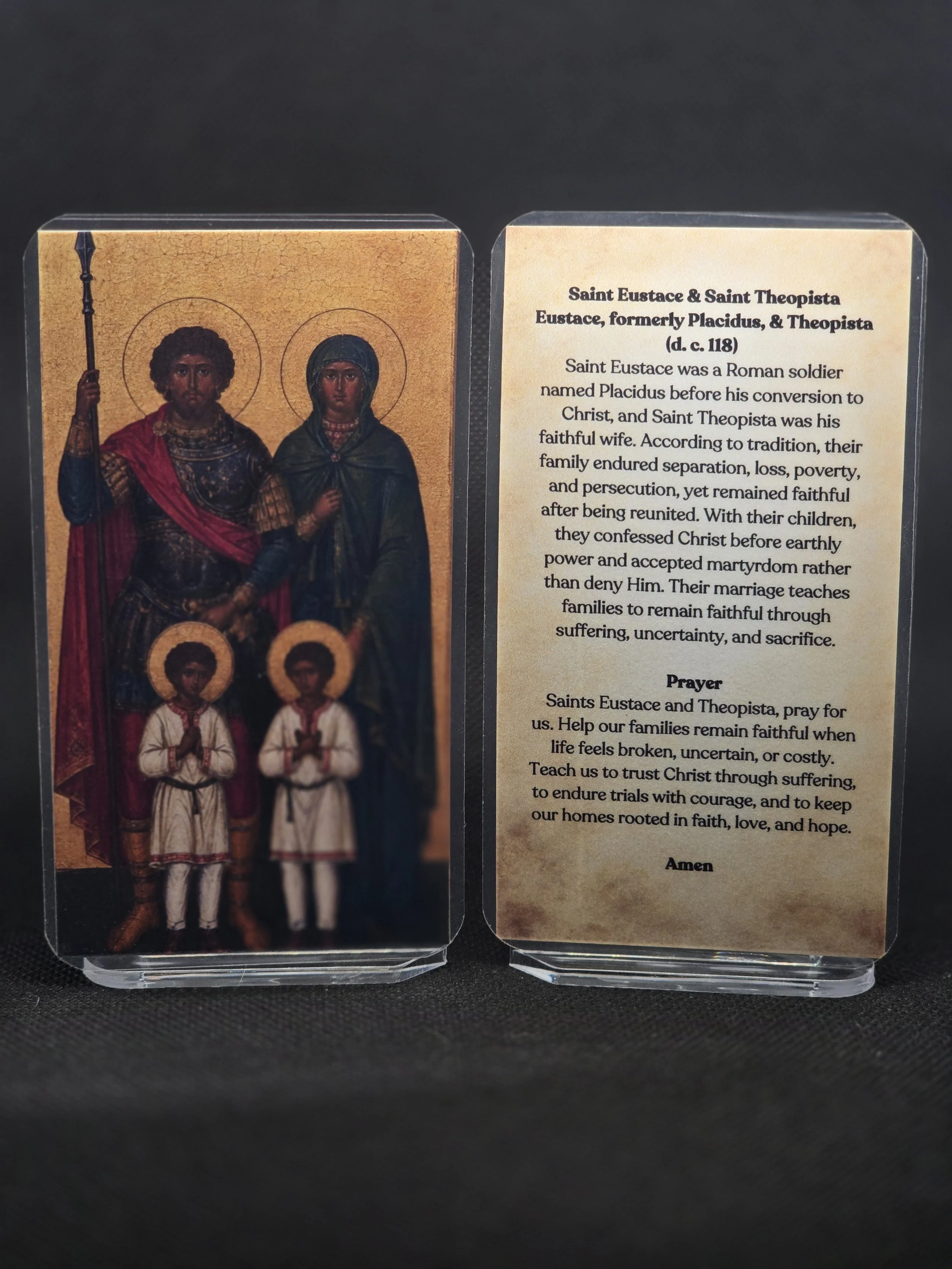
Saint Eustace and Saint Theopista did not lose their faith all at once.
They lost it slowly, painfully, piece by piece.
Before conversion, Eustace was known as Placidus, a Roman military commander respected for discipline and honor. He lived comfortably. He had status, security, and a devoted wife. Their children were young. Their future looked stable.
Then Christ interrupted everything.
According to ancient tradition, Placidus encountered Christ in a miraculous vision while hunting. He was baptized along with his wife Theopista and their two sons, taking the name Eustace.
Almost immediately, suffering followed.
They lost wealth.
They lost position.
They lost their children.
They lost each other.
Their feast is commemorated on September 20 (October 3 on the Old Calendar).
Saint Eustace and Saint Theopista are now sought by families experiencing sudden tragedy, forced separation, and seasons where everything familiar collapses. They understand the shock of loss. They understand what it feels like to obey God and then watch life unravel.
This handmade prayer card is created for people walking through family crisis, unexpected disaster, and prolonged uncertainty. It is for parents grieving children, spouses separated by circumstance, and believers trying to hold faith when nothing makes sense.
Saint Eustace and Saint Theopista teach that faith does not prevent suffering.
It teaches us how to survive it.
Tradition: Pre-Schism Universal Church | Feast day: September 20 (common Western commemoration)
Why They Are Invoked
Saint Eustace, also known as Placidius, is remembered as a Roman military officer who converted after a vision of Christ while hunting. His wife Theopista and their children followed him into the faith.
Their story is marked by extreme trials: loss of wealth, separation, exile, and the long ache of uncertainty. In many retellings, the family is torn apart and then reunited through providential events. Soon after their reunion, they refuse to sacrifice to pagan gods and are martyred together.
Couples invoke Eustace and Theopista because their life shows that marriage can remain faithful even when stability collapses. Their unity was not built on comfort. It was built on fidelity.
Many couples turn to them for:
Perseverance during financial hardship, job loss, and upheaval
Faithfulness during separation, uncertainty, and emotional strain
Trust that God can reunite what suffering has scattered
Prayer
A common way to pray with Saint Eustace is to ask for patience and perseverance in trials. Couples may use a short petition like:
O holy martyrs Eustace and Theopista, strengthen our marriage in hardship. Teach us to remain faithful to Christ and to each other when life becomes unstable. Pray for our family to be preserved in peace. Amen.
Intercession and Devotion
Saint Eustace was widely venerated in both East and West before the Great Schism, and his name appears in many older calendars and dedications. While modern miracle accounts are not commonly cataloged, his devotional value is clear: people invoke him when they feel surrounded by adversity.
For couples, his story gives language to a specific kind of suffering: not a single crisis, but the slow grind of repeated losses. Their witness teaches that perseverance can be a form of love.
Practical Takeaway
If you are in a hardship season, choose one protective habit as a couple: a weekly prayer time, a budget check-in without blame, or a nightly moment of gratitude. Hard seasons do not last forever, but habits formed in hardship often outlast the hardship.
Saint Andronicus of Antioch and Saint Athanasia of Egypt
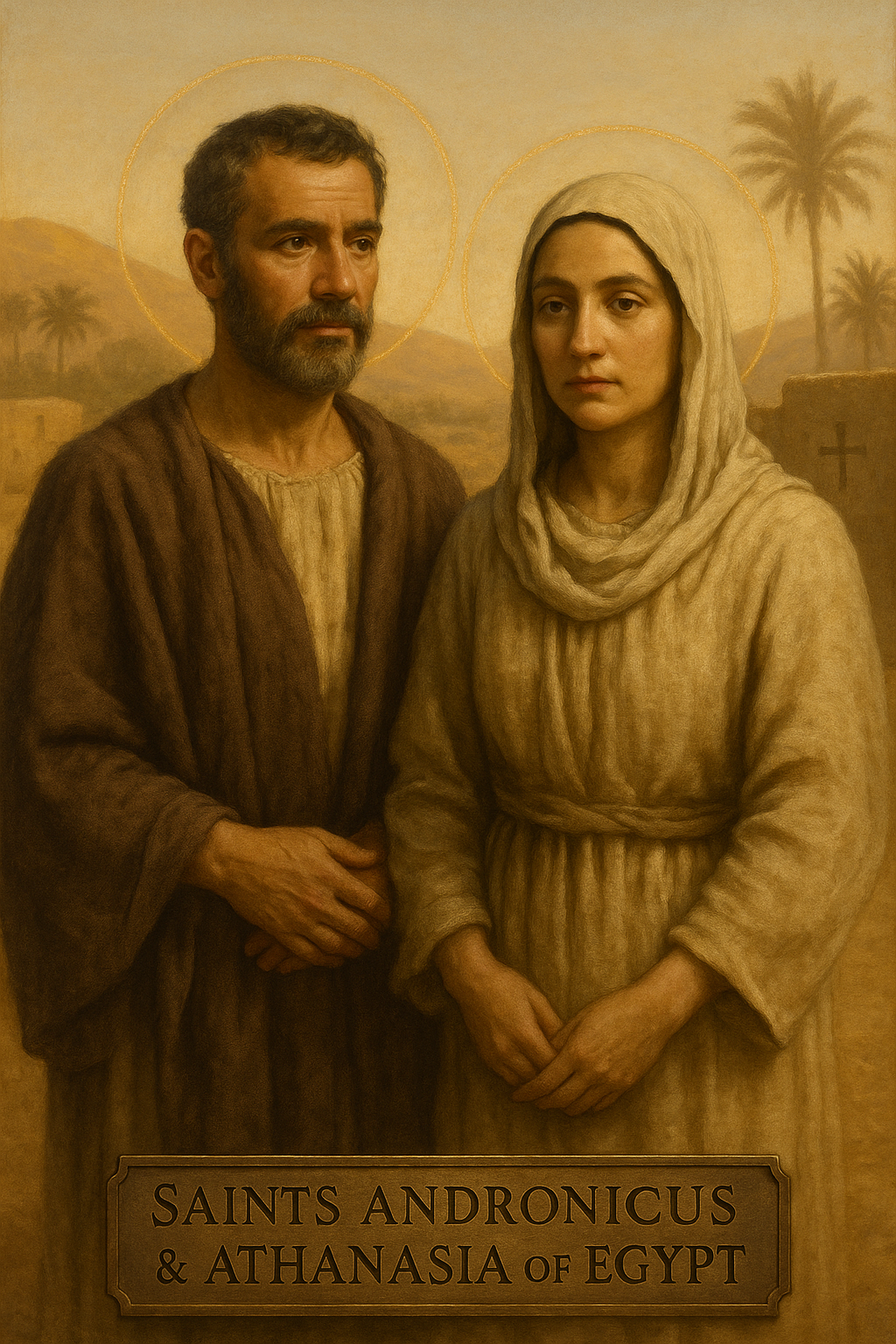
Saint Andronicus and Saint Athanasia did not become holy together in comfort.
They became holy through devastation.
They were an ordinary married couple in early Christian Egypt. They built a home. They raised children. They lived a quiet life of faith. Nothing about their beginning suggested radical asceticism.
Then everything collapsed.
Their children died.
Not one.
All of them.
Grief hollowed their home. Silence replaced laughter. Their marriage stood inside unbearable loss. Instead of turning against God or drifting apart, Andronicus and Athanasia made a decision few couples could imagine.
They gave everything away.
They left the world.
They entered monastic life separately, choosing repentance and prayer over bitterness and despair.
Their feast is commemorated on October 9 (October 22 on the Old Calendar).
Today, Saint Andronicus and Saint Athanasia are sought by couples facing marriage breakdown, parents grieving children, and those trying to rebuild life after tragedy. They understand what it means to lose your future. They understand how grief fractures identity. They understand how faith must be rebuilt from ashes.
This handmade prayer card is created for broken marriages, mourning parents, and souls trying to begin again when life no longer resembles what they planned.
Saint Andronicus and Saint Athanasia teach that devastation does not have to destroy love.
It can purify it.
Tradition: Eastern Orthodox | Feast day: October 9 (commonly)
Why They Are Invoked
Saints Andronicus and Athanasia lived in the fifth century and were known for their generosity, prayer, and hospitality. After losing their children, their grief became a doorway into deeper surrender to God.
They gave their possessions to the poor and embraced monastic life. Later, they encountered one another again and chose a life of spiritual companionship marked by prayer and ascetic struggle. They reposed near the same time.
They are invoked especially by spouses who have endured miscarriage, child loss, or the unique strain that grief places on a marriage.
Many couples turn to them for:
Comfort and unity for couples grieving the loss of children
Hope for spouses enduring infertility or repeated loss
A path for transforming grief into prayer instead of bitterness
Prayer
In the Orthodox tradition, their troparion praises their tears and labors and asks Christ for mercy. Couples often adapt the spirit of that hymn into a personal prayer:
Holy saints Andronicus and Athanasia, you carried grief without losing faith. Pray for our marriage as we carry sorrow. Ask Christ to give us endurance, tenderness, and hope. Amen.
Intercession and Devotion
Orthodox Christians frequently request prayers to these saints for infertility and bereavement. While not every tradition maintains a centralized list of miracles, their devotional role is steady: they are invoked as companions for the kind of grief that can either unite spouses or isolate them.
Their story also offers a difficult but important reminder: shared sorrow does not automatically create unity. Unity is chosen through prayer, humility, and the refusal to blame.
Practical Takeaway
If grief is part of your story, schedule one gentle conversation this week that is not problem-solving. Just name what you feel and listen. Grief needs shared space, not quick fixes.
Saint Basil the Elder and Saint Emmelia of Caesarea
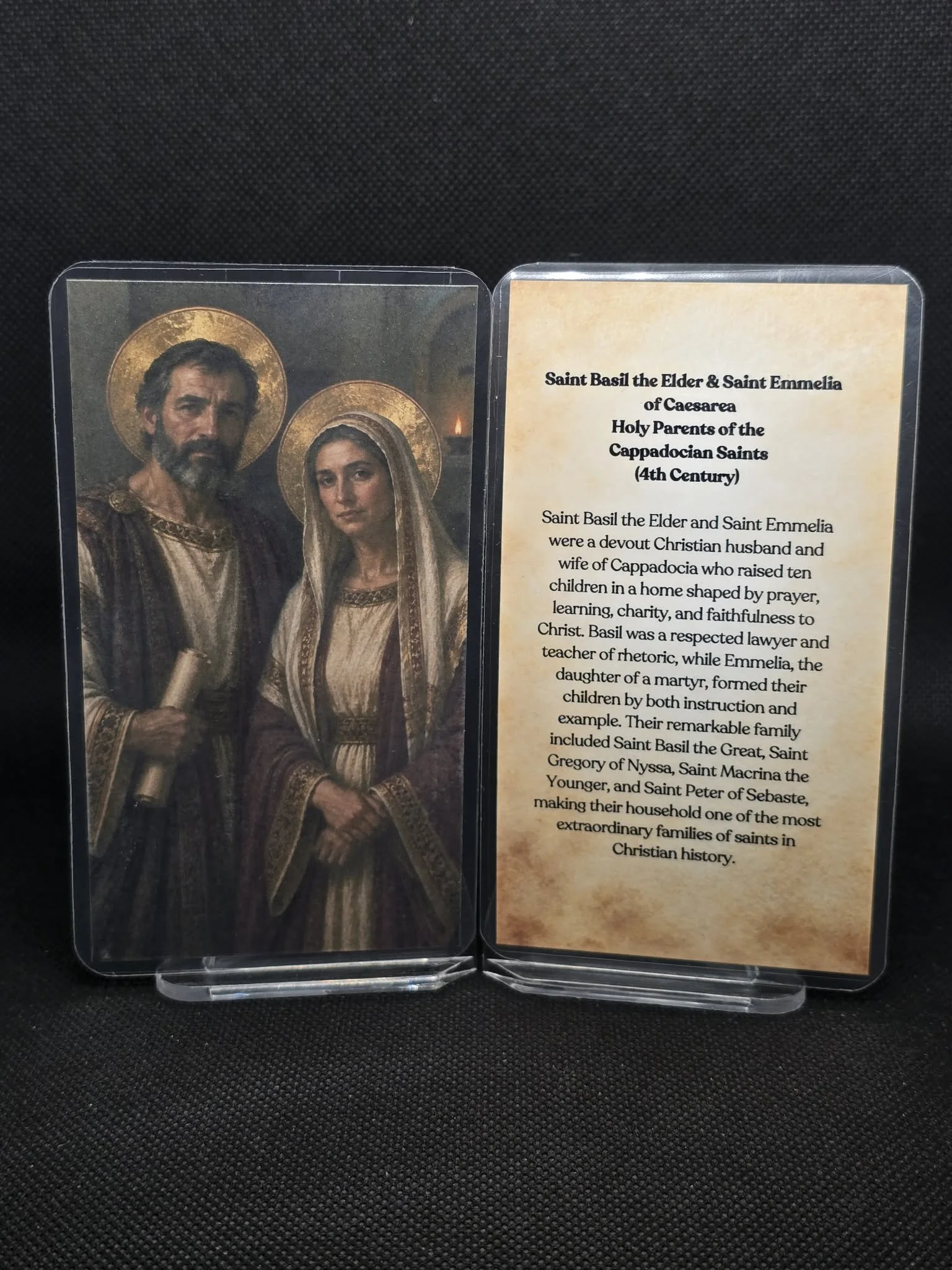
Saint Basil the Elder and Saint Emmelia of Caesarea lived in fourth-century Cappadocia at a time when Christianity had survived persecution but had not yet secured cultural stability. They were not monks, not martyrs, and not bishops. They were husband and wife, mother and father, raising a large family in a world where confessing Christ could still bring exile, loss of property, or public hostility.
Basil the Elder was an educated rhetorician and legal advocate who endured exile for remaining faithful during earlier persecutions. He knew firsthand what it meant to suffer socially and economically for the sake of Christ. Emmelia came from a lineage marked by martyrdom and displacement, and she carried that inheritance of courage into her marriage. Faith was not theoretical in their household. It was lived through risk, discipline, and steady obedience.
Together they raised ten children in a home ordered by prayer, Scripture, fasting, hospitality, and moral clarity. They buried children. They endured instability. They corrected firmly but without harshness. They cultivated humility and generosity long before any of their children became known to history.
Five of their children are honored as saints, including Saint Basil the Great, Saint Gregory of Nyssa, and Saint Macrina the Younger. Their daughter Macrina became the spiritual backbone of the family, guiding her brothers toward ascetic discipline and theological depth. Basil the Great later credited his mother and sister with forming his spiritual conscience. Gregory of Nyssa acknowledged that the faith of his parents shaped his theology more deeply than formal education.
They are commemorated on May 30, with Old Calendar observance on June 12.
Today, Saint Basil the Elder and Saint Emmelia are sought by parents trying to raise faithful children in a confusing culture, families facing division, and mothers and fathers overwhelmed by responsibility. They are especially prayed to by parents whose children are drifting from faith, by families seeking unity after conflict, and by households longing to build something holy rather than merely successful.
This handmade prayer card honors their generational faithfulness and quiet strength. It is created for parents praying after difficult conversations, for families seeking restoration, and for those who understand that building a holy home may be the most important spiritual work of their lifetime.
Tradition: Pre-Schism Universal Church (venerated in both Catholic and Orthodox traditions) | Feast day: May 30 (often associated with Emmelia in some calendars)
Why They Are Invoked
Saint Basil the Elder and Saint Emmelia are remembered not only for their personal holiness, but also for the holy household they built. They were the parents of multiple saints, including Basil the Great, Gregory of Nyssa, and Macrina.
They raised a large family in Cappadocia during a period of instability and persecution. Emmelia is remembered as the daughter of a martyr, and the home was shaped by prayer, Scripture, hospitality, and generosity toward the poor.
Couples invoke them because many marriages are shaped most strongly in the home: the tone of conversation, how conflict is handled, and whether prayer is normal. Their legacy is the domestic church.
Many couples turn to them for:
Grace to build a holy home environment
Wisdom and endurance in parenting
Guidance for families open to life and committed to faith formation
Prayer
A simple invocation used in Eastern Christian practice is:
Saint Basil the Elder and Saint Emmelia, pray to God for our family.
Couples often add a specific intention: patience with children, unity in parenting decisions, or the grace to make prayer normal at home.
Intercession and Devotion
Their intercession is less about a single dramatic miracle and more about the long fruit of a faithful household. The saints they raised are a living testimony to the power of consistent prayer and example.
For parents, their story is a corrective: you do not need a perfect family to raise children in holiness. You need a faithful direction, repentance when you fail, and a home where God is not a weekend idea.
Practical Takeaway
Pick one family prayer rhythm and keep it small: one Psalm line at breakfast, a short prayer before bedtime, or a Sunday evening blessing over the family.
Blessed Franz Jägerstätter and Blessed Franziska Jägerstätter
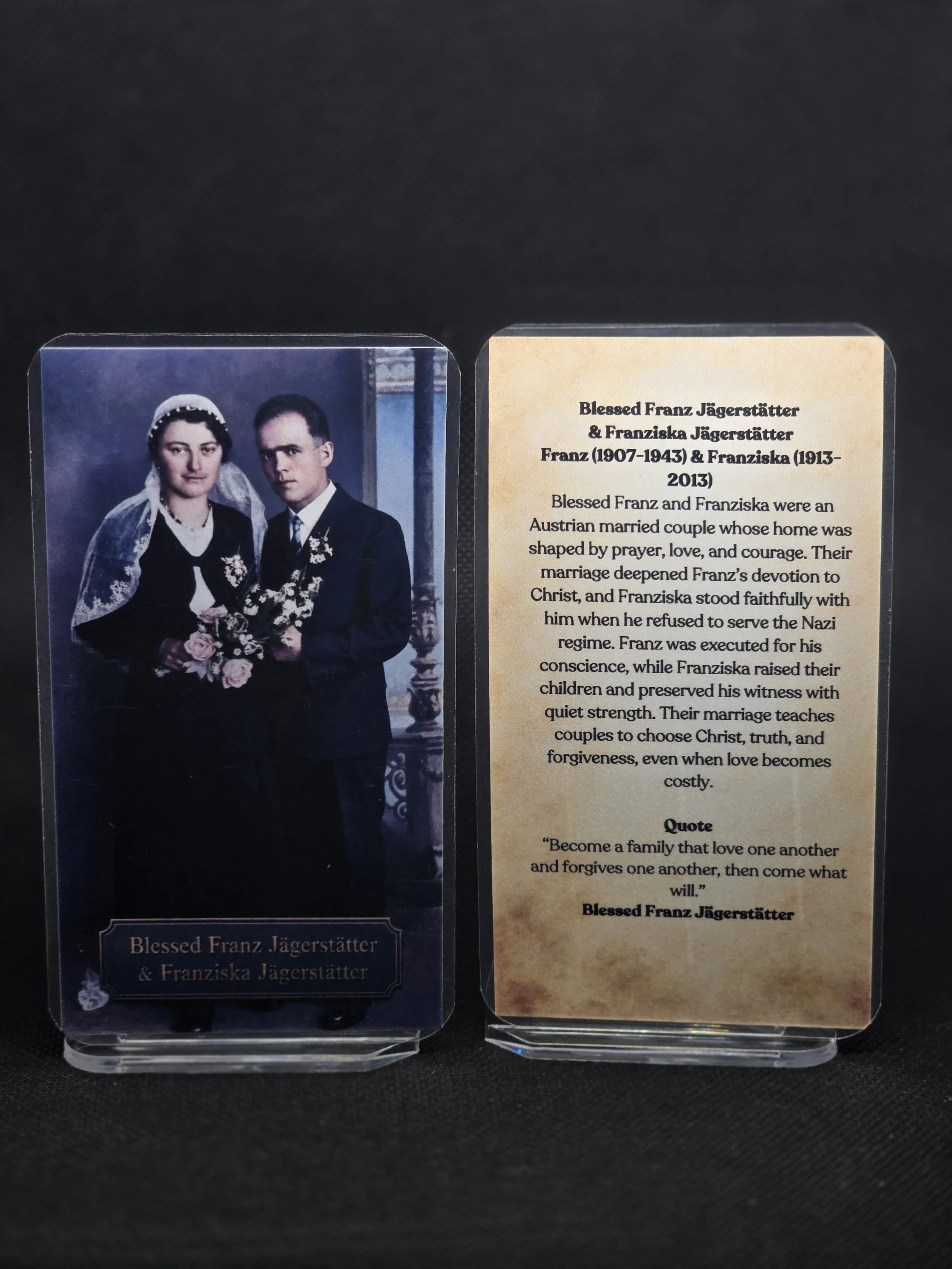
Blessed Franz and Franziska Jägerstätter were not public activists, theologians, or political leaders. They were a young married couple living in the small farming village of St. Radegund in Austria, raising children, tending their land, and practicing a quiet Catholic faith rooted in daily prayer and Sunday Mass.
Franz worked as a farmer and laborer, while Franziska cared for their home and daughters. Their life was ordinary and physically demanding, shaped by rural rhythms and sacramental devotion. They prayed together, attended Mass faithfully, and centered their marriage on Christ long before history forced them into a moment of moral reckoning.
That reckoning arrived with the rise of Nazi Germany.
At first, Franz, like many others, complied with mandatory service requirements. But as Hitler’s ideology became unmistakably violent and racist, Franz began to study Scripture more deeply and reflect seriously on Church teaching. Through prayer and spiritual discernment, he became convinced that swearing loyalty to Hitler and participating in Nazi warfare would make him complicit in grave evil.
This realization isolated him from nearly everyone around him.
Local officials pressured him. Friends dismissed him as naive. Clergy encouraged compromise. Even his own community viewed him as reckless. The overwhelming message was that resistance was pointless and that obedience was expected.
Franziska stood beside him through all of it.
She did not minimize the danger. She did not deny the consequences. She knew that Franz’s refusal would almost certainly leave her a widow with young children, yet she supported his conscience without hesitation. Their marriage became a shared act of witness, one rooted not in emotion but in obedience to God.
Franz was arrested for refusing military service and imprisoned in Berlin. While incarcerated, he was offered multiple opportunities to recant and save his life. Each time, he refused. He was executed by guillotine on August 9, 1943.
Franziska returned home alone.
She raised their three daughters in poverty and social isolation. Neighbors avoided her. Some blamed her for Franz’s death. She endured decades of quiet hardship, remaining faithful to Christ and loyal to her husband’s memory. She never remarried. She lived simply, prayed daily, and carried her grief with dignity for more than sixty years.
Franz is commemorated on August 9, and Franziska is honored alongside him as his wife and spiritual companion.
Today, Blessed Franz and Franziska are sought by couples facing marriage under pressure, Christians struggling to stand for truth in hostile environments, and families navigating political or social persecution. They are especially prayed to by spouses divided over moral decisions, believers facing retaliation at work, and parents trying to raise children with integrity in a culture that rewards compromise.
This handmade prayer card honors their shared witness. It is created for marriages tested by external pressure, for those wrestling with conscience, and for anyone trying to remain faithful when the cost feels unbearable.
Franz and Franziska teach that holiness in marriage is not about comfort. It is about fidelity when everything is at stake.
Tradition: Roman Catholic | Feast day: May 21 (Franz)
Why They Are Invoked
Blessed Franz and Franziska Jägerstätter are a modern witness to conscience-centered marriage. Franz was a farmer in Austria under Nazi rule. Marriage profoundly deepened his spiritual life, and he and Franziska placed Christ at the center of their home.
On their honeymoon, they made a pilgrimage to Rome, a sign that their marriage would not be built around entertainment but around faith. Franz grew in devotion, study, and sacramental life, and Franziska supported that growth.
When required to swear loyalty and serve in Hitler's army, Franz refused on the basis of Christian conscience. He was imprisoned and executed in 1943. Franziska was left to raise their daughters alone. Couples invoke them because their unity did not depend on comfort, and because Franziska's support was active, not passive.
Many couples turn to them for:
Unity of conscience and spiritual courage as a couple
Strength when the culture demands compromise
Peace and fidelity when obedience to Christ has a cost
Prayer
Many couples pray simply in their own words. A short form that fits their witness:
Blessed Franz and Franziska, obtain for our marriage courage, clarity, and unity in Christ. Teach us to choose truth without fear and to love faithfully even when the cost is high. Amen.
Intercession and Devotion
Because Franz was beatified as a martyr, no miracle was required. His prison letters are widely read as a witness of peace, forgiveness, and tenderness toward his family.
Couples facing moral pressure at work, hostility toward Christian convictions, or fear of being isolated for faith often ask the Jägerstätters for help. Their witness is especially valuable for men and women who feel alone in a decision of conscience.
Practical Takeaway
If you are in a conscience conflict, write down your non-negotiables as a couple: what you will not do, what you will not endorse, and what you will protect in your home. Pray for unity before you act.
Blessed Karl (Charles I) of Austria and Servant of God Empress Zita of Bourbon-Parma
Tradition: Roman Catholic | Feast day: October 21 (Karl)
Why They Are Invoked
Blessed Karl and Empress Zita lived their marriage under immense public pressure. They married in 1911, and from the beginning their home was shaped by daily Mass, the Rosary, and family prayer.
Karl famously expressed the core mission of marriage in one sentence: spouses must help each other get to Heaven. They raised eight children and remained devoted even through political collapse, exile, and poverty.
Karl died in exile in 1922 after illness. Zita cared for him to the end and lived decades as a widow, raising their children and maintaining a life of prayer. Couples invoke them as patrons for perseverance, family prayer, and fidelity through instability.
Many couples turn to them for:
Perseverance during financial instability, exile, or major life change
A home anchored in daily prayer, not occasional religion
Strength for spouses carrying illness and caregiving burdens
Prayer
A common devotion is the Prayer for the Canonization of Blessed Karl, asking for courage, charity, and peace through his intercession. Many families also pray for Empress Zita's cause, asking that she be a model of married love and fidelity.
A short prayer couples can use: Blessed Karl and Empress Zita, bless our home with prayer, unity, and peace. Teach us to help each other become holy. Amen.
Intercession and Devotion
A miracle attributed to Blessed Karl has been reported in connection with his cause: a woman suffering from aggressive metastatic cancer was unexpectedly cured after a network of people prayed and used a novena and medal associated with Karl.
Regardless of miracle accounts, the core of their devotion is visible: their marriage did not fall apart under stress. Their home was held together by shared spiritual habits.
Practical Takeaway
If your home lacks shared prayer, begin with one decade of the Rosary once per week, or a short prayer before sleep. Small beginnings are how family prayer becomes normal.
Blessed Luigi Beltrame Quattrocchi and Blessed Maria Corsini
Blessed Luigi and Blessed Maria Beltrame Quattrocchi were Roman Catholic spouses whose holiness unfolded not in monasteries or deserts, but in bedrooms, kitchens, workplaces, hospital rooms, and the daily chaos of family life.
They lived in early twentieth-century Rome, raising children, navigating illness, enduring infertility fears, and carrying professional responsibility, all while building a marriage rooted deeply in prayer and sacramental grace. Luigi was a lawyer and public servant. Maria was a writer, educator, and mother. Their faith was not abstract. It governed their decisions, shaped their parenting, and held them steady when suffering entered their home.
Their marriage began with romance and promise, but it was quickly tested.
Maria faced a life-threatening pregnancy with their fourth child. Doctors urged abortion to save her life. Luigi and Maria refused, choosing instead to entrust everything to God. Maria survived. Their daughter lived. This moment marked them permanently. From then on, their marriage became a conscious offering.
They prayed together daily. They attended Mass regularly. They practiced forgiveness deliberately. They raised their children to love Christ with freedom rather than force. Two of their sons became priests. One daughter entered religious life. Their family became a living testimony that holiness could grow inside ordinary domestic walls.
Their Catholic faith was not sentimental.
It was disciplined.
They carried marital disagreements through prayer. They endured illness with patience. They supported one another through professional pressures and emotional fatigue. When Luigi was hospitalized for long periods, Maria remained spiritually steadfast. When Maria struggled physically, Luigi became her quiet anchor.
Their feast is commemorated on November 25.
Today, Blessed Luigi and Maria are sought by couples facing infertility fear, marital strain, parenting exhaustion, and spiritual dryness within family life. They are especially prayed to by spouses trying to rebuild emotional intimacy, parents overwhelmed by responsibility, and couples longing to raise children in faith without losing themselves in the process.
This prayer card honors their sacred partnership and their witness that marriage itself can become a path to sanctity.
Each card is handmade in Austin and created to order. We do not keep stock, because every prayer card is treated as a unique devotional offering. They are printed on museum-quality photo paper, not cardstock, and each one is made during prayer. The saints are venerated throughout the entire process, and prayers are intentionally offered for the person who will receive the card. These are not mass-produced items. They are created slowly, reverently, and with spiritual intention, because every soul and every prayer matters.
Tradition: Roman Catholic | Feast day: November 25 (common memorial in some communities)
Why They Are Invoked
Blessed Luigi and Maria represent a clear modern example of the domestic church. Married in 1905, they structured their life around daily Mass, the Rosary, consecration to the Sacred Heart, and intentional charity.
During a dangerous pregnancy complicated by placenta previa, they refused pressure to end the child's life and entrusted the situation to God. Both mother and child survived. They also sheltered Jews during World War II and served the Church through lay apostolates.
Later in life, they embraced a deeper discipline of prayer and lived a form of continence. Their children pursued religious vocations, a testimony to a home where God was first.
Many couples turn to them for:
Strength for difficult pregnancies and family medical crises
A model for disciplined family prayer and lay apostolate
Grace to live chastely and lovingly within marriage
Prayer
A common novena asks them to obtain for families the grace to value what matters most: faith, charity, and service. A short petition:
Blessed Luigi and Maria, teach us to build a home where prayer is normal and love is disciplined. Pray for our marriage and our children. Amen.
Intercession and Devotion
Their cause includes an acknowledged healing associated with prayers to the couple. Many modern families pray to them in pregnancy complications and when seeking a stable spiritual rhythm at home.
Their witness is especially useful for couples who need structure: a marriage becomes stronger when prayer is scheduled, not improvised.
Practical Takeaway
Choose one habit from their life: weekly confession as a couple, a set time for the Rosary, or one monthly act of charity done together.
Saints Aquila and Priscilla (Prisca)
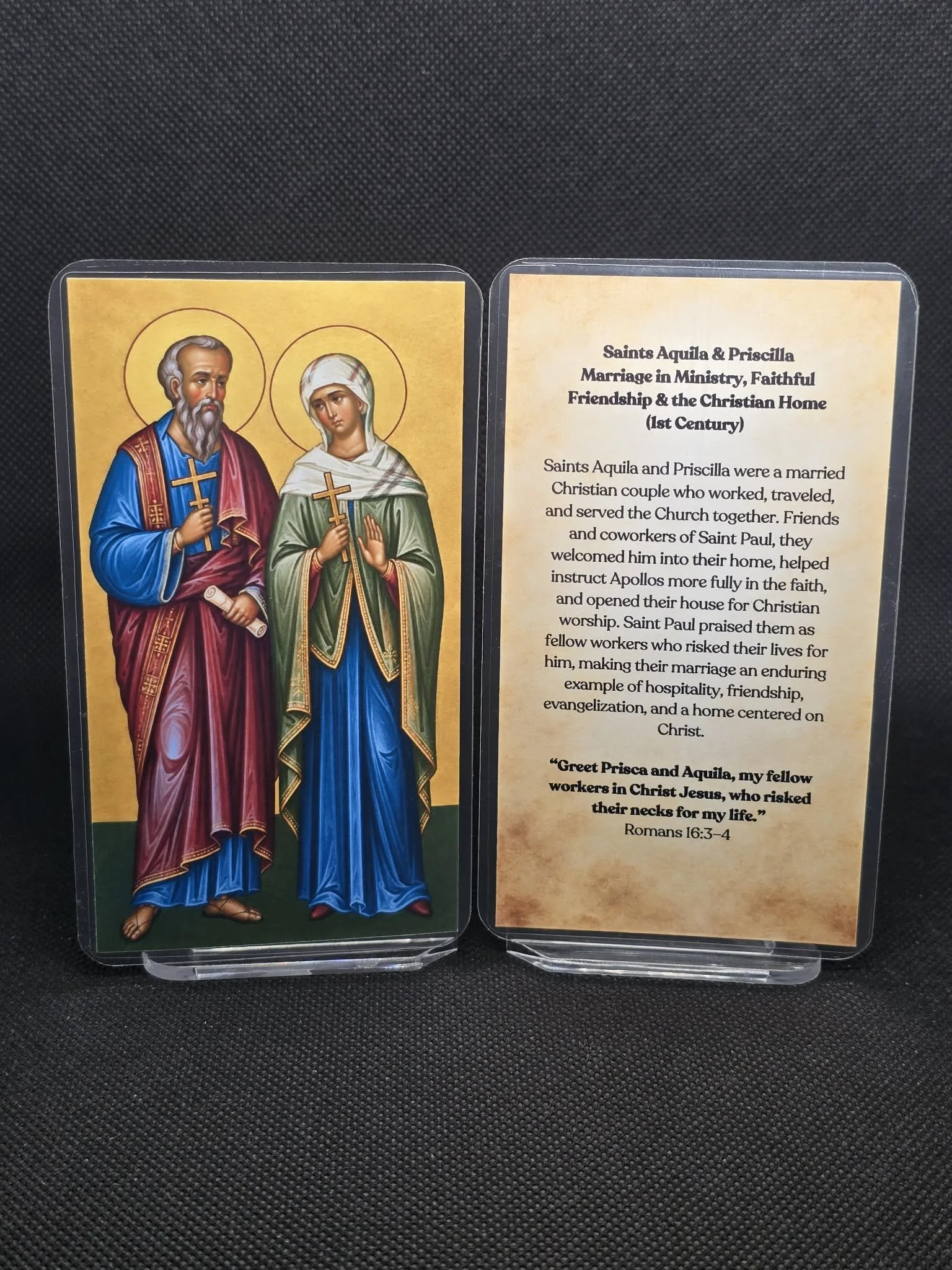
Saints Aquila and Priscilla were first-century Christian spouses whose marriage became a living extension of the early Church, shaped by hospitality, sacrifice, and shared apostolic mission.
They were Jewish converts to Christianity who lived within the earliest Roman Catholic and Eastern Christian roots of the Church, forming part of the apostolic community that gathered around Paul the Apostle. Their story unfolds across multiple cities in the New Testament, including Rome, Corinth, and Ephesus, revealing a married couple constantly on the move, carrying Christ into new places through friendship, work, and open doors.
Aquila was a tentmaker by trade, and Priscilla labored alongside him. Their professional life supported their ministry, and their home became a gathering place for believers. When persecution forced them out of Rome, they did not retreat into safety. They carried their faith forward, rebuilding community wherever they landed.
Their marriage was not private.
It was missionary.
They welcomed strangers. They mentored converts. They risked their lives for fellow believers. Scripture records that they hosted churches in their home and helped form early Christian leaders, including correcting theological misunderstanding with patience and clarity. They did not preach from pulpits.
They discipled across dinner tables.
Their faith expressed itself through shared labor, shared prayer, and shared courage. Paul speaks of them with deep affection, calling them his fellow workers in Christ and acknowledging that they placed their own lives at risk for him.
Their feast is commemorated on February 13.
Today, Saints Aquila and Priscilla are sought by married couples serving in ministry together, families opening their homes to others, and spouses longing to walk in unity of purpose. They are especially prayed to by couples navigating faith together, people discerning shared calling, and households trying to become places of peace, hospitality, and spiritual growth.
This prayer card honors their apostolic partnership and their witness that marriage can become mission.
Each card is handmade in Austin and created to order. We do not keep stock, because every prayer card is treated as a unique devotional offering. They are printed on museum-quality photo paper, not cardstock, and each one is made during prayer. The saints are venerated throughout the entire process, and prayers are intentionally offered for the person who will receive the card. These are not mass-produced items. They are created slowly, reverently, and with spiritual intention, because every soul and every prayer matters.
Tradition: Pre-Schism Universal Church | Feast day: February 13 (often)
Why They Are Invoked
Aquila and Priscilla are mentioned in the Acts of the Apostles and in Paul's letters. They were Jewish Christians who worked as tentmakers and lived as missionary disciples. Expelled from Rome, they met Paul in Corinth and became his close collaborators.
They hosted house churches, offered hospitality, and helped instruct Apollos more accurately in the faith. Paul speaks of them as fellow workers who risked their lives for him.
Couples invoke them when they want a marriage that is not closed in on itself. Their home was open to the Church, and their work supported mission.
Many couples turn to them for:
Unity in ministry and mission as a couple
Hospitality and a home that serves the Church
Wisdom for balancing work, family life, and apostolate
Prayer
Couples may pray simply: Saints Aquila and Priscilla, bless our home. Teach us to serve Christ together and to use our work, time, and resources for the Gospel. Amen.
In Orthodox tradition, hymns honor them as companions and fellow laborers of Paul.
Intercession and Devotion
Many spouses involved in parish life and lay apostolates invoke Aquila and Priscilla for balance and unity. Their witness is also a corrective for couples tempted to isolate: Christian marriage is meant to overflow into hospitality and service.
Practical Takeaway
Invite one small form of hospitality back into your life: coffee with another couple, a meal after church, or a simple act of encouragement for someone in your parish.
Saint Julian of Antioch and Saint Basilissa
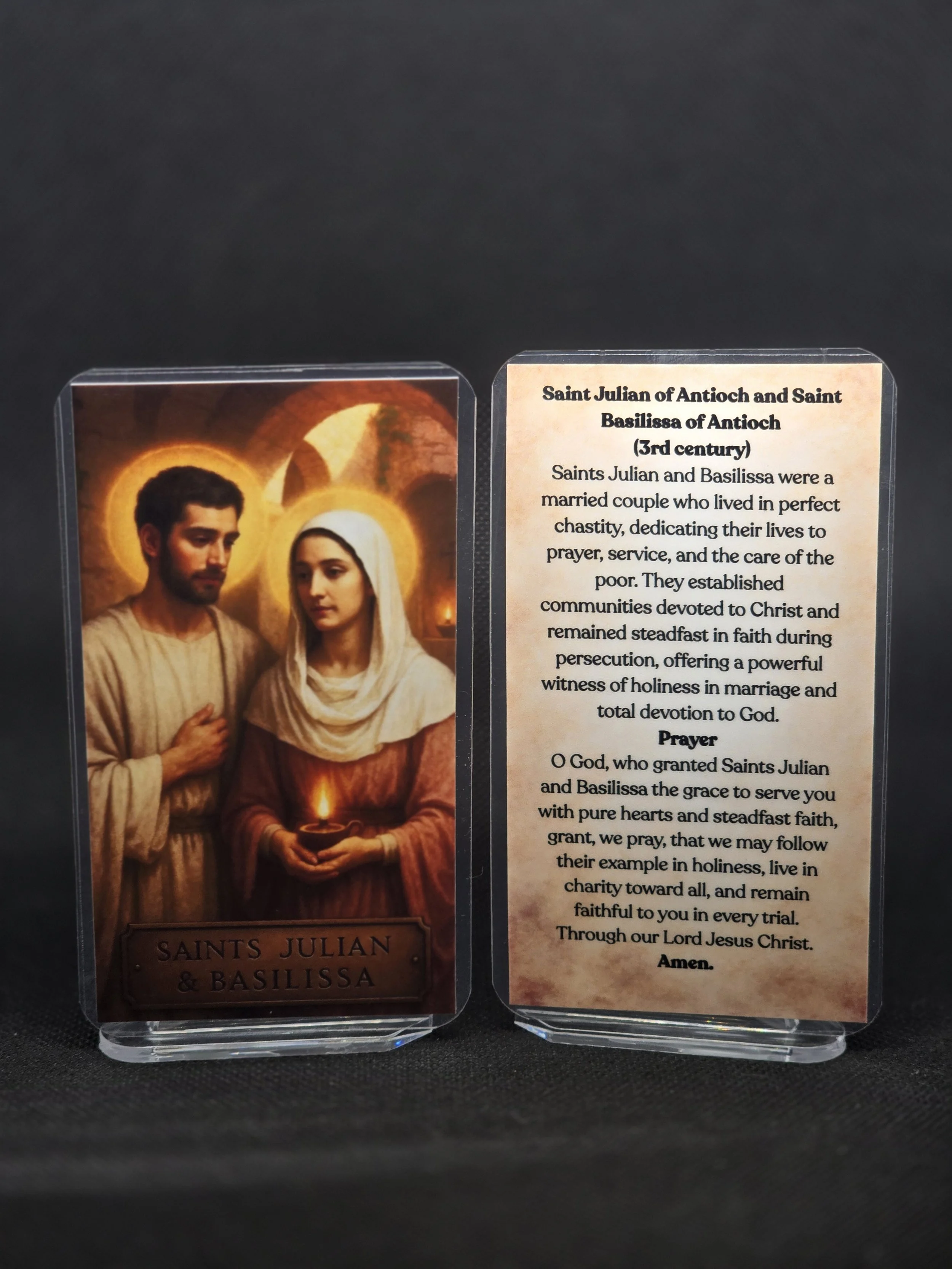
Saint Julian and Saint Basilissa were early Christian spouses whose marriage was consecrated not by comfort, but by radical devotion to Christ.
They lived in the third century in Antioch and belonged to the undivided early Church, venerated today in both Eastern Orthodox and Roman Catholic traditions. Their union was formed in a time when Christianity was still illegal and dangerous. Marriage, for them, was not merely companionship. It was vocation.
Julian was born into wealth and social privilege. Basilissa was known for her virtue and intelligence. When they were married, they made an extraordinary mutual decision. They chose to live in continence, dedicating their marriage entirely to Christ. Their home became a sanctuary for prayer, study, and hospitality, gradually transforming into a community of men and women pursuing holiness under their guidance.
They did not reject marriage.
They transfigured it.
Their life together was marked by service to the poor, care for the sick, and formation of believers who longed for deeper commitment. In time, persecution erupted. Julian was arrested and tortured for refusing to renounce Christ. Basilissa, though facing her own trials, remained spiritually steadfast.
Their feast is commemorated on January 9 in the Roman Catholic calendar and January 21 in the Eastern Orthodox calendar.
Today, Saints Julian and Basilissa are sought by couples striving for spiritual unity, spouses discerning consecrated or chaste marriage, and Christians facing hostility or social pressure because of their faith. They are especially prayed to by married couples seeking deeper spiritual intimacy, individuals longing for courage under persecution, and those desiring to place Christ at the absolute center of their relationship.
This prayer card honors their radical fidelity and the transformation of marriage into holy offering.
Each card is handmade in Austin and created to order. We do not keep stock, because every prayer card is treated as a unique devotional offering. They are printed on museum-quality photo paper, not cardstock, and each one is made during prayer. The saints are venerated throughout the entire process, and prayers are intentionally offered for the person who will receive the card. These are not mass-produced items. They are created slowly, reverently, and with spiritual intention, because every soul and every prayer matters.
Tradition: Pre-Schism Universal Church | Feast day: January 9 (often)
Why They Are Invoked
Julian and Basilissa are remembered in Christian tradition as spouses who embraced a life of chastity and transformed their household into a place of consecration. In many accounts, they established separate communities for men and women connected to their home.
Julian is also remembered for extraordinary charity, including care for the sick and the building of hospitals. Their witness is often associated with hospitality, purity, and the offering of one's home to God.
Couples invoke them when they are discerning a Josephite marriage, striving for chastity, or seeking a model of radical hospitality.
Many couples turn to them for:
Purity, discipline, and chastity within marriage
A home ordered toward hospitality and mercy
Courage to live Christian commitment when it is countercultural
Prayer
A simple prayer: Holy saints Julian and Basilissa, teach us to love with purity and discipline. Help our home become a place of mercy and prayer. Intercede for our marriage. Amen.
Intercession and Devotion
Devotion to Julian and Basilissa appears in older calendars of both East and West. While modern miracle accounts are not often centralized, their story continues to speak to couples trying to live with integrity and self-control.
Practical Takeaway
If chastity is a struggle, set one practical boundary and one positive habit: remove a trigger, and replace it with prayer, exercise, or a shared evening routine.
Saints Timothy and Maura
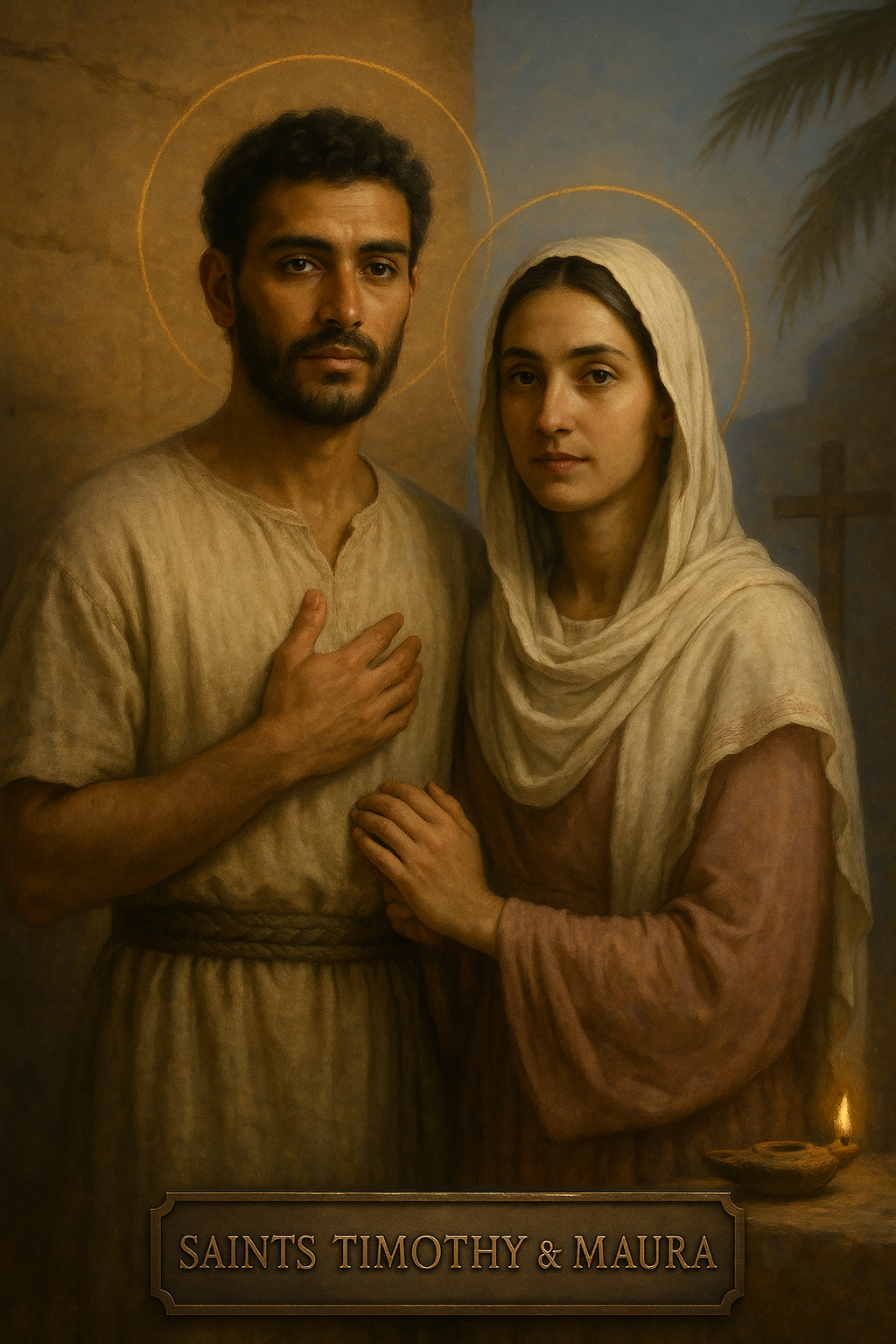
Saint Timothy of Antinoë and Saint Maura were early Christian spouses whose marriage lasted only weeks, yet whose witness echoes through centuries.
They lived in third-century Egypt and belonged to the undivided early Church, honored today in both Eastern Orthodox and Roman Catholic traditions. Their story unfolds during the brutal persecutions under Emperor Diocletian, when confessing Christ meant imprisonment, torture, and death.
Timothy served as a church reader, entrusted with safeguarding sacred Scriptures. Maura was newly married to him, young in faith and newly begun in married life, when authorities arrested Timothy for refusing to surrender holy texts.
He would not betray the Word of God.
They tortured him publicly, gouging out his eyes and beating him mercilessly, hoping fear would force compliance. When this failed, they summoned Maura and attempted to use her as leverage, promising wealth and safety if she persuaded her husband to renounce Christ.
Instead, Maura chose courage.
Rather than pleading for Timothy’s release, she stood beside him in confession of faith. Their marriage, barely begun, became a joint offering. Both were subjected to prolonged torment before being crucified facing one another, where they encouraged each other for nine days until surrendering their souls to God.
Their feast is commemorated on May 3.
Today, Saint Timothy and Saint Maura are sought by couples facing intense external pressure, newlyweds walking through hardship, and Christians struggling to remain faithful under threat or opposition. They are especially prayed to for marriage under pressure, courage during persecution, and strength when faith is tested by fear, family conflict, or hostile environments.
This prayer card honors their brief but blazing witness and their testimony that marriage can become martyrdom in miniature when love is fully surrendered to Christ.
Each card is handmade in Austin and created to order. We do not keep stock, because every prayer card is treated as a unique devotional offering. They are printed on museum-quality photo paper, not cardstock, and each one is made during prayer. The saints are venerated throughout the entire process, and prayers are intentionally offered for the person who will receive the card. These are not mass-produced items. They are created slowly, reverently, and with spiritual intention, because every soul and every prayer matters.
Tradition: Pre-Schism Universal Church | Feast day: May 3 (often)
Why They Are Invoked
Timothy and Maura were newly married when persecution struck. Timothy served the Church as a reader and was arrested for preserving sacred texts. Maura was pressured to renounce Christ, refused, and chose to suffer with her husband.
They were tortured and crucified facing one another, encouraging each other for days until death. Their story is one of the clearest early examples of marital unity expressed as witness.
Couples invoke them when faith brings hostility, when suffering creates fear, or when they need courage to endure together.
Many couples turn to them for:
Courage and unity when faith is opposed
Perseverance in suffering without turning against each other
Strength for couples facing hostility, ridicule, or pressure
Prayer
A short prayer: Holy martyrs Timothy and Maura, strengthen our marriage to endure hardship with faith. Teach us to encourage one another and to keep Christ first. Amen.
Intercession and Devotion
Their story has long been read as a witness that marriage can be martyrdom in the sense of self-offering. For modern couples, the persecution may be social rather than physical, but the spiritual pressure can be real. Timothy and Maura are invoked for steadfastness.
Practical Takeaway
When pressure rises, do one act of unity: pray out loud together for one minute, or speak one concrete word of respect and encouragement before you discuss any hard topic.
Saints Adrian and Natalia of Nicomedia
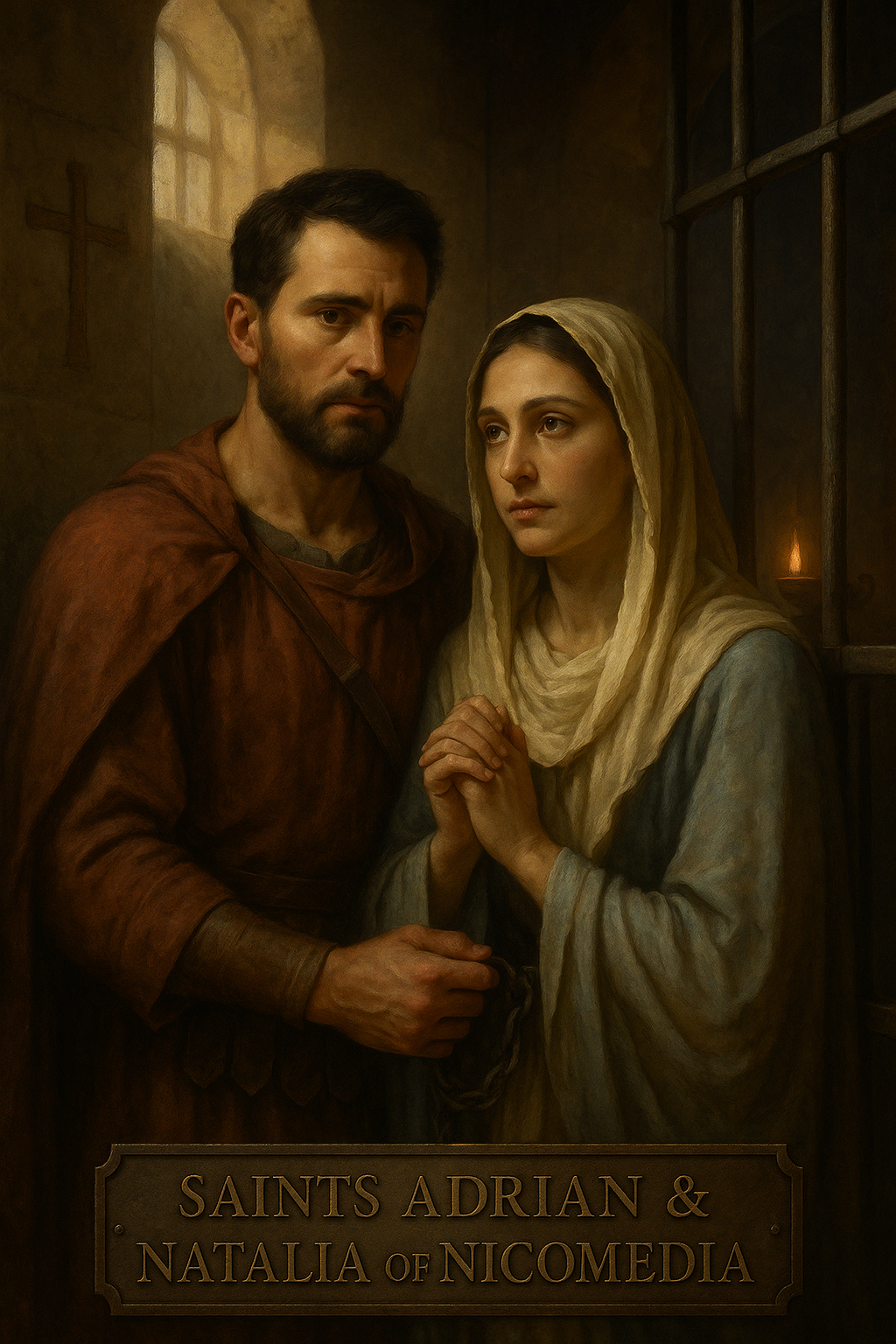
Saints Adrian and Natalia are among the Church’s most powerful witnesses of married love transformed by Christ. They are especially sought by those desperate for restoration of struggling marriages, conversion of a hardened or unbelieving spouse, and strength to endure suffering together as a family.
Their story does not begin in persecution. It begins in comfort.
Adrian was a respected Roman officer, secure in his position and reputation. Natalia was his wife, already a quiet Christian, praying silently for her husband’s heart to awaken to God. Then one moment changed everything. While overseeing the torture of imprisoned Christians, Adrian witnessed something he could not explain: men and women enduring unimaginable pain with peace, courage, and joy. When he asked where such strength came from, they spoke of Christ and eternal life.
On the spot, Adrian publicly confessed Jesus and wrote his own name among the prisoners.
He walked away from power, safety, and status in a single decision.
Natalia did not try to stop him.
She stood beside him.
Their feast is commemorated on August 26, and to this day couples turn to Saints Adrian and Natalia when marriages feel fragile, when one spouse feels spiritually distant, or when suffering threatens to tear a family apart. Natalia’s quiet courage and Adrian’s sudden conversion make them powerful intercessors for homes on the brink.
This handmade prayer card honors their shared sacrifice with museum-quality craftsmanship, created for prayer during marital crisis, emotional strain, and seasons of faith rebuilding. It is not merely devotional art. It is a spiritual heirloom.
Tradition: Pre-Schism Universal Church (venerated in both Eastern Orthodox and Catholic traditions) | Feast day: September 8 (often)
Why They Are Invoked
Adrian served as a pagan military officer in Nicomedia during the persecutions. He converted after witnessing Christian martyrs endure torture with peace and hope. He declared himself a Christian and was imprisoned.
Natalia, his wife, was already a secret Christian. She visited Adrian in prison and strengthened him so he would not lose courage. Their story highlights a rare kind of unity: spouses strengthening each other in virtue, not only in emotion.
After Adrian's martyrdom, accounts describe efforts to destroy the bodies of the martyrs being interrupted by a storm. Natalia preserved a relic and remained faithful, later reposing in peace.
Many couples turn to them for:
Courage when faith is costly
Strength to encourage one another under pressure
Unity of heart when fear threatens to divide
Prayer
The Orthodox troparion emphasizes Adrian's conversion and Natalia's support. Couples may pray:
Holy martyrs Adrian and Natalia, teach us to strengthen one another, not weaken one another. Pray that our marriage becomes a place where courage grows, faith deepens, and Christ is chosen even when it costs us. Amen.
Intercession and Devotion
Modern couples invoke Adrian and Natalia when they are pressured to compromise convictions, when faith becomes socially costly, or when fear begins to divide the home.
Their story also offers a practical pattern to imitate: make encouragement in virtue part of marriage culture. Not vague optimism, but specific strength.
Practical Takeaway
Try one practice this week: pray out loud for your spouse's courage before a hard conversation, or fast one small comfort together for a shared intention.
Saint Monica
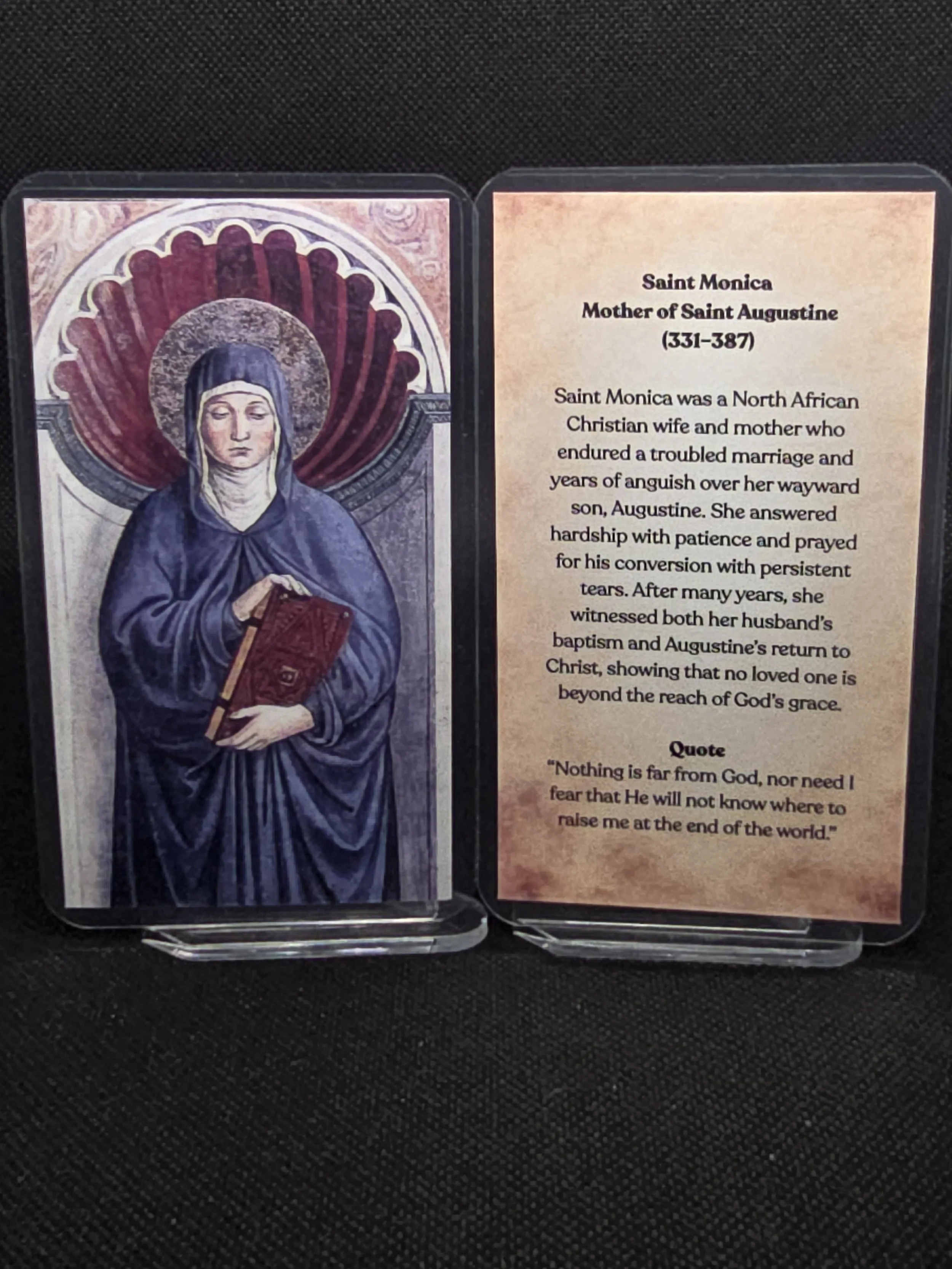
Saint Monica is one of the most beloved mothers in Christian history, venerated in the Roman Catholic Church, honored in Eastern Catholic traditions, and deeply respected across Orthodoxy for her unwavering perseverance in prayer. Her feast day is celebrated on August 27 in the Western calendar, with August 4 observed in many Eastern traditions.
She is remembered not because her life was easy.
She is remembered because it was not.
Monica lived with a difficult husband, carried the sorrow of a broken home, and watched her brilliant son drift far from God into pride, pleasure, and spiritual confusion. For decades she wept, fasted, pleaded, and prayed while nothing seemed to change. Her marriage was strained by her husband’s temper and unbelief. Her son wandered through heresy and moral chaos. Her heart was continually pressed between hope and heartbreak.
Yet Monica did not abandon prayer.
She did not harden.
She did not grow bitter.
Instead, she became a woman shaped by tears.
Her intercession was quiet but relentless. She followed her son across cities and continents. She sought counsel from bishops. She brought her anguish to the altar again and again. When told by a holy bishop that “a child of so many tears cannot be lost,” she held onto that promise with everything she had.
Years later, those tears bore fruit.
Her son would become Saint Augustine, one of the greatest theologians in Christian history. Her husband would come to faith before his death. Her household would be transformed not by argument, but by endurance rooted in love.
Today, Saint Monica is prayed to by parents whose children have walked away from God, by spouses trapped in painful marriages, and by anyone carrying years of unanswered prayer. She is especially sought by mothers and fathers facing anxiety over their children, wives living with emotional or spiritual distance, and souls exhausted from hoping when hope feels thin.
This prayer card honors Monica’s fierce tenderness and unbreakable faith.
Each card is handmade in Austin and created to order. We do not keep stock, because every prayer card is treated as a unique devotional offering. They are printed on museum-quality photo paper, not cardstock, and each one is made during prayer. The saints are venerated throughout the entire process, and prayers are intentionally offered for the person who will receive the card. These are not mass-produced items. They are created slowly, reverently, and with spiritual intention, because every soul and every prayer matters
Tradition: Roman Catholic (ancient Christian model of persevering intercession) | Feast day: August 27
Why They Are Invoked
Saint Monica is invoked by wives and mothers praying for the conversion of a spouse or child. Her story is not sanitized. She endured a difficult marriage marked by her husband's temper and infidelity, yet she refused to let bitterness rule her heart.
Through years of prayer and persistence, Monica obtained her husband's baptism shortly before his death. She also prayed for her son Augustine, who lived far from Christian discipline. Monica followed him across cities, sought counsel, fasted, and wept in prayer until his conversion.
Augustine later wrote that Monica gave him birth twice: once in the flesh and once in faith. That image explains why her patronage remains so strong: she models spiritual endurance that does not collapse into despair.
Many couples turn to them for:
Conversion of a spouse and children
Patience that does not become numbness
Hope when the timeline is long
Prayer
A simple prayer shaped by her witness:
Saint Monica, you prayed through years of heartbreak without losing faith. Ask God to give me patience, clarity, and strength. Obtain the grace of conversion for my spouse and my children, and keep my heart from bitterness while I wait. Amen.
Intercession and Devotion
Saint Monica is one of the most invoked saints for conversions, and many families testify to loved ones returning to confession, prayer, and serious discipleship after sustained prayer to her.
Her story is also a warning against panic: conversion is often slow. Monica teaches steady love paired with steady prayer.
Practical Takeaway
If you feel alone spiritually, choose one daily habit that is quiet and consistent: one Psalm line, one decade of the Rosary, or one short prayer at the same time each day.
Saints Peter and Febronia of Murom
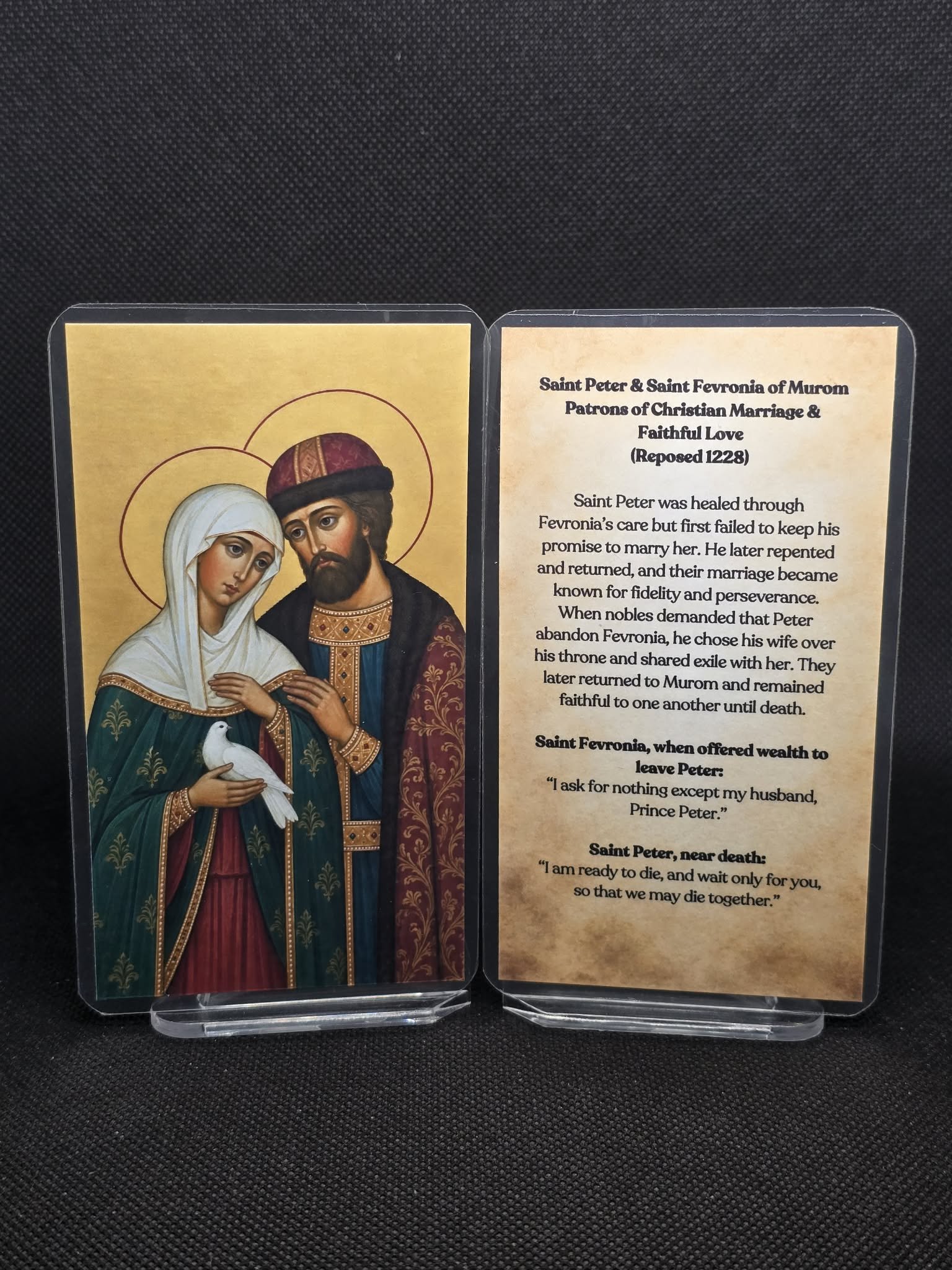
Saint Peter and Saint Fevronia of Murom are among Eastern Christianity’s most beloved married saints, venerated deeply in the Eastern Orthodox Church and honored by Eastern Catholics as living icons of sacrificial love, covenant faithfulness, and emotional healing within marriage. Their feast day is celebrated on July 8 in the Eastern calendar.
People pray to Peter and Fevronia when marriages feel fragile.
When communication has broken down.
When betrayal has wounded trust.
When emotional distance grows quiet and heavy.
When couples wonder if love can be rebuilt.
Their story is not sentimental.
It is honest.
It begins with illness, rejection, misunderstanding, and costly choices.
Peter was a prince, strong and respected, but struck with a mysterious and disfiguring disease after battling evil forces threatening his kingdom. No physician could heal him. His suffering led him to Fevronia, a humble village woman known for wisdom and spiritual insight. She agreed to heal him, but only if he would honor her as his wife.
He agreed.
She healed him.
And then he broke his word.
The illness returned.
Only when Peter repented and returned to Fevronia in humility was he fully healed.
That moment shaped their entire life together.
Peter chose love over pride.
Fevronia chose forgiveness over resentment.
Together they chose covenant over convenience.
Today, Saint Peter and Saint Fevronia are prayed to by couples seeking marriage restoration, emotional reconnection, forgiveness after betrayal, and strength to stay faithful during long seasons of difficulty. They are especially sought by spouses navigating conflict, drifting intimacy, or the slow erosion of trust.
This prayer card honors their sacred partnership and their witness that love can be rebuilt when both hearts surrender to Christ.
Each card is handmade in Austin and created to order. We do not keep stock, because every prayer card is treated as a unique devotional offering. They are printed on museum-quality photo paper, not cardstock, and each one is made during prayer. The saints are venerated throughout the entire process, and prayers are intentionally offered for the person who will receive the card. These are not mass-produced items. They are created slowly, reverently, and with spiritual intention, because every soul and every prayer matters.
Tradition: Eastern Orthodox | Feast day: July 8 (widely celebrated in Russian tradition)
Why They Are Invoked
Saints Peter and Febronia are among the most beloved Orthodox patrons of marriage, especially in the Slavic tradition. Their story is remembered as a model of fidelity, humility, and unity through social pressure.
Tradition recounts that Prince Peter suffered from severe illness and was healed through the wisdom and care of Febronia, a woman of humble origin known for virtue. Their marriage faced resistance from nobility. The couple accepted exile rather than compromise their union.
In time, the people begged them to return, recognizing that pride had pushed away stability. Peter and Febronia ruled with charity and mercy. Later, they embraced monastic life and reposed on the same day, a devotional sign of unity.
Many couples turn to them for:
Unity of mind and heart
Peace in the home and fidelity under temptation
Endurance when outsiders oppose the marriage
Prayer
A widely used Orthodox prayer asks:
Holy wonderworkers Peter and Febronia, preservers of honorable marriage, intercede for us. Grant those united in marriage love, unity of mind, good children, and an imperishable crown in eternal life. Amen.
Intercession and Devotion
A well-known local tradition says their relics, when placed separately, were later found together. Regardless of how a reader interprets that account, the devotional point is clear: their veneration centers on inseparable unity.
Modern Orthodox couples often pray to Peter and Febronia when facing family opposition, financial strain, or early marriage instability.
Practical Takeaway
If outsiders are influencing your marriage, set one boundary together this week. Agree on what information stays private and what decisions you make as a couple before you consult anyone else.
Saint Rita of Cascia
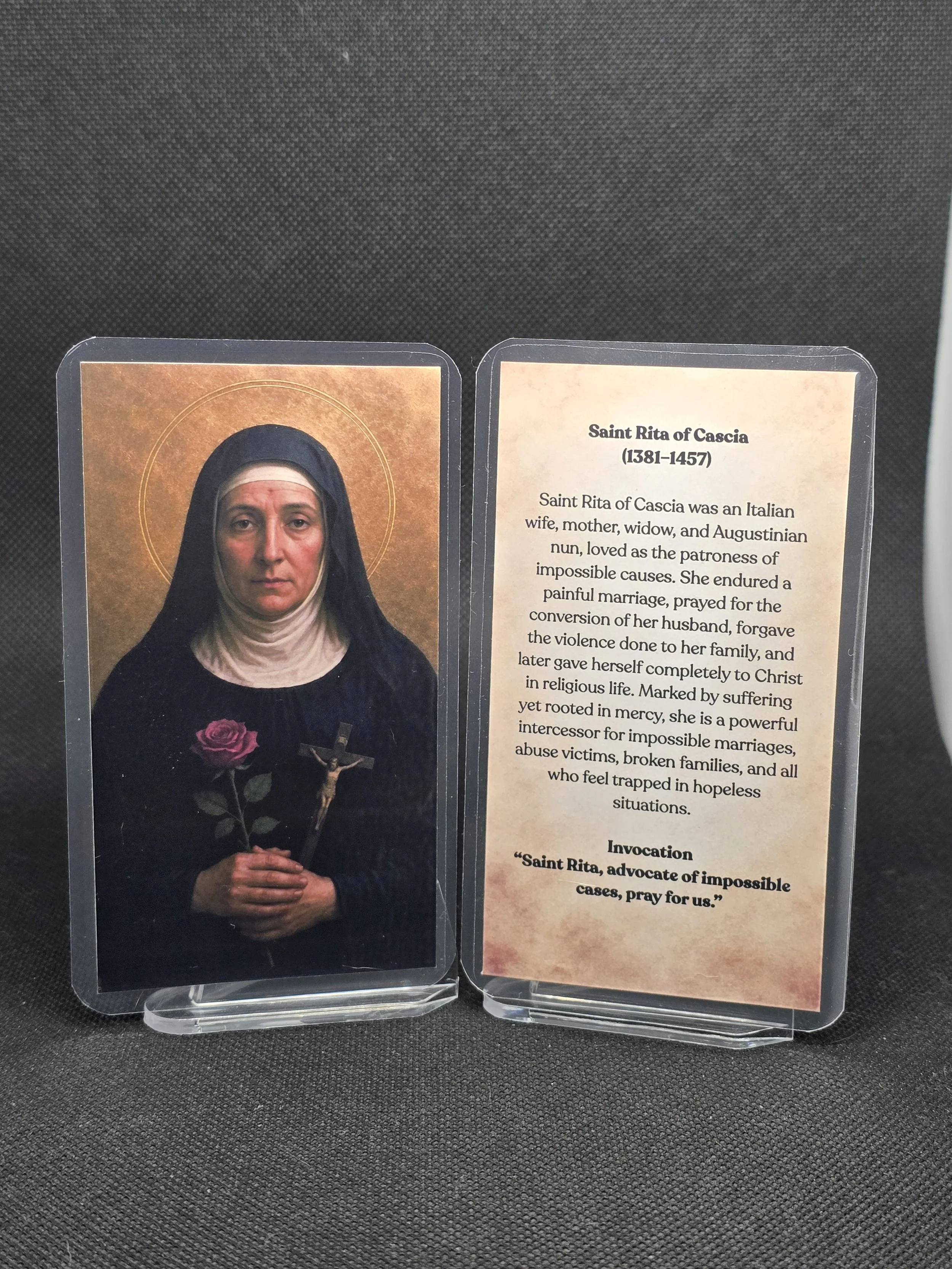
Saint Rita of Cascia is one of the most sought-after intercessors in all of Christian devotion, venerated in the Roman Catholic Church and deeply honored by Eastern Catholics who turn to her when situations feel humanly impossible. Her feast day is celebrated on May 22.
People pray to Saint Rita when marriages are violent or emotionally shattered.
When reconciliation seems unreachable.
When family trauma runs deep.
When grief follows unbearable loss.
When hope feels exhausted.
Rita did not live a sheltered religious life from the beginning.
She lived inside chaos.
Born in fifteenth-century Italy, Rita desired monastic life from childhood. Instead, she was married against her will to a man known for his temper and involvement in local conflict. Her home was unstable. Anger ruled the atmosphere. Violence was normal.
She endured quietly.
She prayed relentlessly.
She chose gentleness where retaliation would have been easier.
Over time, her patience transformed her husband’s heart. He repented. Peace entered their home. But reconciliation came at a cost. He was later murdered in a cycle of vendetta, leaving Rita widowed and raising two sons.
When her sons grew old enough to seek revenge for their father’s death, Rita begged God to prevent further bloodshed. Both sons died of illness before they could commit violence. Her prayer was heartbreaking.
It was also merciful.
Rita eventually entered religious life, bearing the invisible wounds of grief and loss. Late in life, she received a mystical wound on her forehead, sharing spiritually in Christ’s suffering.
Today, Saint Rita is prayed to by those trapped in abusive marriages, by families torn apart by anger or addiction, by widows and widowers, and by anyone living inside a situation that seems impossible to repair. She is especially sought by those asking for marriage healing, protection from domestic violence, reconciliation after betrayal, and peace after trauma.
This prayer card honors her fierce endurance and quiet strength.
Each card is handmade in Austin and created to order. We do not keep stock, because every prayer card is treated as a unique devotional offering. They are printed on museum-quality photo paper, not cardstock, and each one is made during prayer. The saints are venerated throughout the entire process, and prayers are intentionally offered for the person who will receive the card. These are not mass-produced items. They are created slowly, reverently, and with spiritual intention, because every soul and every prayer matters.
Tradition: Roman Catholic | Feast day: May 22
Why Is She Invoked
Saint Rita is widely known as the saint of the impossible. Her married life included serious hardship and instability, and she is invoked by spouses who feel trapped in patterns that will not change.
Rita desired religious life, but her parents arranged her marriage. Sources describe her husband as harsh and unstable. Rita endured suffering and prayed for his conversion. Over time, his behavior changed, and a season of peace followed.
Tragedy later returned: her husband was murdered, and her sons sought revenge. Rita prayed that they would be spared the sin of murder, even if that meant their deaths. Both sons soon died of illness. Rita later entered religious life as an Augustinian.
Many couples turn to them for:
Troubled marriages and hardened hearts
Peace, repentance, and reconciliation
Hope when the situation looks humanly impossible
Prayer
A short prayer inspired by traditional devotions:
Saint Rita, you endured hardship with faith and sought peace when conflict threatened to destroy your home. Intercede for our marriage. Ask God to soften hardened hearts, to restore what is broken, and to grant us the courage to do what is right. Amen.
Intercession and Devotion
Devotion to Saint Rita is widespread, and many families report answered prayers involving reconciliation, peace in the home, and unexpected change in hardened situations.
If you are in danger, seek immediate help from local authorities or trusted support. Saints intercede, but safety matters. Rita's story is about holiness within suffering, not the denial of reality.
Practical Takeaway
If your marriage is in conflict, choose one action that lowers heat: pause a recurring argument, schedule a calm talk with a time limit, or involve a trusted pastor or counselor. Prayer and wise action work together.
Saint Gregory the Elder and Saint Nonna of Nazianzus
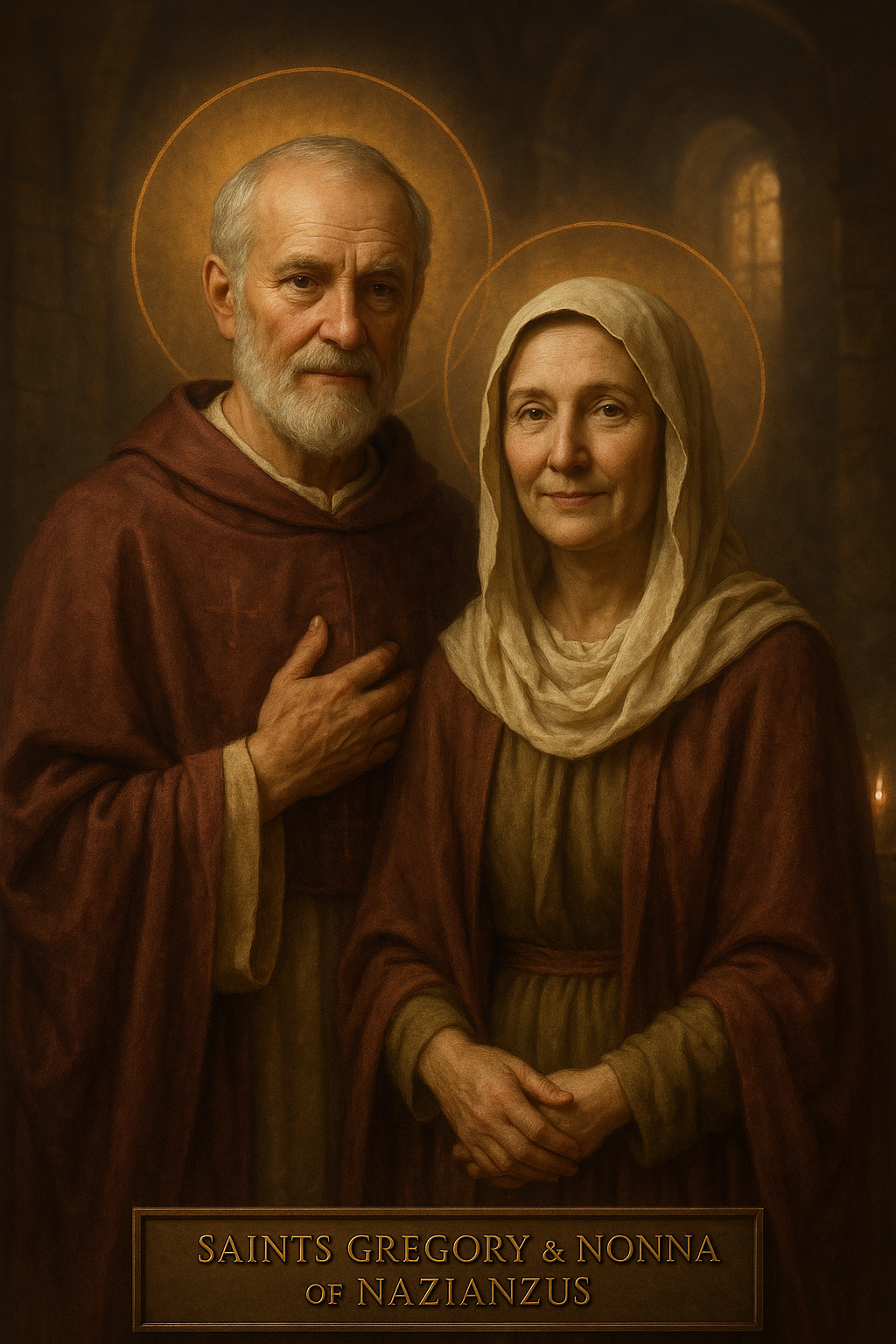
Saints Gregory and Nonna of Nazianzus are among the most quietly powerful married saints in early Christianity, venerated in the Eastern Orthodox Church and honored by Eastern Catholics as living witnesses to how one faithful spouse can transform an entire family.
Their feast is commemorated together on August 5 in the Eastern tradition, with Saint Nonna also remembered separately on August 5 and Saint Gregory the Elder on January 1 in some calendars.
People pray to Gregory and Nonna when marriages feel spiritually divided.
When a husband feels distant from God.
When a wife is carrying the household in prayer alone.
When children drift from faith.
When mothers are exhausted from interceding for their families.
Their story is not romanticized.
It is real.
Nonna entered marriage already devoted to Christ. Gregory did not. He belonged to a sect outside the Church and carried spiritual confusion into their home. Nonna did not argue him into conversion. She did not threaten. She did not withdraw.
She prayed.
For years.
Quietly. Persistently. Faithfully.
Eventually, Gregory surrendered to Christ, entered the Church, and was ordained. He later became Bishop of Nazianzus, shepherding the same community his wife had once wept over in secret prayer. Together, they raised children who would become spiritual giants, including Saint Gregory the Theologian.
Their marriage did not begin in unity.
It became unified through perseverance.
Today, Saints Gregory and Nonna are prayed to by spouses seeking marriage healing, mothers praying for unbelieving husbands, parents interceding for children who have drifted, and families longing for spiritual restoration.
They stand as proof that prayer inside marriage changes generations.
This prayer card honors their covenant faithfulness and Nonna’s fierce intercession that reshaped an entire household.
Each card is handmade in Austin and created to order. We do not keep stock, because every prayer card is treated as a unique devotional offering. They are printed on museum-quality photo paper, not cardstock, and each one is made during prayer. The saints are venerated throughout the entire process, and prayers are intentionally offered for the person who will receive the card. These are not mass-produced items. They are created slowly, reverently, and with spiritual intention, because every soul and every prayer matters.
Tradition: Pre-Schism Universal Church (Fathers-era Christian household honored in East and West) | Feast day: August 5 (Nonna is often commemorated)
Why They Are Invoked
Gregory the Elder and Nonna are invoked by spouses in marriages where one person is spiritually awake and the other is distant. Nonna is remembered as a devout Christian whose prayer and example were central in her husband's conversion.
After Gregory's conversion, he was ordained and became a bishop. Their son, Gregory Nazianzen, later praised their marriage as a union of virtue, not only of bodies. That language matters: the deepest marital unity is moral and spiritual.
Couples look to them as patrons of patient leadership, gentle persuasion, and long-term faithfulness in the home.
Many couples turn to them for:
Conversion of an unbelieving spouse
A home that forms children in holiness
Patience that remains active, not passive
Prayer
A short prayer: Saints Gregory and Nonna, ask Christ to strengthen our home. If one of us is spiritually asleep, awaken us gently. Teach us perseverance in prayer and unity in virtue. Amen.
Intercession and Devotion
Nonna's story remains a source of hope for spouses praying alone. It shows that prayer and example can be more persuasive than pressure.
This section also answers a common question: what does spiritual headship look like. In this story, it looks like humility, consistency, and the long obedience of love.
Practical Takeaway
If you are the only praying spouse, commit to one stable prayer time daily and one stable act of love weekly. Consistency is more convincing than intensity.
Saints Joachim and Anne
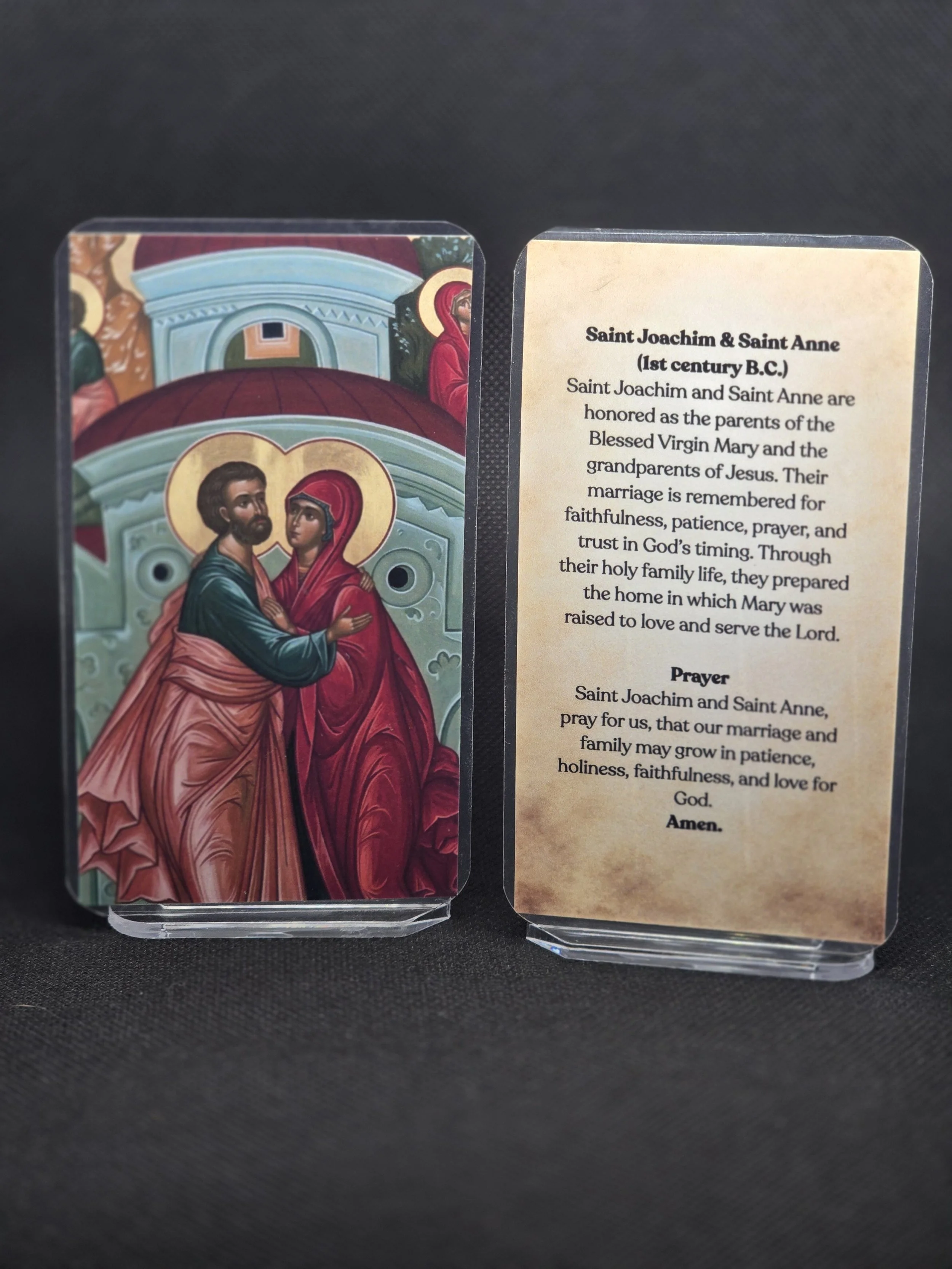
Saints Joachim and Anne are among the most tender figures in all of Christian memory, venerated in the Eastern Orthodox Church, honored deeply in Eastern Catholic tradition, and beloved in Roman Catholic devotion as the holy parents of the Virgin Mary. Their feast is celebrated together on July 26 in the Western calendar, with Eastern tradition commemorating Saint Anne on July 25 and Saint Joachim on September 9.
People pray to Joachim and Anne when pregnancy does not come.
When miscarriage has left silent rooms behind.
When years pass without answers.
When aging bodies feel heavy with disappointment.
When couples wonder if God has forgotten them.
They know this pain.
For most of their married life, Joachim and Anne carried the burden of infertility in a culture that equated childlessness with shame. They lived faithfully. They gave generously. They prayed constantly.
Still, nothing changed.
Neighbors whispered. Religious leaders questioned them. Social isolation followed them quietly through daily life. Joachim eventually withdrew into the wilderness to fast and pray. Anne remained at home, grieving alone, pouring her sorrow out before God.
They did not blame each other.
They did not abandon hope.
They kept praying.
And in God’s time, their tears were answered.
They conceived a daughter who would become the Mother of Christ.
Today, Saints Joachim and Anne are prayed to by couples struggling with infertility, women grieving pregnancy loss, husbands carrying silent disappointment, and families longing for children. They are especially sought by those navigating IVF, miscarriage recovery, delayed conception, and the aching uncertainty of waiting.
This prayer card honors their quiet perseverance and their witness that God still works inside long seasons of unanswered prayer.
Each card is handmade in Austin and created to order. We do not keep stock, because every prayer card is treated as a unique devotional offering. They are printed on museum-quality photo paper, not cardstock, and each one is made during prayer. The saints are venerated throughout the entire process, and prayers are intentionally offered for the person who will receive the card. These are not mass-produced items. They are created slowly, reverently, and with spiritual intention, because every soul and every prayer matters.
Tradition: Pre-Schism Universal Church (venerated strongly in Catholic and Orthodox traditions) | Feast day: July 26 (Western)
Why They Are Invoked
Saints Joachim and Anne are honored as the parents of the Virgin Mary and therefore the grandparents of Jesus Christ according to Christian tradition. They are invoked by married couples, especially those enduring infertility or longing for children.
Tradition describes Joachim and Anne suffering the pain and social shame of childlessness in old age, praying deeply, and receiving divine consolation and promise. Their story is treasured because it combines sorrow with hope rather than resentment.
They are also invoked by parents and grandparents seeking a holy family line and a home where faith is passed on with tenderness.
Many couples turn to them for:
Infertility and conception, especially when hope has been delayed
Peace and stability in family life
Grace for parents and grandparents praying over children
Prayer
A simple daily prayer: Saints Joachim and Anne, you endured longing without losing faith. Intercede for our marriage and our family. Ask God to bless us with life, peace, and holiness according to His will. Amen.
Intercession and Devotion
Devotion to Saints Joachim and Anne is widespread across centuries, and many couples report renewed hope and consolation through their intercession in infertility seasons.
Their witness also helps couples avoid a common trap: letting infertility become a wedge between spouses. Their story calls couples back into unity and mutual comfort.
Practical Takeaway
If infertility is part of your story, protect your marriage from isolation: schedule one weekly time together that is not about fertility tracking, appointments, or problem-solving. Just be together.
Saints Louis and Zélie Martin
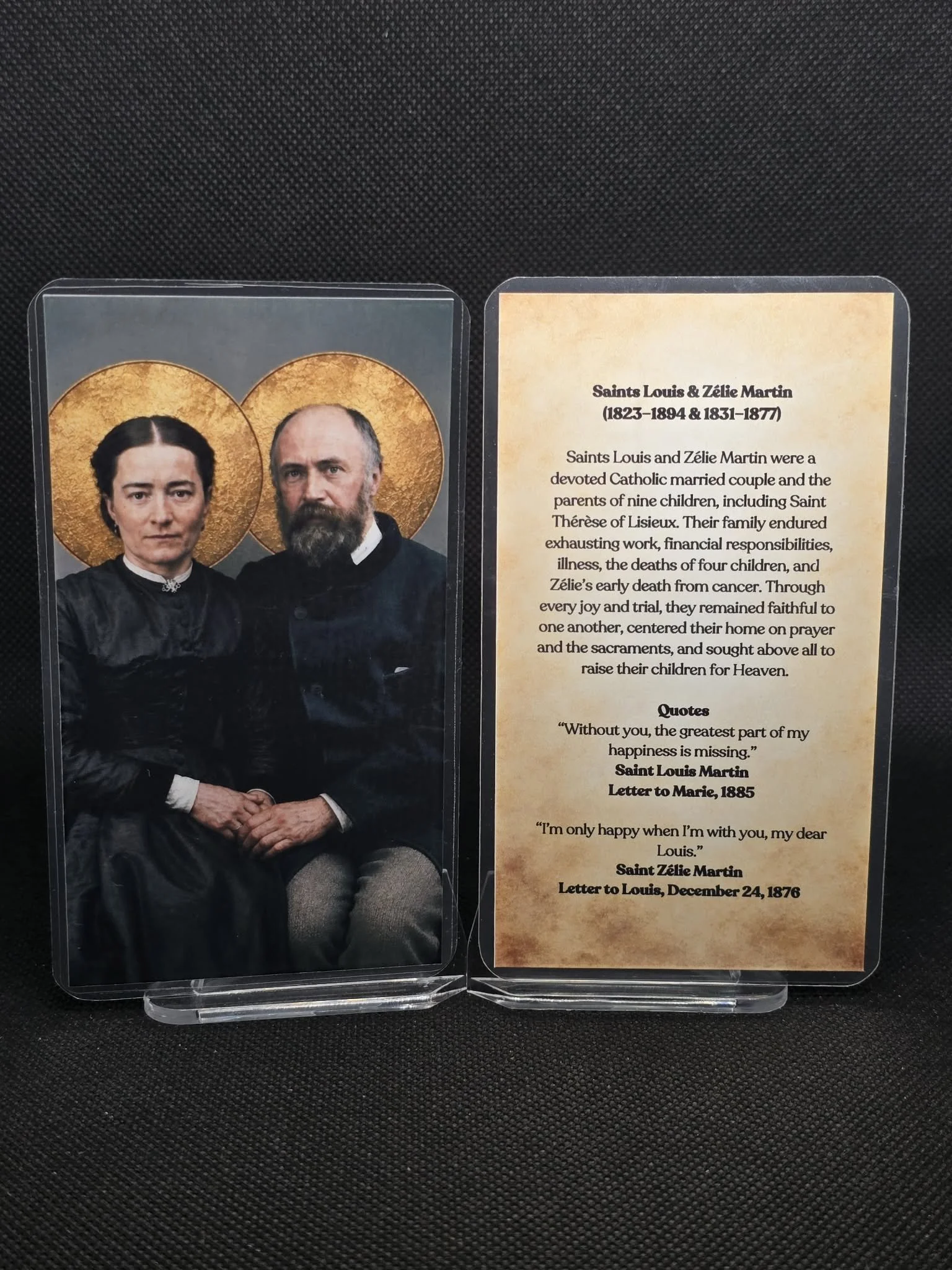
Saint Louis and Saint Zélie Martin are among the most relatable saints in Christian history.
They are venerated in the Roman Catholic Church and deeply honored by Eastern Catholics as living proof that holiness can grow inside ordinary homes, exhausting schedules, financial stress, and the relentless demands of raising children. Their feast day is celebrated on July 12.
People pray to Louis and Zélie when marriage feels strained by daily pressure.
When parenting feels overwhelming.
When grief follows the loss of a child.
When work and family collide.
When faith feels hard to pass on in a noisy world.
They were not monks.
They were not mystics living apart from society.
They were a married couple running businesses, managing a household, burying children, navigating illness, and trying to love each other well in the middle of it all.
Louis wanted to become a monk.
Zélie wanted to become a nun.
Instead, God joined them together.
Their vocation became marriage.
Their monastery became their home.
They built a life marked by prayer, hard work, tenderness, and perseverance. They lost four children in infancy. They carried grief quietly. They kept showing up for each other. They raised five daughters who entered religious life, including Saint Thérèse of Lisieux.
Today, Saints Louis and Zélie are prayed to by exhausted parents, overwhelmed spouses, grieving families, and couples longing to raise children who love God. They are especially sought by those navigating marital stress, emotional burnout, financial pressure, and the deep responsibility of spiritual parenting.
This prayer card honors their faithful ordinary love and their witness that sanctity grows slowly, one day at a time.
Each card is handmade in Austin and created to order. We do not keep stock, because every prayer card is treated as a unique devotional offering. They are printed on museum-quality photo paper, not cardstock, and each one is made during prayer. The saints are venerated throughout the entire process, and prayers are intentionally offered for the person who will receive the card. These are not mass-produced items. They are created slowly, reverently, and with spiritual intention, because every soul and every prayer matters.
Tradition: Roman Catholic | Feast day: July 12 (Louis and Zélie, often celebrated together)
Why They Are Invoked
Saints Louis and Zélie Martin are the first married couple canonized together. Their holiness is practical: a home where faith was normal, love was real, and suffering was carried with trust.
Both initially desired religious life, but they married and grew into a tender and disciplined union. They welcomed many children and also carried deep sorrow through the deaths of children in infancy. Zélie later suffered serious illness, and Louis endured the pain of loss with faith.
They are invoked by couples seeking a Christ-centered home, openness to life, and endurance through illness and grief.
Many couples turn to them for:
A model for married love ordered toward holiness
Parenting and faith formation in the home
Trust during sickness, grief, and financial strain
Prayer
A prayer couples can use: Saints Louis and Zélie, teach us to live our marriage with joy and virtue. Help us trust God in trials and love one another with steadiness. Pray for our children and for the holiness of our home. Amen.
Intercession and Devotion
Their cause includes medically inexplicable healings attributed to their intercession, including the recovery of a seriously ill infant after a novena. Many families ask for their prayers during pregnancy complications, childhood illness, and seasons of grief.
Their story also helps couples resist an illusion: that a holy home is a painless home. Their home was holy because it kept returning to God.
Practical Takeaway
If you want to imitate them, make faith normal: a short prayer before meals, a saint story once per week, and a habit of speaking gratitude out loud to your spouse.
Putting the Saints Into Practice
These saints prove something simple: a happy marriage is not a painless marriage. It is a holy marriage. Their joy was not the absence of suffering. It was the presence of God inside suffering.
Five practical ways to turn their example into daily habits:
Cultivate shared prayer as a normal rhythm: one short prayer daily, and one longer prayer weekly.
Persevere in trials without letting trials define you: choose forgiveness, boundaries, and repentance when needed.
Practice hospitality and charity together so the marriage does not collapse inward.
Support each other’s vocation and spiritual growth using language of "us" rather than "you."
Trust God’s providence with open hands in infertility, illness, finances, and uncertainty.
Frequently Asked Questions
Who is the patron saint of marriage?
There is no single official patron saint of marriage, but several saints are widely invoked. Many Catholics pray with Saint Rita for hard seasons and Saint Monica for conversion. Many Orthodox Christians pray with Saints Peter and Febronia for unity and harmony. Many couples simply choose the saint whose story most closely matches their current need.
What saint helps with a struggling marriage?
Saint Rita of Cascia is one of the most invoked saints for troubled marriages and seemingly impossible situations. Saints Adrian and Natalia are also invoked when a marriage needs courage, perseverance, and spiritual reinforcement.
What saint helps convert a husband or wife?
Saint Monica is the most widely invoked saint for the conversion of a spouse and children. Many also pray with Saint Nonna, whose prayer and example helped bring her husband to Christ.
What saint helps with infertility for married couples?
Saints Joachim and Anne are frequently invoked by couples struggling to conceive and by families longing for children. Their story is a classic example of hope sustained through delay.
Can Orthodox Christians pray to Catholic saints, and vice versa?
Saints of the undivided Church, before 1054, are shared by both traditions. Many believers also privately ask intercession across traditions, while keeping their prayer directed to God. When in doubt, begin with the pre-schism saints honored by both East and West.
What does pre-schism universal church mean?
It refers to saints who lived before the formal division between East and West in 1054. These saints belong to the shared Christian inheritance and are venerated across traditions.
What is a novena and how do I do it?
A novena is nine days of prayer for a specific intention. Choose a saint, pray a short daily prayer for nine days, state your intention clearly, and finish with a familiar prayer such as the Lord’s Prayer. Consistency matters more than length.
How do I ask a saint for intercession correctly?
Speak plainly. Address the saint, name your need, ask them to pray to God for you, and end with trust in God’s will. Saints do not replace God. They join you in prayer.
What if my spouse refuses to pray with me?
Start alone and keep it steady. Avoid pressure or arguments. Pray daily, offer small sacrifices, and focus on loving well. Many spiritual changes begin with one faithful spouse.
What prayers can we say together as a couple?
Keep it simple: a short daily prayer for unity, a shared blessing over each other, or one saint intercession prayer together. A sustainable prayer habit beats an intense plan that you abandon.
Do saints actually help marriages, or is it symbolic?
Christians believe saints intercede by praying with us and for us before God. Many couples report real changes after sustained prayer: softened hearts, restored peace, and renewed commitment. Outcomes remain in God’s hands, but devotion to saints is a longstanding Christian practice.
How long should I pray to a saint before expecting change?
There is no fixed timeline. Some intentions shift quickly, others take months or years. Saint Monica’s story reminds couples that persistence matters and that prayer is not wasted even when answers are delayed.
Can I pray to more than one saint for my marriage?
Yes. Many couples ask several saints for different needs: conversion, unity, fertility, peace, or courage. The saints are not in competition. They all point to Christ.
What if both spouses are hurting spiritually?
Start with something small together: one minute of prayer before sleep, one Our Father per day, or lighting a candle and naming one intention. Small shared habits rebuild spiritual unity.
Is there a saint specifically for communication problems in marriage?
There is no official patron saint of communication, but Saint Rita is often invoked for peace and reconciliation, and Saints Peter and Febronia are invoked for unity of mind and heart. Their lives emphasize humility and patience, which are the foundations of good communication.
What saint should we pray to before getting married?
Engaged couples often pray with Saints Louis and Zélie for a Christ-centered home, Saints Peter and Febronia for fidelity and unity, and Saints Joachim and Anne for stability and openness to life.
Can saints help after divorce or separation?
Yes. Many people pray to Saint Rita and Saint Monica for healing, forgiveness, peace, and protection of children after separation or divorce. Healing is still holy, even when reconciliation is not possible.
Is it okay to ask saints for very specific marriage requests?
Yes. Ask clearly and humbly: reconciliation, peace, healing, fertility, protection of children, or courage in hard decisions. Hold your request with trust in God’s wisdom.
How can we make saints part of our daily married life?
Keep a prayer card near your bed, choose one saint to pray with for nine days, read one saint story per week, and ask your chosen saint to bless your home. Small habits create spiritual rhythm.
What if I don’t feel anything when I pray?
That is normal. Prayer is not measured by emotion but by faithfulness. Many saints prayed through dryness. Keep showing up, and let prayer shape your heart over time.
Offer a Dedication
If this page was meaningful to you, you’re welcome to dedicate this or any educational page in memory of a loved one, for a prayer intention, or in gratitude for blessings received.
Each dedication quietly supports the continued sharing of Eastern Christian history, prayer, and the lives of the saints.