Saints Alexander Peresvet and Andrei Oslyabya: The Complete Guide — Russia's Warrior-Monks
Russian Orthodox • Great Schema Monks • Martyred September 8, 1380 • Battle of Kulikovo, Don River, Russia • Feast: September 7 / 20 • Canonized: Russian Orthodox Church
Saints Alexander Peresvet & Andrei Oslyabya: The Complete Guide — The Great Schema Warrior-Monks Who Rode Into the Battle of Kulikovo, the Legendary Duel with Chelubey, and the Paradox That Made Them Saints
They had renounced the world completely. They wore the highest vows of Orthodox monasticism — the Great Schema — a garment that symbolized total death to earthly life. Then Saint Sergius of Radonezh gave them the cross of Christ sewn onto their schema in place of armor, and sent them into the most important battle in Russian history. This is the complete story of the two warrior-monks of Kulikovo: who they were, what they did, what the sources say, why it still matters, and what the Church made of it when she called them saints.
Saints Peresvet & Oslyabya — At a Glance
- Full Names
- Venerable Alexander (Peresvet) • Venerable Andrei (Oslyabya, also Rodion)
- Died
- September 8, 1380 • Battle of Kulikovo • Near the Don River, Russia
- Origin
- Peresvet: Bryansk boyar family • Oslyabya: Moscow nobleman • Both former warriors before monasticism
- Monastic Home
- Trinity Lavra of Saint Sergius (Trinity Monastery) • Disciples of Saint Sergius of Radonezh
- Monastic Rank
- Great Schema (Megaloscheme) — the highest rank of Orthodox monasticism
- Sent By
- Saint Sergius of Radonezh • At the request of Prince Dmitry Donskoy of Moscow
- The Battle
- Battle of Kulikovo • Russian forces vs. Golden Horde under Mamai • September 8, 1380
- Peresvet’s Role
- Opening single combat against Tatar champion Chelubey (Temir-Murza) • Both died
- Oslyabya’s Role
- Fought in the main battle • Also died • His son Yakov also fought
- The Blessing
- Sergius gave them “the cross of Christ sewn onto the schema, in place of gilded helmets”
- Buried
- Church of the Nativity of the Virgin, Old Simonov Monastery, Moscow
- Canonized
- Russian Orthodox Church • Churchwide veneration decreed by Council of Bishops
- Title
- “Venerable” (Prepodobny) — the title for monk-saints
- Feast Day
- September 7 / 20 (Primary) • Also: All Saints of Russia, Synaxis of Saints of Bryansk, Moscow, Tula, Radonezh
- Primary Sources
- Zadonshchina (late 14th c.) • Tale of the Mamay Massacre (15th c.) • Chronicles of Trinity Monastery
- Patron Of
- Warriors • Those facing impossible odds • Spiritual courage • Defenders of the faith
Who Were They? Two Men the World Would Never Have Expected to Become Icons of Russia
In the summer of 1380, two monks living at the Trinity Monastery near Moscow were summoned to the cell of their abbot, Saint Sergius of Radonezh. The abbot gave them a blessing that would change Russian history. He took the cross of Christ — the distinctive emblem of the Great Schema, the most demanding form of Orthodox monasticism — sewn it onto their monastic vestments, and told them to wear it in place of gilded helmets. Then he sent them to war.
Alexander Peresvet and Andrei Oslyabya were not soldiers. They had been soldiers — Peresvet a boyar warrior from Bryansk, Oslyabya a Moscow nobleman — but they had renounced all of that. They had taken the Great Schema, the monastic vow that the Orthodox tradition calls the image of death to the world, the vow in which a monk symbolically dies to everything earthly and lives only for God. The Great Schema monk is supposed to be invisible to the world. He is supposed to be beyond the world. He wears a garment covered in crosses that represents his total crucifixion with Christ. He is, by definition, someone who has stopped fighting anything except the passions of his own soul.
And yet Sergius of Radonezh — the most spiritually authoritative figure in fourteenth-century Russia, a man who had himself renounced the world so completely that the forest animals ate from his hand — sent two of his most devoted schema-monks into the most important military engagement of the century. The paradox is not incidental to the story. The paradox is the story. And it is the reason why Peresvet and Oslyabya became, across six centuries of Russian Orthodox memory, not merely historical figures but saints: icons of a particular kind of holiness that only appears at the intersection of total consecration and total sacrifice.
This article is the most complete account of their lives, their deaths, their place in history, and their meaning in the Orthodox tradition that is available in the English language. By the end of it you will understand not only what happened at Kulikovo Field on September 8, 1380, but why the Russian Church chose to call these two warrior-monks saints, why the story has only grown in power over six centuries, and why, even today, the image of two black-robed monks on white horses carrying the cross of Christ into battle speaks to something deep in the Christian experience of sacrifice, courage, and the love that lays down its life for others.
Part II
Alexander Peresvet: The Bryansk Warrior Who Became a Schema-Monk
The details of Alexander Peresvet’s early life are preserved primarily through later chronicle tradition, which means they carry the weight of sustained historical memory but not the precision of contemporary documentation. What the tradition consistently says is this: Peresvet was a man of noble warrior origin from the Bryansk region of Russia. He was a boyar — a member of the military aristocracy — and he was known for physical strength and martial skill. He had lived the life of a warrior before he entered monastic life. This background is essential to understanding why Sergius chose him: Peresvet already knew how to fight. His monasticism had not erased that knowledge; it had transformed the context in which it would be used.
At some point before 1380, Peresvet renounced his warrior life and took monastic vows, receiving the name Alexander. The specific monastery where he was first tonsured is debated in the historical record: some traditions link him to the Rostov Monastery of Saints Boris and Gleb; others connect him directly to the Trinity Monastery of Sergius of Radonezh. What is clear is that by 1380 he was at the Trinity Monastery, living as a disciple of Saint Sergius, and that he had advanced to the Great Schema — the highest rank of Orthodox monasticism.
The Great Schema is not given easily. It represents a second renunciation beyond the ordinary monastic vows — a deeper stripping away of everything that was not already stripped away in the first monastic profession. That Peresvet had attained it tells us something about the quality of his interior life: this was not a nominal monk, not a man who had entered a monastery for social reasons or as a retreat from the dangers of the warrior class. He had pressed on to the furthest point the Orthodox monastic tradition offers. He was, in the language of the tradition, living the “angelic life.” And then he was called back to the life he had left — not to live it, but to die in it, for a reason larger than either life or death.
Part III
Andrei Oslyabya: The Moscow Nobleman at the Heart of the Battle
Andrei Oslyabya — his secular name was Rodion; his monastic name was Andrei — was a Moscow nobleman and monk at Old Simonov Monastery, one of the important monastic communities founded in the orbit of Sergius’s influence. Like Peresvet, he was a man of warrior origin who had entered the monastic life. The Zadonshchina, the earliest literary account of the battle, refers to him as the “brother” of Peresvet — likely meaning not a blood brother but a brother in the monastic life, a fellow monk from the same community.
One of the most poignant details the sources provide about Oslyabya is that his son Yakov also fought at Kulikovo. The Zadonshchina records Andrei foreseeing Peresvet’s death and his own son’s death before the battle begins — a prophetic motif that the literary tradition uses to deepen the sacrificial meaning of what Oslyabya was offering. He was not simply offering his own life. He was entering a battle knowing that his son, too, was going to die. The grief that attaches itself to that knowledge is not incidental; it is the human texture of the sacrifice the tradition asks us to contemplate.
There is a scholarly question about Oslyabya’s status at the time of the battle. Some historians have noted that the monastic status attributed to him in later sources — particularly the schema-monk rank — may have developed in the hagiographic tradition as a way of making his story parallel to Peresvet’s and fitting him into the same spiritual framework. The earliest sources describe both men in warrior terms alongside their monastic identity; the later and more developed tradition emphasizes the monastic dimension. Whether or not Oslyabya was technically a schema-monk at the moment he rode into battle, the Church’s judgment is clear: he lived and died as a holy man whose sacrifice was pleasing to God, and that is the judgment that counts for canonization.

Part IV
The Great Schema: What It Is and Why It Makes This Story So Extraordinary
To understand why the story of Peresvet and Oslyabya is theologically extraordinary, you need to understand what the Great Schema is. It is not simply the highest rank of a religious institution, the way a general outranks a colonel. It is, in the Orthodox theological tradition, the most radical possible participation in the death and resurrection of Christ available to a human being still living in the body.
The Three Stages of Orthodox Monastic Life
Orthodox monasticism has three stages. The first is the novitiate — a period of testing and preparation in which a person discerns their monastic vocation and begins learning the monastic way of life, wearing a simple robe and receiving a cross-shaped garment called the paramand. The second stage is the Small Schema (Mikroscheme, sometimes called the Little Habit), in which the person takes the full formal monastic vows of poverty, chastity, obedience, and stability, receives a new name, and begins wearing the fuller monastic habit. The vast majority of Orthodox monks and nuns live their entire monastic lives at this second stage.
The third stage is the Great Schema (Megaloscheme, the Great Habit or the Great Angelic Habit). It is described in the Orthodox tradition with extraordinary seriousness. It requires a second tonsure ceremony — essentially a second monastic profession — in which the monk or nun again receives a new name, takes additional vows, and assumes distinctive vestments that mark them out even from other monastics. According to Archpriest G.S. Debolsky, quoted in the Orthodox theological tradition: “In the understanding of the Church, the Great Schema is nothing less than the supreme vow of the Cross and death; it is the image of complete isolation from the earth, the image of transformation and transfiguration of life, the image of death and the beginning of another, higher, existence.”
The Analavos and the Polystavrion
The distinctive vestment of the Great Schema is the analavos (from the Greek “to take up”, as in “take up your cross”). It is a cross-shaped garment worn over the chest and back, covered in small crosses — the polystavrion (literally “many crosses”) — and adorned with other symbols of the Passion of Christ: the spear, the sponge, the cock that crowed at Peter’s denial, the ladder. The schema-monk wears this garment as a constant reminder that he is crucified with Christ (Galatians 2:20) and that his life is no longer his own.
The koukoulion — the pointed hood worn by schema-monks — is similarly covered in crosses. Everywhere the schema-monk looks, if he looks at himself, he sees the cross. He is visually, symbolically, and by vow someone who has died. The world has no more claim on him. He belongs entirely to the next life.
Why This Makes Peresvet and Oslyabya Unique
Now consider: Saint Sergius of Radonezh took these two men — men who had taken the vow of total death to the world, who wore the cross of the Passion sewn onto their bodies, who had pressed on to the furthest point of monastic renunciation — and sent them into battle. He did not take the crosses off their vestments and replace them with armor. According to the tradition, he did the exact opposite: he took the cross of the schema and said, in effect, this is your armor. Wear the death-vow into the battle. Carry the crucifixion into the war.
There is no other recorded case in Orthodox history of Great Schema monks being sent into battle by their abbot. This is not a tradition; it is an exception so singular that it became legendary. The Orthodox canonical tradition is clear that clergy and monks should not shed blood; the schema-monk is further removed from worldly violence than any other Christian. That Sergius sent them is not a casual act. It was a prophetic act, a theological act, a sign-act of the kind that the prophets of Israel performed when they acted out their messages rather than merely speaking them. Peresvet and Oslyabya were not just soldiers who happened to be monks. They were a message, embodied and delivered in blood, about what Russia was defending and what kind of kingdom it was fighting for.
Part V
Saint Sergius of Radonezh: The Abbot Who Changed Russian History
No figure in Russian Orthodox Christianity — with the possible exception of Seraphim of Sarov in a later era — occupies a place of spiritual authority comparable to Saint Sergius of Radonezh (1314–1392). He is not simply a revered saint; he is the spiritual father of Russian monasticism, the founder of the most important monastery in Russian history, and the man whose blessing is credited with making the Battle of Kulikovo possible. Understanding Sergius is essential to understanding why the sending of Peresvet and Oslyabya carried the weight it did.
Who Sergius Was
Born Bartholomew to a boyar family near Rostov, Sergius entered the forest with his brother Stefan as a young man and founded what would become the Trinity Lavra of Saint Sergius — the most venerated monastic house in Russia, now located in Sergiyev Posad, northeast of Moscow, and recognized by UNESCO as a World Heritage Site. He lived as a hermit before other monks came to him; he founded more than 40 monasteries through his disciples; and he exerted the greatest spiritual influence of any individual on the development of Russian Orthodoxy in the medieval period.
The historian Serge Zenkovsky described Sergius, along with Epiphanius the Wise, Stephen of Perm, and the painter Andrei Rublev, as representing “the Russian spiritual and cultural revival of the late fourteenth and early fifteenth century.” This is the company in which Sergius belongs — not merely a religious leader but a civilizational figure, the monk whose spiritual renewal gave Russia the interior resources it needed to resist the Mongol yoke.
Sergius and the Political World
Sergius was not, by temperament or by vocation, a political figure. He was an ascetic who had renounced the world, and he was deeply reluctant to involve himself in political affairs. He refused when the Byzantine Patriarch offered him the metropolitanate. He refused when the Patriarch offered him the highest office of the Russian Church. He consistently returned from whatever level of public engagement was demanded of him to the forest, to the life of prayer and labor that was his vocation.
And yet he blessed Dmitry Donskoy before Kulikovo. He did so not casually, and not without the theological conditions that his conscience required. According to the account in his Life, Sergius demanded that Dmitry exhaust every peaceful means of resolving the conflict before resorting to battle. Only when Dmitry had done this did Sergius give his blessing. This detail matters: Sergius was not a war-monk, not a crusader-bishop who blessed armies as a matter of course. His blessing of Kulikovo was a singular and carefully considered act, not a habit.
Why He Sent the Monks
The question of why Sergius sent Peresvet and Oslyabya into battle — rather than simply blessing the army and praying from the monastery — is one that the tradition has always understood in spiritual rather than military terms. The iconographic tradition says Sergius told them: “Peace be with you, my brothers, fight hard, like good warriors, for the faith of Christ and for all Orthodox Christianity.” The calling of the monk-fighters, as the tradition at the Iconography of Saints website notes, “had primarily a spiritual significance.” They were not being sent because the Russian army needed two more soldiers. They were being sent because Russia needed two witnesses — two men whose lives and deaths would testify that what was at stake at Kulikovo was not merely territory or political power but the faith of Christ and the survival of Orthodox Christian civilization on the eastern edge of Europe.

Part VI
Russia Under the Mongol Yoke: The World in Which They Lived and Died
To understand what the Battle of Kulikovo meant, and why Sergius considered it worth sending his two most devoted schema-monks into it, you need to understand what Russia had been living with for 150 years before 1380. The Mongol invasion of Russia in the 1230s was one of the most catastrophic events in Russian history. The cities of Kiev, Vladimir, Ryazan, and dozens of others were burned to the ground. The population was decimated — historians estimate that a significant portion of the Kievan Rus’ population was killed or enslaved in the initial invasion. And what remained was subjected to a system of tribute and political subordination that lasted for generations.
The Nature of Tatar Rule
The Golden Horde, the western portion of the Mongol Empire that controlled Russia, did not occupy Russian territory directly in most places. Instead, it extracted tribute from Russian princes who were required to travel to the Horde’s capital and receive their authority (their “patent to rule”) from the Khan. Any prince who refused to pay tribute or who acted without the Khan’s authorization was subject to devastating military punishments — raids that burned cities, enslaved populations, and left nothing behind.
The spiritual effect of this system on Russian Orthodox Christianity was profound. The Church survived — the Mongols were initially tolerant of religious practices, and later some of the Horde’s leadership converted to Islam rather than persecuting Christianity — but it survived under the shadow of foreign domination, humiliation, and the constant awareness that the civilization it was sustaining was subject to a power that could destroy it at will. The saints of the Mongol period in Russia are often saints of endurance: people who held the faith together under pressure rather than people who performed dramatic acts of resistance.
The Moment of 1380
By 1380, the Golden Horde had begun to fracture internally. Mamai — the commander who led the Tatar forces at Kulikovo — was not actually the Khan of the Golden Horde; he was a powerful military commander who was contending for control of the Horde against a rival claimant. His alliance with Lithuanian and Genoese forces (who provided mercenary soldiers) was an attempt to consolidate power through a dramatic military victory over the increasingly assertive Moscow principality. Prince Dmitry had already inflicted a defeat on a Tatar force at the Battle of the Vozha River in 1378 — the first significant Russian military success against the Horde in the period of Tatar domination — and this had made a confrontation inevitable.
The Kulikovo campaign was therefore not a spontaneous act of rebellion but a carefully considered military and political decision. Dmitry had made alliances, gathered forces from multiple Russian principalities, and prepared as thoroughly as the resources of medieval Russia allowed. And he had gone to Sergius of Radonezh for the spiritual resource that military preparation alone could not provide: the blessing of the man who, in the spiritual economy of Russia, stood closest to God. When Sergius sent Peresvet and Oslyabya with the army, he was not merely providing two fighters. He was saying, with his own spiritual authority: this battle has God’s sanction. These monks carry my blessing and God’s cross into it. What happens here is not merely politics; it is Providence.
Part VII
Prince Dmitry Donskoy: The Ruler Who Sought a Monk’s Blessing
Dmitry Ivanovich, Grand Prince of Moscow (1350–1389), received the epithet “Donskoy” — meaning “of the Don River” — specifically because of the victory at Kulikovo, which was fought near the confluence of the Nepryadva and Don rivers. He was canonized as a saint by the Russian Orthodox Church in 1988, in the millennial year of Russian Christianity. His feast day is May 19.
What the tradition records most consistently about Dmitry is not his military genius — though the Kulikovo campaign showed considerable strategic capability — but his spiritual seriousness. He went to Sergius not as a formality but as a genuine act of seeking divine sanction and spiritual guidance. According to the hagiographic account, Dmitry asked Sergius not only for a blessing but specifically for two warriors to reinforce him — a request that the tradition presents as remarkable precisely because he was asking a monk for monks, recognizing that what he most needed at Kulikovo was not additional soldiers but additional holiness.
The response he received — Sergius’s blessing, the prophecy of victory, and the two warrior-monks — became the foundation of Dmitry’s spiritual legitimacy as a ruler. He was not fighting merely as a prince defending territory. He was fighting as a Christian prince who had sought and received the blessing of Russia’s most holy man. The victory at Kulikovo was interpreted in Russian historical memory not primarily as Dmitry’s military achievement but as Sergius’s prophecy fulfilled and God’s grace dispensed through the sacrifice of two monks.
Part VIII
The Blessing at the Trinity Monastery: What Happened Before the Battle
The account of Dmitry Donskoy’s visit to Saint Sergius before the Battle of Kulikovo is one of the most celebrated scenes in Russian Christian history. According to the tradition, Dmitry arrived at the Trinity Monastery on August 18, 1380, with his princes and commanders, seeking the blessing of the holy elder before marching against Mamai. Sergius received him with honor and celebrated the Divine Liturgy for the army. After the Liturgy, the tradition records that Sergius spoke privately with Dmitry, offering spiritual counsel and prophetic assurance: he told the prince that he would be victorious, though the victory would come at great cost and Dmitry himself would be wounded.
Then came the moment that would define the spiritual character of the entire Kulikovo campaign. According to the iconographic and hagiographic tradition, Dmitry asked Sergius for two of his monks to accompany the army. Sergius called Peresvet and Oslyabya. He gave them his blessing — and in place of military armor, he gave them the cross of Christ: the cross embroidered on the schema, which was now to be worn as their protection in battle. “Peace be with you, my brothers,” the tradition records him saying, “fight hard, like good warriors, for the faith of Christ and for all Orthodox Christianity.”
The Icon of Saint Nicholas
Some versions of the tradition include an additional miraculous sign: that as the army camped on the eve of the battle, an icon of Saint Nicholas appeared miraculously in the air and descended into Dmitry’s hands. This element of the story belongs to the hagiographic tradition rather than to the historical core, but it is important for understanding how the Russian Church processed the Kulikovo victory: not as military success but as miraculous provision, divine intervention, the active presence of the saints in the defense of Orthodox Russia.
The Earliest Sources and the Growth of the Tradition
A note that honest scholarship requires: the more elaborate details of the blessing scene — Sergius sending the monks, the specific words he spoke, the prophecy of victory — are not all found in the earliest surviving version of the Life of Sergius. The Life written by Epiphanius the Wise around 1417–1418 does not include all the dramatic particulars that later versions of the story developed. The tradition grew; the story was elaborated over time in ways that made the spiritual significance of the battle increasingly explicit.
This does not mean the tradition is false. It means the tradition is doing what traditions do: drawing out the meaning that was implicit in the event from the beginning and making it explicit in narrative form. The monks were at Kulikovo; Peresvet died in the opening combat; Oslyabya died in the battle; they were buried with honor. The spiritual meaning of these facts was experienced by Russian Orthodox Christianity from the moment of the battle itself. The narratives that grew around the bare historical core were the Church’s way of articulating what she had always understood those facts to mean.
Part IX
Kulikovo Field: The Place Where Russia Was Born as a Nation
The Battle of Kulikovo was fought on September 8, 1380 — the feast of the Nativity of the Most Holy Theotokos in the Orthodox calendar. The date was not chosen by accident; it was the product of the campaign’s timeline and the necessity of engaging Mamai’s forces before they could be reinforced by Lithuanian allies. But the coincidence of the battle with the feast of the Mother of God was not lost on the Russian tradition: the army that Sergius’s monks joined was fighting on the day that honors the woman through whose birth God entered the world. The spiritual resonance was immediate and lasting.
Kulikovo Field is located in what is now Tula Oblast in Russia, near the confluence of the Nepryadva and Don rivers. The landscape in 1380 was open steppe surrounded by forest — terrain that shaped the battle considerably, as Dmitry positioned his forces to use the forest edges to protect his flanks and conceal a reserve force (the “ambush regiment”) that would ultimately decide the battle’s outcome.
The Forces
The forces on both sides were substantial. Russian chronicle tradition gives numbers that modern historians consider inflated, but the consensus is that the battle involved tens of thousands of combatants on each side, making it one of the largest military engagements of its era in Eastern Europe. Dmitry had gathered forces from multiple Russian principalities, though notably not from all of them — Ryazan and Tver did not send troops, and the Lithuanian forces that were supposed to reinforce Mamai arrived too late to participate. Mamai’s army included Tatar cavalry, Genoese mercenary infantry, and troops from various subject peoples of the Horde.
The historical significance of Kulikovo in Russian memory is comparable to the Battle of Patay for France, the Battle of Hastings for England, or the Battle of Gettysburg for the United States: a moment when everything that came before and after can be divided by a single day. Russian historian Lev Gumilev wrote that “Russians went to Kulikovo Field as citizens of various principalities and returned as a united Russian nation.” This is the weight that rested on the day when two schema-monks rode out in black robes to face the Tatar champion.
Part X
The Duel: Peresvet Against Chelubey — The Most Famous Single Combat in Russian History
The most celebrated moment in the entire Kulikovo tradition is the opening single combat between Alexander Peresvet and the Tatar champion known in Russian sources as Chelubey (also rendered as Temir-Murza or Temir-Mirza). This duel has become one of the iconic images of Russian history: reproduced in paintings, celebrated in literature, depicted on icons, and commemorated in countless works of art across six centuries. It is the image from which everything else in the Peresvet story radiates.
The Tatar Champion: Chelubey
Chelubey is described in the Russian tradition as a warrior of exceptional physical size and skill — a champion chosen specifically for his ability to intimidate and defeat any opponent in single combat. The tradition associates him with the name Temir-Murza, suggesting a specific individual of Tatar or related origin, though his historical identity is difficult to confirm independently. In the narrative function of the story, he represents the full power and terror of the Tatar military tradition: the adversary that no ordinary man should be able to face.
The choice of Peresvet as the Russian champion — a man in a black monastic robe, carrying a cross rather than conventional armor, riding out against a professional warrior — is the visual paradox at the center of the entire Kulikovo tradition. It is the paradox of Christian witness applied to battle: the weakest possible figure (by worldly standards) meeting the strongest, and the outcome being decided not by military prowess but by God’s will and the blessing of Sergius of Radonezh.
The Charge and the Mutual Death
Both the Zadonshchina and the Tale of the Mamay Massacre record that Peresvet and Chelubey charged each other on horseback with long lances. The physical details of medieval cavalry combat suggest what this meant: two men on horses, lances leveled, riding toward each other at full gallop, the impact of the collision measured in the force with which each man’s lance struck the other’s body. Both men were struck. Both were mortally wounded. They killed each other.
The divergence between the sources appears in what happened after the impact. The Tale of the Mamay Massacre, the more detailed and more hagiographic account, says that Chelubey fell from his horse immediately while Peresvet remained in the saddle — mortally wounded but upright, his dead body returning to the Russian lines before he fell. The Zadonshchina, the earlier and more poetically focused account, does not give this detail in the same way; it depicts Peresvet as still present for the beginning of the main battle, making a speech to inspire the troops. Some scholars argue the Zadonshchina version is closer to what actually happened; others maintain that Peresvet could have made a dying speech before falling.
The point on which all versions agree is the spiritual meaning: Peresvet’s willingness to accept death, to ride out in a monastic robe against the Horde’s champion, was an act of total self-offering that the Russian tradition understood as decisive for the battle that followed. He did not fight to win by surviving. He fought to witness, to consecrate the moment, to give his life as the opening sacrifice of the day. And the day was won.
Part XI
The Battle of Kulikovo: What Happened After the Duel
The opening duel between Peresvet and Chelubey was followed by the main battle, which unfolded over the course of several hours on the morning of September 8, 1380. The detailed tactical history of the battle is reconstructed primarily from the chronicle sources, which are not always consistent, but the broad outline is well established.
The Main Engagement
The Russian forces were organized into several regiments: a vanguard, a main force, left and right flank regiments, and — crucially — a concealed reserve regiment placed in the forest on the left flank. Dmitry himself, according to the tradition, exchanged armor with a young boyar named Mikhail Brenok to disguise his identity, giving his own standard and armor to Brenok so that the Tatars would concentrate their attack on the decoy. The tactic was successful in one grim way: Brenok, fighting under Dmitry’s banner and in Dmitry’s armor, was killed. Dmitry survived, badly wounded but alive, found later under a fallen tree at the edge of the forest.
The initial phase of the battle went badly for Russia. The Tatar cavalry pushed hard on the Russian left flank, threatening to turn the entire Russian line. The pressure was severe enough that some Russian units began to break. It appeared that the Tatar numbers and cavalry skill might carry the day despite the inspiration of Peresvet’s sacrifice.
The Ambush Regiment and the Turn
At a critical moment, the concealed Russian reserve regiment — the “ambush regiment” (zasadny polk) commanded by Prince Vladimir of Serpukhov and the boyar Dmitry Bobrok-Volynsky — emerged from the forest and struck the Tatar forces on their exposed flank. The effect was immediate and decisive. The Tatar cavalry, already committed deeply into the Russian line and unable to turn quickly enough to face the new threat, broke. Mamai’s army, which had seemed on the verge of victory, collapsed into rout. The Tatar force was pursued and destroyed in large numbers.
Mamai escaped but was fatally politically damaged. He fled to the Crimea, where he was soon murdered. The rival Khan Tokhtamysh, the legitimate claimant to the Golden Horde whom Mamai had been fighting, seized control of the Horde. Two years later, in 1382, Tokhtamysh would sack Moscow, demonstrating that the Kulikovo victory had not ended Russian subordination to the Horde. But the symbolic meaning of Kulikovo — that Russia could fight and defeat a major Tatar force in the open field — was irreversible. The spell of invincibility was broken. The possibility of eventual freedom had been demonstrated.
The Cost
Both sides suffered enormous casualties. The burial of the Russian dead took eight days. The field of Kulikovo was covered with the bodies of men who had traveled from every corner of Russia to fight for what Sergius had called “the faith of Christ and all Orthodox Christianity.” Among them were Alexander Peresvet and Andrei Oslyabya — the two monks whose sacrifice had opened the day and whose black-robed presence on the field had been the sign that something more than military history was happening at Kulikovo.

Part XII
Andrei Oslyabya in the Battle: The Second Warrior-Monk
The narrative tradition around Andrei Oslyabya is less dramatically concentrated than the tradition around Peresvet, precisely because Peresvet’s death in the opening duel gave him a single, iconic, narratively crystallized moment of martyrdom. Oslyabya’s death in the main battle was part of the mass sacrifice of Kulikovo rather than its opening act. This has meant that he is often treated as the secondary figure in the story — “Peresvet and Oslyabya” rather than “Oslyabya and Peresvet” — even though the Church’s veneration of both men is equal.
The Zadonshchina gives Oslyabya a moment of prophetic grief that is, in its own way, as powerful as Peresvet’s duel. The text records Andrei foreseeing the death of Peresvet and of his own son Yakov before the battle begins — and riding into the battle anyway. This is a different kind of courage than Peresvet’s: not the courage of the opening charge, the single dramatic moment of total commitment, but the courage of a man who knows exactly what is coming, who has had time to understand the full cost, and who chooses to pay it.
The detail about Oslyabya’s son Yakov fighting at Kulikovo is a small but humanly significant element of the story. Oslyabya was not only offering his monastic life — the life he had supposedly already surrendered to God — but whatever fatherly love and grief attached to the knowledge that his son would die beside him on the same field. Whatever his canonical status at the moment of the battle — full schema-monk or something more complex, as the scholarly debate suggests — the man who rode into Kulikovo knowing his son would die there and rode in anyway is a figure the Christian tradition knows how to recognize: someone whose love for God and country was greater than any loss, even the worst a father can face.
Part XIII
Their Deaths and Burial: How the Church Honored What They Did
The Russian forces buried their dead on Kulikovo Field for eight days after the battle. The scale of the losses was such that the burial itself was a weeks-long act of mourning and honor, and the Russian Orthodox Church legalized during this period the custom of remembrance of the dead on what became known as “Paternal Saturday” — the special commemoration of those who die in battle, established in direct response to the losses at Kulikovo.
The Return to Moscow
The bodies of Alexander Peresvet and Andrei Oslyabya were not left on the field. They were brought back to Moscow with honor — a recognition that these two men were not simply soldiers who had died in battle but holy men whose relics deserved veneration. The body of Peresvet was brought to the Church of the Nativity of the Virgin at Old Simonov Monastery (Stary Simonov), which had been founded only ten years before the battle in 1370. Oslyabya was buried beside him.
The Stone Church of 1509
For over a century after 1380, Peresvet and Oslyabya lay in the wooden church at Old Simonov. In 1509, the wooden church was replaced with a stone structure — a major act of architectural investment that reflected the deepening veneration of the warrior-monks. Their graves were “equipped in the most thorough way,” as the Russian account describes — honored with the care due to men whom the faithful had always recognized as holy, even before the formal canonization process gave official expression to what popular veneration had maintained for over a century.
The burial place of Peresvet and Oslyabya at Old Simonov Monastery in Moscow is accessible today as a pilgrimage site. The monastery survived the Soviet era with damage but has been restored, and the church where Russia’s warrior-monks lie is a place where the faithful still come to pray and ask for their intercession.
Part XIV
The Primary Sources: What History Actually Records
Any serious account of Saints Peresvet and Oslyabya must grapple honestly with the question of sources. This is not a matter of skepticism about their holiness or their significance; it is a matter of intellectual integrity about what we can know and how we know it. The story of the warrior-monks comes to us through two primary literary sources, each with its own character, limitations, and theological purposes.
The Two Primary Sources
The first and earlier source is the Zadonshchina — a title meaning “Beyond the Don” or “the region beyond the Don River.” It is attributed to Sofonii of Riazan and was composed in the late fourteenth century, making it roughly contemporary with the battle itself (though the earliest surviving manuscript copies are from the fifteenth century). The Zadonshchina is primarily a literary-poetic text, modeled consciously on the great twelfth-century Russian epic the Igor Tale, and it approaches the Kulikovo material through the conventions of epic literature rather than chronicle history. It mentions Peresvet and Oslyabya as participants in the battle and gives Oslyabya a prophetic lament before the fighting begins, but it does not present the duel as a distinct opening event in the dramatic way of the later source.
The second source is the Skazanie o Mamaevom Poboishche — the “Tale of the Mamay Massacre” or “Tale of the Battle against Mamai.” This text was compiled in the fifteenth century and is a much more elaborate, narrative account of the entire Kulikovo campaign. It includes the dramatic episode of Dmitry’s visit to Sergius, the blessing of the monks, the specific words Sergius spoke, and the detailed account of Peresvet’s opening duel with Chelubey ending in mutual death. This is the source from which most of the narrative detail in the popular tradition derives.
What the Sources Agree On
Both sources agree that Peresvet and Oslyabya participated in the Battle of Kulikovo, that they were associated with the monastic community connected to Sergius of Radonezh, and that Peresvet died in the battle. Both treat them as figures of honor whose participation had a significance beyond mere military contribution. The disagreements between the sources concern the specific details of how Peresvet died and the sequence of events at the battle’s opening.
The historical core that scholars treat as reliably established: two monks with warrior backgrounds, connected to the Trinity Monastery and to Sergius of Radonezh, fought at Kulikovo and died there. Their names, their monastic character, and their deaths on September 8, 1380 are part of the historical record that both sources confirm. Everything built on that foundation — the dramatic duel, the specific words of blessing, the schema vestments worn as armor — comes from the hagiographic elaboration of that core in the tradition that followed.
Part XV
The Zadonshchina: Russia’s Epic of Kulikovo
The Zadonshchina is one of the masterworks of medieval Russian literature. Composed in the tradition of the famous Igor Tale of the twelfth century, it uses the conventions of epic poetry — repeated formulae, nature imagery, direct address to the fallen, apostrophe to the land of Russia — to transform the Battle of Kulikovo from a historical event into a national myth. It exists in two manuscript redactions: a shorter version preserved in a single manuscript from the Kirillo-Belozersky Monastery, copied by the monk Efrosin, and a longer version preserved in multiple later manuscripts.
The treatment of Peresvet and Oslyabya in the Zadonshchina is significant for what it includes and for what it does not include. It presents them as monks who participated in the battle — that much is established — but it does not describe the opening single combat in the dramatic, ritualized form that the later Tale of the Mamay Massacre gives it. The Zadonshchina includes what may be the most poignant passage in the entire Kulikovo literary tradition: Andrei Oslyabya speaking before the battle, addressing his fellow warriors and foreseeing the deaths to come. The specific wording varies in translation, but the essence is a man who knows what is about to happen and is calling on his brothers to meet it with courage and faith. He sees his own death and his son’s death in what lies ahead — and he speaks anyway, and rides anyway.
The Zadonshchina also includes one of the most remarkable details of the Peresvet tradition: the description of Peresvet still present on the field after the opening engagement, addressing the troops with a speech of encouragement. Whether this represents a historical tradition that Peresvet survived the initial combat long enough to speak, or whether it is a literary convention placing words of inspiration in the mouth of the fallen hero, it gives Peresvet a voice in the battle that the more dramatic Tale of the Mamay Massacre, which has him die at the moment of the duel, does not preserve. In the Zadonshchina’s account, Peresvet’s last act before death is not a lance strike but a word of courage to his brothers. This, too, is a way of being a schema-monk in battle.
Part XVI
The Tale of the Mamay Massacre: The Full Hagiographic Account
If the Zadonshchina is Russia’s epic of Kulikovo — its literary and poetic monument to the battle — then the Tale of the Mamay Massacre (Skazanie o Mamaevom Poboishche) is its hagiographic monument: the account of the battle told in the mode of spiritual biography, where the theological meaning of every event is made explicit and every figure is placed in relation to God’s providence.
The Tale is a fifteenth-century text, compiled a generation after the Zadonshchina but drawing on oral tradition and earlier chronicle materials about the battle. It is considerably longer and more detailed than the Zadonshchina, and it is the source for most of the narrative elements that the popular Orthodox tradition uses when retelling the Kulikovo story.
The Blessing Scene
The Tale includes the full blessing scene at the Trinity Monastery — Dmitry’s visit to Sergius, the Divine Liturgy, the private prophecy of victory, and the sending of the monks. It records Sergius giving them the cross of Christ in place of armor, and his words of commission to them. The hagiographic purpose of this scene is to establish that everything that followed at Kulikovo was under God’s sanction, prophetically anticipated, and spiritually sustained. The battle was not a human achievement; it was a divine gift, mediated through the holiness of Sergius and the sacrifice of his disciples.
The Duel in Detail
The Tale gives the most elaborate account of the opening duel. It identifies Peresvet by name as the Russian champion, identifies the Tatar champion as Chelubey (with the detail that he was a formidable warrior chosen specifically for this role), and describes the charge, the mutual strike, and the different outcomes: Chelubey falling immediately, Peresvet remaining in the saddle and returning to the Russian lines before dying. The theological point is made explicit: the fact that Peresvet stayed in the saddle even in death was a sign. It was the sign that Sergius’s blessing was real, that God’s hand was on the Russian cause, that the day belonged to the cross rather than to the steppe.
The Tale of the Mamay Massacre was one of the most widely copied and read texts in medieval Russian monasteries. It shaped Russian Orthodox consciousness of the Kulikovo battle more than any other single text. And because it shaped that consciousness, it shaped the tradition of veneration for Peresvet and Oslyabya — giving the Church, and the faithful, and eventually the canonization process itself, the narrative framework within which two monks who died in a battle could be understood as saints.

Part XVII
History vs. Hagiography: The Scholarly Questions and Why They Don’t Diminish the Saints
Modern scholarship on the Kulikovo tradition has raised legitimate questions about the relationship between the historical events of 1380 and the narrative tradition that developed around them over the following century and a half. These questions deserve to be addressed honestly, because honest engagement with them actually strengthens rather than undermines the theological significance of Peresvet and Oslyabya.
The Scholarly Concerns
Some scholars have noted that the most dramatic elements of the Peresvet and Oslyabya story — the detailed blessing scene, the specific words of Sergius, the dramatic opening duel, the schema vestments worn as armor — appear in their fullest form in the fifteenth and sixteenth-century texts rather than in the earlier sources. The Zadonshchina, composed close to the time of the battle, does not include all of these elements. This suggests that the narrative crystallized and was elaborated over time as Muscovite state ideology developed under rulers like Ivan III and Ivan IV, who had strong reasons to celebrate the Kulikovo victory as a founding moment of Russian national and Orthodox identity.
Some scholars have further suggested that Oslyabya’s monastic status may have been emphasized or exaggerated in later tradition to make his story parallel to Peresvet’s. The argument is that the literary and hagiographic tradition shaped how the historical figures were remembered, adding spiritual meaning to a historical core that was already significant but that the tradition wanted to make theologically explicit.
Why This Does Not Diminish the Saints
The scholarly observations are correct as far as they go. But they do not go as far as skeptics sometimes claim. The historical core — two monks with warrior backgrounds, associated with Sergius’s Trinity Monastery, fought at Kulikovo and died there — is not in dispute. The tradition did not invent Peresvet and Oslyabya; it found in them, over time, the full depth of what they had actually done and what it actually meant.
The Church’s canonization process does not require that every hagiographic detail be historically verifiable. It requires that the life of the person shows holiness, that there are spiritual fruits of their veneration (conversions, healings, graces), and that the theological content of their story is consistent with the faith. On all three counts, Peresvet and Oslyabya qualify entirely. Two men who gave their lives at the most critical moment of Russian Christian history, blessed by the most spiritually authoritative figure of their era, in defense of the faith of Christ: the Church looked at this and said, correctly, that is what holiness looks like under those conditions. The legend that grew around them is the tradition’s recognition of a holiness that was always there, expressed in forms that each generation could receive.
Part XVIII
The Theological Meaning: What These Two Monks Teach the Church
The story of Peresvet and Oslyabya is not simply a story about two brave men. It is a theological statement about the nature of Christian holiness and the relationship between contemplative renunciation and engaged sacrifice. It addresses one of the deepest questions in the Christian spiritual tradition: can someone who has given everything to God still have something left to give for the world?
The Schema-Monk and the World
The Great Schema is premised on total renunciation. The schema-monk has died to the world. He is, in the tradition’s language, invisible to the world — not in the sense that no one can see him, but in the sense that the world has no claim on him and he has no claim on the world. He has surrendered everything. He prays. He fasts. He lives in the permanent expectation of death and the permanent orientation toward the kingdom.
Into this life of total renunciation, Sergius of Radonezh introduced a paradox. He said, in effect: your death to the world has not freed you from love for the world. On the contrary, it has freed you to love the world in the only way that can ultimately help it — by offering your life for it without any of the calculations of self-preservation that attach to those who have not yet died to self. Peresvet and Oslyabya could ride into battle without the fear that paralyzes ordinary men because they had already died. The Great Schema had already taken everything from them. There was nothing left for death to take — except the breath, which they offered freely.
The Theology of Christian Courage
The tradition that developed around Peresvet’s duel with Chelubey makes a specific theological claim about the nature of courage. Chelubey was a professional warrior — someone who had dedicated his entire life to combat, who had every worldly advantage in the encounter, who rode out with the confidence of a man who had killed many others and expected to kill this one. Peresvet was a monk in a robe carrying a cross. The worldly calculus said there was only one possible outcome. Peresvet rode out anyway — not because he expected to win by worldly standards, but because the outcome was in God’s hands and he was only responsible for the offering.
This is the theology of Christian martyrdom applied to a battlefield context. The martyrs of the early Church did not go to the arena expecting to survive. They went knowing they would die, and they went anyway, because the act of witness — of standing before the world and saying, this is what I believe and I will not deny it even now — was the thing that needed to be done, regardless of the cost. Peresvet at Kulikovo is this same act in a military key: the witness of a man who has nothing to lose because he has already given everything, riding forward in the sign of the cross to say, before all Russia and before the entire Tatar force, that what Russia is defending here is the faith of Christ and not merely the survival of a political entity.
The Feast Day on the Nativity of the Theotokos
The theological resonance of the battle date — September 8, the feast of the Nativity of the Most Holy Theotokos — was not lost on the Russian Church. The Mother of God, whose birth the feast celebrates, is in the Orthodox tradition the supreme intercessor, the woman through whose “yes” to God the Word entered the world. The feast of her Nativity is a feast of holy beginnings, of the moment when the possibility of salvation became embodied in human history. That Russia’s warrior-monks died on that day, that the battle that changed Russian history was fought on the feast of her Nativity, was interpreted as a sign: she was present, she was interceding, and the victory at Kulikovo was a gift mediated through her protection.
Part XIX
Canonization: How the Church Officially Recognized What Russia Always Knew
The canonization of Saints Alexander Peresvet and Andrei Oslyabya followed the path that the Russian Orthodox tradition has walked in the cases of many of its saints: popular veneration existed long before formal canonization, and the canonical act of the Church was the official recognition of what the people of God had already known and practiced for generations.
The Long History of Popular Veneration
From the time of the battle itself, Peresvet and Oslyabya were honored as holy men. Their burial at Old Simonov Monastery was an act of special honor — their bodies were not left at Kulikovo with the mass of the fallen but were returned to Moscow specifically, which implies that those who made the decision understood these two men as figures whose relics deserved special care. The construction of the stone church at their burial site in 1509 was another act of institutional veneration, predating their formal canonization.
For centuries, the faithful venerated Peresvet and Oslyabya locally — at their burial site in Moscow and in the communities that maintained the Kulikovo memory. They were celebrated in the liturgical tradition of the Russian Church in the Synaxes of the Saints of Bryansk, Moscow, Tula, and Radonezh — regional commemorations that kept their memory alive even before the formal Churchwide canonization.
The Churchwide Canonization
The Russian Orthodox Council of Bishops formally decreed the Churchwide veneration of both Venerable Alexander Peresvet and Venerable Andrei Oslyabya, blessing their inclusion in the full ROC calendar as universal saints rather than merely locally venerated ones. This decree elevated their status from local to universal: they were no longer merely the saints of Moscow or of the Kulikovo tradition but saints of the whole Russian Orthodox Church, to be commemorated by every Orthodox Christian who follows the Russian tradition wherever in the world they live.
The title given to both men is “Venerable” (Prepodobny in Russian) — the title the Orthodox tradition gives to monk-saints who attained holiness through the monastic life. This is theologically precise and significant: they are not “Holy Martyrs” in the technical canonical sense (reserved for those who died specifically for refusing to deny the faith under persecution) but “Venerable” monks who died for the faith in a different mode. Their title honors their monastic identity as the foundation of their holiness, even as their death in battle gives that holiness its distinctive character.
Part XX
How Saints Peresvet and Oslyabya Are Venerated Today
Saints Alexander Peresvet and Andrei Oslyabya are primarily venerated within the Russian Orthodox tradition — including the Russian Orthodox Church, the Russian Orthodox Church Outside Russia (ROCOR), and Orthodox communities with Russian heritage around the world. Their story is not as widely known outside the Russian tradition as it deserves to be, which is part of why this article exists: to make the full account of their lives and significance accessible to the broader English-speaking Orthodox and Eastern Christian world.
Feast Days and Calendar Commemorations
The primary feast day for both saints is September 7 (Old Style) / September 20 (New Style) — the day before the anniversary of the Battle of Kulikovo, which was fought on September 8. This places their commemoration in the liturgical context of the feast of the Nativity of the Most Holy Theotokos — precisely the day on which they died. The proximity of their feast to the feast of the Theotokos’s birth gives their commemoration a particular spiritual resonance: they are honored the day before the feast of the Mother of God under whose protection they fought.
They are also commemorated in multiple regional Synaxes: the Synaxis of Saints of Bryansk (September 20 / October 3), the Synaxis of Saints of Moscow (Week before September 8 / 21 Old Style), the Synaxis of Saints of Tula (September 22 / October 5), and the Synaxis of Saints of Radonezh (July 6 / July 19), reflecting their connections to multiple communities in the Russian Orthodox geographical memory. They are also included in the general feast of All Saints of Russia, celebrated on the Second Sunday after Pentecost.
The Burial Site in Moscow
The Church of the Nativity of the Virgin at Old Simonov Monastery in Moscow is the primary pilgrimage site for the veneration of Saints Peresvet and Oslyabya. The monastery was founded by Theodor, a nephew of Saint Sergius of Radonezh, in 1370 — just ten years before the Battle of Kulikovo — which makes the choice of burial site for the warrior-monks a further connection to the Sergianic spiritual world that had sent them to war. The church was damaged during the Soviet period, when the monastery complex was largely converted to industrial use, but has been restored and is accessible to pilgrims today.
Monuments, Paintings, and Cultural Memory
The visual legacy of Peresvet and Oslyabya in Russian culture is extensive and reaches far beyond the strictly religious tradition. The most famous modern depiction is Pavel Ryzhenko’s “Victory of Peresvet” (c. 2005, oil on canvas, 170x210 cm), a large historical painting that depicts the opening duel with Chelubey in realistic detail. Ryzhenko (1970–2014), who served in the Soviet and Russian military before studying at the Russian Academy of Painting, donated all his paintings to the Russian government before his death at 44. His Peresvet painting now hangs in a Russian state collection and is one of the most reproduced modern images of the battle.
There is also a monument to Peresvet and Oslyabya in Bryansk, the city associated with Peresvet’s origins, erected on Pokrovskaya Mountain with views over the city. The monument is a major landmark of Bryansk, accessible to the public year-round, and it commemorates both warrior-monks in sculptural form.
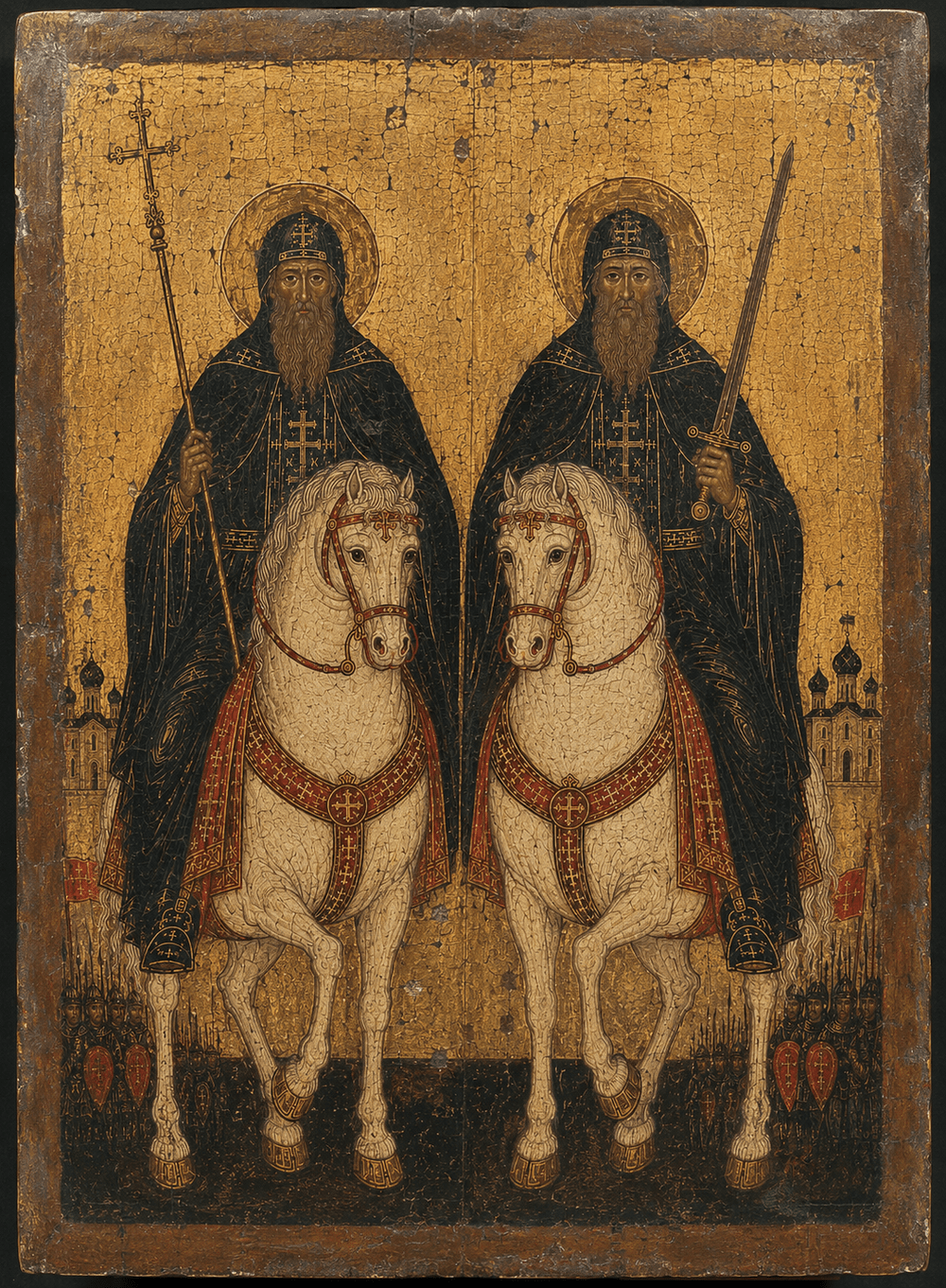
In the icon tradition, Peresvet and Oslyabya are depicted in a consistent and distinctive manner: both wearing black Great Schema robes, both mounted on white horses, holding weapons that function as sacred symbols (cross-topped lance and cross-hilted sword), with gold halos. The image always emphasizes their monastic identity over their military one: they are monks first, warriors second, and the schema vestments with their crosses are always visually prominent.
Part XXI
Their Legacy: Six Centuries of Memory in Russian Christianity and Culture
The names of Peresvet and Oslyabya have been woven into Russian culture for six centuries in ways that go far beyond the religious tradition. The name “Peresvet” has been given to Russian warships, fast trains, cities, and sports teams. It is a name that carries automatic associations with courage, sacrifice, and the willingness to face death for something larger than oneself. This secular cultural legacy is itself a testimony to the depth at which the story has penetrated Russian consciousness: even those with no active Orthodox faith recognize the name and the image.
Within the Orthodox tradition, the legacy is more precisely theological. Peresvet and Oslyabya are the primary examples in the Russian tradition of what might be called “the holiness of the necessary exception”: the situation in which the ordinary rules of the holy life are superseded by a divine call to sacrifice that the ordinary rules were never designed to anticipate. The Great Schema says: withdraw from the world. But there are moments when God himself calls the withdrawn back to the world, not to reenter its ordinary life but to stand at its most critical moment and offer the one thing the ordinary world cannot provide: a life already completely given to God, offered now for the world.
This is the legacy that makes Peresvet and Oslyabya permanently significant. It is not a legacy about war — Orthodoxy does not celebrate war, and the tradition is careful to honor these men as saints of sacrifice rather than as saints of violence. It is a legacy about total consecration and what total consecration looks like when it meets the moment of supreme need. Most of us will never face Chelubey across a battlefield. But most of us will face, at some point in our lives, the moment when what is required of us exceeds what we have, when the only resources available are the ones given to us by God, and when the question is simply whether we will ride forward in the sign of the cross or hold back for the sake of survival.
That is the question Peresvet answered on September 8, 1380. He rode forward. And six centuries later, the Church calls him a saint for it.
Part XXII
Complete Chronological Timeline: From Their Lives to Their Canonization
- c. 1314 — Saint Sergius of Radonezh BornBartholomew (later Sergius) born near Rostov. He will become the greatest monastic reformer in Russian history, found the Trinity Lavra, and become the spiritual father of the men who will ride into Kulikovo. His birth is the beginning of the chain of events that leads to 1380.
- Mid-14th Century — Peresvet and Oslyabya BornAlexander Peresvet born to a boyar family in the Bryansk region. Andrei Oslyabya born into Moscow nobility. Both men live as members of the warrior class before entering monastic life. The exact dates of their births are unknown.
- 1337 — Sergius Tonsured as a MonkBartholomew takes monastic vows and begins the ascetic life in the forest of Radonezh. He will attract disciples and found what becomes the most important monastery in Russian Orthodox history. His influence on Russian Christianity is beginning.
- Before 1380 — Peresvet and Oslyabya Enter Monastic LifeBoth men renounce their warrior pasts and take monastic vows. Peresvet is associated with the Rostov Monastery of Saints Boris and Gleb before moving to the Trinity Monastery; Oslyabya with Old Simonov Monastery. Both advance to the Great Schema at some point before 1380. The exact timing is not recorded in surviving sources.
- 1350 — Dmitry Ivanovich (Donskoy) BornThe prince who will seek Sergius’s blessing before Kulikovo is born. He will become Grand Prince of Moscow and the commander of the Russian forces at the battle.
- 1370 — Old Simonov Monastery FoundedTheodor, nephew of Saint Sergius, founds Old Simonov Monastery in Moscow. This is where Oslyabya is associated before the battle, and where both warrior-monks will be buried after it.
- 1378 — Battle of the Vozha RiverDmitry Donskoy defeats a Tatar force on the Vozha River — the first significant Russian military success against the Golden Horde in the period of Tatar domination. This makes a major confrontation with the Horde inevitable.
- Summer 1380 — Mamai Assembles His ForcesMamai, the Horde’s military commander, assembles a large army and prepares to march against Moscow, forming alliances with Lithuania and Genoese mercenaries. Dmitry Donskoy begins gathering forces from the Russian principalities in response.
- August 18, 1380 — Dmitry Visits Sergius at the Trinity MonasteryDmitry Donskoy arrives at the Trinity Monastery to seek the blessing of Saint Sergius before marching against Mamai. Sergius celebrates the Divine Liturgy for the army, gives Dmitry the blessing, prophesies victory, and — according to the hagiographic tradition — sends Peresvet and Oslyabya with the army with the cross of Christ in place of armor.
- September 8, 1380 — The Battle of KulikovoThe Russian forces and Mamai’s Tatar army meet on Kulikovo Field near the Don River. The battle opens with single combat between Alexander Peresvet and the Tatar champion Chelubey — both men are mortally wounded and both die. The main battle follows; the Russian reserve regiment’s decisive flanking attack turns the tide. The Tatar force is routed. Dmitry Donskoy, badly wounded, is found alive after the battle. Both Peresvet and Oslyabya die on the field. The dead are buried for eight days.
- After September 8, 1380 — The Bodies Returned to MoscowThe bodies of Peresvet and Oslyabya are brought back to Moscow with special honor and buried at the Church of the Nativity of the Virgin at Old Simonov Monastery, founded ten years before the battle.
- 1382 — Tokhtamysh Sacks MoscowTwo years after Kulikovo, the legitimate Khan of the Golden Horde, Tokhtamysh, sacks Moscow. Dmitry, whose forces were weakened by Kulikovo, cannot resist. Russia remains under Tatar suzerainty for another century — but the Kulikovo victory has permanently changed the terms of the relationship.
- 1392 — Saint Sergius of Radonezh DiesThe holy elder who sent Peresvet and Oslyabya to Kulikovo dies on September 25, 1392. His relics are found incorrupt in 1422 and placed in the Trinity Cathedral of the Lavra he founded. He is canonized as a saint by the Russian Orthodox Church (the precise year is uncertain, either 1452 or 1448).
- c. 1380s–1390s — The Zadonshchina ComposedThe Zadonshchina, the earliest literary account of the Battle of Kulikovo, is composed — attributed to Sofonii of Riazan. It includes references to Peresvet and Oslyabya as participants in the battle and preserves Oslyabya’s prophetic lament before the fighting.
- 15th Century — The Tale of the Mamay Massacre CompiledThe more elaborate hagiographic account of Kulikovo, including the full blessing scene, Sergius’s words, and the detailed account of Peresvet’s opening duel, is compiled. It becomes the primary source for the popular tradition and is widely copied in Russian monasteries.
- 1509 — Stone Church Built at SimonovThe original wooden church over the graves of Peresvet and Oslyabya at Old Simonov Monastery is replaced with a stone church. Their graves are specially honored. The faithful have been venerating them since 1380; the stone church is an institutional expression of that veneration.
- 2016 — Churchwide Canonization DecreedThe Russian Orthodox Council of Bishops decrees the Churchwide veneration of both Venerable Alexander Peresvet and Venerable Andrei Oslyabya, blessing their inclusion in the full ROC calendar as universal saints. They receive the title “Venerable” (Prepodobny), honoring their monastic identity as the foundation of their holiness.
- Today — Their Memory LivesSaints Peresvet and Oslyabya are commemorated annually on September 7/20, venerated at Old Simonov Monastery in Moscow, honored in the Synaxes of multiple Russian cities, and remembered in the prayer of every Orthodox Christian who carries their image and asks for the intercession of the men who rode into the most important battle in Russian history in the sign of the cross, armed with nothing but God’s blessing and the schema of their renunciation.
They rode into battle carrying the cross of Christ instead of armor. Honor their sacrifice with a prayer corner that remembers what they lived and died for: the faith of Christ and all Orthodox Christianity. The prayer card is the essential starting point; the icons below surround it with the theological world it came from.
Part XXIII
Prayers to Saints Alexander Peresvet and Andrei Oslyabya
O holy Venerables Alexander Peresvet and Andrei Oslyabya, warrior-monks of the Trinity Monastery, disciples of the holy Sergius of Radonezh — you who exchanged the silence of the schema for the noise of battle, and the safety of the monastery for the certainty of death, and who rode in the sign of the cross into the most important moment your people had ever faced — I come to you today carrying what I cannot carry by myself.
You rode out against Chelubey knowing what was coming. You did not retreat to the monastery and pray from safety. You had already died to the world in the Great Schema; you died for the world at Kulikovo. You know the difference between those two kinds of death, and you know what it costs to choose the second when the first was all that was required of you.
I ask for the courage you had: the courage that comes not from confidence in one’s own strength but from having already given everything to God and therefore having nothing left to protect. Intercede for me. Stand between me and what is coming, as Peresvet stood between Russia and Chelubey. And tell God that I am trying, in my small way, to ride forward in the sign of the cross rather than to hold back for the sake of survival.
Holy Venerables Peresvet and Oslyabya, pray for us. Amen.
Venerable Alexander and Andrei, you know what it is to ride toward death with your eyes open. You know what it means to face an enemy who is stronger by every worldly measure. You know the weight of a spear in the hands of a man who is also a monk, who has taken vows of peace and is now being called to the ultimate act of war that is self-offering.
I bring you today those who are in combat, in danger, in situations they cannot escape by their own strength. I bring you the soldiers and the police and the parents and the children and the sick and everyone who is riding into something they cannot survive without God’s intervention. Be present with them as you were present on September 8, 1380 — not as a warrior who guarantees victory by military means, but as a monk who guarantees that the cross is with them and that nothing that happens to them on that field is outside God’s sight and care.
Holy warriors of Kulikovo, be with those who face their Chelubey today. Amen.
As warriors of the faith and monks of the great habit, you offered your lives for the Orthodox people, Holy Venerables Alexander and Andrei. Blessed by the holy Sergius, you rode in the sign of the cross against the enemies of Christ, and through your sacrifice God granted victory to the Russian land. Wherefore we honor your holy memory and cry out to you: pray to Christ God that He have mercy on our souls.
Saints Peresvet and Oslyabya — you who rode into battle in the sign of the cross, who died for the faith of Christ and for all Orthodox Christianity, and who now intercede from the place of having given everything — be with me today. Whatever my Chelubey is, let me ride toward it in the sign of the cross rather than away from it in the sign of fear. Amen.
Frequently Asked Questions
Saints Peresvet & Oslyabya — Questions & Answers
They Rode Into the Most Important Battle in Russian History in a Monk’s Robe, Armed with the Cross. The Church Called Them Saints. Russia Never Forgot Them.
On September 8, 1380, on the Feast of the Nativity of the Most Holy Theotokos, two Great Schema monks rode out of the Russian lines and into the opening of the Battle of Kulikovo. They had renounced the world. They had taken the most extreme vows of Christian monasticism. And Saint Sergius of Radonezh — Russia’s greatest holy man — had taken the cross of their renunciation, sewn it onto their vestments, and said: this is your armor now. Fight hard, like good warriors, for the faith of Christ and for all Orthodox Christianity.
Peresvet struck Chelubey with a spear and died. Oslyabya fought in the main battle and died. The Russian army, inspired by their sacrifice and sustained by Sergius’s blessing, won. And six centuries later, the Church looked at two monks who had made the only choice available to men who had already died to the world — to die for it — and said: that is what holiness looks like. That is what we call a saint.
Carry their prayer card. Say their prayer. On September 7/20, light a candle for the warrior-monks of Kulikovo. And when you face your own Chelubey — whatever it is, wherever it comes from — remember that the cross was their armor, and it is available to you too.
Get the Peresvet & Oslyabya Prayer Card →