Our Lady of Champion: America's Only Approved Marian Apparition
Roman Catholic • Approved Apparition • Autumn 1859 • Champion, Brown County, Wisconsin, USA • Feast: October 9 • Only Approved Marian Apparition in the United States
Our Lady of Champion: The Complete Guide — America’s Only Approved Marian Apparition, Adele Brise’s Mission, the Message That Has Never Changed, and the Fire That Proved It
A young Belgian immigrant who could never read or write encountered the Queen of Heaven three times in the forests of Wisconsin in 1859. Our Lady gave her a mission so simple it sounded impossible: teach the children what they need to know for salvation. Adele spent the rest of her life doing exactly that. Twelve years later, the deadliest wildfire in American history burned a million acres around the chapel she built — and stopped at its door. America has only one approved Marian apparition. It is in Wisconsin. And it is everything you need to know about what the Mother of God considers urgent in the New World.
Our Lady of Champion — At a Glance
- Location
- Champion (New Franken), Brown County, Wisconsin • ~16 miles NE of Green Bay • Diocese of Green Bay
- Apparition Dates
- Autumn 1859 • Three apparitions • Exact dates disputed in the record (see Part IV)
- Visionary
- Adèle Brise (also spelled Brice) • Belgian immigrant • Age ~28 • Never learned to read or write
- Our Lady’s Title
- “The Queen of Heaven who prays for the conversion of sinners”
- Her Appearance
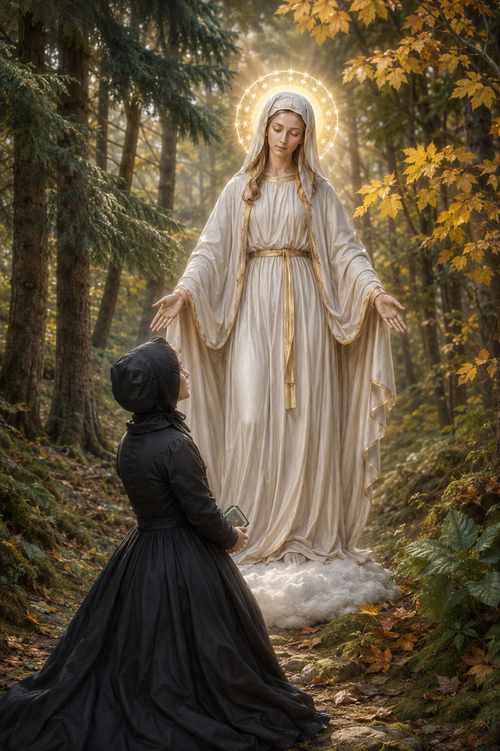
- Beautiful woman in white • Yellow sash • Crown of stars • Surrounded by brilliant white light • Between two large trees
- The Mission
- “Gather the children in this wild country and teach them what they should know for salvation”
- The Request
- Conversion of sinners • Penance • Rosary • Holy Communion offered for sinners • General confession
- Official Approval
- December 8, 2010 • Bishop David L. Ricken, Diocese of Green Bay • “Worthy of Belief”
- National Shrine
- August 15, 2016 • U.S. Conference of Catholic Bishops
- Status
- First and only Church-approved Marian apparition in the United States and Canada
- The Miracle
- Great Peshtigo Fire • October 8, 1871 • Fire surrounded the chapel grounds and stopped • All who sheltered there were saved
- Administered by
- Fathers of Mercy (priests focused on the Eucharist and Reconciliation)
- Original Name
- Shrine of Our Lady of Good Help (Notre Dame de Bon Secours)
- Adele’s Death
- 1896 • Buried at the shrine she founded
- Feast Day
- October 9 (Apparition Anniversary) • Also commemorated October 8 (Fire Miracle)
What Is Our Lady of Champion? The Apparition America Forgot and Found Again
In the autumn of 1859, in the dense forests of what is now Brown County, Wisconsin, a young Belgian woman who had emigrated to the American frontier with her family was walking through the woods when she saw, standing between two large trees in a blaze of brilliant white light, a beautiful woman dressed in white with a yellow sash and a crown of stars. She was terrified. She prayed. She told her parish priest. He instructed her in what to do if the Lady appeared again. The Lady appeared twice more. On the third encounter, Adèle Brise asked who she was. And the answer she received — given in a particular setting, with a particular urgency, to a particular woman who could never read or write — became the only Church-approved Marian apparition message in the history of the United States.
America has had hundreds of claimed Marian apparitions over the centuries. The Church has formally approved exactly one. It is not in New York or Los Angeles or the great Catholic cities of the East Coast. It is in a small community in northeastern Wisconsin, in the Diocese of Green Bay, on land that in 1859 was genuine frontier — forested, isolated, sparsely settled, culturally impoverished in the sense of having almost no access to Catholic formation, filled with immigrant families who had brought their faith across the Atlantic and were struggling to pass it on to their children in the American wilderness.
Our Lady looked at that situation and said: teach the children. Gather them and teach them what they need to know for their salvation. She gave the mission to a woman who could not read. The illiterate woman spent the rest of her life obeying. And then, twelve years later, the deadliest wildfire in American history burned everything around the chapel she had built, and stopped at its edge.
This article is the most complete account of Our Lady of Champion available: every detail of the three apparitions and their evidential record, the full life of Adèle Brise, the message in its theological depth, the Miracle of the Peshtigo Fire, the Church investigation and its conclusions, the shrine as it exists today, and the prayers. America has one approved Marian apparition. It deserves the attention it has not always received.
Part II
America and Wisconsin in 1859: The World She Came Into
Wisconsin became a state in 1848, just eleven years before the Champion apparitions. In 1859, the area around what is now Green Bay was genuine frontier: dense forests being cleared by lumber companies, small farming communities of European immigrants — German, Belgian, Polish, Dutch, Irish — who had settled along the bay and in the surrounding countryside, most of them Catholic, most of them poorly served by the infant Church structures of a newly established diocese.
The Diocese of Green Bay was itself only seven years old in 1859, having been carved out of the Diocese of Milwaukee in 1868. No, actually, let me be precise: the Diocese of Green Bay was established in 1868 — nine years after the apparitions. In 1859, the area was part of the Diocese of Milwaukee, with sparse priestly presence and almost no established Catholic educational infrastructure. Many Catholic families in the region had access to Mass only occasionally, when a traveling priest made his rounds. Catechism for children was haphazard at best — dependent on what parents knew, which was often not much, since many of the immigrants themselves had received minimal formal religious education in the European villages they had left.
The Belgian Community at Champion
The Brise family, like many in the Champion area, was part of the wave of Belgian immigration to northeastern Wisconsin that brought thousands of Flemish and Walloon Catholic families to the forests of Brown County from the 1850s onward. These were not wealthy or sophisticated emigrants; they were farming families and laborers who had been pushed off the land in Belgium by economic pressures and who came to Wisconsin looking for land of their own to farm. They brought their Catholic faith as the most important thing they carried, and they found a landscape where practicing that faith was genuinely difficult: no churches in many areas, no priests within easy reach, no schools, no catechism classes, no religious sisters.
This is the community Our Lady addressed when she told Adèle to gather the children and teach them what they needed to know for their salvation. She was not giving a general exhortation to religious education; she was giving a specific response to a specific crisis. In 1859, in the forests of northeastern Wisconsin, the children of Catholic immigrant families were in genuine danger of growing up without the knowledge of their faith, without access to the sacraments, without the catechetical formation that would allow them to receive God’s grace intelligently and intentionally. Our Lady came to address that crisis. And she chose for her instrument the least likely person available: an illiterate Belgian farmgirl who had never taught a day in her life.
Part III
Adèle Brise: The Woman the Queen of Heaven Chose
Adèle Brise was born in Belgium — the exact year is uncertain in the historical record, but the most consistent estimates place her birth around 1831. She came from a Belgian Catholic family and emigrated to Wisconsin with her parents, Lambert and Marie Brise, as part of the great Belgian immigration wave of the 1850s. The family settled in the Robinsonville area of Brown County (later known as Champion), Wisconsin, where Lambert Brise would eventually build the first chapel at the apparition site.
Adèle was, by all accounts, a woman of genuine and deep faith — but not one who was distinguished by extraordinary religious gifts or mystical experiences before the apparitions. She was a working young woman of the frontier, active, practical, and possessed of the kind of uncomplicated straightforward faith that characterized many Catholic immigrants who had carried their religion across the Atlantic without any elaborate theological formation but with the solid habit of Sunday Mass, the Rosary, and the basic devotional life of their Belgian villages.
One of the most significant facts about Adèle Brise is that she could never learn to read or write. This was not uncommon among women of her class and era, but it has an important evidential implication for the Champion apparitions: the theologically precise message she transmitted — with its specific instructions about the sacraments, its Christological framing, its pastoral specificity about teaching children — could not have been intellectually constructed by Adèle herself. What she received she could not have composed. What she transmitted she could not have designed. The message, in other words, has a quality that exceeds its messenger by a wide margin.
Adèle Brise lived at the Champion apparition site for the rest of her life after 1859, teaching catechism to the children of the surrounding community, running the school she founded, enduring poverty, social criticism, and the ordinary difficulties of frontier religious life with the consistent faithfulness that those who knew her consistently reported. She died in 1896 and is buried at the shrine she built in response to the Queen of Heaven’s commission.
Part IV
The Promise She Made in Belgium: “You Will Be My Mother Now”
One of the most moving details in the Adèle Brise narrative is the promise she had made in Belgium, as a girl, at the time of her First Communion. The Sisters who had prepared her for First Communion made a deep impression on her — their dedication to the children of the parish, their living faith, their willingness to give their lives to teaching the next generation. Adèle had promised, in the way that a deeply moved young girl promises such things, that she would serve the Blessed Mother alongside those Sisters, participating in the same mission of teaching and formation that had so formed her own faith.
Then her family emigrated to Wisconsin. The promise felt unreachable — because in the forests of Brown County there were no Sisters, no organized religious community, no established school. What could a Belgian farmgirl on the American frontier do with a promise to serve the Blessed Mother in the mission of catechesis? The promise seemed like a beautiful intention that the circumstances of her life had rendered impossible.
What Our Lady gave Adèle in 1859 was the context in which that promise could be kept. She was not asked to do something new; she was asked to do what she had already promised, in the specific place and situation where it was most needed. The frontier of Wisconsin was the context she had not anticipated for a Belgian promise. But the Queen of Heaven had planned it differently: she had not released Adèle from the promise when the family emigrated. She had been keeping the promise in trust, waiting for the moment when Adèle would arrive at the place where it needed to be fulfilled — and then she came and showed her where it was.
Part V
All Three Apparitions: The Complete Account
A note on the historical record: the Champion apparitions occurred in 1859, and unlike the great European apparitions of the nineteenth century — Lourdes (1858), La Salette (1846) — they were not immediately subjected to formal documentation or widespread press coverage. Adèle Brise never learned to read or write and thus could not leave a written personal account. The account that exists was assembled from oral tradition, from Adèle’s own verbal account transmitted through those who knew her, and from secondary historical documents. The shrine is candid about this: different accounts contain some variation in details, but the core of the message — the Lady’s identity, her requests, and her commission to Adèle — is consistent across all sources. What follows is the most careful composite account available.
It should also be noted that the date of the apparitions is recorded differently in different sources. The shrine’s own historical account places the apparitions in the autumn of 1859, with October 9 observed as the feast day (anniversary of the principal apparition). The approximate dates given by different sources range from early to mid-October. For the purposes of this account, we follow the shrine’s own tradition.
Part VI
The First Apparition: She Sees the Lady in the Woods
The first apparition came while Adèle was walking through the forest on an errand — she was carrying a sack of grain between her family’s homestead and a neighboring property, following a path through the woods that she had walked many times. Between two large trees, she suddenly became aware of a brilliant white light, and within the light she saw a beautiful woman. The woman was dressed entirely in white with a yellow sash around her waist. On her head was a crown of stars. She appeared luminous — the light emanating from her rather than merely surrounding her. She stood silently.
Adèle was frightened. She did not know who or what she was seeing. She stood for a moment in the presence of the figure and then hurried on her way. When she reached her destination and then returned home, she told her family what she had seen. Her account was received with a mix of wonder and concern. Her father advised her to pray if she saw the Lady again and to ask who she was.
The important thing about the first apparition is its total absence of any explicit message or communication. The Lady appeared. She was beautiful. She was luminous. She stood between two trees. And she said nothing. For Adèle, the first encounter was purely the experience of presence — and a presence that frightened before it consoled.
Part VII
The Second Apparition: The Lady Returns — and Still Says Nothing
The second apparition occurred when Adèle was again traveling the same path through the woods, this time accompanied by two companions. She saw the Lady again in the same place, between the same two trees, in the same white light. Her companions could not see what Adèle saw. They only saw her reaction — the same mixture of awe and fear — and they felt something, a quality in the air around Adèle and the area of the apparition that they described as unusual, though they could not define it precisely.
Again the Lady said nothing. She appeared, was present, and Adèle stood before her in a state of interior disturbance that her companions could observe but not share. And then the Lady was gone.
After the second apparition, Adèle went to her parish priest — Father William Verhoef, the pastor of the local parish — and told him what she had seen. His response was pastoral and theologically sound: he did not dismiss her, but he also did not rush to interpret or validate. He advised her that if the Lady appeared again, she should ask in the name of God who she was and what she wanted. He also instructed her to approach the next encounter in a state of sacramental grace: to go to confession, to receive Holy Communion at Mass, and then to return to the place of the apparitions. The instruction is itself a small model of Catholic pastoral wisdom: before approaching something potentially supernatural, ensure you are in right relationship with God. The sacraments come first.
Part VIII
The Third Apparition: She Speaks — Everything Changes
Following Father Verhoef’s instructions, Adèle went to confession and received Holy Communion. Then she returned to the place between the two trees. A group of companions — perhaps the same two from the second apparition, perhaps others — walked with her. They could not see the Lady. But they could see Adèle — they could see her change when the Lady appeared, the quality of her face, the stillness that came over her, the sense of being in the presence of something beyond ordinary experience.
Adèle, following the priest’s instruction, asked the question she had been given: “In the name of God, who are you and what do you want of me?”
The Lady smiled at the question. And she answered.
The Answer: The Queen of Heaven
The Lady identified herself: “I am the Queen of Heaven who prays for the conversion of sinners, and I wish you to do the same.” The identification is precise: not “I am the Virgin Mary” or “I am the Immaculate Conception” or “I am the Mother of God” — though she is all of these. She gives herself the specific title that describes her present activity: she is the one who intercedes. She is the Queen of Heaven who prays. Her self-identification is not a static title but a description of what she does: she prays, specifically for sinners, and she wants Adèle to join her in that intercession.
Then she noted what Adèle had done that morning: “You received Holy Communion this morning and that is well. But you must do more. Make a general confession and offer Communion for the conversion of sinners. If they do not convert and do penance, my Son will be obliged to punish them.”
This statement — with its warning about punishment and its insistence on reparatory Communion — places Champion in direct continuity with the La Salette (1846) and Fátima (1917) traditions: the Mother of God coming to warn that the consequences of unrepented sin cannot be indefinitely deferred, and asking the faithful to offer their sacramental life as intercession for those who are not repenting.
“Blessed Are They That Believe Without Seeing”
At this point, according to the account, Adèle’s companions — who had been standing nearby and could not see the Lady — called out, asking Adèle who the Lady was and why they could not see her. The Lady responded to their inability to see with words drawn directly from the Gospel of John, chapter 20:29 — the words Jesus spoke to Thomas after the Resurrection: “Blessed are they that believe without seeing.” The Scriptural citation is theologically pointed: the Lady was reminding Adèle’s companions — and through them, all who would hear the message without being present for the vision — that faith is not a second-class spiritual experience. To believe without seeing is a beatitude; it is commended by Christ himself.
The Mission: Gather and Teach
Then, seeing Adèle standing in what the account describes as idleness while her companions were working in the surrounding area, the Lady asked with gentle reproach: “What are you doing here in idleness while your companions are working in the vineyard of my Son?”
Adèle, bewildered, asked what more she could do — “What more can I do, dear Lady?” — noting that she herself knew so little. The Lady’s answer was the mission: “Gather the children in this wild country and teach them what they should know for salvation.”
She then gave specific practical instructions: “Teach them their catechism, how to sign themselves with the sign of the Cross, and how to approach the sacraments; that is what I wish you to do. Go and fear nothing. I will help you.”
The Lady raised her hands in blessing over Adèle and her companions. She slowly vanished from sight. The apparitions were complete. The mission had been given. Everything that followed was obedience.
Part IX
How She Appeared: A Complete Description of Our Lady of Champion
Adèle Brise’s description of the Lady, transmitted through the oral account and recorded by those who interviewed her, is consistent in its essential features across all sources. It is worth examining in detail because every element carries theological meaning and because the visual tradition of Our Lady of Champion — as depicted on the shrine’s imagery, on prayer cards, and in the devotional art associated with the apparition — is drawn from this description.
The White Dress
The Lady wore a white dress of great beauty — a luminous white that appeared to produce its own light rather than merely reflecting the light that surrounded her. White in every major Marian apparition in the modern era carries the same consistent significance: purity, resurrection, the holiness of the one who was preserved from sin from the moment of her conception. The white dress of Our Lady of Champion connects her visually to Our Lady of Lourdes, to the Miraculous Medal apparition, and to every other major approved Marian apparition of the period in which white clothing is consistently reported.
The Yellow Sash
Around the Lady’s waist was a yellow or golden sash. In Marian iconography, yellow and gold are the colors of divine glory — the color of the sun, of gold, of the divine light that surrounds and fills those who are most fully united with God. At Lourdes, Our Lady wore a blue sash; at Champion, her sash is yellow or golden. The color difference has been noted by theologians of Marian apparitions as potentially significant: the blue sash of Lourdes points to Mary’s heavenly queenship, while the golden sash of Champion points to her participation in the glory of her Son — the golden sash of one who has been fully assumed into the divine radiance.
The Crown of Stars
On her head the Lady wore a crown of stars — the crown of twelve stars that appears in Revelation 12:1: “a woman clothed with the sun, with the moon under her feet and a crown of twelve stars on her head.” This crown connects the Lady of Champion directly to the Woman of the Apocalypse, the theological image that the Catholic tradition has consistently understood as a typological representation of the Virgin Mary. The crown of stars at Champion places the apparition in explicit Biblical context: the Woman who appeared in the Wisconsin woods was the Woman of Revelation 12, the Mother who stands in cosmic conflict with the ancient serpent, whose offspring has crushed the serpent’s head. The mission she gives — teaching children the faith, preserving them from the spiritual dangers of the frontier — is the continuation of that cosmic conflict at the most intimate and ordinary level.
Between Two Trees
The Lady appeared between two large trees — a detail that, in the Biblical and liturgical tradition, is not without resonance. The Tree is one of the oldest Christian symbols for the Cross; two trees surrounding the apparition site creates a visual frame within which the Lady stands as Mediatrix, standing between the two pillars of redemptive history. The trees at Champion were real trees in the Wisconsin forest; but their symbolic function in the devotional memory of the site has always been felt, and they are commemorated in the shrine’s visual tradition.

Part X
The Full Message: Every Word She Spoke and Its Theological Depth
[In response to Adèle’s question: “In the name of God, who are you and what do you want of me?”]
“I am the Queen of Heaven who prays for the conversion of sinners, and I wish you to do the same.”
“You received Holy Communion this morning and that is well. But you must do more. Make a general confession and offer Communion for the conversion of sinners. If they do not convert and do penance, my Son will be obliged to punish them.”
[When Adèle’s companions, who could not see Our Lady, asked why:]
“Blessed are they that believe without seeing.”
[Seeing Adèle standing idle while her companions worked:]
“What are you doing here in idleness while your companions are working in the vineyard of my Son?”
[When Adèle asked what she could do, noting she knew so little herself:]
“Gather the children in this wild country and teach them what they should know for salvation.”
“Teach them their catechism, how to sign themselves with the sign of the Cross, and how to approach the sacraments; that is what I wish you to do. Go and fear nothing. I will help you.”
[She raised her hands and blessed Adèle and her companions. Then she slowly vanished.]
Part XI
Pray for the Conversion of Sinners: The First and Most Urgent Request
The first and primary thing Our Lady of Champion says about herself is not her name but her activity: she is the one who prays for the conversion of sinners, and she wants Adèle to join her in that prayer. This is the same orientation as La Salette (1846): pray to God for sinners. It is the same orientation as Fátima (1917): the prayer added to the Rosary at the end of each decade, lead all souls to heaven, especially those in most need of Thy mercy. It is the same orientation as Kibeho (1981): the urgent call to pray for the conversion of those who are furthest from God.
This consistency across multiple approved apparitions, across multiple continents and multiple eras, in the same essential request, is theologically significant. The Mother of God has been saying the same thing since 1846 at La Salette: pray for sinners. She says it in Wisconsin in 1859, in France in 1858 and 1917, in Rwanda in 1981, in Venezuela in 1984. The convergence of all these voices on the same request is not coincidence; it is the expression of a maternal concern that is genuinely urgent and genuinely sustained across time.
Reparatory Communion
The specific request for “offering Communion for the conversion of sinners” is one of the most theologically sophisticated elements of the Champion message. Reparatory Communion — the practice of receiving Holy Communion with the explicit intention of offering the graces received as reparation for the sins of others, particularly those who are not receiving the sacraments or who are actively sinning — is a deep tradition in Catholic spirituality. It connects Champion explicitly to the Fátima tradition, where Our Lady asked for “Communions of reparation” on the Five First Saturdays. At Champion in 1859, she had already been asking for exactly this practice — fifty-eight years before Fátima formalized it. The theological coherence of the Marian tradition across these widely separated apparitions is remarkable.
The Warning About Punishment
The statement “If they do not convert and do penance, my Son will be obliged to punish them” places Champion in the same prophetic register as La Salette, Fátima, and Betania. Our Lady is not describing a vindictive God seeking to punish; she is describing a God of justice whose love cannot coexist indefinitely with the human choices that destroy the people he loves. The “punishment” she describes is not a divine act of vengeance; it is the natural consequence of human moral choices playing out in personal and social history — with the additional theological precision that God may permit those consequences rather than continuously forestalling them through miracle or special protection. The warning, like all the Marian warnings of this era, is a warning of love: convert now, while there is time.
Part XII
Gather the Children and Teach Them: The Most Practical Mission in Marian History
The mission Our Lady gave to Adèle Brise is, of all the missions given at major approved Marian apparitions, the most practically specific and the most directly pastoral. She did not ask for a chapel to be built (as at Lourdes), or for a rosary of Seven Sorrows (as at Kibeho), or for the consecration of a nation to her Immaculate Heart (as at Fátima). She asked for catechism lessons. For the sign of the Cross to be taught correctly. For children to be prepared to receive the sacraments. She asked for the most ordinary possible religious education work, directed at the most specific possible pastoral crisis: the spiritual vulnerability of Catholic children growing up on the American frontier without formation.
Why the Catechism?
The catechism — the systematic presentation of the Catholic faith in a teachable form — is the vehicle through which a child moves from vague religious feeling to actual knowledge of what they believe and why. A child who knows the catechism knows who God is, what Jesus did, what the sacraments are, how to pray, what sin is and how to be forgiven for it, what happens after death, and what the Church is and why it matters. A child who does not know these things is spiritually vulnerable in a way that no amount of pious feeling can adequately address. Our Lady at Champion was asking for the most foundational thing: give these children the knowledge they need to navigate their lives as Christians. Give them the words, the signs, the sacramental access. Give them what they need to be saved.
The phrase “how to sign themselves with the sign of the Cross” is a detail that speaks to how rudimentary the catechetical situation was. The sign of the Cross — one of the simplest and most basic acts of Catholic piety, the first thing a child learns — apparently needed to be specifically mentioned as something the frontier children had not necessarily been taught correctly or at all. This is a marker of just how poor the Catholic formation situation in rural Wisconsin was in 1859, and just how targeted Our Lady’s response was to the specific needs of that specific community.
The Sacramental Focus
Our Lady’s specific instruction to teach children “how to approach the sacraments” reflects the Catholic understanding that the sacraments are not optional extras but the primary channels of God’s grace in the Christian life. A child who does not know how to make a proper confession, who has not been prepared to receive First Communion with understanding and reverence, who has not been taught that the Mass is not merely a community gathering but the actual sacrifice of Christ made present — such a child is missing the fundamental infrastructure of Catholic Christian life. Our Lady was asking Adèle to build that infrastructure for the children of the Wisconsin frontier. And Adèle, who could not read, who had received minimal formal education herself, spent the rest of her life doing exactly that.

Part XIII
Adèle Obeys: Building the Mission with Nothing
Adèle Brise’s response to the commission she received was immediate and sustained, but it was not easy. She was a young woman with no formal education, no teaching experience, no financial resources, and no institutional support. She could not read the catechism she was being asked to teach; she had to have it read to her and commit it to memory. The woman who could not read the words of the faith she was transmitting had to carry those words entirely in memory and oral transmission.
She began by gathering whatever children she could find in the immediate neighborhood of the apparition site, traveling by foot through the Wisconsin forests and farms to reach families who were scattered across the rural landscape. She taught in barns, in farmhouses, in the open air. She taught the same catechism she had received from the Sisters in Belgium, transmitted orally to children whose parents were as poorly catechized as they were. She taught the sign of the Cross. She prepared children for their First Confession and First Communion. She organized what became known as a kind of circuit catechist — regularly visiting multiple communities to maintain the formation she had started.
Father Verhoef’s Critical Role
Father William Verhoef, the parish priest who had instructed Adèle before the third apparition, became an essential supporter of her mission. He validated the apparitions publicly, supported the construction of a chapel at the site, and helped Adèle navigate the ecclesiastical and logistical dimensions of the school and mission she was building. Without a supportive priest, the Champion mission might have died in its first years; with Verhoef’s backing, it had the institutional credibility to survive and grow.
“Go and Fear Nothing. I Will Help You.”
Our Lady’s closing words to Adèle — “Go and fear nothing. I will help you” — were not empty comfort. Adèle needed them, and she received the help they promised, though not in ways that made her life easy. She lived in genuine poverty for most of the years following the apparitions. She faced skepticism from some in the community. She faced the practical impossibility of the mission repeatedly. And she encountered the truth of the promise at what the tradition records as her most desperate moments: when she did not know where the next meal would come from, when she had gathered her small community of sisters and companions in the chapel and prayed to Mary for help, there would arrive — by what she and those around her consistently described as providential timing that exceeded coincidence — a sack of flour or a supply of meat at the door.
Part XIV
The First Chapel: 10×12 Feet of Wood and Everything It Represented
The original chapel at the Champion apparition site was built by Lambert Brise, Adèle’s father, at the spot between the two trees where Our Lady had appeared. It was a wooden structure measuring ten feet by twelve feet — barely large enough to contain a small group at prayer. It was the smallest possible physical response to the request that a chapel be built, but it was a response, and it was made as quickly as the family’s limited means allowed.
Over the door of this small chapel, Lambert Brise inscribed the French words Notre Dame de Bon Secours, priez pour nous — “Our Lady of Good Help, pray for us” — giving the shrine its original name, by which it was known for over 150 years before the 2010 approval formalized the title “Our Lady of Champion.” The name “Good Help” is itself a beautiful encapsulation of the Champion message: she is Our Lady of Good Help, the one who helps in the most practical and immediate way — helping Adèle teach children, helping the poor and sick who come to her shrine, helping the family in the chapel pray their way through the night while the greatest fire in American history burned around them.
Isabella Doyen’s Gift of Land
The expansion of the shrine from a ten-by-twelve chapel to a permanent pilgrimage destination was enabled in part by the generosity of a neighboring woman named Isabella Doyen, who donated five acres of land around the apparition site to the shrine. This gift of land made possible the construction of a larger chapel (a 24×40 foot wooden church built in 1861), and eventually the school, convent, and full pilgrimage complex that developed over the following decades. Isabella Doyen’s donation is one of the small, historically invisible acts of generosity that the great saints’ stories always depend on: the ones who give the land, the flour, the time, the practical support that allows a supernatural mission to take earthly root.
The Growing Pilgrimage
Word spread quickly through the Belgian and German immigrant communities of northeastern Wisconsin that extraordinary things were happening at the site where a young woman had seen a beautiful Lady in the trees. Pilgrims began arriving even before the first small chapel was completed. The sick and troubled and poor came seeking healing and consolation. Some reported graces received. A wooden votive tradition — the leaving of crutches, walking aids, and other ex-votos by those who believed they had been healed — developed within the first decade of the shrine’s existence and continues today: a display case of crutches in the Apparition Oratory at the current shrine is one of the most physically immediate testimonies to the healing tradition of Champion.

Part XV
Adèle’s School: Teaching What She Could Not Read
The school that Adèle Brise founded at the Champion apparition site was, by any institutional standard, deeply impoverished. It had no books she could read, no formal curriculum, no trained staff, no reliable funding. What it had was the catechism Adèle had committed to memory, the oral tradition of Catholic devotion and prayer she had received in Belgium, and the help Our Lady had promised. And the children came.
Over the years following the 1859 apparitions, Adèle attracted a small group of companions — women who joined her in the mission of teaching and in the common life she had organized around the chapel. This community was never a formal religious congregation; it was a group of laypeople living in common at the apparition site, sustaining themselves by farming and the generosity of the pilgrims and neighbors who supported them, and devoting their lives to the catechetical mission the Queen of Heaven had given their foundress. They were, in a sense, the unplanned religious community that the frontier produced: not nuns in any canonical sense, but women living the consecrated life of service and prayer in the only form that the resources and circumstances of their situation allowed.
The school’s influence spread well beyond the immediate vicinity of Champion. Adèle traveled on foot through the surrounding countryside, reaching families whose children could not come to her; bringing the catechism to farmsteads and lumber camps and frontier communities that had no priest, no church, and no other access to Catholic formation. She was doing, in nineteenth-century Wisconsin, what the Church has always needed on every frontier: the lay apostle who goes where the institution has not yet reached.
Part XVI
The Hard Years: Poverty, Doubt, and Providential Help
The decades between the 1859 apparitions and the 1871 fire were not triumphant ones for Adèle Brise. They were years of grinding poverty, persistent uncertainty about the next meal, and the social pressure that always falls on those who claim to have seen visions and who organize their lives around obeying them. Some people believed her from the beginning; others were skeptical, and the skepticism of neighbors and community members was a cross she carried consistently.
The most persistent practical difficulty was simply survival. The community at Champion — Adèle, her father, her companions — had no reliable income source. They farmed as best they could and received what the pilgrims and neighbors contributed, but there were times when the community did not know where the next meal would come from. The accounts of these periods, preserved in the shrine’s oral tradition, describe Adèle gathering her community in the chapel to pray to the Virgin Mary when food ran out — and then, before morning, a bag of flour or a supply of meat appearing at the chapel door, left by someone who had felt moved to bring it. The accounts do not claim that the flour appeared miraculously from nowhere; they claim that it arrived from human hands at times that, in context, had the quality of answered prayer rather than mere coincidence.
The cumulative effect of these small providential helps, across years and decades of genuine hardship, was the formation of a character of faith that those who encountered Adèle consistently described as extraordinary: not the faith of one who has never suffered or doubted, but the faith of one who has been through the places where faith seems unreasonable and has come out the other side with the quiet, un-dramatic certainty of someone who has been proven right often enough to continue trusting. She was not a mystic in the conventional sense; she did not have further visions or extraordinary experiences after 1859. She was an ordinary woman doing an extraordinary thing in an ordinary way, sustained by ordinary prayer, ordinary help, and the memory of having stood between two trees in the Wisconsin woods and been given a mission by the Queen of Heaven.
Part XVII
The Great Peshtigo Fire: October 8, 1871 — America’s Worst Wildfire
The night of October 8, 1871 is remembered in American history primarily as the night of the Great Chicago Fire — the fire that, according to legend, started when Mrs. O’Leary’s cow kicked over a lantern, and that burned a large portion of the young city of Chicago on the southern shore of Lake Michigan. The Chicago fire killed approximately 300 people and destroyed much of the city’s central business district, and it generated enormous press coverage that has ensured its place in the American historical memory.
On the same night, approximately 250 miles north of Chicago, a far worse catastrophe was unfolding in the forests of northeastern Wisconsin. The Great Peshtigo Fire — named for the town of Peshtigo in Marinette County, though it burned far beyond that community — was driven by the same weather conditions that had produced the Chicago fire: weeks of extreme drought in the upper Midwest, combined with strong winds, had turned the cutover forests of Wisconsin into a tinderbox of almost unimaginable scale. When the fires started on the evening of October 8, they did not spread slowly. They exploded. Eyewitness accounts describe a wall of flame driven by gale-force winds, moving faster than horses could run, leaping across rivers, generating its own weather in the form of fire tornadoes that threw burning debris miles ahead of the main fire front.
The Scale of the Disaster
The Great Peshtigo Fire burned approximately 1.2 million acres of Wisconsin and Upper Michigan forest. It killed between 1,200 and 2,400 people — the wide range reflects the fact that many bodies were never identified, many victims were recent immigrants with no family in the area to report them missing, and many communities in the fire’s path were completely obliterated. It remains the deadliest wildfire in recorded American history, killing far more people than the Chicago fire that overshadowed it in the press, and it is relatively unknown to most Americans because the simultaneous Chicago fire consumed almost all of the available journalistic attention.
The Peshtigo fire was driven by the economics of nineteenth-century logging. The lumber companies that had been harvesting Wisconsin’s old-growth forests for decades had left behind vast piles of sawdust, branches, and dry debris. When the fire came, it had fuel of almost incomprehensible density everywhere it went. The forests of northeastern Wisconsin — including the area around Champion — were directly in its path.
Part XVIII
The Miracle of the Fire: When God Stopped It at the Chapel Door
As the Peshtigo fire roared through northeastern Wisconsin on the evening of October 8, 1871, the people of the surrounding countryside did what people do when they cannot outrun a catastrophe: they ran toward whatever shelter offered the greatest possibility of safety. Many of them ran toward the chapel at Champion — the chapel that Adèle and her father had built at the apparition site, that had become the center of Catholic life and prayer for the region, that those who knew it thought of as a place of special protection.
Adèle Brise was at the chapel when the fire came. She refused to leave. This is one of the details of the Champion story that is most immediately striking: when the deadliest wildfire in American history was bearing down on the small wooden chapel in the Wisconsin woods, the woman who had built it in obedience to the Queen of Heaven decided not to run. She organized instead a procession. She took a statue of the Virgin Mary, gathered the people who had fled to the chapel grounds, and began leading them in a procession around the perimeter of the chapel property, praying the Rosary, asking Our Lady’s protection for the grounds.
The Fire Reaches the Edge and Stops
What happened next is attested by multiple witnesses and is the most dramatic miracle in the history of the Champion shrine. The fire, driven by gale-force winds, burning with the ferocity that had already killed hundreds of people in the surrounding communities and consumed a million acres of forest, reached the edge of the chapel grounds. And it stopped.
Not slowly, not incompletely, not in the way that natural firebreaks sometimes explain why a fire changes direction. The accounts of those who were present describe the fire burning up to the very edge of the chapel property and then halting — as if an invisible boundary had been drawn around the grounds. The surrounding land was completely and utterly destroyed. The trees, the farms, the neighboring properties: all burned to ash. Within the chapel grounds — the chapel itself, the small convent Adèle had built, the school, the land Isabella Doyen had donated — everything was untouched. Every person who had taken refuge on the chapel grounds survived. Not one person on the grounds was harmed by the fire that killed, by conservative estimate, 1,200 of their neighbors.
The Significance of the Miracle
The Miracle of the Peshtigo Fire is, in physical scale and evidential weight, one of the most remarkable miracles associated with any Marian apparition site in the history of the Church. There is no natural explanation for why a fire of the intensity and speed of the 1871 Peshtigo fire would stop at a property boundary while consuming everything around it. Firebreaks require water, clearing, or some physical impediment; the chapel grounds had none of these. The fire did not respect natural boundaries anywhere else in its path. It respected this one.
The miracle was understood immediately by those present and by the surrounding community as a direct confirmation of the apparitions: the same Queen of Heaven who had appeared in the woods in 1859 had kept her people safe in 1871. The protection was not abstract or spiritual; it was physical, measurable, and surrounded by the corpses of those who had not been on the protected ground. The event became one of the most powerful arguments for the authenticity of the Champion apparitions in the subsequent Church investigation, and it is commemorated every year on October 8 with a candlelight service at the shrine.
Part XIX
Adèle’s Death and Legacy: Buried Where She Was Sent
Adèle Brise died in 1896, thirty-seven years after the apparitions. She was buried at the Champion shrine — in the ground she had consecrated by obedience, on the land where the Queen of Heaven had appeared and where the fire had stopped. Her grave is at the shrine today and is a place of pilgrimage for those who invoke her intercession.
She left behind a school that had served the catechetical needs of the region for nearly four decades, a chapel that had grown from a ten-by-twelve wooden structure to a community of prayer and pilgrimage that served thousands, and a tradition of Marian devotion in northeastern Wisconsin that would outlast every institutional structure she had built. She did not leave behind a written account of her experiences — she could not write. She did not leave behind a theological treatise or a memoir. She left behind the fruit of the mission: children who knew their catechism, families who had received the sacraments, a shrine that was still standing long after the fire that had tried to consume it.
The Question of Her Canonization
No cause for Adèle Brise’s beatification and canonization has yet been formally opened by the Church, though pilgrims at the Champion shrine have always invoked her intercession informally. The shrine itself encourages pilgrims to ask for her intercession, noting that if prayers are answered through her intercession, a cause for canonization may eventually be opened. The evidence of her heroic virtue — her forty years of faithful obedience to an impossible mission, her survival of poverty and criticism and the terrible responsibility of bearing the weight of an apparition account as its only living witness — is the evidence of a life well lived in the sight of God. Whether the Church formally recognizes it is a matter of process and time; that it deserves recognition is something those who know her story find difficult to dispute.
Part XX
Complete Chronological Timeline: 1859 to Today
- c. 1831 — Adèle Brise Born in BelgiumAdèle Brise is born in Belgium to Lambert and Marie Brise. Her family is Catholic and working-class; she will never learn to read or write. In her childhood she receives First Communion through the instruction of religious Sisters whose dedication inspires a personal promise to serve Our Lady in the same mission.
- 1850s — The Brise Family Emigrates to WisconsinThe Brise family emigrates from Belgium to Wisconsin as part of the large Belgian immigration to northeastern Wisconsin. They settle in the Champion area of Brown County. Adèle carries her promise to serve Our Lady into a context where that service seems impossible to fulfil.
- Autumn 1859 — First ApparitionAdèle is walking through the forest when she sees a beautiful woman in white, with a yellow sash and a crown of stars, standing between two large trees in a blaze of white light. She is frightened and hurries on. She tells her family. Her father advises her to pray if she sees the Lady again.
- Autumn 1859 — Second ApparitionAdèle is traveling the same path, this time with companions, when the Lady appears again. Her companions cannot see the apparition. Adèle goes to Father Verhoef, her parish priest, who advises her to ask in God’s name who the Lady is and to approach in a state of sacramental grace.
- Autumn 1859 — Third and Final ApparitionAfter confession and Holy Communion, Adèle returns. She asks who the Lady is. The Lady identifies herself as the Queen of Heaven who prays for the conversion of sinners. She gives the mission: “Gather the children in this wild country and teach them what they should know for salvation.” She blesses Adèle and her companions and vanishes.
- 1859–1860 — First Chapel BuiltLambert Brise builds a 10×12 foot wooden chapel at the apparition site. The inscription over the door reads Notre Dame de Bon Secours, priez pour nous — “Our Lady of Good Help, pray for us.” This gives the shrine its original name. Adèle begins teaching catechism to children of the surrounding community.
- c. 1860 — Isabella Doyen Donates LandIsabella Doyen donates five acres of land surrounding the chapel to the shrine, enabling its long-term development. The shrine will grow on this donated foundation for the following century and a half.
- 1861 — Larger Chapel BuiltA larger wooden chapel (24×40 feet) is built to accommodate the growing pilgrimage. A school and convent are eventually added to the complex in the 1880s.
- 1868 — Diocese of Green Bay EstablishedThe Diocese of Green Bay is established, bringing the Champion shrine under a newly organized episcopal structure with closer proximity to the local bishop. This institutional development strengthens the shrine’s long-term stability.
- 1871–1880 — The School and Mission GrowAdèle continues teaching catechism, now with a small community of companions. The school serves dozens of children from the surrounding region. The pilgrimage continues to grow. A larger brick chapel is built in 1880 and dedicated by Francis Xavier Krautbauer, the second Bishop of Green Bay.
- October 8, 1871 — The Miracle of the Peshtigo FireThe Great Peshtigo Fire — the deadliest wildfire in American history, killing 1,200–2,400 people and burning 1.2 million acres — roars through northeastern Wisconsin. It reaches the Champion chapel grounds and stops. The surrounding land is completely destroyed. Everyone sheltering on the chapel grounds is unharmed. The same night, the Great Chicago Fire burns approximately 250 miles to the south. The Wisconsin fire receives almost no national attention.
- 1896 — Adèle Brise DiesAdèle Brise dies at the Champion shrine. She is buried there, on the land she devoted her life to, in the ground the Queen of Heaven had consecrated by her appearance.
- 1942 — Current Tudor Gothic Shrine BuiltThe current shrine building — a Tudor Gothic-style church capable of accommodating approximately 300 people in the upper Apparition Chapel, with a small Apparition Oratory below — is constructed with support from Bishop Paul Peter Rhode and dedicated in July 1942. This is the building that stands today.
- 2008 — Bishop Ricken Opens InvestigationBishop David L. Ricken of the Diocese of Green Bay opens a formal two-year canonical investigation into the Champion apparitions, reviewing historical documentation, the life of Adèle Brise, the fruits of the shrine over 150 years, and the consistency of the apparition message with Catholic doctrine.
- December 8, 2010 — Official ApprovalBishop Ricken issues his formal declaration approving the Champion apparitions as “worthy of belief” by the authority of the Catholic Church. This is done on the Feast of the Immaculate Conception. Champion becomes the first and only Church-approved Marian apparition site in the United States and Canada. Bishop Ricken also approves it as a diocesan shrine.
- August 15, 2016 — National Shrine DesignationThe U.S. Conference of Catholic Bishops designates the Shrine of Our Lady of Champion as a national shrine on the Feast of the Assumption of the Blessed Virgin Mary. The shrine’s name is formally updated from “Shrine of Our Lady of Good Help” to “National Shrine of Our Lady of Champion.”
- Today — The Shrine ContinuesThe National Shrine of Our Lady of Champion is open 365 days a year, administered by the Fathers of Mercy. It receives pilgrims from across the United States and internationally, celebrating daily Mass and offering the Sacrament of Reconciliation. Major annual events include the Walk to Mary (first Saturday in May), the Assumption pilgrimage (August 15), and the anniversary events on October 8–9. The shrine’s mission — to teach the faith, to serve the sick, to provide access to the sacraments — continues the work Adèle Brise began in 1859.
Part XXI
The Church Investigation: 2008–2010
The formal canonical investigation of the Champion apparitions was opened by Bishop David L. Ricken of the Diocese of Green Bay in 2008, approximately 149 years after the events it was examining. The delay reflected both the practical challenge of investigating events from 1859 — when documentary evidence is necessarily limited — and the long historical process by which the shrine’s legitimacy had been gradually and informally established over the preceding century and a half, without ever receiving the formal canonical declaration that would conclusively settle the question of the apparitions’ supernatural character.
What the Investigation Examined
Bishop Ricken’s commission reviewed the available historical information on the apparitions themselves, drawing on the oral tradition transmitted from Adèle Brise through those who knew her, the few contemporary documents that had survived, and the shrine’s own archival records. It examined the life of Adèle Brise, assessing her character, her consistency, her lack of personal gain from the apparition claims, and the quality of her lifelong obedience to the mission she had received. It examined the content of the apparition messages, assessing their theological orthodoxy and their consistency with the public revelation of the Catholic faith. And it examined the fruits of the shrine over 150 years: the conversions, the healings, the growth of faith, the extraordinary events like the Miracle of the Fire.
The investigation also applied the standards of the Church’s 1978 norms for evaluating claimed private revelations, examining the apparitions against the criteria that the Congregation for the Doctrine of the Faith had established for distinguishing authentic supernatural events from fabrication, delusion, or natural explanation. The investigation consulted Rome — consistent with the practice that Bishop Ricardo of Los Teques had followed in the Betania investigation and that other modern investigations have employed — to ensure compliance with canonical norms.
The Challenge of 150-Year-Old Evidence
One of the specific challenges of the Champion investigation was the evidentiary character of the record. Unlike the Lourdes investigation (conducted within four years of the apparitions) or the Betania investigation (conducted within three years of the public apparition), the Champion investigation was examining events from 1859 through records that were assembled primarily from oral tradition. Adèle could not write; the contemporary documentation is sparse. The investigation had to work with the historical record as it existed — which is why the bishop noted that “while some details vary, the account strives to do its best in determining the most common and consistent information across the various historical materials.” The core of the message and the consistency of the essential account was found to be credible; the peripheral details showed the normal variation of oral transmission over time.
Part XXII
Official Approval: December 8, 2010 — America Finally Has Its Marian Shrine
On December 8, 2010 — the Feast of the Immaculate Conception — Bishop David L. Ricken of the Diocese of Green Bay formally declared the apparitions of Our Lady of Champion “worthy of belief” by the authority of the Catholic Church. Mass was celebrated at the Champion shrine to mark the declaration, and the announcement was received with deep joy by the shrine’s faithful, by the Diocese of Green Bay, and by Catholics across the United States who had long known about the Champion tradition without its formal approval.
The choice of December 8 for the declaration carries deliberate theological weight. The Feast of the Immaculate Conception — the same feast that Pope Pius IX had used in 1854 to define the dogma of the Immaculate Conception, the same dogma that Our Lady had confirmed at Lourdes in 1858 when she said “I am the Immaculate Conception” — was the feast on which the Bishop of Green Bay declared that the apparitions in Wisconsin were real. The Immaculate Conception, who appeared in France to confirm a French Pope’s dogmatic definition, was recognized in America on the feast that celebrated the doctrine she had confirmed elsewhere. The theological coherence of these convergences is a recurring feature of the history of Marian devotion: things align that human planning could not have arranged.
What “Worthy of Belief” Means
The canonical declaration of “worthy of belief” is the specific positive finding available in the Church’s assessment of Marian apparitions. It means that, after examination, the evidence for the apparitions’ supernatural character is sufficient to justify the faithful in believing them, and that the Church recommends devotion to the apparition as spiritually beneficial. It is not a declaration that the apparitions are absolutely certain in every detail; it is a declaration that they are credible, consistent with doctrine, and fruitful in the life of faith, and that Catholics may wholeheartedly embrace them. The faithful are not required to believe in any private revelation as a matter of faith; but “worthy of belief” means the Church is saying: this deserves your confidence. You can pray here without reservation.
Part XXIII
The National Shrine of Our Lady of Champion Today
The National Shrine of Our Lady of Champion is located at 4047 Chapel Drive, New Franken, Wisconsin, approximately 16 miles northeast of downtown Green Bay in the Diocese of Green Bay. It is open 365 days a year, without appointment or reservation required for individual visitors. It is administered by the Fathers of Mercy, a religious congregation focused on preaching, the Eucharist, and the Sacrament of Reconciliation — a fitting custodianship for a shrine whose foundational message specifically asked for the Eucharist and reconciliation.
The Apparition Oratory
The lower level of the shrine building contains the Apparition Oratory — the small, intimate prayer space that marks the original apparition site, as close as possible to the ground where Adèle stood between the two trees and heard the Queen of Heaven give her mission. The Oratory contains wooden kneelers, religious art, and the collection of crutches left behind by pilgrims who came sick or impaired and departed without needing them. This collection of crutches — visible in the Oratory and often noted by first-time visitors as one of the most moving details of the shrine — is the physical residue of miraculous healings that the shrine has not formally investigated but that its tradition consistently records. Each crutch represents a story, a petition granted, a person who walked away from what they had needed to walk with. There is no formal record of these healings in the way that the Lourdes Medical Bureau maintains records; there is only the crutch, left at the feet of the Queen of Heaven who said she would help.
The Upper Apparition Chapel
The Tudor Gothic-style upper chapel, built in 1942 and capable of accommodating approximately 300 people, is the primary liturgical space of the shrine. Mass is celebrated there daily, and the Sacrament of Reconciliation is available every day. The altar and sanctuary reflect the simple beauty that has always characterized the Champion shrine: not the grandeur of Lourdes or the mountainous setting of La Salette, but a modesty that is entirely in keeping with the apparition itself — a message given in the Wisconsin woods to an illiterate farmwoman about teaching children their catechism. The chapel is as modest as the mission; and the mission, like all humble things, has outlasted everything around it.
The Grounds
The shrine grounds include an outdoor area for the Rosary walk and the Stations of the Cross, a Historical Center that tells the shrine’s story on a continuously playing video, pilgrimage facilities for large groups, and the grave of Adèle Brise. The grounds have the quality that virtually everyone who visits Champion consistently describes: a profound peace. Not the peace of a pleasant garden or a well-designed public space, but the peace of a place where something real happened and where the weight of that reality is still present in some manner that visitors feel before they can articulate it. “Peace and simplicity,” as one long-time observer of the shrine put it, are the two qualities that have characterized the Champion grounds since 1859 — and they remain its defining character today.
How to Visit the Shrine
- Address: National Shrine of Our Lady of Champion, 4047 Chapel Drive, New Franken, WI 54229
- Phone: (920) 866-2571
- Website: championshrine.org
- Distance from Green Bay: ~16 miles northeast of downtown Green Bay • Approximately 25 minutes by car
- Open: 365 days a year • No appointment required for individual visitors
- Masses: Daily at 11:30 AM • Saturdays and Sundays at 9:30 AM and 11:30 AM • Wednesdays additional Mass at 5:45 PM • Additional Masses May–October
- Confessions: Daily at 10:30 AM • Additional times available
- Group Pilgrimages: Groups of 10+ encouraged to contact the shrine in advance: (920) 866-2571 ext. 113
- Self-guided tours: Brochures in English and Spanish available at the entrance
Part XXIV
Annual Events and Pilgrimages at the Champion Shrine
The National Shrine of Our Lady of Champion hosts several major annual pilgrimages and events that draw thousands of participants from across Wisconsin and the wider United States. These events are among the most significant Marian pilgrimage gatherings in the country.
- The Walk to Mary (First Saturday of May) One of the most distinctive and physically demanding expressions of Champion devotion is the Walk to Mary, held annually on the first Saturday of May. Pilgrims walk to the shrine from various starting points at distances of 7, 14, or 22 miles. The walk is understood as a form of the penitential pilgrimage tradition that has accompanied every major Marian shrine in the world — the physical effort of the journey as an expression of the interior disposition of penance and prayer that the Queen of Heaven asked for. Thousands of pilgrims participate annually, coming from across the Diocese of Green Bay and from Catholic communities throughout Wisconsin and beyond.
- Feast of the Assumption (August 15) The largest annual gathering at the shrine takes place on the Feast of the Assumption of the Blessed Virgin Mary, August 15. Mass is celebrated outdoors in a format that can accommodate the thousands who attend, followed by a procession around the shrine precincts. The choice of the Assumption feast as the primary summer gathering reflects the deep connection between the Champion apparition — in which the Queen of Heaven appeared already in her glorified state, already assumed into heaven — and the dogma of the Assumption that expresses that same mystery of Mary’s fullness of grace.
- Anniversary of the Apparition (October 9) The feast day of Our Lady of Champion, October 9, is the anniversary of the decisive third apparition at which Our Lady gave Adèle her mission. An annual pilgrimage gathering marks this feast with Mass, procession, and the full celebration of the shrine’s foundational event. This is the most theologically specific of the three major annual events — the day that commemorates the apparition itself rather than a liturgical feast of the universal Church.
- Anniversary of the Miracle of the Fire (October 8) The day before the Apparition feast — October 8, the anniversary of the Great Peshtigo Fire in 1871 — is marked at the shrine with a candlelight event in which thousands of candles are lit around the grounds and the story of the Fire and the miraculous protection is retold. The event is one of the most visually striking of the shrine’s annual gatherings: a field of candlelight at the site where the fire stopped, held in memory of the people who survived because they were inside the boundary the Queen of Heaven drew.
She called herself the Queen of Heaven who prays for the conversion of sinners, and asked that the children know her Son. Carry her prayer card and surround your prayer space with the sacred images that make the faith visible — the same faith she came to Wisconsin to ensure the frontier children could receive.


Part XXV
Graces Received: The Ongoing Healing and Conversion Tradition
The Champion shrine maintains an archive of reported graces — healings, conversions, and answered prayers — from pilgrims who have experienced something they attribute to Our Lady’s intercession. These accounts are not formally investigated in the manner of the Lourdes Medical Bureau; the shrine has never established an equivalent scientific investigation process. What it maintains is a record of what people say happened to them, and the pattern of that record across over 160 years of pilgrimage is consistent and compelling.
Physical Healings
The most physically immediate testimony to the healing tradition at Champion is the collection of crutches, walking aids, and mobility devices left in the Apparition Oratory by pilgrims who arrived using them and departed without needing them. This collection has been accumulating since the shrine’s earliest years. Each object represents an account — often not written down, often known only to the person who left it and the people who loved them — of something that changed at the site of the apparition. Physical healing in the Catholic tradition is understood not as the primary purpose of Marian shrines but as one of the fruits of genuine faith: a sign that the encounter with God through his Mother’s intercession is real and that it reaches the whole person, not only the soul.
Conversions and Returns to the Faith
The rector of the shrine has consistently identified the most significant and most moving category of graces at Champion as conversions — people who had been away from the Church for years or decades and who came to the shrine, whether out of devotion or out of curiosity or simply accompanying someone else, and who returned to the sacraments. The Sacrament of Reconciliation is available every day at Champion. People who have not gone to confession for twenty or thirty years find themselves in the confessional. This is the miracle that Our Lady of Champion most directly produces — the conversion of sinners that she said she prays for and that she asked Adèle to join her in praying for. Every confession heard at Champion is the direct fruit of the apparition; every person who returns to the Church through the Champion shrine is the answer to the prayer the Queen of Heaven has been praying for 165 years.
Part XXVI
Theological Significance: What Champion Says to America and to the Church
The Champion apparition has a theological significance that extends far beyond its local and historical context, and that addresses the specifically American Catholic situation with remarkable precision.
The Catechetical Crisis: Then and Now
Our Lady came to Wisconsin in 1859 because Catholic children on the American frontier were growing up without adequate knowledge of their faith. In 1859, the reason was physical isolation, the absence of clergy, the poverty of institutional Catholic infrastructure. The same shrine rector who noted the first-time confessions at Champion also observed that “only 30% believe in the Real Presence, and many don’t receive the sacraments at all” — a catechetical crisis not unlike the one Our Lady addressed in 1859, though for entirely different reasons. The frontier is different; the ignorance is different; the abandonment is different. But the Queen of Heaven’s prescription is the same: gather the children and teach them what they need to know for their salvation. The Champion message has lost none of its urgency in the intervening 165 years. If anything, it has grown more urgent.
Mary as Queen of Heaven: The Regal Title
Our Lady’s self-identification as “the Queen of Heaven” at Champion is not a title she used at Lourdes, Fátima, or La Salette. She is the Queen of Heaven everywhere — but she named herself that explicitly only at Champion (and at the Milwaukee-area shrine of Our Lady of Good Help, where the same title was used). The queenly title is the title of the Assumption: of Mary taken up body and soul into the fullness of heavenly life, crowned and enthroned, given the fullness of intercession that her unique participation in the mysteries of salvation has qualified her to exercise. When she calls herself the Queen of Heaven in Wisconsin, she is asserting the fullness of her royal dignity and her royal power of intercession over the spiritual situation of the American frontier. She does not come as a petitioner; she comes as a Queen — with the authority to command, the power to protect, and the love to intercede without ceasing for the sinners of the “wild country” she describes.
Eastern Christian Resonance
The Eastern Christian title for the Theotokos Panagia — the All-Holy One — expresses the same fullness of grace and holiness that “Queen of Heaven” expresses in the Western tradition. The Eastern Church has always understood the Theotokos as the supreme intercessor, the one whose prayer is most efficacious because she is closest to the throne of God, and whose maternal love extends to every human person. When the Queen of Heaven appeared in Wisconsin and asked for prayers for sinners, she was doing what the Eastern Church has always asked of her in every Paraklesis, every Akathist, every Divine Liturgy: interceding for the conversion of those who are lost. See our guides to Orthodox saints for healing and the Jesus Prayer for related Eastern traditions of intercession for sinners.
Part XXVII
Champion in the Chain of Marian Apparitions: The American Voice
Our Lady of Champion stands in the middle of the great chain of nineteenth-century Marian apparitions that together constitute the most sustained series of Marian visits in recorded history. La Salette came in 1846. Lourdes came in 1858. Champion came in 1859. The Miraculous Medal had come in 1830. And Fátima would come in 1917, continuing the same essential message: conversion, penance, prayer, the Rosary, the sacraments, care for those far from God.
What distinguishes Champion in this chain is its American character. The European apparitions of the nineteenth century addressed European situations: the revolutionary secularism of France, the poverty of rural Portugal, the spiritual desolation of the Belgian Alps. Champion addressed the American situation: the frontier, the immigrant poor, the absence of religious infrastructure, the children of Catholic families who were growing up without the knowledge of their faith in the new world their parents had chosen for them. The Queen of Heaven gave the same essential message — convert, pray, teach — in the idiom of the specific situation. In Europe, she produced miraculous springs and confirmed theological dogmas. In Wisconsin, she told an illiterate farmwoman to teach catechism. The scale is different; the urgency is identical.
Champion is also the only approved Marian apparition in the history of the New World north of Mexico — in the United States and Canada combined. This fact has a significance that American Catholics have not always fully appreciated: of all the places the Mother of God could have chosen to make an approved appearance in the vast territory of North America, she chose a small farm in northeastern Wisconsin. She chose a Belgian immigrant who could not read. She chose a frontier church in a modest diocese. She chose the most ordinary thing possible, in the most ordinary place possible, and gave the most practically specific mission possible. This is how she works. This is who she chooses. This is where America’s Marian story begins.
Part XXVIII
Devotion to Our Lady of Champion: For Every American Catholic
Our Lady of Champion is, in the most specific and precise sense, the patron of American Catholicism. She is the only Marian apparition the Church has approved on American soil. She came to the specific American situation — the frontier, the immigrant, the poorly catechized child — and her message addresses the version of that situation that every generation of American Catholics finds itself in. The frontier has changed; the immigrants are different; the poor catechesis has different causes. But the essential crisis she identified in 1859 — Catholic children growing up without adequate knowledge of their faith — is a crisis that has never ceased to be relevant in the history of the American Church.
Who She Is For
Our Lady of Champion is prayed to by those who carry the specific burdens of the American Catholic situation: parents who are struggling to pass on the faith to children who live in a culture that actively undermines it; catechists who are teaching the faith in circumstances that seem inadequate to the task; those who are praying for the conversion of family members who have left the Church; those who need protection from the particular dangers of the American spiritual environment; those who are far from the sacraments and want to be closer; and those who simply want to honor the only approved Marian apparition that happened in their country, on their soil, in the American woods.
The Prayer Card: America’s Marian Image
The Our Lady of Champion prayer card from our store is America’s Marian prayer card. Every other Marian apparition prayer card honors a Lady who came to another country. This one honors the Lady who came to Wisconsin — who came, specifically, to the American frontier, to the immigrant poor of northeastern Wisconsin, and gave the most American possible message: teach the children. The prayer card is the most immediate devotional response to that message. Carry it. Give it to the teachers, the catechists, the parents who are fighting to pass on the faith. Give it to the people you love who have left the Church. Give it to yourself, for the part of your own faith that still needs to be gathered and taught.

Part XXIX
Prayers to Our Lady of Champion
O Mary, Queen of Heaven, who prays without ceasing for the conversion of sinners — I come to you today carrying the sinners you have been praying for since you appeared in the Wisconsin woods in 1859. I come carrying the children who have not been taught what they need to know for their salvation. I come carrying the families where the faith is fading, the communities where the sacraments are neglected, the America where your Son is less known than he was when you came to tell Adèle to teach him to the frontier children.
Do what you have been doing since 1859: pray without ceasing. And gather me — gather me as you asked Adèle to gather the children — and teach me, through this prayer and this day’s ordinary life, what I still need to know for my salvation.
O Lady of Champion, Queen of Heaven, pray for us. Amen.
Queen of Heaven, you told Adèle that you pray without ceasing for the conversion of sinners and you asked her to do the same. I join that prayer today — which has been praying for 165 years without stopping — for the specific sinners I love and the unspecified sinners I don’t know.
I offer this Communion — or this prayer in place of Communion — for their conversion. I offer whatever difficulty I carried today as reparation for the sins that are making the arm of your Son so heavy. And I ask you to continue holding that arm, as you have been holding it, until the sinners I am praying for have had more time.
O Queen of Heaven, pray for the conversion of sinners. Amen.
Queen of Heaven, you came to Wisconsin because children needed to know the faith. You chose an illiterate woman to teach it and said you would help her. I bring you today the teachers and the children who are in the same struggle in a different century.
Bring your help to the catechist who is underprepared and overextended. Bring it to the parent who doesn’t know how to answer their child’s questions. Bring it to the child who is being taught the faith by someone who barely knows it themselves. You said: go and fear nothing, I will help you. The same help is available now that was available to Adèle. We ask for it in the same spirit she asked for it: because we have nothing adequate without it.
Our Lady of Champion, help us teach the children. Amen.
Queen of Heaven, who stopped the deadliest fire in American history at the boundary of the chapel your servant built in your honor — I bring you today what feels like fire in my own life: the thing I cannot outrun, the situation I cannot survive by my own resources, the danger that has already reached what I love.
Adèle refused to run. She walked around the grounds with your statue and prayed the Rosary. I cannot match her courage. But I can do the same thing she did: stop running, pick up the Rosary, walk the perimeter of what I am trying to protect, and ask you to hold the fire back. You held it in 1871. I believe you can hold it now. Amen.
O Queen of Heaven, who prays without ceasing for the conversion of sinners — gather me today. Teach me what I still need to know for my salvation. Let me offer this Communion, or this prayer, for the sinners you are praying for. And go before me into this day’s work in the vineyard of your Son, so that what I do is less idle than it might otherwise be. Amen.
Frequently Asked Questions
Our Lady of Champion — Questions & Answers
She Came to America. She Chose Wisconsin. She Chose an Illiterate Farmwoman. And She Said: Teach the Children.
In 1859, in the forests of northeastern Wisconsin, the Queen of Heaven appeared to a woman who could not read and gave her the most important mission available: gather the children and teach them what they need to know for their salvation. Adèle Brise spent forty years obeying. The fire stopped at the chapel door. The children learned. The school ran. The shrine survived everything. And in 2010, the Church looked at 151 years of evidence and said: this is real. This is from God. America has one approved Marian apparition. One. In Wisconsin.
She is still saying the same thing she said in 1859. What are you doing in idleness while the children of this wild country need to be taught? Carry her prayer card. Say her prayer. Visit the shrine. Offer Communion for the conversion of sinners. Teach someone — your child, your neighbor, yourself — what they still need to know for their salvation. She said she would help. She has been keeping that promise for 165 years. She will keep it for you too.
Visit the National Shrine of Our Lady of Champion: championshrine.org • 4047 Chapel Drive, New Franken, WI 54229 • Open 365 days a year
Get the Our Lady of Champion Prayer Card →