Our Lady of the Miraculous Medal: The Complete Guide
Roman Catholic • Approved Apparition • 1830 • Paris, France • 140 Rue du Bac • Feast: November 27
Our Lady of the Miraculous Medal: The Complete Guide — Saint Catherine Laboure’s Three Apparitions, Every Detail of the Medal and Its Meaning, the Unlit Gems of Unused Grace, the Conversion of Alphonse Ratisbonne, Catherine’s 46-Year Secret, and a Promise That Has Been Kept for 195 Years
In 1830, a young novice in a Paris chapel was visited by the Virgin Mary three times. Our Lady showed her the design of a medal, explained its symbolism in precise theological detail, and made a promise: all who wear it will receive great graces. She kept that promise. The graces came. The conversions came. A billion medals were made. A Jewish lawyer in Rome put one on as a joke and was converted in an instant. And the woman who received all of it kept the secret for 46 years and died unknown. This is everything about Our Lady of the Miraculous Medal.
Our Lady of the Miraculous Medal — At a Glance
- Apparition Dates
- July 18–19, 1830 (First) • November 27, 1830 (Second • Medal Revealed) • Additional 1831
- Location
- Chapel of the Daughters of Charity, 140 rue du Bac, Paris, France • Still open to visitors
- Visionary
- Saint Catherine Laboure • Born May 2, 1806 • Age 24 at first apparition • Died December 31, 1876
- Medal Front
- Mary standing on globe, crushing serpent • Rays from rings • “O Mary, conceived without sin, pray for us who have recourse to thee”
- Medal Back
- Letter M with Cross • Bar beneath • Sacred Heart (thorns) and Immaculate Heart (sword) • 12 stars
- The Rays
- Graces obtained for those who ask • Unlit gems = graces nobody asked for
- The Promise
- “All who wear it will receive great graces; they should wear it around the neck. Graces will abound for persons who wear it with confidence.”
- First Medal Struck
- 1832 • Goldsmith Vachette, Paris • 1,500 medals first run • 6 million distributed by 1836
- Name “Miraculous”
- Given by the people, not by the Church • Due to abundant graces and conversions reported
- Total Produced
- Over 1 billion since 1832 • Most widely distributed sacramental in Catholic history
- Catherine’s Secret
- Kept identity secret for 46 years • Revealed only to superior before death • Told only Father Aladel (spiritual director)
- Canonization
- July 27, 1947 • Pope Pius XII • Feast: November 28
- Incorrupt Body
- Chapel of rue du Bac, Paris • On display in glass reliquary • Same chapel as the apparitions
- Famous Miracle
- Conversion of Alphonse Ratisbonne • Rome, January 20, 1842 • Investigated by two cardinals
- Feast Day
- November 27 (date of the second apparition when the medal was revealed)
What Is the Miraculous Medal? The Most Widely Distributed Sacramental in History
In the autumn of 1830, in a Paris chapel that served the motherhouse of the Daughters of Charity of Saint Vincent de Paul, a twenty-four-year-old French novice named Catherine Laboure received a visit from the Virgin Mary. Our Lady showed her the design of a medal and asked her to have it made. The medal had a specific image on its front, a specific image on its back, and a specific prayer around its rim. Our Lady explained the meaning of every element of the design. And then she made a promise: “All who wear it will receive great graces; they should wear it around the neck. Graces will abound for persons who wear it with confidence.”
The medal was first struck in 1832. By 1836, six million copies had been distributed across France and the world. The name “Miraculous Medal” was not given by the Church but by the people who received the medal and experienced what happened when they wore it: healings, conversions, unexplained recoveries, sudden changes of heart in people who had been hardened against faith for years. In the most famous single case, a Jewish lawyer from Strasbourg who put the medal on as a contemptuous bet was converted in an instant vision of the Lady whose image the medal bore, and spent the rest of his life as a priest serving the cause of Jewish-Christian reconciliation.
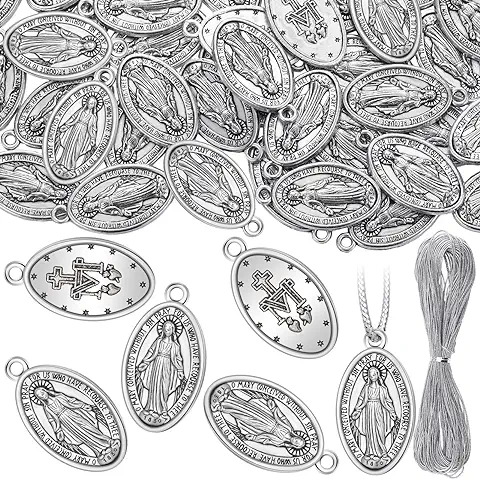
Today over one billion Miraculous Medals have been distributed — making it the most widely produced devotional sacramental in the history of Christianity. It is worn by Catholics, by Orthodox Christians who have encountered the Latin tradition, by people of other faiths who have received it as a gift from someone who loved them, by soldiers who were given it by their mothers and discovered they believed after all, by anyone who has ever held a small oval piece of silver with a woman standing on a globe and felt something they could not explain.
This article is the most complete account of the Miraculous Medal available: every detail of the three apparitions to Catherine Laboure, the complete meaning of every element of the medal’s design (including the element Our Lady called the most important — the unlit gems), the extraordinary conversion of Alphonse Ratisbonne, Catherine’s astonishing 46-year secret, her incorrupt body and her canonization, the theological significance of the medal for the whole Church, and the prayers and devotional practice that have made the Miraculous Medal the most intimate and most carried of all Marian sacramentals for nearly two centuries.
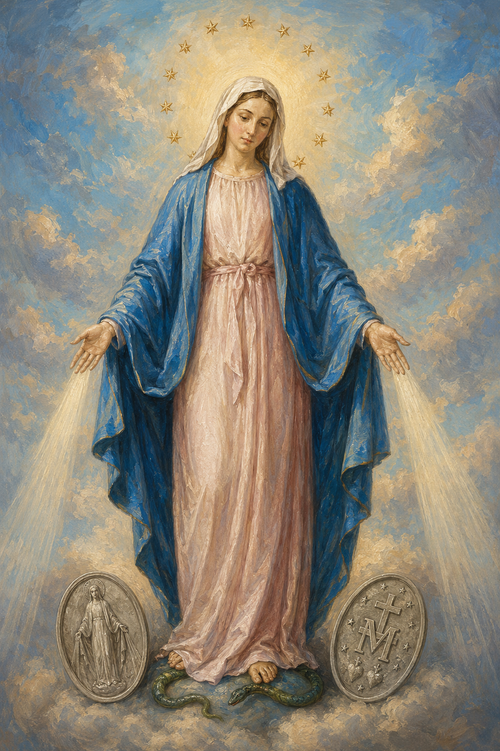
The Our Lady of the Miraculous Medal prayer card carries her image — the Lady who appeared to Catherine Laboure and promised great graces to all who wear her medal with confidence. The prayer card is a companion to the medal: the image before you when you pray, the face behind the promise.
Part II
Paris in 1830: The World the Apparitions Entered
Paris in 1830 was a city in political and social crisis. The Bourbon Restoration had put the old royalist order back in power after Napoleon, but popular resentment was building. In late July 1830 — just weeks before Catherine Laboure arrived at the rue du Bac motherhouse — the July Revolution overthrew Charles X and installed Louis-Philippe as a constitutional monarch. Mobs attacked religious institutions in Paris; crosses were torn down; several churches were threatened. The anti-clerical violence of the revolutionary tradition was pulsing again through the city’s streets. On July 27, as the revolution raged, Catherine arrived at her new community.
The Daughters of Charity of Saint Vincent de Paul — the community Catherine had just joined — were not sheltered from this social reality. They served the poor of Paris: in hospitals, hospices, and schools in the city’s most difficult neighbourhoods. Their motherhouse at 140 rue du Bac was a house of prayer and formation, but it was a house in the middle of Paris, with all of Paris’s spiritual urgency and social chaos pressing against its walls.
It is into this setting — a France tearing down crosses, a Paris burning with revolutionary anti-clericalism — that the Virgin Mary chose to appear and give the world a medal. The timing is not accidental in the La Salette, Lourdes, Fátima reading of Marian history: the apparitions come in the moments of maximum need. When France tears down the cross, Our Lady appears in France and gives the faithful something to wear around their necks. When Paris mobs attack churches, the Mother of God appears in a Paris chapel and produces the most portable and most personally intimate of all her sacramentals: a medal that needs no church, no pilgrimage, no liturgical infrastructure — only a neck, and a heart willing to ask.
Part III
Saint Catherine Laboure: Who She Was Before the Apparitions
Zoe Laboure (she took the name Catherine in religious life) was born on May 2, 1806 in the small farming village of Fain-lès-Moutiers in the Côte-d’Or department of Burgundy, France. She was the ninth of eleven children of Pierre Laboure and Madeleine Louise Gontard, a prosperous farming family. Her childhood was ordinary and rural: farm work, local school, the rhythms of agricultural life in a Catholic Burgundian village.
She was known to those who knew her as practical, direct, decisive, and private. She was not given to emotional religiosity; she was not a girl who fell into ecstasies at Mass or who was noted for remarkable piety by her neighbors. She was solid, hard-working, reliable, and — in the way that the most genuinely spiritual people often are — completely unsentimental about her faith. She prayed; she worked; she was honest and capable. There was nothing about her outward appearance to suggest she was being prepared for anything unusual.
The year before her reception of the apparitions, Catherine had a remarkable dream in which an elderly priest she did not recognize celebrated Mass. Afterward, in the dream, the priest invited her to come and care for the sick, saying that she would one day serve God in a way she could not yet imagine. She recognized the priest later as a portrait of Saint Vincent de Paul, the founder of the Daughters of Charity. She understood the dream as a direction toward that congregation and pursued it — arriving at the rue du Bac motherhouse on January 22, 1830, six months before the first apparition.
Part IV
“You Will Be My Mother Now” — Catherine at Age Nine
Madeleine Laboure, Catherine’s mother, died on October 9, 1815 — when Catherine was nine years old. She died of unknown causes, leaving eleven children and a grieving husband. The death of a mother at nine is one of the defining early losses a child can experience, and for Catherine it appears to have produced one of the most significant spiritual acts of her life.
After the funeral, according to accounts later provided by family members and confirmed by Catherine herself, the nine-year-old girl went to the family’s statue of the Virgin Mary, took it in her arms, and said: “Now, dear Virgin, you will be my mother.”
This act — a child turning to the image of the Mother of God at the moment of her human mother’s death and asking the divine Mother to take the human one’s place — is one of the most moving acts in the whole Miraculous Medal narrative. It established a relationship that would grow for the next fifteen years in the silence of Catherine’s ordinary life until, in 1830, the Mother she had claimed at age nine came to give her a mission.
The theologians of the Miraculous Medal tradition have often reflected on this sequence: a child who lost her mother and chose the Mother of God as a replacement was eventually chosen by that same Mother of God to give the world a sacramental that would make her accessible to everyone who carried it. Catherine gave Mary her confidence at age nine. Mary gave the world her graces through Catherine beginning at age twenty-four. The exchange was not coincidental; it was the logic of a relationship that had been growing in secret for fifteen years.
Part V
First Apparition: The Night of July 18–19, 1830
The first apparition occurred on the night of July 18 to 19, 1830 — the vigil of the feast of Saint Vincent de Paul, the founder of the Daughters of Charity. Catherine had been in the community for six months. She was a novice, twenty-four years old, sleeping in the dormitory with the other novices at the rue du Bac motherhouse.
At approximately 11:30 at night, Catherine was awakened by what she described as the voice of a child — a boy of about ten, dressed in white, luminous, standing by her bed. The child said: “Come to the chapel; the Holy Virgin is waiting for you.”
Catherine dressed and followed the child. She later wrote that as she walked through the corridors toward the chapel, every light was lit as if for a midnight Mass. The doors of the chapel opened at their approach. The chapel was fully illuminated, the candles burning as brightly as Catherine had seen only at High Mass. The child led her to the sanctuary and told her to kneel by the director’s chair in the sanctuary and wait.
The Lady Appears
At midnight, the child said: “Here is the Holy Virgin.” A sound like the rustle of a silk dress preceded a Lady who moved from the direction of the sanctuary and sat in the director’s chair. Catherine looked at her and immediately knew she was looking at the Virgin Mary, though she could not have said how she knew it. Without hesitation she fell to her knees and placed her hands on the Virgin’s lap. She later said that she had never been so happy in her life as in that moment — and that everything she was allowed to say about it could not begin to express the happiness.
The Virgin Mary spoke to Catherine for approximately two hours. She spoke about the community — encouraging Catherine in her vocation and preparing her for difficulties ahead. She spoke about the times: the dangers facing France, the violence that was already building in Paris that summer. She told Catherine that the times were evil and that misfortunes would come. She spoke about the community’s mission and about Catherine’s specific mission — though at this first apparition the mission was not fully revealed. She told Catherine that she would be given things to accomplish, that she would have to undertake something difficult, and that she would suffer on account of it but that this suffering would be sweet if she knew that it was for the glory of God.
The apparition ended as it had begun — with the child’s presence returning. Catherine followed the child back to the dormitory. When she reached her bed, the clock was striking two in the morning.
Part VI
Second Apparition: November 27, 1830 — The Medal Is Revealed
The second apparition — the one in which the Miraculous Medal was shown to Catherine — occurred on November 27, 1830, during a period of evening meditation in the rue du Bac chapel. Catherine was with the other sisters in the chapel for the regular prayer period when she heard the familiar sound that she had associated with the first apparition: what she described as the rustling of a silk dress.
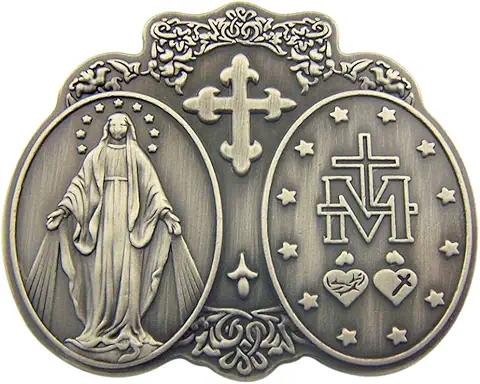
She looked toward the sanctuary and saw a vision of Our Lady standing in the position that would become the Miraculous Medal’s iconic image: a young woman dressed in white with a long blue mantle, standing on a sphere that represented the globe, her feet resting on a serpent she was crushing. Her hands were slightly raised and held downward, level with her hips, and from the rings on her fingers, rays of brilliant light streamed downward toward the globe beneath her feet.
The Oval Frame and the Prayer
As Catherine watched, an oval frame appeared around the vision. Within the frame, at the top, were words in letters of gold: O Marie, conçue sans péché, priez pour nous qui avons recours à vous — O Mary, conceived without sin, pray for us who have recourse to thee. The image and the prayer together formed the front of the medal as it would be struck.
The Lady then spoke to Catherine and explained the vision. She said that the rays of light streaming from her rings represented the graces she obtained for those who asked for them. Then she said something that Catherine later called the most important single detail of the entire apparition: “The gems from which rays do not fall are the graces for which souls forget to ask me.” Some of the rings bore no rays of light. The grace was prepared; the channel was there; but nobody had asked, and so the grace was not flowing.
The Frame Rotates — The Back of the Medal
The oval frame then appeared to rotate, and Catherine saw the reverse of the image — what would become the back of the medal: the letter M surmounted by a cross with a bar beneath it; below the cross, two Hearts side by side — the Sacred Heart of Jesus, crowned with a crown of thorns, and the Immaculate Heart of Mary, pierced by a sword; all of it enclosed within a circle of twelve stars.
The Command and the Promise
Our Lady then gave Catherine her specific instruction: “Have a medal struck after this model. All who wear it will receive great graces; they should wear it around the neck. Graces will abound for persons who wear it with confidence.” The instruction was clear: have the medal made, with exactly this design, and give it to the world. The promise was unconditional in one direction and conditional in another: the graces were available to all who wore it; they would abound for those who wore it with confidence. The medal opened the channel; the confidence determined how much flowed through.

Part VII
The Front of the Medal: A Complete Description and Meaning of Every Element
Every element of the Miraculous Medal’s design was given by Our Lady herself with specific theological meaning. What follows is the complete description and theological account of every element on the front of the medal.
- Mary Standing on the Globe The Virgin Mary stands on a globe representing the world. She is elevated above it — not distant from it, but above it, as a Queen stands above her realm and a mother stands over the world in which her children live. The globe indicates her universal reach: the grace she mediates is not for a particular nation or a particular era but for all of humanity in every time and place. She stands on the world because the world is what she intercedes for.
- Crushing the Serpent Beneath Mary’s feet, crushed under the weight of the globe she stands on, is a serpent — the ancient enemy, the Devil, the Deceiver of Eden. This image is drawn directly from Genesis 3:15, the protoevangelium (the first Gospel): “I will put enmity between you and the woman, and between your offspring and her offspring; he shall bruise your head, and you shall bruise his heel.” Mary is the woman of Genesis 3:15: the one whose offspring (Christ) crushes the head of the serpent, and who herself participates in that victory as the first fruit of the Redemption. The serpent on the Miraculous Medal is not merely a symbol of evil in the abstract; it is the specific enemy against whom the entire drama of salvation is directed, held down under the weight of the Immaculate Conception — the victory of grace over sin — that Mary embodies.
- The White Dress and Blue Mantle Mary’s white dress represents the purity of the Immaculate Conception — the radiant freedom from sin that characterized her entire existence from the first moment of her conception. Her blue mantle — in Catholic iconographic tradition, the color of heaven — represents her queenly dignity and her heavenly role as the Mother of God and Queen of Heaven. The combination of white and blue in the Miraculous Medal image appears again in the apparitions at Lourdes in 1858, where Our Lady appeared in a white dress with a blue sash: the same colors, the same symbolic meaning.
- The Rays of Light from the Rings The rings on Mary’s fingers were of extraordinary beauty, and from them streamed rays of brilliant light directed downward toward the globe. Our Lady explained: the rays are the graces she obtains for those who ask. Each ring represents a specific category or type of grace; the light from the ring is the grace as it flows from God through Mary’s intercession to those who ask for it. The medals themselves, explained the Lady, are the channel through which the asking happens: wearing the medal is a continuous, physical act of asking, a silent prayer that goes on twenty-four hours a day as long as the medal is worn.
- Mary’s Posture: Hands Slightly Raised and Turned Downward The specific posture of Our Lady on the Miraculous Medal — hands raised but slightly downward, as if presenting something to those below — is the posture of bestowing or offering. She is not in the orans prayer posture of the Knock apparition, where her eyes are to heaven and her prayer is entirely upward. She is turned toward the world, offering the grace she has received from God to those below her. She is the Mediatrix in action: receiving from above, distributing below.
Part VIII
The Prayer: “O Mary, Conceived Without Sin, Pray for Us Who Have Recourse to Thee”
The prayer on the Miraculous Medal — O Mary, conceived without sin, pray for us who have recourse to thee — is the most widely prayed Marian prayer in the world after the Hail Mary. It was given by Our Lady herself as the inscription to surround the image on the front of the medal. Every word of it rewards careful attention.
“O Mary”
The prayer begins with a direct address — not a theological statement, not a description, but a vocative: Mary. This is the intimacy of prayer: you address the person you are speaking to. Not “O Mother of God” or “O Queen of Heaven” — both of which are true and important titles. Just: Mary. The name of the woman in whom all those titles are embodied. The prayer begins with her name because it is addressed to a person, not a principle.
“Conceived Without Sin”
This phrase is the theological heart of the Miraculous Medal prayer and its most historically significant element. The prayer invokes Mary specifically as the one who was conceived without original sin — the Immaculate Conception — twenty-four years before Pope Pius IX defined this as a dogma of the Catholic faith. When Our Lady appeared at Lourdes in 1858 and said “I am the Immaculate Conception,” she was confirming a dogma that had been defined four years before. But the Miraculous Medal prayer was asking Catholics to invoke Mary under precisely this title twenty-four years before the dogma was defined — an anticipatory theological precision that has impressed Church scholars since the 1830s.
“Pray for Us Who Have Recourse to Thee”
The word “recourse” is the prayer’s theological key. Recourse means turning to someone in need, appealing to their authority or power in a situation you cannot handle alone. You have recourse to a lawyer when you are in legal trouble you cannot resolve yourself. You have recourse to a doctor when your body has failed in a way beyond your ability to repair. The prayer says: pray for those of us who are turning to you because we need what we cannot provide for ourselves. It is not a casual invocation but an expression of genuine dependence. And it defines who receives the graces the prayer asks for: those who genuinely turn to Mary, who approach her with real need and real faith, who are not merely wearing the medal but actually reaching out to the person whose image it bears.
The Medal as Prayer That Never Stops
One of the Miraculous Medal tradition’s most beautiful theological observations is that the medal itself, when worn around the neck, constitutes a continuous prayer. Wearing the medal is a physical act of recourse: it says, permanently and without words, that the person wearing it has turned to Mary. The medal prays, through its physical presence, when the wearer is not consciously praying. It makes the wearer a living expression of the prayer inscribed on its rim. The graces Our Lady promised are not only for the moments of conscious Miraculous Medal prayer but for the entire period of wearing — because the wearing itself is an act of recourse.

Part IX
The Rays and the Unlit Gems: The Theology of Unused Grace
Of all the theological content in the Miraculous Medal vision, the statement Our Lady made about the unlit gems is the most important and the least known. It is so significant that Catherine Laboure herself, in her accounts of the apparition, consistently identified it as the detail she was most anxious to transmit correctly.
When Our Lady showed Catherine the rays of light streaming from the rings on her fingers, she explained: the rays represent the graces she obtains for those who ask for them. This is the standard theology of Marian intercession: Mary, as Mediatrix, carries the prayers of the faithful to God and channels God’s grace back to the faithful. The rays visualize this movement: grace flowing from God through Mary’s rings — through her intercession — to the world below.
But then Our Lady indicated the rings that gave no light — the gems that sent no rays downward — and said: “The gems from which rays do not fall are the graces for which souls forget to ask me.”
What This Means
This single statement is one of the most extraordinary theological revelations in the entire Marian apparition tradition. It says: God has prepared specific graces for specific people. Those graces are available — they exist, they are ready, they are held in Mary’s capacity to obtain and distribute — but they are not being received because nobody is asking for them. The gem is lit; the grace is there; but the channel between the grace and the person who needs it has been closed by the simple absence of prayer.
The implication is staggering: there are graces in existence right now, prepared by God, held by the Mother of God, that are not reaching the people they were prepared for because those people are not asking. Healing that is available but not requested. Conversion that is possible but not prayed for. Strength that could be given but nobody has thought to seek it. Comfort that God is holding out but that cannot be delivered because its recipient has not looked up to receive it.
This is the deepest reason to wear the Miraculous Medal and to pray the Miraculous Medal prayer. Not because wearing a piece of metal is magically efficacious — it is not. But because wearing it is a form of asking, and asking is what turns the unlit gem into a ray. Every time you touch the medal, every time you see it in a mirror or feel it against your chest, you are doing the thing that turns the light on: you are turning to Mary and saying, without necessarily forming the words, I have recourse to you. And that recourse is what the grace is waiting for.
The Jesus Prayer of the Eastern tradition says something similar from a different angle: the prayer is to be prayed without ceasing, not because God needs constant reminding but because the person praying needs the constant openness that continuous prayer creates. The Miraculous Medal is the Marian equivalent: worn without ceasing, it makes the wearer continuously available to the grace that is continuously being offered.
Part X
The Promise: Great Graces for Those Who Wear It with Confidence
Our Lady’s promise in the Miraculous Medal apparition is among the most specific and most generous promises recorded in any Marian apparition: “All who wear it will receive great graces; they should wear it around the neck. Graces will abound for persons who wear it with confidence.”
This is worth unpacking carefully, because the promise has two distinct levels.
The Unconditional Level: All Who Wear It Will Receive Great Graces
“All who wear it will receive great graces” is a universal statement without qualification. All — not some, not those who qualify, not those whose faith is sufficiently fervent. All. The promise applies to the person who puts the medal on with uncertain faith, who received it from a grandmother who pressed it into their hand on a deathbed, who puts it on for reasons they cannot articulate, who does not yet fully understand what it is or who it represents. The grace is available to all who wear the medal. This is the most generous interpretation of the first half of the promise, and it is the interpretation most consistent with the character of the grace the medal represents: grace is not earned, not qualified by prior spiritual achievement, not restricted to the spiritually advanced. It is given freely to all who open themselves to it — and wearing the medal is a form of opening.
The Conditional Level: Graces Abound for Those Who Wear It with Confidence
The second statement introduces a condition: confidence. Graces will abound — overflow, superabound, come in far greater measure than the minimum — for those who wear the medal with confidence. This is the distinction between receiving and receiving abundantly: both are available, but the abundance is connected to the confidence with which the medal is worn. Confidence here means genuine, active trust in Mary’s intercession; it means wearing the medal as a real act of faith rather than a superstitious habit; it means believing that the person whose image the medal bears is truly present and truly interceding. The confident wearer of the Miraculous Medal is someone who looks at the medal and thinks: she is actually praying for me. Right now. Her intercession is a real, efficacious action in my life. And that confidence is what the grace of abundance is connected to.
Why the Promise Has Been Kept
The evidence that the promise has been kept across nearly two centuries is considerable. Thousands of reported healings. Hundreds of documented conversions, including the dramatic case of Alphonse Ratisbonne (described in Part XVII). The experiences of soldiers in two world wars who were given Miraculous Medals by their mothers and wives and returned home, often crediting the medal. The experiences of ordinary Catholics who prayed the Miraculous Medal prayer for family members who had left the faith and watched those family members return. None of these constitute the kind of scientific evidence that the Lourdes Medical Bureau has compiled. But their cumulative weight across 195 years and a billion medals is itself a form of evidence: the promise has been made, it has been kept, and the tradition of experiencing it as kept stretches unbroken from 1832 to the present day.

Part XI
The Back of the Medal: The M, the Cross, and the Two Hearts
The back of the Miraculous Medal is less immediately striking than the front but no less theologically rich. Every element was given by Our Lady with intentional meaning, and the complete back of the medal is a compressed summary of the theological relationship between Mary and her Son and between both of them and the Church.
The Letter M and the Cross
At the top of the medal’s reverse is a large letter M — the first letter of Mary’s name — surmounted by a cross. The cross stands above the M: Mary’s identity is defined by her relationship to the Cross of her Son. She is the Mother of the one who died on the Cross; she is the one who stood at the foot of the Cross on Calvary; her entire vocation and her entire spiritual authority derive from the mystery of the Cross. The placement of the Cross above the M is not a ranking (Mary beneath the Cross) but a relational statement: Mary’s identity is always in relation to the Cross, always defined by her Son’s sacrifice.
Beneath the Cross is a horizontal bar. This bar has been interpreted in various ways within the tradition: as the base of the Cross, as the earthly horizon, or as the dividing line between the heavenly reality above and the earthly reality below. Whatever the precise interpretation, it reinforces the centrality of the Cross in the entire devotional structure of the back of the medal.
The Two Hearts
Beneath the M and Cross are two Hearts, side by side. The Heart on the left (as the medal faces the viewer) is the Sacred Heart of Jesus, surrounded by a crown of thorns — the symbol of Christ’s Passion and of the love that drove him to accept it. The Heart on the right is the Immaculate Heart of Mary, pierced by a sword — the sword that Simeon prophesied in the Temple when the infant Jesus was presented: “and a sword will pierce through your own soul also” (Luke 2:35), the prophetic anticipation of the sorrow Mary would suffer at Calvary.
Together, the two Hearts on the Miraculous Medal constitute one of the earliest and most widespread representations of the joint devotion to the Sacred Heart and the Immaculate Heart that Fátima would make the centre of its devotional program eighty-seven years later. The Miraculous Medal’s two Hearts anticipate Fátima’s vision: they are the same hearts, the same devotion, the same relational theology. The Miraculous Medal put them together in 1830; Fátima confirmed and expanded the joint devotion in 1917. The hearts are inseparable because the lives that produced them were inseparable: Mary’s sorrow is always the sorrow of the mother of the suffering Christ; Christ’s Heart is always the Heart of the Son whose love included and required the cooperation of his Mother.
Part XII
The Twelve Stars
Surrounding all the elements of the medal’s reverse — the M, the Cross, and the two Hearts — is a circle of twelve stars. The twelve stars are one of the most scripturally dense elements in the entire Miraculous Medal design.
Twelve is the number of the apostles, the foundational witnesses of the New Testament Church. It is also the number of the tribes of Israel — the complete People of God in the Old Covenant. And it appears specifically in the twelfth chapter of the Book of Revelation, where John sees “a great sign appeared in heaven: a woman clothed with the sun, with the moon under her feet and a crown of twelve stars on her head” (Revelation 12:1). This woman of Revelation 12 has been understood by Catholic tradition as an image of Mary — the same Mary who stands on the globe of the Miraculous Medal, crushing the serpent described in Genesis 3, crowned with the twelve stars of Revelation 12. The Miraculous Medal is, in part, the visual rendering of the woman of the Apocalypse: the Mary of Scripture made into a devotional object for the pockets and necks of the faithful.
The twelve stars also represent, in the La Salette and Miraculous Medal traditions, the community of those who pray the medal’s prayer: the twelve are the foundation, and those who pray around them are joined to the apostolic community of the Church, praying with and through the same Church that the apostles founded. Wearing the Miraculous Medal connects its wearer to this universal community.
Part XIII
Father Aladel and the Path to Having the Medal Made
Catherine Laboure told the apparitions only to one person during the 46 years she kept them secret: Father Jean-Marie Aladel, her spiritual director at the rue du Bac community. He was the single necessary intermediary between Catherine’s vision and the medal’s production, and the path from one to the other was neither quick nor smooth.
Father Aladel was a sensible and educated man who, when Catherine first told him about the apparitions, received the account with the scepticism appropriate to a confessor hearing claims of this nature. He did not dismiss her; he listened. But he did not immediately act. Catherine returned to him repeatedly, pressing the request that he approach the Archbishop of Paris for permission to have the medal struck. Father Aladel continued to defer. The pressure apparently became significant: Catherine later said that Our Lady herself had indicated that the medal needed to be made and that its delay was a failure of obedience on the part of those who knew about it.
The Archbishop of Paris Gives Permission
In 1836, approximately six years after the first apparition, Father Aladel finally brought the matter to Archbishop Hyacinthe-Louis de Quélen of Paris. He presented the case for the medal without revealing the identity of the visionary — Catherine’s secrecy was preserved throughout; even the Archbishop did not know who had received the apparitions. The Archbishop granted permission for the medal to be struck. Father Aladel commissioned the goldsmith Vachette in Paris to make the first medals.
The first run was 1,500 medals. They were distributed beginning in 1832. Within four years, six million copies had been made and distributed. By 1836, the demand for the medal was exceeding any capacity that had been planned for it, and the Archbishop of Paris — observing the graces and healings reported by those who wore it — became one of its most enthusiastic supporters. He wore the medal himself and gave it to those he visited in prison and in hospitals.
Part XIV
How the Miraculous Medal Spread Around the World
The speed with which the Miraculous Medal spread from a first run of 1,500 copies in 1832 to over six million in four years is one of the most remarkable examples of popular Marian devotion growing faster than any institutional structure could have planned or organized. The medal spread primarily through the Daughters of Charity, who distributed it in the hospitals, schools, and hospices where they served — giving it to patients, to the poor, to those they nursed. But it spread equally through word of mouth among the lay faithful: people who received the medal and experienced something when they wore it, and gave it to others, who gave it to others.
By the mid-nineteenth century the Miraculous Medal had spread from France to every Catholic country in Europe, to the Americas, to Asia, and to the missions in Africa. It traveled with Catholic immigrants to the United States and became part of Irish-American, Italian-American, and Polish-American Catholic culture in ways that still persist. It was given to soldiers going to war, to mothers in childbirth, to the dying, to the newly converted. It was placed in the hands of children at First Communion, hung around the necks of infants at baptism, pressed into the palms of the grieving at funerals.
Famous People Who Received the Miraculous Medal
- Blessed Frédéric Ozanam — The founder of the Society of Saint Vincent de Paul, the great lay apostle of nineteenth-century French Catholicism, wore the Miraculous Medal with devotion throughout his life. He was one of its earliest advocates among the educated Catholic elite of Paris.
- Alphonse Ratisbonne — The most famous Miraculous Medal story: a young Jewish lawyer who wore it as a bet and was converted in a vision. Described in full in Part XVII.
- President John F. Kennedy — The first Catholic President of the United States was buried with a Miraculous Medal, along with his Rosary and other devotional objects.
- Pope John Paul II — Wore a Miraculous Medal. His personal Marian devotion was among the most profound of any modern pontiff.
- Countless soldiers in two World Wars — The Miraculous Medal became one of the most common devotional objects carried by Catholic soldiers in both World Wars. Letters home and memoirs from the period contain hundreds of references to the medal and to grace experienced through it.
Part XV
The Conversion of Alphonse Ratisbonne: January 20, 1842
The most famous miracle associated with the Miraculous Medal is the conversion of Alphonse Ratisbonne on January 20, 1842, in Rome. It is one of the best-documented religious conversions of the modern era, investigated by formal apostolic process, examined by two cardinals, and declared miraculous by Church authority. Its details are worth knowing precisely because it is one of the clearest demonstrations in recorded history of what Our Lady of the Miraculous Medal promised: great graces for those who turn to her, even when that turning begins in contempt.
Alphonse Ratisbonne: Who He Was
Alphonse Ratisbonne was born in 1814 in Strasbourg, France, into a wealthy and prominent Jewish banking family. He was educated and cosmopolitan, deeply proud of his Jewish identity, and strongly anti-Catholic — partly in reaction to the conversion of his older brother Théodore to Catholicism, which he regarded as a betrayal. He was twenty-seven years old, engaged to be married, and visiting Rome briefly in January 1842 as part of a tour through Italy.
The Bet
In Rome, Alphonse encountered Théodore de Bussières, an acquaintance whose connection to the Ratisbonne family came through Alphonse’s converted brother. De Bussières had been asked by Alphonse’s brother to pray for Alphonse’s conversion and to offer him the Miraculous Medal. Alphonse, when approached, was contemptuous but willing to treat the matter as a game: he agreed to wear the medal and to say the Miraculous Medal prayer daily for as long as he remained in Rome. He agreed as a bet — to demonstrate that he had no fear of Catholic devotions and that nothing would happen.
He received the medal on January 17, 1842. Three days later, on January 20, he entered the Roman church of Sant’Andrea delle Fratte while waiting for de Bussières, who had gone to arrange a funeral. He went in without any devotional intention — to wait, to look at the art. He was inside for a short time. When de Bussières returned, he found Ratisbonne on his knees before a side chapel, in a state of complete transformation.
What Ratisbonne Saw
Ratisbonne’s own account: upon entering the church, everything suddenly went dark except for one chapel, which was suffused with brilliant light. He moved toward it and saw the Virgin Mary — exactly as she appeared on the Miraculous Medal — standing in the light in the chapel. She made no gesture toward him and said no word. But her appearance was, for him, the total and instantaneous reversal of everything he had been. He described himself as knowing, in that moment, everything the Catholic faith had been trying to tell him without being able to reach him. He knelt. When he came to himself, he asked de Bussières to take him to a priest immediately.
The Investigation
The conversion was investigated with exceptional rigor. Two cardinals — Cardinals Patrizi and Sala — oversaw a formal apostolic process. Multiple witnesses testified to Ratisbonne’s state before and after the event. His own signed testimony was taken and preserved. The investigation examined whether any natural explanation was available for the conversion — psychological suggestion, prior disposition, social pressure — and found none. Ratisbonne had been actively, vocally, publicly anti-Catholic three days before; he was requesting baptism on January 20. The process declared the conversion miraculous.
Ratisbonne’s Life After the Conversion
Alphonse Ratisbonne was baptized on January 31, 1842, with his friend de Bussières as his godfather. He was ordained a priest, joined the Society of Jesus (Jesuits), then later left the Jesuits to co-found with his converted brother Théodore the Congregation of Our Lady of Sion — a religious congregation dedicated to promoting Jewish-Christian understanding and the baptism of Jewish people who sought it. He spent the rest of his life in this mission. He died in Ein Karem, near Jerusalem, on May 6, 1884, and is buried there. He had spent the entire remaining forty-two years of his life in the service of the God and the Mother who had found him in a Roman church with a medal around his neck that he had accepted as a contemptuous bet.
Part XVI
Catherine’s 46-Year Secret: The Most Hidden Visionary in Catholic History
Of all the remarkable aspects of the Miraculous Medal tradition, none is more extraordinary than this: the woman who received the apparitions and was responsible for the medal’s existence kept her identity as the visionary entirely secret for forty-six years. From 1830 until 1876 — a period during which the medal spread across the world, millions of lives were transformed, and the name “Miraculous Medal” became one of the most widely recognized phrases in Catholic devotional life — nobody in Catherine Laboure’s community knew that she was the source of it all. She told only Father Aladel, her spiritual director, and he kept the secret as she required.
Life at Enghien
After her novitiate, Catherine was assigned to the hospice at Enghien-Reuilly, a suburb of Paris, where the Daughters of Charity cared for elderly men who needed institutional support. She worked there as a nurse for the remaining forty-six years of her life, from 1831 until her death in 1876. She managed the dispensary, cared for the elderly residents, supervised the poultry yard. She did the ordinary work of her religious community in an ordinary way. Her fellow sisters knew her as capable and somewhat brusque — not particularly warm or easy to approach, precise and reliable in her work, not given to expressions of religious sentiment. Nobody suspected anything.
She participated in the growth of the Miraculous Medal devotion along with everyone else in her community, without any indication that she had anything to do with it. She wore the medal. She prayed the prayer. She received the graces it was distributing. She knew, and said nothing.
Why She Kept the Secret
Catherine believed she had been instructed by Our Lady to maintain the secret of her identity. She understood that the mission was about the medal, not about her. The medal and its grace were the point; the visionary was irrelevant to the mission once the medal was made. Any revelation of her identity would have transformed her from a working nurse into a celebrity, subjected her community to the disruption of public attention, and potentially corrupted the simplicity of her mission. Her anonymity protected the purity of the medal’s witness: the grace came from the medal and from Mary’s promise, not from the particular quality of the person who had received the vision.
There is something deeply consistent about this anonymity with the entire theology of the Miraculous Medal: the unlit gems, the graces prepared but not asked for, the emphasis on the receiver’s confidence rather than on any quality of the giver. Catherine embodied, in her silence, the same theological truth the medal taught through its imagery: it is not the vessel but the grace that matters; it is not the visionary but the Lady whose image the medal bears.
Part XVII
The Last Months: Catherine Finally Reveals Herself
In early 1876, Catherine Laboure was seventy years old, in declining health, and still resident at Enghien. For the first time since 1830 she was feeling an urgency about something connected to the apparitions that she could not satisfy through Father Aladel — who had died in 1865, leaving no one who knew her secret. The urgent concern was a specific request Our Lady had made in the apparitions that had not yet been fully carried out: the creation of a statue of Our Lady of the Globe — the image of Mary holding the world in her hands that she had shown Catherine but that had not been included in the medal’s final design.
Catherine approached her superior, Sister Dufès, in late 1876 and asked her to arrange for such a statue to be made. Sister Dufès, naturally, asked why this was important and where the request was coming from. Catherine, now understanding that she had very little time left, told her the truth: she was the visionary who had received the Miraculous Medal apparitions. She was the source of the medal.
Sister Dufès received this revelation with understandable astonishment. The quiet, brusque, reliable nurse who had been managing the hospice’s dispensary for decades was the woman to whom the Virgin Mary had shown the design of the Miraculous Medal. The conversation was extensive, and Catherine answered all of Sister Dufès’s questions fully and clearly. She was not distressed by the revelation. She appeared relieved. She had carried the secret for forty-six years; now the one person who needed to know — the one who could actually accomplish the remaining unfulfilled request about the statue — had been told.
Catherine died six months later, on December 31, 1876. She had kept the secret for the duration of her active life and released it only when its purpose — the fulfilment of the remaining request — required it.
Part XVIII
Catherine’s Death and Incorrupt Body
Catherine Laboure died on December 31, 1876, at approximately five-thirty in the evening at the Enghien hospice. She was seventy years old. She had spent the last forty-five years of her life in the same place, doing the same work, without recognition, without distinction, without any indication to those around her of the extraordinary communication she had received in 1830. She died as she had lived: quietly, efficiently, and without making a fuss.
Her body was exhumed on March 28, 1933, as part of the beatification process — fifty-seven years after her death. The coffin was found to be in a poor state from the moisture of the soil, but Catherine’s body was essentially intact. The most striking detail recorded by those who were present at the exhumation: her eyes were still blue and clear, as if she were simply sleeping. The examining physicians certified that the state of her body was beyond natural explanation for a body buried fifty-seven years without embalming.
The body was transferred to the chapel at 140 rue du Bac in Paris — the same chapel in which the apparitions had occurred — where it was placed in a glass reliquary. Her incorrupt body can be seen there today by the millions of visitors who come to the chapel each year. She lies in the chapel where Our Lady appeared to her, near the chair in which Our Lady sat during the first apparition — a chair that has been preserved at the chapel as a devotional object since 1830. The woman who received the mission and kept it secret lies in the place where she received it, and the Lady who gave it to her has never stopped visiting the chapel where their conversation began.

Part XIX
Beatification and Canonization
Saint Catherine Laboure was beatified on May 28, 1933, by Pope Pius XI — the same Pope who had beatified Bernadette Soubirous of Lourdes earlier in the same year (June 14, 1925 for Bernadette’s beatification; Bernadette was canonized December 8, 1933). Catherine was canonized on July 27, 1947 by Pope Pius XII. Her feast day in the universal calendar is November 28, the day after the anniversary of the second apparition in which the medal was revealed (November 27, 1830).
The canonization process for Catherine was conducted with the particular care due to a visionary whose apparitions had been so consequential: the Church needed to be satisfied not only that she had lived heroically virtuous life — which the evidence of her 46-year hidden service at Enghien abundantly confirmed — but that the apparitions she had received were consistent with Catholic doctrine and with the overall trajectory of her spiritual life. Both elements of the process produced positive findings. Catherine was raised to the altar as a saint whose entire life was characterized by the same hiddenness and the same confidence in Mary that she had modelled from 1830 until 1876.
Part XX
Complete Chronological Timeline: 1806 to Today
- May 2, 1806 — Catherine Laboure BornZoé Laboure is born in Fain-lès-Moutiers, Côte-d’Or, France, the ninth of eleven children of a prosperous farming family.
- October 9, 1815 — Her Mother DiesCatherine’s mother Madeleine dies. The nine-year-old girl takes the family statue of Mary in her arms and says: “Now, you will be my mother.”
- 1829 — The Dream of Saint Vincent de PaulCatherine has a dream in which an elderly priest invites her to care for the sick. She later recognizes him as Saint Vincent de Paul in a portrait, and understands the dream as a call to the Daughters of Charity.
- January 22, 1830 — Catherine Enters the Daughters of CharityShe arrives at the motherhouse at 140 rue du Bac, Paris. She takes the name Catherine in religious life. The July Revolution breaks out in Paris six months later.
- July 18–19, 1830 — First ApparitionCatherine is awakened by a child’s voice and led to the chapel, where she spends two hours in conversation with the Virgin Mary. She is told she will have a difficult mission to accomplish.
- November 27, 1830 — Second Apparition • The Medal RevealedDuring evening meditation, Our Lady appears and shows Catherine the design of the Miraculous Medal: the front with Mary on the globe, the prayer, the rays; the back with the M, Cross, two Hearts, and twelve stars. She gives the command to have the medal struck and makes the promise of great graces.
- 1831 — Third and Further ApparitionsAdditional apparitions provide further details about the medal’s design and Catherine’s mission. Catherine is assigned to the Enghien hospice, where she will spend the next 45 years.
- 1836 — The Archbishop Opens an InvestigationArchbishop de Quélen of Paris gives permission to have the medal struck and opens an informal investigation into the reported graces. By this year, six million medals have already been distributed.
- 1832 — First Medals StruckGoldsmith Vachette in Paris makes the first run of 1,500 medals. The name “Miraculous Medal” is given by the people who receive it, in response to the graces and healings they experience.
- January 20, 1842 — Conversion of Alphonse RatisbonneThe Jewish lawyer Ratisbonne, wearing the Miraculous Medal for three days as a contemptuous bet, has a vision of Our Lady in the church of Sant’Andrea delle Fratte in Rome and is instantly converted. The conversion is investigated by two cardinals and declared miraculous.
- 1854 — Immaculate Conception Defined as DogmaPope Pius IX defines the Immaculate Conception as a dogma of the Catholic Church on December 8 — 24 years after the Miraculous Medal’s prayer had already been invoking Mary under this title.
- 1865 — Father Aladel DiesCatherine’s spiritual director, the only person who knew her secret, dies. Catherine continues her work at Enghien, still unknown as the visionary of the Miraculous Medal.
- 1876 — Catherine Reveals Her IdentityIn the last months of her life, Catherine tells her superior Sister Dufès that she is the visionary of the Miraculous Medal. The revelation comes in connection with an unfulfilled request about a statue.
- December 31, 1876 — Catherine Dies at EnghienCatherine Laboure dies at the age of seventy at the Enghien hospice. Her identity as the Miraculous Medal visionary is now known only to Sister Dufès and a few others. Her body is buried at Enghien.
- March 28, 1933 — First ExhumationCatherine’s body is exhumed as part of the beatification process, 57 years after her death. Her body is found essentially intact, with her eyes still blue and clear. The examining physicians certify the unusual state of preservation.
- May 28, 1933 — BeatificationPope Pius XI beatifies Catherine Laboure. Her body is transferred to the chapel at 140 rue du Bac, Paris, where it is placed in a glass reliquary.
- July 27, 1947 — CanonizationPope Pius XII canonizes Saint Catherine Laboure. Her feast day is set for November 28.
- Today — Over One Billion Medals DistributedThe Miraculous Medal remains the most widely distributed Catholic sacramental in history. The chapel at 140 rue du Bac in Paris receives hundreds of thousands of visitors annually. The medal is worn by Catholics worldwide and continues to generate reports of graces, conversions, and healings.
Part XXI
The Immaculate Conception Connection: 24 Years Before the Dogma
The Miraculous Medal sits at the centre of a remarkable theological trajectory involving the Immaculate Conception that spans forty-two years and three Marian apparitions. Understanding this trajectory requires tracing the connections between the medal (1830), the 1854 dogmatic definition, and the Lourdes self-identification (1858).
In 1830, Our Lady showed Catherine Laboure a medal with the prayer: O Mary, conceived without sin, pray for us who have recourse to thee. This prayer invokes Mary specifically as the one conceived without original sin — which, in 1830, was a matter of theological opinion, not defined doctrine. The Church had discussed and debated the Immaculate Conception for centuries; devotion to it was widespread; but it had not been formally defined. Our Lady asked to be invoked under this title before the Church had finished deliberating whether to formally define it.
In 1846, Our Lady of La Salette appeared in France with urgent messages about sin and penance, without identifying herself under this specific title but in the broader Marian tradition that the 1830 medal had strengthened.
In 1854, Pope Pius IX defined the Immaculate Conception as a dogma of the Catholic Church in the apostolic constitution Ineffabilis Deus. The prayer on the Miraculous Medal — already distributed in the tens of millions — had been praying Mary under this title for twenty-four years before the formal definition.
Then in 1858, at Lourdes, Our Lady appeared to Bernadette Soubirous and identified herself: I am the Immaculate Conception. Four years after the dogma, and twenty-eight years after the Miraculous Medal had begun distributing her prayer under precisely this title, the Mother of God provided the most authoritative possible confirmation of the doctrine: direct self-identification using the theological terminology of the 1854 definition. The medal had been preparing the faithful to receive this identification for nearly three decades before it was given.
Part XXII
The Two Hearts: How the Miraculous Medal Anticipated Fátima
The back of the Miraculous Medal shows the Sacred Heart of Jesus and the Immaculate Heart of Mary side by side, together. This joint representation appears for the first time in any Marian apparition in the Miraculous Medal of 1830. It would appear again, in far more developed and urgent form, at Fátima in 1917 — eighty-seven years later.
At Fátima, Our Lady not only showed the two hearts but requested specific devotional acts connected to them: devotion to the Immaculate Heart, the Communion of reparation on five consecutive First Saturdays, the consecration of Russia to the Immaculate Heart. The Fátima message made the two-hearts devotion the centre of its entire program of conversion and reparation. And the theological basis for everything Fátima asked for was already present, in compressed visual form, on the back of the Miraculous Medal that had been circulating the world since 1832.
The Sacred Heart of Jesus, crowned with thorns: the love of God incarnate, the love that chose suffering as its expression, the Heart that the devotion founded by Saint Margaret Mary Alacoque had been building toward since the seventeenth century. The Immaculate Heart of Mary, pierced by a sword: the sorrow of the Mother at Calvary, the love that participated in the Passion by refusing to leave, the Heart that receives into itself all the suffering of those who have recourse to it. Together, on the back of a small oval medal made of silver or base metal: the complete theology of divine love and maternal love offered together to anyone who would accept them.
Part XXIII
Theological Significance: Mary as Mediatrix, the Theology of Sacramentals, and the Grace of Asking
The Miraculous Medal is theologically significant in ways that extend well beyond its status as a popular devotional object. It carries a concentrated form of the Church’s teaching on Mary as Mediatrix, on the theology of sacramentals, and on the specific grace of intercessory prayer.
Mary as Mediatrix
The Miraculous Medal’s image — rays from Mary’s rings flowing to the world below — is a visual expression of the theological concept of Mary as Mediatrix of All Graces. This title, which has been in theological discussion for centuries and was proposed (though not yet formally defined) by Pope Benedict XV, describes Mary’s role in the economy of grace: not as an independent source of grace (which belongs to God alone) but as the privileged channel through which God’s grace reaches the human race, in consequence of her unique cooperation with the Incarnation and the Redemption. She bore the Redeemer, raised him, stood at his Cross, and participated in the total act of salvation that he accomplished. The graces that flow from that Redemption flow, in the tradition’s understanding, through the same person who was most intimately involved in the Redemption’s accomplishment. The rays on the Miraculous Medal make this abstract theology visually immediate: the grace is flowing, and it is flowing through her.
The Theology of Sacramentals
A sacramental is a physical object or action blessed by the Church for devotional use, which — when used with faith and prayer — prepares and disposes the person to receive God’s grace. Sacramentals differ from sacraments (baptism, Eucharist, etc.) in that they do not themselves cause grace but create the spiritual conditions in which grace can be received. The Miraculous Medal is a sacramental: it does not cause grace by its physical presence; it creates the conditions for grace through the faith and recourse of the person who wears it. The promise of great graces for those who wear it with confidence is a promise about what God will do in response to the conditions the medal creates in the wearer — not a guarantee that every person who owns a Miraculous Medal will automatically receive specific benefits. The medal is a channel, not a machine.
The Eastern Christian Resonance
The Miraculous Medal resonates deeply with the Eastern Christian tradition of sacred objects and their relationship to grace — particularly the Eastern tradition of icons, relics, and blessed objects. In the Eastern Church, an icon is not merely a picture but a window through which the Holy enters the world of the visible: the icon of the Theotokos, prayed before with genuine faith, becomes a point of contact between the earthly worshipper and the heavenly Theotokos she depicts. The Miraculous Medal operates within the same fundamental logic: it is a physical object that, when approached with genuine faith, becomes a point of contact between the wearer and the Mother of God whose image it bears. See our guide to setting up a home prayer corner for how Eastern Christians integrate sacred objects into daily devotional life — a practice with strong parallels to the Miraculous Medal’s role in daily Catholic prayer.
Part XXIV
The Chapel at 140 Rue du Bac, Paris: Where the Apparitions Occurred
The chapel at 140 rue du Bac in the 7th arrondissement of Paris is one of the most visited Catholic pilgrimage sites in Europe. It is the original chapel of the Daughters of Charity motherhouse where the Miraculous Medal apparitions occurred — and it has been continuously in use as a chapel since 1830, receiving pilgrims and visitors throughout the 195 years since Catherine Laboure received her apparitions there.
What You Will See
The chapel today preserves several elements of its 1830 appearance alongside its devotional development since then. The sanctuary retains the approximate layout Catherine would have recognised. On the right side of the sanctuary, preserved in its original position, is the chair in which Our Lady sat during the first apparition of July 18–19, 1830 — a simple wooden chair, now enclosed and displayed as a devotional object. The chair has been in the chapel since 1830 and is one of the few tangible physical objects directly associated with the apparitions.
The most significant presence in the chapel is the incorrupt body of Saint Catherine Laboure herself, displayed in a glass reliquary in the side chapel dedicated to her. Her body has been on display there since her beatification in 1933. She lies as if sleeping, her hands folded, her face serene, her religious habit intact. The blue eyes that the 1933 examiners described are no longer visible — she was given wax eyelids for display purposes — but the body itself is authentically preserved.
The chapel also contains a comprehensive display of Miraculous Medal history: original medals from 1832, documents related to the apparitions and the apostolic process, and materials related to the conversion of Alphonse Ratisbonne. Masses are celebrated daily, and confessions are available to pilgrims.
Getting to the Chapel
- Address: 140 rue du Bac, 75007 Paris, France
- Métro: Rue du Bac (Line 12) • Sèvres–Babylone (Lines 10 & 12)
- Opening Hours: Daily 7:45 AM – 1:00 PM and 2:30 PM – 7:00 PM • Closed on certain feast days; check current hours
- Masses: Multiple daily Masses; check the chapel website for current schedule
- Saint Catherine’s Feast Day: November 28 • Major gathering at the chapel
- Miraculous Medal Feast: November 27 • The anniversary of the apparition in which the medal was shown

Part XXV
Devotion to Our Lady of the Miraculous Medal: Who Wears It and Why
The Miraculous Medal is the most widely given and most widely received of all Marian sacramentals precisely because its promise is addressed to the widest possible category of person: all who wear it. Not all who believe strongly enough. Not all who have been to confession recently. Not all who are already devout. All who wear it, and most abundantly those who wear it with confidence.
The Medal for Those Who Have Left the Faith
The tradition of giving the Miraculous Medal to people who have left the faith — or who have never had it — is one of the oldest and most consistent threads in the medal’s history. The Ratisbonne case established the pattern: a man who was actively contemptuous of the faith put the medal on, and the grace came. The medal’s promise is not conditioned on the initial faith of the recipient; it is conditioned on the wearing. Many Catholics have given Miraculous Medals to family members who have left the faith, to friends who have never believed, to people they love who are in spiritual danger, because the Ratisbonne case says: put it on them, let them wear it, and then pray. The wearing is the beginning of the recourse; the grace is already prepared.
The Medal for the Sick
Our Lady of the Miraculous Medal is prayed to for healing of all kinds — physical, emotional, relational, spiritual. See our guides to saints for healing and saints for cancer for the broader tradition of healing intercession in which the Miraculous Medal participates. The specific healing charism of the Miraculous Medal is connected to the rays on the front: the grace flowing from Mary’s intercession to those who ask includes healing grace, and the unlit gems principle applies here too: healing grace has been prepared for specific people that they have not yet asked for. The medal is an invitation to ask.
The Medal as Gift
The Miraculous Medal is one of the most meaningful religious gifts available because it carries a specific promise from the Lady who designed it. Giving someone a Miraculous Medal is not merely giving them a piece of metal with a religious image; it is extending to them the Lady’s own promise of great graces. The person giving the medal is acting as the Lady’s agent in the same way that de Bussières acted as her agent when he gave the medal to Ratisbonne. The gift opens the channel. What flows through it is the grace she promised.
Part XXVI
How to Wear the Miraculous Medal: Our Lady’s Specific Instruction
Our Lady was specific about how the medal should be worn: “They should wear it around the neck.” This instruction is not arbitrary. Wearing the medal around the neck places it close to the heart — which is where the two Hearts on its back are located — and makes it a constant physical presence on the person of the wearer. It cannot be put in a pocket and forgotten the way a medal in a wallet can. It moves with the wearer, is felt when the wearer moves, and creates a continuous tactile reminder of the Lady’s presence and promise.
Blessing the Medal
The Miraculous Medal should be blessed by a priest before it is worn for the first time — this is the blessing that constitutes it as a sacramental rather than merely an object. An unblessed Miraculous Medal has the spiritual value of any religious image; a blessed one has been formally commissioned for devotional use by the Church’s authority. Many parishes will bless Miraculous Medals at any time; it can also be done at a Mass, or during a visit to a chapel where Miraculous Medal blessings are regularly given (such as the rue du Bac chapel in Paris).
Wearing with Intention
Wearing the medal with confidence — as Our Lady specified — means wearing it with the active intention of having recourse to Mary through it. This does not require a constant state of conscious attention to the medal; it means that the choice to wear it was made as an act of faith and trust, and that this choice continues. It means that when the wearer touches the medal or sees it in a mirror or feels its weight, they consciously renew their recourse to Mary at that moment. This constant renewal of trust — not dramatic, not requiring heroic spiritual effort, just a repeated quiet turning to the Lady whose image the medal bears — is the confidence that opens the unlit gems.
The Daily Miraculous Medal Prayer
The primary daily prayer associated with the Miraculous Medal is the prayer on its rim: O Mary, conceived without sin, pray for us who have recourse to thee. This can be prayed once, as a simple daily invocation; it can be prayed in the traditional pattern of three times in a row (in honour of the Trinity); or it can be incorporated into a longer morning or evening prayer. See our guide to establishing a daily prayer rule for guidance on building consistent daily prayer practice.
Part XXVII
Prayers to Our Lady of the Miraculous Medal
O Mary, conceived without sin, pray for us who have recourse to thee.
This prayer may be prayed once, or three times in succession (in honour of the Blessed Trinity), or as many times as feels right. It is the prayer Our Lady herself composed and placed on the medal. It is enough. It is the recourse the medal asks for. Say it while touching the medal. Say it when you wake and when you sleep. Say it for the people you love who are not saying it for themselves.
O Immaculate Virgin Mary, Mother of Our Lord Jesus Christ and our Mother, penetrated with the most lively confidence in your all-powerful and never-failing intercession, manifested so often through the Miraculous Medal, we your loving and trustful children implore you to obtain for us the graces and favors we ask during this novena, if they be beneficial to our immortal souls, and the souls for whom we pray. [Here state your intention.] You know, O Mary, how often our souls have been the sanctuaries of your Son who hates iniquity. Obtain for us then a deep hatred of sin and that purity of heart which will attach us to God alone so that our every thought, word and deed may tend to His greater glory.
Obtain for us also a spirit of prayer and self-denial that we may recover by penance what we have lost by sin and at length attain to that blessed abode where you are the Queen of angels and of men. Amen.
O Mary, conceived without sin, I bring you today the one I love who has no faith or whose faith has gone cold. You showed Alphonse Ratisbonne your face after three days of wearing your medal as a contemptuous bet. You turned in three days what years of argument had not moved. I am not asking for three days. I am asking you to start the process that only you can start — the process of opening someone to grace they have been refusing.
I cannot convert them. I cannot make them believe. But the gems that give no light give no light because nobody has asked. I am asking. For them. This is my asking: pray for them without ceasing, as you prayed without ceasing for the people of La Salette. And let me be the one who gave them the medal or prayed for them in the dark, and let me trust you with what happens next. Amen.
O Mary, conceived without sin, you showed Catherine that the gems giving no light were the graces nobody had asked for. This is my asking. I am asking for healing — for this body, for this condition, for this person I love who is sick and frightened and in pain. The healing grace, if it is prepared, is waiting in the unlit gem. I am the one asking. I have recourse to thee.
You cannot be asked too often. You cannot be overwhelmed by petitions. You have been praying without ceasing for your people for 195 years. One more petition is not one too many. One more sick person is not one too many. Take this to your Son who healed the sick as the first sign of the Kingdom. And whatever he gives, give me the grace to receive it — healing if it is his will, and his presence if it is not. Amen.
O Mary, conceived without sin, pray for us who have recourse to thee. I am turning to you today, right now, for [your intention]. The gems are lit or they are not lit depending on whether anyone asks. I am asking. Amen.
Frequently Asked Questions
Our Lady of the Miraculous Medal — Questions & Answers
She Came in 1830. She Made a Promise. She Has Been Keeping It for 195 Years.
In July and November of 1830, in a Paris chapel that still stands and can still be visited, the Mother of God appeared to a twenty-four-year-old novice and showed her the design of a medal. She explained every element. She pointed to the rings giving no light and said: these are the graces for which souls forget to ask me. And then she made a promise that she has been keeping for 195 years: great graces to all who wear the medal; graces that abound for those who wear it with confidence.
Over a billion medals have been made since 1832. A Jewish lawyer put one on as a bet and saw her face in three days. The girl who received the vision kept the secret for 46 years and has an incorrupt body in the same chapel where the Lady appeared. The prayer on the medal anticipated the Immaculate Conception dogma by 24 years and the Fátima two-hearts devotion by 87 years. The promise is real. The grace is waiting. The unlit gems are ready to glow. All it requires is the asking. Wear the medal. Say the prayer. Have recourse to her. She is praying for you whether you know it or not. Knowing it — and asking — is what makes the difference.
Get the Our Lady of the Miraculous Medal Prayer Card →